
61
133) Cahuilla Corporation predicts the following sales in units for the coming four months:
April
May
June
July
Sales in units
240
280
300
240
Each month’s ending Finished Goods Inventory in units should be 40% of the next month’s sales.
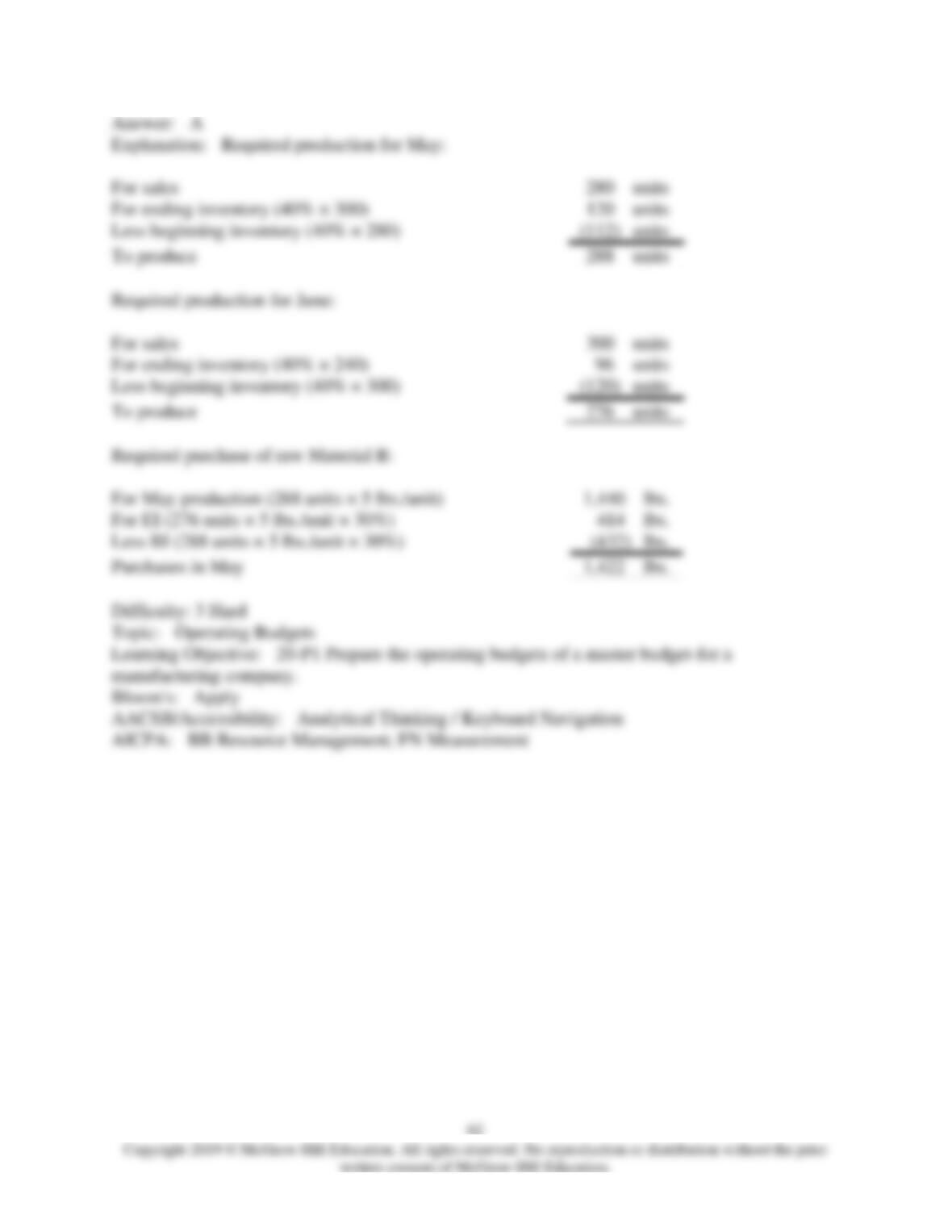
March 31 Finished Goods inventory is 96 units. A finished unit requires five pounds of direct
material B at a cost of $2.00 per pound. The March 31 Raw Materials Inventory has 200 pounds
of direct material B. Each month’s ending Raw Materials Inventory should be 30% of the
following month’s production needs. The budgeted purchases of pounds of direct material B
during May should be:
A) 1,422 lbs.
B) 288 lbs.
C) 1,854 lbs.
D) 276 lbs.
E) 1,008 lbs.

63
134) Cahuilla Corporation predicts the following sales in units for the coming four months:
April
May
June
July
Sales in units
240
280
300
240
Each month’s ending Finished Goods Inventory in units should be 40% of the next month’s sales
March 31 Finished Goods inventory is 96 units. A finished unit requires five pounds of direct
material B at a cost of $2.00 per pound. The March 31 Raw Materials Inventory has 200 pounds
of direct material B. Each month’s ending Raw Materials Inventory should be 30% of the
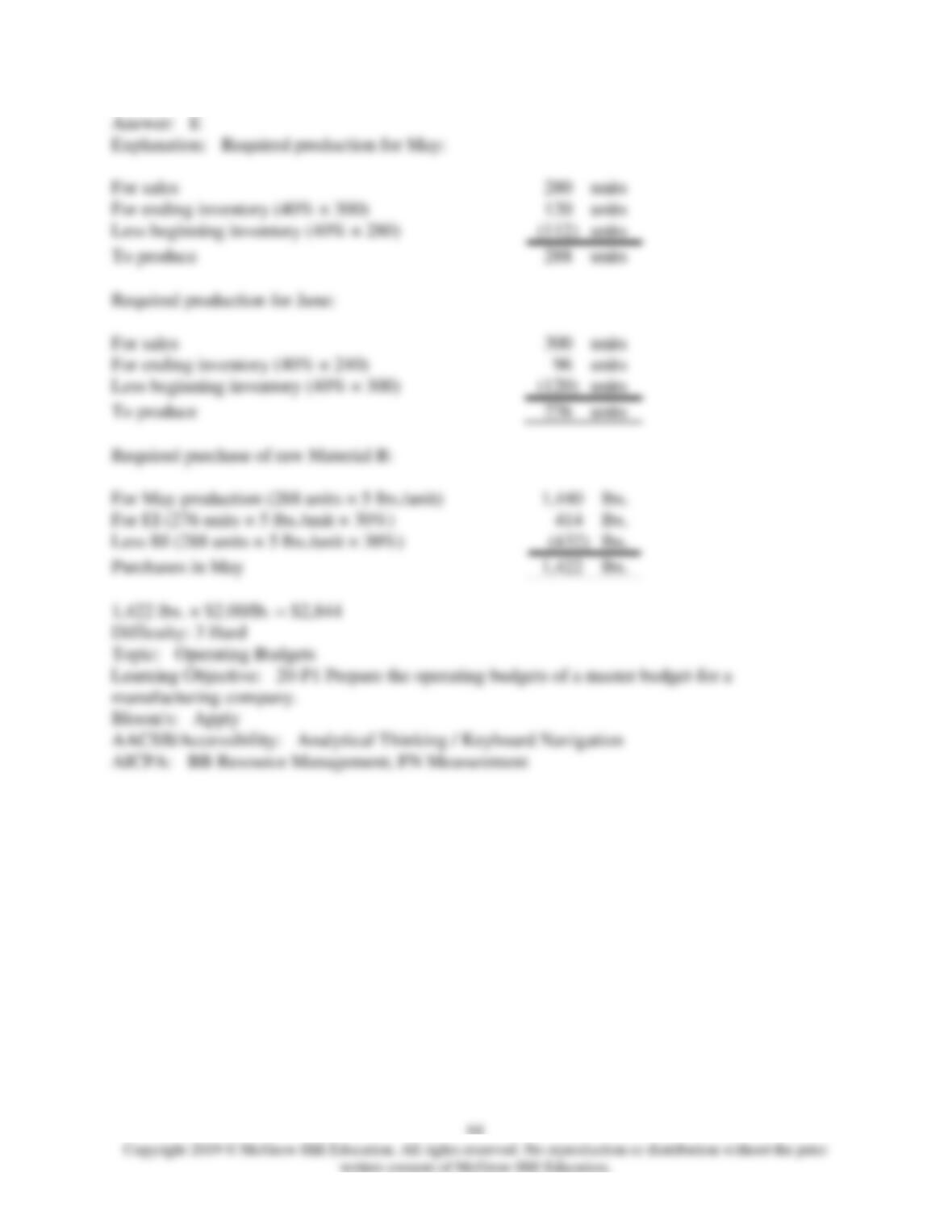
following month’s production needs. The budgeted cost of direct material B during May should
be:
A) $576.
B) $3,708.
C) $552.
D) $2,016.
E) $2,844.
135) Charm Enterprises’ production budget shows the following units to be produced for the
coming three months:
April
May
June
Units to be produced
2,560
2,880
2,760
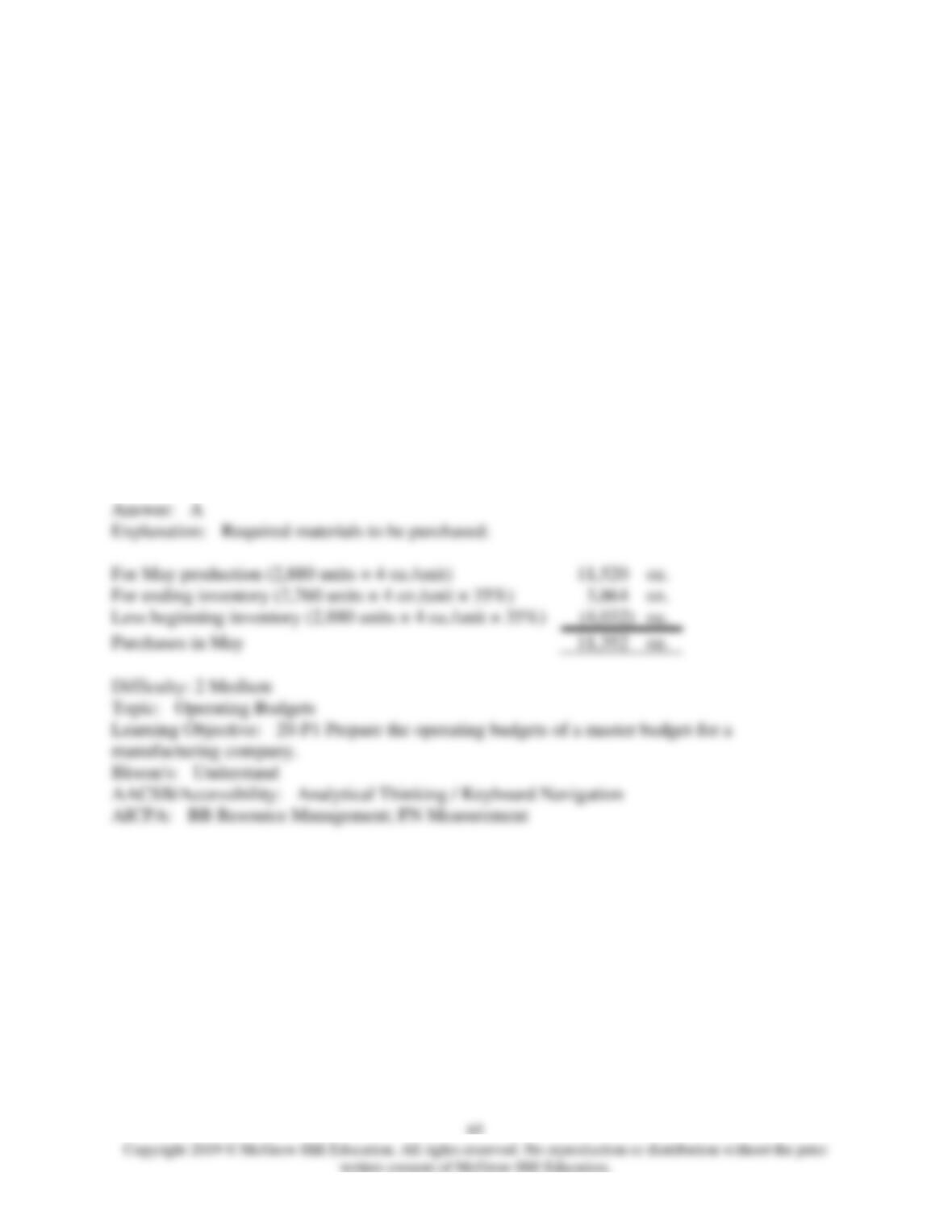
A finished unit requires four ounces of a key direct material. The March 31 Raw Materials
Inventory has 4,032 ounces (oz.) of the material. Each month’s ending Raw Materials Inventory
should be 35% of the following month’s production needs. Materials purchases in May should
be?
A) 11,352 oz.
B) 11,520 oz.
C) 7,448 oz.
D) 15,384 oz.
E) 7,616 oz.
For May production (2,880 units × 4 oz./unit)
oz.
For ending inventory (2,760 units × 4 oz./unit × 35%)
oz.
Less beginning inventory (2,880 units × 4 oz./unit × 35%)
)
oz.
Purchases in May
oz.
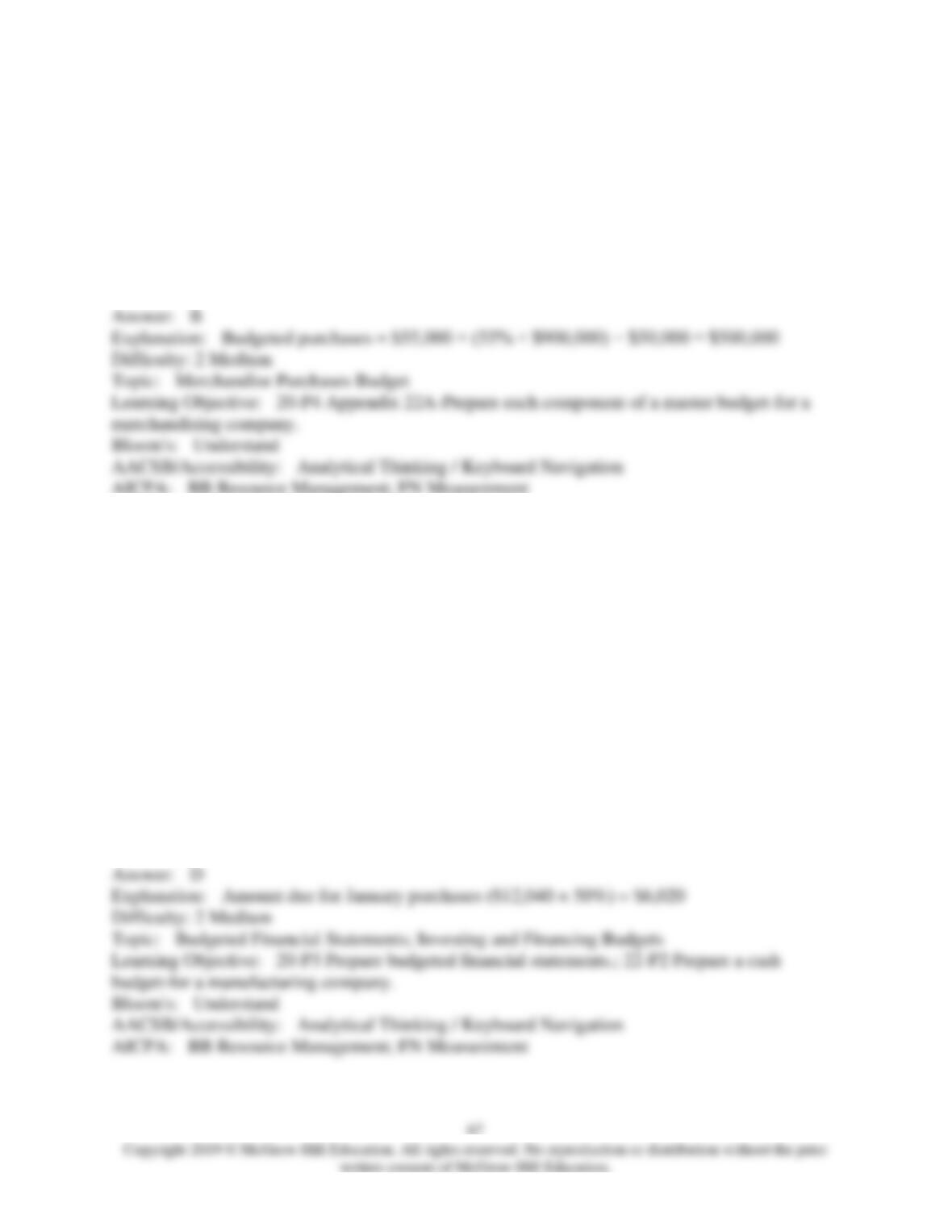
136) Fortune Company’s direct materials budget shows the following cost of materials to be
purchased for the coming three months:
January
February
March
Material purchases
$12,040
$14,150
$10,970
Payments for purchases are expected to be made 50% in the month of purchase and 50% in the
month following purchase. The December Accounts Payable balance is $6,500. The budgeted
cash payments for materials in January are:
A) $6,500.
B) $9,270.
C) $12,520.
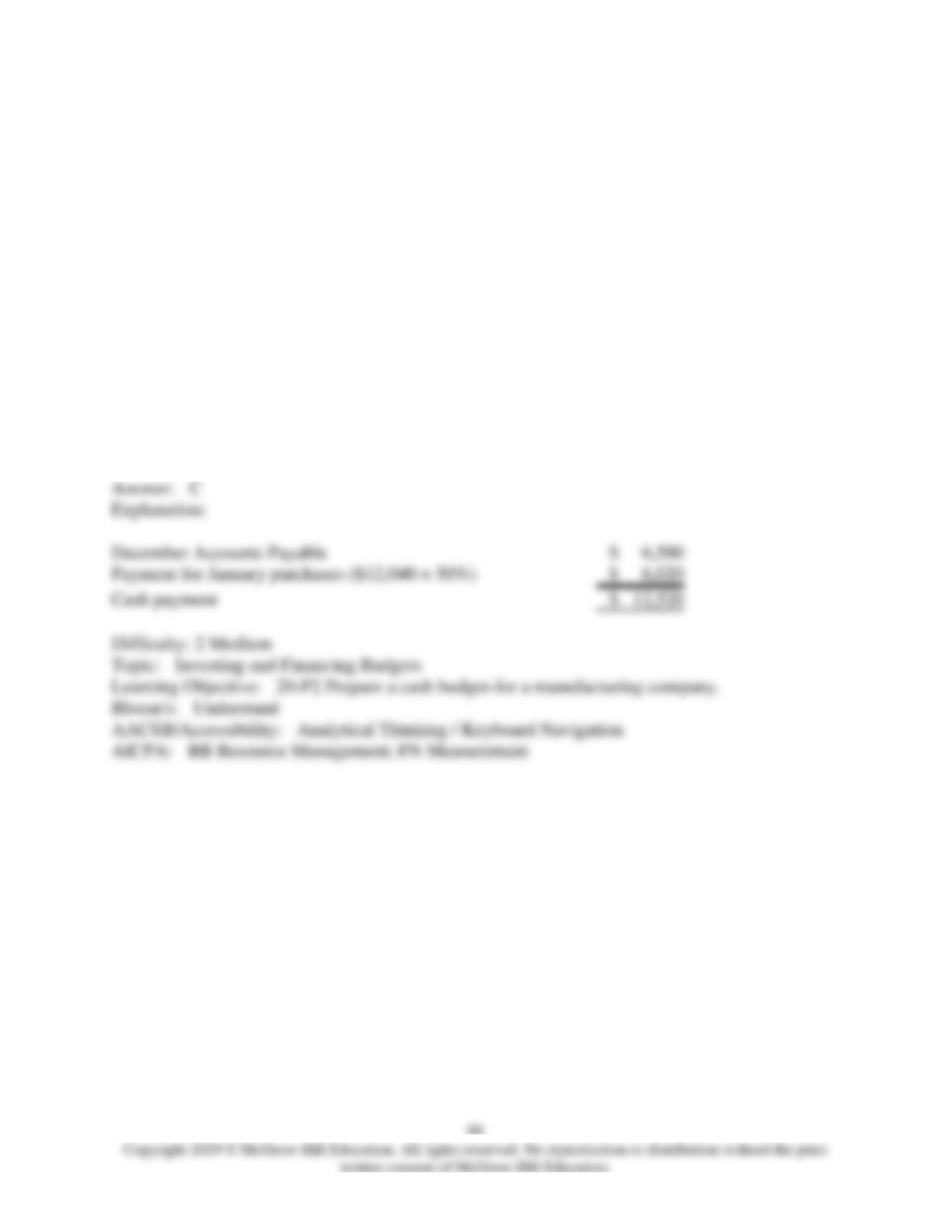
D) $13,095.
E) $18,540.
December Accounts Payable
Payment for January purchases ($12,040 × 50%)
Cash payment
137) Memphis Company’s May sales budget calls for sales of $900,000. The store expects to
begin May with $50,000 of inventory and to end the month with $55,000 of inventory. Gross
margin is typically 45% of sales. Compute the budgeted cost of merchandise purchases for May.
A) $550,000.
B) $500,000.
C) $495,000.
D) $460,000.
E) $490,000.
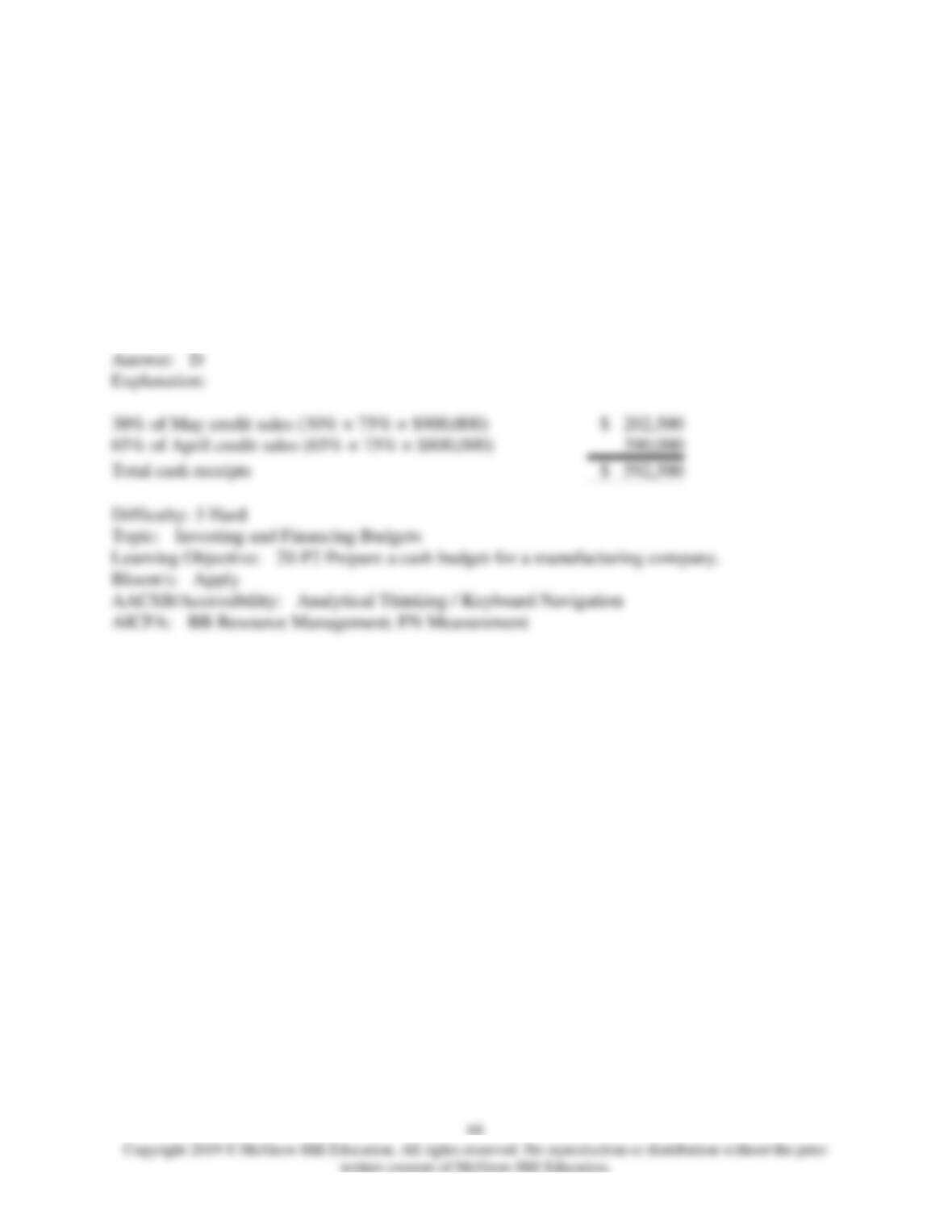
138) Fortune Company’s direct materials budget shows the following cost of materials to be
purchased for the coming three months:
January
February
March
Material purchases
$12,040
$14,150
$10,970
Payments for purchases are expected to be made 50% in the month of purchase and 50% in the
month following purchase. The December Accounts Payable balance is $6,500. The expected
January 31 Accounts Payable balance is:
A) $6,500.
B) $7,075.
C) $12,040.
D) $6,020.
E) $9,270.
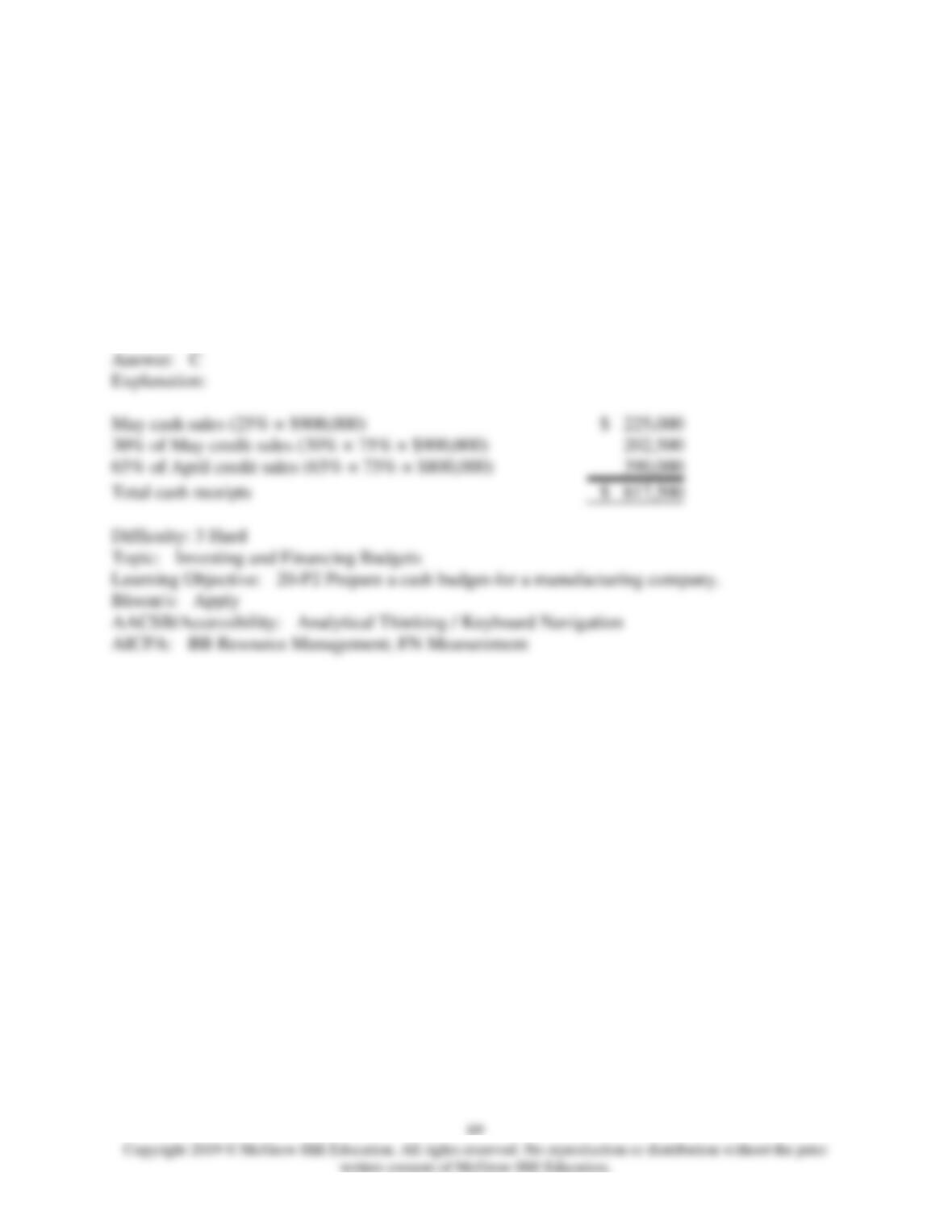
139) Memphis Company anticipates total sales for April, May, and June of $800,000, $900,000,
and $950,000 respectively. Cash sales are normally 25% of total sales. Of the credit sales, 30%
are collected in the same month as the sale, 65% are collected during the first month after the
sale, and the remaining 5% are not collected. Compute the amount of cash received from credit
sales during the month of May.
A) $561,500.
B) $652,500.
C) $817,500.
D) $592,500.
E) $890,000.
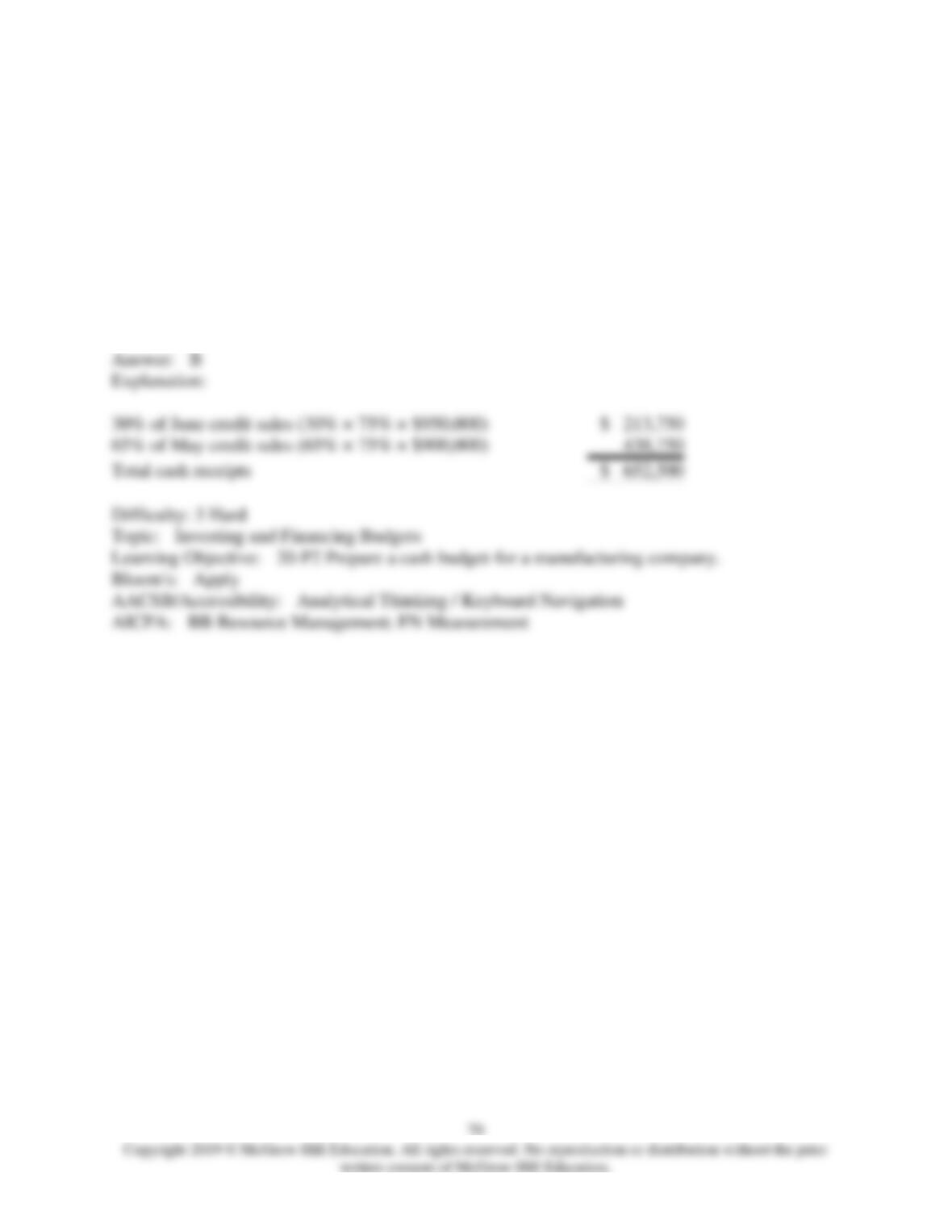
140) Memphis Company anticipates total sales for April, May, and June of $800,000, $900,000,
and $950,000 respectively. Cash sales are normally 25% of total sales. Of the credit sales, 30%
are collected in the same month as the sale, 65% are collected during the first month after the
sale, and the remaining 5% are not collected. Compute the amount of cash received from total
sales during the month of May.
A) $561,500.
B) $652,500.
C) $817,500.
D) $592,500.
E) $890,000.
141) Memphis Company anticipates total sales for April, May, and June of $800,000, $900,000,
and $950,000 respectively. Cash sales are normally 25% of total sales. Of the credit sales, 30%
are collected in the same month as the sale, 65% are collected during the first month after the
sale, and the remaining 5% are not collected. Compute the amount of cash received from credit
sales during the month of June.
A) $561,500.
B) $652,500.
C) $817,500.
D) $592,500.
E) $890,000.
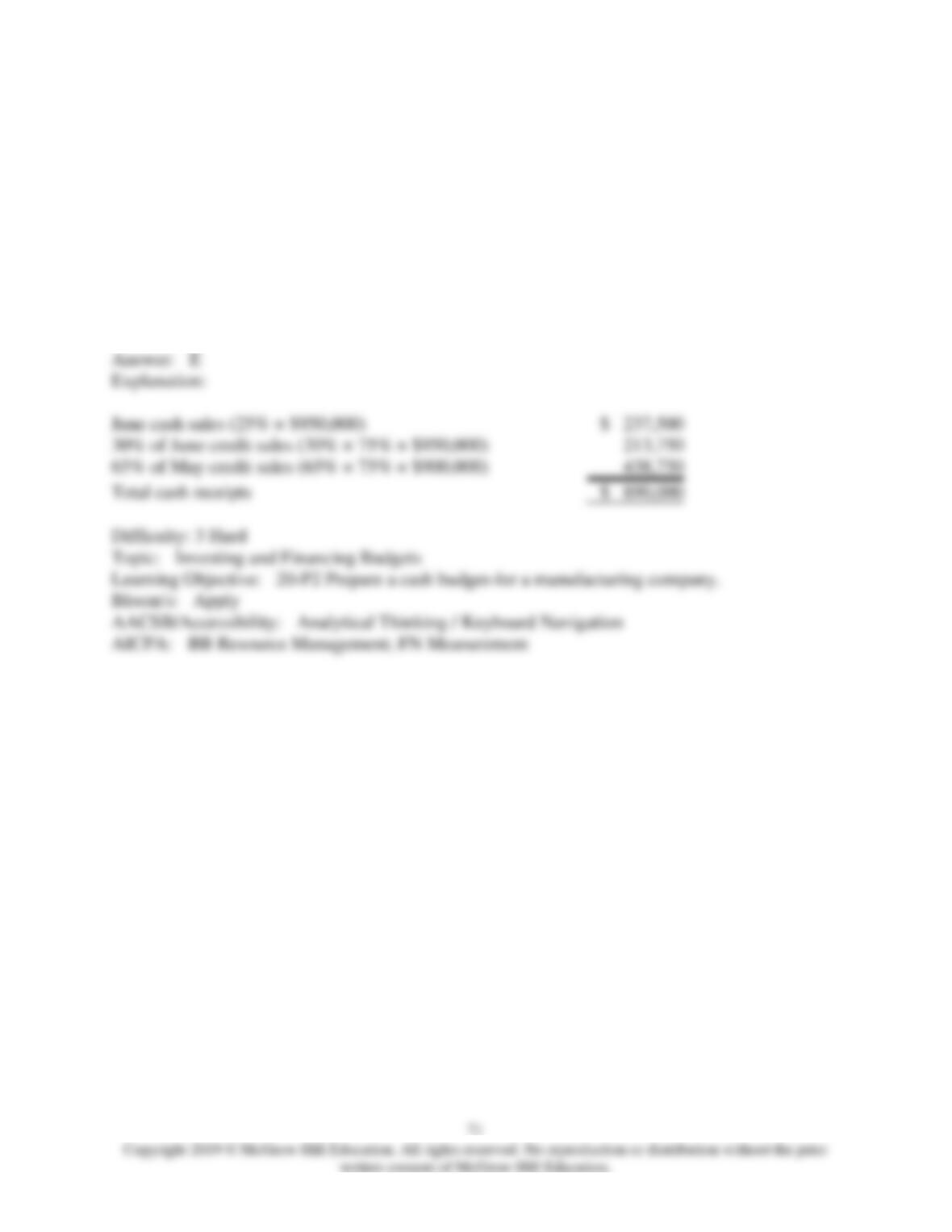
142) Memphis Company anticipates total sales for April, May, and June of $800,000, $900,000,
and $950,000 respectively. Cash sales are normally 25% of total sales. Of the credit sales, 30%
are collected in the same month as the sale, 65% are collected during the first month after the
sale, and the remaining 5% are not collected. Compute the amount of cash received from total
sales during the month of June.
A) $561,500.
B) $652,500.
C) $817,500.
D) $592,500.
E) $890,000.
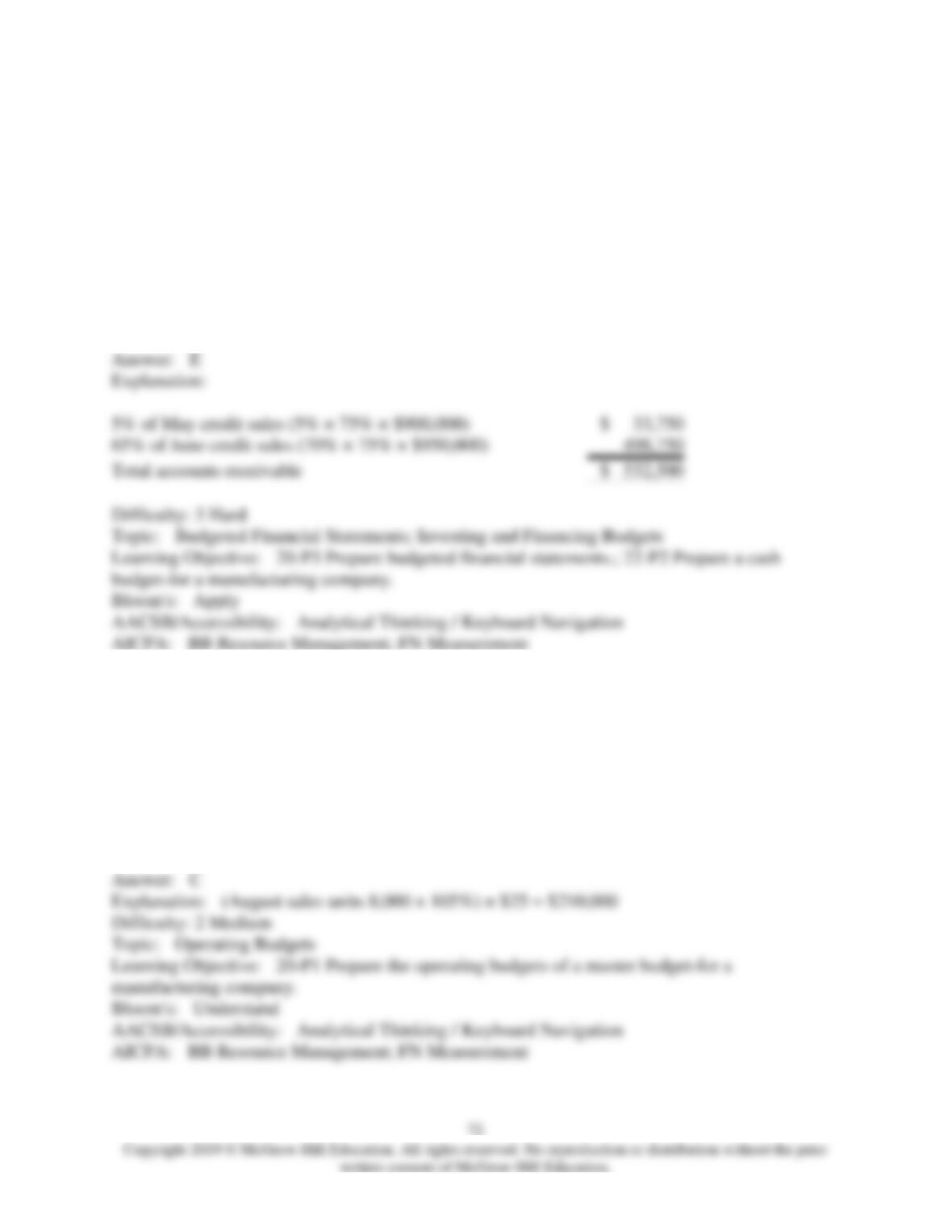
143) Memphis Company anticipates total sales for April, May, and June of $800,000, $900,000,
and $950,000 respectively. Cash sales are normally 25% of total sales. Of the credit sales, 30%
are collected in the same month as the sale, 65% are collected during the first month after the
sale, and the remaining 5% are collected in the second month. Compute the amount of accounts
receivable reported on the company’s budgeted balance sheet for June 30.
A) $617,500.
B) $561,500.
C) $712,500.
D) $463,125.
E) $532,500.
144) Ratchet Manufacturing’s August sales budget calls for sales of 8,000 units. Each month’s
unit sales are expected to grow by 5%. The product selling price is $25 per unit. The expected
total sales dollars for September’s sales budget are:
A) $200,000.
B) $190,000.
C) $210,000.
D) $220,000.
E) $8,400.
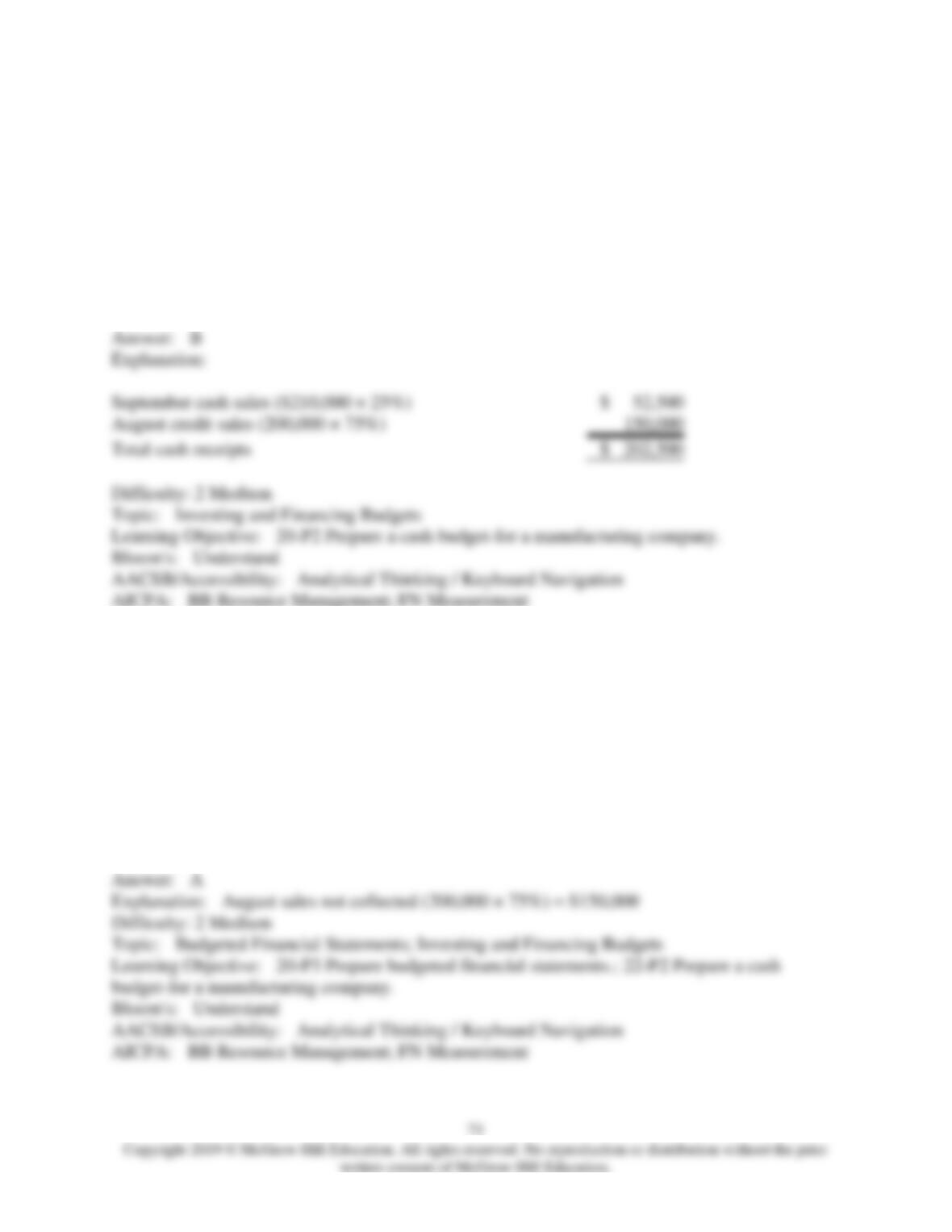
145) Ratchet Manufacturing anticipates total sales for August, September, and October of
$200,000, $210,000, and $220,500 respectively. Cash sales are normally 25% of total sales and
the remaining sales are on credit. All credit sales are collected in the first month after the sale.
Compute the amount of cash received for September.
A) $150,000.
B) $202,500.
C) $157,500.
D) $102,500.
E) $307,500.
146) Ratchet Manufacturing anticipates total sales for August, September, and October of
$200,000, $210,000, and $220,500 respectively. Cash sales are normally 25% of total sales and
the remaining sales are on credit. All credit sales are collected in the first month after the sale.
Compute the amount of accounts receivable to be reported on the company’s budgeted balance
sheet for August.
A) $150,000.
B) $50,000.
C) $157,500.
D) $52,500.
E) $200,000.
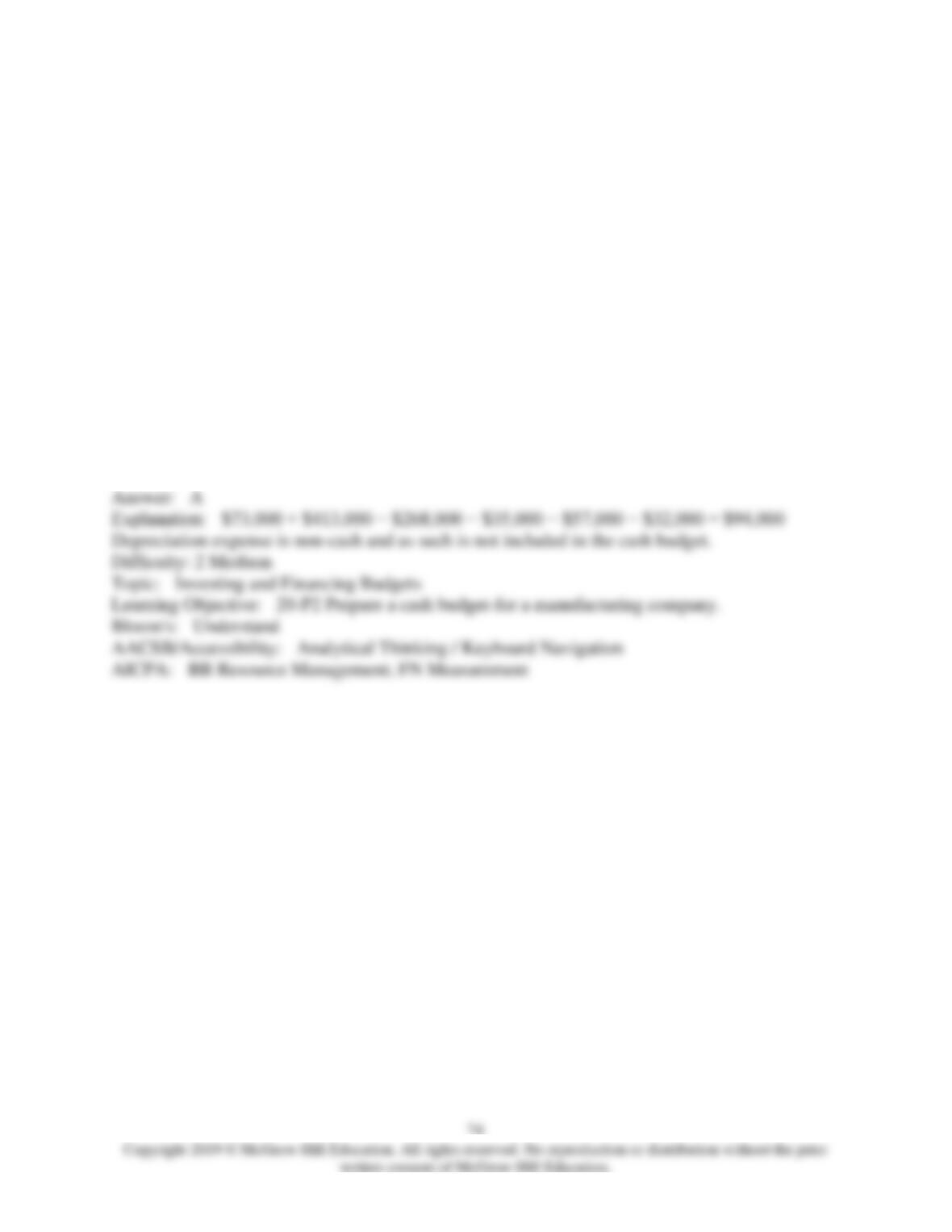
147) Use the following information to determine the ending cash balance to be reported on the
month ended June 30 cash budget.
• Beginning cash balance on June 1, $73,000.
• Cash receipts from sales, $413,000.
• Budgeted cash payments for purchases, $268,000.
• Budgeted cash payments for salaries, $35,000.
• Other budgeted cash expenses, $57,000.
• Cash repayment of bank loan, $32,000.
• Budgeted depreciation expense, $34,000.
A) $94,000.
B) $60,000.
C) $126,000.
D) $149,000.
E) $21,000.
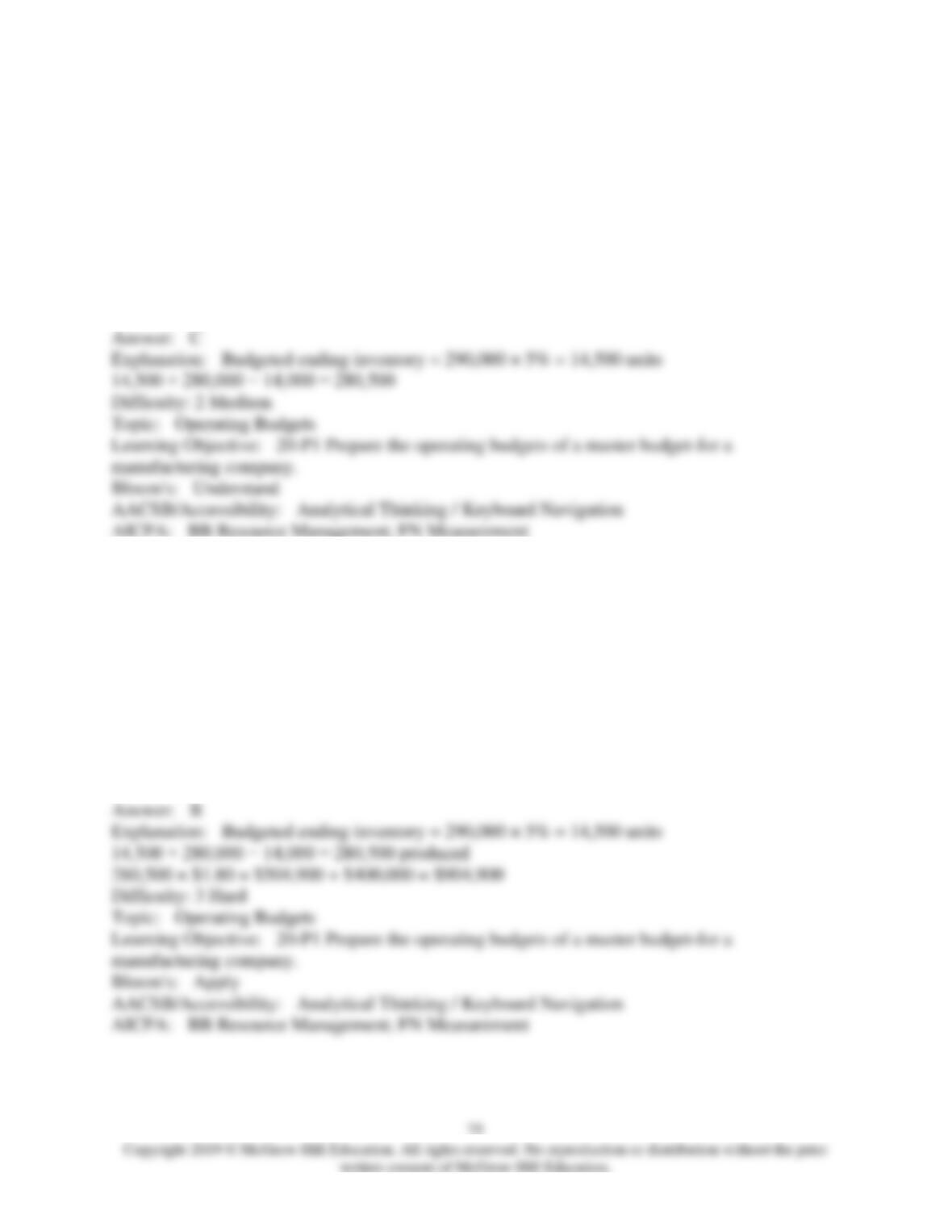
148) Trago Company manufactures a single product and has a JIT policy that ending inventory
must equal 5% of the next month’s sales. It estimates that May’s ending inventory will consist of
14,000 units. June and July sales are estimated to be 280,000 and 290,000 units, respectively.
Compute the number of units to be produced in June.
A) 290,000.
B) 294,500.
C) 280,500.
D) 280,000.
E) 266,000.
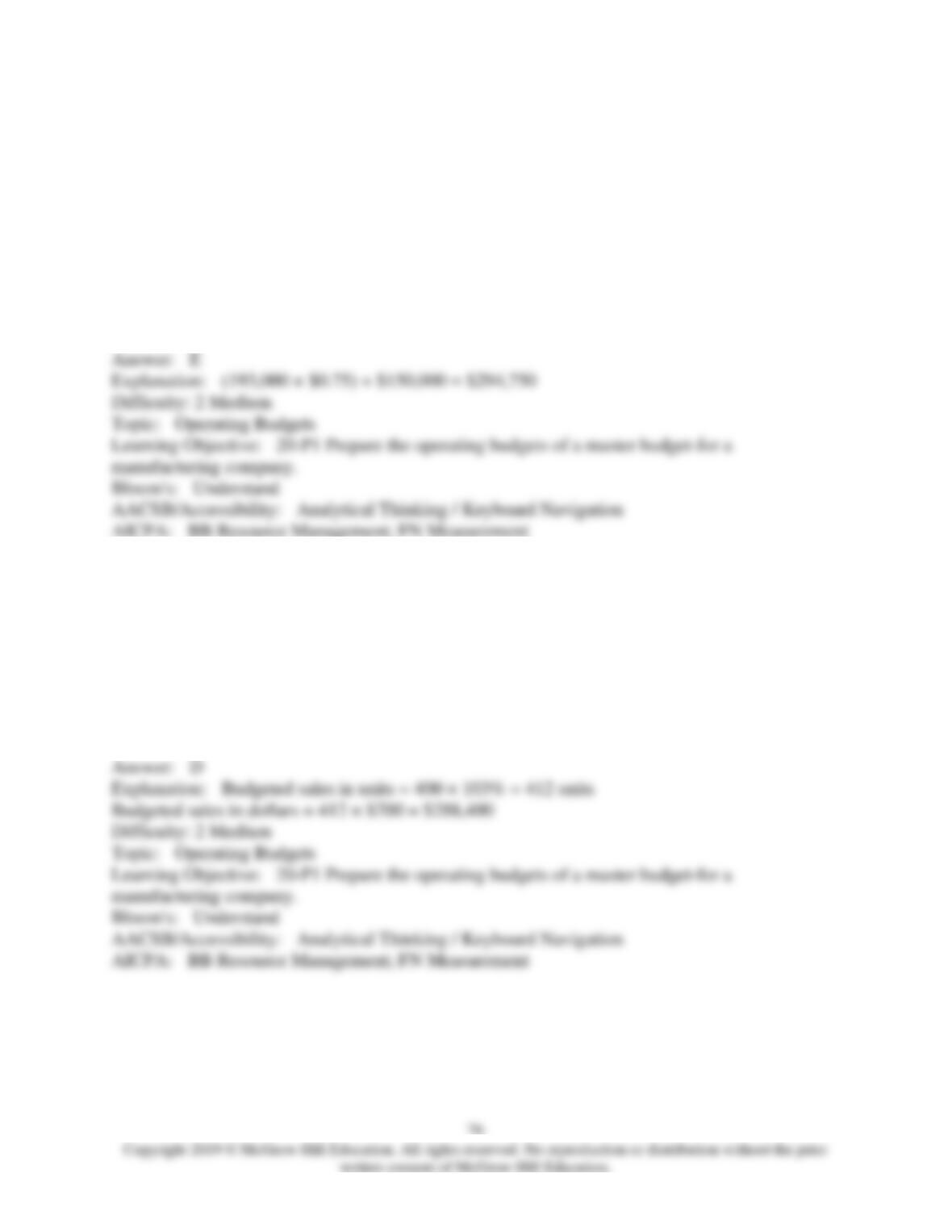
149) Trago Company manufactures a single product and has a JIT policy that ending inventory
must equal 5% of the next month’s sales. It estimates that May’s ending inventory will consist of
14,000 units. June and July sales are estimated to be 280,000 and 290,000 units, respectively.
Trago assigns variable overhead at a rate of $1.80 per unit of production. Fixed overhead equals
$400,000 per month. Compute the total budgeted overhead for June.
A) $920,200.
B) $904,900.
C) $930,100.
D) $922,000.
E) $878,800.
150) Glaston Company manufactures a single product using a JIT inventory system. The
production budget indicates that the number of units expected to be produced are 193,000 in
October, 201,500 in November, and 198,000 in December. Glaston assigns variable overhead at
a rate of $0.75 per unit of production. Fixed overhead equals $150,000 per month. Compute the
total budgeted overhead for October.
A) $343,000.
B) $150,000.
C) $144,750.
D) $301,125.
E) $294,750.
151) Zhang Industries sells a product for $700. Unit sales for May were 400 and each month’s
sales are expected to exceed the prior month’s results by 3%. Compute the total budgeted sales
dollars for the month ended June 30.
A) $280,000.
B) $297,000.
C) $271,600.
D) $288,400.
E) $364,000.
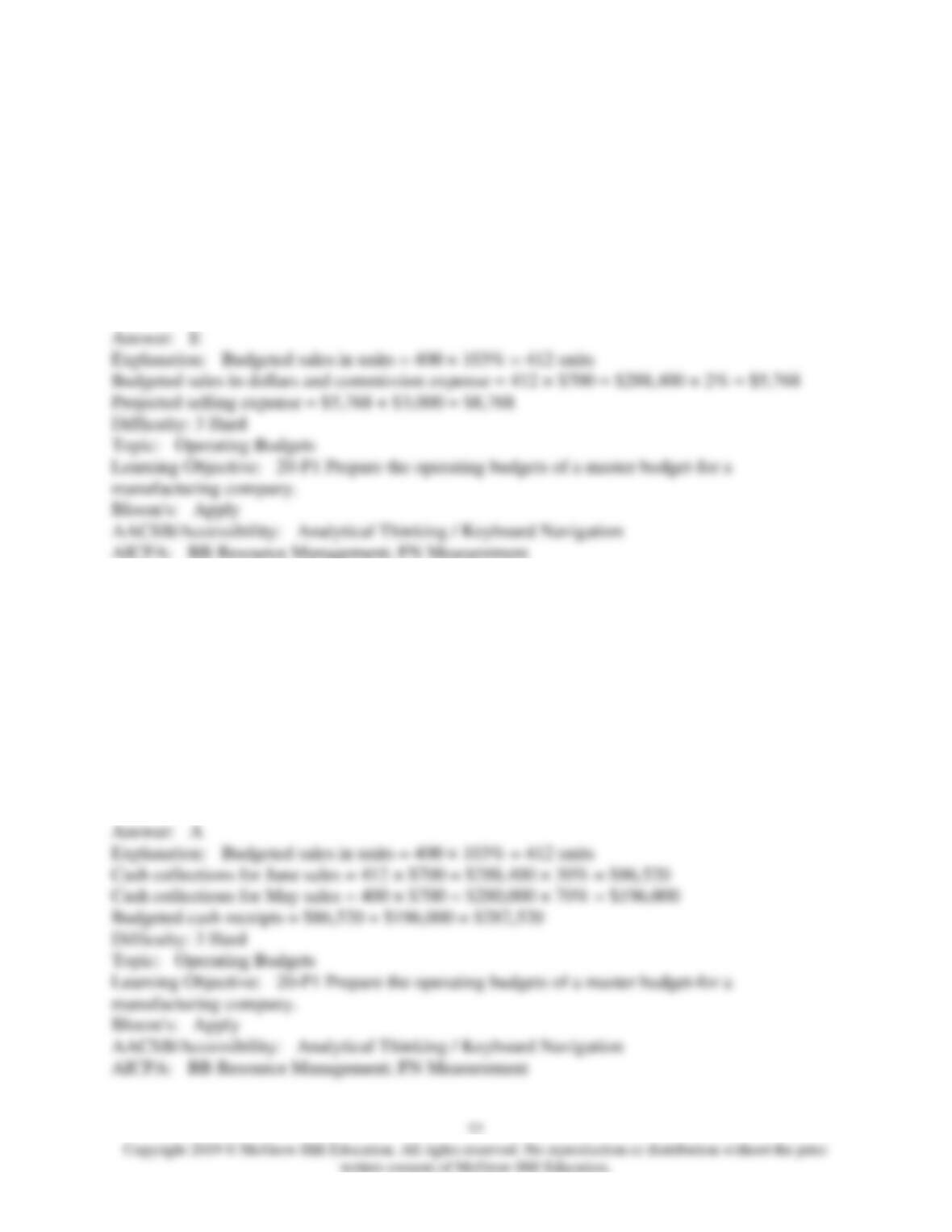
152) Zhang Industries sells a product for $700 per unit. Unit sales for May were 400, and each
month’s unit sales are expected to grow by 3%. Zhang pays a sales manager a monthly salary of
$3,000 and a commission of 2% of sales. Compute the budgeted selling expense for the manager
for the month ended June 30.
A) $8,600.
B) $11,652.
C) $8,652.
D) $5,768.
E) $8,768.
153) Zhang Industries sells a product for $700. Unit sales for May were 400 and each month’s
sales are expected to grow by 3%. Zhang pays a sales manager a monthly salary of $3,000 and a
commission of 2% of sales in dollars. Assume 30% of Zhang’s sales are for cash. The remaining
70% are credit sales; these customers pay in the month following the sale. Compute the budgeted
cash receipts for June.
A) $282,520.
B) $196,000.
C) $201,880.
D) $280,000.
E) $285,880.
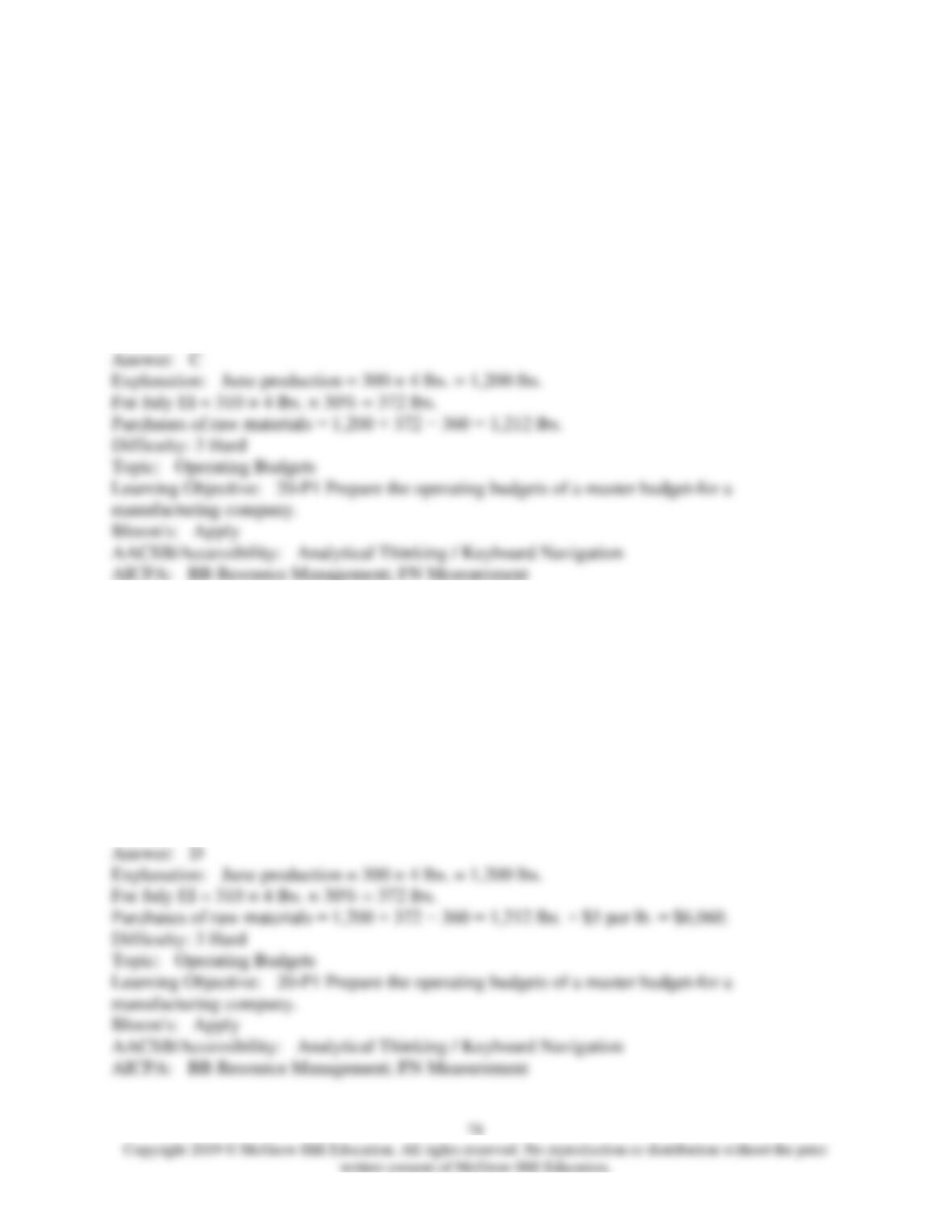
154) Zhang Industries budgets production of 300 units in June and 310 units in July. Each
finished unit requires 4 pounds (lbs.) of raw material K, which costs $5 per pound. Each month’s
ending inventory of raw materials should be 30% of the following month’s budgeted production.
The June 1 raw materials inventory has 360 pounds of raw material K. Compute the budgeted
purchases for raw material K in pounds for June.
A) 1,200 lbs.
B) 1,240 lbs.
C) 1,212 lbs.
D) 1,220 lbs.
E) 880 lbs.
155) Zhang Industries budgets production of 300 units in June and 310 units in July. Each
finished unit requires 4 pounds of raw material K, which costs $5 per pound. Each month’s
ending inventory of raw materials should be 30% of the following month’s budgeted production.
The June 1 raw materials inventory has 360 pounds of raw material K. Compute the budgeted
cost of purchases for raw material K for June.
A) $4,400.
B) $6,000.
C) $6,200.
D) $6,060.
E) $6,100.
156) Zhang Industries budgets production of 300 units in June and 310 units in July. Each unit
requires 1.5 hours of direct labor. The direct labor rate is $14 per hour. The indirect labor rate is
$21 per hour. Compute the budgeted direct labor cost for July.
A) $6,300.
B) $6,510.
C) $9,450.
D) $9,765.
E) $16,275.
157) Zhang Industries is preparing a cash budget for June. The company has $25,000 cash at the
beginning of June and anticipates $95,000 in cash receipts and $111,290 in cash payments during
June. The company has no loans outstanding on June 1. Compute the amount the company must
borrow, if any, to maintain a $20,000 cash balance.
A) $28,710.
B) $12,290.
C) $16,290.
D) $11,290.
E) $6,290.
158) Webster Corporation’s budgeted sales for February are $325,000. Webster pays sales
representatives a commission of 6% of sales dollars. The company pays a sales manager a
monthly salary of $4,400 and expects advertising expense of $2,000 per month. Compute the
total budgeted selling expenses for February.
A) $19,500.
B) $6,400.
C) $23,900.
D) $25,900.
E) $21,500.
159) Webster Corporation is preparing a master budget for the first quarter. The company
budgets production of 2,680 units in January, 2,600 units in February and 2,740 units in March.
Each unit requires 0.6 hours of direct labor. The direct labor rate is $12 per hour. Compute the
budgeted direct labor cost for the first quarter budget.
A) $56,160.
B) $57,744.
C) $96,240.
D) $93,600.
E) $48,120.