Chapter 20–Accounting for Postemployment Benefits Key
1. An Internal Revenue Code rule that impacts the design of pension plans is
2. A pension plan provides for future retirement income based on the employee’s income and length of service
with the company. This type of pension plan is termed a
3. Which of the following statements is true regarding a defined contribution pension plan?
4. Which of the following statements is true regarding a defined benefit pension plan?
5. GAAP for pension plans requires companies with defined benefit pension plans to
6. Which of the following pension-related definitions is not correct?
7. Benefits for which the employee’s right to receive a present or future pension benefit is no longer contingent
on remaining in the service of the employer are called
8. The cost of retroactive benefits granted in a plan amendment or at the initial adoption of a pension plan is
called
9. If an employer were to account for a defined benefit pension plan on the cash basis, it would be a violation of
the
10. According to current GAAP, termination benefits paid to an employee should be
11. Which statement is not true?
12. The projected benefit obligation is equal to the
13. Current GAAP regarding employers’ accounting for defined benefit pension plans defines an underfunded
pension at the end of the period when the
14. Current GAAP defines the required calculations for all of the following items except
15. The accumulated benefit obligation is equal to the
16. Code:
A =
amortization of unrecognized prior service cost
B =
interest cost
C =
gain or loss (to the extent recognized)
D =
service cost
E =
expected return on plan assets
F =
net periodic pension expense to be reported on the income statement
Which equation is correct?
17. If a pension plan amendment is adopted and retroactive benefits are granted to employees, the amount of the
prior service cost at the date of grant is accounted for
18. A company’s net periodic pension cost (expense) includes all of the following items except
19. Amortization of any unrecognized net gain or loss is included in pension expense of a given year if at the
20. Which of the following is not a component of the net periodic pension expense to be reported on a
company’s income statement?
21. O’Brien began a defined benefit pension plan on January 1, 2010. During 2010, the service cost was
$450,000. O’Brien contributed $450,000 to the pension plan for 2010. The actuary said the projected benefit
obligation at December 31, 2010 was $450,000. As of December 31, 2010, what statements can O’Brien make
about the pension plan?
I.
The pension plan is fully funded.
II.
O’Brien does not need to report a liability regarding the pension plan at December 31, 2010.
22. In 2011, the Marsha Company closed a manufacturing plant. The resulting actuarial loss should be
23. The interest rate that may be used to compute the interest cost component of pension expense is equal to the
24. In 2010, the Barbara Company initiated a defined benefit pension plan. It recorded $240,000 as pension
expense and paid $280,000 to a funding agency. As a result, Barbara will report
25. The Margie Company has a defined benefit pension plan for its employees. The following information
pertains to the pension plan as of December 31, 2010:
Projected benefit obligation, January 1, 2010
$1,600,000
Service cost, 2010
750,000
Interest cost, 2010
100,000
Payments to retired employees
80,000
Actual return on plan assets
99,600
26. Given the following information
2010
2011
Service cost
$20,000
$ 24,000
Plan assets at beginning of year
180,000
Projected benefit obligation at beginning of
year
200,000
Discount rate =
7%
Actual and expected rate of return on plan assets =
5%

What is pension expense for 2011?
27. The Susan Company has a defined benefit pension plan for its employees. The following information
pertains to the pension plan:
Projected benefit obligation, December 31, 2010
$1,680,000
Fair value of plan assets, December 31, 2010
1,739,000
Accrued/prepaid pension cost (asset), December 31, 2009
51,300
The December 31, 2010 adjusting journal entries include a
28. On January 1, 2010, a company had $84,000 of unrecognized prior service cost. The years-of-future-service
method of amortization is used. The company has seven employees, as indicated below:
Expected Years of
Employee
Future Service
A
3
B
5
C
5
D
6
E
6
F
8
G
9
What amount of prior service cost should be included in pension expense for 2010?
29. Exhibit 20-1
Given the following information:
Beginning of
2010
2011
2012
Projected benefit obligation
$600
$700
$1,200
Plan asset value
400
800
1,100
Average remaining service life = 5 years
An unrecognized net loss existed at the beginning of 2010 in the amount of $100. An additional unrecognized net loss of $20 is reported by actuaries
as of the end of 2011.
Refer to Exhibit 20-1. What amount of loss should be added to pension expense in 2010?
30. Exhibit 20-1
Given the following information:
Beginning of
2010
2011
2012
Projected benefit obligation
$600
$700
$1,200
Plan asset value
400
800
1,100
Average remaining service life = 5 years
An unrecognized net loss existed at the beginning of 2010 in the amount of $100. An additional unrecognized net loss of $20 is reported by actuaries
as of the end of 2011.
Refer to Exhibit 20-1. What amount of loss should be added to pension expense in 2012?
31. Exhibit 20-2
Minnie Co. has an unfunded prepaid/accrued pension cost of $2,000 (debit balance) at December 31, 2010. The
following information pertains to 2011:
Pension expense
$320,000
Projected benefit obligation, December 31, 2011
840,000
Contributions
330,000
Plan assets (fair value), December 31, 2011
810,000
Refer to Exhibit 20-2. The balance in Prepaid/Accrued Pension Cost at December 31, 2011, should be
32. Exhibit 20-2
Minnie Co. has an unfunded prepaid/accrued pension cost of $2,000 (debit balance) at December 31, 2010. The
following information pertains to 2011:
Pension expense
$320,000
Projected benefit obligation, December 31, 2011
840,000
Contributions
330,000
Plan assets (fair value), December 31, 2011
810,000
Refer to Exhibit 20-2. The December 31, 2011, adjusting entry should be
33. Exhibit 20-3
The Grace Company adopted a defined benefit pension plan on January 1, 2010, and prior service credit was
granted to employees. The present value of those benefits was calculated to be $1,351,800 at that date. The
service cost is funded in full at the end of each year, plus an additional amount of $220,000 is funded each
year-end. The unrecognized prior service cost is being amortized by the straight-line method over the remaining
10-year service life of the company’s active employees. Additional information relating to the company’s
pension plan is presented below:
2010
2011
Service cost (annual)
$ 95,000
$105,000
Unrecognized prior service cost
amortization
135,180
135,180
Interest cost
10%
10%
Expected (and actual) return on plan assets
10%
10%
Refer to Exhibit 20-3. What is the pension expense for 2010?
34. Exhibit 20-3
The Grace Company adopted a defined benefit pension plan on January 1, 2010, and prior service credit was
granted to employees. The present value of those benefits was calculated to be $1,351,800 at that date. The
service cost is funded in full at the end of each year, plus an additional amount of $220,000 is funded each
year-end. The unrecognized prior service cost is being amortized by the straight-line method over the remaining
10-year service life of the company’s active employees. Additional information relating to the company’s
pension plan is presented below:
2010
2011
Service cost (annual)
$ 95,000
$105,000
Unrecognized prior service cost
amortization
135,180
135,180
Interest cost
10%
10%
Expected (and actual) return on plan assets
10%
10%
Refer to Exhibit 20-3. What is the pension expense for 2011?
35. Exhibit 20-3
The Grace Company adopted a defined benefit pension plan on January 1, 2010, and prior service credit was
granted to employees. The present value of those benefits was calculated to be $1,351,800 at that date. The
service cost is funded in full at the end of each year, plus an additional amount of $220,000 is funded each
year-end. The unrecognized prior service cost is being amortized by the straight-line method over the remaining
10-year service life of the company’s active employees. Additional information relating to the company’s
pension plan is presented below:
2010
2011
Service cost (annual)
$ 95,000
$105,000
Unrecognized prior service cost
amortization
135,180
135,180
Interest cost
10%
10%
Expected (and actual) return on plan assets
10%
10%
Refer to Exhibit 20-3. What is the correct balance in Prepaid/Accrued Pension Cost at December 31, 2010?

36. Exhibit 20-3
The Grace Company adopted a defined benefit pension plan on January 1, 2010, and prior service credit was
granted to employees. The present value of those benefits was calculated to be $1,351,800 at that date. The
service cost is funded in full at the end of each year, plus an additional amount of $220,000 is funded each
year-end. The unrecognized prior service cost is being amortized by the straight-line method over the remaining
10-year service life of the company’s active employees. Additional information relating to the company’s
pension plan is presented below:
2010
2011
Service cost (annual)
$ 95,000
$105,000
Unrecognized prior service cost
amortization
135,180
135,180
Interest cost
10%
10%
Expected (and actual) return on plan assets
10%
10%
Refer to Exhibit 20-3. What is the correct amount of the projected benefit obligation as of December 31, 2011?
37. Danielle Company adopted a defined benefit pension plan on January 1, 2010, and prior service credit was
granted to employees. The present value of that prior service obligation as of January 1, 2010 was $1,400,000
and is being amortized by the straight-line method over the remaining 20-year service life of the company’s
active employees. Additional information relating to the company’s pension plan for 2010 is presented below:
Annual service cost
$132,000
Contribution to the plan (December 31, 2010)
390,000
Interest cost
10%
Expected (and actual) return on plan assets
12%
What amount should be recorded in Prepaid/Accrued Pension Cost when recording the 2010 pension expense and funding at December 31, 2010?
38. The McMurry Company offers employees a defined contribution pension plan. In 2010, McMurry
contributed $75,000 to the plan, which paid $95,000 to retired employees. Which of the following statements is
true?
39. Which of the following would not be a component of pension expense?
40. ACME has a defined benefit pension plan. ACME is preparing the December 31, 2010 financial statement
disclosures related to the plan assets. It should disclose which of the following?
I.
Expected Return on Plan Assets
II.
Actual Return on Plan Assets
41. Unrecognized prior service cost would be reported on the balance sheet and affect the amount(s) reported
for
42. Which of the following items attributable to a defined benefit pension plan would be recognized on a
company’s balance sheet?
Projected Benefit
Pension Plan
Prepaid Pension
Obligation
Assets
Costs
I.
Yes
Yes
Yes
II.
Yes
Yes
No
III.
Yes
No
No
IV.
No
No
Yes
43. Disclosures for a defined benefit pension plan should include which of the following?
I.
number of beneficiaries
II.
reconciliation of the ending value of the projected benefit obligation
III.
reconciliation of the ending fair value of the plan assets
IV.
the composition of plan assets
V.
the discount rate used
VI.
expected long-term rate of return on plan assets
44. Vested benefits are
45. Current GAAP requires that the financial statements issued by a funding agency for a company’s pension
plan include all of the following except
46. Current GAAP requires that the net gain or loss from a settlement or curtailment be included in the
47. The Pension Benefit Guaranty Corporation’s purpose is to
48. ERISA (Pension Reform Act of 1974) provides guidance for
49. Disclosures for vested benefits
50. The expense for other postretirement benefits, such as health care benefits, dental benefits, and eye care
benefits, currently is accounted for
51. Which of the following statements is true?
52. Which of the following statements regarding postretirement benefits other than pensions is true?
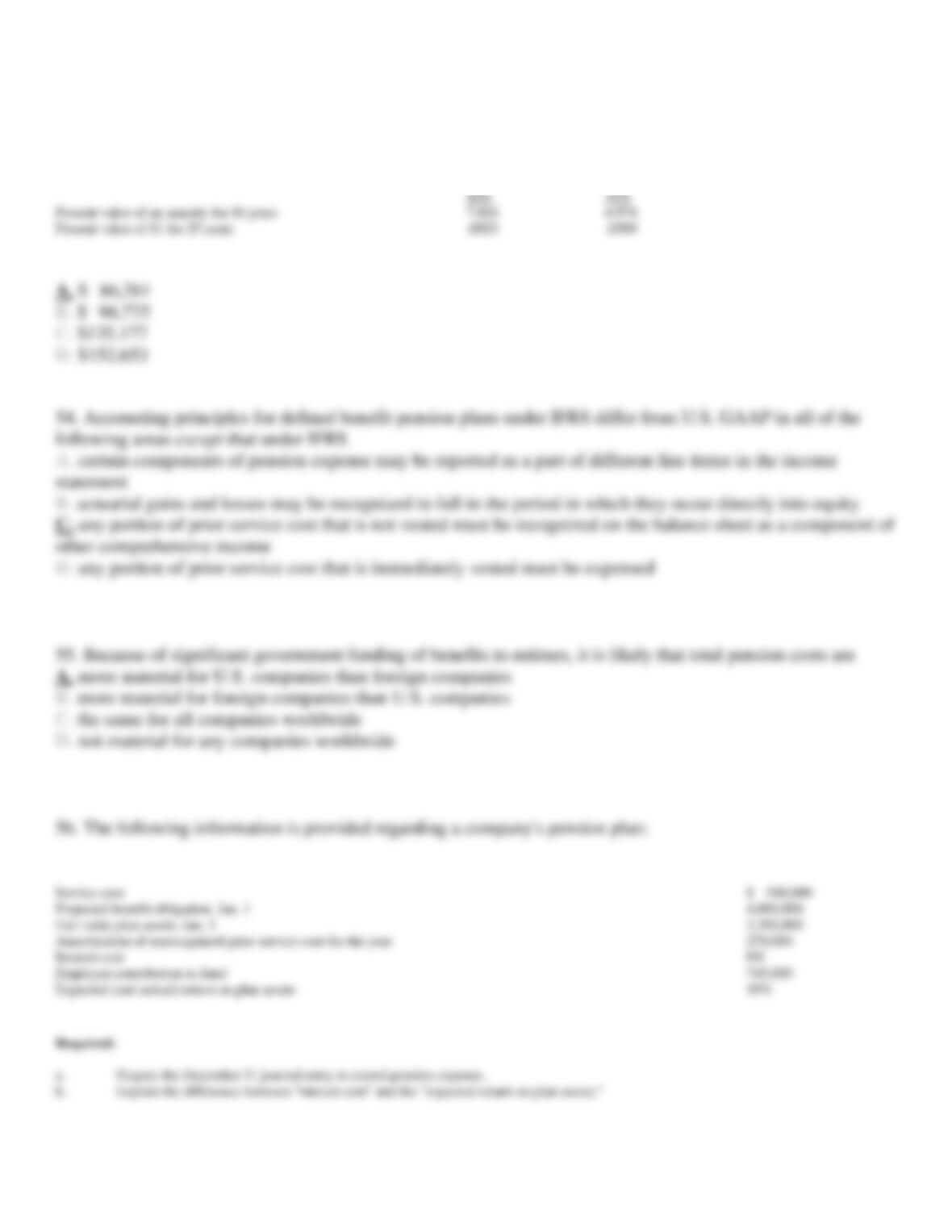
53. Corporate employees are expected to retire on average in 25 years and to live 16 years after retiring. The
pension plan’s interest (discount) rate is 12% and the expected return on plan assets is 10%. Compute the PBO
(Projected Benefit Obligation) if total annual benefits expected to be paid out to retirees is expected to be
$210,000. The following factors are available:
10%
12%
Present value of an annuity for 16 years
7.824
6.974
Present value of $1 for 25 years
.0923
.0589
54. Accounting principles for defined benefit pension plans under IFRS differ from U.S. GAAP in all of the
following areas except that under IFRS
55. Because of significant government funding of benefits to retirees, it is likely that total pension costs are
56. The following information is provided regarding a company’s pension plan:
Service cost
$ 540,000
Projected benefit obligation, Jan. 1
4,000,000
Fair value plan assets, Jan. 1
3,300,000
Amortization of unrecognized prior service cost for the year
270,000
Interest cost
8%
Employer contribution to fund
745,000
Expected (and actual) return on plan assets
10%
Required:
a.
Prepare the December 31 journal entry to record pension expense.
b.
Explain the difference between “interest cost” and the “expected return on plan assets.”