below)
125) Macintosh Inc. changed from LIFO to the FIFO inventory costing method on January 1,
2018.
Inventory values at the end of each year since the inception of the company are as follows:
FIFO
LIFO
2016
$200,000
$180,000
2017
400,000
360,000
Required:
Ignoring income tax considerations, prepare the entry to report this accounting change.
January 1, 2018
Inventory
Retained earnings
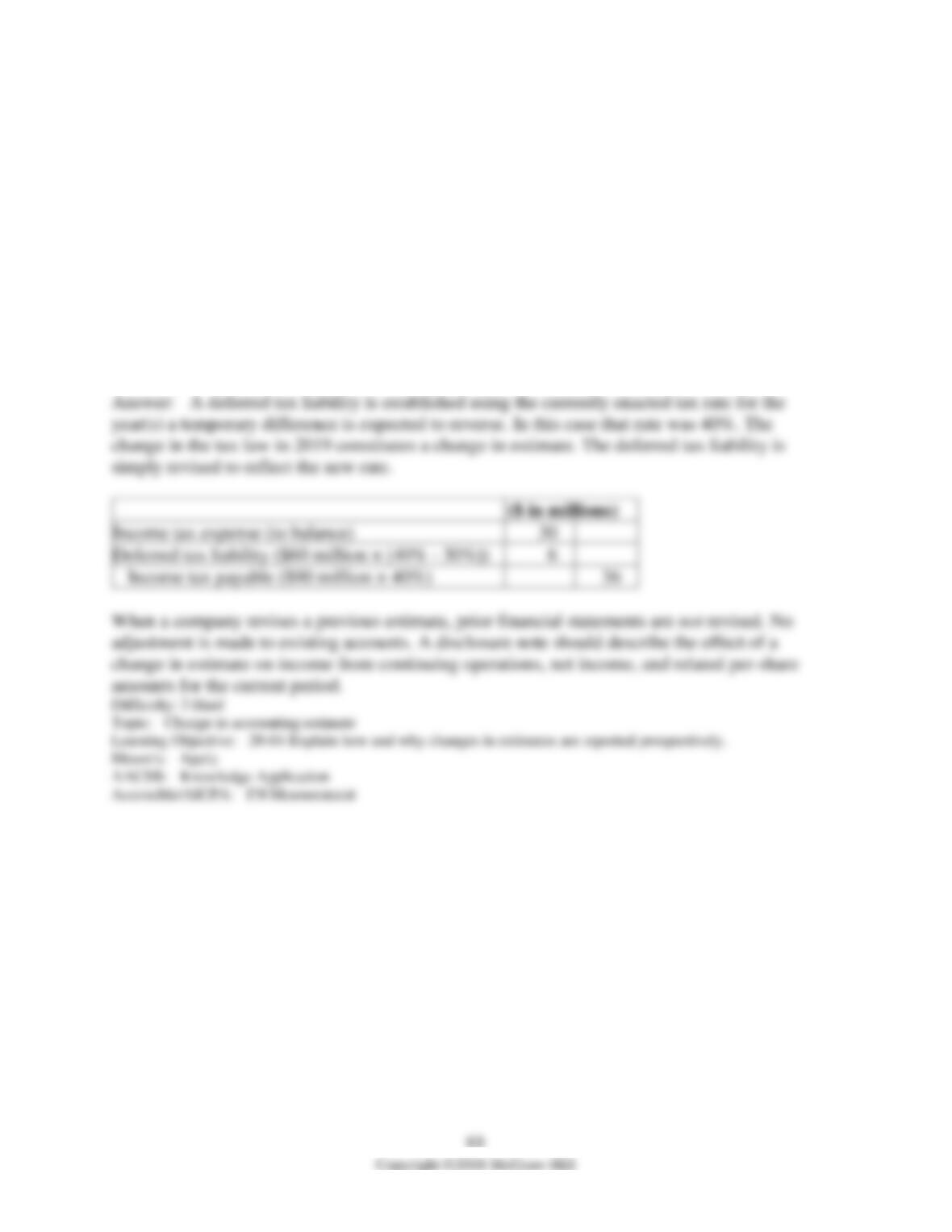
126) B Co. reported a deferred tax liability of $24 million for the year ended December 31,
2017, related to a temporary difference of $60 million. The tax rate was 40%. The temporary
difference is expected to reverse in 2019 at which time the deferred tax liability will become
payable. There are no other temporary differences in 2017-2019. Assume a new tax law is
enacted in 2018 that causes the tax rate to change from 40% to 30% beginning in 2019. (The
rate remains 40% for 2018 taxes.) Taxable income in 2018 is $90 million.
Required:
Determine the effect of the change and prepare the appropriate journal entry to record B’s
income tax expense in 2018. What adjustment, if any, is needed to revise retained earnings as a
result of the change?
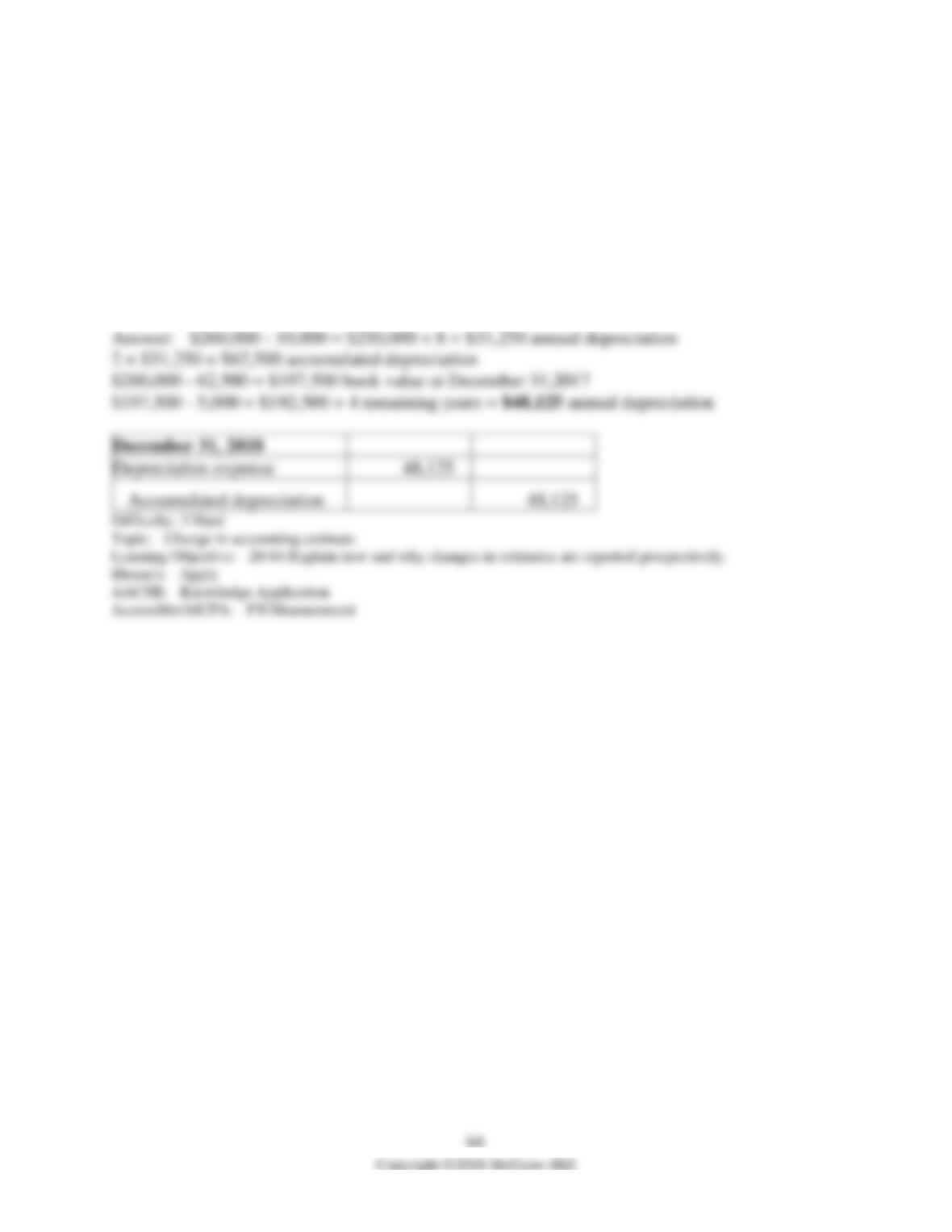
127) Buckeye Company purchased a machine on January 1, 2016. The machine had a cost of
$260,000 with a $10,000 residual value. The estimated useful life of the machine was eight
years. On January 1, 2018, due to technological innovations, the estimated useful life was
reduced by two years from the original life and the residual value was reduced by 50%. The
company uses straight-line depreciation.
Required:
Prepare the journal entry to record the annual depreciation on December 31, 2018.
128) Johnson Company receives royalties on a patent it developed several years ago. Royalties
are 5% of net sales, to be received on September 30 for sales from January through June and
receivable on March 31 for sales from July through December. The patent rights were
distributed on July 1, 2017, and Johnson accrued royalty revenue of $50,000 on December 31,
2017, as follows:
Receivable-royalty revenue
50,000
Royalty revenue
50,000
Johnson received royalties of $65,000 on March 31, 2018, and $90,000 on September 30,
2018. In December, 2018, the patent user indicated to Johnson that sales subject to royalties
for the second half of 2018 should be $600,000.
Required:
Prepare any journal entries Johnson should record during 2018 related to the royalty revenue.
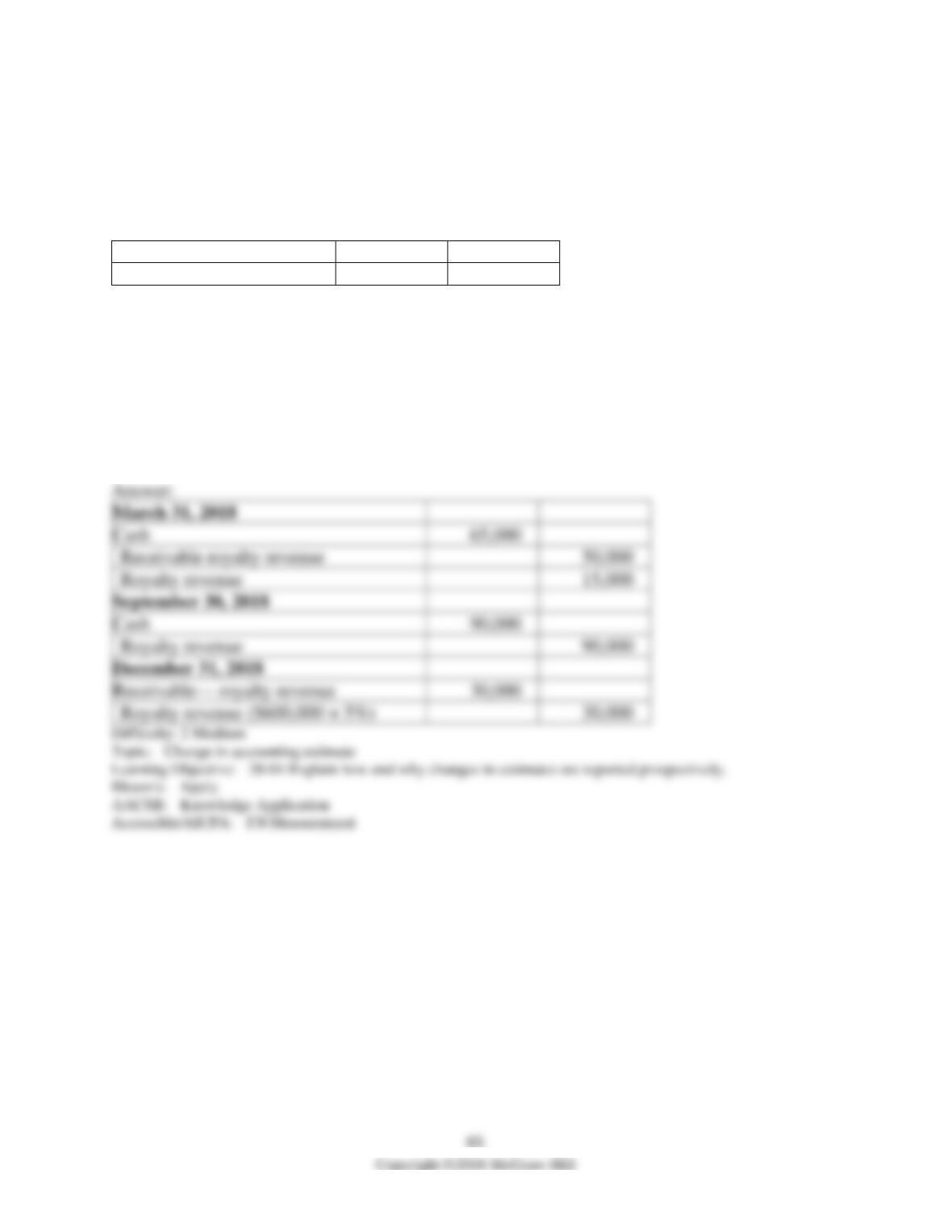
Cash
65,000
Receivable royalty revenue
50,000
Royalty revenue
15,000
Cash
90,000
Royalty revenue
90,000
30,000
Royalty revenue ($600,000 × 5%)
30,000
129) Mattson Company receives royalties on a patent it developed several years ago. Royalties
are 5% of net sales, to be received on September 30 for sales from January through June and
receivable on March 31 for sales from July through December. The patent rights were
distributed on July 1, 2017, and Mattson accrued royalty revenue of $60,000 on December 31,
2017, as follows:
Receivable-royalty revenue
60,000
Royalty revenue
60,000
Mattson received royalties of $65,000 on March 31, 2018, and $80,000 on September 30,
2018. In December, 2018, the patent user indicated to Mattson that sales subject to royalties
for the second half of 2018 should be $800,000.
Required:
(1.) Prepare any journal entries Mattson should record during 2018 related to the royalty
revenue.
(2.) What changes should be made to retained earnings relative to these royalties?
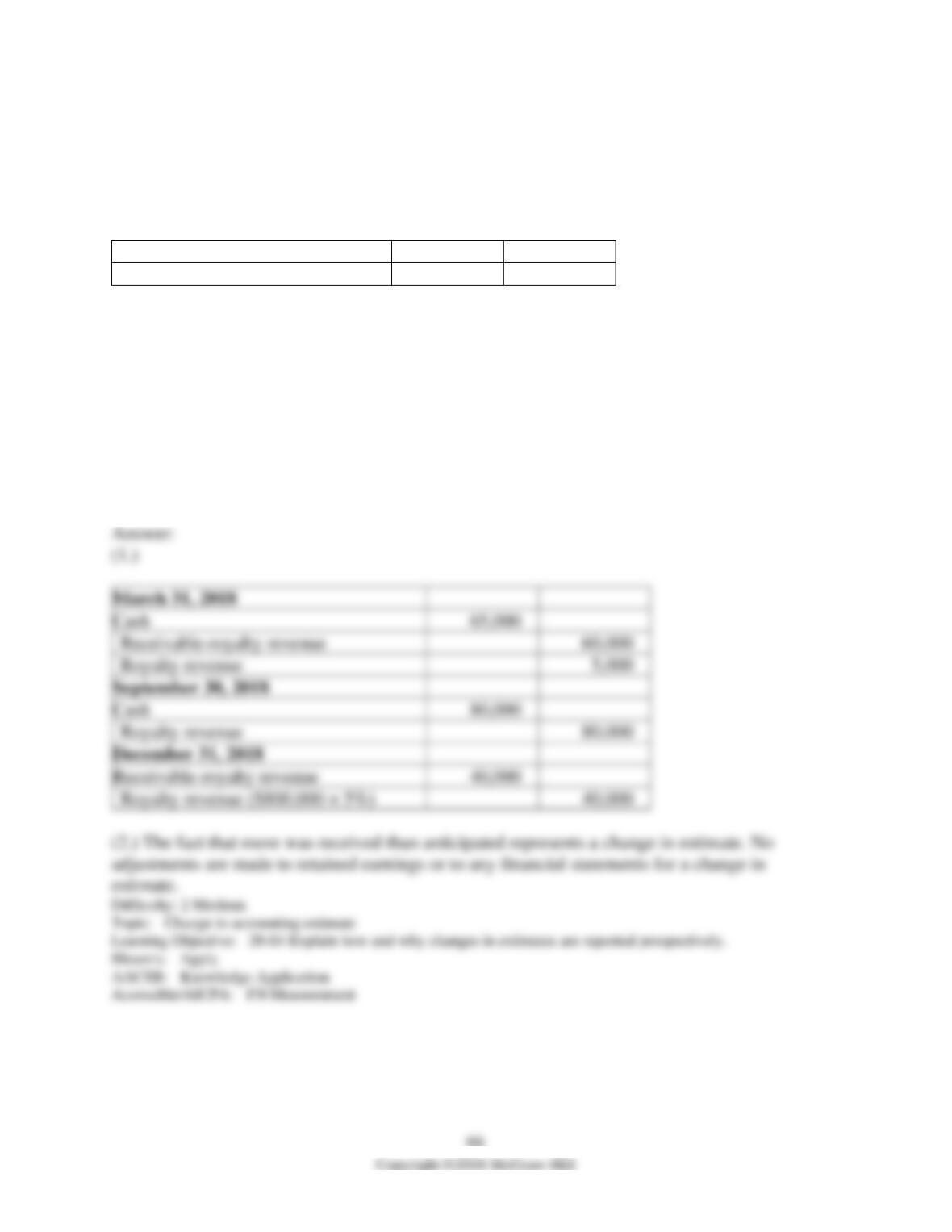
Cash
65,000
Royalty revenue
Cash
80,000
Royalty revenue
80,000
Receivable-royalty revenue
40,000
Royalty revenue ($800,000 × 5%)
40,000
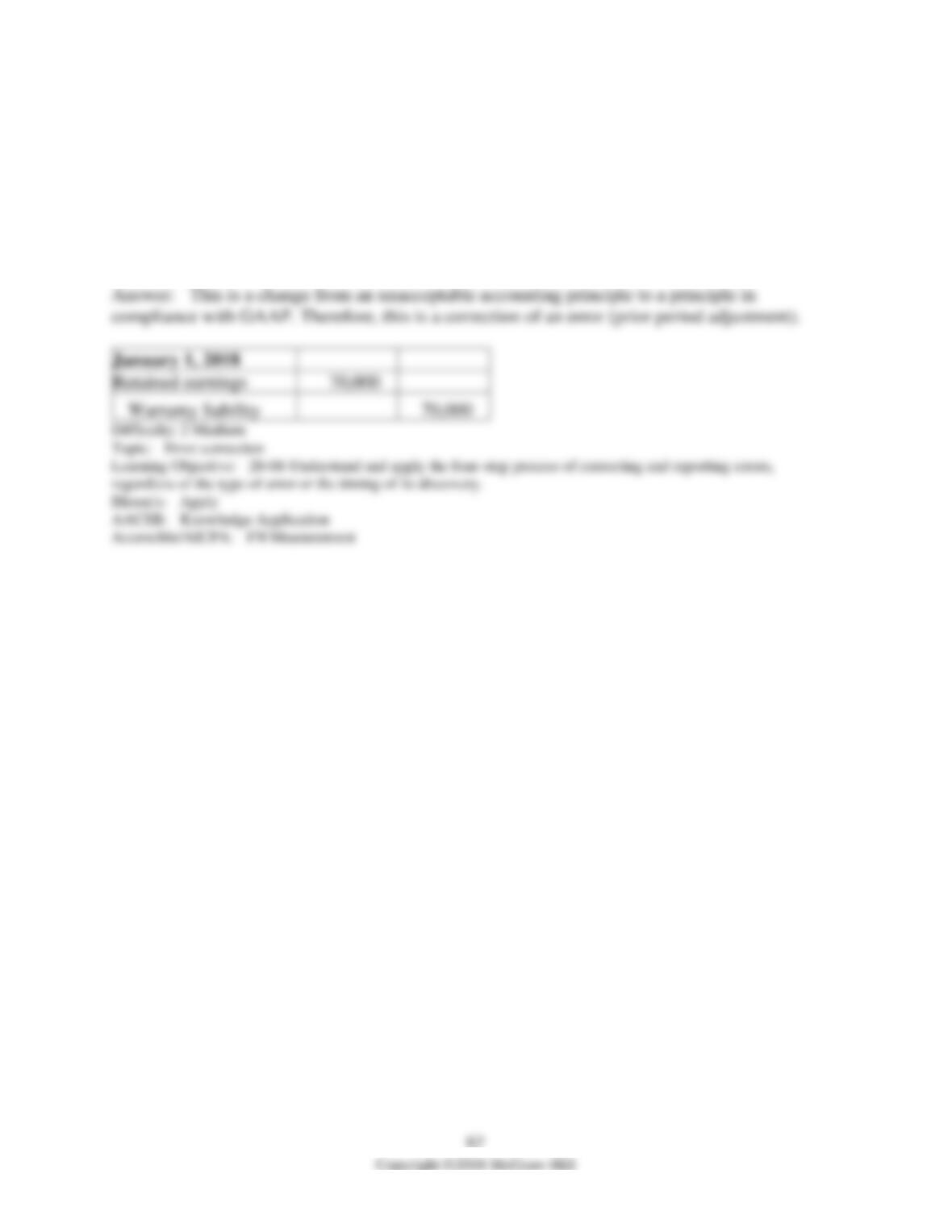
130) Nash Industries changed its method of accounting for warranties from the cash basis to
the accrual basis on January 1, 2018. The company’s accountant determined that a liability of
$70,000 should be established. Ignore income taxes.
Required:
Prepare the journal entry to record the accounting change.
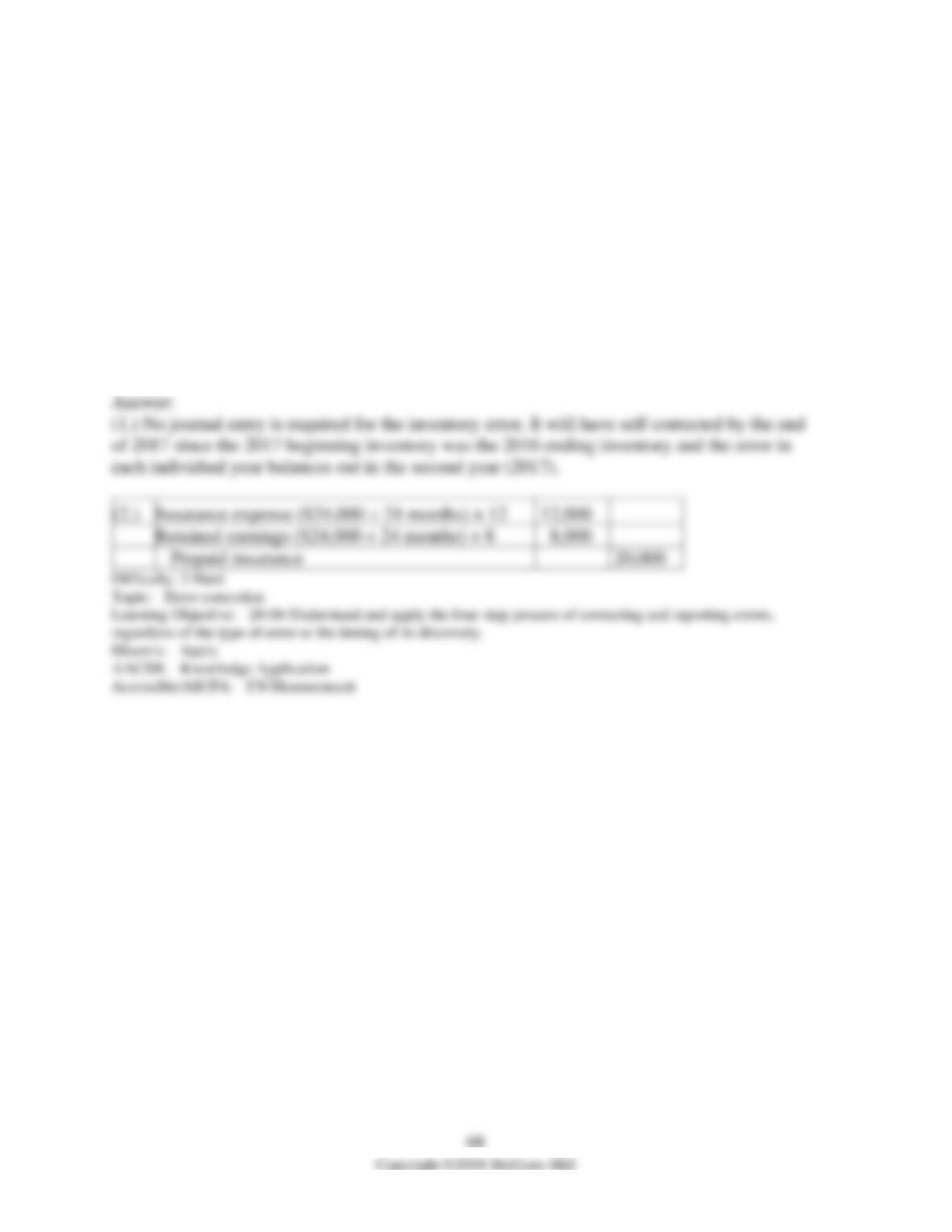
131) Cherokee Company’s auditor discovered some errors. No errors were corrected during
2017. The errors are described as follows:
(1.) Beginning inventory on January 1, 2017, was understated by $5,000.
(2.) A two-year insurance policy purchased on April 30, 2017, in the amount of $24,000 was
debited to Prepaid Insurance. No adjustment was made on December 31, 2017, or on
December 31, 2018.
Required:
Prepare appropriate journal entries (assume the 2018 books have not been closed). Ignore
income taxes.
132) Lindy Company’s auditor discovered two errors. No errors were corrected during 2017.
The errors are described as follows:
(1.) Merchandise costing $4,000 was sold to a customer for $9,000 on December 31, 2017, but
it was recorded as a sale on January 2, 2018. The merchandise was properly excluded from the
2017 ending inventory. Assume the periodic inventory system is used.
(2.) A machine with a five-year life was purchased on January 1, 2017. The machine cost
$20,000 and has no expected salvage value. No depreciation was taken in 2017 or 2018.
Assume the straight-line method for depreciation.
Required:
Prepare appropriate journal entries (assume the 2018 books have not been closed). Ignore
income taxes.
133) Name and briefly describe the three categories of accounting changes.
134) Describe briefly the approaches of reporting changes in accounting principles.
135) There is not always a clear-cut distinction between a change in estimate and a change in
principle or a simultaneous change in estimate and change in principle. How are such
situations accounted for?
136) How may accounting changes detract from accounting information?
137) How are accounting errors treated?
138) Describe in detail the way companies report most voluntary changes in accounting
principle.
139) A company changes depreciation methods. Briefly describe the steps the company should
take to report this accounting change in its current comparative financial statements.
140) On December 1, 2018, LCD Distributing Company (“LCD or “Company”) issued a press
release announcing its financial results for the fiscal year ended November 30, 2018. Included
was the following information regarding a change in inventory method (in part):
In the fourth quarter of fiscal 2018, the Company changed its inventory valuation method from
the Last-In First-Out (LIFO) method to the First-In First-Out (FIFO) method. The change is
preferable as it provides a more meaningful presentation of the Company’s financial position
as it values inventory in a manner which more closely approximates current cost; better
represents the underlying commercial substance of selling the oldest products first; and more
accurately reflects the Company’s realized periodic income. As required by U.S. generally
accepted accounting principles, this change in accounting principle has been reflected in the
consolidated statements of financial position, consolidated statements of operations, and
consolidated statements of cash flows through retroactive application of the FIFO method.
Previously reported net income (loss) available to common shareholders’ for the fiscal years
2018 and 2017 were increased by $0.4 million and $2 million after income taxes, respectively.
Required:
1. Why does GAAP require LCD to retrospectively adjust prior years’ financial statements for
this type of accounting change?
2. Assuming that the quantity of inventory remained stable during 2017, did the cost of LCD’s
inventory move up or down during that period?
141) Branch Industries changes from declining balance depreciation to straight-line
depreciation for existing assets. Describe in detail the way Branch would account for the
change and include reasons for the accounting.
142) We record and report most changes in accounting principle retrospectively, but
sometimes report the changes prospectively. Explain when it is appropriate to report the
changes prospectively. Provide examples.
143) Describe the way we account for a change in estimate. What is the appropriate
accounting if we are unable to determine whether a change is a change in estimate or a change
in principle?
144) What are the situations deemed to constitute a change in reporting entity? Describe the
way changes in reporting entity are reported.
145) Describe the way we account for an error when that error is discovered in a subsequent
reporting period.
146) What are the changes in accounting principle that require the prospective approach?
147) L Company discovered that a three-year insurance premium payment of $240,000 one
year ago was debited to insurance expense.
Required:
1. What action is required? Ignore taxes.
2. What action is required if the error is not discovered until four years after it occurred?
148) Some inventory errors are described as “self-correcting” in that they have the opposite
financial statement effect in the period following the errors, thereby “correcting” the original
account balance errors.
Required:
Given this “self-correcting” feature, discuss why these errors should not be ignored and
describe the steps needed to correct these errors.
149) If inventory is understated at the end of 2017 and the error is not discovered, how will net
income be affected in 2018?
150) What is the difference between U.S. GAAP and IFRS with regard to the correction of
accounting errors?