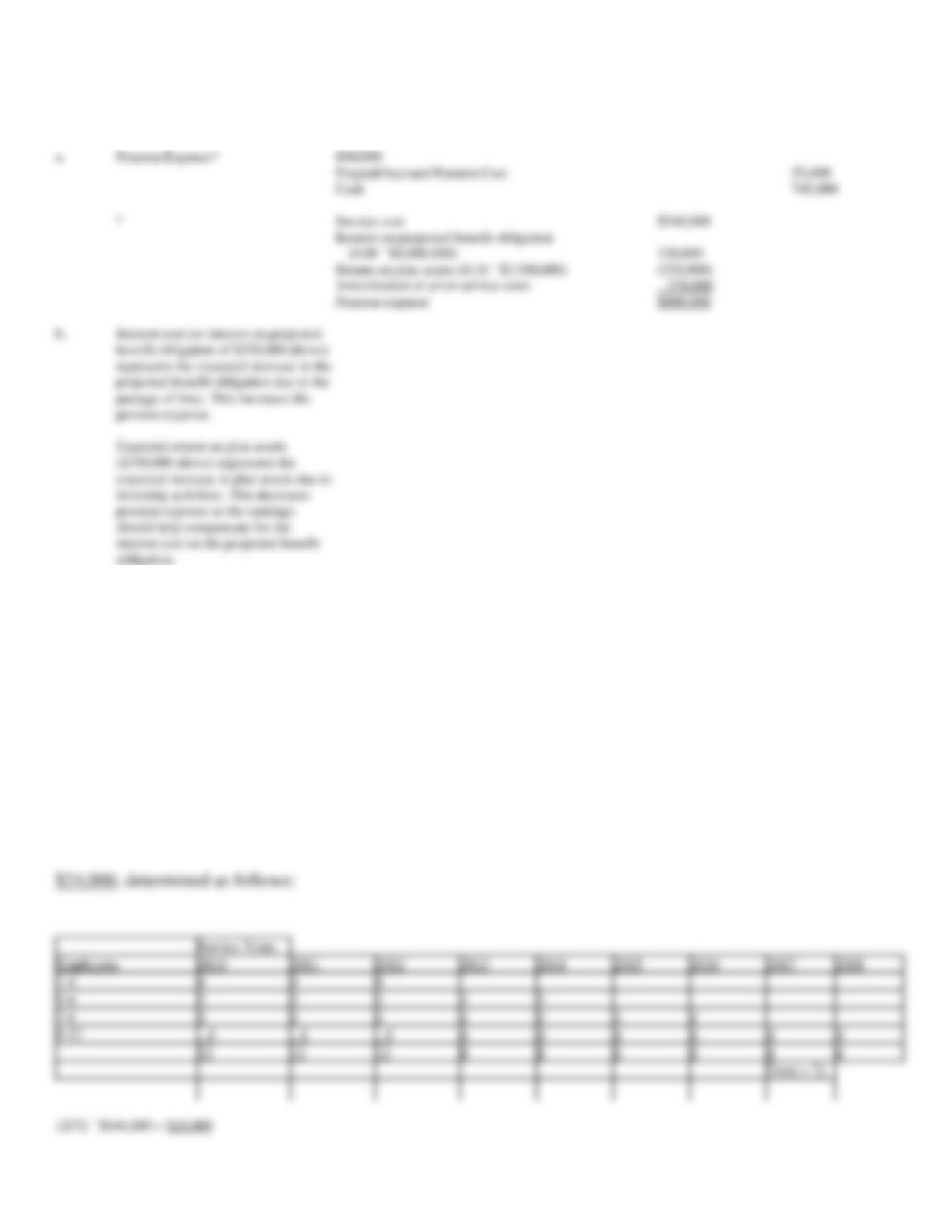
57. Matilda, Inc. amended its defined benefit pension plan as of January 1, 2010. Matilda received a report from
its actuary stating that at the beginning of 2010 unrecognized prior service cost resulting from the amendment
amounted to $144,000. The company’s work force was composed of twelve people. Four were expected to retire
at the end of 2012. Two were expected to retire at the end of 2014, two more at the end of 2016, and four at the
end of 2018.
Required:
Using the years-of-future-service method, compute the amount of prior service cost to be amortized in the first
year.
58. Tina Company had the following information related to its pension plan:
Beginning of
2010
2011
2012
Projected benefit obligation
$6,000
$7,990
$9,200
Plan assets
8,400
8,700
8,800
Unrecognized net loss reported by actuary
990
The average remaining service life = 3 years
An additional unrecognized net loss of $990 was reported as of January 1, 2011 (see table). This amount has been included in the January 1, 2011.
projected benefit obligation balance.
Required:
Compute the amount of unrecognized loss that should be included in pension expense in:
a.
2011
b.
2012
59. Becky Company began a defined benefit pension plan on January 1, 2010. No prior service credit was
granted to employees. Service costs amounted to $34,000 in 2010 and $37,000 in 2011. All contributions to the
fund were made at the end of the year. A 10% discount rate was used. The expected (and actual) rate of return
of plan assets was 12%.
Required:
Prepare journal entries for December 31, 2010 and 2011, assuming:
a.
Funding equaled expense.
b.
$31,000 was funded each year.
c.
$38,000 was funded each year.
a.
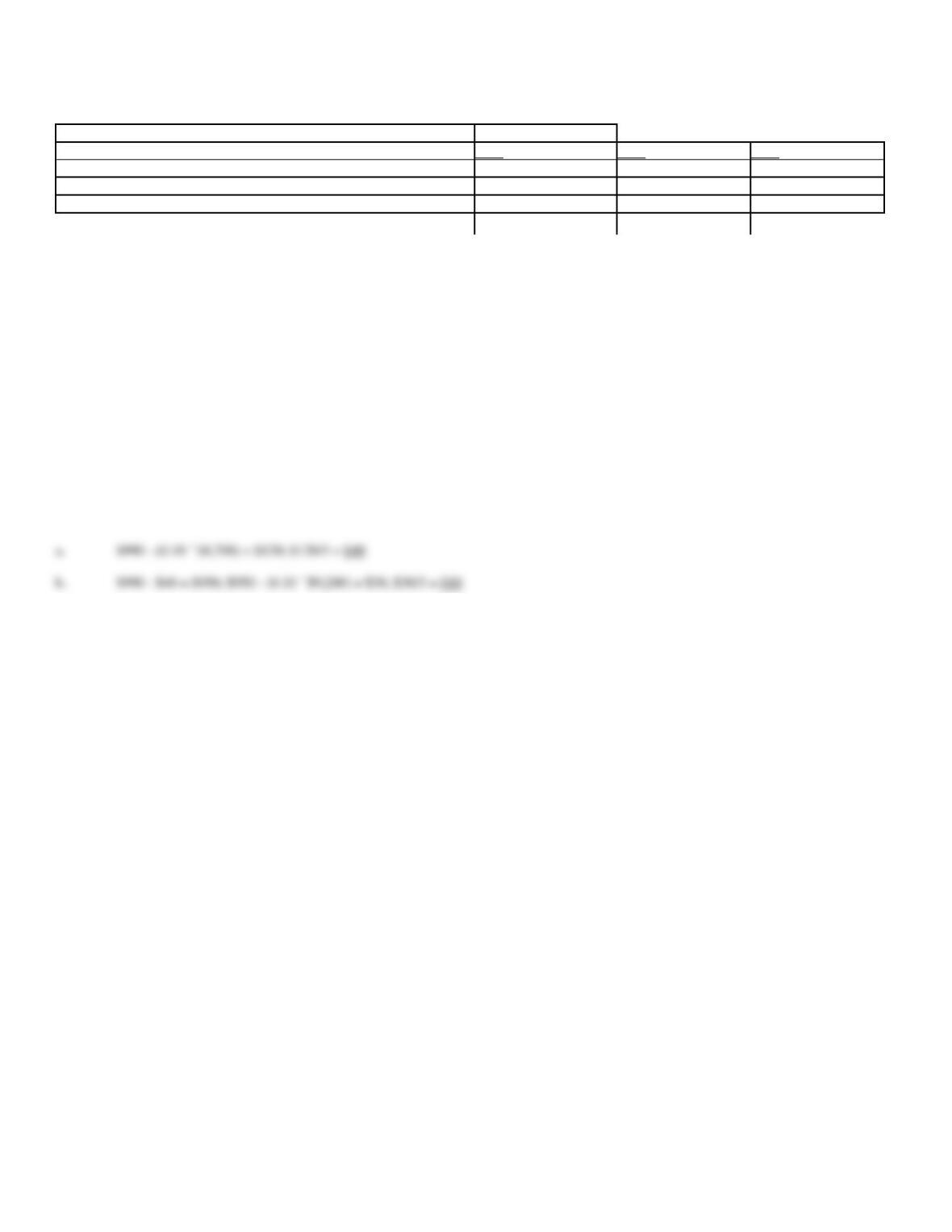
$990 – (0.10 ´ $8,700) = $120; $120/3 = $40
$990 – $40 = $950; $950 – (0.10 ´ $9,200) = $30; $30/3 = $10
60. The Sherri Company adopted a defined benefit pension plan on January 1, 2010, and prior service credit
was granted to employees. As of January 1, 2010, the prior service cost is $68,250. The unrecognized prior
service cost is amortized by the straight-line method over the remaining 15-year service life of the company’s
active employees. Funding for the pension plan was $170,745 and $186,933 at December 31, 2010 and 2011,
respectively.
2010
2011
Annual service cost
$161,877
$178,065
Discount (interest) rate
8%
8%
Expected (and actual) return on plan assets
10%
10%
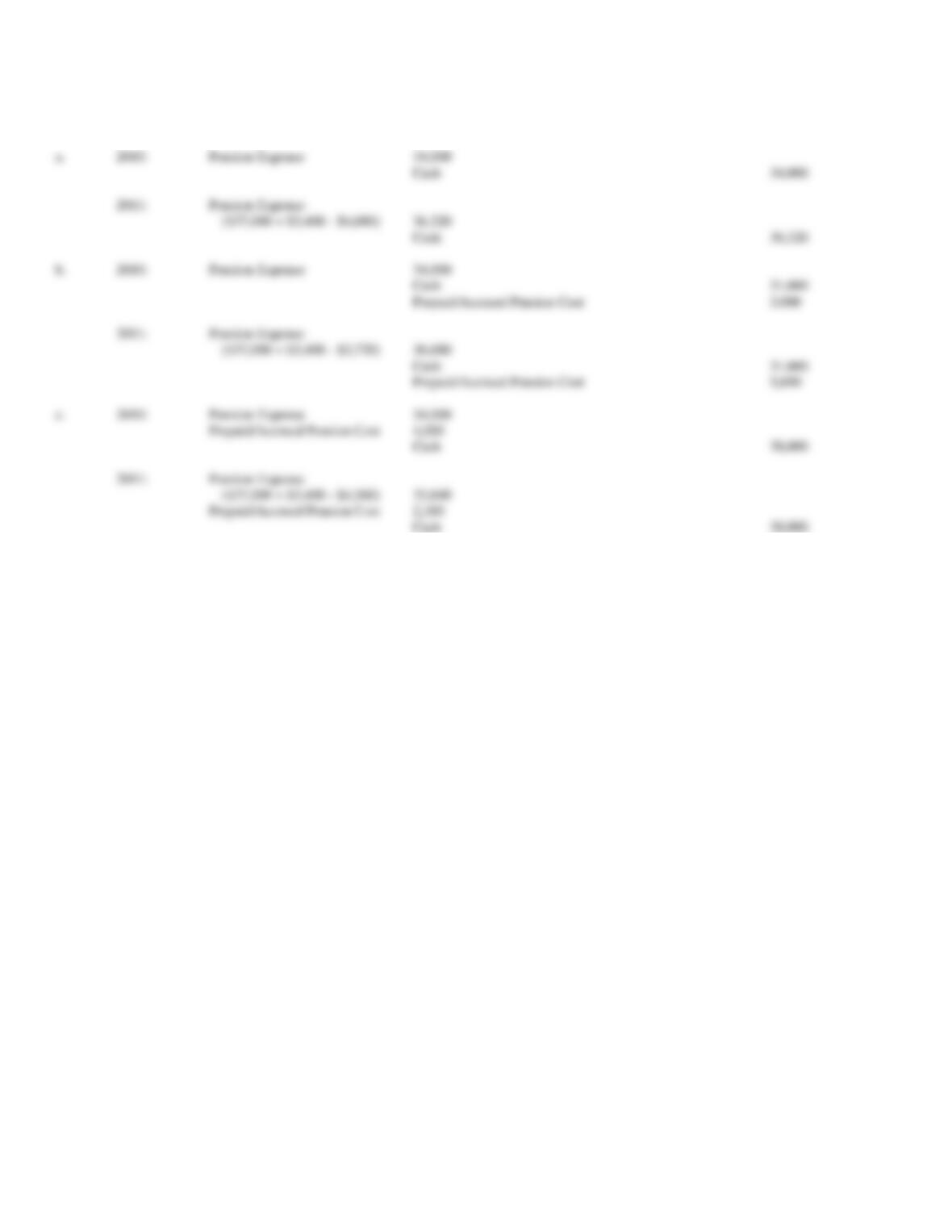
2010:
Pension Expense
34,000
Cash
34,000
2011:
Pension Expense
($37,000 + $3,400 – $4,080)
36,320
Cash
36,320
b.
2010:
Pension Expense
34,000
Cash
31,000
Prepaid/Accrued Pension Cost
3,000
2011:
Pension Expense
($37,000 + $3,400 – $3,720)
36,680
Cash
31,000
Prepaid/Accrued Pension Cost
5,680
2010:
Pension Expense
34,000
Prepaid/Accrued Pension Cost
4,000
Cash
38,000
2011:
Pension Expense
($37,000 + $3,400 – $4,560)
35,840
Prepaid/Accrued Pension Cost
2,160
Cash
38,000
Required:
Prepare the journal entries to record net periodic pension expense and the funding as of December 31, 2010 and 2011. Show computations and round
answers to the nearest dollar.
61. Gretchen Corp’s defined benefit pension plan had an amendment as of January 1, 2010, that retroactively
included benefits of $1,500,000. The remaining service life of the employees impacted by this change is 10
years. Gretchen uses the straight-line method to amortize the prior service cost.
As of January 1, 2010, Gretchen had the following information related to its pension plan, including
adjustments for the plan amendment:
Accrued/prepaid pension cost (credit)
$3,790,000
Projected benefit obligation
5,200,000
Accumulated other comprehensive income (debit)
1,500,000
Fair value of plan assets
1,410,000
Interest (discount) rate
10%
Expected rate of return on plan assets
12%
The actuary reported service cost of $600,000 in both 2010 and 2011. Annual payments to retirees totaled $90,000. The trustee of the plan assets
reported the actual rate of return to be 11% in 2010.
Gretchen’s annul year-end contribution to the plan equals the current year’s service cost less actual return on plan assets plus interest growth of the
projected benefit obligation and amortization of prior service costs and/or gains and losses as calculated for pension expense.
Required:
a.
Compute Gretchen’s 2010 contribution.
b.
Compute Gretchen’s 2010 pension expense.
c.
Prepare the journal entry to record the pension expense and pension contribution.
d.
Compute the December 31, 2010 balance in Pension Benefit Obligation.
e.
Compute the December 31, 2010 balance in Plan Assets.
f.
Prepare the adjusting journal entry to record the plan’s adjustment to other comprehensive income at December 31, 2010.
g.
Is Gretchen’s plan overfunded or underfunded, and by how much, as of December 31, 2010?
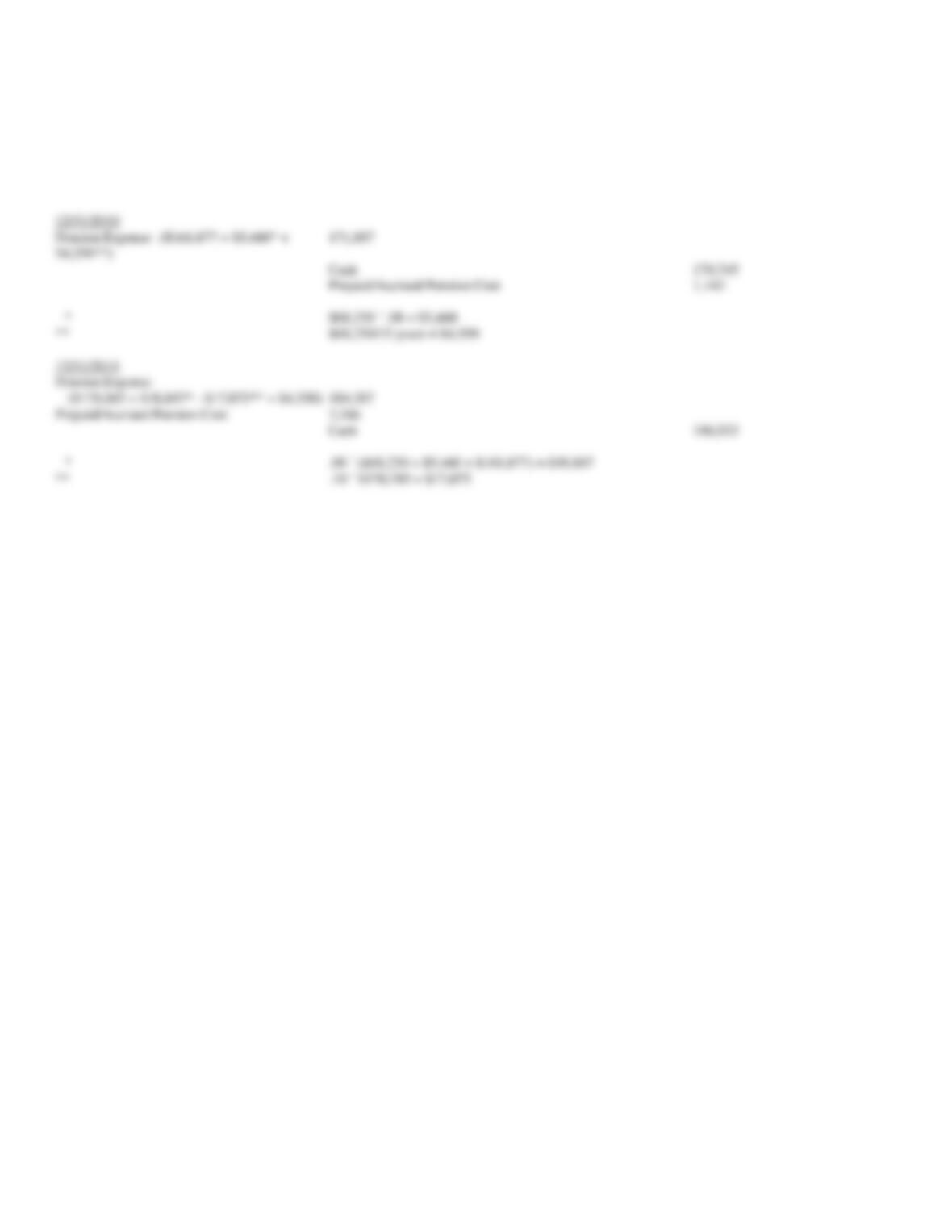
Cash
170,745
Prepaid/Accrued Pension Cost
1,142
*
$68,250 ´ .08 = $5,460
$68,250/15 years = $4,550
Pension Expense
($178,065 + $18,847* – $17,075** + $4,550)
184,387
Prepaid/Accrued Pension Cost
2,546
Cash
186,933
*
.08 ´ ($68,250 + $5,460 + $161,877) = $18,847
.10 ´ $170,745 = $17,075
62. The following information is related to a company’s pension plan:
Projected benefit obligation
$5,000
Accumulated benefit obligation
4,000
Plan assets (fair value)
3,000
Accrued/prepaid pension cost
800
Prior service cost
1,800
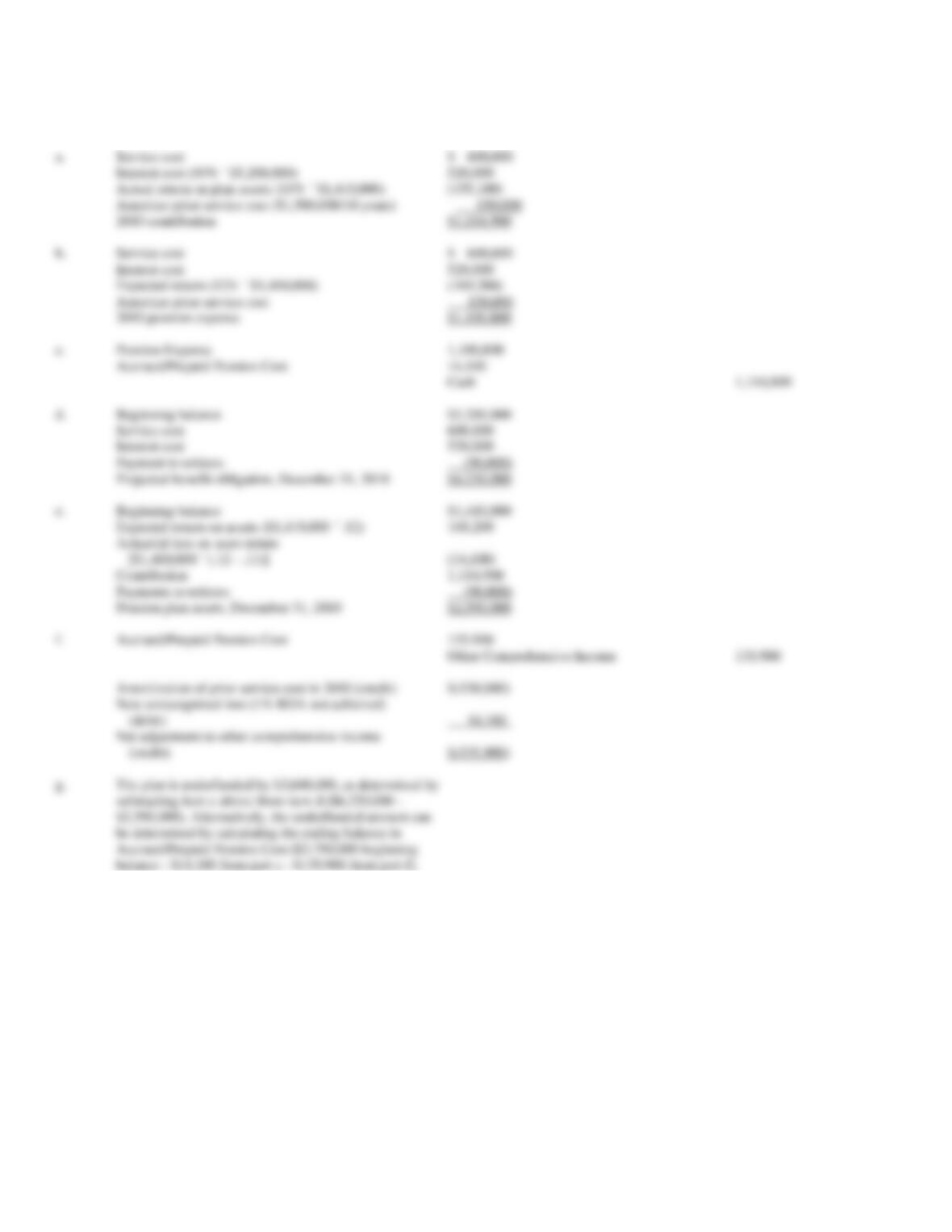
Service cost
$ 600,000
Interest cost (10% ´ $5,200,000)
520,000
Actual return on plan assets (11% ´ $1,410,000)
(155,100)
Amortize prior service cost ($1,500,000/10 years)
150,000
2010 contribution
$1,114,900
Service cost
$ 600,000
Interest cost
520,000
Expected return (12% ´ $1,410,000)
(169,200)
Amortize prior service cost
150,000
2010 pension expense
$1,100,800
Pension Expense
1,100,800
Accrued/Prepaid Pension Cost
14,100
Cash
1,114,900
d.
Beginning balance
$5,200,000
Service cost
600,000
Interest cost
520,000
Payment to retirees
(90,000)
Projected benefit obligation, December 31, 2010
$6,230,000
Beginning balance
$1,410,000
Expected return on assets ($1,410,000 ´ .12)
169,200
Actuarial loss on asset return
[$1,410,000 ´ (.12 – .11)]
(14,100)
Contribution
1,114,900
Payments to retirees
(90,000)
Pension plan assets, December 31, 2010
$2,590,000
Accrued/Prepaid Pension Cost
135,900
Other Comprehensive Income
135,900
Amortization of prior service cost in 2010 (credit)
$(150,000)
New unrecognized loss (1% ROA not achieved)
(debit)
14,100
Net adjustment to other comprehensive income
(credit)
$(135,900)
Required:
a.
Prepare the adjusting journal entry to update the pension liability.
b.
Assume that instead of Accrued/Prepaid Pension Cost having a credit balance of $800, it had a $600 debit balance. Prepare the
adjusting journal entry to record the pension liability.
63. Stephanie, Inc. started a pension plan on January 1, 2010. At that date, prior service cost of $1,100,000 was
granted to employees. At December 31, 2010, the following information was available:
Service cost for 2010
$ 90,000
Fair value of plan assets
225,500
Projected benefit obligation
1,278,000
Employer contribution for 2010 (at 12/31)
225,500
Expected asset return rate
7%
Discount rate
8%
Average remaining service life
16 years
Required:
a.
Compute the pension expense for 2010.
b.
Prepare appropriate journal entries for 2010.
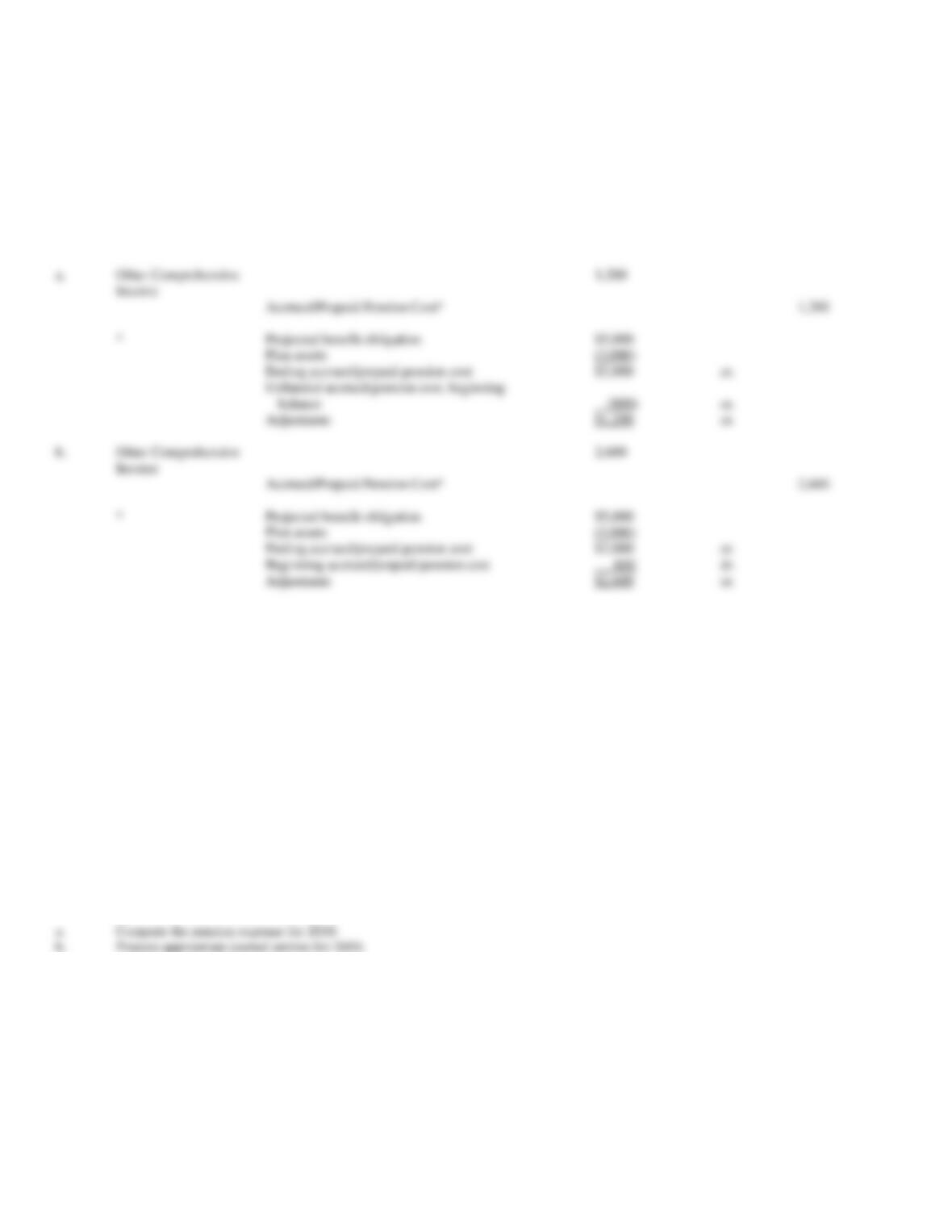
Accrued/Prepaid Pension Cost*
1,200
*
Projected benefit obligation
$5,000
Plan assets
(3,000)
Ending accrued/prepaid pension cost
$2,000
cr.
Unfunded accrued pension cost, beginning
balance
(800)
cr.
Adjustment
$1,200
cr.
b.
Other Comprehensive
2,600
Accrued/Prepaid Pension Cost*
2,600
*
Projected benefit obligation
$5,000
Plan assets
(3,000)
Ending accrued/prepaid pension cost
$2,000
cr.
Beginning accrued/prepaid pension cost
600
dr.
Adjustment
$2,600
cr.
64. Mandy Co. has a defined benefit pension plan for its employees. The plan was amended at the beginning of
2010 which increased benefits based on services rendered by certain employees in prior periods. The actuary
has reported that unrecognized prior service cost resulting from the amendment is $385,000. Five employees
expect to receive the increased benefits. Shown below is a schedule of the employees and their expected years
of future service:
Employee No.
Expected Years of
Future Service
1
5
2
6
3
7
4
8
5
9
Required:
Using the straight-line method:
a.
Compute the average remaining service life.
b.
Determine the amount of unrecognized prior service cost to be included in the 2010 pension expense calculation.
a.
Average remaining service life
= Sum of the expected years of future service/
No. of employees
= 35/5
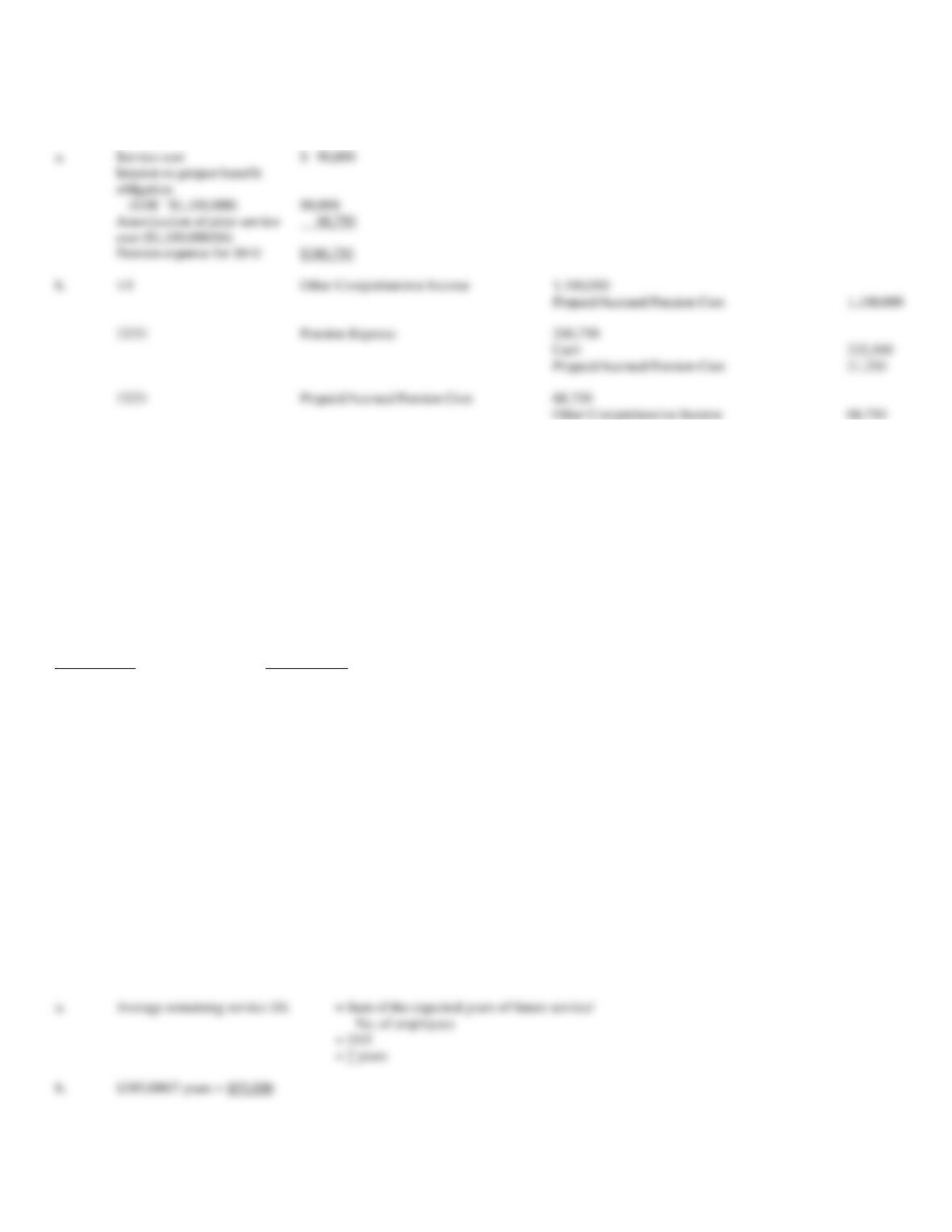
a.
Service cost
$ 90,000
(0.08 ´ $1,100,000)
88,000
Amortization of prior service
cost ($1,100,000/16)
68,750
Pension expense for 2010
$246,750
b.
1/1
Other Comprehensive Income
1,100,000
Prepaid/Accrued Pension Cost
12/31
Pension Expense
246,750
Cash
Prepaid/Accrued Pension Cost
12/31
Prepaid/Accrued Pension Cost
68,750
Other Comprehensive Income

65. A list of terms (a-i) and a list of descriptive phrases (1-9) related to pension accounting are provided below:
a.
actuary
b.
expected return on plan assets
c.
defined benefit plan
d.
noncontributory plan
e.
prior service cost
f.
service cost
g.
accumulated benefits approach
h.
pension expense
i.
Pension Reform Act of 1974 (ERISA)
____
1.
Amount normally recorded at the end of a period and often at the time of funding, although often not equal to the amount of
funding.
____
2.
Uses compound interest techniques with projections of future events to estimate components of pension costs.
____
3.
Specifically states either postretirement employee benefits or the method of determining such benefits by formula.
____
4.
Is the primary component of pension cost.
____
5.
Generally requires service costs to be funded in the current year.
____
6.
Places the entire pension cost on the employer.
____
7.
A negative component of pension cost.
____
8.
Assigns pension costs to the years of service, using the plan formula and the actual history of service and pay.
____
9.
Is the amount actuarially assigned to years before the inception of the plan.
Required:
Match each item to its descriptive phrase by placing the appropriate letter in the space provided.
66. Samantha Co. has a defined benefit pension plan that has experienced differences between its expected and
actual projected benefit obligation. Data on the plan as of January 1, 2010, follow:
Unrecognized net gain
$ 88,000
Fair value of plan assets
250,000
Actual projected benefit obligation
280,000
1.
h
4.
f
7.
b
2.
a
5.
i
8.
g
3.
c
6.
d
9.
e
There was no difference between the company’s expected and actual return on plan assets during 2010. The average remaining service life of the
company’s employees is 12 years.
Required:
Determine the amount of the net gain or loss to be included in pension expense for 2010 and indicate whether it is an increase or decrease in the
pension expense calculation.
67. A list of descriptive phrases related to pension plan accounting is shown below:
____
a.
A reconciliation of the beginning and ending balances of the projected benefit obligation.
____
b.
The amounts and types of securities included in the plan assets.
____
c.
A reconciliation of the beginning and ending balances of the fair value of the plan assets.
____
d.
The discount rate.
____
e.
The actuarial value of the vested benefits.
____
f.
The funded status of the plan, the amounts not recognized on the balance sheet, and the amounts recognized on the balance
sheet.
____
g.
The expected long-term rate of return on the plan assets.
____
h.
The basis for determining payments to which employees will be entitled during retirement.
____
i.
The amount of pension expense.
____
j.
The names of employees who are presently receiving pension benefits.
Required:
In the space preceding each phrase, indicate whether the item described must be disclosed per the requirements of current GAAP regarding an
employer’s disclosures about pensions and other postemployment benefits. Use “Y” if the item is a required disclosure and “N” if it is not a required
disclosure.
a.
Y
e.
N
i.
Y
b.
Y
Y
j.
N
c.
Y
g.
Y
d.
Y
h.
N
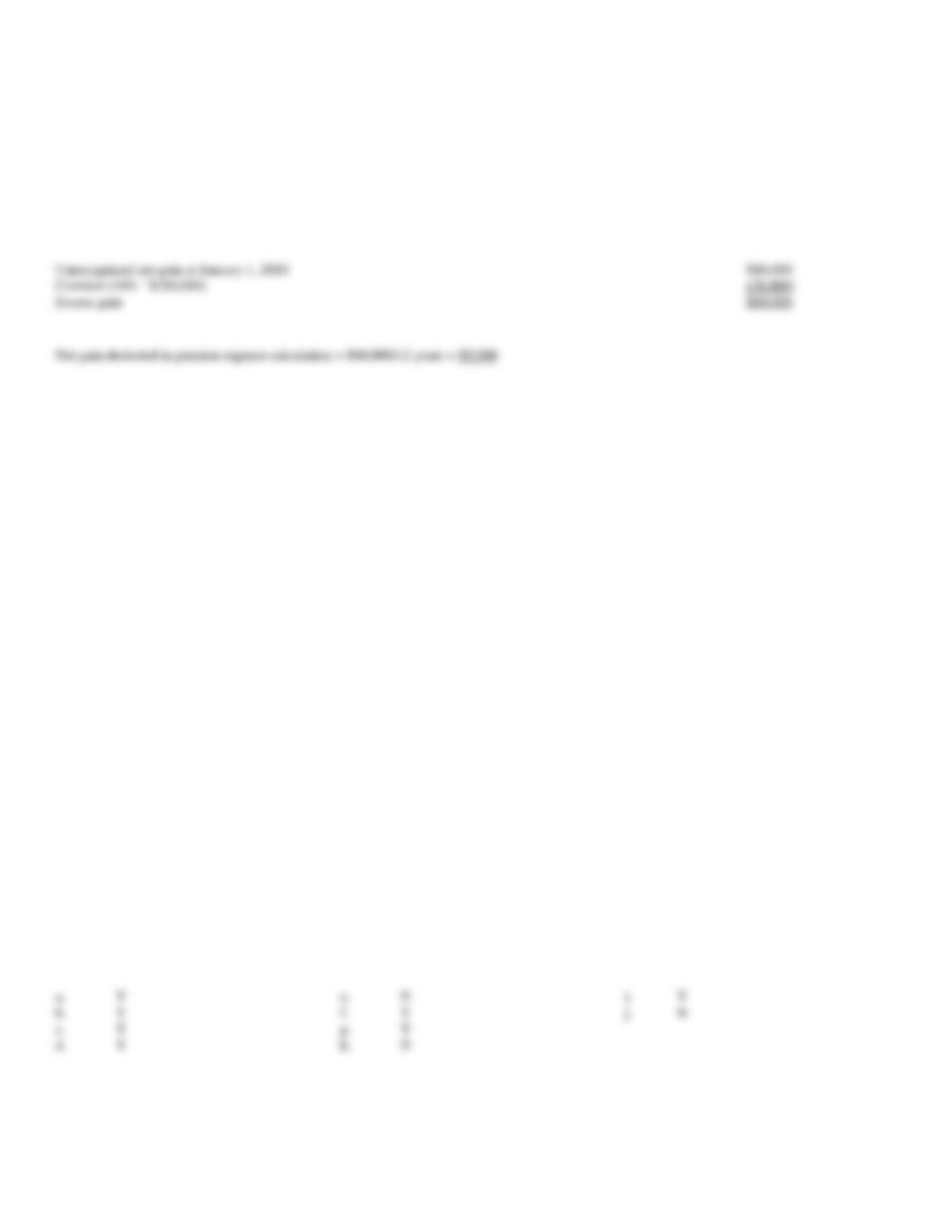
Unrecognized net gain at January 1, 2010
$88,000
Corridor (10% ´ $280,000)
(28,000)
Excess gain
$60,000
68. Marlene, Inc.’s records contained the following data as of December 31, 2010, on its OPEB plan:
Service cost
$ 250,000
Benefits paid
90,000
Contributions to the plan
50,000
Actual & expected return on plan assets
68,000
Unrecognized prior service cost amortization
36,000
Accumulated postretirement benefit obligation (1/1/2010)
1,200,000
Discount rate
8%
Required:
a.
Compute the OPEB expense for 2010.
b.
Prepare the journal entry to record the 2010 OPEB expense.
69. Wendy, Inc. presents the following information pertaining to its pension plan, which was initiated in 2010:
December 31
2010
2011
2012
Service cost
$3,000
$4,000
$ 5,000
Employer funding (at 12/31)
2,000
3,500
4,800
Fair value of plan assets
2,000
5,500
10,800
Projected benefit obligation
2,300
7,900
12,500
Additional unrecognized actuarial loss
—
1,640
2,120
The company uses a 10% interest rate in all pension calculations. For simplicity, an average remaining service life of 20 years is always used. When
appropriate, beginning-of-year actuarial information is used in year-end pension accruals. There is no unrecognized prior service cost.
Required:
a.
Compute pension expense for 2011.
b.
Prepare appropriate journal entries for December 31, 2011.
c.
Compute pension expense for 2012.
a.
Service cost
$250,000
Interest cost ($1,200,000 ´ 8%)
96,000
Return on plan assets
(68,000)
OPEB expense
$314,000
b.
Post-retirement Benefit Expense
314,000
Cash
50,000
Accumulated Postretirement Benefit Cost
264,000
70. Betsy Company estimated that at the end of seven years, it will be necessary to have $90,000 available in a
pension fund. The correct interest rate was 9%. Actuarial information for seven periods at 9% follows:
71. According to GAAP, the net periodic pension cost or, for simplicity, pension expense for a defined benefit
pension plan consists of five components.
Required:
List and briefly describe each of the five components of net periodic pension cost that a company must
recognize.
72. The board of directors of the Hampton Company is going to adopt a defined benefit pension plan for the
company’s employees. The board is considering granting pension credit for up to ten (10) years of service
rendered prior to the date that the plan is adopted. The board desires to grant the retroactive credit in order to
provide equity to employees for their previous years of service. The board has hired an actuary to determine the
cost of granting the retroactive credit. The actuary has calculated the cost of the retroactive benefits to be
approximately one million dollars. The board has asked the company’s controller to explain how the cost of the
prior service credit would be accounted for in the financial statements.
Required:
a.
Describe the GAAP that would be required by Hampton Company if prior service credit is granted to its employees.
b.
Many people have argued that the method adopted by the FASB to account for prior service costs has several conceptual flaws. Briefly
discuss the flaws of the approach adopted by the FASB for prior service costs.
c.
The textbook discusses three other approaches that might have been used to account for prior service costs. Describe these three
alternative approaches.
Service cost. The service cost is the actuarial present value of the benefits attributed by the pension benefit formula to services rendered
by the employees during the current period.
Expected return on plan assets. The expected return on plan assets is the fair value of the plan assets at the beginning of the year times
the expected long-term rate of return on plan assets.
rendered in periods prior to (a) the adoption of a plan, or (b) an amendment to a plan. The prior service cost is amortized by assigning
Gain or loss. The gain or loss is the amortization of the cumulative unrecognized net gain or loss from previous periods in excess of the
corridor.
73. Current GAAP requires that a company with a defined benefit pension plan disclose a reconciliation of the
beginning and ending balances of the projected benefit obligation.
Required:
74. One type of post-retirement benefit other than pensions is healthcare benefits.
Required:
Discuss the major differences between postretirement healthcare benefits and pensions.
75. In addition to providing pensions to their employees, many companies also offer postemployment benefits.
These are benefits going to former employees after employment but before retirement.
Required:
Describe how the cost of these benefits is to be accounted for under current GAAP.