
Name:
Class:
Date:
chapter 20
Indicate whether the statement is true or false.
1. Industries that typically use process cost systems include chemicals, oil, metals, food, paper, and pharmaceuticals.
a.
True
b.
False
2. The direct materials costs and direct labor costs incurred by a production department are referred to as conversion costs.
a.
True
b.
False
3. If 10,000 units that were 40% completed were in process on November 1, 80,000 units were completed during
November, and 12,000 units were 20% completed on November 30, the number of equivalent units of production for
November was 75,600. (Assume no loss of units in production and that inventories are costed by the first-in, first–out
method.)
a.
True
b.
False
4. If 16,000 units of materials enter production during the first year of operations, 12,000 of the units are finished, and
4,000 are 75% completed, the number of equivalent units of production would be 15,000.
a.
True
b.
False
5. Conversion costs are usually incurred evenly throughout a process.
a.
True
b.
False
6. Costs of ending inventory in process are included in the cost per equivalent unit computation on the cost of production
report by the FIFO method.
a.
True
b.
False
7. One of the primary uses of a cost of production report is to assist management in controlling production costs.
a.
True
b.
False
8. If a department that applies the FIFO cost flow method starts the reporting period with 50,000 physical units that were
25% complete with respect to direct materials and 40% complete with respect to conversion, it must add 12,500
equivalent units of direct materials and 20,000 equivalent units of direct labor to complete them.
a.
True
b.
False
9. Yield measures the ratio of the materials output quantity to the materials input quantity.
a.
True
b.
False
10. If the costs of direct materials, direct labor, and factory overhead were $60,000, $35,000, and $25,000, respectively,

Name:
Class:
Date:
chapter 20
for 20,000 equivalent units of production, the conversion cost per equivalent unit was $6.
a.
True
b.
False
11. If the costs of direct materials, direct labor, and factory overhead were $522,200, $82,700, and $45,300, respectively,
for 16,000 equivalent units of production, the conversion cost per equivalent unit was $8.
a.
True
b.
False
12. If the principal products of a manufacturing process are identical, a process cost system is more appropriate than a job
order cost system.
a.
True
b.
False
13. Conversion costs are generally added evenly throughout the process.
a.
True
b.
False
14. Process manufacturing usually reflects a manufacturer that produces small quantities of unique items.
a.
True
b.
False
15. The closer a company moves toward lean manufacturing, the more differences in unit costs between average costing
and FIFO will be reduced.
a.
True
b.
False
16. In applying the first-in, first-out method of costing inventories, if 8,000 units that are 30% completed are in process on
June 1, 28,000 units are completed during June, and 4,000 units are 80% completed on June 30, the number of equivalent
units of production for June is 28,600.
a.
True
b.
False
17. Direct materials, direct labor, and factory overhead are assigned to each manufacturing process in a process cost
system.
a.
True
b.
False
18. If a company uses average costing instead of FIFO, it will still get the same unit costs.
a.
True
b.
False
19. A process manufacturer will have a separate work in process account for each process or department.
a.
True
b.
False
20. In a process cost system, the cost per equivalent unit is computed before computing equivalent units.

Name:
Class:
Date:
chapter 20
a.
True
b.
False
21. The journal entry to transfer goods in process from Department X to Department Y includes a debit to Work in
Process—Department X.
a.
True
b.
False
22. When the purchase of materials is journalized in a process cost accounting system, the materials account is credited.
a.
True
b.
False
23. If 10,000 units that were 50% completed were in process on November 1, 90,000 units were completed during
November, and 20,000 units were 20% completed on November 30, the number of equivalent units of production for
November was 90,000. (Assume no loss of units in production and that inventories are costed by the first-in, first–out
method.)
a.
True
b.
False
24. The last step in the preparation of a cost of production report is the computation of equivalent units of production.
a.
True
b.
False
25. In a process cost system, indirect materials are charged to Work in Process.
a.
True
b.
False
26. In lean manufacturing, processing functions are combined into work centers, sometimes called departments.
a.
True
b.
False
27. Custom-made goods would be accounted for using a process cost system.
a.
True
b.
False
28. With a process cost system, the amount journalized for the cost added to finished goods is taken from the cost of
production report of the last processing department.
a.
True
b.
False
29. If the costs of direct materials, direct labor, and factory overhead were $277,300, $52,600, and $61,000, respectively,
for 14,000 equivalent units of production, the total conversion cost was $390,900.
a.
True
b.
False
30. Process manufacturers typically use large machines to process a continuous flow of raw materials into a finished state.

Name:
Class:
Date:
chapter 20
a.
True
b.
False
31. If the products of a manufacturing process are produced to customer specifications, a process cost system is more
appropriate than a job order cost system.
a.
True
b.
False
32. Both job order and process cost accounting systems use equivalent units of production to determine costs.
a.
True
b.
False
33. The FIFO method of process costing is simpler than the average cost method.
a.
True
b.
False
34. In applying the first-in, first-out method of costing inventories, if 8,000 units that are 30% completed are in process on
June 1, 28,000 units are completed during June, and 4,000 units are 75% completed on June 30, the number of equivalent
units of production for June is 33,400.
a.
True
b.
False
35. In a process cost system, costs flow into finished goods inventory only from the work in process inventory of the last
manufacturing process.
a.
True
b.
False
36. Conversion costs include materials, direct labor, and factory overhead.
a.
True
b.
False
37. A process cost accounting system records all actual factory overhead costs directly in the work in process account.
a.
True
b.
False
38. Both process and job order cost systems use a perpetual inventory system for materials, work in process, and finished
goods.
a.
True
b.
False
39. Equivalent units of production are the number of units that could have been manufactured from start to finish during
an accounting period.
a.
True
b.
False
40. One of the differences between process costing and job order costing is that the amounts used to transfer costs
between accounts come from the cost of production report instead of job cost sheets.

Name:
Class:
Date:
chapter 20
a.
True
b.
False
41. The first step in determining the cost of goods completed and ending inventory valuation using process costing is to
compute equivalent units of production.
a.
True
b.
False
42. In a process cost system, a separate work in process inventory account is maintained for each customer’s job.
a.
True
b.
False
43. Conversion and direct materials are generally both added at the end of the production process.
a.
True
b.
False
44. All costs of the processes in a process cost system ultimately pass through the cost of goods sold account.
a.
True
b.
False
45. Equivalent units of production are always the same as the total number of physical units finished during the period.
a.
True
b.
False
46. Companies recognizing the need to simultaneously produce products with high quality, low cost, and instant
availability have adopted a lean manufacturing philosophy.
a.
True
b.
False
47. The cost of production report summarizes (1) the units for which the department is accountable and the disposition of
those units and (2) the costs incurred by the department and the allocation of those costs.
a.
True
b.
False
48. If 30,000 units of materials enter production during the first year of operations, 25,000 of the units are finished, and
5,000 are 50% completed, the number of equivalent units of production would be 28,500.
a.
True
b.
False
49. The cost of production report reports the cost of the goods sold.
a.
True
b.
False
50. Process cost systems use job cost sheets to accumulate cost data.
a.
True
b.
False

Name:
Class:
Date:
chapter 20
51. Companies that use the average cost method for process costing have unit costs that include costs from more than one
accounting period.
a.
True
b.
False
52. Gilbert Corporation had 25,000 finished units and 8,000 units 35% complete. The equivalent units totaled 30,200.
a.
True
b.
False
53. Equivalent units are the sum of direct materials used and direct labor incurred.
a.
True
b.
False
54. Equivalent units should be computed separately for direct materials and conversion costs.
a.
True
b.
False
55. The direct labor costs and factory overhead costs incurred by a production department are referred to as conversion
costs.
a.
True
b.
False
56. Once equivalent units are computed for materials, this number will also be used for direct labor and factory overhead.
a.
True
b.
False
57. In a process cost system, product costs are accumulated by processing department rather than by job.
a.
True
b.
False
58. In a process cost system, each process will have a work in process inventory account.
a.
True
b.
False
59. The cost of production report shows the costs incurred by a department and the allocation of those costs between
completed (transferred out) and partially completed units.
a.
True
b.
False
60. The FIFO cost flow method separates work done on beginning inventory in the previous period from work done on it
in the current period.
a.
True
b.
False
Indicate the answer choice that best completes the statement or answers the question.

Name:
Class:
Date:
chapter 20
61. The debits to Work in Process—Assembly Department for April, together with data concerning production, are as
follows:
April 1, work in process:
Materials cost, 3,000 units
$ 7,200
Conversion costs, 3,000 units, 40% completed
6,000
Materials added during April, 10,000 units
25,000
Conversion costs during April
30,800
Goods finished during April, 12,000 units
April 30 work in process, 1,000 units, 40% completed
All direct materials are added at the beginning of the process, and the first-in, first-out cost flow method is used.
The conversion cost per equivalent unit for April is
a.
$2.48
b.
$2.75
c.
$2.50
d.
$5.25
Use this information about Mocha Company to answer the questions that follow.
Mocha Company manufactures a single product by a continuous process, involving three production departments. The
records indicate that direct materials, direct labor, and applied factory overhead for Department 1 were $100,000,
$125,000, and $150,000, respectively. The records further indicate that direct materials, direct labor, and applied factory
overhead for Department 2 were $55,000, $65,000, and $80,000, respectively. In addition, work in process at the
beginning of the period for Department 1 totaled $75,000, and work in process at the end of the period totaled $60,000.
62. The journal entry for the flow of costs from Department 1 into Department 2 is
a.
Work in Process—Department 2 390,000
Work in Process—Department 1 390,000
b.
Work in Process—Department 2 330,000
Work in Process—Department 1 330,000
c.
Work in Process—Department 2 215,000
Work in Process—Department 1 215,000
d.
Work in Process—Department 2 375,000
Work in Process—Department 1 375,000
63. Which of the following is not a use of the cost of production report?
a.
to help managers control operations
b.
to help managers isolate problems
c.
to project production
d.
to help managers improve operations
Use this information about Department W to answer the questions that follow.
Department W had 2,400 units, one-third completed at the beginning of the period. There were 16,000 units transferred to
Department X from Department W during the period, and 1,800 units were one-half completed at the end of the
period. Assume the completion ratios apply to both direct materials and conversion costs, and the company uses the FIFO
cost flow method.
Name:
Class:
Date:
chapter 20
64. Determine the conversion equivalent units of production for the period for Department W.
a.
16,100 units
b.
13,600 units
c.
15,000 units
d.
18,500 units
65. Which of the following is not a characteristic of a process cost system?
a.
Manufacturing costs are grouped by departments.
b.
The system may use several work in process accounts.
c.
The system measures costs for each completed job.
d.
The system allocates costs between completed and partially completed units within a department.
66. In process cost accounting, the costs of direct materials and direct labor are charged directly to
a.
service departments
b.
processing departments
c.
customer accounts receivable
d.
job orders
Use this information about Department B to answer the questions that follow.
Department B had 3,000 units in work in process that were 25% completed at the beginning of the period at a cost of
$12,500. There were 13,700 units of direct materials added during the period at a cost of $28,700, 15,000 units were
completed during the period, and 1,700 units were 95% completed at the end of the period. All materials are added at the
beginning of the process, and the first-in, first-out cost flow method is used. Direct labor was $32,450, and factory
overhead was $18,710.
67. The conversion equivalent units of production for the period are
a.
14,365
b.
13,615
c.
12,000
d.
15,865
Use this information about Penny, Inc. to answer the questions that follow.
Penny, Inc., employs a process cost system and uses the FIFO cost flow method. Direct materials are added at the
beginning of the process. Here is information about the July activities:
On July 1:
Beginning inventories
850 units, 60% complete
Direct materials cost
$5,000
Conversion costs
$4,000
During July:
Number of units started
15,000
Direct materials added
$155,000
Conversion costs added
$83,520

Name:
Class:
Date:
chapter 20
$125,000, and $150,000, respectively. The records further indicate that direct materials, direct labor, and applied factory
On July 31:
Ending inventories
1,600 units, 40% complete
68. Determine the cost of goods completed and transferred out during July. Round unit cost computations to the nearest
cent and final answer to the nearest whole dollar.
a.
$227,251
b.
$225,060
c.
$236,905
d.
$228,200
69. When preparing the cost of production report using the FIFO method, equivalent production units are generally
determined for
a.
direct materials and conversion costs
b.
direct materials only
c.
conversion costs only
d.
direct materials and direct labor costs only
70. In a process cost system, the amount of work in process inventory is valued by
a.
finding the sum of all open job costs
b.
allocating departmental costs between completed and partially completed units
c.
multiplying units in ending inventory by the direct materials cost per unit
d.
finding the sum of all completed jobs
Use this information about Department E to answer the questions that follow.
Department E had 4,000 units in Work in Process that were 40% completed at the beginning of the period at a cost of
$12,500. There were 14,000 units of direct materials added during the period at a cost of $28,700. There were 15,000
units completed during the period, and 3,000 units were 75% completed at the end of the period. All materials are added
at the beginning of the process, and the average cost method is used to cost inventories. Direct labor was $32,450, and
factory overhead was $18,710.
71. The total (whole) units to account for during production is
a.
15,650
b.
18,000
c.
17,250
d.
17,700
72. If a company uses a process cost system to account for the costs in its five production departments, how many work in
process accounts will it use?
a.
6
b.
5
c.
4
d.
2
73. Mocha Company manufactures a single product by a continuous process involving three production departments. The
records indicate that direct materials, direct labor, and applied factory overhead for Department 2 were $100,000,

Name:
Class:
Date:
chapter 20
overhead for Department 3 were $50,000, $60,000, and $70,000, respectively. In addition, work in process at the
beginning of the period for Department 3 totaled $75,000, and work in process at the end of the period totaled $60,000.
The journal entry for the flow of costs into Department 3 during the period for direct materials is
a.
Work in Process—Department 3 100,000
Materials 100,000
b.
Work in Process—Department 3 125,000
Materials 125,000
c.
Work in Process—Department 3 50,000
Materials 50,000
d.
Work in Process—Department 3 70,000
Materials 70,000
74. The four steps necessary to complete a cost of production report in a process cost system are:
1.
Allocate costs to units transferred out and partially completed units.
2.
Determine the units to be assigned costs.
3.
Determine the cost per equivalent unit.
4.
Compute equivalent units of production.
The correct ordering of the steps is
a.
2, 4, 3, 1
b.
4, 2, 3, 1
c.
2, 3, 4, 1
d.
2, 3, 1, 4
75. Which of the following costs incurred by a tool manufacturer would not be included in conversion costs?
a.
factory supervisor’s salary
b.
machine operator’s wages
c.
raw steel
d.
factory maintenance personnel supplies
76. In the manufacture of 10,000 units of a product, direct materials cost incurred was $165,000, direct labor cost incurred
was $105,000, and applied factory overhead was $53,000. What is the total conversion cost?
a.
$218,000
b.
$158,000
c.
$323,000
d.
$53,000
Use this information about Department B to answer the questions that follow.
Department B had 3,000 units in work in process that were 25% completed at the beginning of the period at a cost of
$12,500. There were 13,700 units of direct materials added during the period at a cost of $28,700, 15,000 units were
completed during the period, and 1,700 units were 95% completed at the end of the period. All materials are added at the
beginning of the process, and the first-in, first-out cost flow method is used. Direct labor was $32,450, and factory
overhead was $18,710.
77. The materials equivalent units of production for the period are
a.
16,700

Name:
Class:
Date:
chapter 20
b.
12,000
c.
1,700
d.
13,700
78. A report prepared periodically for each processing department summarizing the product costs incurred by the
department and the allocation of those costs between completed and partially completed units is termed a
a.
factory overhead production report
b.
manufacturing cost report
c.
process cost report
d.
cost of production report
Use this information about Department E to answer the questions that follow.
Department E had 4,000 units in Work in Process that were 40% completed at the beginning of the period at a cost of
$12,500. There were 14,000 units of direct materials added during the period at a cost of $28,700. There were 15,000
units completed during the period, and 3,000 units were 75% completed at the end of the period. All materials are added
at the beginning of the process, and the average cost method is used to cost inventories. Direct labor was $32,450, and
factory overhead was $18,710.
79. The number of equivalent units of production for the period is
a.
15,650
b.
14,850
c.
18,000
d.
17,250
Use this information about Department W to answer the questions that follow.
Department W had 2,400 units, one-third completed at the beginning of the period. There were 16,000 units transferred to
Department X from Department W during the period, and 1,800 units were one-half completed at the end of the
period. Assume the completion ratios apply to both direct materials and conversion costs, and the company uses the FIFO
cost flow method.
80. What is the total number of units to be assigned costs on the cost of production report for Department W?
a.
12,000 units
b.
13,600 units
c.
18,500 units
d.
17,800 units
81. Department M had 600 units 60% completed in process at the beginning of June, 6,000 units completed during June,
and 700 units 30% completed at the end of June. Using the first-in, first-out method of inventory costing, what was the
number of equivalent units of production for conversion costs for the period?
a.
7,300 units
b.
5,640 units
c.
6,700 units
d.
5,850 units
Use this information about Carmelita Inc. to answer the questions that follow.
Name:
Class:
Date:
chapter 20
Carmelita Inc. has the following information available:
Costs from Beginning Inventory
Costs from Current Period
Direct materials
$2,000
$ 22,252
Conversion costs
6,200
150,536
82. At the beginning of the period, there were 500 units in process that were 60% complete as to conversion costs and
100% complete as to direct materials costs. During the period, 4,500 units were started and completed. Ending inventory
contained 340 units that were 30% complete as to conversion costs and 100% complete as to materials costs. Assume that
the company uses the FIFO cost flow method. Round cost-per-unit figures to the nearest cent when computing total costs.
The total costs transferred to Finished Goods for units started and completed were
a.
$161,775
b.
$156,960
c.
$162,855
d.
$161,505
Use this information about Department G to answer the questions that follow.
Department G had 3,600 units that were 40% completed at the beginning of the period, 12,000 units that were completed
during the period, 2,000 units that were 20% completed at the end of the period, and the following manufacturing costs
that were debited to the departmental work in process account during the period:
Work in process, beginning of period
$ 60,000
Costs added during period:
Direct materials (10,400 at $9.8365)
102,300
Direct labor
79,800
Factory overhead
25,200
All direct materials are added at the beginning of the process, and the first-in, first-out cost flow method is used.
83. Determine the direct materials cost and conversion cost per equivalent unit, respectively.
a.
$5.94 and $5.86
b.
$5.94 and $6.38
c.
$8.00 and $8.68
d.
$9.84 and $9.58
84. Blue Lake Water Company has two departments: Purifying and Bottling. The Bottling Department received 76,000
liters from the Purifying Department. During the period, the Bottling Department completed 74,000 liters, including 3,000
liters of work in process at the beginning of the period. The ending work in process was 5,000 liters. How many liters
were started and completed during the period?
a.
71,000
b.
69,000
c.
73,000
d.
79,000
Use this information about Department G to answer the questions that follow.
Department G had 3,600 units 25% completed at the beginning of the period, 11,000 units were completed during the

Name:
Class:
Date:
chapter 20
period, 3,000 units were 20% completed at the end of the period, and the following manufacturing costs were debited to
the departmental work in process account during the period:
Work in process, beginning of period
$40,000
Costs added during period:
Direct materials (10,400 units at $8)
83,200
Direct labor
63,000
Factory overhead
25,000
All direct materials are added at the beginning of the process, and the first-in, first-out cost flow method is used.
85. Determine the total cost of the 3,600 units of beginning inventory that were completed during the period. Round the
unit cost computation to the nearest cent.
a.
$62,194
b.
$16,163
c.
$40,000
d.
$19,275
86. The portion of whole units that were completed with respect to either materials or conversion costs within a given
accounting period is the definition of
a.
units started and completed
b.
equivalent units
c.
conversion costs
d.
ending work in process
87. Process and job order cost systems are similar in all of the following ways except
a.
both classify product costs as direct materials, direct labor, and factory overhead
b.
both allocate factory overhead costs to products
c.
both use perpetual inventory system for materials, work in process, and finished goods
d.
both use job cost sheets
88. According to lean manufacturing,
a.
finished goods should always be available in case a customer wants something
b.
employees should be expert at one function rather than be cross-trained for multiple functions
c.
movement of the product and material is reduced
d.
the product moves from process to process until completion
89. Which of the following would use a process cost system?
a.
custom home builder
b.
custom helicopter manufacturer
c.
graduation photographer
d.
lumber mill
Use this information about Mocha Company to answer the questions that follow.
Mocha Company manufactures a single product by a continuous process, involving three production departments. The
records indicate that direct materials, direct labor, and applied factory overhead for Department 1 were $100,000,
$125,000, and $150,000, respectively. The records further indicate that direct materials, direct labor, and applied factory

Name:
Class:
Date:
chapter 20
overhead for Department 2 were $55,000, $65,000, and $80,000, respectively. In addition, work in process at the
beginning of the period for Department 1 totaled $75,000, and work in process at the end of the period totaled $60,000.
90. The journal entry for the flow of costs into Department 1 during the period for direct materials is
a.
Work in Process—Department 1 100,000
Materials 100,000
b.
Work in Process—Department 1 55,000
Materials 55,000
c.
Materials 100,000
Work in Process—Department 1 100,000
d.
Materials 55,000
Work in Process—Department 1 55,000
Use this information about Department G to answer the questions that follow.
Department G had 3,600 units that were 40% completed at the beginning of the period, 12,000 units that were completed
during the period, 2,000 units that were 20% completed at the end of the period, and the following manufacturing costs
that were debited to the departmental work in process account during the period:
Work in process, beginning of period
$ 60,000
Costs added during period:
Direct materials (10,400 at $9.8365)
102,300
Direct labor
79,800
Factory overhead
25,200
All direct materials are added at the beginning of the process, and the first-in, first-out cost flow method is used.
91. Determine the equivalent units for direct materials and conversion costs, respectively.
a.
14,000 and 12,160
b.
10,400 and 10,960
c.
14,000 and 13,600
d.
10,400 and 10,240
92. A process cost system would be appropriate for a
a.
natural gas refinery
b.
jet airplane builder
c.
catering business
d.
custom cabinet builder
93. Which of the following best describes the effect on direct labor when management adopts a lean production process?
a.
Workers typically perform one function.
b.
The environment becomes more labor intensive.
c.
Each employee runs a single machine.
d.
Workers are often cross-trained to perform more than one function.
94. Mocha Company manufactures a single product by a continuous process involving three production departments. The
records indicate that direct materials, direct labor, and applied factory overhead for Department 1 were $100,000,
$125,000, and $150,000, respectively. The records further indicate that direct materials, direct labor, and applied factory
Name:
Class:
Date:
chapter 20
overhead for Department 2 were $50,000, $60,000, and $70,000, respectively. Department 2 has transferred in costs of
$390,000 for the current period. In addition, work in process at the beginning of the period for Department 2 totaled
$75,000 and work in process at the end of the period totaled $90,000. The journal entry for the flow of costs into
Department 3 during the period is
a.
Work in Process—Department 3 375,000
Work in Process—Department 2 375,000
b.
Work in Process—Department 3 570,000
Work in Process—Department 2 570,000
c.
Work in Process—Department 3 490,000
Work in Process—Department 2 490,000
d.
Work in Process—Department 3 555,000
Work in Process—Department 2 555,000
Use this information about Carmelita Inc. to answer the questions that follow.
Carmelita Inc. has the following information available:
Costs from Beginning Inventory
Costs from Current Period
Direct materials
$2,000
$ 22,252
Conversion costs
6,200
150,536
95. At the beginning of the period, there were 500 units in process that were 60% complete as to conversion costs and
100% complete as to direct materials costs. During the period, 4,500 units were started and completed. Ending inventory
contained 340 units that were 30% complete as to conversion costs and 100% complete as to materials costs. The
company uses the FIFO cost flow method.
The cost of completing a unit of product during the current period was
a.
$36.19
b.
$34.88
c.
$35.90
d.
$35.89
96. The debits to Work in Process—Assembly Department for May, together with data concerning production, are as
follows:
May 1, work in process:
Materials cost, 3,000 units
$ 8,000
Conversion costs, 3,000 units, 66.7% completed
6,000
Materials added during May, 10,000 units
30,000
Conversion costs during May
31,000
Goods finished during May, 11,500 units
May 31 work in process, 1,500 units, 50% completed
All direct materials are added at the beginning of the process, and the first-in, first-out cost flow method is used. The
materials cost per equivalent unit for May is
a.
$3.00
b.
$3.80
c.
$2.92
d.
$2.31
Name:
Class:
Date:
chapter 20
Use this information about Penny, Inc. to answer the questions that follow.
Penny, Inc., employs a process cost system and uses the FIFO cost flow method. Direct materials are added at the
beginning of the process. Here is information about the July activities:
On July 1:
Beginning inventories
850 units, 60% complete
Direct materials cost
$5,000
Conversion costs
$4,000
During July:
Number of units started
15,000
Direct materials added
$155,000
Conversion costs added
$83,520
On July 31:
Ending inventories
1,600 units, 40% complete
97. The number of units started and completed in July was
a.
14,250
b.
15,000
c.
13,400
d.
15,740
Use this information about Mocha Company to answer the questions that follow.
Mocha Company manufactures a single product by a continuous process, involving three production departments. The
records indicate that direct materials, direct labor, and applied factory overhead for Department 1 were $100,000,
$125,000, and $150,000, respectively. The records further indicate that direct materials, direct labor, and applied factory
overhead for Department 2 were $55,000, $65,000, and $80,000, respectively. In addition, work in process at the
beginning of the period for Department 1 totaled $75,000, and work in process at the end of the period totaled $60,000.
98. The journal entry for the flow of costs into Department 2 for applied overhead is
a.
Factory Overhead—Department 2 80,000
Work in Process—Department 2 80,000
b.
Work in Process—Department 2 230,000
Factory Overhead—Department 2 230,000
c.
Work in Process—Department 2 80,000
Factory Overhead—Department 2 80,000
d.
Work in Process—Department 2 150,000
Factory Overhead—Department 2 150,000
99. The journal entry for the flow of costs into Department 1 during the period for applied overhead is
a.
Factory Overhead—Department 1 150,000
Work in Process—Department 1 150,000
b.
Work in Process—Department 1 125,000
Factory Overhead—Department 1 125,000
Name:
Class:
Date:
chapter 20
c.
Work in Process—Department 1 80,000
Factory Overhead—Department 1 80,000
d.
Work in Process—Department 1 150,000
Factory Overhead—Department 1 150,000
100. In a process cost system, the cost of completed production in Department A is transferred to Department B by which
of the following journal entries?
a.
debit Work in Process—Dept. B; credit Work in Process—Dept. A
b.
debit Work in Process—Dept. B; credit Finished Goods—Dept. A
c.
debit Work in Process—Dept. B; credit Cost of Goods Sold—Dept. A
d.
debit Finished Goods—Dept. A; credit Work in Process—Dept. B
101. Which of the following costs incurred by a paper manufacturer would be included in the group of costs referred to as
conversion costs?
a.
accounting department costs
b.
raw lumber
c.
assembly labor’s wages
d.
administrative salaries
Use this information about Carmelita Inc. to answer the questions that follow.
Carmelita Inc. has the following information available:
Costs from Beginning Inventory
Costs from Current Period
Direct materials
$2,000
$ 22,252
Conversion costs
6,200
150,536
102. At the beginning of the period, there were 500 units in process that were 60% complete as to conversion costs and
100% complete as to direct materials costs. During the period, 4,500 units were started and completed. Ending inventory
contained 340 units that were 30% complete as to conversion costs and 100% complete as to materials costs. The
company uses the FIFO cost flow method.
The equivalent units of production for direct materials and conversion costs, respectively, were
a.
5,340 for direct materials and 4,902 for conversion costs
b.
4,840 for direct materials and 4,802 for conversion costs
c.
4,602 for direct materials and 4,802 for conversion costs
d.
4,902 for direct materials and 4,802 for conversion costs
Use this information about Mocha Company to answer the questions that follow.
Mocha Company manufactures a single product by a continuous process, involving three production departments. The
records indicate that direct materials, direct labor, and applied factory overhead for Department 1 were $100,000,
$125,000, and $150,000, respectively. The records further indicate that direct materials, direct labor, and applied factory
overhead for Department 2 were $55,000, $65,000, and $80,000, respectively. In addition, work in process at the
beginning of the period for Department 1 totaled $75,000, and work in process at the end of the period totaled $60,000.
103. The journal entry for the flow of costs into Department 2 for direct labor is

Name:
Class:
Date:
chapter 20
d.
32,000
a.
Work in Process—Department 2 65,000
Wages Payable 65,000
b.
Wages Payable 65,000
Work in Process—Department 2 65,000
c.
Work in Process—Department 2 125,000
Wages Payable 125,000
d.
Work in Process—Department 2 185,000
Wages Payable 185,000
104. Which of the following measures would not help managers to control and improve operations?
a.
units produced per time period
b.
cost trends of a product
c.
yield trends
d.
commissions paid per time period
105. Department A had 1,000 units in Work in Process that were 60% completed at the beginning of the period at a cost of
$7,000. During the period, 4,000 units of direct materials were added at a cost of $8,200 and 4,500 units were completed.
At the end of the period, 500 units were 40% completed. All materials are added at the beginning of the process. Direct
labor was $28,700, and factory overhead was $4,510. The cost of the 500 units in process at the end of the period if the
first-in, first-out cost flow method is used was
a.
$3,240
b.
$5,175
c.
$2,569
d.
$2,645
106. Department R had 5,000 units in work in process that were 75% completed as to labor and overhead at the beginning
of the period. During the period, 30,000 units of direct materials were added, 32,000 units were completed, and 3,000
units were 40% completed as to labor and overhead at the end of the period. All materials are added at the beginning of
the process. The first-in, first-out method is used to cost inventories. The number of equivalent units of production for
conversion costs for the period was
a.
32,450
b.
29,450
c.
31,950
d.
26,000
Use this information about Department A to answer the questions that follow.
Department A had 5,000 units in Work in Process that were 60% completed as to labor and overhead at the beginning of
the period. There were 39,000 units of direct materials added during the period, 31,000 units were completed during the
period, and 8,000 units were 80% completed as to labor and overhead at the end of the period. All materials are added at
the beginning of the process, and the first-in, first-out cost flow method is used.
107. The materials equivalent units of production for the period are
a.
39,000
b.
29,800
c.
29,000

Name:
Class:
Date:
chapter 20
108. Carolwood Company manufactures widgets and uses process costing. The status of the beginning and ending
inventory is as follows:
Beginning inventory
30% of the manufacturing process is complete
Ending inventory
55% of the manufacturing process is complete
Direct materials are added to the manufacturing process in stages. None are added when production begins.
Approximately half of the materials are added when the product is 25% complete. The other half is added when the
product is 50% complete.
What percentage complete are beginning inventory and ending inventory with respect to direct materials (DM) and
conversion costs (CC)?
a.
Beg. inventory: DM—50%, CC—30%
End. inventory: DM—100%, CC—55%
b.
Beg. inventory: DM—50%, CC—30%
End. inventory: DM—55%, CC—55%
c.
Beg. inventory: DM—30%, CC—30%
End. inventory: DM—55%, CC—55%
d.
Beg. inventory: DM—50%, CC—70%
End. inventory: DM—100%, CC—45%
Use this information about Department G to answer the questions that follow.
Department G had 3,600 units 25% completed at the beginning of the period, 11,000 units were completed during the
period, 3,000 units were 20% completed at the end of the period, and the following manufacturing costs were debited to
the departmental work in process account during the period:
Work in process, beginning of period
$40,000
Costs added during period:
Direct materials (10,400 units at $8)
83,200
Direct labor
63,000
Factory overhead
25,000
All direct materials are added at the beginning of the process, and the first-in, first-out cost flow method is used.
109. Determine the total cost of the units started and completed during the period. Round the unit cost computation to the
nearest cent.
a.
$211,200
b.
$120,028
c.
$190,275
d.
$20,934
Use this information about the Finishing Department to answer the questions that follow.
The following production data were taken from the records of the Finishing Department for June:
Inventory in process, June 1 (30% completed)
4,000 units
Completed units during June
65,000 units
Ending inventory (60% complete)
7,000 units
All direct materials are added at the beginning of the process, and the first-in-first-out cost flow method is used.

Name:
Class:
Date:
chapter 20
110. The materials equivalent units of production in the June 30 Finishing Department inventory are
a.
7,000 units
b.
68,000 units
c.
72,000 units
d.
76,000 units
Use this information about Mocha Company to answer the questions that follow.
Mocha Company manufactures a single product by a continuous process, involving three production departments. The
records indicate that direct materials, direct labor, and applied factory overhead for Department 1 were $100,000,
$125,000, and $150,000, respectively. The records further indicate that direct materials, direct labor, and applied factory
overhead for Department 2 were $55,000, $65,000, and $80,000, respectively. In addition, work in process at the
beginning of the period for Department 1 totaled $75,000, and work in process at the end of the period totaled $60,000.
111. The journal entry for the flow of costs into Department 2 during the period for direct materials is
a.
Work in Process—Department 2 100,000
Materials 100,000
b.
Work in Process—Department 2 55,000
Materials 55,000
c.
Work in Process—Department 2 150,000
Materials 150,000
d.
Materials 55,000
Work in Process—Department 2 55,000
Use this information about the Finishing Department to answer the questions that follow.
The following production data were taken from the records of the Finishing Department for June:
Inventory in process, June 1 (30% completed)
4,000 units
Completed units during June
65,000 units
Ending inventory (60% complete)
7,000 units
All direct materials are added at the beginning of the process, and the first-in-first-out cost flow method is used.
112. The conversion equivalent units of production in the June 30 Finishing Department inventory are
a.
68,000 units
b.
70,400 units
c.
66,200 units
d.
4,200 units
Use this information about Department S to answer the questions that follow.
Department S had no work in process at the beginning of the period. It added 12,000 units of direct materials during the
period at a cost of $84,000. During the period, 9,000 units were completed, and 3,000 units were 30% completed as to
labor and overhead at the end of the period. All materials are added at the beginning of the process. Direct labor was
$49,500, and factory overhead was $9,900.
113. The total cost of units completed during the period was

Name:
Class:
Date:
chapter 20
a.
$117,000
b.
$143,400
c.
$121,000
d.
$127,450
114. The three categories of manufacturing costs comprising the total cost of work in process are direct labor, direct
materials, and
a.
selling expenses
b.
direct expenses
c.
accounting salaries expense
d.
factory overhead
Use this information about Department J to answer the questions that follow.
Department J had no work in process at the beginning of the period. 18,000 units were completed during the period, and
2,000 units were 30% completed at the end of the period. The following manufacturing costs were debited to the
departmental work in process account during the period:
Direct materials (20,000 at $5)
$100,000
Direct labor
142,300
Factory overhead
57,200
Assume that all direct materials are added at the beginning of the process, the company uses the FIFO cost flow method,
and unit cost computations are rounded to the nearest cent.
115. The total cost of the 18,000 units completed during the period is
a.
$199,500
b.
$299,500
c.
$256,500
d.
$283,140
116. When a firm adopts lean manufacturing,
a.
new, more efficient machinery and equipment must be purchased and installed in the original layout
b.
machinery and equipment are moved into small autonomous production lines called manufacturing cells
c.
new machinery and equipment must be purchased from franchised JIT dealers
d.
employees are retrained on different equipment but the plant layout generally stays unchanged
117. For which of the following businesses would a process cost system be appropriate?
a.
boat repair service
b.
shampoo manufacturer
c.
dressmaker
d.
custom furniture manufacturer
118. The cost system best suited to industries that manufacture a large number of products that are indistinguishable from
each other using a continuous production process is the
a.
process cost system
b.
departmental cost system
Name:
Class:
Date:
chapter 20
c.
Work in Process—Department 1 125,000
c.
first-in, first-out cost system
d.
job order cost system
119. In the manufacture of 8,000 units of a product, direct materials cost incurred was $154,600, direct labor cost incurred
was $84,000, and applied factory overhead was $45,500. What is the total conversion cost?
a.
$129,500
b.
$154,600
c.
$284,100
d.
$238,600
Use this information about Penny, Inc. to answer the questions that follow.
Penny, Inc., employs a process cost system and uses the FIFO cost flow method. Direct materials are added at the
beginning of the process. Here is information about the July activities:
On July 1:
Beginning inventories
850 units, 60% complete
Direct materials cost
$5,000
Conversion costs
$4,000
During July:
Number of units started
15,000
Direct materials added
$155,000
Conversion costs added
$83,520
On July 31:
Ending inventories
1,600 units, 40% complete
120. The conversion equivalent units of production for July are
a.
14,400
b.
14,380
c.
14,550
d.
15,850
Use this information about Mocha Company to answer the questions that follow.
Mocha Company manufactures a single product by a continuous process, involving three production departments. The
records indicate that direct materials, direct labor, and applied factory overhead for Department 1 were $100,000,
$125,000, and $150,000, respectively. The records further indicate that direct materials, direct labor, and applied factory
overhead for Department 2 were $55,000, $65,000, and $80,000, respectively. In addition, work in process at the
beginning of the period for Department 1 totaled $75,000, and work in process at the end of the period totaled $60,000.
121. The journal entry for the flow of costs into Department 1 for direct labor is
a.
Work in Process—Department 1 65,000
Wages Payable 65,000
b.
Wages Payable 125,000
Work in Process—Department 1 125,000

Name:
Class:
Date:
chapter 20
Wages Payable 125,000
d.
Wages Payable 65,000
Work in Process—Department 1 65,000
122. All of the following are characteristics of a process cost system except
a.
the system may use several work in process inventory accounts
b.
manufacturing costs are grouped by department rather than by job
c.
the system accumulates costs per job
d.
the cost flows are similar to the physical flow of materials through the production departments
123. The following production data were taken from the records of the Finishing Department for June:
Inventory in process, June 1, 25% completed
1,500 units
Transferred to finished goods during June
5,000 units
Equivalent units of production during June
5,200 units
Determine the number of equivalent units of production in the June 30 Finishing Department inventory, assuming that the
first-in, first-out cost flow method is used. The completion percentage of 25% applies to both direct materials and
conversion costs.
a.
575 units
b.
200 units
c.
1,000 units
d.
300 units
124. Lean manufacturing is a business philosophy that focuses on reducing time and cost and eliminating poor quality.
This is accomplished in manufacturing and nonmanufacturing processes by
a.
moving a product from process to process as each function is completed
b.
combining processing functions into work centers and cross-training workers to perform more than one
function
c.
having production supervisors attempt to enter enough materials into manufacturing to keep all manufacturing
departments operating
d.
having workers typically perform one function on a continuous basis
125. Department S had 500 units 60% completed in process at the beginning of the period, 9,000 units completed during
the period, and 600 units 30% completed at the end of the period. Assume the completion percentage applies to both
direct materials and conversion costs, and the first-in-first-out cost flow method is used. The conversion equivalent units
of production for the period are
a.
8,880
b.
9,300
c.
8,700
d.
9,000
126. Mocha Company manufactures a single product by a continuous process involving three production departments.
The records indicate that direct materials, direct labor, and applied factory overhead for Department 1 were $100,000,
$125,000, and $150,000, respectively. Work in process at the beginning of the period for Department 1 was $75,000, and
work in process at the end of the period totaled $60,000. The records indicate that direct materials, direct labor, and
applied factory overhead for Department 2 were $50,000, $60,000, and $70,000, respectively. In addition, work in process
at the beginning of the period for Department 2 totaled $75,000, and work in process at the end of the period totaled

Name:
Class:
Date:
chapter 20
$60,000. The journal entry for the flow of costs into Department 3 during the period is
a.
Work in Process—Department 3 585,000
Work in Process—Department 2 585,000
b.
Work in Process—Department 3 570,000
Work in Process—Department 2 570,000
c.
Work in Process—Department 3 555,000
Work in Process—Department 2 555,000
d.
Work in Process—Department 3 165,000
Work in Process—Department 2 165,000
Use this information about the Assembly Department to answer the questions that follow.
The debits to Work in Process—Assembly Department for April, together with data concerning production, are as
follows:
April 1, work in process:
Materials cost, 3,000 units
$ 7,500
Conversion costs, 3,000 units, 80% completed
6,000
Materials added during April, 10,000 units
29,000
Conversion costs during April
35,000
Goods finished during April, 11,500 units
—
April 30 work in process, 1,500 units, 60% completed
—
All direct materials are added at the beginning of the process, and the average cost method is used to cost inventories.
127. The number of equivalent units of production for April is
a.
10,000
b.
11,500
c.
12.400
d.
13,000
128. Department K had 3,000 units 45% completed in process at the beginning of the period, 17,000 units completed
during the period, and 1,200 units 40% completed at the end of the period. Assume the completion percentage applies to
both direct materials and conversion costs, and the first-in first-out cost flow method is used. The conversion equivalent
units of production for the period are
a.
18,350
b.
16,310
c.
15,650
d.
16,130
Use this information about Penny, Inc. to answer the questions that follow.
Penny, Inc., employs a process cost system and uses the FIFO cost flow method. Direct materials are added at the
beginning of the process. Here is information about the July activities:
On July 1:
Beginning inventories
850 units, 60% complete
Direct materials cost
$5,000
Conversion costs
$4,000
Name:
Class:
Date:
chapter 20
During July:
Number of units started
15,000
Direct materials added
$155,000
Conversion costs added
$83,520
On July 31:
Ending inventories
1,600 units, 40% complete
129. The cost per equivalent unit for materials used during July was
a.
$10.78
b.
$10.33
c.
$9.78
d.
$10.65
Use this information about Department S to answer the questions that follow.
Department S had no work in process at the beginning of the period. It added 12,000 units of direct materials during the
period at a cost of $84,000. During the period, 9,000 units were completed, and 3,000 units were 30% completed as to
labor and overhead at the end of the period. All materials are added at the beginning of the process. Direct labor was
$49,500, and factory overhead was $9,900.
130. The total conversion costs for the period were
a.
$59,400
b.
$49,500
c.
$143,400
d.
$9,900
Use this information about Department J to answer the questions that follow.
Department J had no work in process at the beginning of the period. 18,000 units were completed during the period, and
2,000 units were 30% completed at the end of the period. The following manufacturing costs were debited to the
departmental work in process account during the period:
Direct materials (20,000 at $5)
$100,000
Direct labor
142,300
Factory overhead
57,200
Assume that all direct materials are added at the beginning of the process, the company uses the FIFO cost flow method,
and unit cost computations are rounded to the nearest cent.
131. The total cost of the departmental work in process inventory at the end of the period is
a.
$90,000
b.
$283,140
c.
$199,500
d.
$16,438
132. Lean manufacturing attempts to significantly reduce

Name:
Class:
Date:
chapter 20
a.
profits
b.
inventory needed to produce products
c.
waste and simplify the production process
d.
processing time
133. Department M had 2,000 units 40% completed in process at the beginning of June, 12,000 units completed during
June, and 1,200 units 25% completed at the end of June. What was the number of equivalent units of production for
conversion costs for June if the first-in, first-out method is used to cost inventories?
a.
11,500 units
b.
11,200 units
c.
15,200 units
d.
10,000 units
Use this information about the Assembly Department to answer the questions that follow.
The debits to Work in Process—Assembly Department for April, together with data concerning production, are as
follows:
April 1, work in process:
Materials cost, 3,000 units
$ 7,500
Conversion costs, 3,000 units, 80% completed
6,000
Materials added during April, 10,000 units
29,000
Conversion costs during April
35,000
Goods finished during April, 11,500 units
—
April 30 work in process, 1,500 units, 60% completed
—
All direct materials are added at the beginning of the process, and the average cost method is used to cost inventories.
134. The cost per equivalent unit for April is
a.
$2.70
b.
$6.25
c.
$6.40
d.
$6.74
Use this information about Department G to answer the questions that follow.
Department G had 3,600 units 25% completed at the beginning of the period, 11,000 units were completed during the
period, 3,000 units were 20% completed at the end of the period, and the following manufacturing costs were debited to
the departmental work in process account during the period:
Work in process, beginning of period
$40,000
Costs added during period:
Direct materials (10,400 units at $8)
83,200
Direct labor
63,000
Factory overhead
25,000
All direct materials are added at the beginning of the process, and the first-in, first-out cost flow method is used.
135. Determine the total cost of the inventory in process at the end of the period. Round the unit cost computation to the
nearest cent.

Name:
Class:
Date:
chapter 20
a.
$16,163
b.
$21,432
c.
$35,670
d.
$28,932
136. Department E had 4,000 units in work in process that were 40% completed at the beginning of the period at a cost of
$12,500. During the period, 14,000 units of direct materials were added at a cost of $28,700 and 15,000 units were
completed. At the end of the period, 3,000 units were 75% completed. All materials are added at the beginning of the
process. Direct labor was $32,450, and factory overhead was $18,710. The number of equivalent units of production for
the period for conversion if the first-in, first-out method is used to cost inventories was
a.
15,650
b.
14,850
c.
14,150
d.
14,650
Use this information about Department A to answer the questions that follow.
Department A had 5,000 units in Work in Process that were 60% completed as to labor and overhead at the beginning of
the period. There were 39,000 units of direct materials added during the period, 31,000 units were completed during the
period, and 8,000 units were 80% completed as to labor and overhead at the end of the period. All materials are added at
the beginning of the process, and the first-in, first-out cost flow method is used.
137. The conversion equivalent units of production for the period are
a.
34,400
b.
34,200
c.
32,400
d.
34,000
138. The debits to Work in Process—Assembly Department for April, together with data concerning production, are as
follows:
April 1, work in process:
Materials cost, 3,000 units
$ 7,200
Conversion costs, 3,000 units, 60% completed
6,000
Materials added during April, 10,000 units
25,000
Conversion costs during April
35,750
Goods finished during April, 12,000 units
April 30 work in process, 1,000 units, 40% completed
All direct materials are added at the beginning of the process, and the first-in, first-out cost flow method is used.
The materials cost per equivalent unit for April is
a.
$2.48
b.
$2.08
c.
$2.50
d.
$5.25
139. The two categories of cost comprising conversion costs are

Name:
Class:
Date:
chapter 20
a.
direct labor and indirect labor
b.
direct labor and factory overhead
c.
factory overhead and direct materials
d.
direct labor and direct materials
Use this information about Super Co. to answer the questions that follow.
The following unit data were assembled for the assembly process of Super Co. for the month of April. Direct materials are
added at the beginning of the process. Conversion costs are added uniformly over the production process. The company
uses the FIFO cost flow method.
Units
Beginning work in process (60% completed)
5,000
Units started in April
48,000
Ending work in process (30% completed)
4,000
140. The conversion equivalent units of production for the period are
a.
50,200
b.
48,000
c.
53,000
d.
46,200
141. The materials equivalent units of production for the period are
a.
48,000
b.
49,000
c.
43,000
d.
53,000
Use this information about Department E to answer the questions that follow.
Department E had 4,000 units in Work in Process that were 40% completed at the beginning of the period at a cost of
$12,500. There were 14,000 units of direct materials added during the period at a cost of $28,700. There were 15,000
units completed during the period, and 3,000 units were 75% completed at the end of the period. All materials are added
at the beginning of the process, and the average cost method is used to cost inventories. Direct labor was $32,450, and
factory overhead was $18,710.
142. The cost per equivalent unit for the period is
a.
$4.63
b.
$5.13
c.
$5.35
d.
$5.79
143. Which of the following is not included in conversion costs?
a.
direct labor
b.
factory overhead
c.
indirect labor
d.
direct materials

Name:
Class:
Date:
chapter 20
Match each of the following phrases to the term (a–i) it best describes.
a.
Direct labor and factory overhead
b.
Direct labor and direct materials
c.
Transferred-in costs
d.
Equivalent units
e.
Process costing
f.
Job order costing
g.
First-in, first-out method
h.
Cost of production report
i.
Whole units
144. A cost flow method that assumes that items and their associated costs flow out of a process in the same order that
they came into the process
145. Measure of the work done during a production period, expressed in terms of fully completed units of output
146. Conversion costs
147. Summary of the activity in a processing department for a specific period
148. Cost system used by a company producing computer chips
149. The number of units in production during a period, whether completed or not
150. Costs incurred in a previous process that are carried forward as part of the product’s cost when it moves to the next
department
151. Cost system used by a company producing custom window treatments
Match each of the following phrases to the term (a–e) it best describes.
a.
Cost of production report
b.
Equivalent units of production
c.
Manufacturing cells
d.
Yield
e.
Lean manufacturing
152. Measures the quantity of output of production relative to the inputs
153. Provides information for controlling and improving operations
154. Focuses on reducing time, cost, and poor quality within the process
155. The portion of whole units that are complete with respect to materials or conversion costs
156. Work centers for processing in a lean production process
Match each of the following businesses to the type of cost system (a or b) it would most likely use.

Name:
Class:
Date:
chapter 20
a.
Job order cost system
b.
Process cost system
157. Movie studio
158. Gasoline refinery
159. Home construction
160. Paper manufacturer
161. Flour mill
162. Tax consultant
163. Paint manufacturer
164. Nail manufacturer
165. Web designer
166. Lotions and cosmetics manufacturer
167. Alexandra Company’s Molding Department opened on July 1. During July, 70,000 units were completed and
transferred out to the next department. On July 31, the 10,000 units that remained in inventory were 40% complete with
respect to conversion costs and 100% complete with respect to materials.
How many equivalent units of work did the Molding Department complete during July for materials and conversion
costs?
168. Mountain Springs Water Company has two departments, Purifying and Bottling. The Bottling Department received
58,000 liters from the Purifying Department. During the period, the Bottling Department completed 56,000 liters,
including 4,000 liters of work in process at the beginning of the period. The ending work in process had 6,000 liters. How
many liters were started and completed during the period?
169. The Bottling Department of Mountain Springs Water Company had 4,000 liters in beginning work in process that
were 40% complete. During the period, 66,000 liters were completed. The ending work in process inventory had 3,000
liters that were 70% complete. Assume that Mountain Springs uses the FIFO cost flow method and that materials are
added at the beginning of the process. What are the conversion equivalent units of production for the period?
170. Zang Co. manufactures its products in a continuous process involving two departments, Machining and
Assembly. Journalize the following transactions related to production during June:
a.
Materials purchased on account, $180,000.
b.
Materials requisitioned by: Machining, $73,000 direct and $9,000 indirect materials;
Assembly, $4,900 indirect materials.
c.
Direct labor used by Machining, $23,000; Assembly, $47,000.
d.
Depreciation expenses: Machining, $4,500; Assembly, $7,800.
e.
Factory overhead applied: Machining, $9,700; Assembly, $11,300.
f.
Machining Department transferred $98,300 to Assembly Department; Assembly

Name:
Class:
Date:
chapter 20
e.
Total cost of work in process inventory, June 30
Department transferred $83,400 to finished goods.
g.
Sold goods on account, $100,000; cost of goods sold, $68,000.
171. The Bottling Department of Mountain Springs Water Company had 5,000 liters in beginning work in process that
were 20% complete. During the period, 58,000 liters were completed. The ending work in process inventory had 3,000
liters that were 90% complete. Assume that Mountain Springs uses the FIFO cost flow method and that materials are
added at the beginning of the process. What are the conversion equivalent units of production for the period?
172. Austin Co. manufactures a product called Aster in a three-process series. All materials are added at the beginning of
the first process, and Austin uses the first-in, first-out cost flow method. Unit and cost data for the first process
(Department A) for the month of December follow:
Units
Completion
Cost
Work in process inventory:
December 1
12,000
60%
$140,400
December 31
5,000
40%
?
Started in December:
14,000
Direct materials cost
106,400
Conversion cost
70,310
Completed in December
21,000
?
Prepare Austin’s Department A cost of production report for December.
173. Discuss how the equivalent units of production are computed under the average cost method.
174. Kramer Company started its production operations on August 1. During August, the Printing Department completed
17,600 units. There were 4,400 units in ending inventory that were 80% complete with respect to materials and 10%
complete with respect to conversion costs. During August, the department had accumulated materials costs of $45,408 and
conversion costs of $76,670.
a. Compute the cost of the goods transferred out.
b. Determine the value of the Printing Department’s ending inventory in process.
175. Describe the flow of materials in a process cost accounting system.
176. The inventory on June 1 and costs charged to Work in Process—Department A during June are as follows:
3,800 units, 60% completed
$ 60,400
Direct materials, 32,000 units
378,000
Direct labor
274,000
Factory overhead
168,000
Total
$880,400
During June, 32,000 units were placed into production and 31,200 units were completed, including those in inventory on
June 1. On June 30, the inventory of work in process consisted of 4,600 units which were 85% completed. All materials
are added at the beginning of the process, and the first-in, first-out cost flow method is used.
Determine the following (round unit cost data to four decimal places to minimize rounding differences):
a.
Conversion equivalent units of production
b.
Conversion cost per equivalent unit
c.
Total and unit cost of finished goods started in prior period and completed in the current period
d.
Total and unit cost of finished goods started and completed in the current period

Name:
Class:
Date:
chapter 20
177. Eagle Co. manufactures bentwood chairs and tables. Wood for both products is steam-bent in the same process, but
different types of wood are used for each product. Thus, materials cost is identified separately to each product. One
production cycle uses 20 board feet. Labor cost is identified to the process as a whole, as is overhead cost. Data for the
month of July follow:
Chairs
Tables
Direct material cost per board foot
$3.60
$4.20
Number of parts formed per production
cycle (20 board feet)
10
8
Actual operating hours in July
120
380
Parts produced during July
4,000
9,000
Budgeted annual conversion cost:
Labor
$150,000
Utilities
125,000
Depreciation
65,000
Other overhead
50,000
Total
$390,000
Budgeted annual operating hours for
steam-bending
5,200
a
Compute July’s predetermined rate for the steam-bending process
b.
Compute July’s direct material costs for chairs and tables
c.
Compute conversion costs to be applied to chairs and tables in July
d.
Journalize the following entries:
(1)
Assignment of direct materials to chairs and tables
(2)
Application of conversion costs to chairs and tables
(3)
The transfer of completed chairs and tables to the Finishing Department. All of July’s
production was completed in July.
178. Mountain Springs Water Company has two departments, Purifying and Bottling. The Bottling Department had 3,000
liters in beginning work in process that were 30% completed. During the period, 71,000 liters were completed. The ending
work in process had 5,000 liters that were 70% completed. Assume that Mountain Springs uses the FIFO cost flow
method and that materials are added at the beginning of the process. What are the materials equivalent units of production
for the period?
179. Welber Corporation had inventory at June 1 and costs charged to Work in Process—Department 60 during June as
follows:
Inventory, June 1 (3,800 units, 80% completed)
$ 60,400
Direct materials added, 32,000 units
368,000
Direct labor
244,000
Factory overhead applied
188,000
Total
$860,400
During June, 32,000 units were placed into production and 31,200 units were completed and transferred to finished goods,
including those in inventory on June 1. On June 30, the inventory of work in process consisted of 4,600 units that were
40% completed. Inventories are costed by the average cost method, and all materials are added at the beginning of the
process.

Name:
Class:
Date:
chapter 20
Prepare a cost of production report for Department 60 for June, using the average cost method. Round the cost per
equivalent unit to four decimal places.
180. The Brass Works is in the process of determining manufacturing overhead. Journalize events (a) through (d) to
Factory Overhead, Administrative Expenses, or Selling Expenses, or allocate between the three as appropriate. Next,
compute the predetermined factory overhead rate and apply overhead to Work in Process.
a.
Brass Works purchases an insurance policy for $4,000. It has been determined that 80%
of the value of the policy protects production, and the balance protects the administrative
offices. Brass Works charges insurance initially to expense.
b.
The electric bill shows an amount due of $1,200. This meter is utilized only by
production, as the office spaces have their own meter.
c.
Payroll reports that the sales manager’s salary for the period is $3,500 and that
production supervisors’ wages for the period are $5,500.
d.
The stockroom reports that $2,575 in materials were purchased for the Maintenance
Department.
e.
If the driver for the application of overhead is drop-forge strokes and there are expected
to be 1,000 strokes in this period, what is the rate per stroke? Round to three decimal
places.
f.
Assuming that there are 1,150 drop-forge strokes in this period, apply factory overhead to
Work in Process. Round to the nearest dollar.
181. The cost of energy consumed in producing good units in the Bottling Department of Mountain Springs Water
Company was $36,850 and $39,060 for June and July, respectively. The number of equivalent units produced in June and
July was 55,000 and 62,000 liters, respectively. Evaluate the change in the cost of energy between the two months.
182. Everett Company’s inventory at December 31 and the costs charged to Work in Process—Department B during
December are as follows:
Dec. 1 WIP, 500 units, 60% completed
$ 3,460
From Department A, 10,000 units
36,300
Direct labor
7,960
Factory overhead
12,500
During December, all direct materials were transferred in from Department A, and the units in process at December 1
were completed during the period and transferred to finished goods. Of the 10,000 units entering the department, all were
completed except 1,200 units that were 25% completed as to conversion costs. Inventories are costed by the first-in, first-
out method.
Prepare a cost of production report for December.
183. Job order and process cost systems are both used by manufacturers. Briefly contrast the characteristics of the two
types of manufacturers likely to use these systems.
184. Erin Company’s inventory at December 1 and the costs charged to Work in Process—Department B during
December are as follows:
1,200 units, 40% completed
$ 47,800

Name:
Class:
Date:
chapter 20
From Department A, 26,000 units
845,000
Direct labor
312,000
Factory overhead
176,770
During December, all direct materials are transferred from Department A, the units in process at December 1 were
completed during the period and transferred to finished goods, and of the 26,000 units that entered the department, all
were completed during the period except 1,000 units that were 70% complete as to conversion costs. Inventories are
costed by the first-in, first-out method.
Prepare a cost of production report for December.
185. Mountain Springs Water Company has two departments, Purifying and Bottling. The Bottling Department had 8,000
liters in beginning work in process that were 60% complete. During the period, 70,000 liters were completed. The ending
work in process had 3,000 liters that were 60% complete. Assume that Mountain Springs uses the FIFO cost flow method
and that materials are added at the beginning of the process. What are the materials equivalent units of production for the
period?
186. The cost of materials transferred into the Bottling Department of Mountain Springs Water Company is $32,400, with
$26,000 from the Purifying Department, plus an additional $6,400 from the materials storeroom. The conversion cost for
the period in the Bottling Department is $8,750 ($3,750 factory applied and $5,000 direct labor). The total cost transferred
to finished goods for the period is $31,980. The Bottling Department had a beginning inventory of $1,860.
a.
Journalize the cost of transferred-in materials, conversion costs, and the cost transferred
out to finished goods.
b.
Determine the balance of Work in Process—Bottling at the end of the period.
187. Mountain Springs Water Company has two departments, Purifying and Bottling. The Bottling Department received
67,000 liters from the Purifying Department. During the period, the Bottling Department completed 65,000 liters,
including 3,000 liters of work in process at the beginning of the period. The ending work in process had 5,000 liters. How
many liters were started and completed during the period?
188. A firm produces its products by a continuous process involving three production departments, 1 through 3. Journalize
the following selected transactions related to production during August:
a.
Materials purchased on account, $120,000.
b.
Material requisitioned for use in Department 1, $125,700, of which $124,200
entered directly into the product.
c.
Labor cost incurred in Department 1, $195,400, of which $174,000 was used
directly in the manufacture of the product.
d.
Factory overhead costs for Department 1 incurred on account, $54,700.
e.
Depreciation on machinery in Department 1, $29,200.
f.
Expiration of prepaid insurance chargeable to Department 1, $7,000.
g.
Factory overhead applied to production in Department 1, $106,300.
h.
Output of Department 1 transferred to Department 2, $362,700.
189. The estimated total factory overhead cost and total machine hours for Department 40 for the current year are
$250,000 and 56,250, respectively. During January, the first month of the current year, actual machine hours used totaled
5,100 and factory overhead cost incurred totaled $22,000.
a.
Compute the predetermined factory overhead rate based on machine hours. Round to the
nearest cent.
Name:
Class:
Date:
chapter 20
b.
Journalize the entry to apply factory overhead to production in Department 40 for January.
c.
Determine the balance of Factory Overhead—Department 40 at January 31.
d.
Does the balance of Factory Overhead—Department 40 at January 31 represent over- or
underapplied factory overhead?
190. The cost of direct materials transferred into the Bottling Department of Mountain Springs Water Company is
$28,072. The conversion cost for the period in the Bottling Department is $10,275. The total equivalent units for direct
materials and conversion are 63,800 and 68,500, respectively. Determine the direct materials and conversion cost per
equivalent unit. Round answers to the nearest cent.
191. Explain the concept of equivalent units. Give an example to validate your explanation.
192. The cost per equivalent unit of direct materials and conversion in the Bottling Department of Beverages on Jolt
Company is $0.47 and $0.15, respectively. The equivalent units to be assigned costs are as follows:
Direct Materials
Conversion
Inventory in process, beginning of period
0
3,000
Started and completed during the period
52,000
52,000
Transferred out of Bottling (completed)
52,000
55,000
Inventory in process, end of period
3,500
2,100
Total units to be assigned costs
55,500
57,100
The beginning work in process inventory had a cost of $3,500. Determine the cost of completed and transferred-out
production and the ending work in process inventory.
193. Nichols Manufacturing Company has one processing department with information for the month of May as follows:
May 1 WIP, 800 units, 70% completed
$5,010
Units started, 14,000 units
Direct materials
57,400
Direct labor
20,049
Factory overhead
30,073
All direct materials are added at the beginning of the process. During May, the units in process on May 1 were completed.
Of the 10,000 units started, all were completed except 1,500 units that were 30% completed as to conversion costs.
Inventories are costed by the first-in, first–out method.
Prepare a cost of production report for May.
194. Stevens Company’s inventory on March 1 and the costs charged to Work in Process—Department B during March
are as follows:
Beginning work in process, 12,000 units, 60% complete
$ 62,400
From Department A, 55,000 units started this period
Direct materials added
115,500
Direct labor incurred
384,915
Factory overhead incurred
138,000
During March, all direct materials were transferred in from Department A; the units in process at March 1 were completed
and transferred to finished goods; and of the 55,000 units entering the department, all were completed except 6,000 units
that were 70% completed. Stevens uses the first-in, first-out cost flow method.
Name:
Class:
Date:
chapter 20
Prepare a cost of production report for March. Round unit cost data to four decimal places and total cost to the nearest
dollar.
195. The cost per equivalent unit of direct materials and conversion in the Bottling Department of Mountain Springs
Water Company is $0.45 and $0.12, respectively. The equivalent units to be assigned costs are as follows:
Direct Materials
Conversion
Inventory in process, beginning of period
0
3,500
Started and completed during the period
57,000
57,000
Transferred out of Bottling (completed)
57,000
60,500
Inventory in process, end of period
3,500
1,800
Total units and costs to be assigned
60,500
62,300
The beginning work in process inventory had a cost of $2,200. Determine the cost of completed and transferred-out
production and the ending work in process inventory.
196. The cost of direct materials transferred into the Bottling Department of Mountain Springs Water Company is
$27,225. The conversion cost for the period in the Bottling Department is $7,596. The total equivalent units for direct
materials and conversion are 60,500 and 63,300, respectively. Determine the direct materials and conversion cost per
equivalent unit. Round answers to the nearest cent.
Name:
Class:
Date:
chapter 20
Answer Key
Name:
Class:
Date:
chapter 20
Name:
Class:
Date:
chapter 20
Name:
Class:
Date:
chapter 20
Name:
Class:
Date:
chapter 20
Name:
Class:
Date:
chapter 20
Name:
Class:
Date:
chapter 20
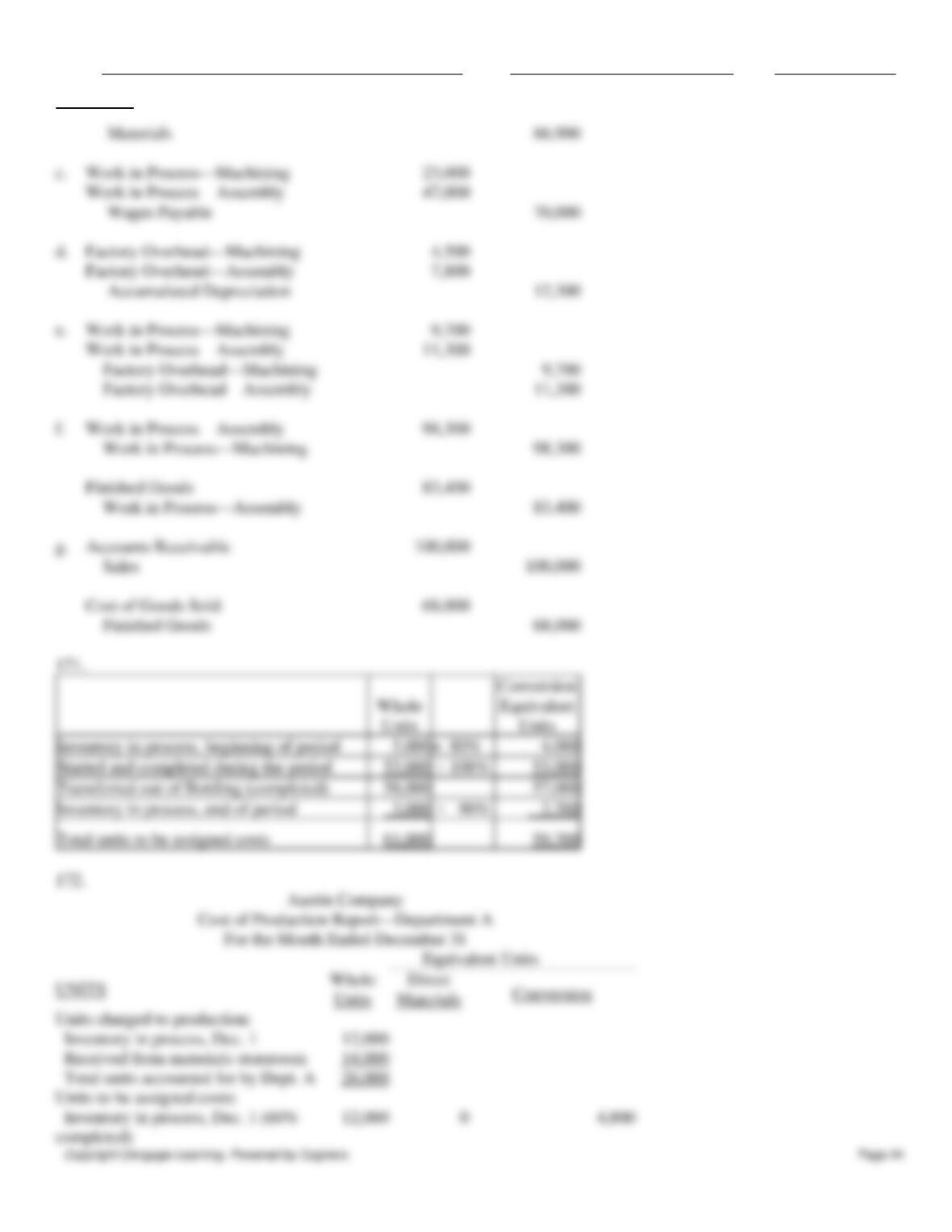
Name:
Class:
Date:
chapter 20
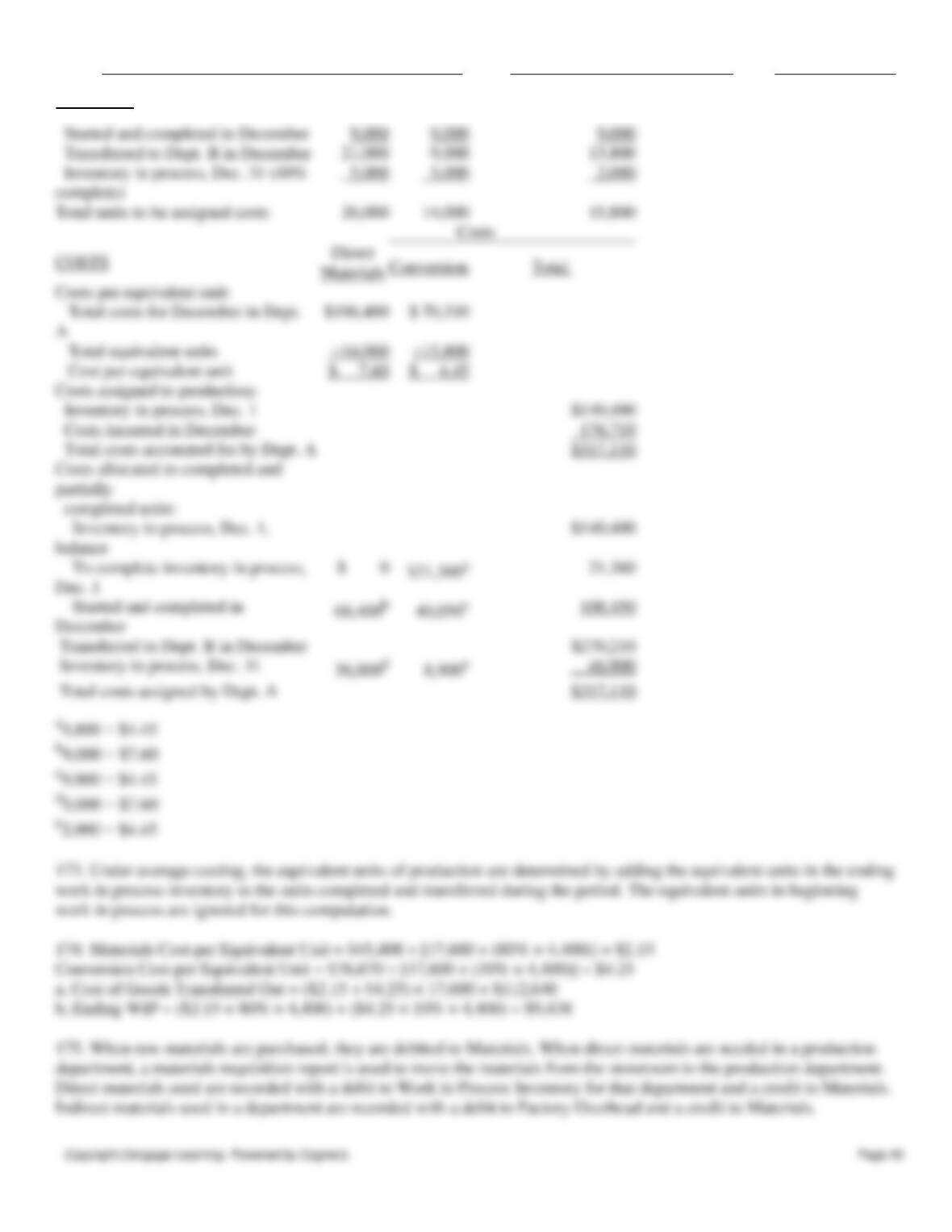
Name:
Class:
Date:
chapter 20
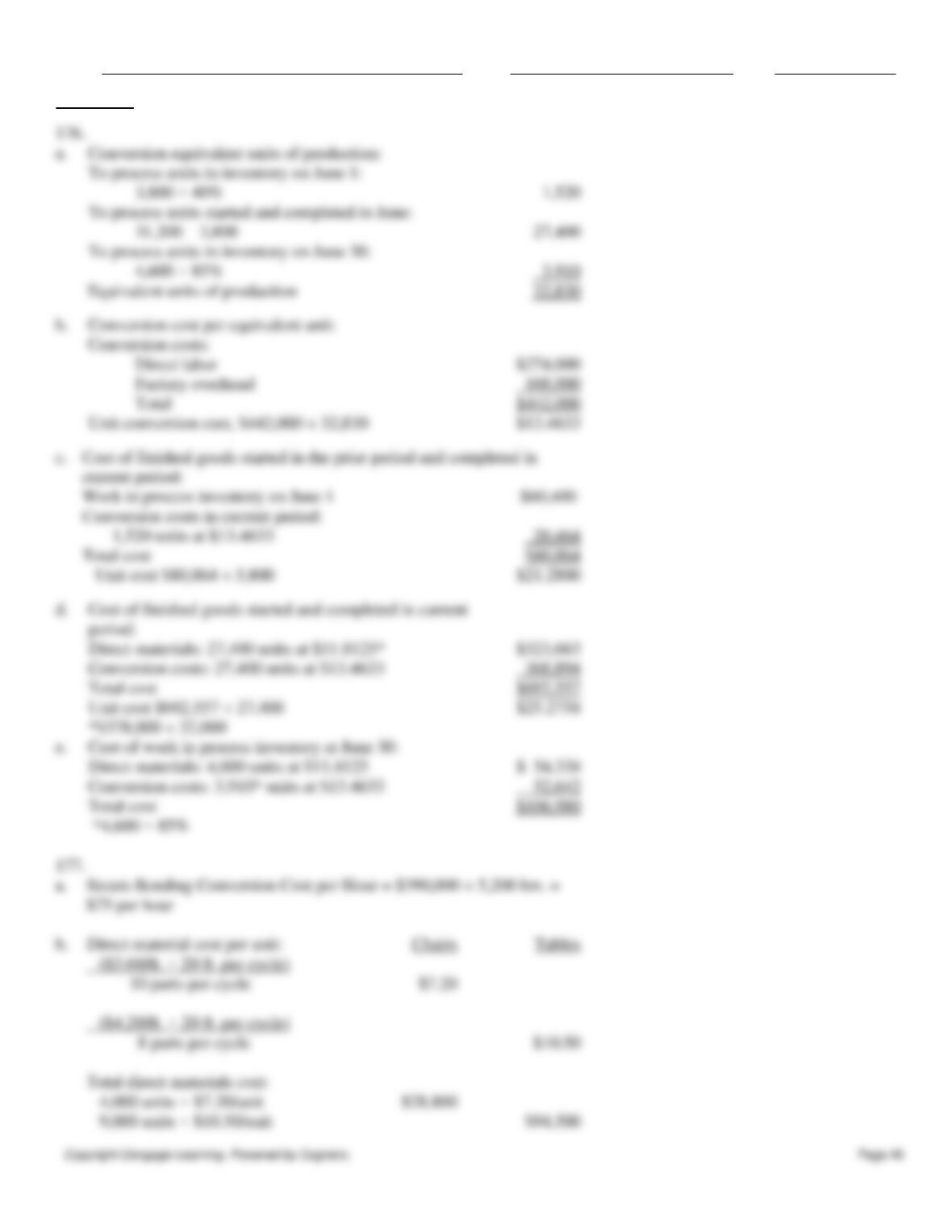
Name:
Class:
Date:
chapter 20
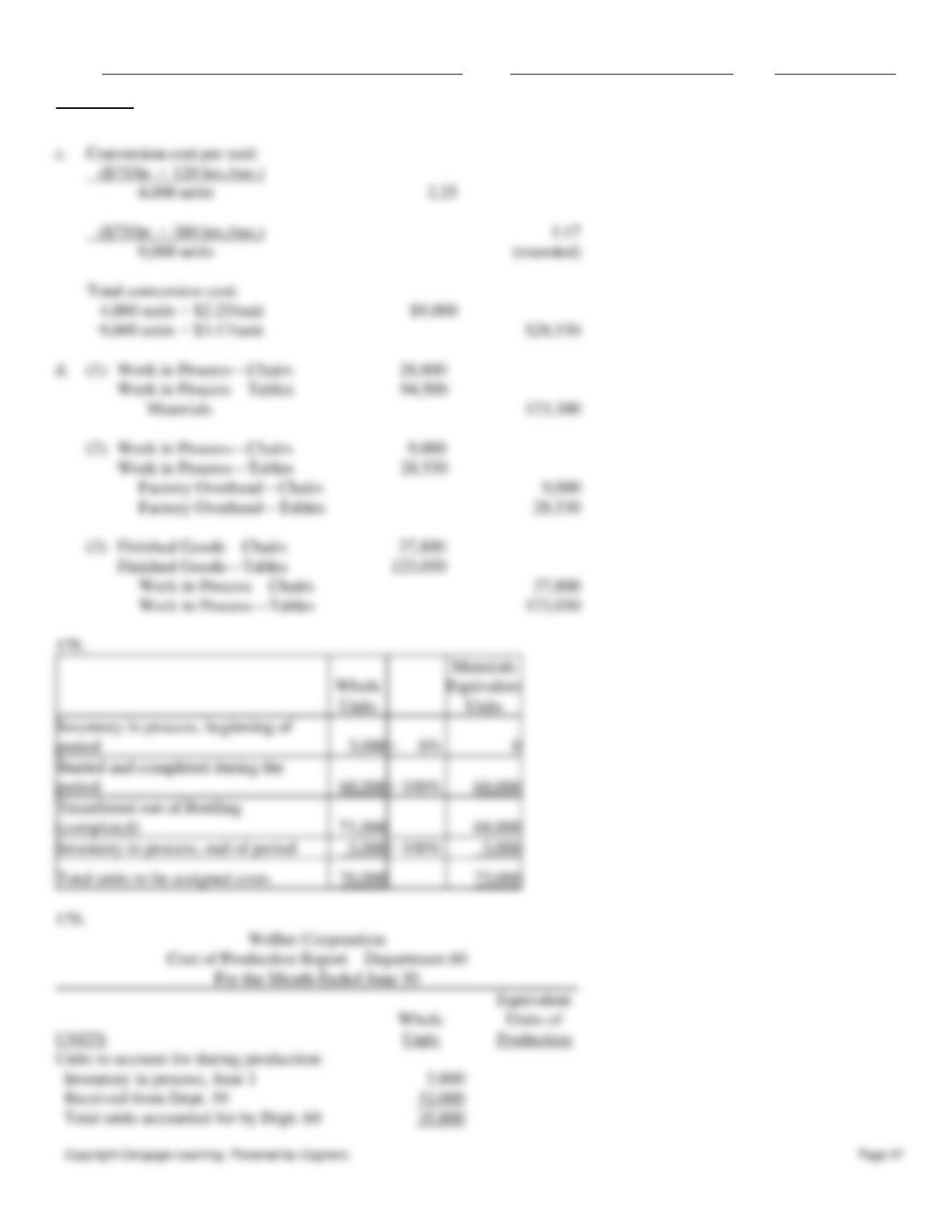
Name:
Class:
Date:
chapter 20
Name:
Class:
Date:
chapter 20
Name:
Class:
Date:
chapter 20
Name:
Class:
Date:
chapter 20
Name:
Class:
Date:
chapter 20
Name:
Class:
Date:
chapter 20
Name:
Class:
Date:
chapter 20
Name:
Class:
Date:
chapter 20
Name:
Class:
Date:
chapter 20

Name:
Class:
Date:
chapter 20