102) If budgeted beginning inventory is $8,300, budgeted ending inventory is $9,400, and
budgeted cost of goods sold is $10,260, budgeted purchases should be:
A) $860
B) $1,100
C) $1,960
D) $9,160
E) $11,360
103) Coomb’s Fashions forecasts sales of $125,000 for the quarter ended December 31. Its gross
profit rate is 20% of sales, and its September 30 inventory is $32,500. If the December 31
inventory is targeted at $41,500, budgeted purchases for this quarter should be:
A) $134,000.
B) $109,000.
C) $91,500.
D) $25,000.
E) $91,000.
104) A plan that shows the expected cash inflows and cash outflows during the budget period,
including receipts from loans needed to maintain a minimum cash balance and repayments of
such loans, is called a(n):
A) Capital expenditures budget.
B) Operating budget.
C) Rolling budget.
D) Cash budget.
E) Income statement.
105) Which of the following accounts would appear on a budgeted balance sheet?
A) Income tax expense.
B) Accounts receivable.
C) Sales commissions.
D) Depreciation expense.
E) All of the choices are correct.
106) Which of the following budgets is not completed before a cash budget is prepared?
A) Capital expenditures budget.
B) Sales budget.
C) Merchandise purchases budget.
D) General and administrative expense budget.
E) Budgeted income statement.
107) Which of the following would not be used in preparing a cash budget for October?
A) Beginning cash balance on October 1.
B) Budgeted sales and collections for October.
C) Estimated depreciation expense for October.
D) Budgeted salaries expense for October.
E) Budgeted capital equipment purchases for October.
108) Western Company is preparing a cash budget for June. The company has $12,000 in cash at
the beginning of June and anticipates $30,000 in cash receipts and $34,500 in cash payments
during June. Western Company has an agreement with its bank to maintain a minimum cash
balance of $10,000. As of May 31, the company has no loans outstanding. To maintain the
$10,000 required balance, during June the company must:
A) Borrow $4,500.
B) Borrow $2,500.
C) Borrow $10,000.
D) Repay $7,500.
E) Repay $2,500.
109) A managerial accounting report that presents predicted amounts of the company’s assets,
liabilities, and equity as of the end of the budget period is called a(n):
A) Rolling balance sheet.
B) Continuous balance sheet.
C) Budgeted balance sheet.
D) Cash balance sheet.
E) Operating balance sheet.
110) Southland Company is preparing a cash budget for August. The company has $17,000 cash
at the beginning of August and anticipates $120,800 in cash receipts and $134,500 in cash
payments during August. Southland Company wants to maintain a minimum cash balance of
$10,000. The preliminary cash balance at the end of August before any loan activity is:
A) $13,300.
B) $137,800.
C) ($13,700).
D) $3,300.
E) $27,000.
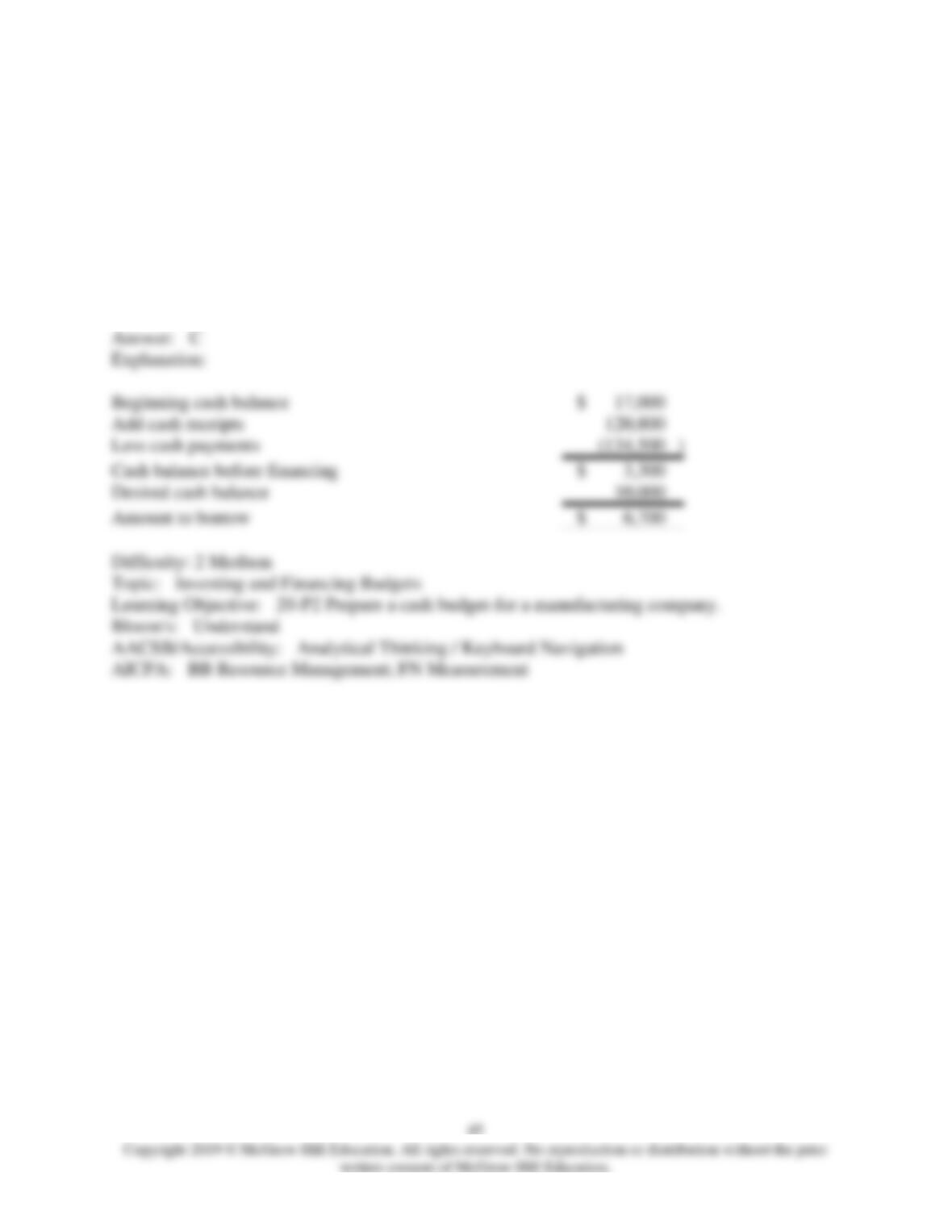
111) Southland Company is preparing a cash budget for August. The company has $17,000 cash
at the beginning of August and anticipates $120,800 in cash receipts and $134,500 in cash
payments during August. Southland Company wants to maintain a minimum cash balance of
$10,000. To maintain the minimum cash balance of $10,000, the company must borrow:
A) $0.
B) $10,000.
C) $6,700.
D) $7,000.
E) $27,700.
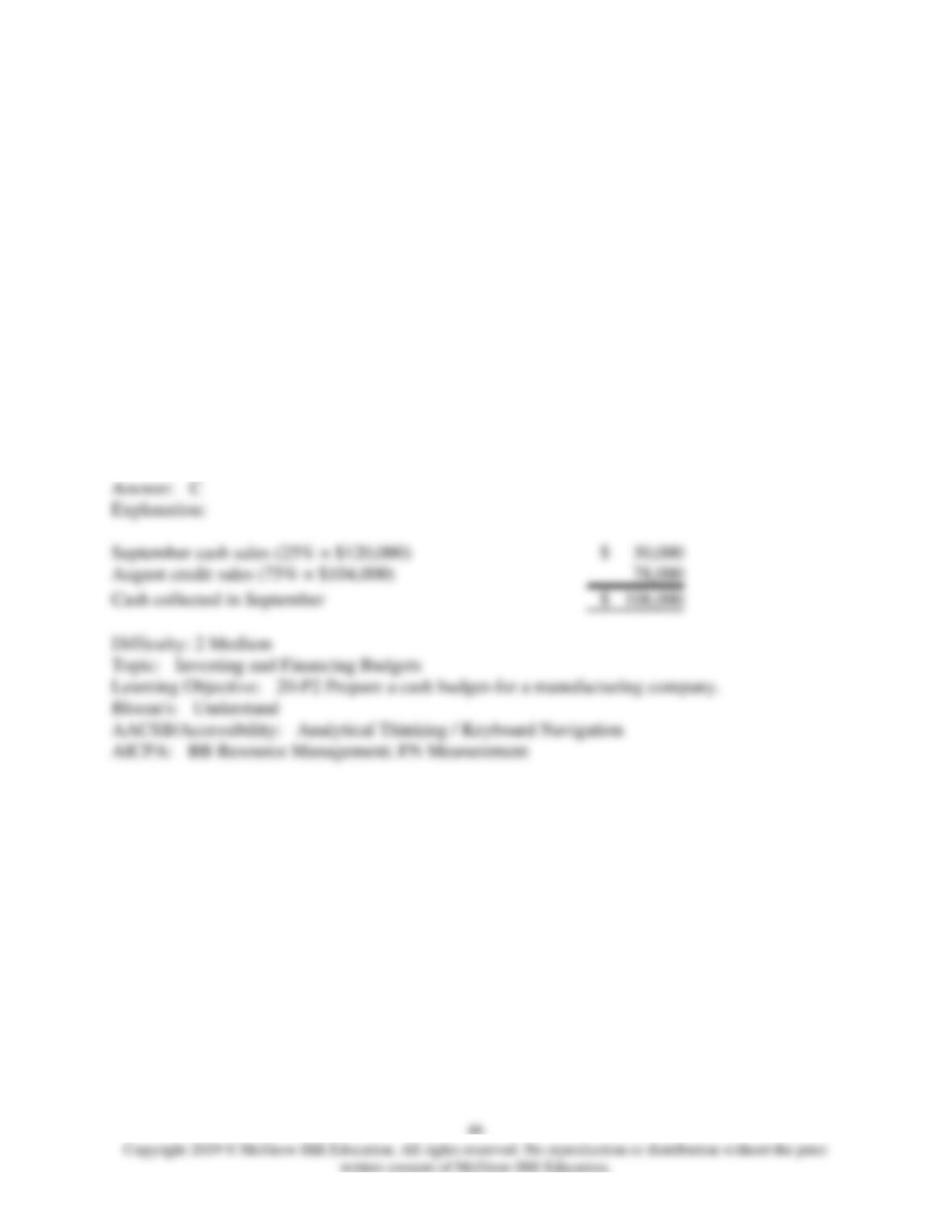
112) Chocolate Co. reports the following information from its sales budget:
Expected sales:
July
$
90,000
August
104,000
September
120,000
Cash sales are normally 25% of total sales and all credit sales are expected to be collected in the
month following the date of sale. The total amount of cash expected to be received from
customers in September is:
A) $30,000.
B) $78,000.
C) $108,000.
D) $120,000.
E) $130,500.
September cash sales (25% × $120,000)
$
August credit sales (75% × $104,000)
Cash collected in September
$
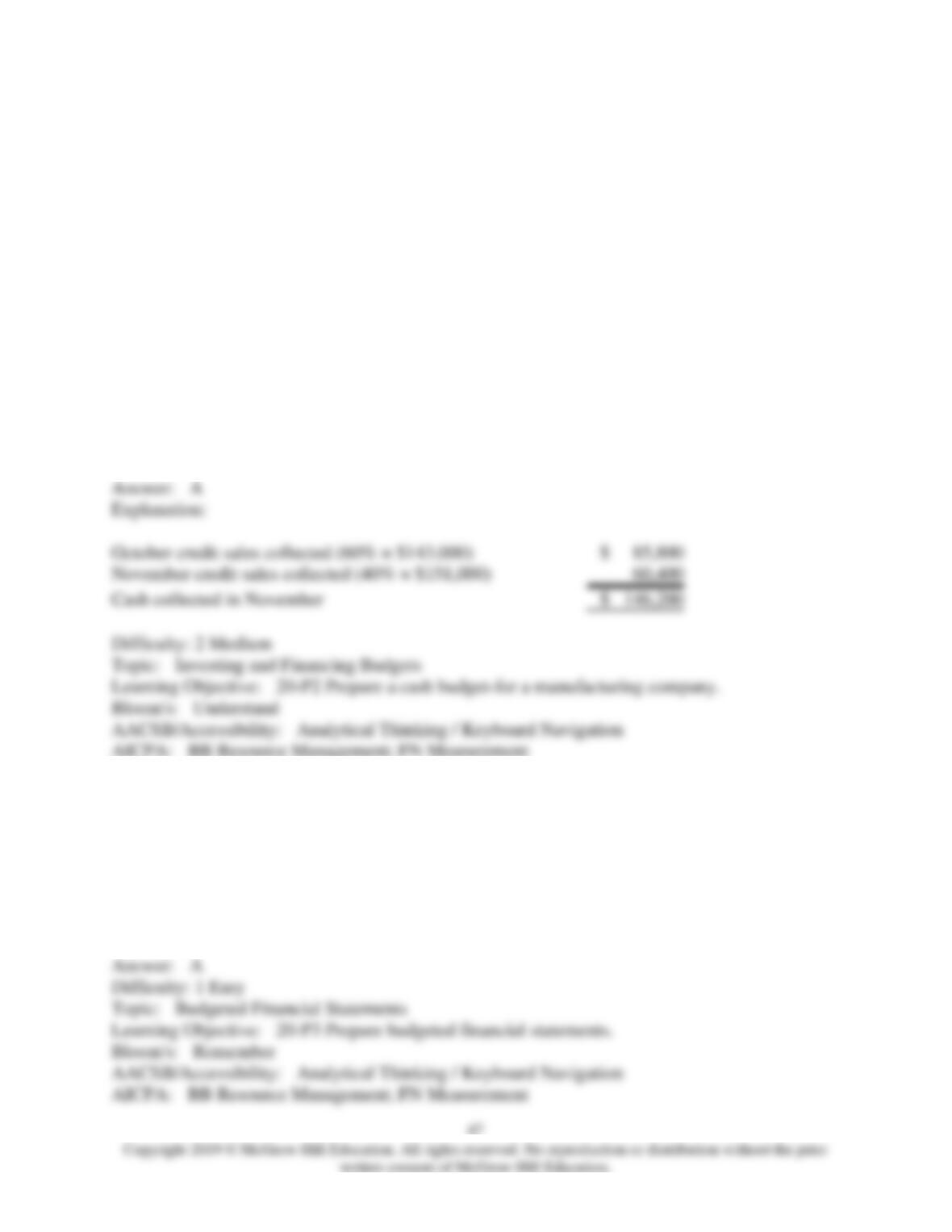
113) Junior Snacks reports the following information from its sales budget:
Expected sales:
October
$
143,000
November
151,000
December
187,000
All sales are on credit and are expected to be collected 40% in the month of sale and 60% in the
month following sale. The total amount of cash expected to be received from customers in
November is:
A) $146,200.
B) $85,800.
C) $151,000.
D) $236,800.
E) $60,400.
October credit sales collected (60% × $143,000)
$
November credit sales collected (40% × $151,000)
Cash collected in November
$
114) A managerial accounting report that presents predicted amounts of the company’s revenues
and expenses for the budget period is called a:
A) Budgeted income statement.
B) Budgeted balance sheet.
C) Master plan.
D) Rolling income statement.
E) Continuous profit statement.
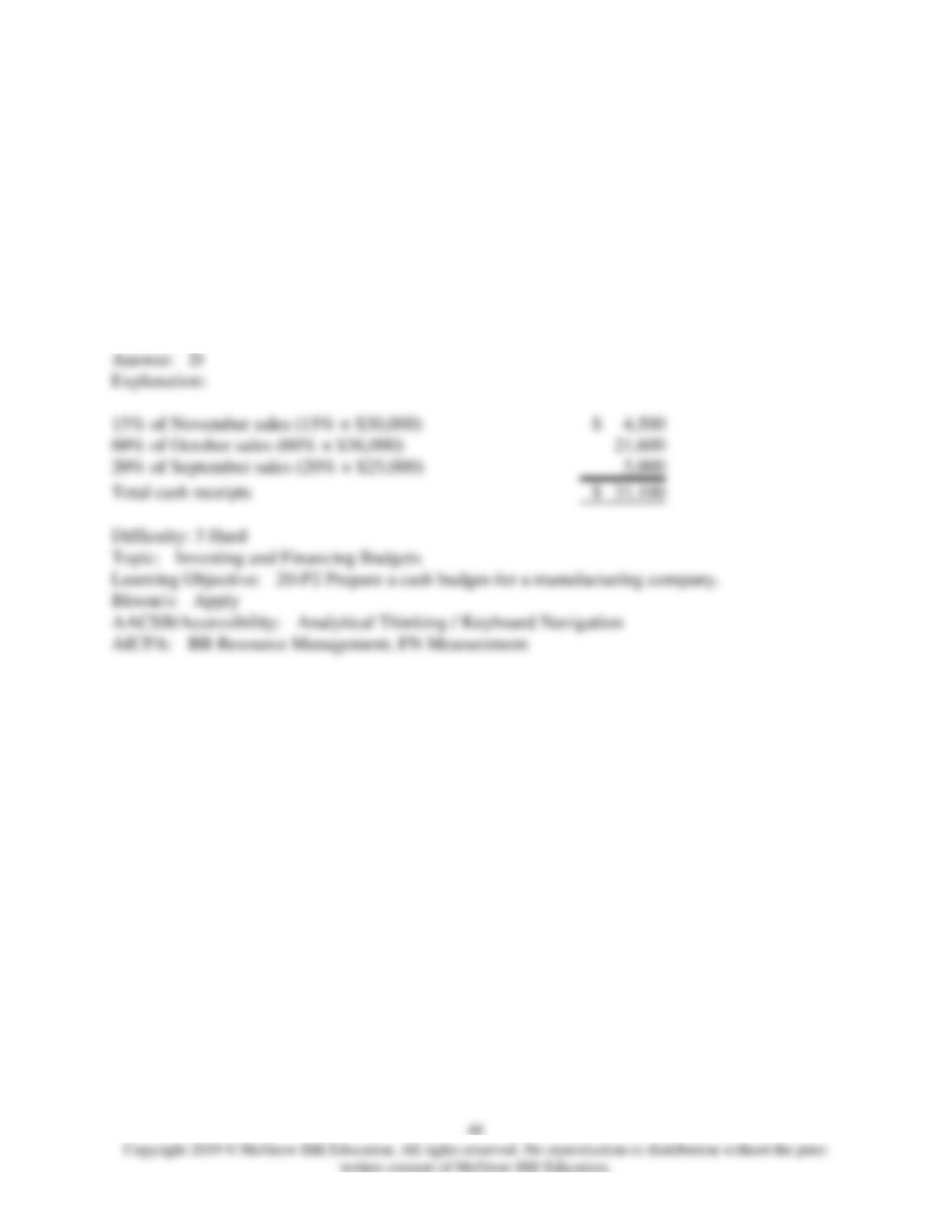
115) Justin Company’s budget includes the following credit sales for the current year:
September, $25,000; October, $36,000; November, $30,000; December, $32,000. Credit sales
are collected as follows: 15% in the month of sale, 60% in the first month after sale, 20% in the
second month after sale, and 5% is uncollectible. How much cash can Justin expect to collect in
November as a result of current and past credit sales?
A) $19,700.
B) $28,500.
C) $30,000.
D) $31,100.
E) $33,900.
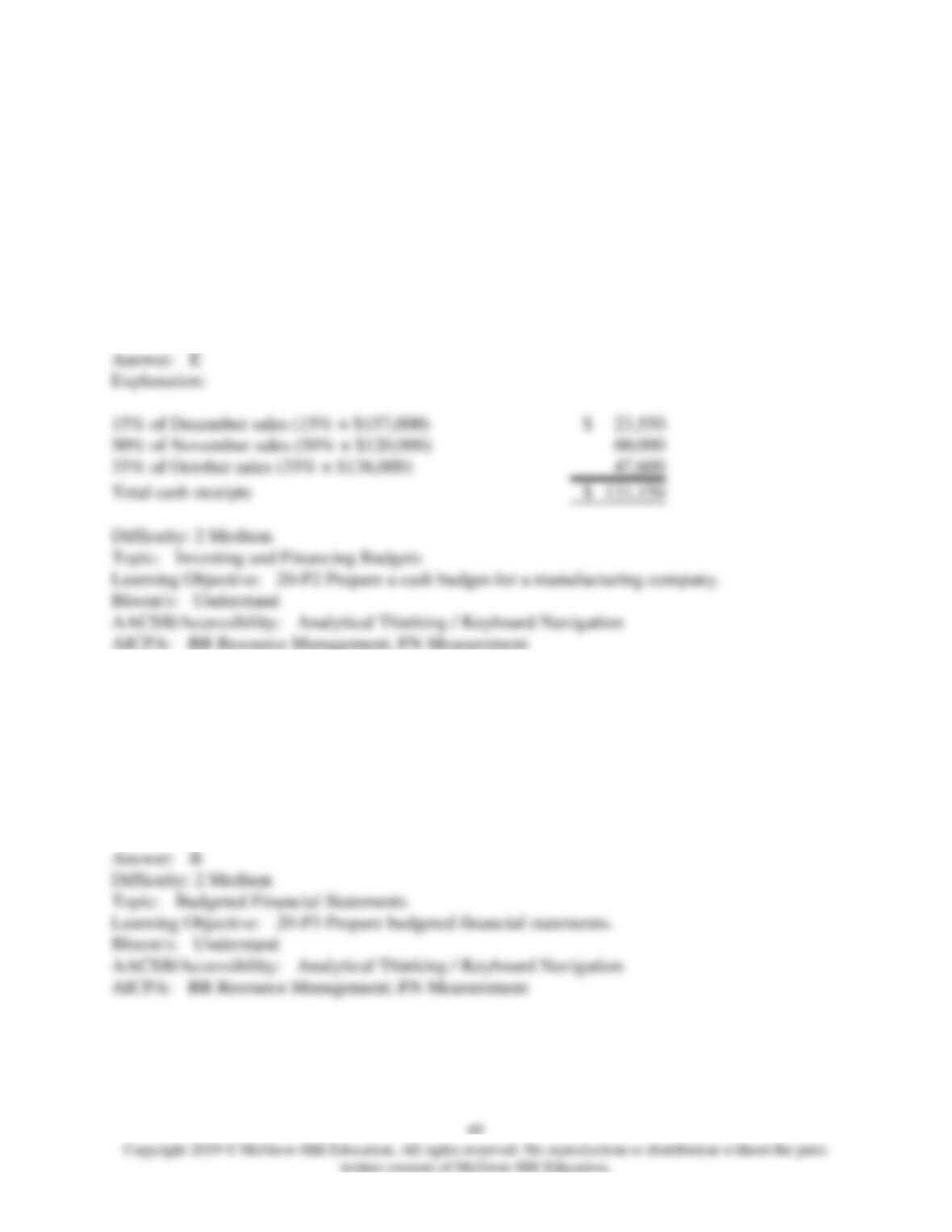
116) Ruiz Co.’s budget includes the following credit sales for the current year: September,
$145,000; October, $136,000; November, $120,000; December, $157,000. Credit sales are
collected as follows: 15% in the month of sale, 50% in the first month after sale, and 35% in the
second month after sale. How much cash can the company expect to collect in December as a
result of current and past credit sales?
A) $23,550.
B) $107,600.
C) $83,550.
D) $157,000.
E) $131,150.
117) In preparing a budgeted balance sheet, the dollar amount of Accounts Receivable can be
derived from:
A) The purchases budget and schedule of cash payments.
B) The sales budget and the schedule of cash receipts.
C) The capital expenditures budget and purchases budget.
D) The budgeted income statement and budgeted balance sheet.
E) The selling expenses budget and the schedule of cash receipts.
118) Long-term liability balances for the budgeted balance sheet are obtained from:
A) The cash budget and capital expenditures budget.
B) The cash budget and sales budget.
C) The cash budget and budgeted income statement.
D) The sales budget and production budget.
E) The asset budget and debt budget.
119) In preparing financial budgets:
A) The budgeted balance sheet is usually prepared last.
B) The cash budget is usually not prepared.
C) The budgeted income statement is usually not prepared.
D) The capital expenditures budget is usually prepared last.
E) The budgeted income statement is usually prepared last.
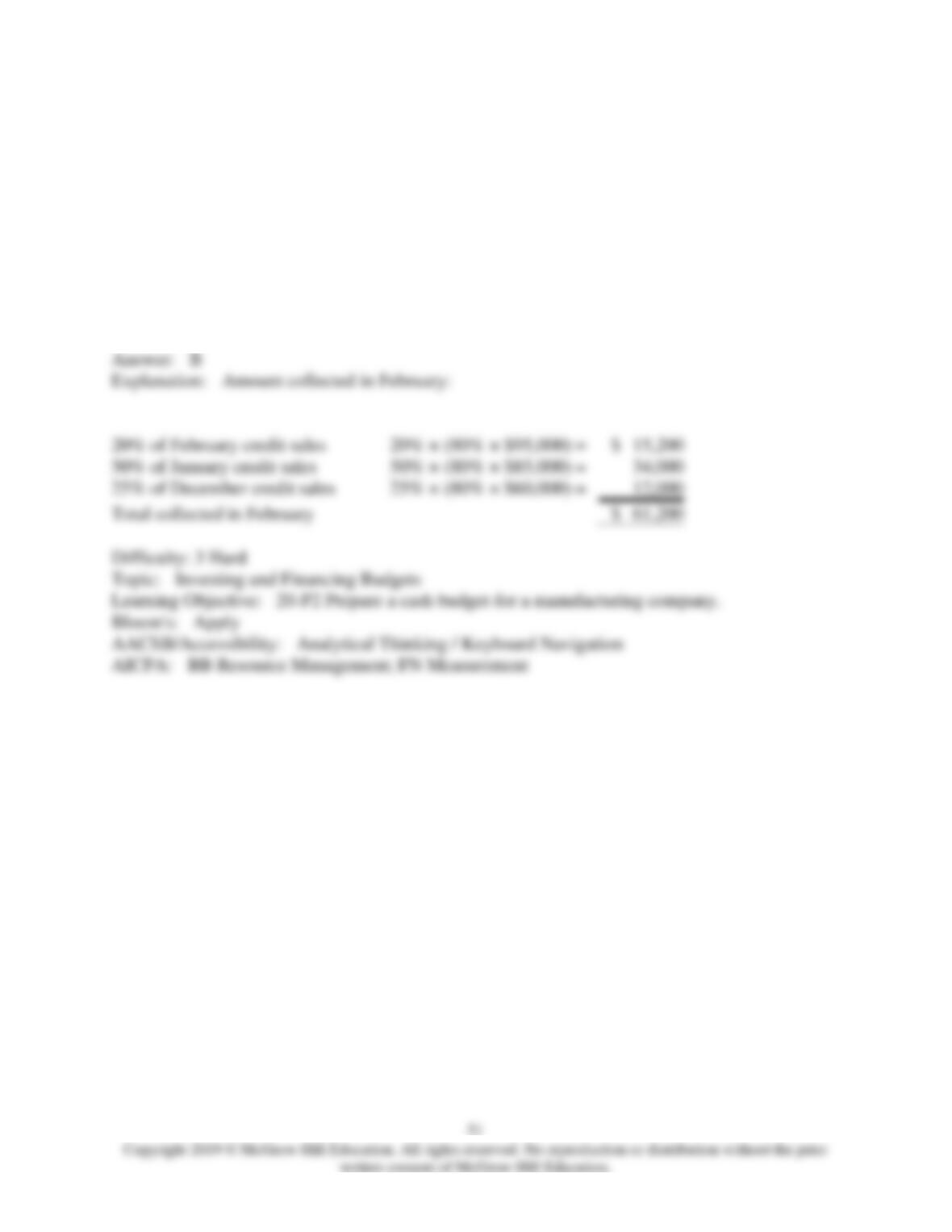
120) A company’s history indicates that 20% of its sales are for cash and the rest are on credit.
Collections on credit sales are 20% in the month of the sale, 50% in the next month, 25% the
following month, and 5% is uncollectible. Projected sales for December, January, and February
are $60,000, $85,000 and $95,000, respectively. The February expected cash receipts from
current and prior credit sales is:
A) $57,000
B) $61,200
C) $66,400
D) $80,750
E) $90,250
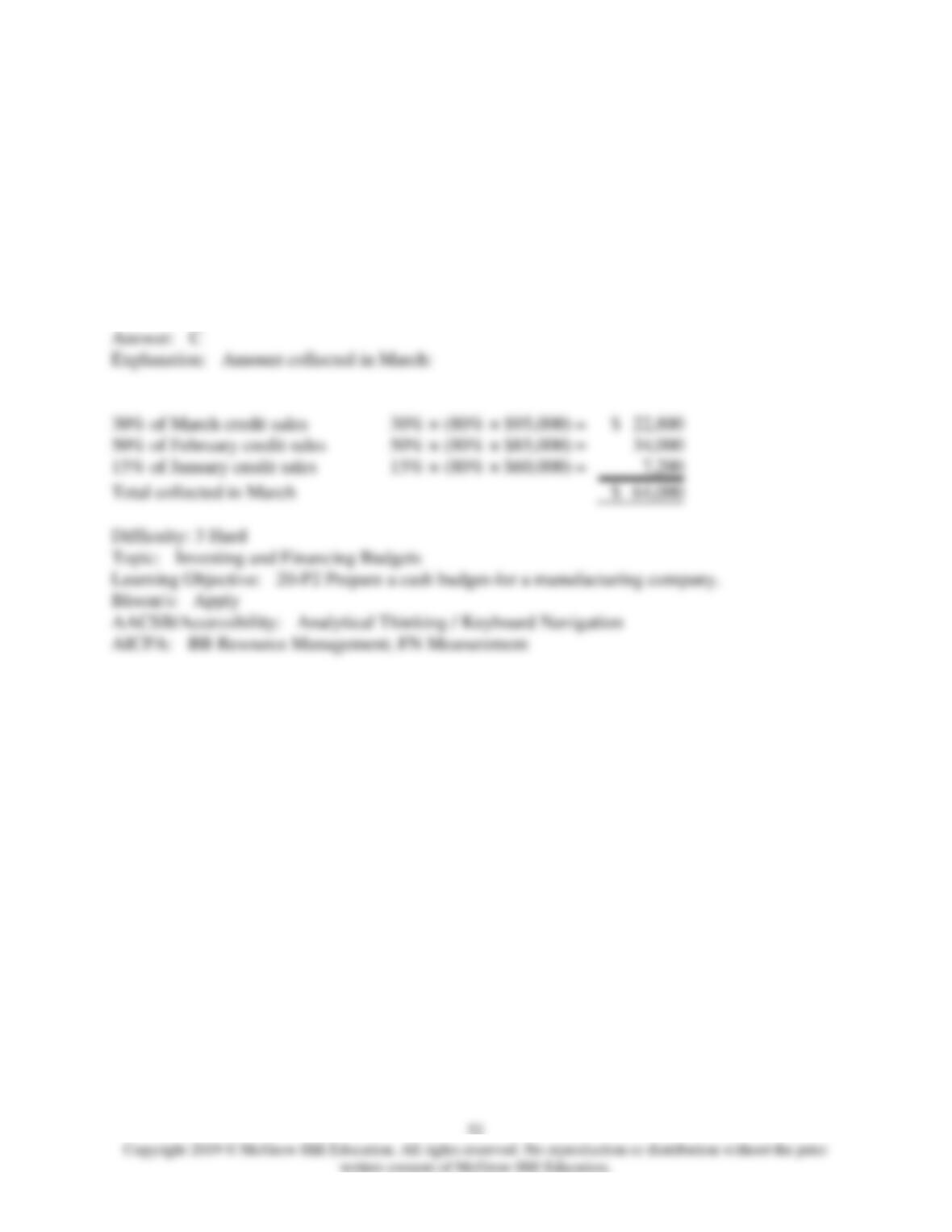
121) A company’s history indicates that 20% of its sales are for cash and the rest are on credit.
Collections on credit sales are 30% in the month of the sale, 50% in the next month, and 15% the
following month. Projected sales for January, February, and March are $60,000, $85,000 and
$95,000, respectively. The March expected cash receipts from current and prior credit sales is:
A) $57,000
B) $63,080
C) $64,000
D) $80,750
E) $90,250
122) Walter Enterprises expects its September sales to be 20% higher than its August sales of
$150,000. Purchases were $100,000 in August and are expected to be $120,000 in September.
All sales are on credit and are collected as follows: 30% in the month of the sale and 70% in the
following month. Merchandise purchases are paid as follows: 25% in the month of purchase and
75% in the following month. The beginning cash balance on September 1 is $7,500. The ending
cash balance on September 30 would be:
A) $31,500.
B) $67,500.
C) $54,000.
D) $61,500.
E) $136,500.
123) Ballentine Company expects sales for June, July, and August of $48,000, $54,000, and
$44,000, respectively. Experience suggests that 40% of sales are for cash and 60% are on credit.
The company collects 50% of its credit sales in the month following sale, 45% in the second
month following sale, and 5% are not collected. What are the company’s expected cash receipts
for August from its current and past sales?
A) $29,160.
B) $46,760.
C) $61,160.
D) $66,200.
E) $78,800.
124) Gardner Company expects sales for October of $248,000. Experience suggests that 45% of
sales are for cash and 55% are on credit. The company collects 50% of its credit sales in the
month of sale and 50% in the month following sale. Budgeted Accounts Receivable on
September 30 is $67,000. What is the amount of cash expected to be collected in October?
A) $124,000.
B) $178,600.
C) $179,800.
D) $111,600.
E) $246,800.
125) Gardner Company expects sales for October of $248,000. Experience suggests that 45% of
sales are for cash and 55% are on credit. The company collects 50% of its credit sales in the
month of sale and 50% in the month following sale. Budgeted Accounts Receivable on
September 30 is $67,000. What is the amount of Accounts Receivable on the October 31
budgeted balance sheet?
A) $111,600.
B) $124,000.
C) $67,000.
D) $68,200.
E) $136,400.
126) Wichita Industries’ sales are 10% cash and 90% on credit. Credit sales are collected as
follows: 30% in the month of sale, 50% in the next month, and 20% in the second following
month. On December 31, the accounts receivable balance includes $12,000 from November sales
and $42,000 from December sales. Assume that total sales for January are budgeted to be
$50,000. What are the expected cash receipts for January from the current and past sales?
A) $18,500.
B) $51,500.
C) $51,900.
D) $55,500.
E) $60,500.
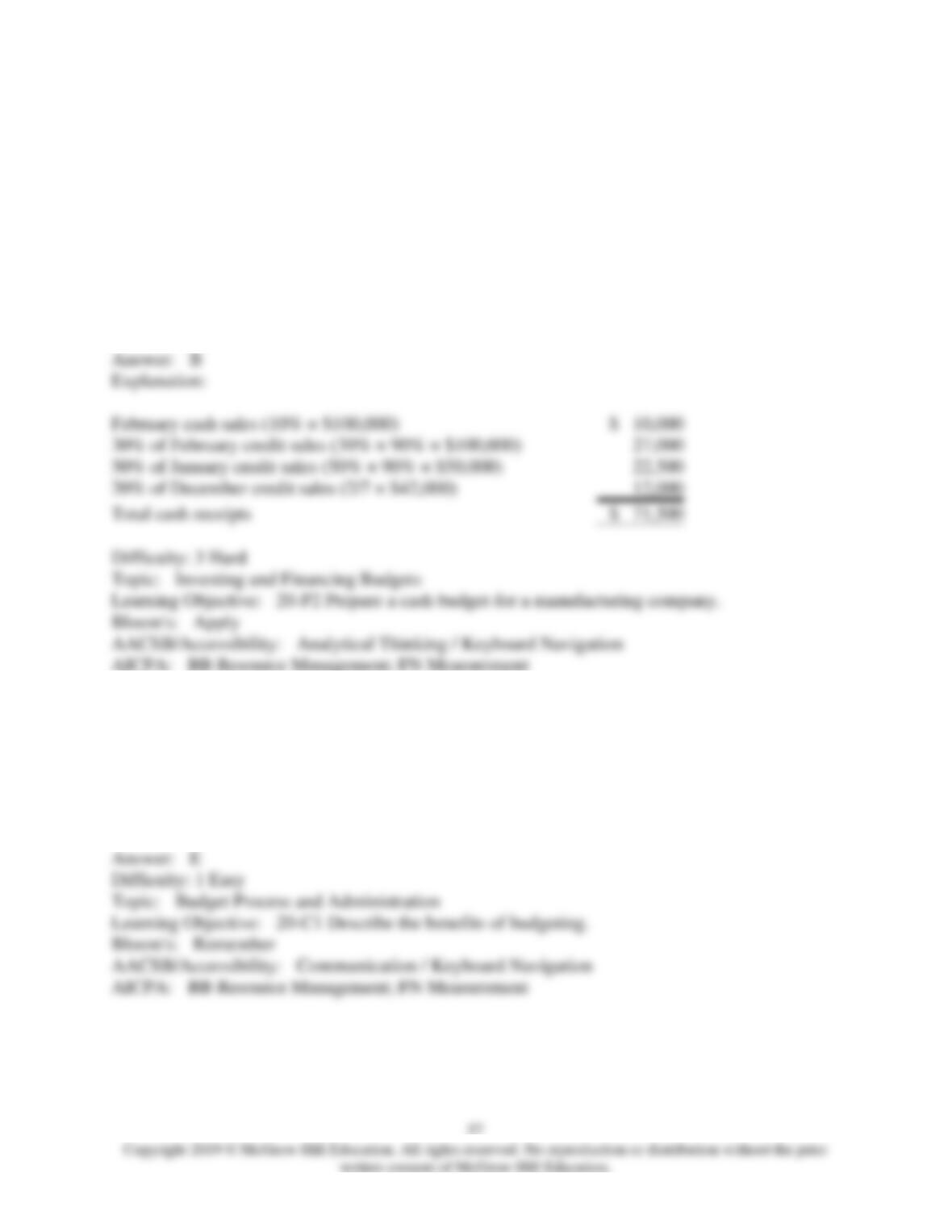
127) Wichita Industries’ sales are 10% for cash and 90% on credit. Credit sales are collected as
follows: 30% in the month of sale, 50% in the next month, and 20% in the second following
month. Wichita Industries’ had $12,000 from November sales and $42,000 from December sales.
Assume that total sales for January and February are budgeted to be $50,000 and $100,000,
respectively. What are the expected cash receipts for February from current and past sales?
A) $80,500.
B) $71,500.
C) $34,500.
D) $61,500.
E) $59,500.
128) Which of the following must be prepared before the direct labor budget?
A) Budgeted income statement.
B) Merchandise purchases budget.
C) Capital expenditures budget.
D) Selling expense budget.
E) Production budget.
129) To determine the production budget for an accounting period, consideration is given to all
of the following except:
A) Budgeted ending inventory.
B) Budgeted beginning inventory.
C) Budgeted sales.
D) Budgeted overhead.
E) Safety stock.
130) Which of the following budgets is not a budget that a manufacturer would include in its
master budget?
A) Sales budget.
B) Direct materials budget.
C) Production budget.
D) Merchandise purchases budget.
E) Cash budget.
131) A plan that states the number of units to be produced in a future period, based on the
projected unit sales and inventory considerations, is the:
A) Sales budget.
B) Merchandise purchases budget.
C) Production budget.
D) Cash budget.
E) Manufacturing budget.
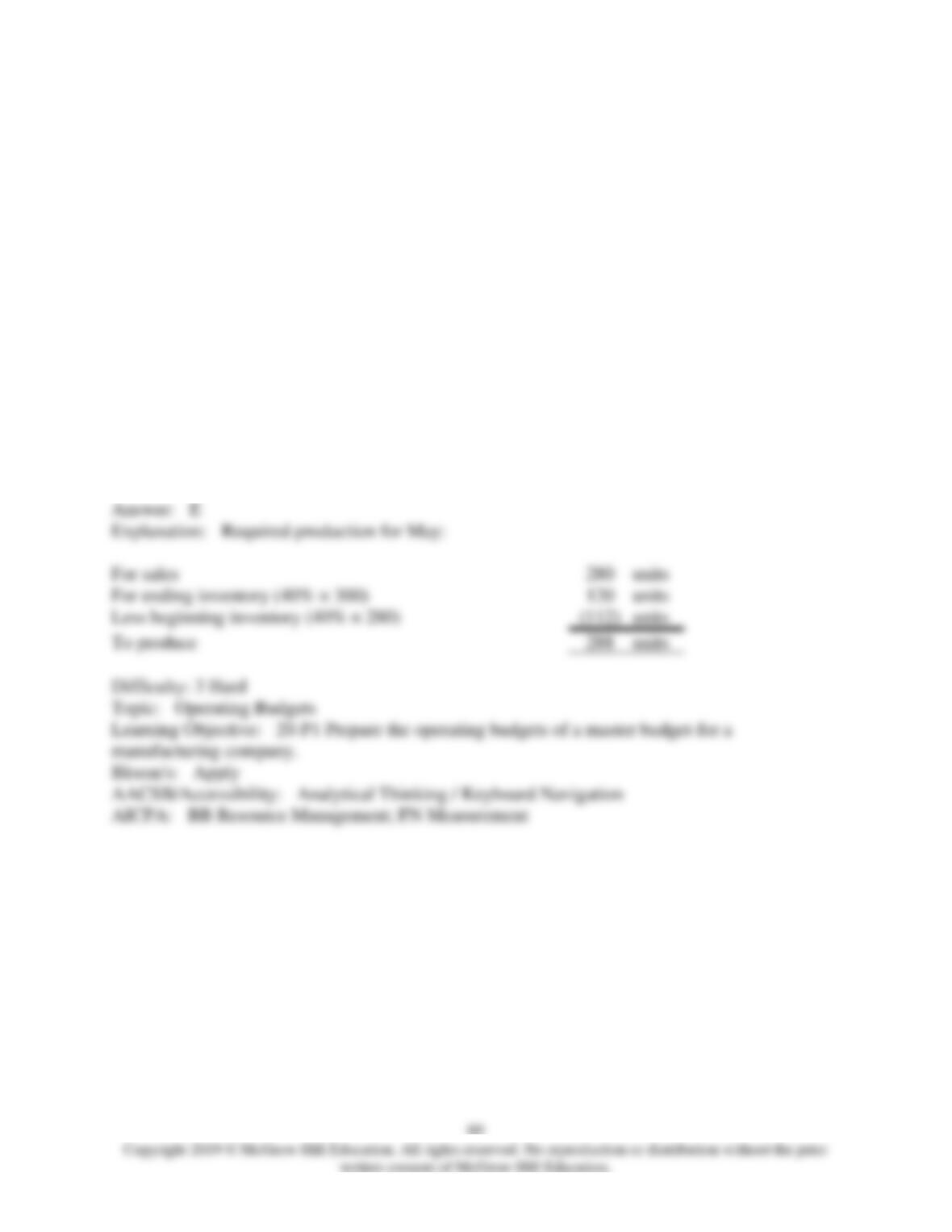
132) Cahuilla Corporation predicts the following sales in units for the coming four months:
April
May
June
July
Sales in units
240
280
300
240
Each month’s ending Finished Goods Inventory should be 40% of the next month’s sales. March
31 finished goods inventory is 96 units. A finished unit requires five pounds of direct material B
at a cost of $2.00 per pound. The March 31 Raw Materials Inventory has 200 pounds of B. Each
month’s ending Raw Materials Inventory should be 30% of the following month’s production
needs. The budgeted production for May is:
A) 232 units.
B) 168 units.
C) 400 units.
D) 280 units.
E) 288 units.
For sales
units
For ending inventory (40% × 300)
units
Less beginning inventory (40% × 280)
)
units
To produce
288
units