Chapter 2
87. Conversion cost is the sum of
a. product costs and period costs.
b. selling cost and administrative costs.
c. direct labor cost and direct materials costs.
d. direct labor cost and overhead costs.
88. Period costs
a. are selling costs and administrative costs.
b. are used to compute product cost.
c. can be included in overhead costs.
d. are carried in inventory until the goods are sold.
Chapter 2
89. Which of the following is an example of a period cost?
a. research and development
b. selling and marketing
c. general accounting
d. all of these
90. Product costs are expensed
a. when the product is finished.
b. when the product unit cost is calculated.
c. when the product is sold.
d. all of these are correct.
Chapter 2
91. Excellent Inc. had a per-unit conversion cost of $3.00 during April and incurred direct materials cost of $112,000,
direct labor costs of $84,000, and manufacturing overhead costs of $50,400 during the month. How many units did it
manufacture during the month?
a. 70,000
b. 18,000
c. 44,800
d. 30,000
92. Synergy Inc. manufactured 6,000 units during the month of March. They incurred direct materials cost of $120,000
and manufacturing overhead costs of $48,000. If their per-unit prime cost was $31.20 per unit, how much direct labor cost
did it incur during March?
a. $20,000
b. $35,000
c. $90,000
Chapter 2
d. $67,200
93. During the month of January, Robinson & Green Inc. had total manufacturing costs of $121,000. It incurred $44,000
of direct labor cost and $33,000 of manufacturing overhead cost during the month. If the materials inventory on January 1
was $3,300 less that the materials inventory on January 31, what was the cost of materials purchased during the month?
a. $37,000
b. $47,300
c. $40,000
d. None of these
Chapter 2
94. Product costs that are not attached to units that are sold are reported as:
a. selling expenses on the income statement.
b. costs of goods sold on the balance sheet.
c. administrative costs on the income statement.
d. inventory on the balance sheet.
95. Information from the records of Davies & Moore Corporation for December of the current year is as follows:
Sales $1,353,000
Selling and administrative expenses 231,000
Direct materials used 290,400
Direct labor 330,000
Manufacturing overhead 445,500
Inventories
Dec. 1 Dec. 31
Direct materials $39,600 $46,200
Work in process 82,500 92,400
Finished goods 75,900 62,700
The conversion costs are:
a. $960,000.
b. $1,179,000.
c. $775,500.
d. $564,000.
Chapter 2
96. Information from the records of Garcia & Gordon Corp. for December of the current year is as follows:
Sales $1,353,000
Selling and administrative expenses 2,310,00
Direct materials used 290,400
Direct labor 330,000
Factory overhead 445,500
Inventories
Dec. 1 Dec. 31
Direct materials $39,600 $46,200
Work in process 82,500 92,400
Finished goods 75,900 62,700
The prime costs are:
a. $960,000.
b. $620,400.
c. $705,000.
d. $969,000.
Chapter 2
97. Taylor & Edwards Inc. manufactures television sets. Last month, direct materials (electronic components, etc.) costing
$550,000 were put into production. Direct labor of $880,000 was incurred, manufacturing overhead equaled $495,000,
and selling and administrative costs totaled $396,000. The company manufactured 8,400 television sets during the month.
Assume that there were no beginning or ending work in process balances. What was the per-unit conversion cost? (Note:
Round answer to two decimal places.)
a. $218.75
b. $163.69
c. $162.54
d. $100.15
98. Taylor & Edwards Inc. manufactures television sets. Last month, direct materials (electronic components, etc.) costing
$550,000 were put into production. Direct labor of $880,000 was incurred, manufacturing overhead equaled $495,000,
and selling and administrative costs totaled $396,000. The company manufactured 8,400 television sets during the month.
Assume that there were no beginning or ending work in process balances. What was the per unit prime cost? (Note:
Round your answer to two decimal places.)
a. $263.75
b. $62.50
Chapter 2
c. $170.24
d. $156.25
99. Atlas Inc. manufactures television sets. Last month, direct materials (electronic components, etc.) costing $550,000
were put into production. Direct labor of $880,000 was incurred, manufacturing overhead equaled $495,000, and selling
and administrative costs totaled $396,000. The company manufactured 8,400 television sets during the month. Assume
that there were no beginning or ending work in process balances. What was the total product cost for last month?
a. $1,925,000
b. $2,110,000
c. $1,300,000
d. $1,250,000
Chapter 2
100. Wooten & McMahon Enterprises produces a product with the following per-unit costs:
Direct materials $13.00
Direct labor 8.80
Manufacturing overhead 16.50
Last year, Wooten & McMahon Enterprises produced and sold 825 units at a sales price of $74.80 each. Total selling and
administrative expense was $24,200.What was the per-unit prime cost? (Note: Round your answer to two decimal places.)
a. $21.80
b. $23.50
c. $34.20
d. $11.70
101. Last year, Buckner & Jones Company incurred the following costs:
Direct materials $42,000
Direct labor 63,000
Manufacturing overhead 94,500
Selling expenses 25,200
Administrative expenses 23,100
Buckner & Jones produced and sold 2,060 units at a sales price of $131.25 each. Assume that beginning and ending
inventories of materials, work in process, and finished goods were zero.
The total period expense was:
a. $24,000.
Chapter 2
b. $190,000.
c. $48,300.
d. $250,000.
102. Last year, Buckner & Jones Company incurred the following costs:
Direct materials $42,000
Direct labor 63,000
Manufacturing overhead 94,500
Selling expenses 25,200
Administrative expenses 23,100
Buckner & Jones produced and sold 2,060 units at a sales price of $131.25 each. Assume that beginning and ending
inventories of materials, work in process, and finished goods were zero. What was the conversion cost per unit? (Note:
Round answer to two decimal places.)
a. $50.55
b. $76.46
c. $95.00
d. $125.65
Chapter 2
103. Last year, Buckner & Jones Company incurred the following costs:
Direct materials $42,000
Direct labor 63,000
Manufacturing overhead 94,500
Selling expenses 25,200
Administrative expenses 23,100
Buckner & Jones produced and sold 2,060 units at a sales price of $131.25 each. Assume that beginning and ending
inventories of materials, work in process, and finished goods were zero.
The total product costs were:
a. $199,500.
b. $100,000.
c. $150,000.
d. $236,000.
Chapter 2
104. In July, Greenwood Company purchased materials costing $23,100 and incurred direct labor cost of $19,800.
Manufacturing overhead totaled $35,200 for the month. Information on inventories was as follows:
July 1 July 31
Materials $6,820 $7,810
Work in process 770 1,320
Finished goods 3,630 2,970
What was the cost of direct materials used in production for the month of July?
a. $21,000
b. $22,110
c. $21,900
d. $20,500
105. In July, Noel & Vang Company purchased materials costing $23,100 and incurred direct labor cost of $19,800.
Manufacturing overhead totaled $35,200 for the month. Information on inventories was as follows:
July 1 July 31
Materials $6,820 $7,810
Work in process 770 1,320
Finished goods 3,630 2,970
What was the total manufacturing costs in July?
a. $71,000
b. $50,000
c. $69,600
d. $77,110
Chapter 2
106. Taylor & Edwards Inc. manufactures television sets. Last month, direct materials (electronic components, etc.)
costing $550,000 were put into production. Direct labor of $880,000 was incurred, manufacturing overhead equaled
$495,000, and selling and administrative costs totaled $396,000. The company manufactured 8,400 television sets during
the month. Assume that there were no beginning or ending work in process balances. What was the amount of cost of
goods manufactured last month?
a. $1,925,000
b. $1,250,000
c. $1,300,000
d. $2,110,000
Chapter 2
107. Cost of goods manufactured equals
a. total product costs incurred during the current period + beginning work in process − ending work in process.
b. direct materials cost + direct labor cost + overhead cost.
c. sales − cost of goods sold.
d. none of these are correct.
108. The cost of the partially completed goods at the end of the period would be
a. ending work in process inventory.
b. cost of goods sold.
c. beginning finished goods inventory.
d. beginning work in process inventory.
Chapter 2
109. Cost of goods manufactured equals
a. the cost of indirect materials used in production.
b. the product cost of goods completed during the current period and transferred to finished goods.
c. the period costs for the current period.
d. the cost of direct materials and direct labor used during the current period.
110. In July, Noel & Vang Company purchased materials costing $23,100 and incurred direct labor cost of $19,800.
Manufacturing overhead totaled $35,200 for the month. Information on inventories was as follows:
July 1 July 31
Materials $6,820 $7,810
Work in process 770 1,320
Finished goods 3,630 2,970
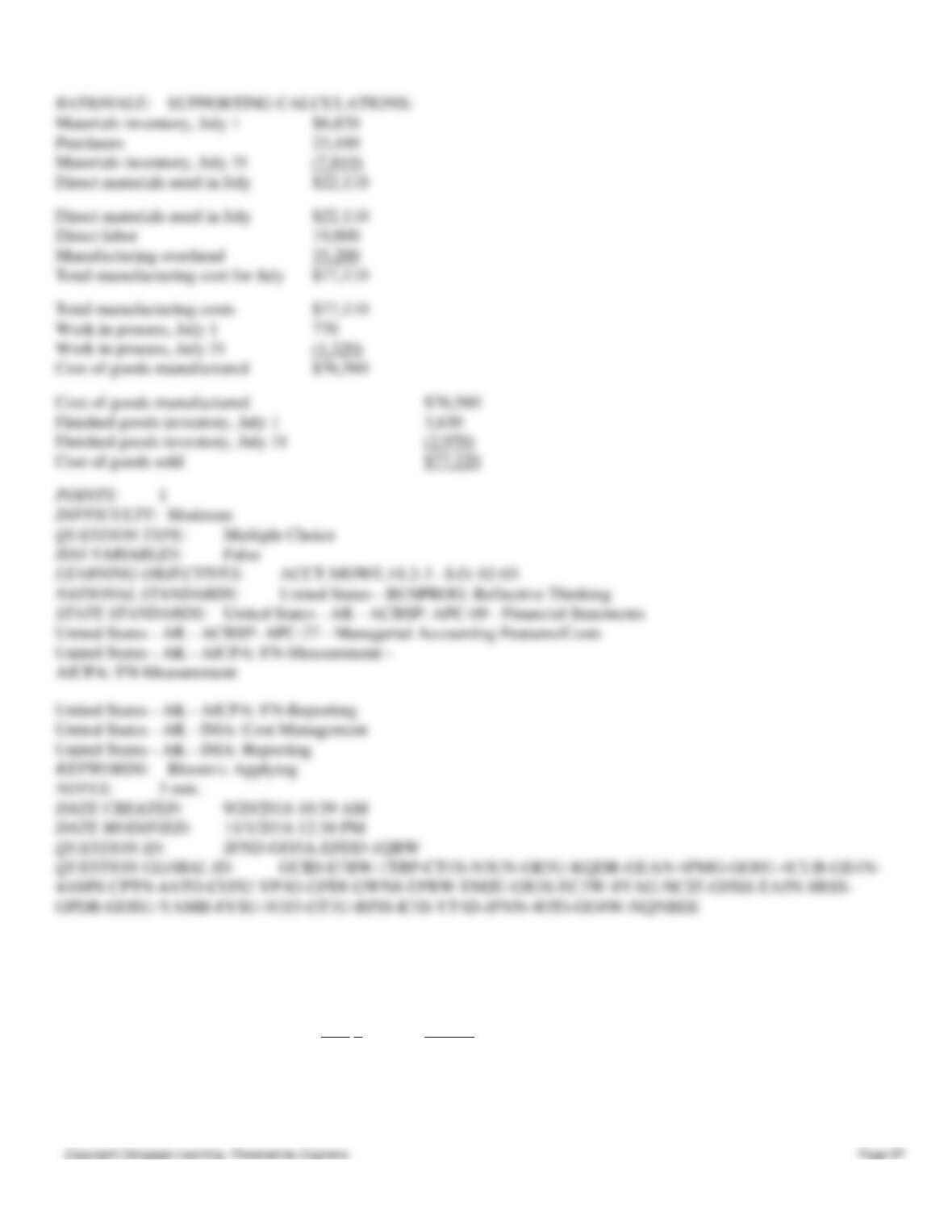
What was the cost of goods manufactured for July?
a. $70,500
b. $70,700
Chapter 2
c. $76,560
d. $76,650
111. In July, Noel & Vang Company purchased materials costing $23,100 and incurred direct labor cost of $19,800.
Manufacturing overhead totaled $35,200 for the month. Information on inventories was as follows:
July 1 July 31
Materials $6,820 $7,810
Work in process 770 1,320
Finished goods 3,630 2,970
What was the cost of goods sold for July?
a. $77,220
b. $69,600
c. $71,300
d. $71,100
Chapter 2
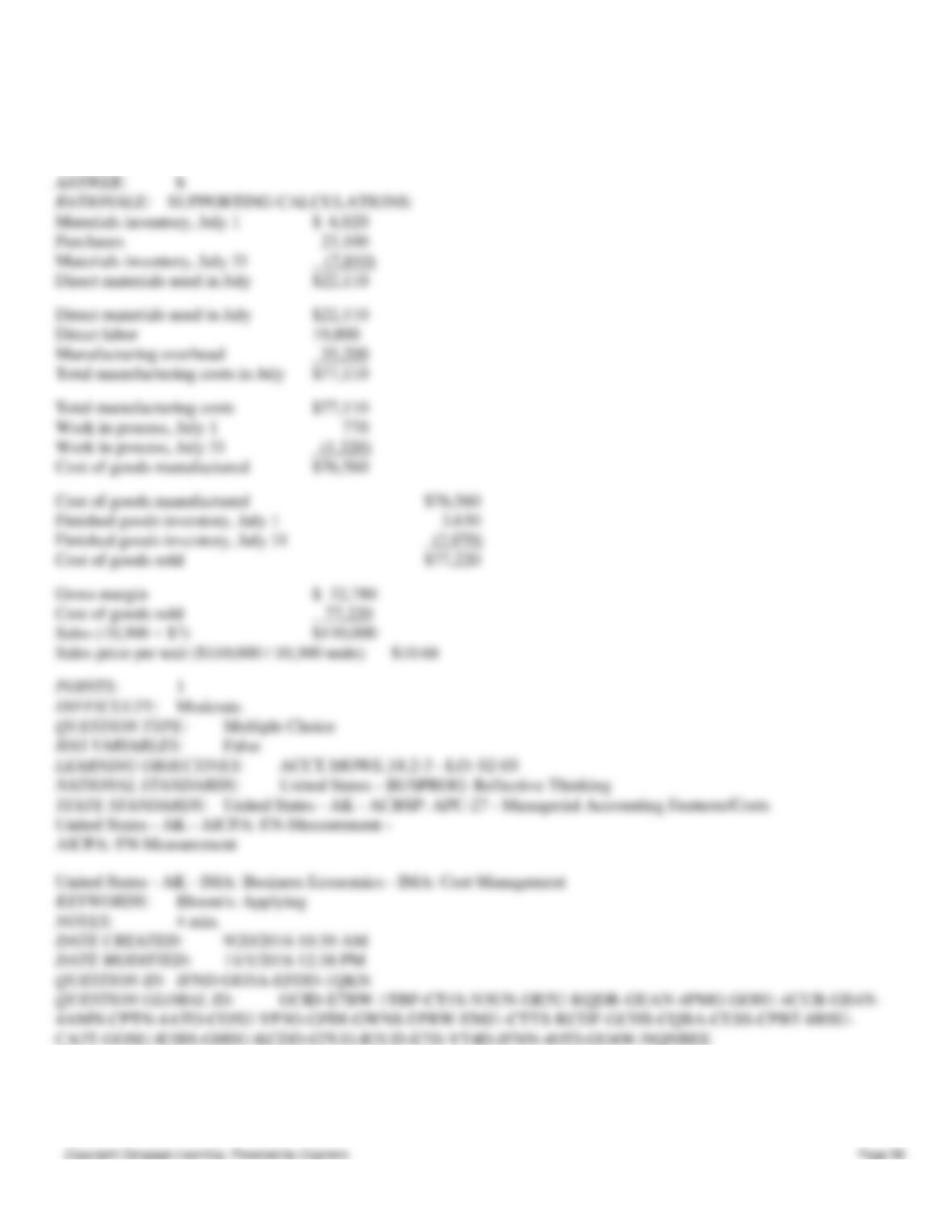
112. In July, Noel & Vang Company purchased materials costing $23,100 and incurred direct labor cost of $19,800.
Manufacturing overhead totaled $35,200 for the month. Information on inventories was as follows:
July 1 July 31
Materials $6,820 $7,810
Work in process 770 1,320
Finished goods 3,630 2,970
If Noel &Vang Company sold 10,300 units during July and its gross margin totaled $32,780, what was the sales price per
unit? (Note: Round answer to two decimal places.)
Chapter 2
a. $9.94
b. $10.68
c. $10.09
d. $10.11
113. Wooten & McMahon Enterprises produces a product with the following per-unit costs:
Direct materials $13.00
Chapter 2
Direct labor 8.80
Manufacturing overhead 16.50
Last year, Wooten & McMahon Enterprises produced and sold 825 units at a sales price of $74.80 each. Total selling and
administrative expense was $24,200. What was the cost of goods sold last year? (Note: Round answer to two decimal
places.)
a. $47,500.10
b. $31,597.50
c. $14,250.50
d. $51,000.20
114. Wooten & McMahon Enterprises produces a product with the following per-unit costs:
Direct materials $13.00
Direct labor 8.80
Manufacturing overhead 16.50
Last year, Wooten & McMahon Enterprises produced and sold 825 units at a sales price of $74.80 each. Total selling and
administrative expense was $24,200. What was the total operating income last year? (Note: Round answer to two decimal
places.)
a. $29,000.75
b. $51,000.00
c. $25,500.50
d. $5,912.50
Chapter 2
115. Last year, Buckner & Jones Company incurred the following costs:
Direct materials $42,000
Direct labor 63,000
Manufacturing overhead 94,500
Selling expenses 25,200
Administrative expenses 23,100
Buckner & Jones produced and sold 2,060 units at a sales price of $131.25 each. Assume that beginning and ending
inventories of materials, work in process, and finished goods were zero. What was the gross margin per unit? (Note:
Round your answer to two decimal places.)
a. $125.25
b. $7.56
c. $95.50
d. $34.41