50. Which of the following sets includes only accounting assumptions and conventions?
51. The use of the historical cost principle is justified because the resulting information has the primary quality
ingredients of
52. Which of the following transactions would be reported in the cash flows from investing activities section in
the statement of cash flows for the Haleem Company?
53. Distributions that are paid to owners would affect both the
54. The financial statement that would be most useful in evaluating a company’s financial flexibility is the
55. The framework for the model of business reporting includes all of the following except
56. The AICPA’s Special Committee on Financial Reporting issued a report on a model for business reporting
that addresses concerns about
57. The model for business reporting is designed to fit the decision processes of users to
58. The AICPA’s Special Committee on Financial Reporting issued a report on a model for business reporting.
The “Financial Reporting” sources of information used in external decision making outlined in the model
included all of the following except
59. The CFA’s Comprehensive Business Reporting Model argues that certain key weaknesses in the current
financial reporting model exist. The weaknesses include all of the following except
60. The goal of the boards of the IASB and FASB is to develop a joint conceptual framework project that is
both complete and internally consistent. However, as a limitation the boards concluded that
61. The IASB and FASB boards have agreed that the objective of general purpose financial reporting is to
provide
62. The IASB and FASB joint boards feel that financial reporting should
63. The IASB and FASB joint boards have identified the primary user groups of financial information as all of
the following except
64. One of the differences between the IASB/FASB joint conceptual framework and the FASB conceptual
framework is that while the FASB identifies relevance and reliability as the primary decision-specific qualities,
the tentative joint framework identifies the fundamental qualitative characteristics to be
65. The joint IASB and FASB boards identified several “enhancing” characteristic of financial information
including
66. Similar to the constraints in the FASB’s qualitative characteristics, the joint IASB/FASB boards have
identified two constraints including
67. The joint IASB/FASB qualitative characteristics Exposure Draft identifies a logical order in which to
evaluate the qualities. That order (first, second, third) is
68. The FASB identified several objectives of financial reporting, which are listed below. Following the list is a
series of descriptive statements.
a.
general objective
b.
derived external user objective
c.
derived company objective
d.
specific objectives
____
1.
Provide information about a company’s economic resources, obligations, and owners’ equity.
____
2.
Provide useful information for present and potential investors, creditors, and other external users in making their investment,
credit, and similar decisions.
____
3.
Provide information about a company’s financial performance during a period.
____
4.
Provide information about a company’s cash flows.
____
5.
Provide information that is useful to external users in assessing the amounts, timing, and uncertainty of prospective cash
receipts.
____
6.
Provide information to help external users in assessing the amounts, timing, and uncertainty of a company’s prospective net
cash flows.
Required:
Match each objective with the appropriate statement by placing the appropriate letter in the space provided.
1.
d
4.
d
2.
a
5.
b
3.
d
6.
c

69. A list of statements follows:
a.
GAAP identifies the ____________________ of financial reporting.
b.
Financial reporting should, above all, provide information that is ____________________ to external decision makers.
c.
A company’s financial statements and other means of financial reporting should include explanations and interpretations by its
management to help external users understand the financial information provided. This represents management’s
____________________ ____________________ to outsiders.
Required:
Fill in the words necessary to complete the statements.
70. A list of statements follows:
a.
____________________ on ____________________ provides a measure of overall company performance.
b.
____________________ is the uncertainty or unpredictability of the future results of a company.
c.
____________________ ____________________ is the ability of a company to take effective actions to change the amounts and
timing of cash flows.
d.
____________________ is the term used to describe how quickly a company can convert its assets into cash to pay a liability.
e.
____________________ ____________________ refers to the ability of a company to maintain a given physical level of operations.
Required:
Fill in the words necessary to complete the statements.
a.
Return, investment
b.
Risk
Financial flexibility
d.
Liquidity
e.
Operating capability
a.
objectives
b.
useful
c.
full disclosure

71. A list of statements follows:
a.
GAAP states that the two primary qualitative characteristics that make accounting information useful for decision-making purposes are
____________________ and ____________________.
b.
Corporations prepare quarterly financial statements in order to help achieve ____________________, an ingredient of the primary
quality of relevance.
c.
Expensing the purchase of waste paper baskets that have a three-year estimated useful life at the date of acquisition is a permissible
procedure according to the ____________________ constraint.
d.
The three components of reliability are ____________________, ____________________, and ____________________
____________________.
e.
____________________ ____________________ is the overall qualitative characteristic to be used in judging the quality of accounting
information.
Required:
Fill in the words necessary to complete the statements.
72. Below is a list of the qualitative characteristics identified by GAAP. Following the list is a series of
descriptive phrases.
a.
feedback value
g.
verifiability
b.
relevance
h.
consistency
c.
decision usefulness
i.
representational faithfulness
d.
reliability
j.
timeliness
e.
comparability
k.
neutrality
f.
predictive value
____
1.
When information can make a difference in a decision.
____
2.
Making information available when it is needed.
____
3.
When accounting policies and procedures are unchanged from period to period.
____
4.
When information is verifiable and neutral.
____
5.
Occurs when the measurement results can be duplicated.
____
6.
The overall qualitative characteristic accounting information should possess.
____
7.
When information enables decision makers to confirm prior expectations.
____
8.
When accounting information is reported the same way by different companies.
a.
relevance, reliability
b.
timeliness
materiality
d.
verifiability, neutrality, representational faithfulness
e.
Decision usefulness
Required:
Match each characteristic with the appropriate phrase.
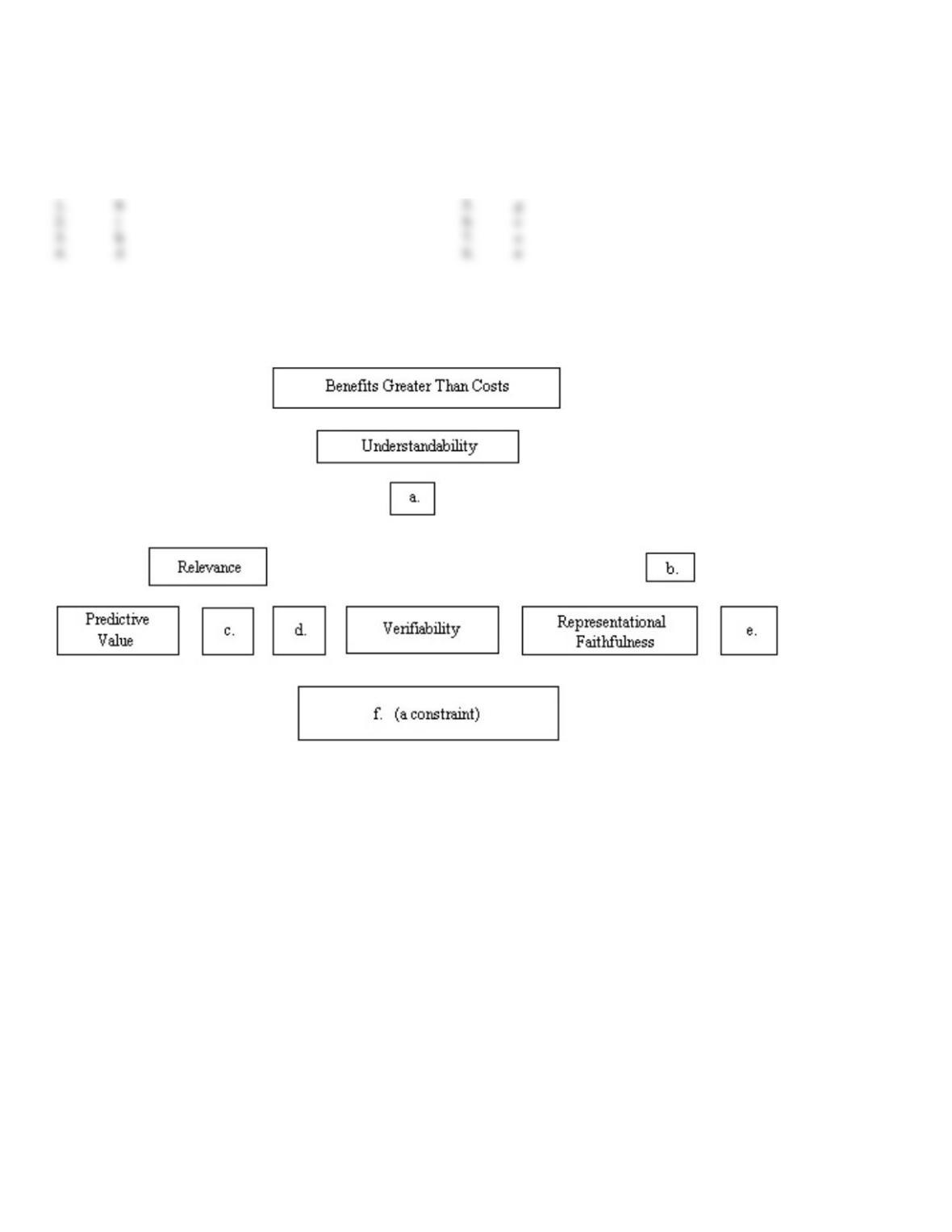
73. Part of the hierarchy of qualitative characteristics is presented below.
Required:
Provide the qualitative characteristic for each lettered box.
a.
_________________________
b.
_________________________
c.
_________________________
d.
_________________________
e.
_________________________
f.
_________________________
1.
b
5.
g
2.
j
6.
c
3.
h
7.
a
d
e

74. Following the list below is a series of descriptions of inappropriate accounting procedures.
a.
full disclosure
b.
historical cost
c.
revenue recognition
d.
conservatism
e.
monetary-unit assumption
f.
matching principle
g.
period of time
____
1.
The company signs a contract to produce four machines according to the customer’s specifications. On the date of the
contract, the customer pays one half of the total contract price, and the company records the cash receipt as a sale. The
machines will be manufactured and delivered during the next year.
____
2.
The company delayed issuing its annual financial statements in order to include a large sale expected early in the next year.
____
3.
The market value of the company’s inventory declined sharply. The president, optimistically predicting a rise in value,
insisted that the inventory be reported at its historical cost.
____
4.
The market value of the company’s large inventory rose sharply. The inventory was reported on the balance sheet at current
market value.
____
5.
Although the company can estimate its uncollectible accounts receivable, it does not recognize the bad debts expense until it
determines that an account receivable is uncollectible.
Required:
Indicate which item (or items) on the list was (were) violated in each description by placing the appropriate letter(s) in the space provided.
1.
c
f, c
3.
d
4.
b, c, d
5.
g, d, f
a.
decision usefulness
b.
reliability
c.
feedback value or timeliness
d.
timeliness or feedback value
e.
neutrality
f.
materiality

75. Below is a list of accounting assumptions, conventions, and principles. Following the list is a series of
descriptive statements.
a.
entity assumption
b.
historical cost principle
c.
going-concern assumption
d.
conservatism convention
e.
monetary-unit assumption
f.
matching principle
g.
period of time
h.
realization
i.
recognition
____
1.
A company records sales on account when providing a service.
____
2.
A company recognizes as expense the portion of its prepaid rent that has expired.
____
3.
A company reports the land that it purchased in 1990 for $500,000, at the same amount on its 2010 balance sheet.
____
4.
A company reports its inventories on the balance sheet at the lower of cost or market.
____
5.
An entity is preparing its five-year strategic plan.
____
6.
A company amortizes its patent, an intangible asset, over its useful life.
Required:
Match each item in the list with its descriptive statement by placing the appropriate letter in the space provided.
76. Presented below are five inappropriate accounting procedures that are being used by the Devin Corporation.
a.
On the year-end balance sheet, Devin Corporation reported its inventory at market value, which was greater than cost. As a result of this
procedure, a gain was recognized on the company’s income statement.
b.
Mrs. Devin, the president of the company, purchased an automobile for her son using the company’s money. The company’s accountant
recorded the expenditure as salaries expense.
c.
Devin Corporation reported income from operations of $5,000,000 for the current year. During the year, Devin settled and paid a
$5,000,000 class action lawsuit against the company resulting from damages incurred from the sale of defective products. The
settlement was reported as a miscellaneous expense with no footnotes provided.
d.
Devin Corporation is going to issue additional common stock next year. In order to improve its income, the company switched from the
LIFO inventory cost flow method to FIFO. The company did not disclose the accounting change. Comparative financial statements
were prepared.
e.
The company made $3,000,000 of expenditures to expand a building that originally cost $5,000,000. The expenditures are expected to
benefit operations over the building’s remaining useful life of ten years. The expenditures were expensed as maintenance.
1.
i
2.
g, f
3.
b
4.
d
5.
c
6.
f

Required:
For each of the above items, list the accounting assumption(s), convention(s), or principle(s) that is (are) being violated.
77. Certain elements of the financial statements are listed below, followed by a series of descriptive statements.
a.
assets
f.
gains
b.
liabilities
g.
losses
c.
equity
h.
operating cash flows
d.
revenues
i.
investing cash flows
e.
expenses
j.
financing cash flows
____
1.
Decrease in equity from peripheral or incidental transactions.
____
2.
The owners’ residual interest in a company’s assets.
____
3.
Inflows of assets or settlement of liabilities, or a combination of both, from the sale of goods or services.
____
4.
Acquiring and selling investments; property, plant & equipment; and intangibles, as well as lending money and collecting
on loans.
____
5.
Probable future sacrifices of economic benefits arising from present obligations.
____
6.
Outflows or other using up of assets or incurrence of liabilities, or a combination of both, in the sale of goods and services.
____
7.
Cash flows from acquiring, selling, and delivering goods or from providing services.
____
8.
Probable future economic benefits obtained as a result of past transactions or events.
____
9.
Increases in equity from peripheral or incidental transactions.
____
10.
Obtaining resources from owners and providing them with a return on, and of, their investment, as well as obtaining and
repaying resources from long-term creditors.
Required:
Match each element with the appropriate statement by placing the appropriate letter in the space provided.
1.
g
6.
e
2.
c
7.
h
3.
d
8.
a
a.
conservatism, historical cost, revenue recognition
b.
entity
c.
materiality, disclosure
d.
consistency, disclosure
e.
matching
78. The AICPA Special Committee on Financial Reporting developed a comprehensive model of business
reporting in an attempt to provide a foundation for future improvement in business reporting. The five
statements below relate to the five categories of information outlined in the committee’s work.
a.
____________________ and ____________________ ____________________, including (1) financial statements and related
disclosures and (2) high-level operating data and performance measurements.
b.
____________________ ____________________ of the financial and nonfinancial data, including (1) reasons for changes in the data
and (2) the identity and past effect of key trends.
c.
____________________ ____________________, including (1) assessment of opportunities and risks, (2) management’s plans, and (3)
comparison of actual performance to previously disclosed opportunities, risks, and plans.
d.
____________________ about ____________________ and ____________________, including (1) directors, management,
compensation, and major shareholders and (2) transactions and relationships among related parties.
e.
____________________ about the ____________________, including (1) broad objectives and strategies, (2) scope and description of
the company’s business and properties, and (3) the impact of industry structure.
Required:
Fill in the blanks in each statement above with the appropriate information category.
79. At lunch recently, two accountants were discussing the merits of the FASB’s conceptual framework project,
which resulted in the publication of seven Statements of Financial Accounting Concepts and required more than
ten years of effort. One accountant thought the effort was a waste of resources, since accounting was unlike
physics, chemistry, and biology, where natural laws apply. The other accountant thought the effort was very
valuable. He stated that “accounting, like any other discipline, benefits from having a coherent theory.”
Required:
Write a brief essay that discusses the advantages that are derived from the existence of a conceptual framework
for financial accounting and reporting.
Financial, nonfinancial data
Management’s analysis
Forward-looking information
Information, management, shareholders
Background, company
80. The task of developing the conceptual framework was so enormous that the FASB had to divide it into
several projects.
Required:
Identify each of the projects by name and provide a brief description of their results.
81. GAAP lists and describes the qualitative characteristics that make accounting information useful for
decision-making purposes. The FASB viewed the characteristics as a hierarchy of qualities that make
accounting information useful. The FASB stated that accounting information must possess both relevance and
reliability qualities to be useful, but it was noted that relevance and reliability may conflict with each other in
some instances. For example, to increase relevance, reliability may have to be sacrificed, or vice versa.
Required:
a.
Define “relevance” and
“reliability” and list the
components or
“ingredients” of each
quality.
b.
Give an example in
financial accounting that
illustrates the following
tradeoffs:
(1)
Relevance is sacrificed in order to make accounting information more reliable.
(2)
Reliability is sacrificed in order to make accounting information more relevant.
82. The CFA’s Comprehensive Business Reporting Model Subcommittee reported that current financial
statements do not provide the information necessary to analyze and value securities or make optimal financial
decisions.
Required:
Discuss the objectives of changes identified by the Subcommittee that need to be made to the current system of
reporting.
Changes need to be made to the current system in order to
83. The IASB/FASB tentative joint conceptual framework includes two “fundamental qualitative
characteristics” that must be present for financial reporting information to be useful.
Required:
Name and describe the two joint conceptual framework fundamental characteristics.