62. Which of the following errors will not cause the debit and credit columns of the trial balance to be
unequal?
a.
A debit entry was recorded in the wrong account.
b.
A debit was entered in an account as a credit.
c.
The account balance was carried to the wrong column of the trial balance.
d.
The balance of an account was incorrectly computed.
63. Which of the following errors will not cause the debit and credit columns of a trial balance to be
unequal?
a.
A debit was posted to an account as a credit.
b.
A journal entry was posted twice.
c.
The trial balance was incorrectly summed.
d.
Only part of a journal entry was posted.
64. Which of the following errors will cause a trial balance to be out of balance?
a.
The bookkeeper forgot to journalize a transaction.
b.
The bookkeeper forgot to post a journal entry to the ledger.
c.
A credit was posted to an account as a debit.
d.
A debit to Office Equipment was incorrectly debited to Office Supplies.
65. Which of the following errors will cause a trial balance to be out of balance?
a.
Posting a debit to Land as a debit to Machinery
b.
Placing a debit balance amount into the credit balance column of the ledger
c.
Omitting an entire transaction
d.
Incorrectly recording the purchase of land for cash as a debit to Cash and a credit to Land
66. Which of the following errors will cause the trial balance to be out of balance?
a.
An entire transaction was entered in the general journal as $27 instead of $72.
b.
An entire transaction was omitted from the general journal.
c.
The balance of an account was incorrectly computed.
d.
A debit entry was entered in the wrong debit account.
67. A $150 debit item is accidentally posted as a credit. The trial balance column totals will therefore
differ by
a.
$0.
b.
$75.
c.
$150.
d.
$300.
68. A $95 credit item is posted as a debit. The trial balance column totals therefore will differ by
a.
$190.
b.
$380.
c.
$95.
d.
$0.
69. Here is the trial balance for Sebastian Corporation:
Sebastian Corporation
Trial Balance
January 31, 2013
Cash
$11,000
Accounts Receivable
4,000
Art Supplies
6,000
Office Supplies
10,000
Prepaid Rent
14,000
Prepaid Insurance
10,000
Art Equipment
10,000
Office Equipment
6,000
Accounts Payable
$20,000
Common Stock
10,000
Retained Earnings
10,000
Dividends
?
Advertising Fees Earned
?
Wages Expense
?
Utilities Expense
10,000
Telephone Expense
6,000
________
$ A
$ B
On the trial balance, total assets equal
a.
$91,000.
b.
$87,000.
c.
$71,000.
d.
$51,000.
70. Here is the trial balance for Sebastian Corporation:
Sebastian Corporation
Trial Balance
January 31, 2013
Cash
$6,000
Accounts Receivable
4,000
Art Supplies
6,000
Office Supplies
10,000
Prepaid Rent
14,000
Prepaid Insurance
10,000
Art Equipment
10,000
Office Equipment
6,000
Accounts Payable
$20,000
Common Stock
10,000
Retained Earnings
10,000
Dividends
?
Advertising Fees Earned
?
Wages Expense
?
Utilities Expense
10,000
Telephone Expense
6,000
________
$ A
$
B
If the balance of the Dividends account were $72,000 and the balance of the Wages Expense account
were $10,000, what would be the amount of B?
a.
$96,000
b.
$122,000
c.
$164,000
d.
$124,000
71. Here is the trial balance for Sebastian Corporation:
Sebastian Corporation
Trial Balance
January 31, 2013
Cash
$6,000
Accounts Receivable
4,000
Art Supplies
6,000
Office Supplies
10,000
Prepaid Rent
14,000
Prepaid Insurance
10,000
Art Equipment
10,000
Office Equipment
6,000
Accounts Payable
$20,000
Common Stock
10,000
Retained Earnings
10,000
Dividends
?
Advertising Fees Earned
?
Wages Expense
?
Utilities Expense
10,000
Telephone Expense
6,000
________
$ A
$
B
If the trial balance showed a balance of $14,000 in the Dividends account and a balance of $22,000 in
the Wages Expense account, what would be the amount of Advertising Fees Earned for the period?
a.
$98,000
b.
$78,000
c.
$108,000
d.
$48,000
72. Here is the trial balance for Sebastian Corporation:
Sebastian Corporation
Trial Balance
January 31, 2013
Cash
$6,000
Accounts Receivable
4,000
Art Supplies
6,000
Office Supplies
10,000
Prepaid Rent
14,000
Prepaid Insurance
10,000
Art Equipment
10,000
Office Equipment
6,000
Accounts Payable
$20,000
Common Stock
10,000
Retained Earnings
10,000
Dividends
?
Advertising Fees Earned
?
Wages Expense
?
Utilities Expense
10,000
Telephone Expense
6,000
________
$ A
$
B
If the trial balance showed a balance of $16,000 in the Wages Expense account and a balance of
$68,000 in the Advertising Fees Earned account, what would be the amount of A?
a.
$108,000
b.
$88,000
c.
$118,000
d.
$98,000
73. Here is the trial balance for Sebastian Corporation:
Sebastian Corporation
Trial Balance
January 31, 2013
Cash
$6,000
Accounts Receivable
4,000
Art Supplies
6,000
Office Supplies
10,000
Prepaid Rent
14,000
Prepaid Insurance
10,000
Art Equipment
10,000
Office Equipment
6,000
Accounts Payable
$20,000
Common Stock
10,000
Retained Earnings
10,000
Dividends
?
Advertising Fees Earned
?
Wages Expense
?
Utilities Expense
10,000
Telephone Expense
6,000
________
$ A
$
B
If the trial balance showed a balance of $8,000 in the Wages Expense account and a balance of
$60,000 in the Advertising Fees Earned account, what would be the amount of Dividends?
a.
$50,000
b.
$28,000
c.
$10,000
d.
$38,000
74. The general journal does not have a column titled
a.
Debit
b.
Account Balance.
c.
Date.
d.
Post. Ref.
75. Which of the following terms does not mean the same as the others?
a.
Footing
b.
Folio
c.
LP
d.
Post. Ref.
76. To find an explanation of a transaction, one should look at the
a.
posting entry.
b.
financial statements.
c.
journal.
d.
chart of accounts.
77. Which of the following statements is true about a journal entry?
a.
The Post. Ref. column is filled in prior to posting.
b.
All credits are listed before any debits.
c.
The name of the month should be repeated for each entry.
d.
An explanation must follow each journal entry.
78. Which of the following statements is false about a journal entry?
a.
It may have more than one debit or credit entry.
b.
Credits are always indented.
c.
Accounts that are increased are always listed first.
d.
A space should be skipped between journal entries.
79. Which of the following statements is true about a journal entry?
a.
Decreases in liabilities are indented.
b.
The Post. Ref. column is left blank until entries are posted.
c.
A line is skipped between each debit and each credit.
d.
Assets are entered before liabilities.
80. Which of the following statements is not necessarily true about a journal entry?
a.
Assets are indented.
b.
The date of the journal entry is always recorded.
c.
The Post. Ref. column is left blank until the entry is posted.
d.
All debits must be recorded before any credits.
81. The process of transferring journal entry information from the journal to the ledger is called
a.
journalizing.
b.
posting.
c.
footing.
d.
analyzing.
82. The Post. Ref. column in the general journal is used to show that an amount has been posted to the
ledger when which of the following is placed in it?
a.
An X
b.
Journal number
c.
Journal page number
d.
Account number
83. The principal purpose of posting is to
a.
enter transactions directly into the ledger.
b.
help identify errors made in the journal.
c.
obtain updated account balances.
d.
help determine if the financial statements are ready to be prepared.
84. Posting is performed by transferring information from the
a.
journal to the trial balance.
b.
source documents to the ledger.
c.
journal to the ledger.
d.
chart of accounts to the journal.
85. Which of the following bookkeeping techniques generally is not acceptable?
a.
A ruled line before each subtotal or total
b.
Dollar signs used in journals and ledgers
c.
A double line after final totals
d.
A dash in the cents column to indicate zero cents
86. The chart of accounts is the starting point for a
a.
journal.
b.
trial balance.
c.
ledger.
d.
financial statement.
87. Typically, the chart of accounts begins with
a.
stockholders’ equity accounts.
b.
asset accounts.
c.
liability accounts.
d.
expense accounts.
88. The purpose of the ledger is to
a.
compile all source documentation materials that support each transaction.
b.
make sure that all accounts have credit balances at all times.
c.
record chronologically the day’s transactions.
d.
update each account.
89. Which of the following accounts might be placed first in a journal entry?
a.
Bonds Payable, when it has been decreased
b.
Cash, when it has been decreased
c.
Unearned Revenue, when it has been increased
d.
Interest Income, when it has been increased
90. Which of the following accounts should be credited in a journal entry?
a.
Dividends, when it has been decreased
b.
Accounts Receivable, when it has been increased
c.
Wages Expense, when it has been increased
d.
Wages Payable, when it has been decreased
91. Which of the following accounts probably would be listed before the others in a chart of accounts?
a.
Rent Expense
b.
Dividends
c.
Notes Payable
d.
Buildings
92. Which of the following accounts probably would be listed after the others in a chart of accounts?
a.
Unearned Art Fees
b.
Prepaid Rent
c.
Retained Earnings
d.
Art Fees Earned
93. Which of the following accounts will eventually be followed with an inflow of cash?
a.
Prepaid Insurance
b.
Unearned Revenue
c.
Dividends
d.
Accounts Receivable
94. Which of the following accounts will eventually be followed with an outflow of cash?
a.
Design Revenue
b.
Notes Receivable
c.
Accounts Payable
d.
Prepaid Rent
95. All of the following actions can help a business manage its cash flows except
a.
convince its creditors to allow payment over a period of time.
b.
pay for all expenditures immediately.
c.
be efficient in making collections from its customers.
d.
arrange for a line of credit at the bank, should the funds be needed.
SHORT ANSWER
1. Use this journal entry to answer the following question.
Nov.
16
Accounts Payable
685
Cash
685
Recorded payment of a liability
Explain how the above journal entry relates to the measurement issues of (a) recognition, (b) valuation,
and (c) classification.
2. Discuss the difference between business events that are transactions and those that are not. Why is the
distinction important?
3. List, in order, the series of six steps that makes up the accounting cycle.
4. Indicate whether each account below has a normal debit or a normal credit balance.
a. Automobiles
g. Dividends
b. Accounts Payable
h. Retained Earnings
c. Common Stock
i. Land
d. Insurance Expense
j. Interest Payable
e. Rent Expense
k. Notes Receivable
f. Revenues Earned
l. Equipment
5. Indicate whether each account below has a normal debit or a normal credit balance.
a. Cash
g. Interest Receivable
b. Wages Payable
h. Inventory
c. Wages Expense
i. Legal Fees Earned
d. Income Taxes Payable
j. Common Stock
e. Utilities Expense
k. Depreciation Expense
f. Notes Payable
l. Accounts Receivable
a. Debit
g. Debit
c. Debit
i. Credit
d. Credit
j. Credit
e. Debit
k. Debit
f. Credit
l. Debit
6. Harris Corporation provided monthly waste-removal services for Goble Corporation, which resulted in
the following transactions in Harris’s records:
Cash
Accounts Receivable
Sept. 27 2,000
Aug. 31
3,000
Sept. 27 2,000
Waste Removal Service Revenue
Aug. 31
3,000
a. Debit
g. Debit
b. Credit
h. Credit
c. Credit
i. Debit
d. Debit
j. Credit
e. Debit
k. Debit
f. Credit
l. Debit
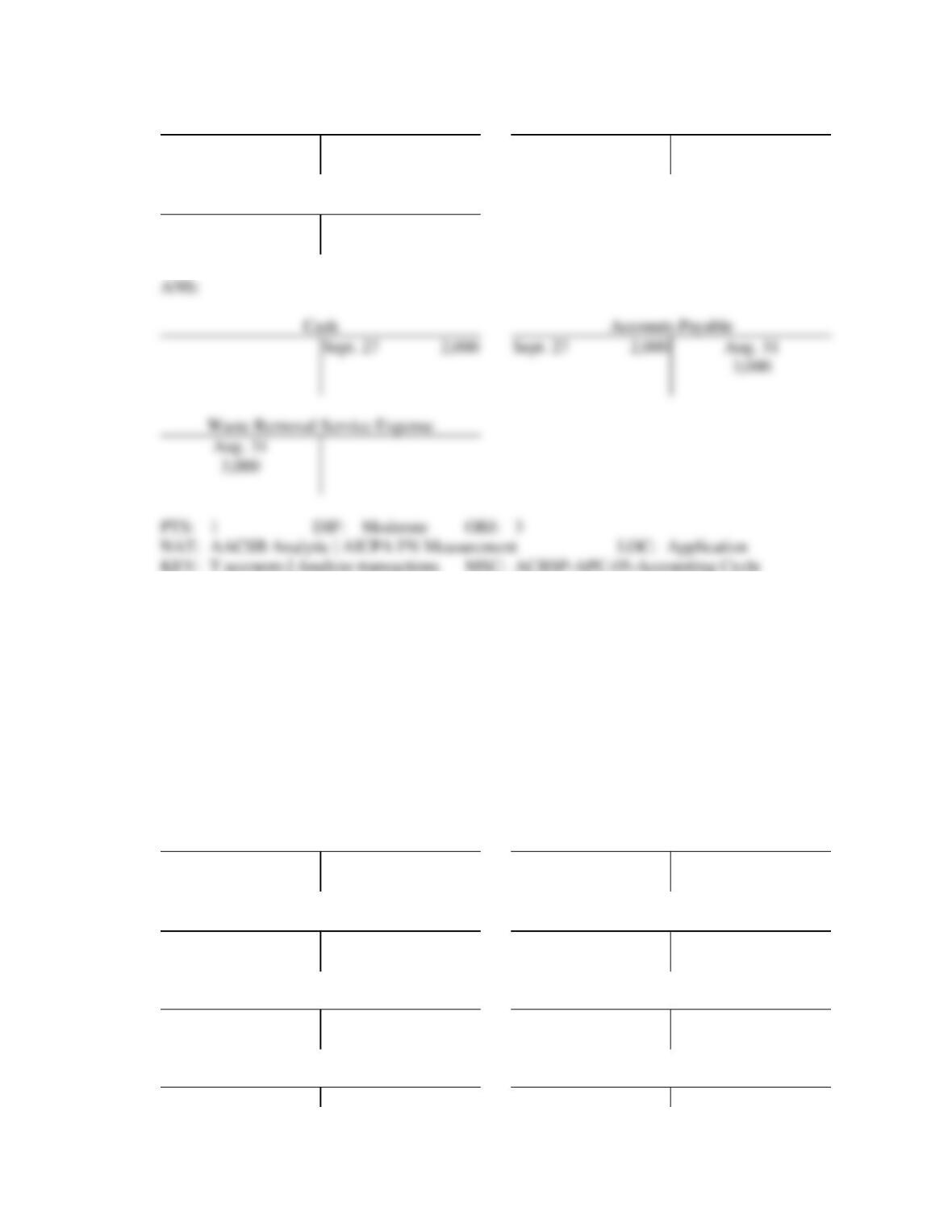
Using T accounts, prepare the corresponding entries in Goble’s records.
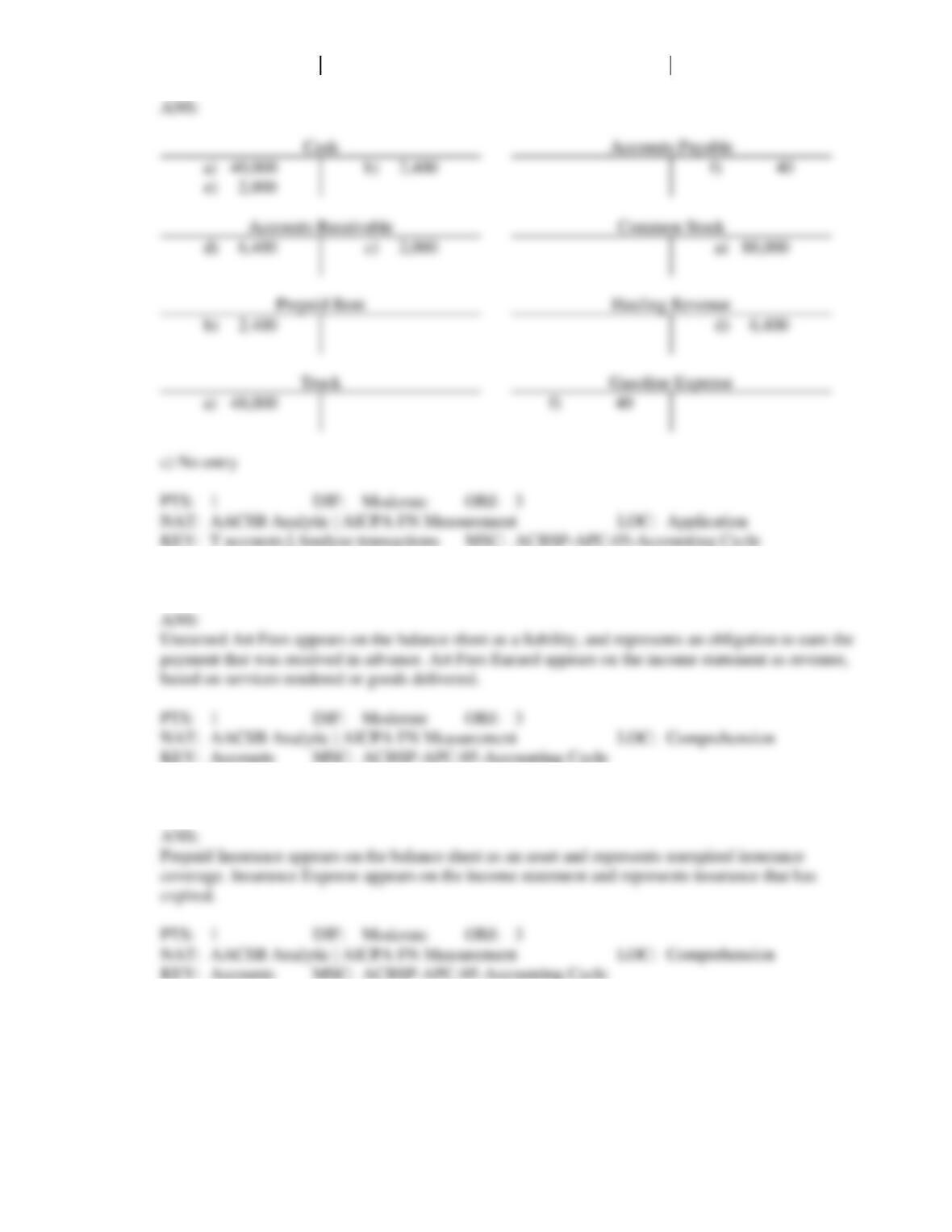
7. Using the T accounts below, record the following transactions. Label each entry with the appropriate
letter.
a. The stockholders contributed cash of $40,000 and a truck worth $48,000 into the business in
exchange for 8,800 shares of $10 par value stock.
b. Paid two months’ rent in advance, $2,400.
c. Agreed to do a hauling job for a price of $6,400.
d. Performed the hauling job. Will get paid later.
e. Received payment of $2,000 on the hauling job.
f. Purchased gasoline on credit, $40.
Cash
Accounts Payable
Accounts Receivable
Common Stock
Prepaid Rent
Hauling Revenue
Truck
Gasoline Expense
Cash
Accounts Payable
8. Briefly explain the difference between Unearned Art Fees and Art Fees Earned.
9. Briefly discuss the differences between Prepaid Insurance and Insurance Expense.
10. By what amount, if any, would each of the following errors cause a trial balance to be out of balance?
a. A purchase of supplies of $840 was recorded as a debit to Equipment and a credit to Cash for $840.
b. An $890 balance in Prepaid Insurance was copied to the trial balance as a debit of $980.
c. A $600 balance in Accounts Payable was copied to the trial balance as a debit of $600.
11. If a debit to Supplies were posted as a credit, and a credit of the same amount to Cash were posted as a
debit, what would be the effect, if any, on the two accounts and on the trial balance column totals?
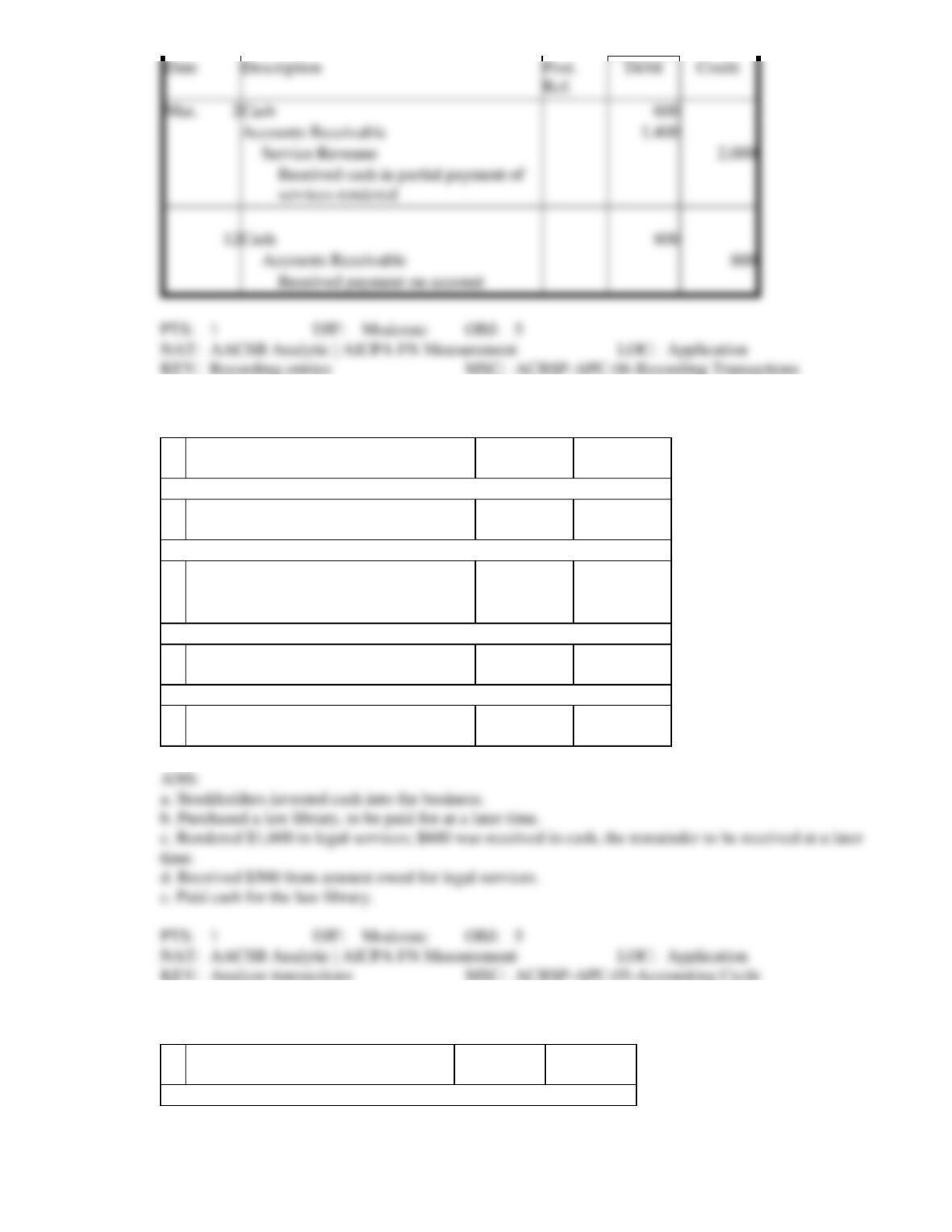
12. Record the following transactions, using proper form, in the journal provided.
Mar.
2
Provided services in the amount of $2,000, receiving $600 in partial payment.
12
Received $800 of the amount owed from March 2.
General Journal
Page 1
Date
Description
Post.
Ref.
Debit
Credit
13. Provide explanations for the following related journal entries:
a.
Cash
6,000
Common Stock
6,000
b.
Law Library
3,400
Accounts Payable
3,400
c.
Cash
600
Accounts Receivable
1,000
Legal Fees Earned
1,600
d.
Cash
500
Accounts Receivable
500
e.
Accounts Payable
3,400
Cash
3,400
14. Provide explanations for the following related journal entries:
a.
Prepaid Rent
4,000
Cash
4,000
Received payment on account
b.
Trucks and Automobile
36,000
Notes Payable
36,000
c.
Cash
600
Accounts Receivable
600
d.
Notes Payable
18,000
Cash
18,000
e.
Cash
2,500
Unearned Fees
2,500
15. Given the following ledger account and postings, complete the Balance column. Assume no previous
postings in the account.
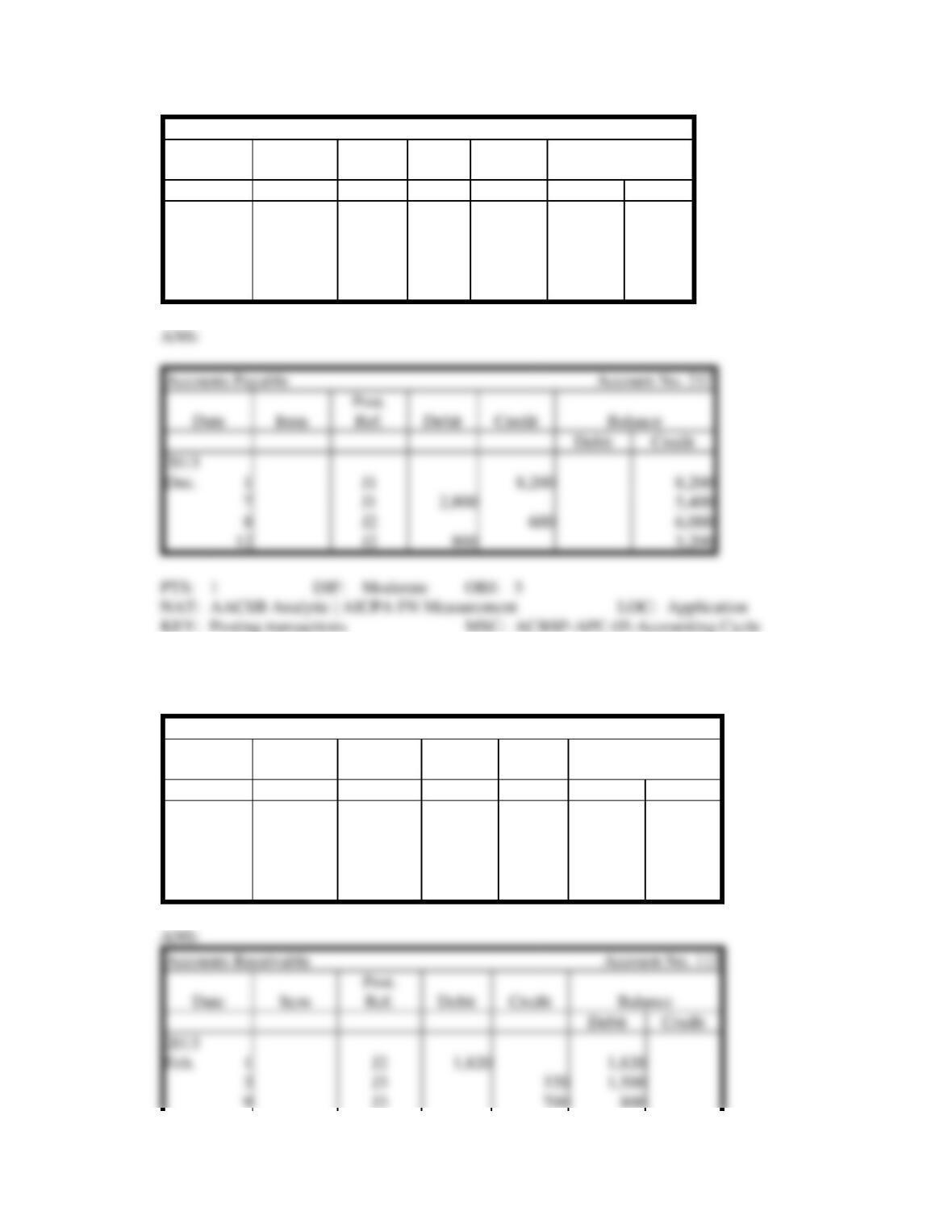
Unearned Fees Revenue
Account No. 214
Date
Item
Post.
Ref.
Debit
Credit
Balance
Debit
Credit
2013
June
3
J1
5,000
10
J1
1,400
12
J2
1,000
16
J2
400
Unearned Fees Revenue
Debit
Credit
2013
June
3
J1
5,000
5,000
10
J1
3,600
12
J2
1,000
4,600
16
J2
4,200
16. Given the following ledger account and postings, complete the Balance column. Assume no previous
postings in the account.
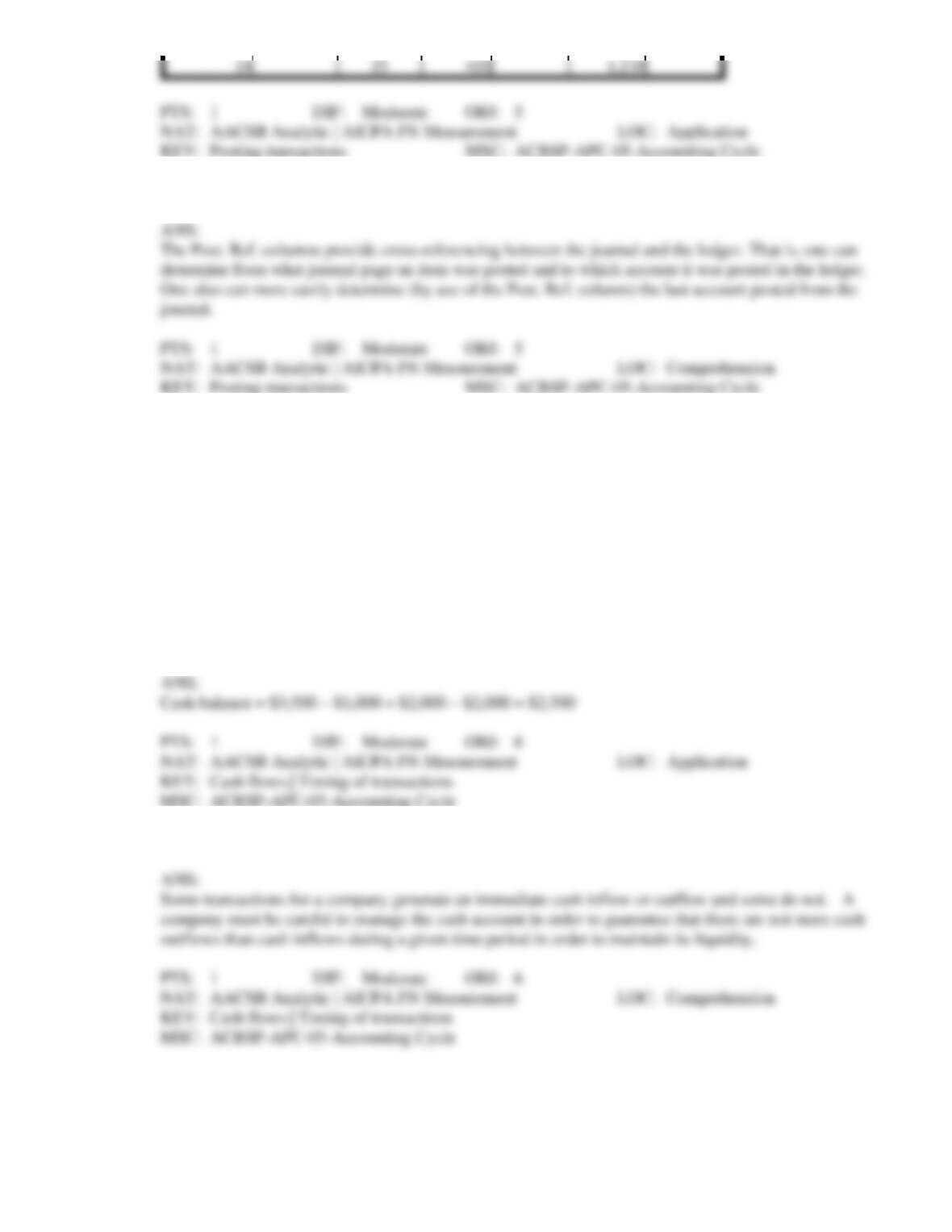
Accounts Payable
Account No. 212
Date
Item
Post.
Ref.
Debit
Credit
Balance
Debit
Credit
2013
Dec.
1
J1
8,200
7
J1
2,800
8
J2
600
12
J2
800
17. Given the following ledger account and postings, complete the Balance column. Assume no previous
postings in the account.
Accounts Receivable
Account No. 113
Date
Item
Post.
Ref.
Debit
Credit
Balance
Debit
Credit
2013
Feb.
1
J2
1,820
3
J3
320
9
J3
700
14
J3
410
Accounts Receivable
Post.
Debit
Credit
2013
Feb.
1
J2
1,820
3
J3
320
1,500
9
J3
700
800
Accounts Payable
Account No. 212
Date
Debit
Credit
2013
Dec.
1
8,200
7
8
600
12
800
18. What two purposes are served by using the Post. Ref. columns of a journal and ledger?
19. Lindsay Company had the following transactions for the month of August.
5
Performed services on credit, $4,000
10
Performed services for cash, $3,500
12
Paid expenses in cash, $1,000
14
Collected on account, $2,000
19
Incurred expenses on credit, $2,500
24
Performed services on credit, $1,200
29
Paid on account, $2,000
Assuming all accounts were zero at the beginning of the month, determine the cash balance after these
transactions.
20. Discuss why a company must pay careful attention to its cash flows and liquidity.
MATCHING
Match each definition with the correct term below.
a.
A journal entry that involves more than two accounts.
b.
A list of account numbers with corresponding account titles.
c.
The difficulty of deciding when a business transaction should be recorded.
d.
The difference in dollars between the total debit footing and the total credit footing.
e.
The chronological accounting record sometimes known as the book of original entry.
f.
The basic storage units for accounting data.
g.
The item that is prepared at the end of the accounting period to test if total debits equals
total credits.
h.
The process of transferring information from the journal to the ledger.
i.
The exchange price of an actual or potential business transaction.
j.
The practice of recording transactions at the exchange price at the point of recognition.
1. Compound entry
2. Accounts
3. Posting
4. Cost principle
5. Chart of accounts
6. Fair value
7. Trial balance
8. Balance
9. Journal
10. Recognition