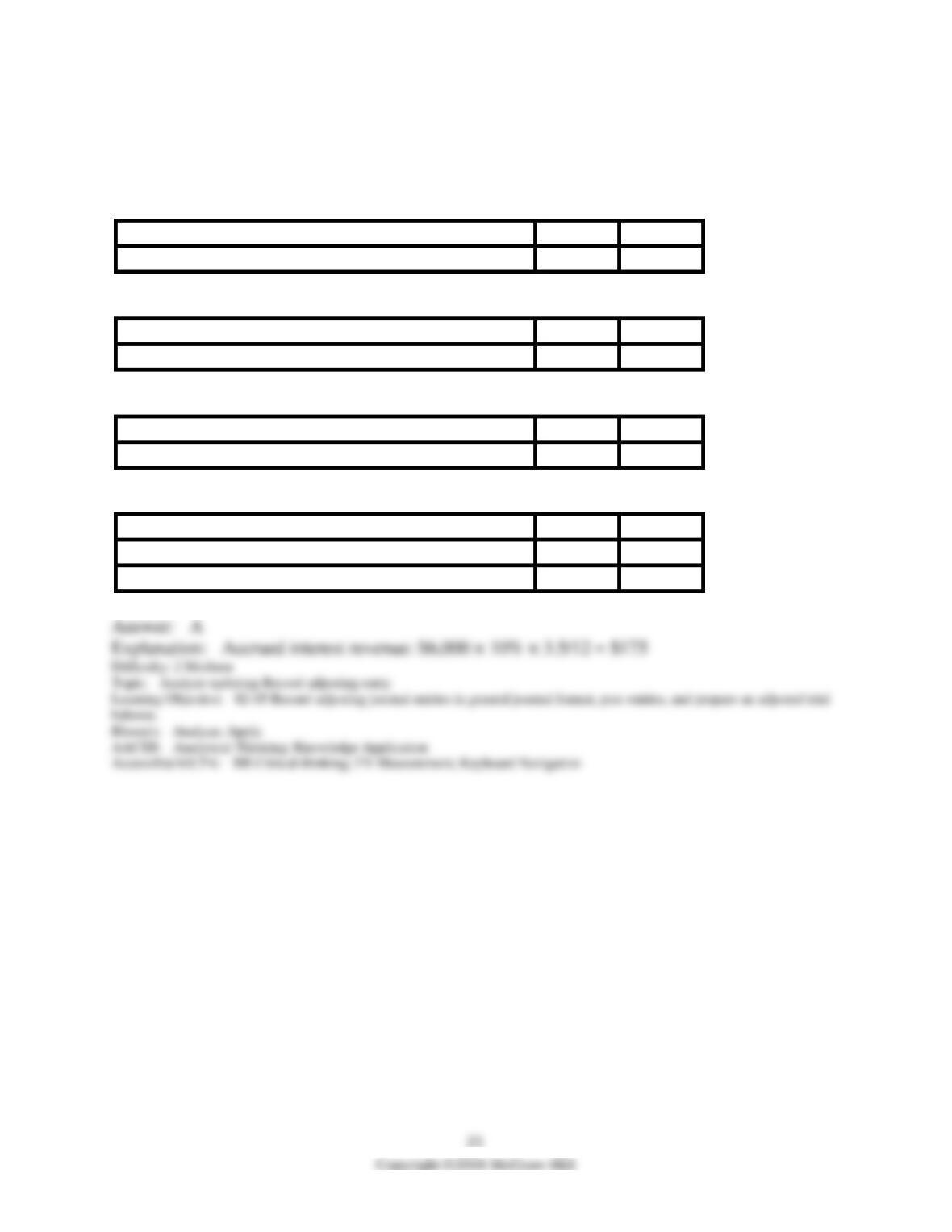
50) On September 15, 2018, Oliver’s Mortuary received a $6,000, nine-month note bearing
interest at an annual rate of 10% from the estate of Jay Hendrix for services rendered. Oliver’s
has a December 31 year-end. What adjusting entry will the company record on December 31,
2018?
A)
Interest receivable
175
Interest revenue
175
B)
Interest receivable
230
Interest revenue
230
C)
Interest receivable
175
Notes receivable
175
D)
Interest receivable
600
Interest revenue
175
Cash
425
51) In its first year of operations Acme Corp. had income before tax of $400,000. Acme made
income tax payments totaling $150,000 during the year and has an income tax rate of 40%. What
is the balance in income tax payable at the end of the year?
A) $160,000 credit.
B) $150,000 credit.
C) $10,000 credit.
D) $10,000 debit.
52) Eve’s Apples opened its business on January 1, 2018, and paid for two insurance policies
effective that date. The liability policy was $36,000 for 18 months, and the crop damage policy
was $12,000 for a two-year term. What is the balance in Eve’s prepaid insurance as of December
31, 2018?
A) $9,000.
B) $18,000.
C) $30,000.
D) $48,000.
53) Fink Insurance collected premiums of $18,000,000 from its customers during the current
year. The adjusted balance in the Deferred premiums account increased from $6 million to $8
million dollars during the year. What is Fink’s revenue from insurance premiums recognized for
the current year?
A) $10,000,000.
B) $16,000,000.
C) $18,000,000.
D) $20,000,000.
54) On November 1, 2018, Tim’s Toys borrows $30,000,000 at 9% to finance the holiday sales
season. The note is for a six-month term and both principal and interest are payable at maturity.
What is the balance of interest payable for the loan as of December 31, 2018?
A) $112,500.
B) $225,000.
C) $450,000.
D) $1,350,000.
55) An economic resource of an entity is:
A) A revenue.
B) An asset.
C) A liability.
D) A contra asset until used.
56) Cost of goods sold is:
A) An asset account.
B) A revenue account.
C) An expense account.
D) A permanent equity account.
57) The balance in retained earnings at the end of the year is determined by retained earnings at
the beginning of the year:
A) Plus revenues, minus liabilities.
B) Plus accruals, minus deferrals.
C) Plus net income, minus dividends.
D) Plus assets, minus liabilities.
58) In its first year of operations Best Corp. had income before tax of $500,000. Best made
income tax payments totaling $210,000 during the year and has an income tax rate of 40%. What
was Best’s net income for the year?
A) $290,000.
B) $294,000.
C) $300,000.
D) $306,000.
59) Dave’s Duds reported cost of goods sold of $2,000,000 this year. The inventory account
increased by $200,000 during the year to an ending balance of $400,000. What was the cost of
merchandise that Dave’s purchased during the year?
A) $1,600,000.
B) $1,800,000.
C) $2,200,000.
D) $2,400,000.
60) Permanent accounts would not include:
A) Interest expense.
B) Salaries and wages payable.
C) Prepaid rent.
D) Deferred revenues.
61) Permanent accounts would not include:
A) Cost of goods sold.
B) Inventory.
C) Current liabilities.
D) Accumulated depreciation.
62) The purpose of closing entries is to transfer:
A) Accounts receivable to retained earnings when an account is fully paid.
B) Balances in temporary accounts to a permanent account.
C) Inventory to cost of goods sold when merchandise is sold.
D) Assets and liabilities when operations are discontinued.
63) Temporary accounts would not include:
A) Salaries payable.
B) Depreciation expense.
C) Supplies expense.
D) Cost of goods sold.
64) When converting an income statement from a cash basis to an accrual basis, expenses:
A) Exceed cash payments to suppliers.
B) Equal cash payments to suppliers.
C) Are less than cash payments to suppliers.
D) May exceed or be less than cash payments to suppliers.
65) When the amount of revenue collected in advance decreases during an accounting period:
A) Accrual-basis revenues exceed cash collections from customers.
B) Accrual-basis net income exceeds cash-basis net income.
C) Accrual-basis revenues are less than cash collections from customers.
D) Accrual-basis net income is less than cash-basis net income.
66) When converting an income statement from a cash basis to an accrual basis, which of the
following is incorrect?
A) An adjustment for depreciation reduces net income.
B) A decrease in salaries payable decreases net income.
C) A reduction in prepaid expenses decreases net income.
D) An increase in accrued payables decreases net income.
67) Molly’s Auto Detailers maintains its records on the cash basis. During 2018, Molly’s
collected $72,000 from customers and paid $21,000 in expenses. Depreciation expense of $5,000
would have been recorded on the accrual basis. Over the course of the year, accounts receivable
increased $4,000, prepaid expenses decreased $2,000, and accrued liabilities decreased $1,000.
Molly’s accrual basis net income was:
A) $38,000.
B) $54,000.
C) $49,000.
D) $42,000.
68) Pat’s Custom Tuxedo Shop maintains its records on the cash basis. During this past year Pat’s
collected $42,000 in tailoring fees, and paid $14,000 in expenses. Depreciation expense totaled
$2,000. Accounts receivable increased $1,500, supplies increased $4,000, and accrued liabilities
increased $2,500. Pat’s accrual basis net income was:
A) $18,000.
B) $34,000.
C) $23,000.
D) $29,000.
69) The Hamada Company sales for 2018 totaled $150,000 and purchases totaled $95,000.
Selected January 1, 2018, balances were: accounts receivable, $18,000; inventory, $14,000; and
accounts payable, $12,000. December 31, 2018, balances were: accounts receivable, $16,000;
inventory, $15,000; and accounts payable, $13,000. Net cash flows from these activities were:
A) $45,000.
B) $55,000.
C) $58,000.
D) $74,000.
70) When the amount of interest receivable decreases during an accounting period:
A) Accrual-basis interest revenue exceeds cash collection from borrowers.
B) Accrual-basis net income exceeds cash-basis net income.
C) Accrual-basis interest revenue is less than cash collection from borrowers.
D) Accrual-basis net income is less than cash-basis net income.
71) When converting an income statement from a cash basis to an accrual basis, cash received
for services:
A) Exceeds service revenue.
B) May exceed or be less than service revenue.
C) Is less than service revenue.
D) Equals service revenue.
72) Compared to the accrual basis of accounting, the cash basis of accounting produces a higher
amount of income by the net decrease during the accounting period of:
Accounts Receivable
Accrued Liabilities
a.
Yes
No
b.
No
Yes
c.
Yes
Yes
d.
No
No
A) Option a
B) Option b
C) Option c
D) Option d
73) On June 1, Royal Corp. began operating a service company with an initial cash investment
by shareholders of $2,000,000. The company provided $6,400,000 of services in June and
received full payment in July. Royal also incurred expenses of $3,000,000 in June that were paid
in August. During June, Royal paid its shareholders cash dividends of $1,000,000. What was the
company’s income before income taxes for the two months ended July 31 under the following
methods of accounting?
Cash Basis
Accrual Basis
a.
$
3,400,000
$
3,400,000
b.
$
5,400,000
$
2,400,000
c.
$
6,400,000
$
3,400,000
d.
$
6,400,000
$
2,400,000
A) Option a
B) Option b
C) Option c
D) Option d
74) When Castle Corporation pays insurance premiums, the transaction is recorded as a debit to
prepaid insurance. Additional information for the year ended December 31 is as follows:
Prepaid insurance at January 1
$
52,500
Insurance expense recognized during the year
218,750
Prepaid insurance at December 31
61,250
What was the total amount of cash paid by Castle for insurance premiums during the year?
A) $218,750
B) $166,250
C) $210,000
D) $227,500
Beg. Bal.
Insurance expense
Cash paid
Bal.
75) The accounting processing cycle:
A) Is a three-wheeled vehicle used to deliver audit papers to clients.
B) deals only with internal transactions.
C) Is the process of bringing the company’s financial information up to date before preparing the
financial statements.
D) Is the process used to identify, analyze, record, and summarize transactions and prepare
financial statements.
Listed below are five terms followed by a list of phrases that describe or characterize each of the
terms. Match each phrase with the correct term.
A) A list of accounts and balances containing the source data for preparation of financial
statements.
B) A list of accounts and their balances prepared before the effects of internal transactions are
recorded.
C) Assets or liabilities created when recognition precedes cash flows.
D) Assets or liabilities created when cash flows precede recognition.
E) A list of only permanent accounts and their balances prepared to show that the accounting
equation is in balance.
76) Prepayments
77) Post-closing trial balance
78) Accruals
79) Unadjusted trial balance
80) Adjusted trial balance
Listed below are five terms followed by a list of phrases that describe or characterize each of the
terms. Match each phrase with the correct term.
A) The last step in the accounting processing cycle.
B) Records internal transactions not previously reported
C) Portrays financial position at a point in time.
D) Represents outflows of resources incurred to generate revenues.
E) Reports operating, investing, and financing activities.
81) Balance sheet
82) Adjusting entries
83) Expenses
84) Statement of cash flows
85) Post-closing trial balance
Listed below are five terms followed by a list of phrases that describe or characterize each of the
terms. Match each phrase with the correct term.
A) Requires adjusting entries to update the inventory account.
B) Recorded when there are dispositions of assets for consideration in excess of book values.
C) Requires entries to cost of goods sold account when merchandise is sold.
D) Recorded when there are dispositions of assets for consideration less than book values.
E) When cash flow precedes either expense or revenue recognition.
86) Periodic system
87) Prepayments
88) Perpetual system
89) Losses
90) Gains
Difficulty: 2 Medium
Topic: Accounting equation; Analyze transaction-Record journal entry; Analyze updating-Identify type of adjustment
Learning Objective: 02-02 Record transactions using the general journal format; 02-05 Record adjusting journal entries in
general journal format; post entries; and prepare an adjusted trial balance.
Bloom’s: Understand
AACSB: Reflective Thinking
Accessible/AICPA: BB Critical thinking
Listed below are five terms followed by a list of phrases that describe or characterize each of the
terms. Match each phrase with the correct term.
A) Contains all the accounts of an entity.
B) Refers to the right side of an account.
C) Asset and expense accounts normally have this type of balance.
D) Used to record any type of transaction in chronological order.
E) Used to reset temporary accounts to a zero balance.
91) General ledger
92) Credit
93) General journal
94) Debit
95) Closing entries
Listed below are five terms followed by a list of phrases that describe or characterize each of the
terms. Match each phrase with the correct term.
A) Used to record repetitive types of transactions.
B) Record chronologically the effects of transactions in debit/credit form.
C) Refers to nonowner claims against the assets of a firm.
D) Transfer balances from journals to ledgers.
E) Represents the cumulative amount of net income, less distributions to shareholders.
96) Liabilities
97) Retained earnings
98) Journalize
99) Post
100) Special journals
Listed below are five terms followed by a list of phrases that describe or characterize each of the
terms. Match each phrase with the correct term.
A) Used to identify external transactions
B) Refers to inflows of assets from the sale of goods and services.
C) Determines the effects of an event in terms of the accounting equation.
D) Used to record repetitive types of transactions.
E) Liabilities created by a customer’s prepayment.
101) Source documents
102) Revenues
103) Transaction analysis
104) Deferred revenues
105) Special journals