CHAPTER 2
CONCEPTUAL FRAMEWORK FOR FINANCIAL
REPORTING
IFRS questions are available at the end of this chapter.
TRUE-FALSE—Conceptual
Answer No. Description
MULTIPLE CHOICE—Conceptual
Answer No. Description
Test Bank for Intermediate Accounting, Fifteenth Edition
2 – 2
MULTIPLE CHOICE—Conceptual (cont.)
Answer No. Description
Conceptual Framework Underlying Financial Accounting
2 – 3
MULTIPLE CHOICE—Conceptual (cont.)
Answer No. Description
Test Bank for Intermediate Accounting, Fifteenth Edition
2 – 4
MULTIPLE CHOICE—CPA Adapted
BRIEF EXERCISES
EXERCISES
CHAPTER LEARNING OBJECTIVES
1. Describe the usefulness of a conceptual framework.
2. Describe the FASB’s efforts to construct a conceptual framework.
3. Understand the objective of financial reporting.
4. Identify the qualitative characteristics of accounting information.
5. Define the basic elements of financial statements.
6. Describe the basic assumptions of accounting.
7. Explain the application of the basic principles of accounting.

Conceptual Framework Underlying Financial Accounting
2 – 5
8. Describe the impact that the cost constraint has on reporting accounting information.
9. Compare the conceptual frameworks underlying GAAP and IFRS.

Test Bank for Intermediate Accounting, Fifteenth Edition
2 – 6
SUMMARY OF LEARNING OBJECTIVES BY QUESTIONS
Item
Type
Item
Type
Item
Type
Item
Type
Item
Type
Item
Type
Item
Type
Learning Objective 1
1.
TF
21.
MC
23.
MC
S25.
MC
2.
TF
22.
MC
24.
MC
134.
E
Learning Objective 2
3.
TF
4.
TF
5.
TF
26.
MC
94.
E
Learning Objective 3
6.
TF
27.
MC
P29.
MC
7.
TF
28.
MC
134.
BE
Learning Objective 4
8.
TF
32.
MC
38.
MC
44.
MC
50.
MC
56.
MC
136.
BE
9.
TF
33.
MC
39.
MC
45.
MC
51.
MC
57.
MC
137.
E
10.
TF
34.
MC
40.
MC
46.
MC
52.
MC
58.
MC
138.
E
11.
TF
35.
MC
41.
MC
47.
MC
53.
MC
125.
MC
30.
MC
36.
MC
42.
MC
48.
MC
54.
MC
126.
MC
31.
MC
37.
MC
43.
MC
49.
MC
55.
MC
135.
BE
Learning Objective 5
12.
TF
60.
MC
63.
MC
S66.
MC
69.
MC
128.
MC
131.
MC
13.
TF
61.
MC
P64.
MC
67.
MC
70.
MC
129.
MC
132.
MC
59.
MC
62.
MC
S65.
MC
68.
MC
127.
MC
130.
MC
Learning Objective 6
14.
TF
72.
MC
S75.
MC
78.
MC
81.
MC
135.
BE
140.
E
15.
TF
73.
MC
S76.
MC
79.
MC
82.
MC
138.
E
71.
MC
74.
MC
77.
MC
80.
MC
83.
MC
139.
E
Learning Objective 7
16.
TF
87.
MC
93.
MC
99.
MC
105.
MC
136.
BE
17.
TF
88.
MC
94.
MC
100.
MC
106.
MC
137.
E
18.
TF
89.
MC
95.
MC
101.
MC
107.
MC
138.
E
84.
MC
90.
MC
96.
MC
102.
MC
108.
MC
140.
E
85.
MC
91.
MC
97.
MC
103.
MC
133.
MC
141.
E
86.
MC
92.
MC
98.
MC
104.
MC
135.
BE
Learning Objective 8
19.
TF
110.
MC
113.
MC
116.
MC
119.
MC
122.
MC
135.
BE
20.
TF
111.
MC
114.
MC
117.
MC
120.
MC
123.
MC
136.
BE
109.
MC
112.
MC
115.
MC
118.
MC
121.
MC
P124.
MC
Learning Objective 9 – IFRS Questions
1.
TF
2.
TF
3.
TF
4.
TF
5.
TF
6.
TF
7.
TF
8.
TF
9.
TF
10.
TF
11.
MC
12.
MC
13.
MC
14.
MC
15.
MC
16.
SA
17.
SA
Note: TF = True-False SA = Short Answer
MC = Multiple Choice BE = Brief Exercises
E = Exercise

Conceptual Framework Underlying Financial Accounting
2 – 7
TRUE-FALSE—Conceptual
1. A soundly developed conceptual framework enables the FASB to issue more useful and
consistent pronouncements over time.
2. A conceptual framework is a coherent system of concepts that flow from an objective.
3. The first level of the conceptual framework identifies the recognition, measurement, and
disclosure concepts used in establishing accounting standards.
4. The IASB has issued a conceptual framework and has agreed to develop a common
conceptual framework with the FASB.
5. Although the FASB has developed a conceptual framework, no Statements of Financial
Accounting Concepts have been issued to date.
6. The objective of financial reporting is the foundation of the conceptual framework.
7. Users of financial statements are assumed to need no knowledge of business and financial
accounting matters to understand information contained in financial statements.
8. Relevance and faithful representation are the two primary qualities that make accounting
information useful for decision making.
9. The idea of consistency does not mean that companies cannot switch from one accounting
method to another.
10. Timeliness and neutrality are two ingredients of relevance.
11. Verifiability and predictive value are two ingredients of faithful representation.
12. Revenues, gains, and distributions to owners all increase equity.
13. Comprehensive income includes all changes in equity during a period except those
resulting from investments by owners and distributions to owners.
14. The historical cost principle would be of limited usefulness if not for the going concern
assumption.
15. The economic entity assumption means that economic activity can be identified with a
particular legal entity.
16. The expense recognition principle states that debits must equal credits in each transaction.
17. Revenues are recognized in the accounting period in which the performance obligation is
satisfied.
18. Supplementary information may include details or amounts that present a different
perspective from that adopted in the financial statements.

Test Bank for Intermediate Accounting, Fifteenth Edition
2 – 8
19. In order to justify requiring a particular measurement or disclosure, the benefits to be
derived from it must equal the costs associated with it.
20. Prudence or conservatism means when in doubt, choose the solution that will be least likely
to overstate liabilities or expenses.
True False Answers—Conceptual
Item
Ans.
Item
Ans.
Item
Ans.
Item
Ans.
MULTIPLE CHOICE—Conceptual
21. Generally accepted accounting principles
a. are fundamental truths or axioms that can be derived from laws of nature.
b. derive their authority from legal court proceedings.
c. derive their credibility and authority from general recognition and acceptance by the
accounting profession.
d. have been specified in detail in the FASB conceptual framework.
22. A soundly developed conceptual framework of concepts and objectives should
a. increase financial statement users’ understanding of and confidence in financial
reporting.
b. enhance comparability among companies’ financial statements.
c. allow new and emerging practical problems to be more quickly solved.
d. All of these answer choices are correct.
23. Which of the following is not true concerning a conceptual framework in accounting?
a. It should be a basis for standard-setting.
b. It should allow practical problems to be solved more quickly by reference to it.
c. It should be based on fundamental truths that are derived from the laws of nature.
d. All of these answer choices are true.
24. What is a purpose of having a conceptual framework?
a. To enable the profession to more quickly solve emerging practical problems.
b. To provide a foundation from which to build more useful standards.
c. Neither a nor b.
d. To enable the profession to more quickly solve emerging practical problems and to
provide a foundation from which to build more useful standards.

Conceptual Framework Underlying Financial Accounting
2 – 9
S25. Which of the following is not a benefit associated with the FASB Conceptual Framework
Project?
a. A conceptual framework should increase financial statement users’ understanding of
and confidence in financial reporting.
b. Practical problems should be more quickly solvable by reference to an existing
conceptual framework.
c. A coherent set of accounting standards and rules should result.
d. Business entities will need far less assistance from accountants because the financial
reporting process will be quite easy to apply.
26. In the conceptual framework for financial reporting, what provides “the why”—the purpose
of accounting?
a. Recognition, measurement, and disclosure concepts such as assumptions, principles,
and constraints
b. Qualitative characteristics of accounting information
c. Elements of financial statements
d. Objective of financial reporting
27. The underlying theme of the conceptual framework is
a. decision usefulness.
b. understandability.
c. faithful representation.
d. comparability.
28. The objective of general-purpose financial reporting is to provide financial information
about a reporting entity to each of the following except
a. potential equity investors.
b. potential lenders.
c. present investors.
d. All of these answers are correct.
29. What is the primary objective of financial reporting as indicated in the conceptual
framework?
a. Provide information that is useful to those making investing and credit decisions.
b. Provide information that is useful to management.
c. Provide information about those investing in the entity.
d. All of these answer choices are correct.
P30. If the LIFO inventory method was used last period, it should be used for the current and
following periods because of
a. comparability.
b. materiality.
c. timeliness.
d. verifiability.

Test Bank for Intermediate Accounting, Fifteenth Edition
2 – 10
S31. What is the following is a characteristic describing the primary quality of relevance?
a. Predictive value.
b. Materiality.
c. Verifiability.
d. Understandability.
32. Which of the following is a fundamental quality of useful accounting information?
a. Comparability.
b. Relevance.
c. Neutrality.
d. Materiality.
33. Which of the following is a primary quality of useful accounting information?
a. Conservatism.
b. Comparability.
c. Faithful representation.
d. Consistency.
34. What is meant by comparability when discussing financial accounting information?
a. Information has predictive or confirmatory value.
b. Information is reasonably free from error.
c. Information that is measured and reported in a similar fashion across companies.
d. Information is timely.
35. What is meant by consistency when discussing financial accounting information?
a. Information that is measured and reported in a similar fashion across points in time.
b. Information is timely.
c. Information is measured similarly across the industry.
d. Information is verifiable.
36. Which of the following is an ingredient of relevance?
a. Verifiability.
b. Neutrality.
c. Timeliness.
d. Materiality.
37. Which of the following is an ingredient of faithful representation?
a. Predictive value.
b. Materiality.
c. Neutrality.
d. Confirmatory value.
38. Changing the method of inventory valuation should be reported in the financial statements
under what qualitative characteristic of accounting information?
a. Consistency.
b. Verifiability.
c. Timeliness.
d. Comparability.
39. Company A issuing its annual financial reports within one month of the end of the year is
an example of which enhancing quality of accounting information?
a. Comparability.

Conceptual Framework Underlying Financial Accounting
2 – 11
b. Timeliness.
c. Understandability.
d. Verifiability.
40. What is the quality of information that is capable of making a difference in a decision?
a. Faithful representation.
b. Materiality.
c. Timeliness.
d. Relevance.
41. Neutrality is an ingredient of which fundamental quality of information?
a. Faithful representation.
b. Comparability.
c. Relevance.
d. Understandability.
42. If the FIFO inventory method was used last period, it should be used for the current and
following periods because of
a. relevance.
b. neutrality.
c. understandability.
d. consistency.
43. The pervasive criterion by which accounting information can be judged is that of
a. decision usefulness.
b. freedom from bias.
c. timeliness.
d. comparability.
44. The two fundamental qualities that make accounting information useful for decision
making are
a. comparability and timeliness.
b. materiality and neutrality.
c. relevance and faithful representation.
d. faithful representation and comparability.
45. Accounting information is considered to be relevant when it
a. can be depended on to represent the economic conditions and events that it is
intended to represent.
b. is capable of making a difference in a decision.
c. is understandable by reasonably informed users of accounting information.
d. is verifiable and neutral.
46. The quality of information that means the numbers and descriptions match what really
existed or happened is
a. relevance.
b. faithful representation.
c. completeness.
d. neutrality.

Test Bank for Intermediate Accounting, Fifteenth Edition
2 – 12
47. Which of the following does not relate to relevance?
a. Materiality
b. Predictive value
c. Confirmatory value
d. All of these answer choices relate to relevance.
48. According to Statement of Financial Accounting Concepts No. 2, materiality is an ingredient
of the fundamental quality of
Relevance Faithful Representation
a. Yes Yes
b. No Yes
c. Yes No
d. No No
49. According to Statement of Financial Accounting Concepts No. 2, completeness is an
ingredient of the fundamental quality of
Relevance Faithful Representation
a. Yes No
b. Yes Yes
c. No No
d. No Yes
50. According to Statement of Financial Accounting Concepts No. 2, neutrality is an ingredient
of the fundamental quality of
Relevance Faithful Representation
a. Yes Yes
b. No Yes
c. Yes No
d. No No
51. Neutrality means that information
a. provides benefits which are at least equal to the costs of its preparation.
b. can be compared with similar information about an enterprise at other points in time.
c. would have no impact on a decision maker.
d. cannot favor one set of interested parties over another.
52. The characteristic that is demonstrated when a high degree of consensus can be secured
among independent measurers using the same measurement methods is
a. relevance.
b. faithful representation.
c. verifiability.
d. neutrality.
53. According to Statement of Financial Accounting Concepts No. 2, predictive value is an
ingredient of the fundamental quality of
Relevance Faithful Representation
a. Yes No
b. Yes Yes
c. No No
d. No Yes

Conceptual Framework Underlying Financial Accounting
2 – 13
54. Under Statement of Financial Accounting Concepts No. 2, free from error is an ingredient
of the fundamental quality of
Faithful Representation Relevance
a. Yes Yes
b. No Yes
c. Yes No
d. No No
55. Financial information demonstrates consistency when
a. firms in the same industry use different accounting methods to account for the same
type of transaction.
b. a company changes its estimate of the salvage value of a fixed asset.
c. a company fails to adjust its financial statements for changes in the value of the
measuring unit.
d. None of these answer choices are correct.
56. Financial information exhibits the characteristic of consistency when
a. expenses are reported as charges against revenue in the period in which they are paid.
b. a company applies the same accounting treatment to similar events, from period to
period.
c. extraordinary gains and losses are not included on the income statement.
d. accounting procedures are adopted which give a consistent rate of net income.
57. Information about different companies and about different periods of the same company
can be prepared and presented in a similar manner. Comparability and consistency are
related to which of these objectives?
Comparability Consistency
a. Companies Companies
b. Companies Periods
c. Periods Companies
d. Periods Periods
58. When information about two different enterprises has been prepared and presented in a
similar manner, the information exhibits the characteristic of
a. relevance.
b. faithful representation.
c. consistency.
d. None of these answer choices are correct.
59. The elements of financial statements include investments by owners. These are increases
in an entity’s net assets resulting from owners’
a. transfers of assets to the entity.
b. rendering services to the entity.
c. satisfaction of liabilities of the entity.
d. All of these answer choices are correct.
60. In classifying the elements of financial statements, the primary distinction between
revenues and gains is
a. the materiality of the amounts involved.
b. the likelihood that the transactions involved will recur in the future.
c. the nature of the activities that gave rise to the transactions involved.
d. the costs versus the benefits of the alternative methods of disclosing the transactions
involved.

Test Bank for Intermediate Accounting, Fifteenth Edition
2 – 14
61. A decrease in net assets arising from peripheral or incidental transactions is called a(n)
a. capital expenditure.
b. cost.
c. loss.
d. expense.
62. One of the elements of financial statements is comprehensive income. As described in
Statement of Financial Accounting Concepts No. 6, “Elements of Financial Statements,”
comprehensive income is equal to
a. revenues minus expenses plus gains minus losses.
b. revenues minus expenses plus gains minus losses plus investments by owners minus
distributions to owners.
c. revenues minus expenses plus gains minus losses plus investments by owners minus
distributions to owners plus assets minus liabilities.
d. None of these answer choices are correct.
63. Which of the following elements of financial statements is not a component of
comprehensive income?
a. Revenues
b. Distributions to owners
c. Losses
d. Expenses
P64. The calculation of comprehensive income includes which of the following?
Operating Income Distributions to Owners
a. Yes Yes
b. No No
c. No Yes
d. Yes No
S65. According to the FASB conceptual framework, which of the following elements describes
transactions or events that affect a company during a period of time?
a. Assets.
b. Expenses.
c. Equity.
d. Liabilities.
S66. According to the FASB Conceptual Framework, the elements⎯assets, liabilities, and
equity⎯describe amounts of resources and claims to resources at/during a
Moment in Time Period of Time
a. Yes No
b. Yes Yes
c. No Yes
d. No No
67. Which of the following is not a basic element of financial statements?
a. Assets.
b. Balance sheet.
c. Losses.
d. Revenue.

Conceptual Framework Underlying Financial Accounting
2 – 15
68. Which of the following basic elements of financial statements is more associated with the
balance sheet than the income statement?
a. Equity.
b. Revenue.
c. Gains.
d. Expenses.
69. Issuance of common stock for cash affects which basic element of financial statements?
a. Revenues.
b. Losses.
c. Liabilities.
d. Equity.
70. Which basic element of financial statements arises from peripheral or incidental
transactions?
a. Assets.
b. Liabilities.
c. Gains.
d. Expenses.
71. Which of the following is not a basic assumption underlying the financial accounting
structure?
a. Economic entity assumption.
b. Going concern assumption.
c. Periodicity assumption.
d. Historical cost assumption.
72. Which basic assumption is illustrated when a firm reports financial results on an annual
basis?
a. Economic entity assumption.
b. Going concern assumption.
c. Periodicity assumption.
d. Monetary unit assumption.
73. Which basic assumption may not be followed when a firm in bankruptcy reports financial
results?
a. Economic entity assumption.
b. Going concern assumption.
c. Periodicity assumption.
d. Monetary unit assumption.
74. Which accounting assumption or principle is being violated if a company provides financial
reports only when it introduces a new product?
a. Economic entity.
b. Periodicity.
c. Revenue recognition.
d. Full disclosure.

Test Bank for Intermediate Accounting, Fifteenth Edition
2 – 16
S75. Which of the following basic accounting assumptions is threatened by the existence of
severe inflation in the economy?
a. Monetary unit assumption.
b. Periodicity assumption.
c. Going-concern assumption.
d. Economic entity assumption.
S76. During the lifetime of an entity accountants produce financial statements at artificial points
in time in accordance with the concept of
Relevance Periodicity
a. No No
b. Yes No
c. No Yes
d. Yes Yes
77. Under current GAAP, inflation is ignored in accounting due to the
a. economic entity assumption.
b. going concern assumption.
c. monetary unit assumption.
d. periodicity assumption.
78. The economic entity assumption
a. is inapplicable to unincorporated businesses.
b. recognizes the legal aspects of business organizations.
c. requires periodic income measurement.
d. is applicable to all forms of business organizations.
79. Preparation of consolidated financial statements when a parent-subsidiary relationship
exists is an example of the
a. economic entity assumption.
b. relevance characteristic.
c. comparability characteristic.
d. neutrality characteristic.
80. During the lifetime of an entity, accountants produce financial statements at arbitrary
points in time in accordance with which basic accounting concept?
a. Cost constraint
b. Periodicity assumption
c. Conservatism constraint
d. Expense recognition principle
81. What accounting concept justifies the usage of depreciation and amortization policies?
a. Going concern assumption
b. Fair value principle
c. Full disclosure principle
d. Monetary unit assumption

Conceptual Framework Underlying Financial Accounting
2 – 17
82. The assumption that a company will not be sold or liquidated in the near future is known
as the
a. economic entity assumption.
b. monetary unit assumption.
c. periodicity assumption.
d. None of these answer choices are correct.
83. Which of the following is an implication of the going concern assumption?
a. The historical cost principle is credible.
b. Depreciation and amortization policies are justifiable and appropriate.
c. The current-noncurrent classification of assets and liabilities is justifiable and
significant.
d. All of these.
84. Proponents of historical cost ordinarily maintain that in comparison with all other valuation
alternatives for general purpose financial reporting, statements prepared using historical
costs are more
a. verifiable.
b. relevant.
c. indicative of the entity’s purchasing power.
d. conservative.
85. Valuing assets at their liquidation values rather than their cost is inconsistent with the
a. periodicity assumption.
b. expense recognition principle.
c. materiality constraint.
d. historical cost principle.
86. Revenue is recognized in the accounting period in which the performance obligation is
satisfied. This statement describes the
a. consistency characteristic.
b. expense recognition principle.
c. revenue recognition principle.
d. relevance characteristic.
87. Generally, revenue from sales should be recognized at a point when
a. management decides it is appropriate to do so.
b. the product is available for sale to the ultimate consumer.
c. the entire amount receivable has been collected from the customer and there remains
no further warranty liability.
d. None of these answer choices are correct.
88. Revenue generally should be recognized
a. at the end of production.
b. at the time of cash collection.
c. when realized.
d. when the performance obligation is satisfied.

Test Bank for Intermediate Accounting, Fifteenth Edition
2 – 18
89. The measurement principle includes the
a. fair value principle only.
b. historical cost principle only.
c. revenue recognition principle and expense recognition principle.
d. historical cost principle and the fair value principle.
90. Which of the following is commonly referred to as the matching principle?
a. Revenue recognition principle
b. Measurement principle
c. Expense recognition principle
d. Full disclosure principle
91. Product costs include each of the following except
a. overhead.
b. officer’s salaries.
c. material.
d. labor.
92. The allowance for doubtful accounts, which appears as a deduction from accounts
receivable on a balance sheet and which is based on an estimate of bad debts, is an
application of the
a. consistency characteristic.
b. expense recognition principle.
c. materiality quality.
d. revenue recognition principle.
93. The accounting principle of expense recognition is best demonstrated by
a. not recognizing any expense unless some revenue is realized.
b. associating effort (expense) with accomplishment (revenue).
c. recognizing prepaid rent received as revenue.
d. establishing an Appropriation for Contingencies account.
94. Which of the following serves as the justification for the periodic recording of depreciation
expense?
a. Association of efforts (expense) with accomplishments (revenue)
b. Systematic and rational allocation of cost over the periods benefited
c. Immediate recognition of an expense
d. Minimization of income tax liability
95. Application of the full disclosure principle
a. is theoretically desirable but not practical because the costs of complete disclosure
exceed the benefits.
b. is violated when important financial information is buried in the notes to the financial
statements.
c. is demonstrated by the use of supplementary information explaining the effects of
financing arrangements.
d. requires that the financial statements be consistent and comparable.

Conceptual Framework Underlying Financial Accounting
2 – 19
96. Which of the following is an argument against using historical cost in accounting?
a. Fair values are more relevant.
b. Historical costs are based on an exchange transaction.
c. Historical costs are reliable.
d. Fair values are subjective.
97. When is revenue generally recognized?
a. When cash is received.
b. When the warranty expires.
c. When production is completed.
d. When the company satisfies the performance obligation.
98. Which of the following is a component of the revenue recognition principle?
a. Cash is received and the amount is material.
b. Recognition occurs when the performance obligation is satisfied.
c. Production is complete and there is an active market for the product.
d. Cash is realized or realizable and production is complete.
99. A company has a performance obligation when it agrees to
a. perform a service for a customer and receives cash payment.
b. sell a product to a customer after receiving payment.
c. perform a service or sell a product to a customer.
d. None of the answer choices are correct.
100. Which of the following is not a required component of financial statements prepared in
accordance with generally accepted accounting principles?
a. President’s letter to shareholders.
b. Balance sheet.
c. Income statement.
d. Notes to financial statements.
101. What is the general approach as to when product costs are recognized as expenses?
a. In the period when the expenses are paid.
b. In the period when the expenses are incurred.
c. In the period when the vendor invoice is received.
d. In the period when the related revenue is recognized.
102. Not adjusting the amounts reported in the financial statements for inflation is an example
of which basic principle of accounting?
a. Economic entity.
b. Going concern.
c. Historical cost.
d. Full disclosure.
103. Recognition of expense related to amortization of an intangible asset illustrates which
principle of accounting?
a. Expense recognition.
b. Full disclosure.
c. Revenue recognition.
d. Historical cost.

Test Bank for Intermediate Accounting, Fifteenth Edition
2 – 20
104. When should an expenditure be recorded as an asset rather than an expense?
a. Never.
b. Always.
c. If the amount is material.
d. When future benefit exists.
105. Which accounting assumption or principle is being violated if a company reports its
corporate headquarter building at its fair value on the balance sheet?
a. Going concern.
b. Monetary unit.
c. Historical cost.
d. Full disclosure.
106. Which accounting assumption or principle is being violated if a company is a party to
major litigation that it may lose and decides not to include the information in the financial
statements because it may have a negative impact on the company’s stock price?
a. Full disclosure.
b. Going concern.
c. Historical cost.
d. Expense recognition.
107. Which assumption or principle requires that all information significant enough to affect a
decision of reasonably informed users should be reported in the financial statements?
a. Matching.
b. Going concern.
c. Historical cost.
d. Full disclosure.
108. A company has a factory building that originally cost the company $250,000. The current
fair value of the factory building is $3 million. The president would like to report the
difference as a gain. The write-up would represent a violation of which accounting
assumption or principle?
a. Revenue recognition.
b. Going concern.
c. Historical cost.
d. Monetary unit.
109. Which of the following is a constraint in presenting financial information?
a. Cost-benefit relationship.
b. Full disclosure.
c. Relevance.
d. Consistency.
110. All of the following represent costs of providing financial information except
a. preparing.
b. disseminating.
c. accessing capital.
d. auditing.

Conceptual Framework Underlying Financial Accounting
2 – 21
111. Which of the following is a benefit of providing financial information?
a. Potential litigation.
b. Auditing.
c. Disclosure to competition.
d. Improved allocation of resources.
112. Where is materiality not used in providing financial information?
a. Applying the revenue recognition principle.
b. Determining what items to include in the financial statements.
c. Applying the going concern assumption.
d. Determining the level of disclosure.
113. What is prudence or conservatism?
a. Understating assets and net income.
b. When in doubt, recognizing the option that is least likely to overstate assets and
income.
c. Recognizing the option that is least likely to overstate assets and income.
d. Recognizing revenue when earned and realized.
114. Expensing the cost of copy paper when the paper is acquired is an example
a. materiality.
b. expense recognition.
c. conservatism.
d. industry practices.
115. Which of the following statements concerning the cost-benefit relationship is not true?
a. Business reporting should exclude information outside of management’s expertise.
b. Management should not be required to report information that would significantly harm
the company’s competitive position.
c. Management should not be required to provide forecasted financial information.
d. If needed by financial statement users, management should gather information not
included in the financial statements that would not otherwise be gathered for internal
use.
116. Which of the following relates to both relevance and faithful representation?
a. Cost constraint
b. Predictive value
c. Verifiability
d. Neutrality
117. Charging off the cost of a wastebasket with an estimated useful life of 10 years as an
expense of the period when purchased is an example of the application of the
a. consistency characteristic.
b. expense recognition principle.
c. materiality quality.
d. historical cost principle.

Test Bank for Intermediate Accounting, Fifteenth Edition
2 – 22
118. Which of the following statements about materiality is correct?
a. An item must make a difference or it need not be disclosed.
b. Materiality is a matter of relative size or importance.
c. An item is material if its inclusion or omission would influence or change the judgment
of a reasonable person.
d. All of these answers are correct.
119. Which of the following is considered a pervasive constraint by Statement of Financial
Accounting Concepts No. 8?
a. Conservatism
b. Timeliness
c. Verifiability
d. Cost-constraint
120. The basic accounting concept that refers to the tendency of accountants to resolve
uncertainty in favor of understating assets and revenues and overstating liabilities and
expenses is known as
a. prudence or conservatism.
b. the materiality concept.
c. the substance over form principle.
d. the industry practices concept.
121. The second level of the conceptual framework includes each of the following except
a. elements.
b. principles.
c. enhancing qualities.
d. fundamental qualities.
122. Trade-offs between the characteristics that make information useful may be necessary or
beneficial. Issuance of interim financial statements is an example of a trade–off between
a. relevance and faithful representation.
b. faithful representation and periodicity.
c. timeliness and materiality.
d. understandability and timeliness.
123. Allowing firms to estimate rather than physically count inventory at interim (quarterly)
periods is an example of a trade-off between
a. verifiability and faithful representation.
b. faithful representation and comparability.
c. timeliness and verifiability.
d. neutrality and consistency.
P124. In matters of doubt and great uncertainty, accounting issues should be resolved by
choosing the alternative that has the least favorable effect on net income, assets, and
owners’ equity. This guidance comes from
a. the cost constraint.
b. the industry practices constraint.
c. prudence or conservatism.
d. the full disclosure principle.
Conceptual Framework Underlying Financial Accounting
2 – 23
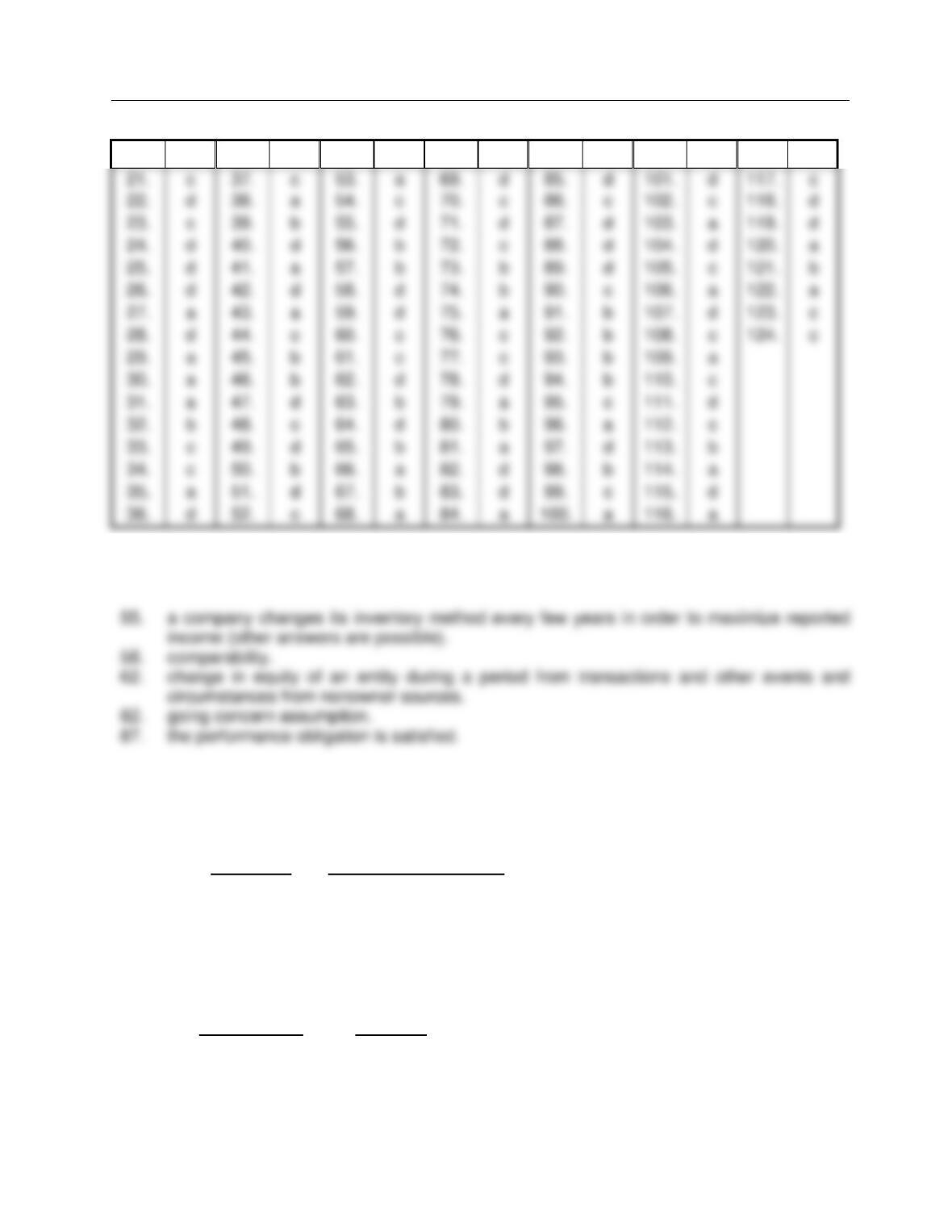
Multiple Choice Answers—Conceptual
Item
Ans.
Item
Ans.
Item
Ans.
Item
Ans.
Item
Ans.
Item
Ans.
Item
Ans.
Solutions to those Multiple Choice questions for which the answer is “none of these answers are
correct.”
MULTIPLE CHOICE—CPA Adapted
125. According to the FASB’s conceptual framework, predictive value is an ingredient of
Relevance Faithful Representation
a. Yes No
b. Yes Yes
c. No Yes
d. No No
126. According to the FASB’s conceptual framework, which of the following relates to both
relevance and faithful representation?
Comparability Neutrality
a. Yes Yes
b. Yes No
c. No Yes
d. No No

Test Bank for Intermediate Accounting, Fifteenth Edition
2 – 24
127. The FASB’s conceptual framework classifies gains and losses based on whether they are
related to an entity’s major ongoing or central operations. These gains or losses may be
classified as
Nonoperating Operating
a. Yes No
b. Yes Yes
c. No Yes
d. No No
128. According to the FASB’s conceptual framework, earnings
a. is the same as comprehensive income.
b. excludes certain gains and losses that are included in comprehensive income.
c. includes certain gains and losses that are excluded from comprehensive income.
d. includes certain losses that are excluded from comprehensive income.
129. According to the FASB’s conceptual framework, comprehensive income includes which of
the following?
Operating Income Investments by Owners
a. Yes No
b. Yes Yes
c. No Yes
d. No No
130. According to the FASB’s conceptual framework, the calculation of comprehensive income
includes which of the following?
Income from Distributions
Continuing Operations to Owners
a. No No
b. Yes No
c. Yes Yes
d. No Yes
131. According to the FASB’s conceptual framework, comprehensive income includes which of
the following?
Gross Margin Operating Income
a. No Yes
b. No No
c. Yes No
d. Yes Yes
132. Under Statements of Financial Accounting Concepts, comprehensive income includes
which of the following?
Gains Gross Margin
a. No No
b. No Yes
c. Yes No
d. Yes Yes

Conceptual Framework Underlying Financial Accounting
2 – 25
133. Which of the following is an application of the principle of rational and systematic
allocation?
a. Amortization of intangible assets.
b. Sales commissions.
c. Research and development costs.
d. Officers’ salaries.
Multiple Choice Answers—CPA Adapted
Item
Ans.
Item
Ans.
Item
Ans.
Item
Ans.
Item
Ans.
BRIEF EXERCISES
BE. 2–134—Qualitative Characteristics.
Accounting information provides useful information about business transactions and events.
Those who provide and use financial reports must often select and evaluate accounting
alternatives. The FASB statement on qualitative characteristics of accounting information
examines the characteristics of accounting information that make it useful for decision-making. It
also points out that various limitations inherent in the measurement and reporting process may
necessitate trade-offs or sacrifices among the characteristics of useful information.
Instructions.
(a) Describe briefly the following characteristics of useful accounting information.
(1) Relevance (4) Comparability
(2) Faithful representation (5) Consistency
(3) Understandability
(b) For each of the following pairs of information characteristics, give an example of a situation in
which one of the characteristics may be sacrificed in return for a gain in the other.
(1) Relevance and faithful representation. (3) Comparability and consistency.
(2) Relevance and consistency. (4) Relevance and understandability.
(c) What criterion should be used to evaluate trade-offs between information characteristics?
Test Bank for Intermediate Accounting, Fifteenth Edition
2 – 26
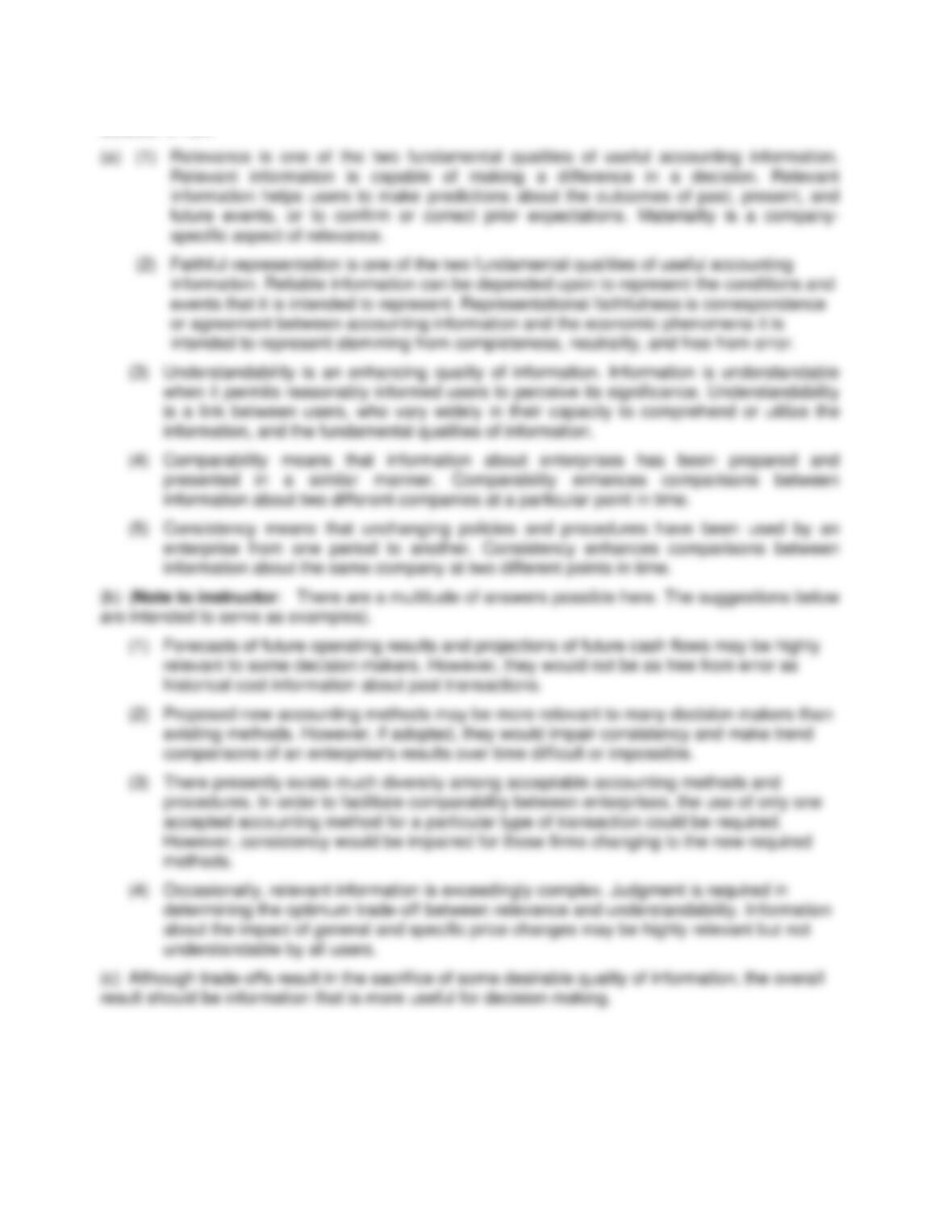
Solution 2-134.

Conceptual Framework Underlying Financial Accounting
2 – 27
BE. 2–135—Accounting concepts—identification.
State the accounting assumption, principle, information characteristic, or constraint that is most
applicable in the following cases.
1. All payments less than $25 are expensed as incurred. (Do not use conservatism.)
2. The company employs the same inventory valuation method from period to period.
3. A patent is capitalized and amortized over the periods benefited.
4. Assuming that dollars today will buy as much as ten years ago.
5. Rent paid in advance is recorded as prepaid rent.
6. Financial statements are prepared each year.
7. All significant post-balance sheet events are reported.
8. Personal transactions of the proprietor are distinguished from business transactions.
Solution 2-135
BE. 2–136—Accounting concepts—identification.
Presented below are a number of accounting procedures and practices in Ramirez Corp. For
each of these items, list the assumption, principle, information characteristic, or modifying
convention that is violated.
1. Because the company’s income is low this year, a switch from accelerated depreciation to
straight-line depreciation is made this year.
2. The president of Ramirez Corp. believes it is foolish to report financial information on a yearly
basis. Instead, the president believes that financial information should be disclosed only when
significant new information is available related to the company’s operations.
3. Ramirez Corp. decides to establish a large loss and related liability this year because of the
possibility that it may lose a pending patent infringement lawsuit. The possibility of loss is
considered remote by its attorneys.
4. An officer of Ramirez Corp. purchased a new home computer for personal use with company
money, charging miscellaneous expense.
5. A machine, that cost $40,000, is reported at its current market value of $45,000.
Test Bank for Intermediate Accounting, Fifteenth Edition
2 – 28
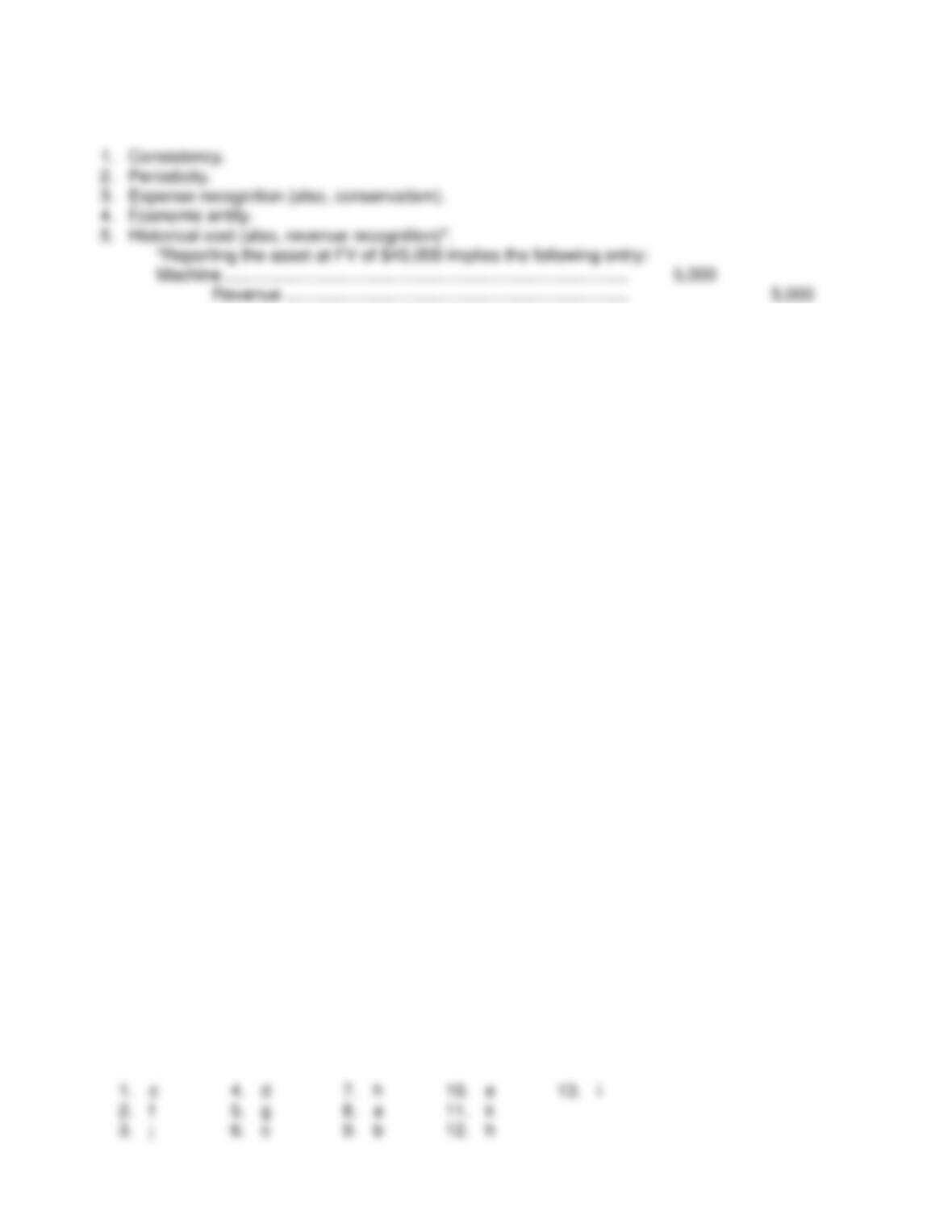
Solution 2-136
EXERCISES
Ex. 2-137—Accounting concepts—matching.
Listed below are several information characteristics and accounting principles and assumptions.
Match the letter of each with the appropriate phrase that states its application. (Items a through k
may be used more than once or not at all.)
a. Economic entity assumption g. Expense recognition principle
b. Going concern assumption h. Full disclosure principle
c. Monetary unit assumption i. Relevance characteristic
d. Periodicity assumption j. Faithful representation characteristic
e. Historical cost principle k. Consistency characteristic
f. Revenue recognition principle
____ 1. Stable-dollar assumption (do not use historical cost principle).
____ 2. The performance obligation is satisfied.
____ 3. Numbers and descriptions match what really existed or happened.
____ 4. Yearly financial reports.
____ 5. Accruals and deferrals in adjusting and closing process. (Do not use going concern.)
____ 6. Useful standard measuring unit for business transactions.
____ 7. Notes as part of necessary information to a fair presentation.
____ 8. Affairs of the business distinguished from those of its owners.
____ 9. Company assumed to have a long life.
____ 10. Valuing assets at amounts originally paid for them.
____ 11. Application of the same accounting principles as in the preceding year.
____ 12. Summarizing significant accounting policies.
____ 13. Presentation of timely information with predictive and confirmatory value.
Solution 2-137

Conceptual Framework Underlying Financial Accounting
2 – 29

Test Bank for Intermediate Accounting, Fifteenth Edition
2 – 30
Ex. 2-138—Accounting concepts—fill in the blanks.
Fill in the blanks below with the accounting principle, assumption, or related item that best
completes the sentence.
1. ________________________ and _______________________ are the two fundamental
qualities that make accounting information useful for decision making.
2. Information that helps users confirm or correct prior expectations has _________________
___________________.
3. ________________________ enables users to identify the real similarities and differences
in economic events between companies.
4. _________________ is the price that would be received to sell an asset or paid to transfer
a liability in an orderly transaction between market participants at the measurement date.
5. Information is _______________________ if omitting it or misstating it could influence
decisions that users make on the basis of the reported financial information.
6. The ________________________ characteristic requires that the same accounting method
be used from one accounting period to the next, unless it becomes evident that an
alternative method will bring about a better description of a firm’s financial situation.
7. ____________________ means when in doubt, choose the solution that will be least likely
to overstate income and assets.
8. Providing information that is of sufficient importance to influence the judgement and
decisions of an informed user is referred to as _______________________.
9. Corporations must prepare accounting reports at least yearly due to the _______________
assumption.
10. _________________ occurs when the performance obligation is satisfied.
Solution 2-138
Ex. 2-139—Basic assumptions.
Briefly explain the four basic assumptions that underlie financial accounting.
Conceptual Framework Underlying Financial Accounting
2 – 31
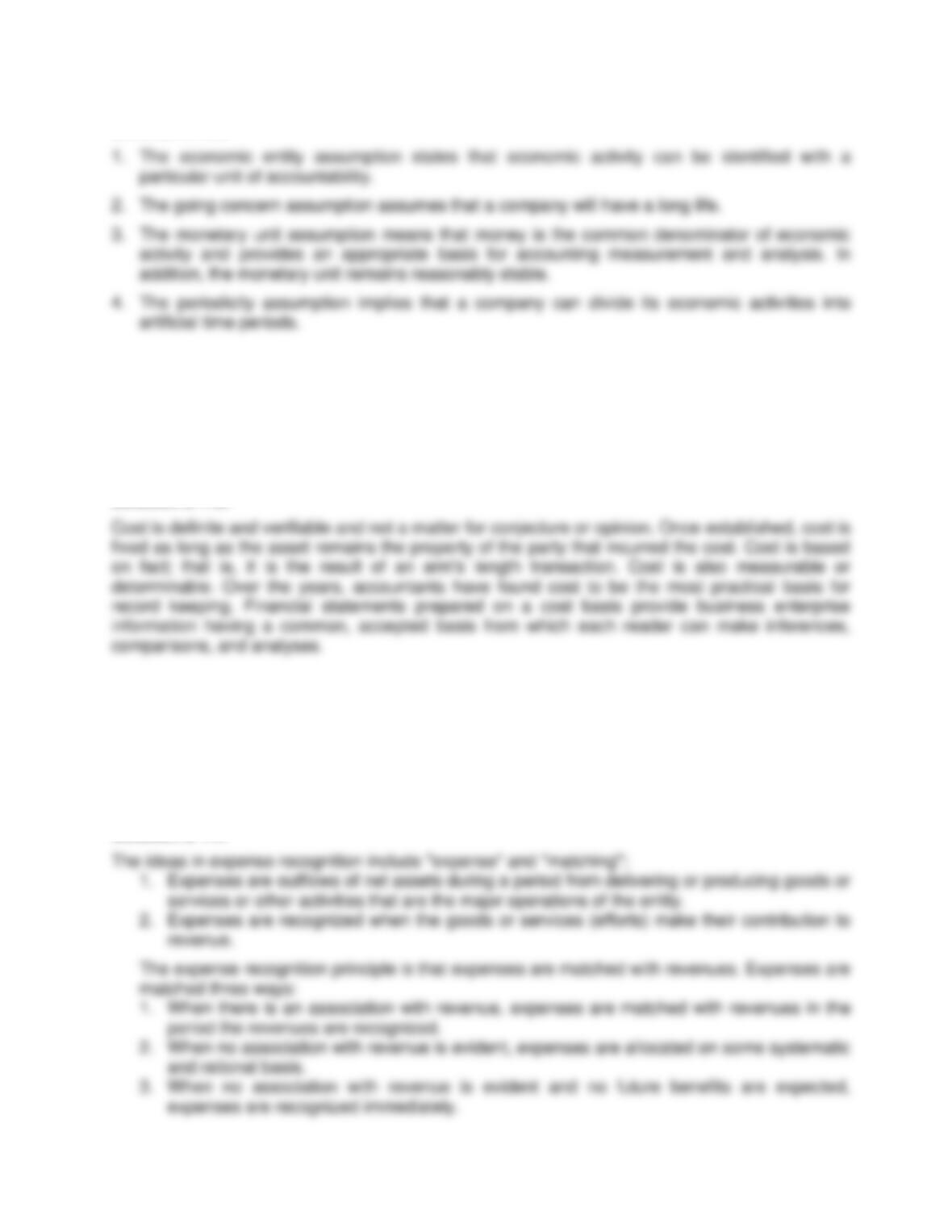
Solution 2-139
Ex. 2-140—Historical cost principle.
Cost as a basis of accounting for assets has been severely criticized. What defense can you build
for cost as the basis for financial accounting?
Solution 2-140
Ex. 2-141—Matching concept.
A concept is a group of related ideas. Matching could be considered a concept because it
includes ideas related to expense recognition. Briefly explain the ideas in expense recognition.
Solution 2-141

Test Bank for Intermediate Accounting, Fifteenth Edition
2 – 32
IFRS QUESTIONS
True / False
1. The IASB and the FASB are working on a joint project to develop a common conceptual
framework.
2. Under IFRS, expenses include losses that are not the result of ordinary activities.
3. Under IFRS, it is mandatory to report property, plant, and equipment at historical cost.
4. The number of financial statement elements in the IFRS conceptual framework is equal to
those in GAAP.
5. The existing conceptual frameworks underlying GAAP and IFRS are very similar.
6. It is unlikely that the basic concepts related to the existing conceptual framework will change.
7. The IASB is considering a proposal to provide expanded guidance on estimating fair values.
8. GAAP has a concept statement to guide estimation of fair values when market-related data is
not available.
9. The monetary unit assumption is a part of GAAP, but not IFRS.
10. A company incorporated in Japan uses the dollar as its unit of measurement.
Answers to True / False questions:
Multiple Choice:
11. The IASB and the FASB are working on a joint project that has an objective of developing a
conceptual framework that leads to standards that are:
a. rule-based and internally consistent.
b. principle-based and internally consistent.
c. rule-based and flexible in nature.
d. principle-based and rigid in nature.
12. In the first stage of creating conceptual framework, the IASB and the FASB agreed on the
objective of financial reporting and a common set of desired _________.
a. characteristics of GAAP
b. quantitative characteristics
c. qualitative characteristics
d. rule-based characteristics
13. Which of the following is an element of financial statements identified under IFRS?
a. Investment by owners
b. Losses
c. Comprehensive income
d. Equity
Conceptual Framework Underlying Financial Accounting
2 – 33
14. Under IFRS, a decrease in economic benefit that results in a decrease in equity is termed as
a(an):
a. Loss of economic benefit
b. Comprehensive loss
c. Expense
d. Distributions to owners
15. Phase D of convergence project addresses the _______.
a. elements and recognition
b. reporting entity
c. monetary unit assumption
d. periodicity assumption
Answers to Multiple Choice:
Short Answer:
16. What two assumptions are part of both the IFRS and GAAP conceptual framework?
17. How does the IFRS conceptual framework differ from U.S. GAAP’s framework?