Chapter 2 Job-Order Costing for Manufacturing and Service Companies
2-33
EXERCISES
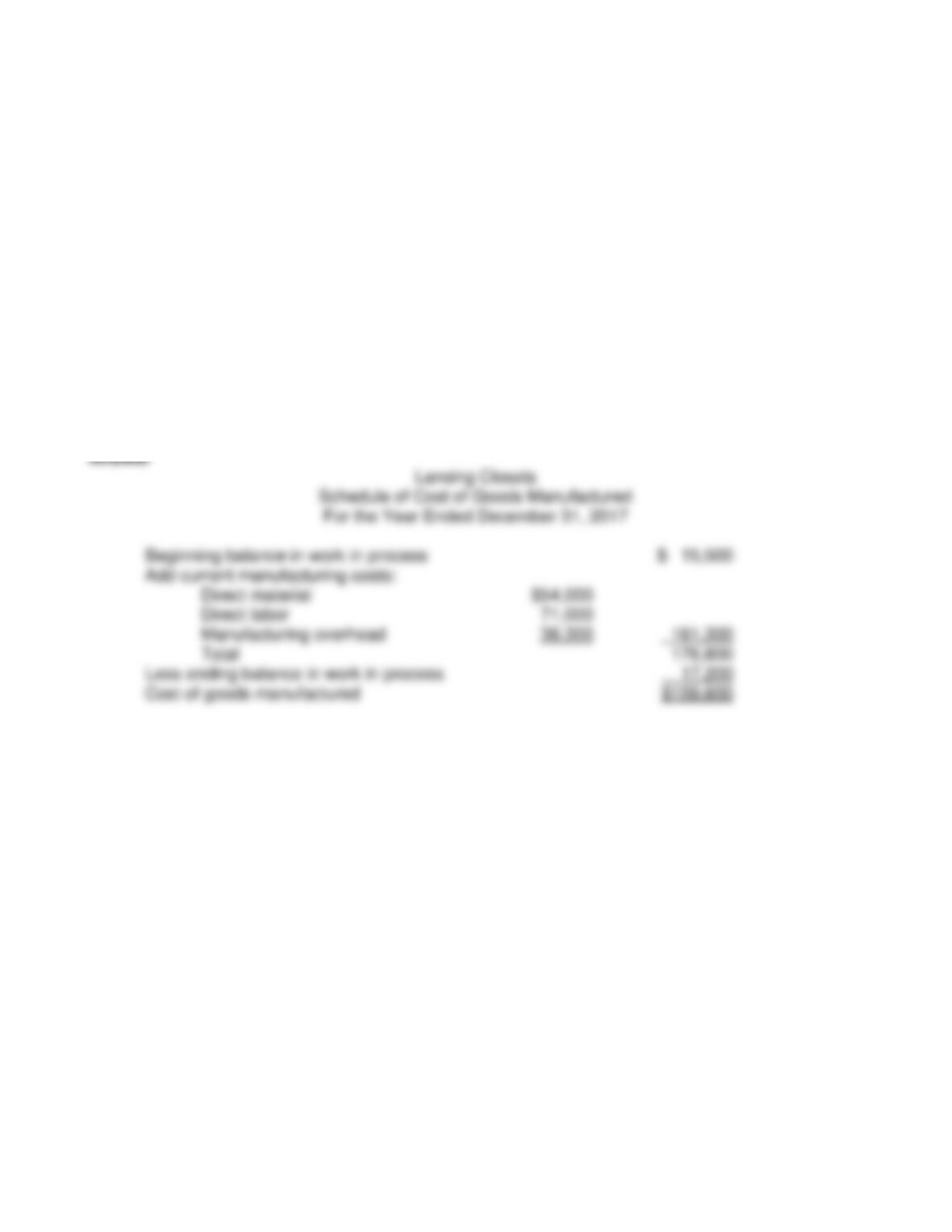
152. The following information is available for Lansing Closets for the fiscal year ending December
31, 2017.
Beginning balance in Finished Goods $ 12,000
Ending balance in Finished Goods 10,200
Beginning balance in Work in Process 15,500
Ending balance in Work in Process 17,200
Selling expenses 102,000
General and administrative expenses 67,000
Direct material cost incurred 54,000
Direct labor cost 71,000
Manufacturing overhead applied 36,300
Sales 367,000
Prepare a schedule of cost of goods manufactured for 2017.
153. The following information is available for Lansing Closets for the fiscal year ending December
31, 2017.
Beginning balance in Finished Goods $ 12,000
Ending balance in Finished Goods 10,200
Beginning balance in Work in Process 15,500
Ending balance in Work in Process 17,200
Selling expenses 102,000
General and administrative expenses 67,000
Direct material cost incurred 54,000
Direct labor cost 71,000
Manufacturing overhead applied 36,300
Sales 367,000
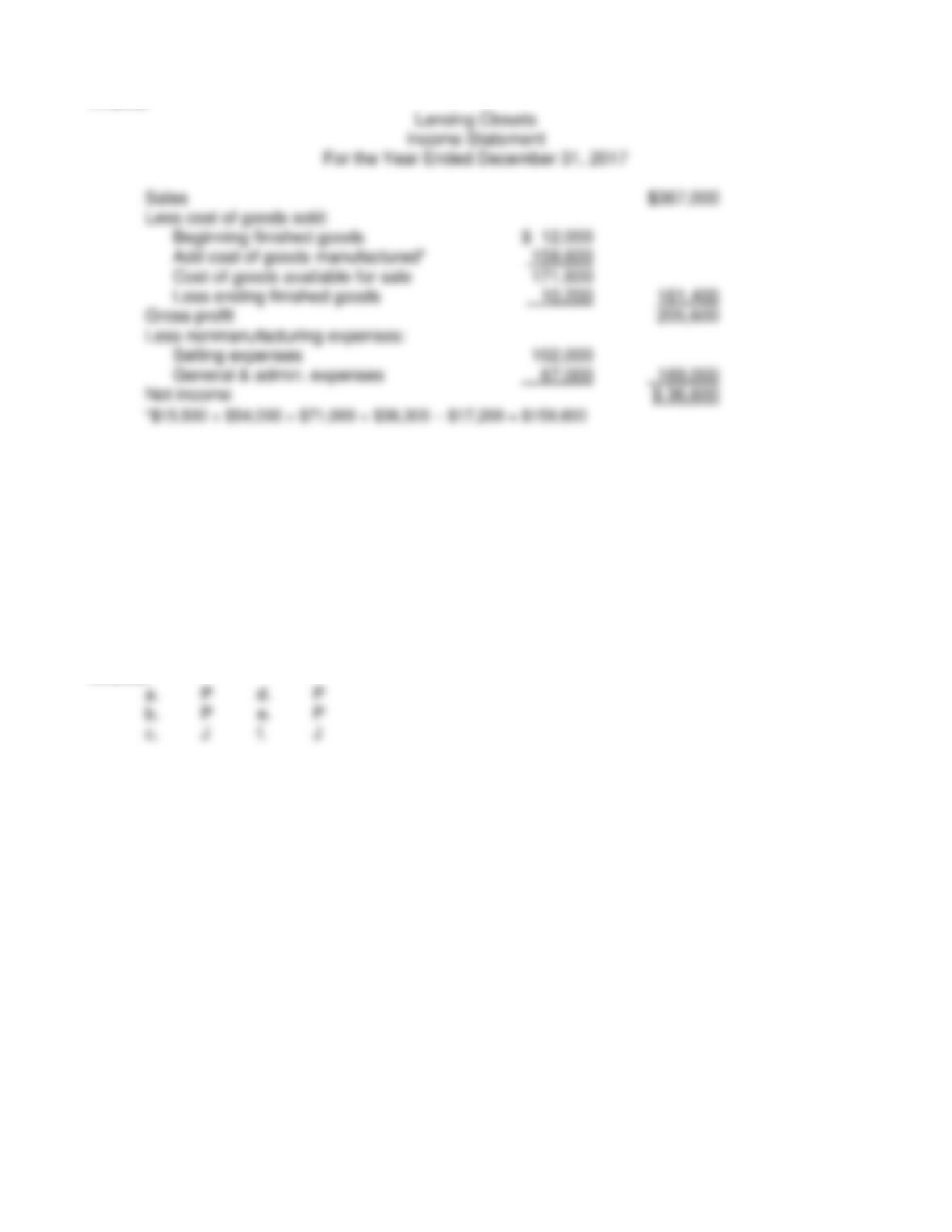
Prepare an income statement for fiscal 2017. Ignore income taxes.
Test Bank to accompany Jiambalvo Managerial Accounting, 6th Edition
2-34
Answer
154. For the list of product manufacturers below, indicate whether a job-cost system (J) or a
process cost system (P) would be most appropriate.
______ a. Jelly bean producer
______ b. Cereal producer
______ c. Custom kitchen cabinet builder
______ d. Oil refinery
______ e. Paint manufacturer
______ f. Accounting firm
Answer
Chapter 2 Job-Order Costing for Manufacturing and Service Companies
2-35
155. IT Consulting had the following labor time tickets for the month of March:
Ticket # Employee #Hourly Pay Rate Hours Worked Job #
456 16 $10.00 32 201
457 19 21.00 30 202
458 8 14.00 21 202
459 11 20.00 28 204
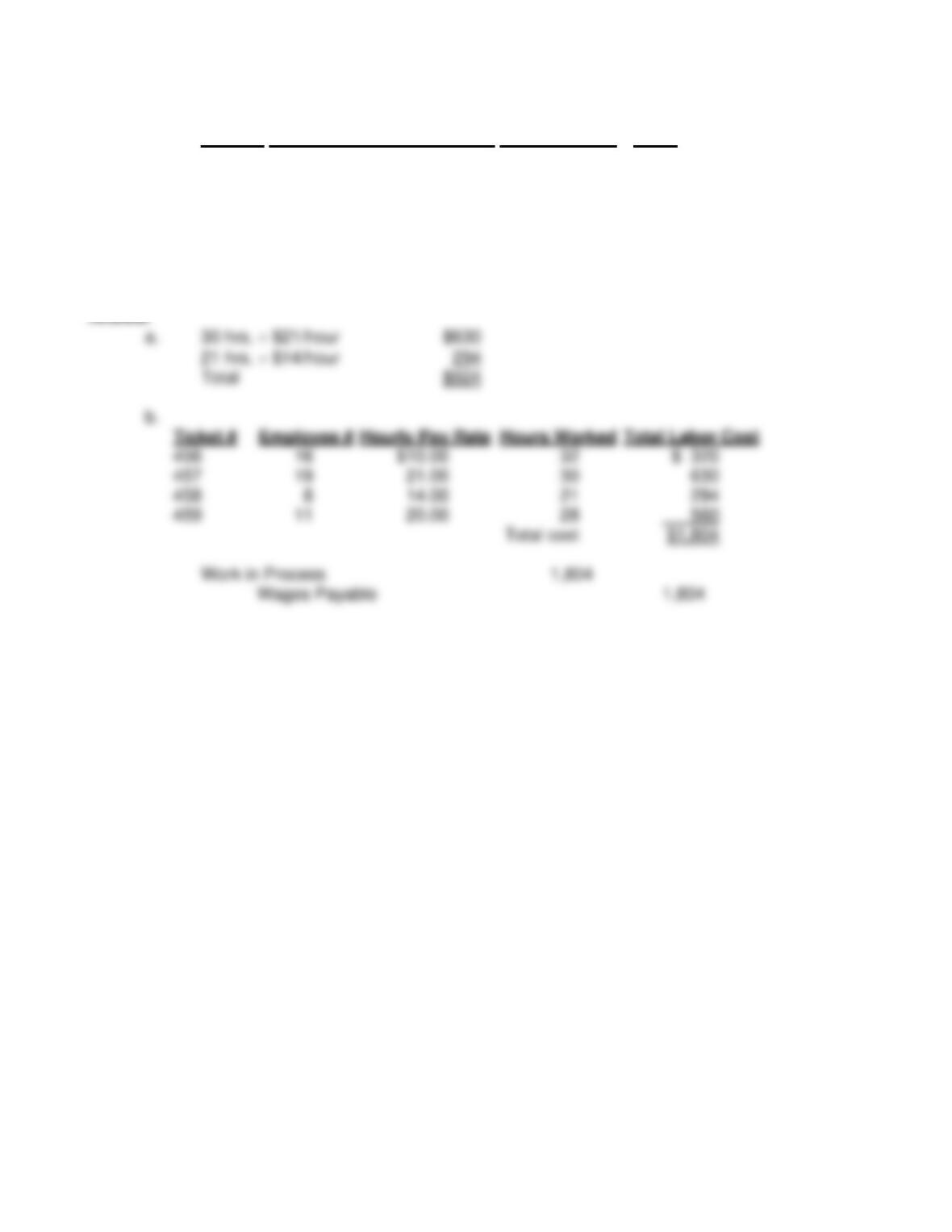
a. Calculate the amount of direct labor cost assigned to job 202.
b. Prepare a journal entry to record direct labor for March for IT Consulting.
156. Crystal Catering had three jobs in process as of January 1, 2017:
Job 47 $2,500
Job 49 1,600
Job 50 3,600
In addition, Job 48 was completed and awaiting shipment on January 1, 2017. Its cost was
$5,600. During 2017, the company incurred the following costs:
Direct material $ 135,000
Direct labor 120,000
Manufacturing overhead 110,000
At the end of 2017, two jobs were in process with costs incurred as of December 31, 2017:
Job 56 $5,200
Job 58 1,500
In addition, two jobs were completed and awaiting shipment at the end of 2017 with costs
incurred as of December 31, 2017:
Job 55 $1,300
Job 59 3,300
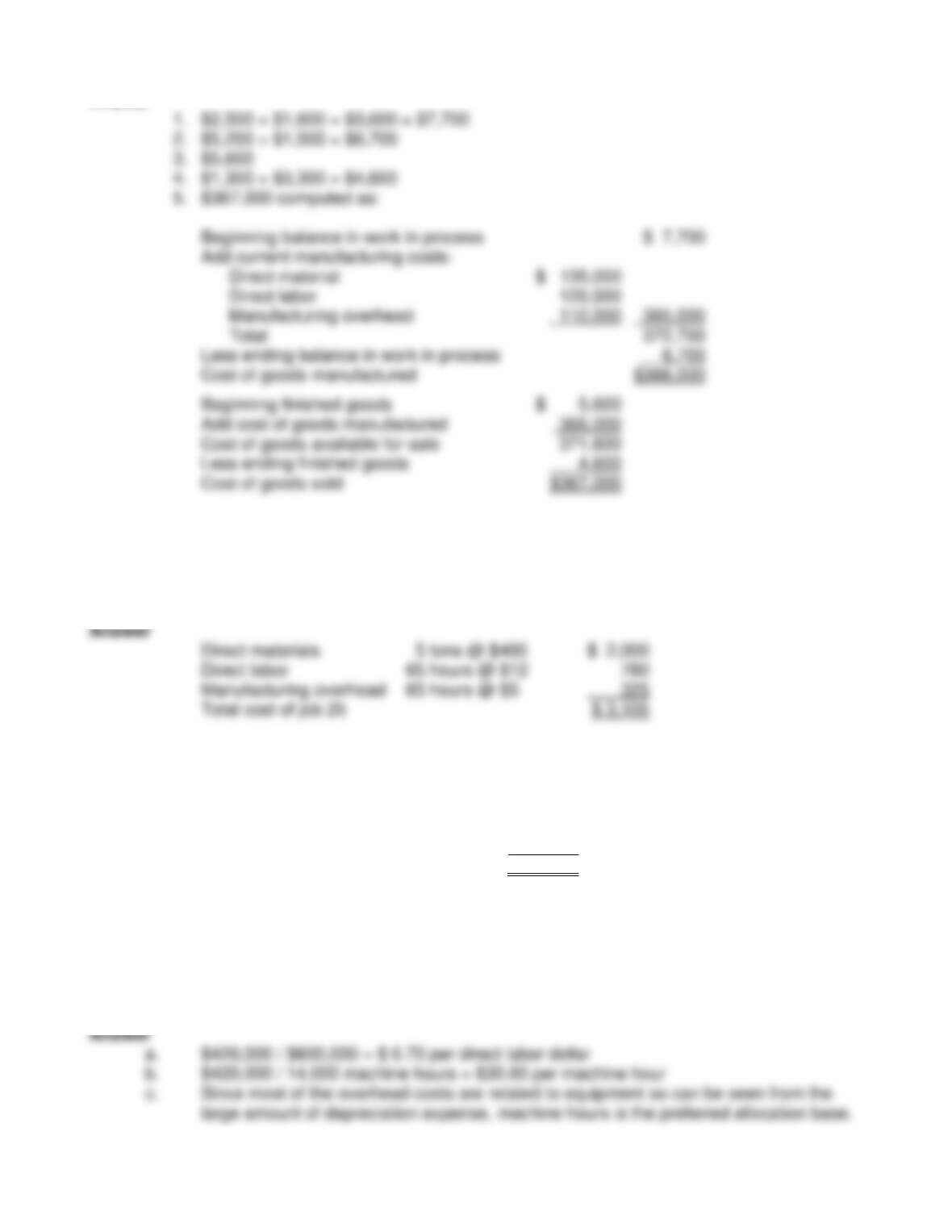
Calculate the following amounts:
1. Beginning Work in Process
2. Ending Work in Process
3. Beginning Finished Goods
4. Ending Finished Goods
5. Cost of Goods Sold
Test Bank to accompany Jiambalvo Managerial Accounting, 6th Edition
2-36
Answer
157. Special Installations allocates overhead based on a predetermined overhead rate of $5.00 per
direct labor hour. Job 25 required 5 tons of direct material at a cost of $400.00 per ton and
took employees who earn $12.00 per hour a total of 65 hours to complete. What is the total
cost of Job 25?
158. Frinut Company estimates the following overhead costs for the coming year:
Equipment depreciation $250,000
Equipment maintenance 50,000
Supervisory salaries 20,000
Factory rent 100,000
Total $420,000
Frinut budgeted $600,000 in direct labor costs and 14,000 machine hours for the coming year.
a. Calculate the predetermined overhead rate using direct labor costs as the allocation
base.
b. Calculate the predetermined overhead rate using machine hours as the allocation
base.
c. Which of the allocation bases is preferred and why?
Chapter 2 Job-Order Costing for Manufacturing and Service Companies
2-37
159. Barnett Brass allocates overhead based on machine hours. Estimated overhead costs for the
year total $420,000 and the company estimates that it will use 42,000 machine hours during
the year. Barnett Brass used 41,600 machine hours during the year and incurred $424,320 of
overhead.
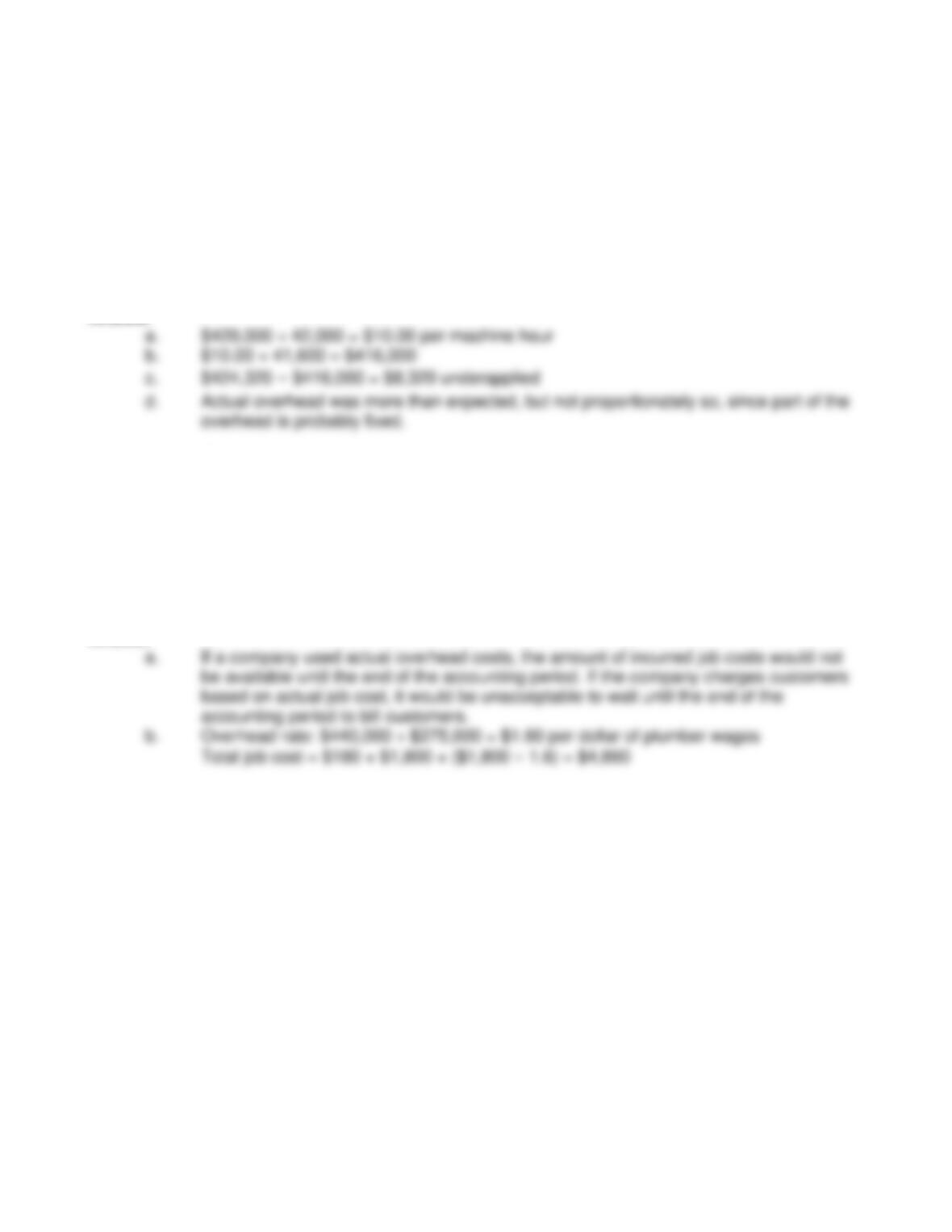
a. What is the overhead application rate for the year?
b. What is the amount of applied overhead for the year?
c. What is the amount of under or overapplied overhead for the year? Label as over or
underapplied.
d. Why does the result you obtained in part c above differ from the actual overhead cost?
Answer
160. Ponder Plumbing uses job-order costing for each of its installations and repairs. Overhead is
allocated based on the cost of plumber wages. At the start of the year, annual plumber wages
were estimated to be $275,000 based on 17,600 labor hours, and company overhead was
estimated to be $440,000.
a. Briefly state why the use of a predetermined overhead rate would be preferred to
assigning actual overhead to repair jobs.
b. Suppose a job required parts costing $180 and plumber time costing $1,800. How
much will be the total cost of the job?
Answer
161. Rooftop Solar estimated the following annual costs:
Expected annual direct labor hours 12,000
Expected annual direct labor cost $198,000
Expected machine hours 10,400
Expected material cost for the year $65,000
Expected manufacturing overhead $218,400
Job 612 used $350 of direct materials, 26 direct labor hours, and 14 machine hours. Actual
labor cost is $17 per hour.
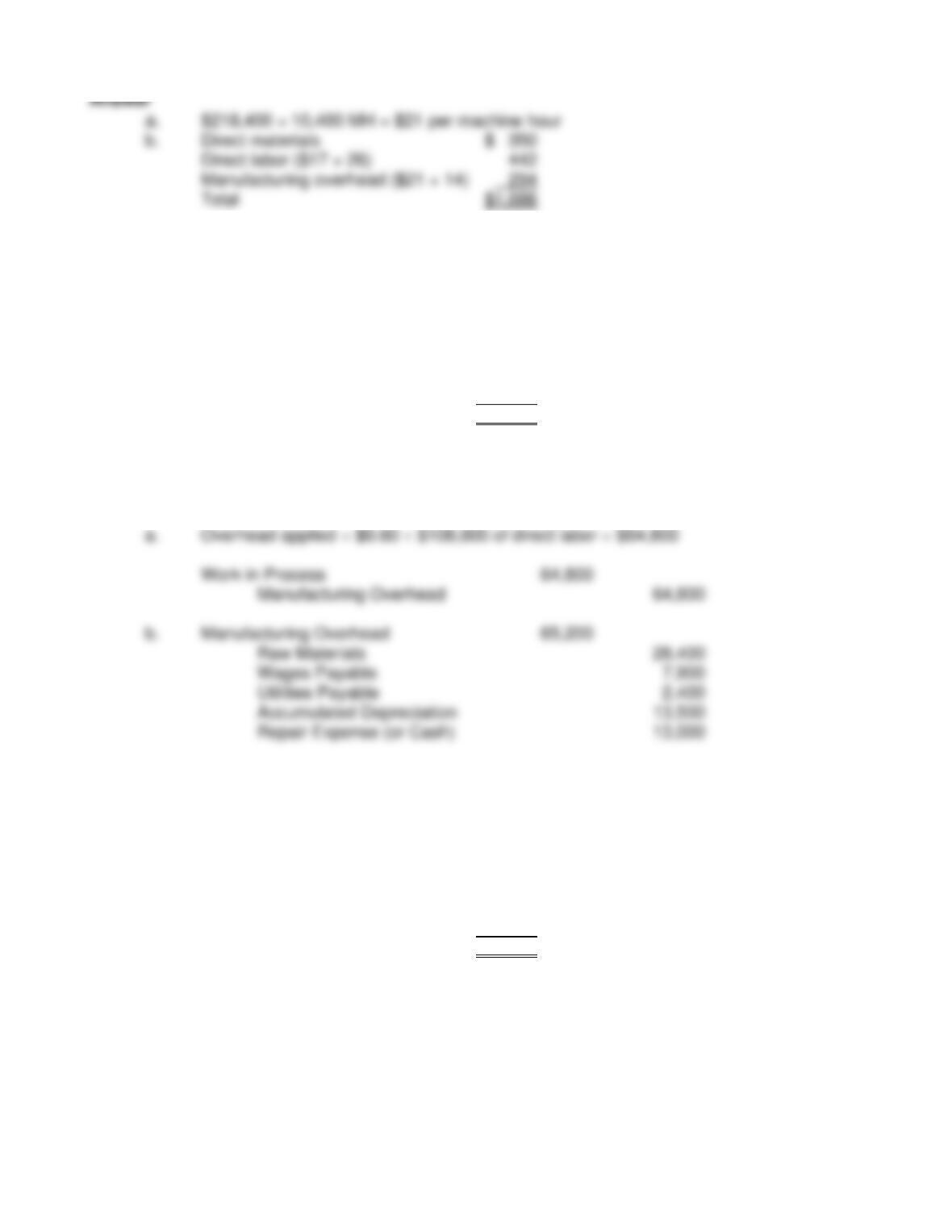
a. If Rooftop Solar allocates overhead based upon machine hours, how much is the
overhead rate?
b. Determine the cost of job 612.
Test Bank to accompany Jiambalvo Managerial Accounting, 6th Edition
2-38
162. During the month of August, Pamator Products applied overhead to jobs using an overhead
rate of $0.60 per dollar of direct labor. Direct labor in August was $108,000. Actual overhead in
August was $65,200, and consisted of the following items:
Indirect materials $28,400
Indirect labor 7,900
Utilities 2,400
Depreciation 13,500
Repair expense 13,000
Total $65,200
a. Prepare a journal entry to record overhead applied to jobs.
b. Prepare a journal entry to record actual overhead.
Answer
163. During the month of August, Winslow Chemicals applied overhead to jobs using an overhead
rate of $0.80 per dollar of direct labor. Direct labor in August was $65,000. Actual overhead in
August was $51,200. Actual overhead was composed of the following items:
Indirect materials $ 21,200
Indirect labor 6,800
Utilities 1,400
Depreciation 12,500
Repair expense 9,300
Total $51,200
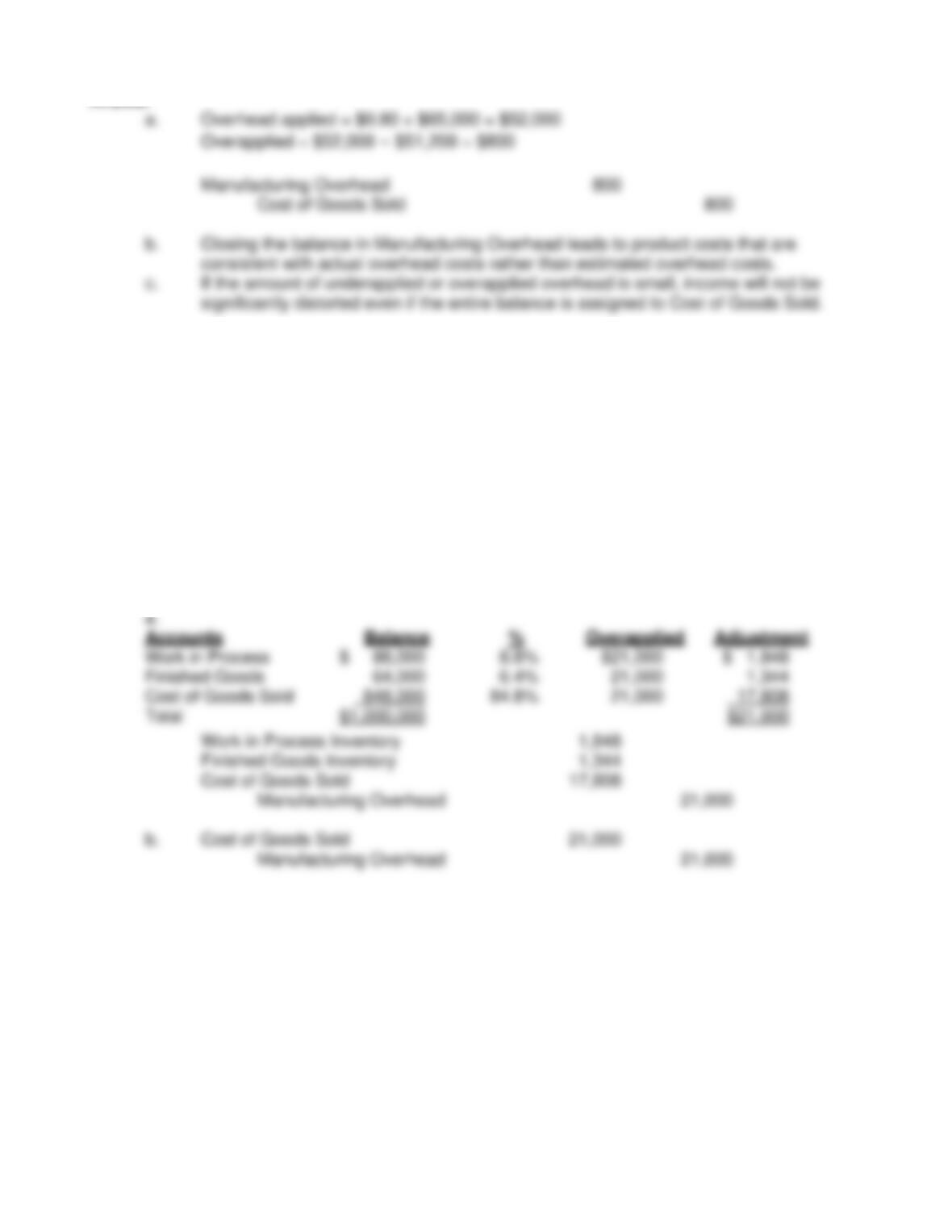
a. Determine the balance in the Manufacturing Overhead account and prepare a journal
entry to close the balance to cost of goods sold.
b. Why is it important to close the balance in the Manufacturing Overhead account?
c. What is the justification for assigning the balance in manufacturing overhead to Cost of
Goods Sold rather than apportioning it to three accounts?
Chapter 2 Job-Order Costing for Manufacturing and Service Companies
2-39
Answer
164. At the end of the period, Harris Renovators had the following balances in selected accounts:
Raw Materials Inventory $ 42,000
Work in Process Inventory 88,000
Finished Goods 64,000
Cost of Goods Sold 848,000
Manufacturing Overhead (debit balance) 21,000
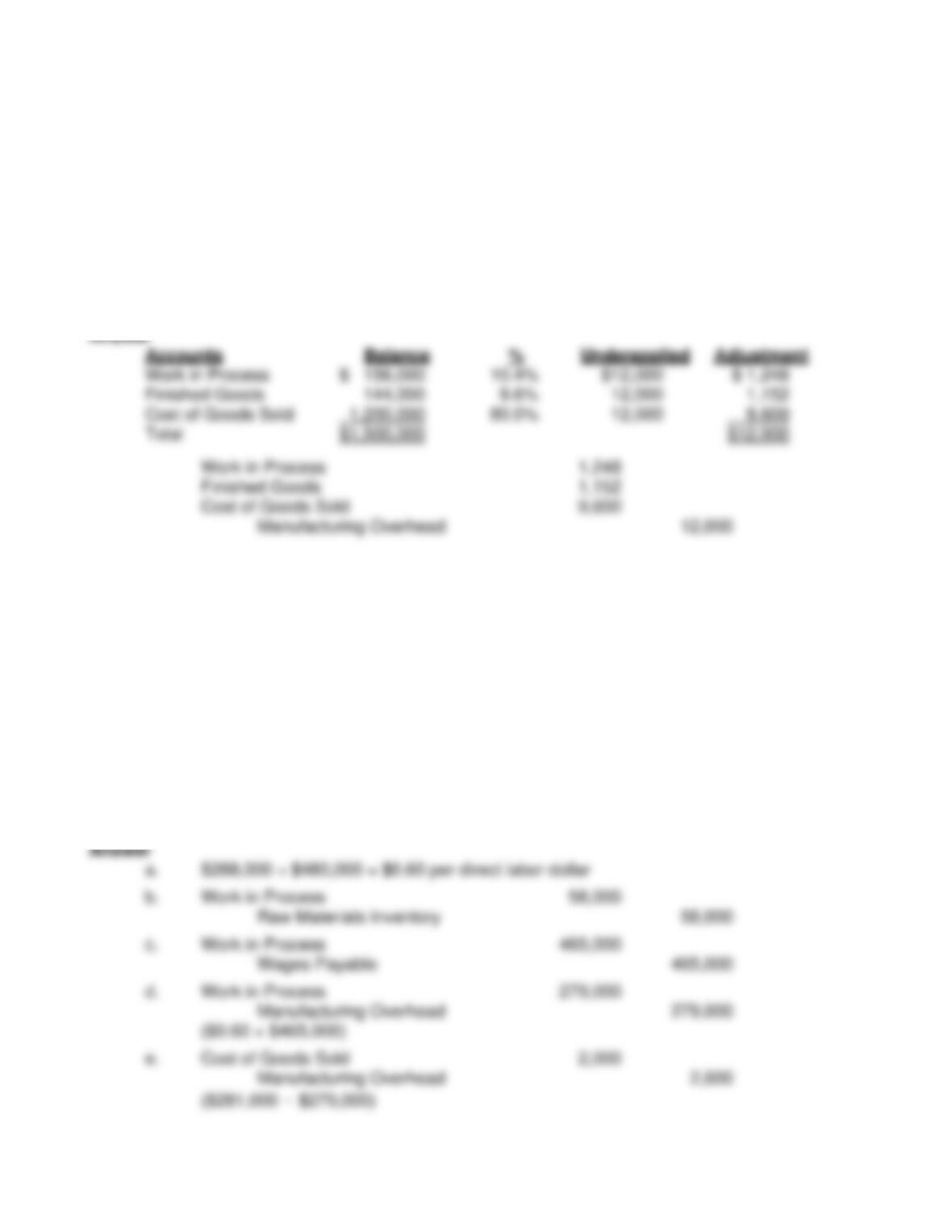
a. Prepare the journal entry to close the Manufacturing Overhead account if the balance
in the account is considered material.
b. Prepare the journal entry assuming the balance is considered to be immaterial.
Answer
Test Bank to accompany Jiambalvo Managerial Accounting, 6th Edition
2-40
165. Window Tinters uses a job-order costing system. The balances at the end of the period for the
selected accounts are as follows:
Raw Materials Inventory $ 82,000
Work in Process Inventory 156,000
Finished Goods Inventory 144,000
Cost of Goods Sold 1,200,000
Manufacturing Overhead (debit) 12,000
Prepare a journal entry to close the Manufacturing Overhead account assuming that the over
or underapplied overhead is material.
166. Cisco Pool Service cleans and maintains residential pools and spas. At the beginning of the
year, the company estimated that it would incur $480,000 of direct labor cost and $288,000 of
manufacturing overhead. Overhead is allocated to production on the basis of direct labor cost.
Actual supplies (direct materials) used during the year were $58,000, actual direct labor cost
was $465,000, and actual overhead was $281,000.
a. Calculate the overhead rate for the current year.
b. Prepare the journal entry to record use of direct materials.
c. Prepare the journal entry to record direct labor.
d. Prepare the journal entry to record manufacturing overhead applied to production.
e. Prepare the journal entry to close the balance in manufacturing overhead to cost of
goods sold assuming over or underapplied overhead is considered to be material in
amount.
Chapter 2 Job-Order Costing for Manufacturing and Service Companies
2-41
CHALLENGE EXERCISES
167. Norris Decorators manufactures special order window coverings. During May, Norris’s
transactions included the following:
Work in process inventory, May 1
$ 160
Sales
$23,000
Factory equipment depreciation exp.
2,800
Selling expenses
2,100
Work in process inventory, May 31
240
Factory supervision wages expense
2,300
Raw materials purchased
11,500
Indirect labor cost incurred
400
Raw materials inventory, May 1
160
Factory utilities expense
900
Raw materials inventory, May 31
280
Direct labor cost incurred
5,400
Finished goods inventory, May 1
700
Finished goods inventory, May 31
950
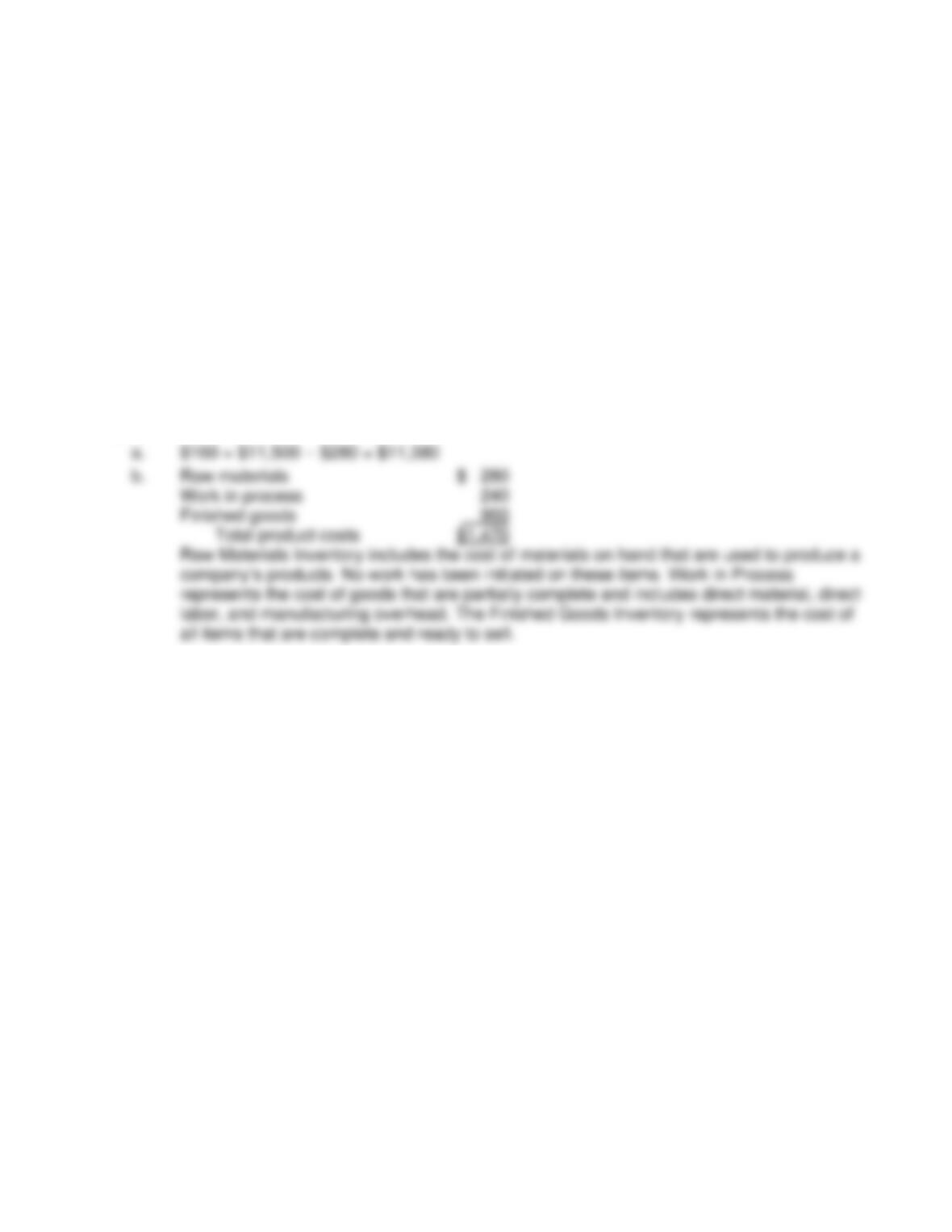
a. How much is the cost of direct materials issued to production during May?
b. Show the product cost amounts that would be reported on Norris’ balance sheet as of
May 31, and describe the nature of each amount.
Answer
168. Howard Manufacturing applies manufacturing overhead to production at a rate of $3 per direct
labor hour. The following information is provided for the month of March in 2017:
Direct materials used in production
$86,000
Direct labor
Product delivery costs (shipping to customers)
Factory janitor salary
57,000
13,000
31,000
Manufacturing overhead applied
94,100
Direct materials purchased
89,400
Indirect labor
10,000
Depreciation on factory building
32,000
Factory rental expense
21,000
Indirect materials
2,600
Sales commissions
20,000
Administrative expenses
54,000
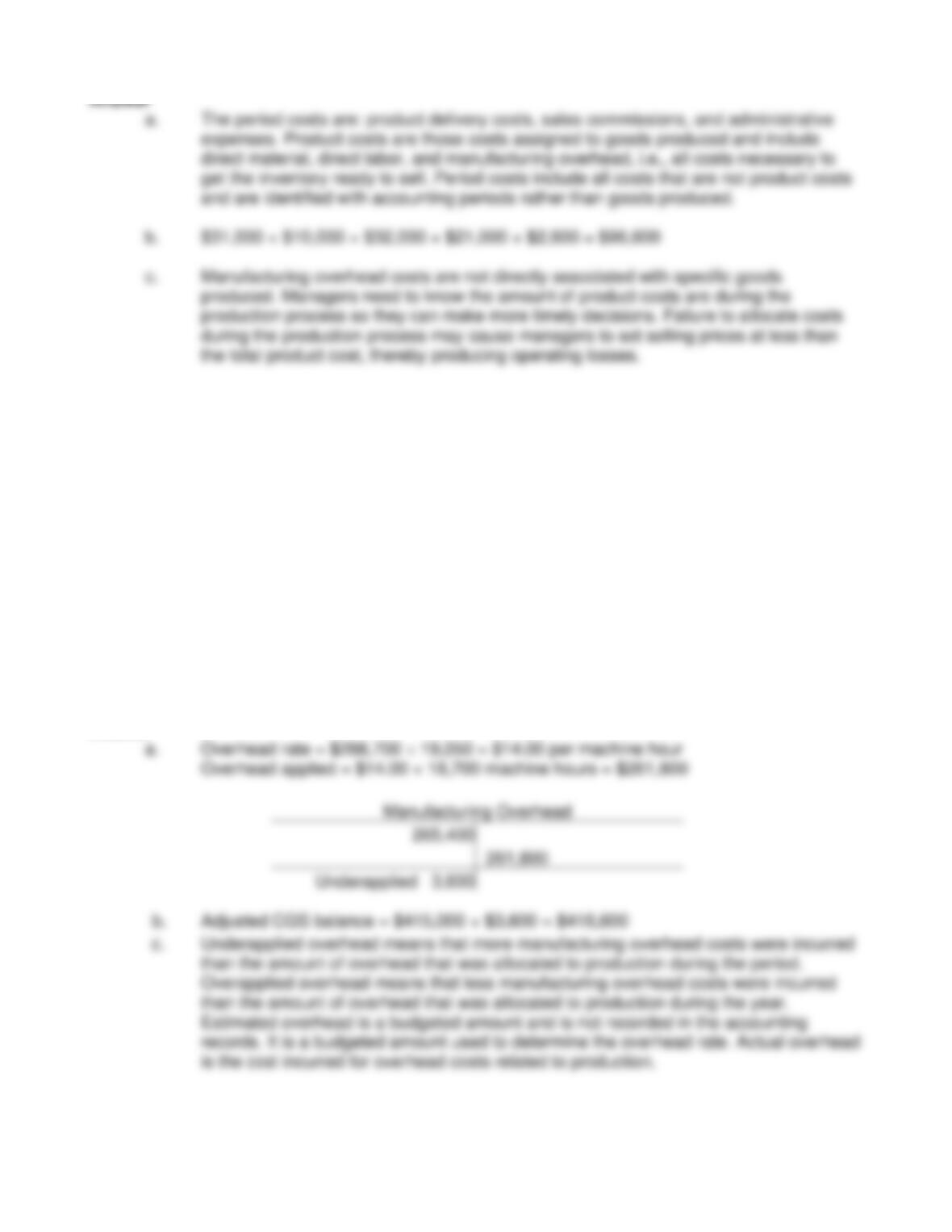
a. List the account names of all period costs. How does the identification of product costs
differ from period costs?
b. How much is the actual manufacturing overhead for March?
c. Why is it necessary to allocate manufacturing overhead costs to products when it is not
necessary to allocate other product costs?
Test Bank to accompany Jiambalvo Managerial Accounting, 6th Edition
2-42
169. Ryder Electric applies overhead based upon machine hours. Budgeted factory overhead was
$266,700 and budgeted machine hours were 19,050 for 2017. Actual machine hours totaled
18,700. The company treats under or overapplied overhead as immaterial in amount. Actual
manufacturing overhead was $265,400 for the year. Before disposition of the under– or
overapplied overhead, Cost of Goods sold was $415,000. Other account balances are:
Raw materials $40,000
Work in process 35,000
Finished goods 50,000
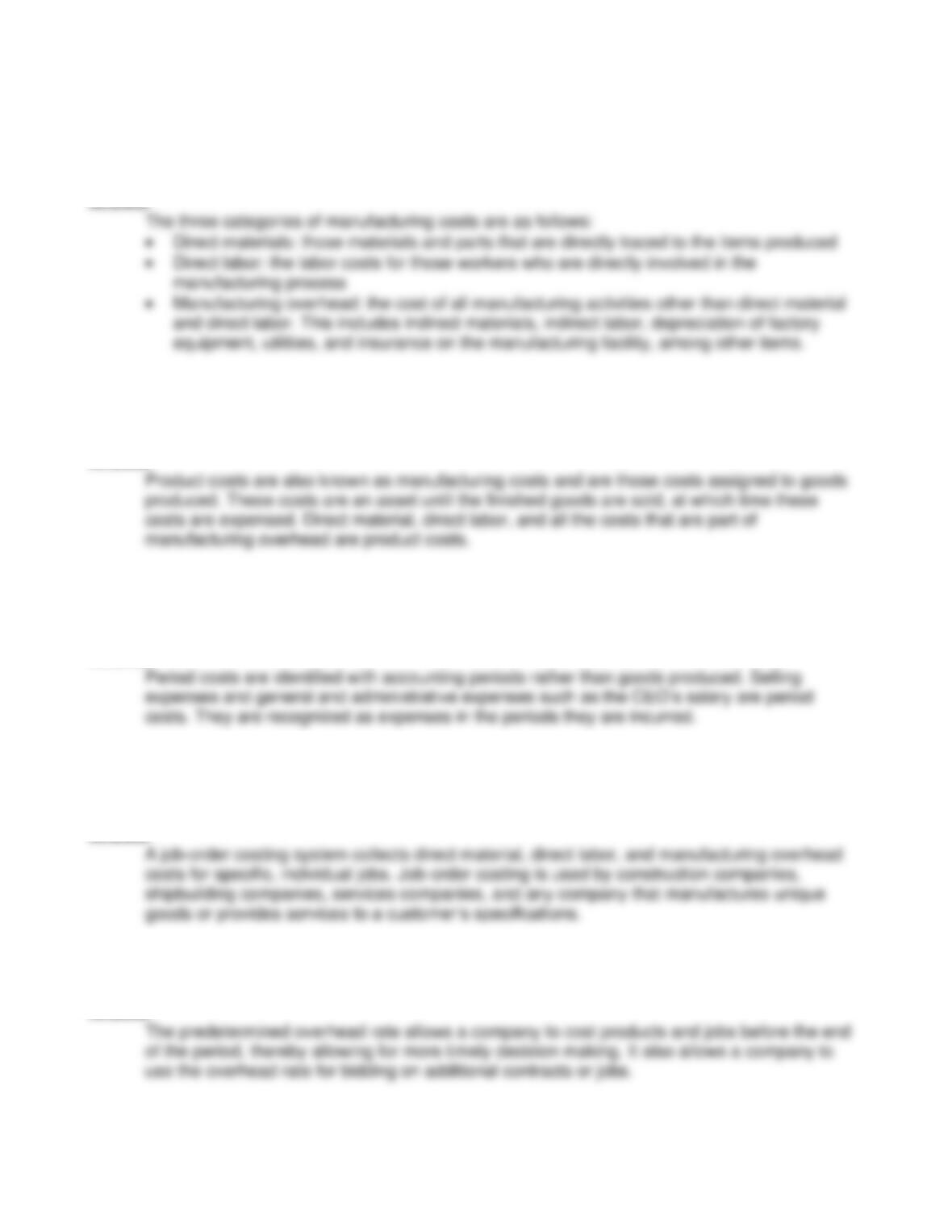
a. Determine the amount of any over or underapplied overhead at the end of 2017 by
posting the respective amounts to the T-account in which these amounts will be
accumulated. Calculate the account balance and label as over- or underapplied.
b. How much Cost of Goods sold will be reported on Ryder’s income statement for 2017?
c. Explain the nature of underapplied overhead and overapplied overhead as it relates to
both actual and estimated overhead.
Answer
Chapter 2 Job-Order Costing for Manufacturing and Service Companies
2-43
SHORT-ANSWER ESSAYS
170. Manufacturing costs are added to the Work in Process Inventory account as goods are
manufactured. List and briefly describe the three categories of manufacturing costs.
171. Costs can be classified as product costs or period costs. Define the term “product cost” and
give at least two examples of costs that are considered product costs.
Answer
172. Define the term “period cost” and give at least two examples of costs that are considered
period costs. Identify the timing of when period costs are recognized as expenses.
Answer
173. What is a job-order costing system? What type of company would be most likely to use a job–
order costing system?
Answer
174. Why is a predetermined overhead rate preferred to an actual rate?
Answer
Test Bank to accompany Jiambalvo Managerial Accounting, 6th Edition
2-44
175. Discuss the use of job-order costing by service companies. Give at least two examples of
service companies that use job-order costing. How does the amount of each type of ‘product’
cost differ for service companies compared to typical manufacturing companies?
Answer
176. Many companies are going to computer-controlled manufacturing systems. Identify what effect
this has on a company’s total fixed and total variable costs and on product costs as a whole.
Answer
177. Briefly explain the concepts of JIT and TQM. Are these ideas mutually exclusive or a company
can use both?
Answer
178. A company may choose from several possible bases when allocating overhead costs. How
does the company decide which allocation basis it will use?
Answer