89) Superior has provided the following information for its recent year of operation:
The common stock account balance at the beginning of the year was $20,000 and the year-end
balance was $25,000.
The additional paid-in capital account balance increased $2,500 during the year.
The retained earnings balance at the beginning of the year was $75,000 and the year-end balance
was $91,000.
Net income was $26,000.
How much were Superior’s dividend declarations during its recent year of operation?
A) $10,000.
B) $42,000.
C) $26,000.
D) The dividend declarations cannot be determined from the information provided.
90) Superior has provided the following information for its recent year of operation:
The common stock account balance at the beginning of the year was $20,000 and the year-end
balance was $25,000.
The additional paid-in capital account balance increased $2,500 during the year.
The retained earnings balance at the beginning of the year was $75,000 and the year-end balance
was $91,000.
Net income was $26,000.
How much did Superior sell its common stock for during the year?
A) $5,000.
B) $2,500.
C) $7,500.
D) $27,500.
91) Which of the following statements is correct?
A) Assets normally have a credit balance and are increased with debits.
B) Assets normally have a debit balance and are increased with credits.
C) Liability accounts normally have debit balances and are increased with debits.
D) Stockholders’ equity accounts normally have credit balances and are increased with credits.
92) Which of the following journal entries is correct when a business entity purchases land
costing $30,000 by signing a one-year note payable?
A)
Cash
30,000
Notes Payable
30,000
B)
Land
30,000
Accounts payable
30,000
C)
Land
30,000
Notes Payable
30,000
D)
Notes Payable
30,000
Land
30,000
93) Which of the following journal entries is correct when a business entity issues common
stock, above par value, to stockholders in exchange for cash?
A)
Cash
xxx
Common Stock
xxx
Retained earnings
xxx
B)
Cash
xxx
Common Stock
xxx
Additional paid-in capital
xxx
C)
Cash
xxx
Investments
xxx
D)
Common stock
xxx
Cash
xxx
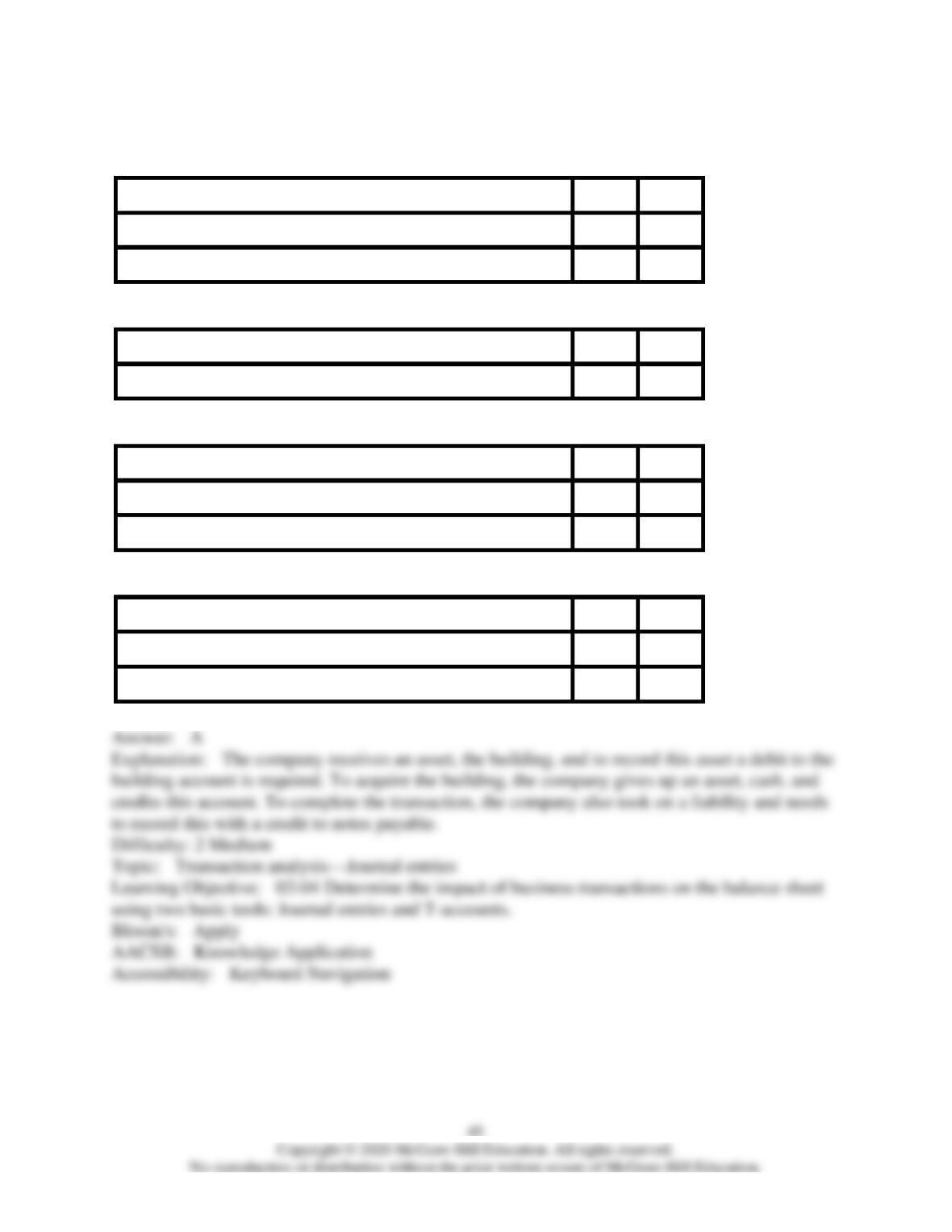
94) Which of the following journal entries is correct when a business entity purchases a building
by paying cash and by signing a note payable for the balance?
A)
Building
xxx
Cash
xxx
Notes Payable
xxx
B)
Building
xxx
Cash
xxx
C)
Cash
xxx
Notes Payable
xxx
Building
xxx
D)
Building
xxx
Cash
xxx
Notes Payable
xxx
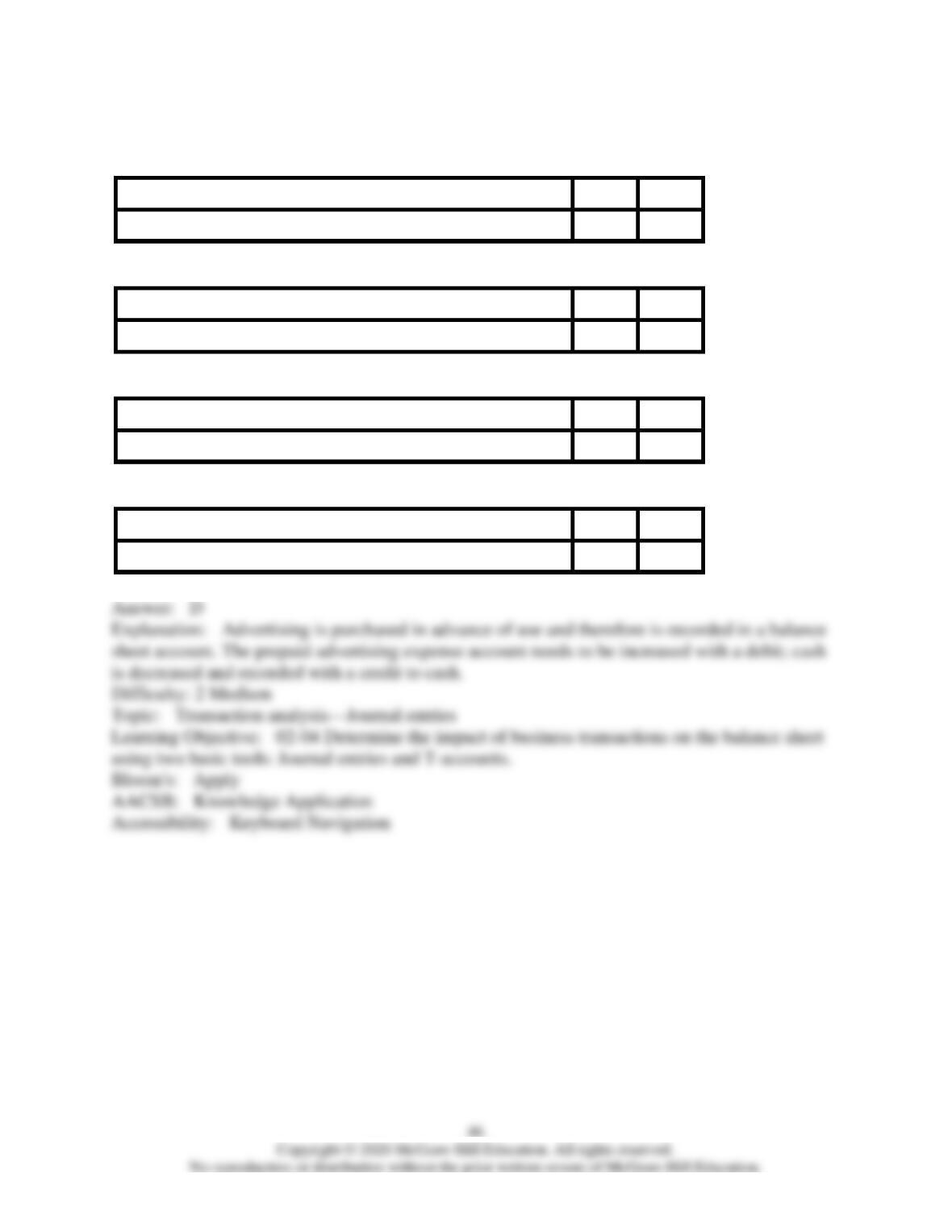
95) Which of the following journal entries is correct when a business entity pays cash for
advertising to be used next year?
A)
Cash
xxx
Advertising expense
xxx
B)
Advertising expense
xxx
Cash
xxx
C)
Cash
xxx
Prepaid advertising expense
xxx
D)
Prepaid advertising expense
xxx
Cash
xxx
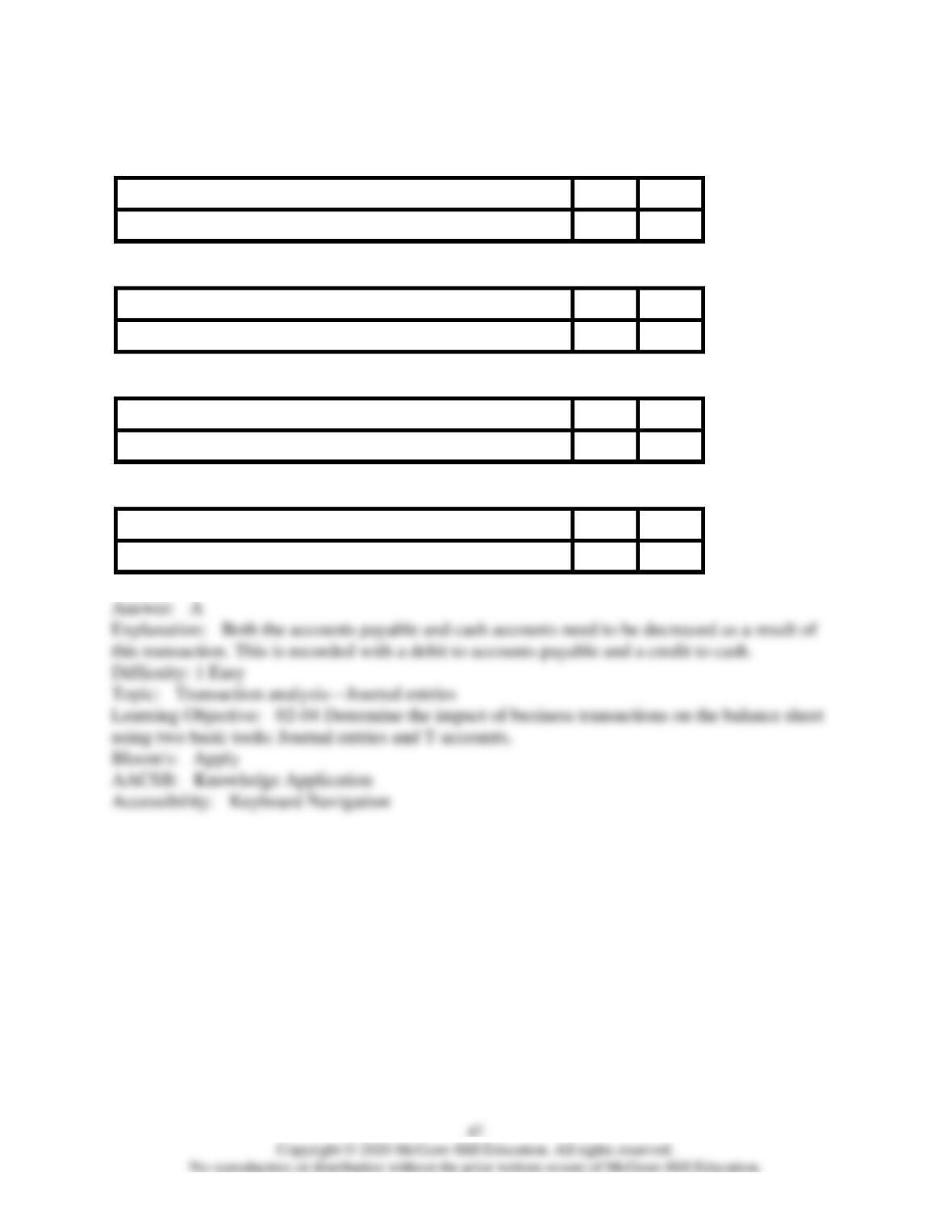
96) Which of the following journal entries is correct when a business entity uses cash to pay an
account payable?
A)
Accounts Payable
xxx
Cash
xxx
B)
Accounts Receivable
xxx
Cash
xxx
C)
Cash
xxx
Accounts Payable
xxx
D)
Cash
xxx
Notes Payable
xxx
97) Which of the following transactions would result in an increase in the current ratio?
A) Collection of cash from an account receivable.
B) Selling shares of stock to stockholders in exchange for cash.
C) Purchasing a building with cash.
D) Declaration of a cash dividend by the board of directors.
98) Which of the following transactions would result in a decrease in the current ratio?
A) Collection of cash from an account receivable.
B) Selling shares of stock to stockholders in exchange for cash.
C) Purchasing a delivery vehicle by signing a long-term note payable.
D) Purchasing land by paying cash.
99) Which of the following account balances would not be included in the calculation of the
current ratio?
A) Accounts receivable.
B) Short-term investments.
C) Equipment.
D) Supplies.
100) Which of the following statements does not properly describe the current ratio?
A) It measures the ability of a firm to pay its debts in the short-run.
B) It is current assets divided by current liabilities.
C) It is a measure of a firm’s short-run liquidity.
D) It measures a firm’s ability to pay its long-term debts as they mature.
101) The Pioneer Company has provided the following account balances:
Cash $38,000;
Short-term investments $4,000;
Accounts receivable $48,000;
Supplies $6,000;
Long-term notes receivable $2,000;
Equipment $96,000;
Factory Building $180,000;
Intangible assets $6,000;
Accounts payable $30,000;
Accrued liabilities payable $4,000;
Short-term notes payable $14,000;
Long-term notes payable $92,000;
Common stock $180,000;
Retained earnings $60,000.
What are Pioneer’s total current assets?
A) $48,000.
B) $96,000.
C) $90,000.
D) $42,000.
102) The Pioneer Company has provided the following account balances:
Cash $38,000;
Short-term investments $4,000;
Accounts receivable $48,000;
Supplies $6,000;
Long-term notes receivable $2,000;
Equipment $96,000;
Factory Building $180,000;
Intangible assets $6,000;
Accounts payable $30,000;
Accrued liabilities payable $4,000;
Short-term notes payable $14,000;
Long-term notes payable $92,000;
Common stock $180,000;
Retained earnings $60,000.
What are Pioneer’s total current liabilities?
A) $44,000.
B) $34,000.
C) $48,000.
D) $140,000.
103) The Pioneer Company has provided the following account balances:
Cash $38,000;
Short-term investments $4,000;
Accounts receivable $48,000;
Supplies $6,000;
Long-term notes receivable $2,000;
Equipment $96,000;
Factory Building $180,000;
Intangible assets $6,000;
Accounts payable $30,000;
Accrued liabilities payable $4,000;
Short-term notes payable $14,000;
Long-term notes payable $92,000;
Common stock $180,000;
Retained earnings $60,000.
What is Pioneer’s current ratio?
A) 2.00.
B) 2.17.
C) 2.71.
D) 1.00.
104) At the beginning of April, Warren Corporation’s assets totaled $240,000 and liabilities
totaled $60,000. During April the following summarized transactions occurred:
Additional shares of stock were sold for $20,000 cash.
A building costing $95,000 was purchased using $10,000 cash and by signing an $85,000 long-
term note payable.
Short-term investments costing $9,000 were purchased using cash.
$10,000 was paid to an employee as a loan; the employee signed a six-month note in exchange
for the loan.
How much are Warren’s total assets at the end of April?
A) $335,000.
B) $249,000.
C) $345,000.
D) $250,000.
105) At the beginning of April, Warren Corporation’s assets totaled $240,000 and liabilities
totaled $60,000. During April the following summarized transactions occurred:
Additional shares of stock were sold for $20,000 cash.
A building costing $95,000 was purchased using $10,000 cash and by signing an $85,000 long-
term note payable.
Short-term investments costing $9,000 were purchased using cash.
$10,000 was paid to an employee as a loan; the employee signed a six-month note in exchange
for the loan.
How much are Warren’s total liabilities at the end of April?
A) $145,000.
B) $155,000.
C) $165,000.
D) $135,000.
106) Tiger Company’s total stockholders’ equity at the beginning of the year was $175,000.
During the year Tiger reported the following:
Net income of $79,000.
Dividend declarations totaling $17,000.
Issued stock to stockholders in exchange for $42,000 cash.
Borrowed $20,000 from a stockholder.
What is Tiger’s total stockholders’ equity at the end of the year?
A) $296,000.
B) $279,000.
C) $290,000.
D) $273,000.
107) ABC Company’s total stockholders’ equity at the beginning of the year was $200,000.
During the year ABC reported the following:
Net loss of $30,000.
Stock issued in exchange for land totaling $80,000.
Collections of accounts receivable $40,000.
Dividends declared and paid totaling $2,000.
What is ABC’s total stockholders’ equity at the end of the year?
A) $348,000.
B) $288,000.
C) $248,000.
D) $168,000.
108) Which of the following transactions would create an increase in cash from a financing
activity?
A) Issuing shares of common stock to stockholders in exchange for cash.
B) Selling a short-term stock investment in exchange for cash.
C) Selling used equipment, which was a part of property and equipment, for cash.
D) The payment of an account payable.
109) Which of the following best describes financing activities?
A) They primarily deal with securing money by bank loans or selling stock to investors.
B) They primarily are connected to the income-producing activities of the company as reported
on the income statement.
C) They primarily deal with buying buildings to be used over many years by the business.
D) They primarily deal with selling facilities once used by the business.
110) Which of the following would cause a decrease in cash from investing activities?
A) Purchasing shares of stock of another company.
B) Paying a cash dividend to stockholders.
C) Issuing additional shares of the company’s common stock.
D) Using cash to purchase supplies.
111) Which of the following would result when a company borrows cash and signs a note
payable that is due in two years?
A) A noncurrent liability and an investing cash flow are created.
B) A noncurrent liability and a financing cash flow are created.
C) A current liability and an investing cash flow are created.
D) A current liability and a financing cash flow are created.
112) Which of the following would result when a company sells additional shares of common
stock for cash?
A) A noncurrent liability and a financing cash flow are created.
B) Common stock increases and a financing cash flow results.
C) A noncurrent liability and an investing cash flow are created.
D) Common stock increases and an investing cash flow results.
113) Which of the following would result when a company purchases a factory building using
cash?
A) A noncurrent asset and an investing cash flow are created.
B) A noncurrent asset and a financing cash flow are created.
C) A current asset and an investing cash flow are created.
D) A current asset and a financing cash flow are created.
114) Which of the following would result when a company lends cash to a customer in exchange
for a ten-month note receivable?
A) A noncurrent asset and an investing cash flow are created.
B) A noncurrent asset and a financing cash flow are created.
C) A current asset and a financing cash flow are created.
D) A current asset and an investing cash flow are created.
115) Which of the following would result when a company pays a previously declared cash
dividend?
A) Current liabilities are reduced and a financing cash flow is created.
B) Stockholders’ equity is reduced and a financing cash flow is created.
C) Current assets are reduced and an investing cash flow is created.
D) Stockholders’ equity is reduced and an investing cash flow is created.
116) Which of the following would be classified as financing cash flows on a statement of cash
flows?
1. Paying cash dividends.
2. Lending cash to others.
3. Issuing stock for cash.
4. Purchasing long-term assets for cash.
A) 1, 2, 3.
B) 2, 3, 4.
C) 1, 3.
D) 2, 4.