
Chapter 2 Job-Order Costing for Manufacturing and Service Companies
2-21
105. Sharp Tables produces go carts designed to a customer’s specification with the customer’s
logo. Job 65 consists of producing 40 carts for Race Around for a new store opening.
Overhead is applied on the basis of direct labor hours using a predetermined overhead rate of
$18 per hour. Job 65 incurred the following amounts:
Direct materials $2,200
Direct labor 28 hours at $15 per hour
How much is the cost of Job 65?
A. $2,620
B. $3,124
C. $2,704
D. $604
106. Mudd Shoe Company has expected overhead costs of $864,000. The majority of the overhead
costs are incurred providing production support to the direct labor force. Direct labor rates vary
from $12 to $21 per hour, and more complex tasks are assigned to more skilled workers who
have higher pay rates. Management projects direct labor costs to be $540,000 with 39,273
direct labor hours. More complex tasks require proportionally more support than do the less
complex tasks.
Each model/size of shoe is produced in a separate production batch and constitutes a job.
Mudd allocates overhead based on direct labor hours. During the year, the company produced
6,600 pairs of the size 8 Beachcomber shoes. A total of 4,200 direct labor hours, costing
$54,600, were assigned to the job. How much overhead will be assigned to the size 8
Beachcomber shoes?
A. $92,400
B. $87,360
C. $10,560
D. $57,750
107. Mudd Shoe Company has expected overhead costs of $864,000. The majority of the overhead
costs are incurred providing production support to the direct labor force. Direct labor rates vary
from $12 to $21 per hour, and more complex tasks are assigned to more skilled workers who
have higher pay rates. Management projects direct labor costs to be $540,000 with 39,273
direct labor hours. More complex tasks require proportionally more support than do the less
complex tasks.
Each model/size of shoe is produced in a separate production batch and constitutes a
job. Mudd allocates overhead based on direct labor cost. During the year, the company
produced 6,600 pairs of the size 8 Beachcomber shoes. A total of 4,200 direct labor hours,
costing $54,600, were assigned to the job. How much overhead will be assigned to the size 8
Beachcomber shoes?
A. $92,400
B. $90,560
C. $87,360
D. $57,750
Test Bank to accompany Jiambalvo Managerial Accounting, 6th Edition
2-22
108. Haskell Construction began the month of July with jobs 60 and 63 completed and waiting to be
shipped to customers. At the end of June, jobs 61, 64, and 65 were in production. During July,
jobs 66, 67, 68, 69 and 70 were begun. The company completed Jobs 61, 65, 66, 68, and 69
during July. Jobs 60, 61, 63, 66, and 68 were shipped to customers during July. Which jobs
are in Work in Process on July 31?
A. 61, 65, 66, 68, and 69
B. 64, 67, and 70
C. 67 and 70
D. 65 and 69
109. Reef Shoe Company has expected overhead costs of $864,000. The majority of the overhead
costs are incurred providing production support to the direct labor force. Direct labor rates vary
from $12 to $21 per hour, and more complex tasks are assigned to more skilled workers who
have higher pay rates. Management projects direct labor costs to be $540,000 with 39,273
direct labor hours. More complex tasks require proportionally more support than do the less
complex tasks.
Each model/size of shoe is produced in a separate production batch and constitutes a
job. During the year, the company produced 6,600 pairs of the size 8 Beachcomber flip flop. A
total of 4,200 direct labor hours, costing $54,600, were assigned to the job. Which method of
assigning overhead should management prefer?
A. Direct labor cost is the preferred allocation base because workers paid a higher rate
work on more complex jobs, and more complex jobs lead to more overhead cost.
B. Direct labor hours is the preferred allocation base because workers paid a higher rate
work on more complex jobs, and more complex jobs lead to more overhead cost.
C. Direct labor cost is the preferred allocation base because it is not possible to track
hours during which workers spend on each type of shoe produced.
D. Direct labor hours is the preferred allocation base because the number of hours
incurred for each model of shoe is the same for each worker, regardless of the rate of
pay each worker earns.
110. Haskell Construction began the month of July with jobs 60 and 63 completed and waiting to be
shipped to customers. At the end of June, jobs 61, 64, and 65 were in production. During July,
jobs 66, 67, 68, 69 and 70 were begun. The company completed Jobs 61, 65, 66, 68, and 69
during July. Jobs 60, 61, 63, 66, and 68 were shipped to customers during July. Which jobs
are in Finished Goods Inventory on July 31?
A. 64, 67, and 70
B. 60, 65, and 69
C. 65 and 69
D. 60, 63, 65, and 69
111. During 2017, Anhover Wedding Planners applied overhead using a job-order costing system
at a rate of $3.25 per direct labor hour. Estimated direct labor hours totaled 220,000 and
estimated overhead was $715,000 for the year. Actual direct labor hours for 2017 totaled
215,000 and actual overhead was $702,000. What is the amount of under or overapplied
overhead as of the end of 2017?
A. $13,000 overapplied
B. $13,000 underapplied
C. $16,250 underapplied
D. $3,250 underapplied
Chapter 2 Job-Order Costing for Manufacturing and Service Companies
2-23
112. Lansing Productions estimated it would use $360 of materials and take 20 hours at $14.50 per
hour to complete job 456. It calculated a predetermined overhead rate of $9.00 per direct labor
hour. Job 456 required $380 of material and took employees a total of 19.25 hours at a cost of
$15.20 per hour to complete the job. Actual manufacturing overhead costs totaled $223,000
for the year for the company. How much is the cost of Job 456?
A. $173.25
B. $553.25
C. $845.85
D. $823.25
113. Osprey Production uses job-order costing for batches of customer printed t-shirts. For job R45,
the company incurred the following costs:
Direct materials used $4,235
Direct labor $1,300
Applied overhead $450
Actual overhead for Osprey for the month totaled $24,840, based on a total of 2,300 shirts for
the month. If Job R45 consisted of 570 shirts, how much is the cost per shirt for this job?
A. $10.80
B. $14.95
C. $10.50
D. $15.25
114. Alex Constructors uses job-order costing for production of custom playground sets. The
company incurred the following costs during March:
Direct materials used $22,000
Direct labor $14,000
Applied overhead $18,000
Actual overhead $20,000
If Alex Constructors closes out any under or overapplied overhead directly to cost of goods
sold, which entry will the company make to eliminate the over or underapplied amount in
March?
A. Cost of Goods Sold 2,000
Work in Process Inventory 2,000
B. Manufacturing Overhead 2,000
Work in Process Inventory 2,000
C. Manufacturing Overhead 2,000
Cost of Goods Sold 2,000
D. Cost of Goods Sold 2,000
Manufacturing Overhead 2,000
Test Bank to accompany Jiambalvo Managerial Accounting, 6th Edition
2-24
115. Assume that managers are rewarded for reducing product costs as calculated by the
accounting system. In keeping with the theme that “you get what you measure,” if a company
switches its overhead application basis from direct labor hours to machine hours, what would
you expect to happen?
A. Machine hours will increase
B. Machine hours will decrease
C. Total costs will increase
D. Output will reduce
116. Why is overhead applied using a predetermined overhead rate?
A. The actual amount of overhead is not determined until yearend and the company
desires timely cost information.
B. Actual manufacturing overhead costs are often larger than expected.
C. It allows a company to overcost and undercost specific jobs as desired.
D. It helps to reduce the overhead cost for the company.
117. Brothers Construction uses a predetermined overhead rate of $6.00 per direct labor hour.
Budgeted overhead was $720,000 and actual overhead incurred was $700,000. Actual direct
labor hours worked were 125,000 hours. How many labor hours did Brothers plan to work
during the year?
A. 120,000 hours
B. 116,667 hours
C. 20,833 hours
D. Cannot be determined from the information given
118. Ansley Products applies overhead using a predetermined overhead rate. Overhead is applied
based on direct labor hours. At the beginning of the year, it is estimated that $500,000 in
overhead will be incurred and 25,000 hours will be worked. At year-end, the company had
used 24,000 hours of labor, and actual overhead costs were $470,000. What can be
concluded from this?
A. Cost control was good.
B. Overhead is overapplied by $10,000.
C. Overhead is underapplied by $10,000.
D. Overhead is applied at a rate of $19.58 per hour
119. If the amount of underapplied overhead or overapplied overhead is small in amount, the
Manufacturing Overhead account is closed to
A. Raw Materials Inventory.
B. Work in Process Inventory.
C. Finished Goods Inventory.
D. Cost of Goods Sold.
120. Stalk Products has $27,000 of underapplied overhead at the end of the year. Management has
asked you what the impact on income will be if you prorate the underapplied overhead to the
appropriate accounts. What will you tell them?
A. Income will be higher if the underapplied overhead is prorated than if it is closed to
Cost of Goods Sold.
B. Income will be lower if the underapplied overhead is prorated than if it is closed to Cost
of Goods Sold.
C. Income will be the same regardless of which method is used.
D. The answer depends on the reason that the underapplied exists.
Chapter 2 Job-Order Costing for Manufacturing and Service Companies
2-25
121. If the amount of underapplied overhead is large in amount, it is
A. closed to Finished Goods.
B. apportioned between Raw Materials, Finished Goods, and Work in Process Inventory.
C. apportioned among Work in Process, Finished Goods, and Cost of Goods Sold.
D. closed to Cost of Goods Sold.
122. What is the impact of disposing any overapplied overhead between the appropriate accounts,
if the amount is material?
A. It will increase cost of goods sold, decrease income, and reduce inventory.
B. It will reduce cost of goods sold, increase income, and increase inventory.
C. It will reduce cost of goods sold, increase income, and reduce inventory.
D. It will increase cost of goods sold, decrease income and increase inventory.
123. Factory Containers allocates overhead based on machine hours. Estimated overhead costs for
the year total $68,000 and the company estimates that it will use 16,000 machine hours during
the year. Actual overhead for the year was $62,250 and the company used 15,000 machine
hours. If Job J33 requires 420 machine hours, how much overhead will be allocated to Job
J33?
A. $1,743
B. $1,904
C. $1,634
D. $1,785
124. King Manufacturing estimated manufacturing overhead costs to be $248,000 for the year,
incurred manufacturing overhead costs of $251,000, and applied overhead to jobs in the
amount of $253,000. How much is the amount of overapplied or underapplied overhead?
A. $2,000 overapplied
B. $5,000 overapplied
C. $3,000 underapplied
D. $2,000 underapplied
125. Juarez, Inc. designs and manufactures custom cabinets. The company uses a job-order
costing system, and the allocates overhead at $18 per direct labor hour. Over or underapplied
overhead is not material. During May, Juarez’s transactions included the following:
Direct labor cost incurred at $15 an hour $5,400
Manufacturing overhead cost incurred 6,800
Direct materials purchased 11,500
Raw materials inventory, beginning 160
Raw materials inventory, ending 280
Sales 23,000
Selling expenses 2,100
Work in process inventory, beginning 220
Work in process inventory, ending 250
How much is over or underapplied overhead for May?
A. $320 underapplied
B. $1,400 overapplied
C. $6,800 underapplied
D. More information is needed
Test Bank to accompany Jiambalvo Managerial Accounting, 6th Edition
2-26
126. Sandross, Inc. applies overhead based on direct labor cost using a job-order costing system.
The company estimated the following annual amounts:
Estimated manufacturing overhead $42,000
Estimated direct labor 1,600 hours at $15 per hour
Actual amounts for the year were:
Actual manufacturing overhead $44,000
Actual direct labor 1,550 hours at $16 per hour
How much is over or underapplied overhead?
A. $600 underapplied
B. $2,000 underapplied
C. $3,313 underapplied
D. $1,419 underapplied
127. Elm Street Company incurred $440,000 direct labor costs this year. Manufacturing overhead
was applied at a predetermined rate of $5.50 per direct labor hour. The average hourly wage
rate was $16 per hour. If actual overhead incurred was $160,000, what was the amount of
overapplied or underapplied overhead?
A. $151,250 underapplied
B. $8,750 underapplied
C. $27,500 overapplied
D. $151,250 overapplied
128. Rivertown Products applied overhead to jobs at a rate of $10.00 per direct labor hour. If the
budgeted manufacturing overhead was $660,000 and the actual manufacturing overhead
incurred was $630,000, how much under or over applied overhead did Rivertown have?
A. $30,000 underapplied
B. $30,000 overapplied
C. $60,000 overapplied
D. Information provided is not sufficient to derive the answer
129. Harvard Binding had budgeted direct labor costs of $870,000 and budgeted manufacturing
overhead of $304,500. It allocates manufacturing overhead based on direct labor costs. If
actual direct labor costs were $840,000 and actual manufacturing overhead costs were
$286,000, identify the true statement.
A. The company applied more overhead than it incurred.
B. The company estimated less overhead than it applied.
C. The company incurred more overhead than it estimated.
D. The company estimated less overhead than it incurred.
130. Why is factory overhead ‘applied’ to products and jobs by manufacturing companies?
A. Actual overhead costs can never be accurately determined for jobs.
B. Managers prefer job costs to be exact in amount for budgeting purposes.
C. It allows managers more timely determination of product costs during the
manufacturing process.
D. It provides a more accurate cost of the job or products being processed.
Chapter 2 Job-Order Costing for Manufacturing and Service Companies
2-27
131. At the end of the period, the Manufacturing Overhead account had a $4,200 debit balance.
The balances in the Work in Process Inventory, Finished Goods Inventory, and Cost of Goods
Sold were $10,000, $20,000, and $70,000, respectively. Assuming that the balance in
Manufacturing Overhead is considered material, which of the following is part of the journal
entry to close the Manufacturing Overhead account at the end of the period?
A. A $4,200 debit to Finished Goods Inventory.
B. A $4,200 debit to Cost of Goods Sold.
C. Debits to Work in Process Inventory, Finished Goods Inventory, and Cost of Goods
Sold for $420, $840, and $2,940, respectively.
D. Debits to Work in Process Inventory, Finished Goods Inventory, and Cost of Goods
Sold for $1,400 each
132. At the end of the period, the Manufacturing Overhead account had a $21,000 debit balance.
The balances in the Work in Process Inventory, Finished Goods Inventory, and Cost of Goods
Sold were $10,000, $20,000, and $70,000, respectively. Assuming that the balance in
Manufacturing Overhead is considered immaterial, which of the following is a part of the
journal entry to close the Manufacturing Overhead account at the end of the period?
A. A $21,000 debit to Cost of Goods Sold.
B. A $21,000 debit to Finished Goods Inventory.
C. Debits to Work in Process Inventory, Finished Goods Inventory, and Cost of Goods
Sold for $7,000 each.
D. Debits to Work in Process Inventory, Finished Goods Inventory, and Cost of Goods
Sold for $2,100, $4,200, and $14,700, respectively.
133. At the end of the period, Massive Designs had the following debit balances in its accounts.
Raw Materials Inventory $ 20,000
Work in Process Inventory 40,000
Finished Goods Inventory 60,000
Cost of Goods Sold 400,000
Manufacturing Overhead 8,000
Assuming the amount in Manufacturing Overhead is considered material, the entry to allocate
Manufacturing Overhead will include a
A. debit to Cost of Goods Sold for $6,400.
B. debit to Cost of Goods Sold for $8,000.
C. debit to Cost of Goods sold for $6,154.
D. credit to Work in Process Inventory for $6,400.
134. At the end of 2017, Harbin Toys had the following balances in its accounts
Raw Materials Inventory $ 12,000
Work in Process Inventory 30,000
Finished Goods Inventory 48,000
Cost of Goods Sold 360,000
Manufacturing Overhead (credit) 3,200
Assuming the amount in Manufacturing Overhead is considered immaterial, which of the
following accounts will be credited for $3,200 in eliminating the balance in the Manufacturing
Overhead account?
A. Raw Materials Inventory
B. Work in Process Inventory
C. Manufacturing Overhead
D. Cost of Goods Sold
Test Bank to accompany Jiambalvo Managerial Accounting, 6th Edition
2-28
135. Actual manufacturing overhead incurred during the year was $332,000 and manufacturing
overhead applied to jobs was $336,000. Assuming the balance in the Manufacturing Overhead
account is considered immaterial, the journal entry to close the Manufacturing Overhead
account will include a $4,000 debit to
A. Cost of Goods Sold.
B. Work in Process Inventory.
C. Manufacturing Overhead.
D. Finished Goods.
136. Overhead applied to jobs during the period was $180,000. Actual overhead costs incurred
were $181,000. Budgeted overhead used to calculate the predetermined overhead rate was
$184,000. Which of the following is a correct entry to close the Manufacturing Overhead
account assuming the under or overapplied overhead is immaterial?
A. Manufacturing Overhead 1,000
Cost of Goods Sold 1,000
B. Cost of Goods Sold 1,000
Manufacturing Overhead 1,000
C. Manufacturing Overhead 3,000
Cost of Goods Sold 3,000
D. Cost of Goods Sold 4,000
Manufacturing Overhead 4,000
137. Hanover Fence produces custom wrought iron fencing. At the end of 2017, the account
balances indicated the following:
Raw Materials Inventory $ 18,000
Work in Process Inventory 74,000
Finished Goods Inventory 42,000
Cost of Goods Sold 384,000
Manufacturing Overhead (credit balance) 8,000
Hanover considers the balance of manufacturing overhead to be immaterial. How much will
Hanover Fence report as Cost of Goods Sold on its income statement for the year ending
December 31, 2017?
A. $376,000
B. $392,000
C. $384,000
D. $382,000

Chapter 2 Job-Order Costing for Manufacturing and Service Companies
2-29
138. Walston’s Designs produces custom portable spas. At the end of its accounting period, the
account balances indicated the following:
Raw Materials Inventory $ 22,000
Work in Process Inventory 38,000
Finished Goods Inventory 62,000
Cost of Goods Sold 300,000
Manufacturing Overhead (credit balance) 9,000
Walston’s Designs considers the balance of manufacturing overhead to be material in amount.
How much is the adjusted balance of Cost of Goods Sold to be reported by Walston on its
income statement?
A. $300,000
B. $293,250
C. $306,750
D. $294,313
139. Raindrop Gear utilizes job-order costing for production of customized umbrellas. Each division
establishes its own estimates regarding overhead, which are as follows:
Division A Division B
Total estimated overhead $78,750 $240,000
Total estimated machine hours 26,250 15,000
Total estimated direct labor costs $262,500 $120,000
If Division A allocates overhead on the basis of direct labor costs, and Division B allocates
overhead based on machine hours, what will be the predetermined overhead rate for each
division?
Division A Division B
A. $3.00 per direct labor dollar $16.00 per machine hour
B. $3.00 per machine direct labor dollar $0.625 per machine hour
C. $0.30 per machine direct labor dollar $16.00 per machine hour
D. $0.30 per machine direct labor dollar $2.00 per machine hour
140. Kamins Company uses a predetermined overhead rate of $6.00 per machine hour. Overhead
was underapplied by $40,000 for the year, and actual machine hours totaled 70,000. How
much was the actual overhead cost?
A. $460,000
B. $380,000
C. $420,000
D. $360,000
141. Templeton Widgets applies manufacturing overhead based on direct labor hours. It budgeted
123,000 direct labor hours at $11.50 per labor hour and incurred 125,000 direct labor hours at
an actual total labor cost of $1,500,000. It incurred $720,000 of manufacturing overhead and
estimated the manufacturing overhead cost to be $707,250 for the period. What was the
predetermined overhead rate?
A. $0.50
B. $5.75
C. $0.48
D. $5.76
Test Bank to accompany Jiambalvo Managerial Accounting, 6th Edition
2-30
142. The balances in Dellco Company’s accounts at the end of the period were:
Work in Process Inventory $ 40,000
Finished Goods Inventory 60,000
Cost of Goods Sold 300,000
Manufacturing Overhead (credit balance) 12,000
If the balance in the Manufacturing Overhead account is considered immaterial, which of the
following represents the amounts that should be adjusted to the Work in Process Inventory
account?
A. $0
B. Debit of $12,000
C. Credit of $12,000
D. Credit of $9,000
143. Which of these service-type companies typically do not assign overhead costs to jobs when
using a job-order costing system?
A. Consulting firms
B. Hospitals
C. Repair shops
D. Law firms
144. In which country were just-in-time (JIT) systems first used?
A. England
B. United States
C. Japan
D. Germany
145. If a company has zero beginning inventory and zero ending inventory which of the following is
true?
A. Cost of goods sold will equal cost of goods manufactured.
B. Cost of goods sold will be zero.
C. Cost of goods manufactured will be zero.
D. Inventory levels will fluctuate each period.
146. To which of the following is the goal of minimizing raw materials and work in process
inventories considered to be a key objective?
A. ABC
B. JIT
C. TQM
D. Computer-controlled manufacturing systems
147. Which of the following is true concerning computer-controlled manufacturing systems?
A. They require a company to use a just–in-time inventory system.
B. They result in a decrease in direct labor costs.
C. They increase the variable costs and decrease fixed costs.
D. They require overhead to be allocated based on machine hours.
148. Which of the following is another name for the total quality management program?
A. Just-in-time
B. Activity-based allocation
C. Lean manufacturing
D. Continuous quality improvement
Chapter 2 Job-Order Costing for Manufacturing and Service Companies
2-31
149. Which of the following is not a component of a total quality management (TQM) program?
A. Making products right the first time, which reduces rework and scrap costs
B. Listening to the customers’ needs
C. Encouraging workers to continuously improve the production process
D. Reducing inventories to very small, or non-existent levels
150. What occurs when state of the art equipment is installed as part of incorporating a computer–
controlled manufacturing system?
A. Labor costs generally decrease.
B. Direct labor becomes a good allocation base.
C. Fixed costs will generally decrease.
D. All of these choices are correct
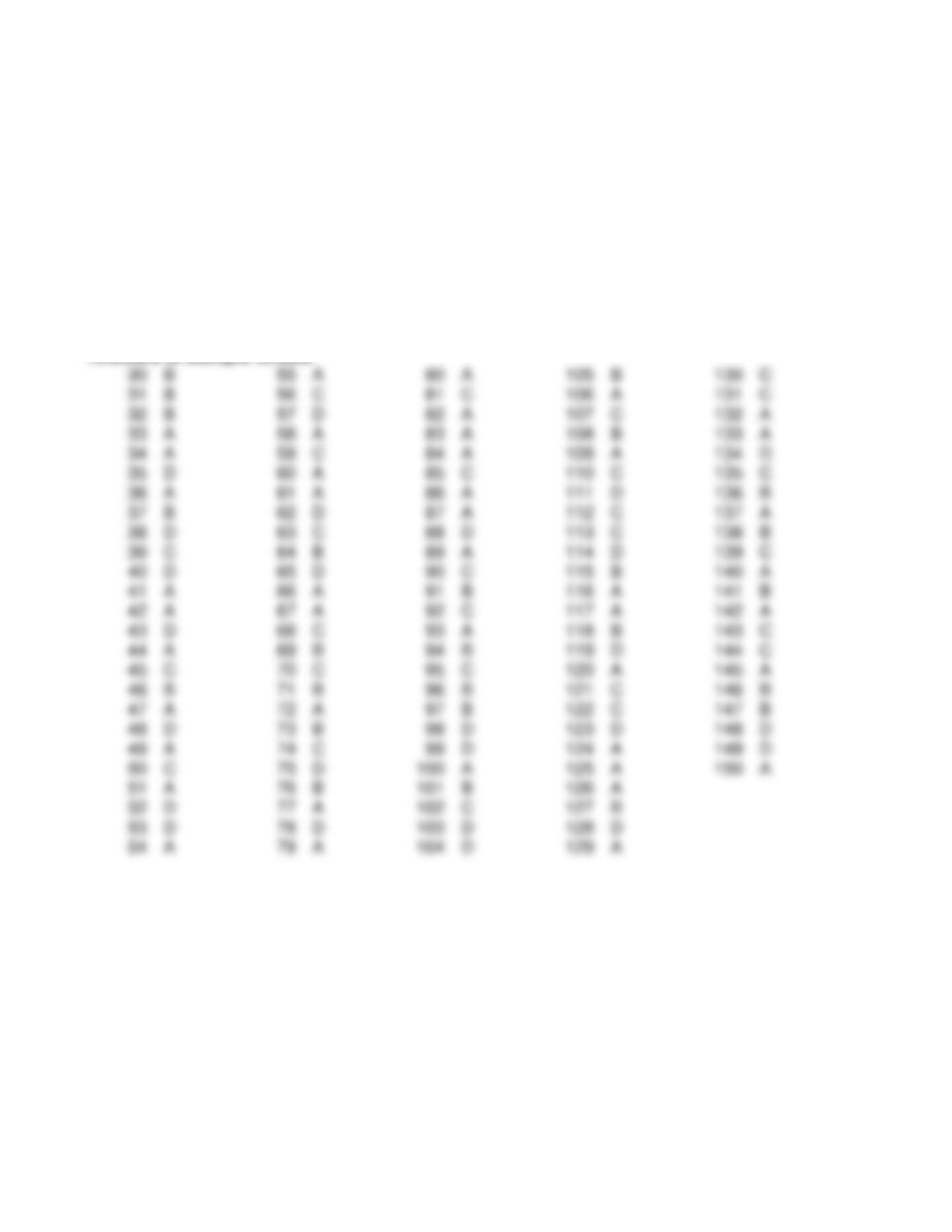
Answers to Multiple Choice

Test Bank to accompany Jiambalvo Managerial Accounting, 6th Edition
2-32
MATCHING
151. Match each of the following terms with the phrase that most closely describes it. Each answer
may be used only once.
______ 1. activity-based costing ______ 9. overapplied overhead
______ 2. cost of goods available for sale ______ 10. period costs
______ 3. cost of goods manufactured ______ 11. process costing system
______ 4. direct materials ______ 12. product costs
______ 5. job-order costing system ______ 13. total quality management
______ 6. just–in-time system ______ 14. underapplied overhead
______ 7. indirect materials ______ 15. work in process
______ 8. manufacturing overhead 16. predetermined overhead rate
A. Method of assigning overhead costs that uses multiple allocation bases
B. System that uses a job cost sheet to collect costs for each individual job
C. Cost of all materials that are directly traced to the items produced
D. Beginning balance in the Finished Goods Inventory plus cost of goods manufactured
E. Overhead applied to products is greater than the actual overhead costs incurred
F. Used by companies that produce large quantities of identical items
G. Cost of all manufacturing activities other than direct material and direct labor
H. Inventory account that contains the cost of goods that are only partially completed
I. Program that encourages workers to constantly improve their production processes
J. Amount determined at the beginning of the period to be used to apply overhead to production
K. Costs assigned to the goods produced; also known as manufacturing costs
L. Materials costs that are not traced directly to products produced
M. System that seeks to minimize Raw Materials Inventory and Work in Process Inventory
N. Cost of items that are completed and transferred from Work in Process Inventory to Finished
Goods Inventory
O. Costs that are identified with accounting periods rather than with goods produced
P. Actual overhead is greater than overhead that has been applied to products
Answers to Matching