56. Using the compound interest tables, solve the following questions.
Required:
a.
What amount of interest will be earned on an investment of $7,500 left on deposit by Mary for three years at 7% compounded annually?
b.
Taylor deposited $10,000 in a fund that earns 8% interest compounded annually. How many years will it take for the fund to grow to
$21,589.25?
a.
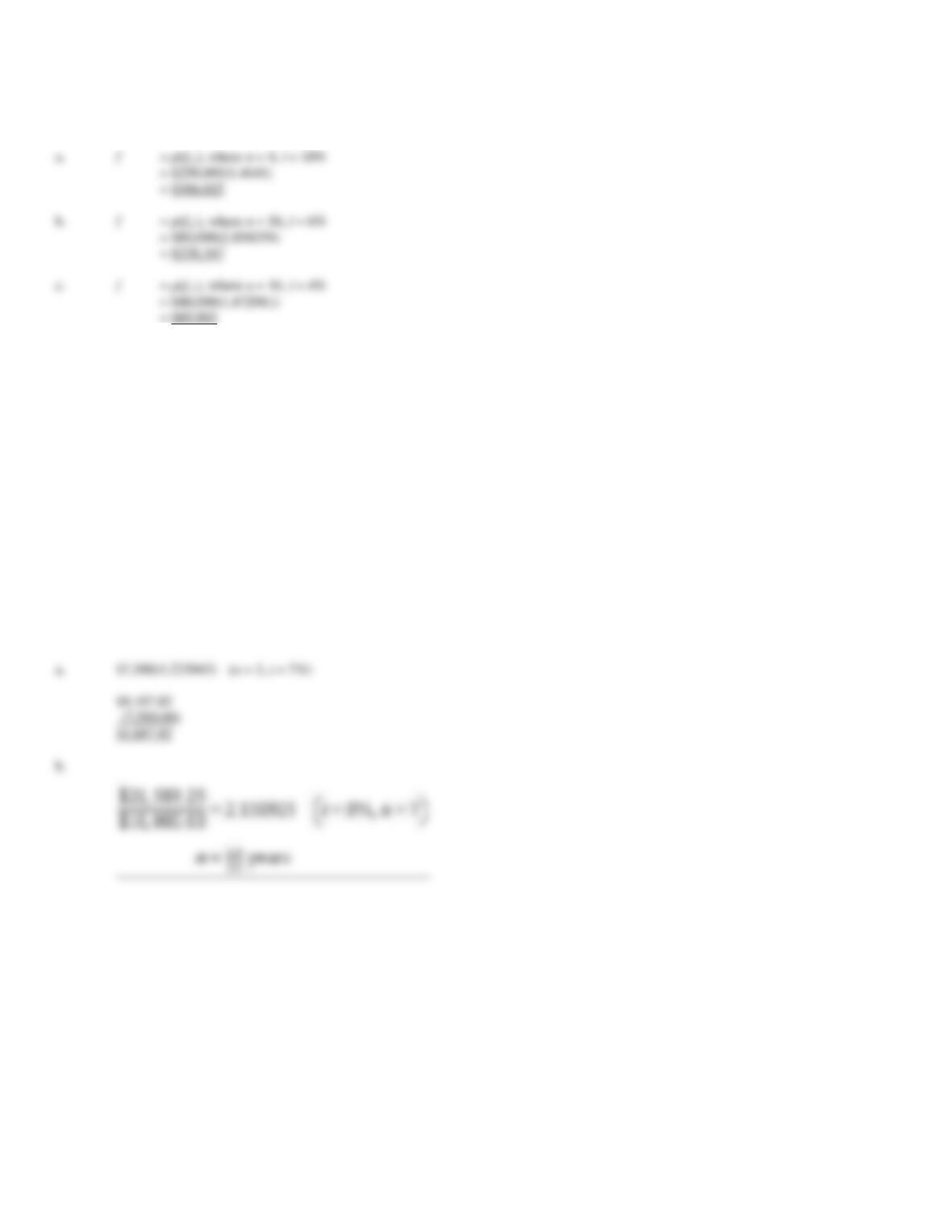
$7,500(1.225043) (n = 3, i = 7%)
$9,187.82
(7,500.00)
$1,687.82
a.
= $250,000(1.4641)
= $80,000(2.854339)
c.
= $48,000(1.872981)
57. Rose deposited $18,000 in a savings account that provides for interest at the rate of 16% compounded
quarterly.
Required:
Compute the balance in the account at the end of seven years.
58. Using the compound interest tables, solve each of the following questions.
Required:
a.
Assuming that $100,000 to be paid at the end of ten years has a present value today of $50,834.90, what interest rate compounded
annually is used in the calculation of the present value?
b.
What amount must be deposited today if $500,000 is to be accumulated six years from today, and interest at 12% is compounded
semiannually?
b.
= $500,000.00(.496969)
59. Using the compound interest tables, solve each of the following questions.
Required:
a.
What is the present value on January 1, 2010, of $40,000 due on January 1, 2016, and discounted at 6% compounded annually?
b.
What is the present value on January 1, 2010, of $8,000 due on January 1, 2018, and discounted at 9% compounded semiannually?
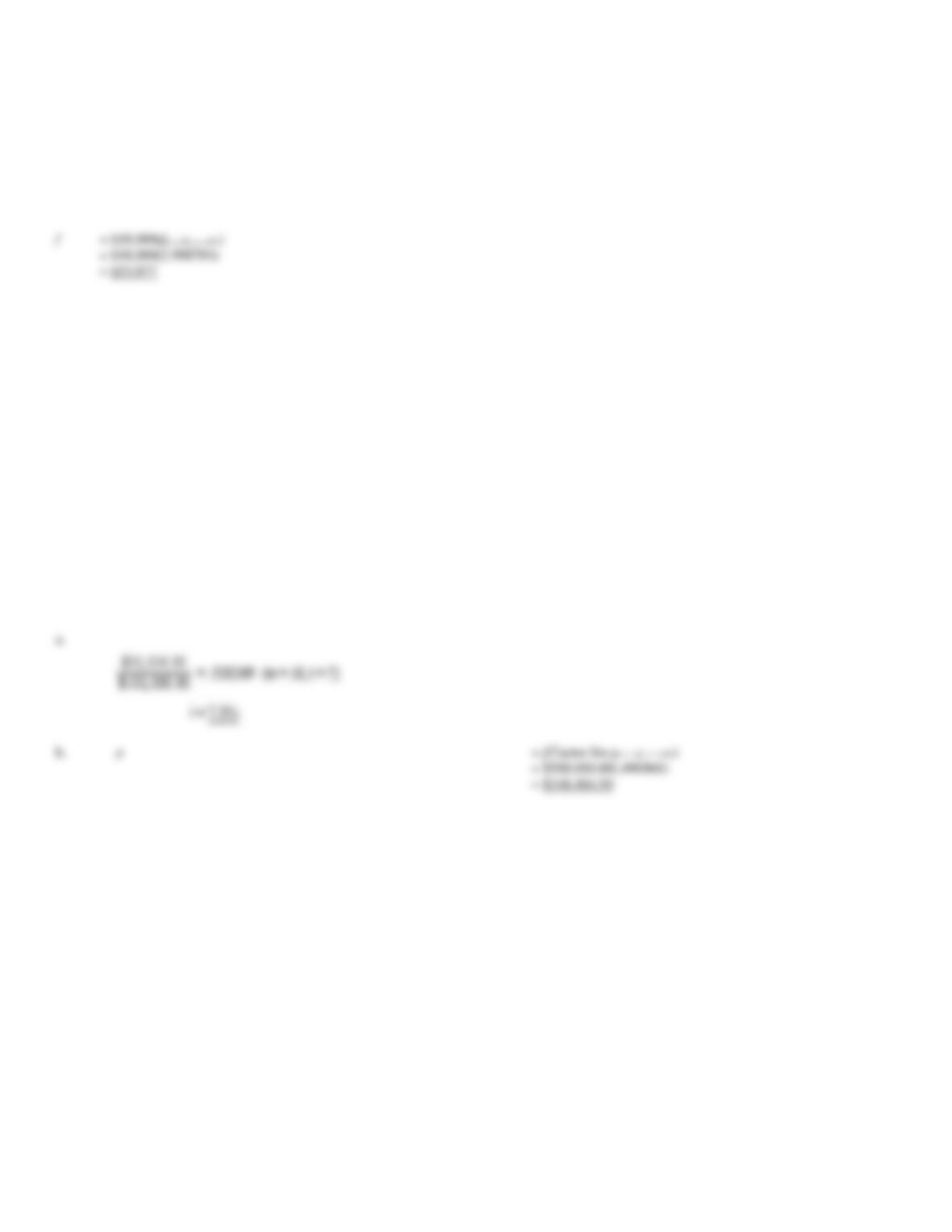
= $18,000(fn = 28, i = 4%)
= $18,000(2.998703)
60. Teresa would like to retire on December 31, 2020, and take a trip around the world. In order to do this, she
feels she must accumulate $200,000 in her retirement account by that date. She is willing to deposit a certain
amount each year into her retirement account, which earns 12% interest compounded annually. Teresa will
make the first deposit on December 31, 2011, and the last deposit on December 31, 2020.
Required:
Determine the amount Teresa must deposit into her retirement account each year. Clearly label all work.
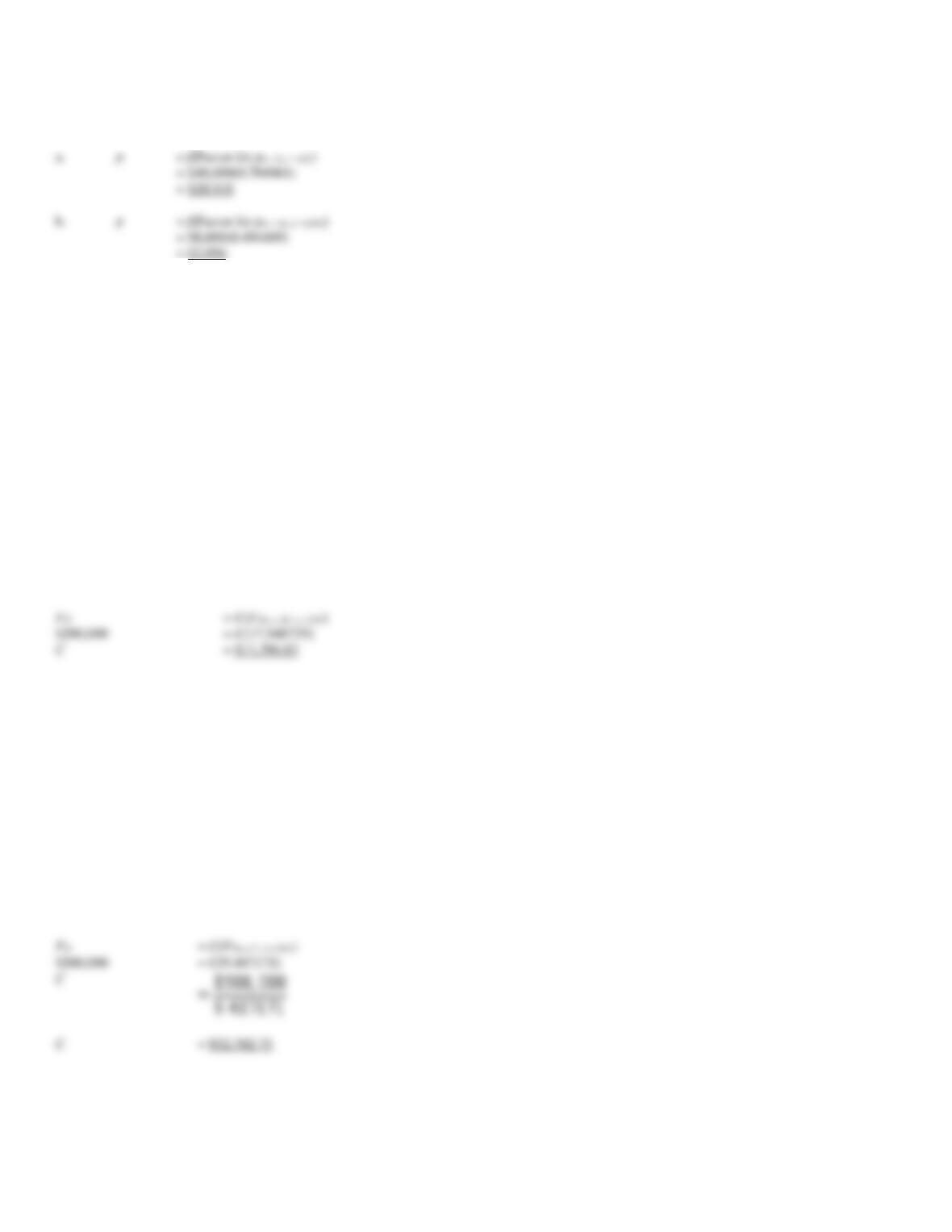
This problem involves the future value of an ordinary annuity where the future amount is known. The solution
approach using the ordinary annuity table is as follows:
61. At the beginning of 2010, Lucy Co. issued bonds with a face value of $500,000 due on December 31, 2016.
The company desires to accumulate a fund to retire these bonds at maturity by making equal annual deposits
beginning on December 31, 2010.
Required:
Compute the amount that the company must deposit at the end of each year, assuming that the fund will earn
10% interest a year compounded annually and seven deposits are made.
62. Using an appropriate compound interest table, solve the following question.
Required:
What is the future amount on December 31, 2020, of eleven deposits of $4,000 each with the first deposit being
made on December 31, 2010, and interest at 12% compounded annually?
63. Using the compound interest tables, solve each of the following questions.
Required:
a.
John has a $35,000 bank loan that he wishes to pay off in five equal annual payments with 12% interest. If the first payment is due one
year from today, what will be the amount of the annual payment necessary?
b.
Jeff wants to borrow some money from the bank to start a small business. Jeff can afford to pay off the loan in 15 annual installments of
$9,500. The bank charges an annual interest rate of 12%. If Jeff makes the first payment one year from the date of the loan, how much
can Jeff borrow?
a.
Present value of an ordinary annuity when the
64. Beginning December 31, 2010, ten equal annual withdrawals are to be made.
Required:
Using the appropriate tables, determine the equal annual withdrawals if $140,000 is invested on January 1, 2010
at an interest rate of 10% compounded annually.
65. Pricilla is considering buying a lottery ticket. She has to decide whether she wants to receive an immediate
lump sum payment based upon $50,000,000 or 20 equal annual payments of $2,500,000. The annual payments
begin the day after the lottery is won.
Below are compound interest amounts for 10% and 20 periods taken from the appropriate tables.
Future value of a lump sum
6.723
Present value of a lump sum
.149
Future value of an ordinary annuity
57.275
Present value of an ordinary annuity
8.514
Present value of an annuity due
9.365
Required:
Compute the present value of the amounts to be received under each alternative plan.
Present value of a lump sum:
$50,000,000 ´ .149 = $ 7,450,000
Present value of an annuity due:
$2,500,000 ´ 9.365 = $23,412,500
66. Compound interest factors are provided below:
5%, n = 10
5%, n = 20
10%, n = 10
10%, n = 20
Future value of a lump sum
1.629
2.653
2.594
6.728
Future value of an ordinary annuity
12.578
33.067
15.937
57.275
Present value of a lump sum
.614
.377
.386
.149
Present value of an ordinary annuity
7.722
12.462
6.145
8.514
Present value of an annuity due
8.108
13.089
6.759
9.365
$140,000
$140,000
Required:
Using the above factors, answer each of the following questions.
a.
How much will you have in 10 years if you invest $30,000 in an investment that earns 10% semiannually?
b.
How much do you have to invest today to have $30,000 in 10 years if the investment earns 10% annually?
c.
How much will you have in 10 years if you invest $15,000 at the end of each year in an investment earning 10% annually?
d.
How much do you have to invest at the end of each year if you want to accumulate a total of $400,000 at the end of 10 years in an
investment paying 10% semiannually?
a.
Future value, 5%, 20 periods: $30,000 ´ 2.653 = $79,590
Present value, 10%, 10 periods: $30,000 ´ .386 = $11,580
c.
Future value ordinary annuity, 10%, 10 periods: $15,000 ´ 15.937 = $239,055
Present value ordinary annuity, 5%, 20 periods: $400,000/12.462 = $32,098
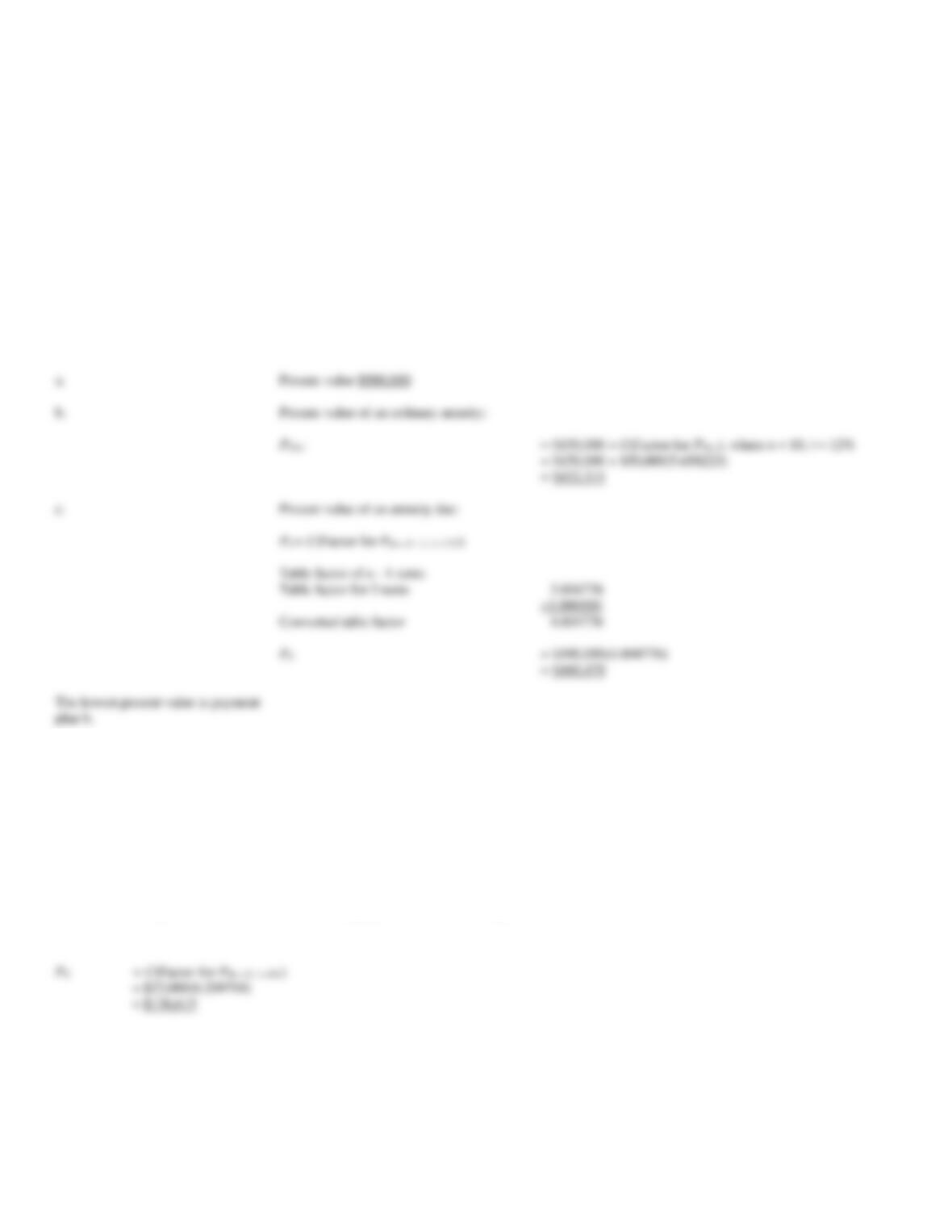
67. Match the diagrams with the concepts by writing the identifying letter of the diagram on the blank line to
the left of the concept. “VAL” represents the value to be calculated.
Concept
___
1.
Future value of $1
___
2.
Present value of $1
___
3.
Future value of an annuity due of $1
___
4.
Future value of an ordinary annuity of $1
___
5.
Present value of an ordinary annuity of $1
___
6.
Present value of an annuity due of $1
1.
E
2.
A
3.
F
68. On August 1, 2010, Jack purchased machinery from Morgan for expanding its production operation.
Morgan has given Jack three options for payment:
a.
$500,000 in cash now.
b.
$150,000 down payment now and $50,000 per year for the next ten years beginning August 1, 2011.
c.
$100,000 now and $100,000 per year for five years beginning August 1, 2010.
Required:
Determine which of the above payment plans has the lowest present value. Clearly label all of your work. The effective annual interest rate is
expected to be 12% during this period.
69. On January 1, 2010, Betty’s Produce Market leased some equipment from another company. The lease
contract calls for $22,000 payments for eight years, beginning on December 31, 2010.
Required:
Calculate the present value of the lease payments on January 1, 2010. Assume a 6% interest rate.
= $22,000(6.209794)
a.
Present value $500,000
b.
Present value of an ordinary annuity:
= $150,000 + C(Factor for POn,i), where n = 10, i = 12%
= $150,000 + $50,000(5.650223)
c.
Present value of an annuity due:
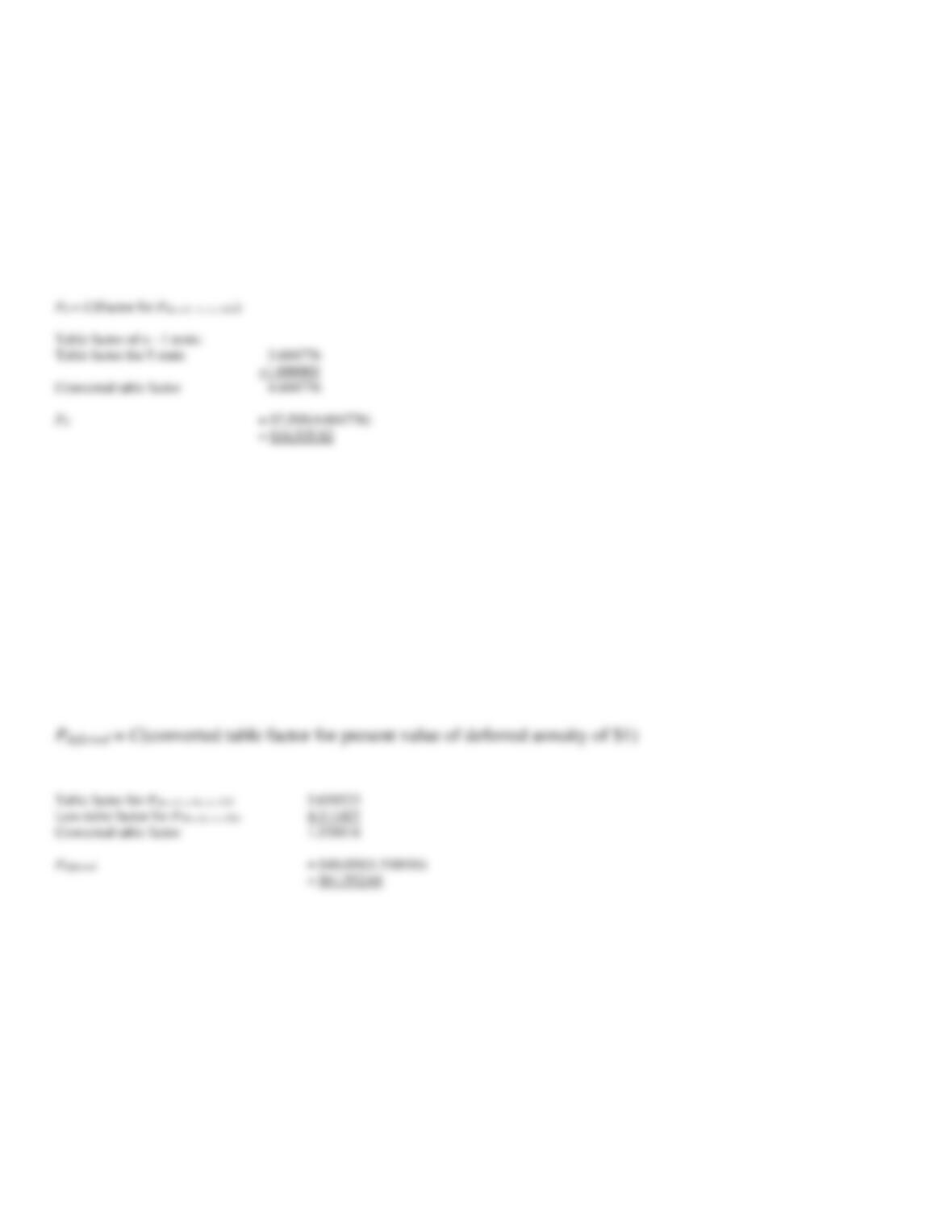
Table factor of n – 1 rents:
Table factor for 5 rents
3.604776
+1.000000
Converted table factor
4.604776
= $100,000(4.604776)
70. On January 1, 2010, Steelton Company completed arrangements to purchase a new piece of equipment. The
agreement calls for equal annual payments on January 1 of each year for six years. The first payment of $7,500
is to be made on January 1, 2010. The implied interest rate is 12%.
Required:
Calculate the cost of the equipment to Steelton Company.
Present value of an annuity due, table approach:
71. Grandpa Brown has agreed to deposit a lump sum into an account that pays 12% interest compounded
annually in order to pay for his granddaughter’s college education. The granddaughter estimated that she will
need to withdraw $40,000 at the beginning of each year for four years to pay for room, board, tuition, and
books. Grandpa will deposit the lump sum on August 1, 2010, and the granddaughter will make the first
withdrawal on September 1, 2016.
Required:
Determine the amount that Grandpa Brown must deposit. Clearly label all work.
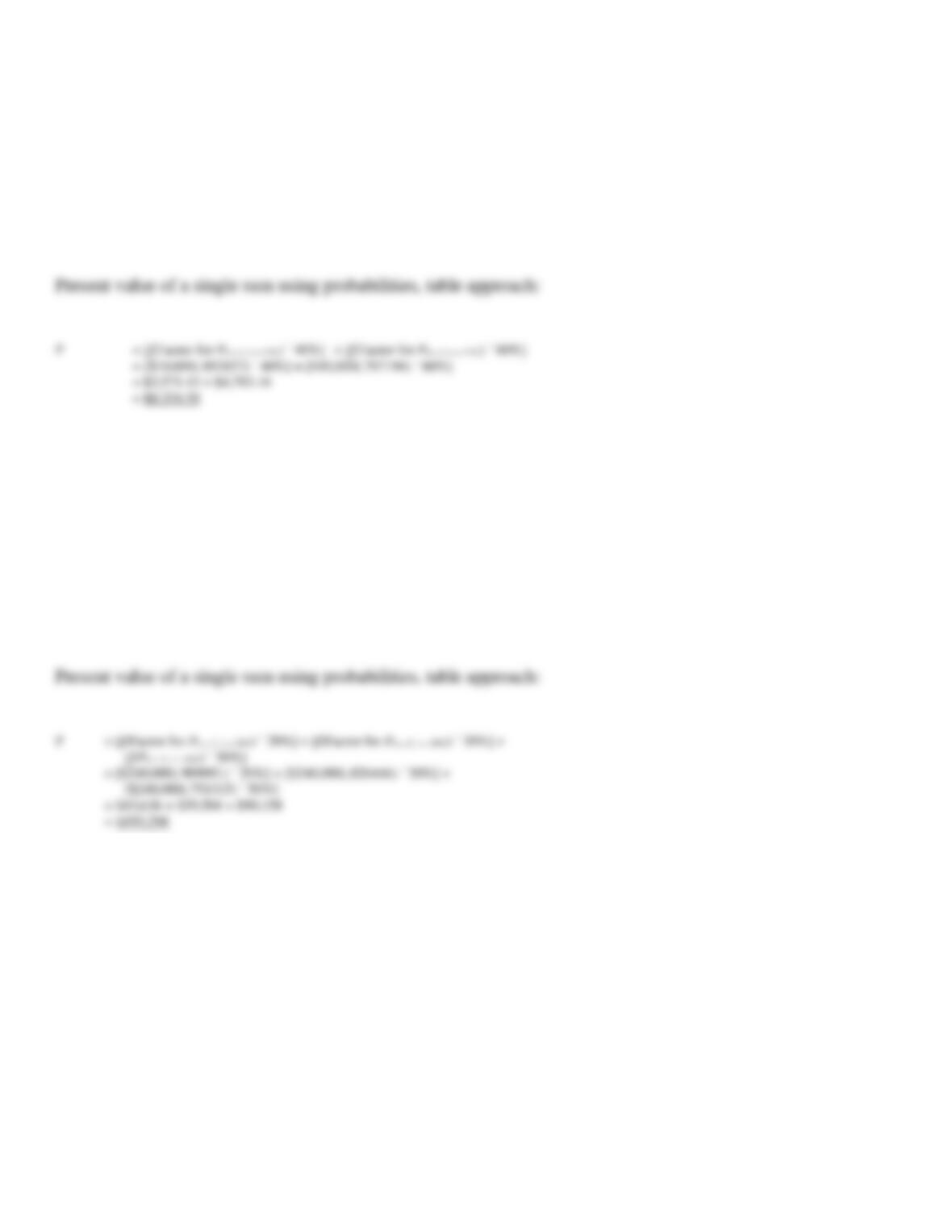
72. The FASB concepts statement relating to cash flow information introduces the concept of expected cash
flows when using present values for accounting measurements. Assume that the Smith Company determined
that it has a 40% probability of receiving $10,000 in one year but a 60% probability of receiving $10,000 two
years from now.
Required:
Using the FASB concepts, calculate the present value of the cash flows assuming a 12% interest rate
compounded annually.
73. Maggie Company estimated that it has a 20% probability of receiving $240,000 one year from now, a 30%
probability of receiving $240,000 two years from now, and a 50% probability of receiving $240,000 three years
from now.
Required:
Using the FASB’s concept of “expected cash flows,” calculate the present value of the cash flows assuming a
10% interest rate compounded annually.
74. A beginning accounting student comes to you with the following question, “What is the time value of
money and does it relate to interest?”
Required:
Explain the two concepts and how they are related.
75. A beginning accounting student has just been introduced to present and future values analysis and has been
told that it is based on compound interest, not simple interest. The student is confused about the differences
between the two interest methods.
Required:
Explain the difference between the two methods using a single deposit of $1,000 for two years at 10% interest.
76. The present values of ordinary annuities, annuities due, and deferred annuities were discussed in the
textbook. Discuss the ways these three annuities are similar and dissimilar.
77. Although most accountants believe that the use of present value creates relevant accounting measurements,
there are some reliability questions. Discuss the reasons why present value computations create less reliable
measurements.
Reliability questions exist with present value calculations because they require
78. An accounting student has just been introduced to present value analysis and comes to you with the
following question, “How is present value used in the financial statements?”
Required:
Give the student examples of financial statement accounts that are stated at present value and explain the
advantages of using present value for certain financial statement items.
Present value has many applications in accounting. For example, present value is used for the following items: