
Chapter 2: The Use of Funds in Governmental Accounting
Multiple Choice
1. To what does basis of accounting refer?
a. whether an entity is trying to measure the excess of inflows over outflows
b. how much cash an entity received in a particular reporting period
c. the timing of recognition of assets, liabilities, revenues, and
expenditures/expenses in financial statements
d. the ownership of the assets, liabilities, and equities reported in a balance
sheet
2. Governmental accounting normally does not
a. use separate funds to account for various activities
b. incorporate budgetary accounts into the accounting system
c. measure the amount of profit earned during a fiscal year
d. focus on flows of current financial resources
3. In governmental accounting, a fund is best defined as:
a. a sum of cash set aside to attain certain objectives
b. a fiscal entity that has both financial and capital resources
c. a fiscal entity that has cash resources only
d. a fiscal and accounting entity with a self-balancing set of accounts
4. Which of the following funds all use the current financial resources measurement
focus?
a. Debt Service Fund, Special Revenue Fund, and Capital Projects Fund
b. General Fund, Debt Service Fund, and Internal Service Fund
c. Debt Service Fund, Investment Trust Fund, and Capital Projects Fund
d. General Fund, Debt Service Fund, and Pension Trust Fund
5. The three broad categories of funds used by governmental entities are:

a. Governmental, Proprietary, and Fiduciary
b. Unrestricted, Partially Restricted, and Fully Restricted
c. General, Special, and Fiduciary
d. General, Enterprise, and Agency
6. Which category of funds is used to account for most of the day-to-day public
services provided by a government?
a. Fiduciary-type funds
b. Enterprise-type funds
c. Proprietary-type funds
d. Governmental-type funds
7. Which category of funds focuses on financial resources available for current
spending?
a. Enterprise-type funds
b. Proprietary-type funds
c. Governmental-type funds
d. Fiduciary-type funds
8. The broad categories of funds used in government accounting do not include which one
of the following?
a. revolving
b. governmental
c. proprietary
d. fiduciary
9. Within a fund, which of the following results from using the current financial
resources measurement focus?
a. capital assets will be depreciated
b. property taxes will be recognized on the cash basis of accounting
c. a liability must be reported for unsettled claims, provided payment
ultimately will be made
d. long-term assets and liabilities will not be recorded in the fund
10. Which of the following set of funds use the economic resources measurement

focus?
a. Enterprise Fund, Special Revenue Fund, and General Fund
b. Internal Service Fund, Pension Trust Fund, and Enterprise Fund
c. Debt Service Fund, Internal Service Fund, and Pension Trust Fund
d. Enterprise Fund, Internal Service Fund, and Capital Projects Fund
11. Which basis of accounting is used by funds that have a current financial resources
measurement focus?
a. full accrual basis
b. cash basis
c. modified accrual basis
d. modified cash basis
12. Which of the following are fiduciary-type funds?
a. Pension Trust Fund, Agency Fund, and Permanent Fund
b. Investment Trust Fund, Special Revenue Fund, and Internal Service Fund
c. Agency Fund, Internal Service Fund, and Pension Trust Fund
d. Pension Trust Fund, Investment Trust Fund, and Agency Fund
13. The General Fund levies property taxes in the amount of $1,000,000 for calendar
year 2009. It expects to collect $950,000 during the year, $30,000 in the first 60
days of the next year, and $15,000 during the rest of the next year. It does not
expect to collect the remaining $5,000. How much property tax revenue should it
recognize for the year 2009?
a. $1,000,000
b. $980,000
c. $995,000
d. $990,000

14. Under modified accrual accounting, when are revenues considered to be
“available?”
a. when cash has been collected
b. when cash is collectible within the current period or soon enough
thereafter to be used to pay liabilities of the current period
c. when cash is on hand or reasonably expected to be collected at any time in
the future so they can pay liabilities incurred in the current period
d. when property tax bills have been mailed
15. Which of the following is an example of activities that are likely to be accounted
for in a government’s general fund?
a. business-type activities of government that are financed by user charges
b. sales taxes collected by a state on behalf of counties within the state
c. property taxes to be used to provide basic government services
d. donations that must be kept intact, but whose income must be used to
beautify parks
16. Which of the following terms best describes the types of assets accounted for in
governmental-type funds?
a. any resource that can be used to provide service to the citizenry
b. financial assets and capital assets
c. current assets and movable fixed assets
d. financial assets
17. For financial reporting purposes, a government may have only one
a. Capital projects fund
b. Enterprise fund
c. General fund
d. Permanent fund

18. Which of the following activities is the most likely to be accounted for in a General
Fund?
a. payment of salaries of police and firefighters
b. construction of a new school building from bond proceeds
c. accumulation of resources to pay pension benefits to employees
d. accumulation of resources required by law to be used only to beautify parks
19. Which of the following types of liabilities is least likely to appear in the balance
sheet of a governmental-type fund?
a. amounts owed to suppliers of goods and services
b. amounts owed to bondholders over the entire 20-year life of a debt
c. amounts owed to other funds
d. amounts owed to employees for services performed before an accounting
period ends
20. At what point are revenues recognized in the General Fund?
a. when the revenues are earned
b. when cash is received
c. when the revenues are measurable and available
d. when billings are mailed to service recipients
21. Which of the following is a distinguishing characteristic of proprietary funds?
a. they recognize revenues when they are measurable and available
b. they always earn sufficient revenues to cover their expenses
c. they charge fees for the services they provide
d. they are legally prohibited from selling services to other governmental agencies
22. What is the purpose of a debt service fund?
a. to accumulate resources for paying interest on all debt issued by the
government
b. to account for all outstanding long-term and short-term debt issued by the
government
c. to account for outstanding general long-term debt
d. to accumulate resources for paying principal and interest on general long-
term debt

23. Which of the following statements about capital projects funds is true?
a. The assets of a capital projects fund include both financial and capital
assets
b. All fixed assets acquired by a government are paid for from a capital
projects fund
c. A capital projects fund accounts for resources that are restricted or
otherwise limited to spending for capital outlays
d. When capital assets are financed through the issuance of long-term debt,
that long-term debt is accounted for in a capital projects fund.
24. A state legislature enacts a new park entrance fee that may be used only for
adding to and maintaining the collection of tropical plants in that state’s nationally
famous Prospect Park. Which type of fund should be used to account for those
resources?
a. Special Revenue Fund
b. General Fund
c. Internal Service Fund
d. Agency Fund
25. A city has an Arts and Cultural Fund that is used to account for private
contributions that are restricted by the donors for the financing of the city’s
museum operations and functions. The Arts and Cultural Fund is a:
a. General Fund
b. Special Revenue Fund
c. Permanent Fund
d. Private-Purpose Trust Fund
26. Which of the following is a distinguishing characteristic of the resources
accounted for in fiduciary funds?
a. They must be held intact in perpetuity.
b. They are generally held for very short periods of time.
c. They are used only to support programs of the governmental entity having
custody of the resources.
d. They are not used to support programs of the governmental entity having
custody of the resources.

27. A city uses a Library Fund to account for proceeds restricted for an addition to the
main library and construction of neighborhood libraries. The Library Fund is a:
a. Capital Projects Fund
b. General Fund
c. Permanent Fund
d. Debt Service Fund
e. Private-Purpose Trust Fund
28. A governmental unit establishes a central motor pool to provide service to
governmental departments and agencies. The pricing objective of the central
motor pool is to break-even by charging all agencies a user fee. What type of fund
should be established for this activity?
a. Special Revenue Fund
b. Agency Fund
c. Permanent Fund
d. Internal Service Fund
29. Which of the following is an appropriate objective of an Internal Service Fund?
a. accounting for the full costs of services, including depreciation of capital
assets, to provide a basis for charging governmental users
b. providing services to other governmental agencies without charge
c. temporarily holding tax resources on behalf of another government
d. accounting for the full costs of providing services to the general public
30. A municipal government decides to construct and operate a public swimming
pool. It will charge user fees to recover its costs, but will allow senior citizens and
children under the age of three to enter at half-price. What type of fund should it
use for this purpose?
a. Special Revenue Fund
b. Enterprise Fund
c. Agency Fund
d. Private Purpose Fund

31. Which of the following pairs of accounts are likely to appear on the balance sheet
of a government’s general fund?
a. cash and buildings
b. cash and investments
c. accounts payable and long-term bonds payable
d. current portion of bonds payable and non-current portion of bonds
payable
32. A governmental entity has a General Fund and an Enterprise Fund. At the
beginning of the year, neither fund has any unpaid salary liability. During the
year, both funds paid salaries of $600,000. In addition, salaries for the last three
days of the fiscal year ($15,000 for each fund) will be paid during the first week
of the next fiscal year. How much should each fund report as salary expenditures
(expenses) for the fiscal year?
General Enterprise
Fund Fund
a. $600,000 $615,000
b. $600,000 $600,000
c. $615,000 $600,000
d. $615,000 $615,000
33. What is the disposition of the earnings of a Permanent Fund?
a. The earnings remain indefinitely in a permanent fund.
b. The earnings are used only for non-governmental programs.
c. The earnings are used for programs that benefit the government or its
citizens.
d. The earnings must be used for permanent projects, such as bridges.
34. The Dillard Park Fund is used to account for a private donation by Mr. and Mrs.
Bud Dillard. When making the donation, the Dillard’s stipulated that only the
income from this fund could be used for the operations of Dillard Park, a city
owned park. The Dillard Park Fund is a:
a. General Fund
b. Special Revenue Fund
c. Permanent Fund
d. Private-Purpose Trust Fund

35. A city has a General Fund and an Enterprise Fund. During the year, legal claims
are filed against the resources of both funds. City attorneys believe that each
claim will ultimately be settled for about $55,000, but settling claims of this kind
usually is about a three-year process. How much should be reported as a liability
in each fund’s balance sheet at the end of the current year?
General Enterprise
Fund Fund
a. $0 $0
b. $0 $55,000
c. $55,000 $0
d. $55,000 $55,000
36. A governmental fund has total liabilities in excess of its total assets at the end of
the fiscal year. It has no deferred resource inflows or outflows. Which of the
following statements is always true?
a. fund balance is negative
b. cash is less than short-term receivables
c. payables exceed receivables
d. payables exceed cash
37. In what section of the Enterprise Fund statement of revenues, expenses, and
changes in fund net position is interest expense generally reported?
a. with operating expenses
b. with nonoperating expenses
c. either with extraordinary or special items, depending on the circumstances
d. with capital contributions and transfers
38. A state collects sales taxes not only for itself, but also on behalf of all cities within
the state. What type of fund should the state use to account for the sales taxes held
for the cities?
a. Private Purpose Trust Fund
b. Agency Fund
c. Special Revenue Fund
d. Investment Trust Fund

39. Which of the following is a characteristic of an Agency Fund’s financial reporting?
a. Its statement of fiduciary net position shows assets, liabilities, and fund balance
b. Its statement of fiduciary net position shows no net position
c. Its statement of fiduciary net position shows no liabilities
d. Its statement of fiduciary net position shows no assets
40. Which measurement focus and basis of accounting should be used in a Special
Revenue Fund?
Measurement Focus Basis of Accounting
a. current financial resources full accrual
b. current financial resources modified accrual
c. economic resources modified accrual
d. economic resources full accrual
41. The information generated from the accounting system of a governmental-type fund
a. is budget oriented
b. measures profitability
c. measures operational efficiency
d. is intended for use only by legislators
42. Which measurement focus and basis of accounting should be used in an Internal
Service Fund?
measurement focus basis of accounting
a. current financial resources full accrual
b. current financial resources modified accrual
c. economic resources modified accrual
d. economic resources full accrual
43. A local government sells bonds having a face value of $1,000,000 at par. The bond
proceeds will be accounted for in a Capital Projects Fund. What account will be
credited to offset the debit to cash?
a. other financing sources
b. citizens’ equity
c. fund balance
d. bonds payable

44. A long-term loan from the General Fund to another fund is reported in the General
Fund as:
a. due from other fund
b. due to other fund
c. advance to other fund
d. advance from other fund
45. Which of the following accounts is associated with the current financial resources
measurement focus but not with the economic resources measurement focus?
a. assets
b. expenditures
c. revenues
d. liabilities
46. A government will prepare a statement of cash flows for which of the following
funds?
a. General Fund
b. Enterprise Fund
c. Debt Service Fund
d. Agency Fund
47. Which of the following is true regarding a statement of cash flows prepared by a
government?
a. the statement of cash flows will be identical to one prepared by a business
b. the statement of cash flows will be prepared using the indirect method
c. the statement of cash flows will have no more than three cash flow
classifications
d. the statement of cash flows will be prepared using the direct method
48. Which of the following financial statements would be prepared for enterprise funds?
a. a statement of net position
b. a statement of cash flows
c. a statement of revenues, expenses, and changes in net position
d. All of the above would be prepared.
e. Only a and c would be prepared.
Problems
49. (True or false – Capital Projects Fund items)
State whether these statements are true or false. Discuss why the false statements
are false.
a. Assets of the Capital Projects Fund include cash and investments, but not
capital assets.
b. It is not possible for expenditures of the Capital Projects Fund to exceed
revenues in a particular year.
c. Likely sources of funding major capital projects are proceeds from long-
term borrowing and transfers from other funds.
d. Long-term borrowing is a source of financing capital acquisitions, but the
borrowing is not reported as a liability of the Capital Projects Fund.
e. Capital assets are reported in the assets section of the Capital Projects
Fund balance sheet.
f. Capital asset acquisitions are always financed with Capital Projects Fund
resources.
50. (True or false – Enterprise Fund items)
State whether these statements are true or false. Discuss why the false statements
are false.
a. Enterprise Funds may receive subsidies from the General Fund for
operating purposes.
b. Enterprise Funds provide services primarily to governmental departments
and agencies.
c. Enterprise Funds use a different basis of accounting than Internal Service
Funds.
d. Enterprise Funds are financed primarily through user charges.
e. As a general rule, Internal Service Funds sell goods and services to
governmental agencies, and Enterprise Funds sell goods and services to
the general public. This means an Enterprise Fund cannot sell some goods
and services to the government itself.
51. (True or false – Fiduciary Fund items)
State whether these statements are true or false. Discuss why the false statements
are false.
a. Pension Trust Funds use the modified accrual basis of accounting.
b. The external portion of an investment pool should be reported in a
Fiduciary Fund.
c. Agency Funds are different from other Fiduciary Funds because
Agency Funds have no liabilities; that is, the assets of Agency
Funds are always equal to the equity of the Funds.
d. A Private-Purpose Trust Fund is used when a donor provides
resources to a state that the state can use for any purpose agreed
upon by the governor and the legislature.
52. (True or false – basis of accounting items)
State whether these statements are true or false. Discuss why the false statements
are false.
a. Basis of accounting refers to the timing of the recognition of assets,
liabilities, revenues and expenses or expenditures. The basis of
accounting facilitates what one is trying to measure.
b. To determine whether they have obtained sufficient revenues to
cover their expenses, funds that account for governmental
business-type activities use the modified accrual basis of
accounting.
c. Depreciation of capital assets is not recognized as an expense in a
Special Revenue Fund, but it is recognized as an expense in an
Internal Service Fund.
d. Property taxes are recognized as revenues in governmental type
funds to the extent that they are collected in the year for which they
are levied.
e. Under the modified accrual basis of accounting, expenditures are
generally recognized in the period that goods and services are
received, but there are a number of exceptions to that rule.
53. (True or false – financial reporting and other items)
State whether these statements are true or false. Discuss why the false statements
are false.
a. All the long-term debt of a government, including the long-term
debt that will be financed by Enterprise Fund revenues, is reported
in the fund-level financial statements.
b. Long-term liabilities resulting from the operating activities of a
General Fund, such as accrued vacation leave, are reported in the
fund-level financial statements. Long-term liabilities resulting
from the capital acquisition activities of a Capital Projects Fund,
however, are not.
c. For financial reporting purposes, operating transfers from one fund
to another are generally reported in a separate section of the
operating statements for each of the funds.
d. For financial reporting, current assets and liabilities are separated
from long-term assets and liabilities in the balance sheets of
Enterprise Funds.
e. All funds report both financial resources and capital resources.
54. (Comparative computations of expenditures and expenses based on the same underlying
transactions)
A department of a local government began operations at the beginning of the
current fiscal year with $250,000 cash. During the fiscal year, the department
made cash disbursements for the following:
# Salaries and other personnel costs, $100,000
# Office rent and utilities, $24,000
# Retirement of debt principal, $10,000; payment of interest, $2,200
# Purchased equipment at the beginning of the fiscal year for $30,000; the
equipment is expected to last 6 years and have a salvage value of $6,000
# Photocopier rental, $10,500
Based on the preceding transactions, compute total annual expenditures for this
department assuming it performs governmental-type activities and is accounted
for in the General Fund.
Then compute total annual expenses for this department assuming it performs
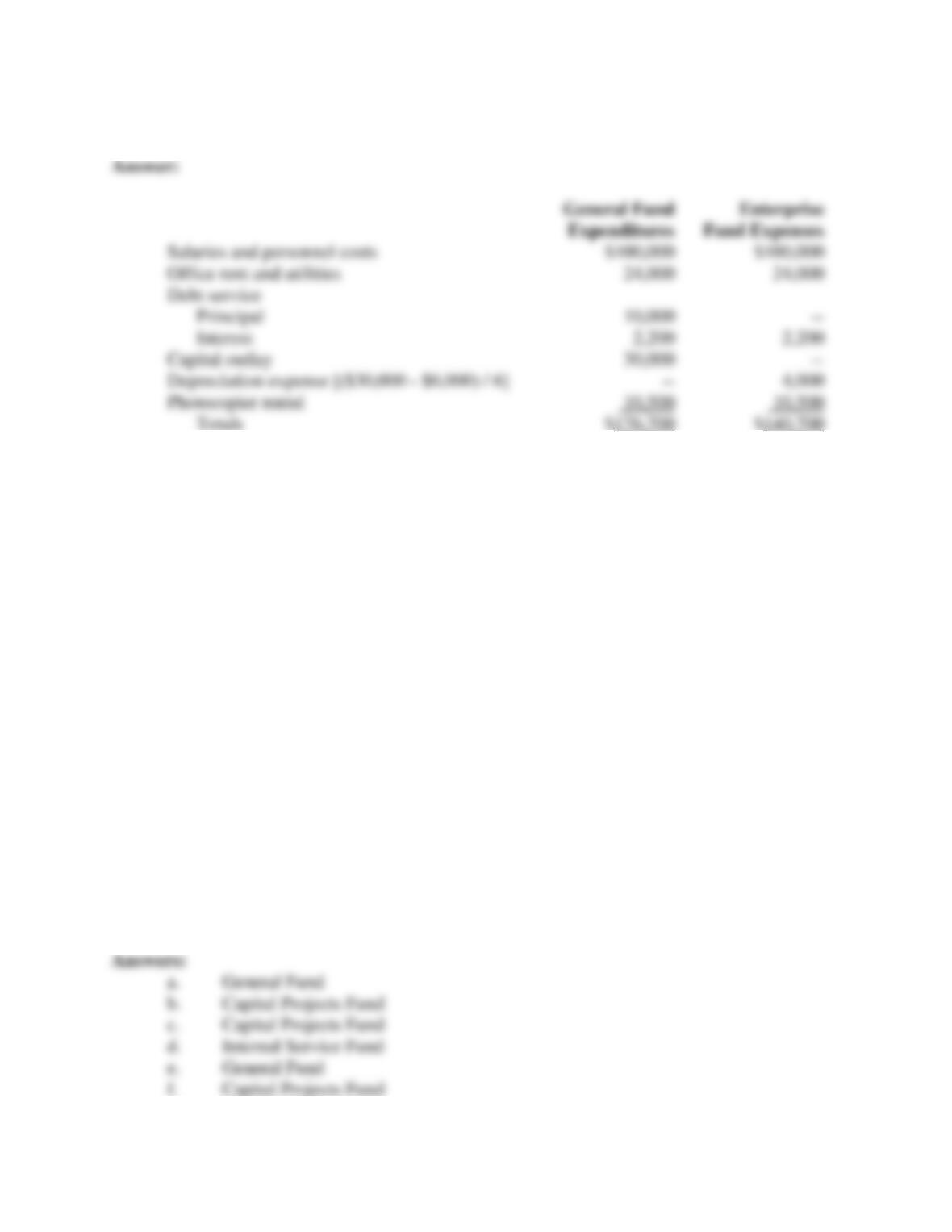
activities within an Enterprise Fund.
55. (Identifying transactions to the appropriate fund – relatively simple situations)
A small village maintains a General Fund, Special Revenue Fund, Capital Projects
Fund, and Internal Service Fund. State the fund (or funds) that would be used to
record each of the following events.
a. Property taxes were collected to finance the day-to-day activities of
the village.
b. The village issued debt for the purpose of constructing a new
firehouse.
c. The village paid an invoice for construction of a new firehouse.
d. Mechanics’ salaries were paid by the Motor Pool Fund, which was
established to provide a centralized location for servicing all
village vehicles on a user-charge basis.
e. The village paid the salaries of its police officers.
f. The village received a check from the state to help finance the new
firehouse.
g. The village received a grant, which must be used for beautifying
and creating nature walks within the park.
h. The Motor Pool Fund sent an invoice for maintenance of police
and fire vehicles.
56. (Identifying transactions to funds – situations involving more than one fund)
A large city uses governmental-type funds (General, Special Revenue, Debt
Service, Capital Projects) and proprietary-type funds (Internal Service,
Enterprise). State the fund or funds that would be used to record the following
transactions.
a. The city sent property tax bills to all taxpayers. Most of the taxes were
to be used to finance the day-to-day activities of the city. A portion of
the tax, however, was levied for the specific purpose of financing
operations of the City Library District, created by vote of the Public.
b. The city needed a new school. It issued $4 million of long-term debt
and put the proceeds into a fund to finance school construction.
c. The city paid the salaries of its police and fire officers.
d. To help finance construction of the school, the city received $1 million
from the state.
e. Central Vehicle Repair Shop is a city-operated facility that does work
for all city agencies and bills the agencies at cost for the work. At the
end of the month, Central Vehicle Repair Shop sent invoices to the
police department for servicing the police vehicles.
f. To pay interest and principal on the debt issued to construct the
school, the city transferred $150,000 from the fund that finances
day-to-day activities to the fund that accumulates resources to pay
off the debt.
g. Metro Bus is a city-operated mass transit facility. Metro Bus
deposited passenger fares for the day into its bank account. Also,
Metro Bus received an invoice from Central Vehicle Repair Shop for
bus repair work.
h. The city paid $500,000 to the contractor that was building the new
school.
i. The city bought a new police sedan. In accordance with city
financial policies, the city paid for the sedan out of its day-to-day
operating funds.
j. The new school was completed. In accordance with city statutes,
all remaining construction assets were sent to the fund that pays
the debt service on the construction bonds.

57. (Identifying transactions to funds – comprehensive problem)
Indicate which fund or funds would be used by a state to record each of the following events.
Use the codes shown below:
General Fund GF Pension Trust Fund PTF
Special Revenue Fund SRF Investment Trust Fund ITF
Debt Service Fund DSF Private-Purpose Trust Fund PPTF
Capital Projects Fund CPF Agency Fund AF
Enterprise Fund EF Internal Service Fund ISF
a. The state collected personal income taxes to finance its day-to-day activities.
b. The state collected gasoline taxes, which in accordance with state law were
dedicated solely to the maintenance of state roads.
c. The state collected a state-enacted sales tax at the rate of 4% of sales. Collections
also included a 3% sales tax that certain counties piggy-backed on the state tax.
All county sales taxes were deposited in a fund, pending county-by-county
analysis of all sales tax returns to determine amounts due to the state and to each
county.
d. As authorized by Public referendum, the state sold $55 million of bonds to
finance a new highway construction program. The debt proceeds were deposited
in a fund.
e. The state received $15 million from the federal government for the federal share
of the costs of constructing the highways.
f. The state office of general services performs centralized printing services for all
state agencies, and bills the state agencies at cost for each printing project. The
office sent a bill to the State Comptroller for printing the state’s annual financial
report.

g. The Office of the State Lottery sells lottery tickets to the public. In accordance
with state law, 50% of all lottery ticket sales must be used to finance major capital
projects including the acquisition of land for parks. The state received a check
from the Office of the State lottery for the state share of the lottery ticket sales.
h. The state paid the regular bi-weekly payroll of the state police. The state also paid
the payroll of personnel who maintain the state roads referred to in transaction b.,
above.
i. The state deposited funds received from three county governments into a fund.
The state will invest the funds and send quarterly checks to the county
governments based on the interest earned by the fund.
j. The Employees Retirement System, a state-operated agency that administers the
payment of pensions to retired state employees, paid the monthly pensions.
k. The state purchased 5 sedans for the State Police at a cost of $80,000, using day-
to-day operating funds. The sedans have a four-year life.
l. A partial payment was made to the contractors involved in constructing state
highways.
m. The state made an operating transfer, using day-to-day operating funds, to the fund
that accumulates resources for payment of debt service on capital projects.
n. The state paid interest and principal on the debt that had been issued earlier to
finance the construction of highways.
o. The state received collections from individual citizens to pay college education
expenses for state National Guard members, who are wounded in military service.