156.
A $15 credit to Sales was entered on the trial balance as a $150 credit. By what amount is the
Sales account in error?
157.
At year-end, a trial balance showed total credits exceed total debits by $4,950. This difference
could have been caused by:
158.
Identify the item below that would cause the trial balance to
not
balance.
159.
The credit purchase of a new oven for $4,700 was posted to Kitchen Equipment as a $4,700
debit and to Accounts Payable as a $4,700 debit. What effect would this error have on the trial
balance?
160.
On a trial balance, if the Debit and Credit column totals are equal, then:
161.
Given the following errors, identify the one by itself that will cause the trial balance to be out
of balance.
162.
A $130 credit to Supplies was credited to Fees Earned by mistake. By what amounts are the
accounts under or overstated as a result of this error?
163.
All of the following are asset accounts
except
:
164.
Compare the list of accounts below and choose the list that contains only accounts that would
be classified as asset accounts on the Chart of Accounts.
165.
Which financial statement reports an organization’s financial position at a single point in
time?
166.
Joe Jackson opened Jackson’s Repairs, Inc. on March 1 of the current year. During March, the
following transactions occurred and were recorded in the company’s books:
1. Jackson invested $25,000 cash in the business.
2. Jackson contributed $100,000 of equipment to the corporation.
3. The company paid $2,000 cash to rent office space for the month.
4. The company received $16,000 cash for repair services provided during March.
5. The company paid $6,200 for salaries for the month.
6. The company provided $3,000 of services to customers on account.
7. The company paid cash of $500 for monthly utilities.
8. The company received $3,100 cash in advance of providing repair services to a customer.
Based on this information, net income for March would be:
167.
Ferguson’s Computer Repairs, Inc. opened on February 1 of the current year. During February,
the following transactions occurred and were recorded in the company’s books:
1. The owner invested $20,000 cash in the business.
2. The contributed $50,000 of equipment to the corporation.
3. The company paid $1,000 cash to rent office space for the month.
4. The company provided $6,000 of services for cash during February.
5. The company paid $2,200 for salaries for the month.
6. The company provided $3,000 of services to customers on account.
7. The company paid cash of $800 for monthly utilities.
8. The company paid a cash dividend of $500 to the owner.
Based on this information, net income for February would be:
168.
Joel Consulting received $3,000 from a customer for services provided. Joel’s general journal
entry to record this transaction will be:
2-89
169.
Wiley Hill opened Hill’s Repairs, Inc. on March 1 of the current year. During March, the
following transactions occurred and were recorded in the company’s books:
1. Wiley invested $25,000 cash in the corporation.
2. Wiley contributed $100,000 of equipment to the corporation.
3. The company paid $2,000 cash to rent office space for the month.
4. The company received $16,000 cash for repair services provided during March.
5. The company paid $6,200 for salaries for the month.
6. The company provided $3,000 of services to customers on account.
7. The company paid cash of $500 for monthly utilities.
8. The company received $3,100 cash in advance of providing repair services to a customer.
9. The company paid $5,000 cash in dividends to Wiley. (sole shareholder)
Based on this information, the balance in Stockholders’ Equity reported on the Balance Sheet
at the end of March would be:
Matching Questions
170.
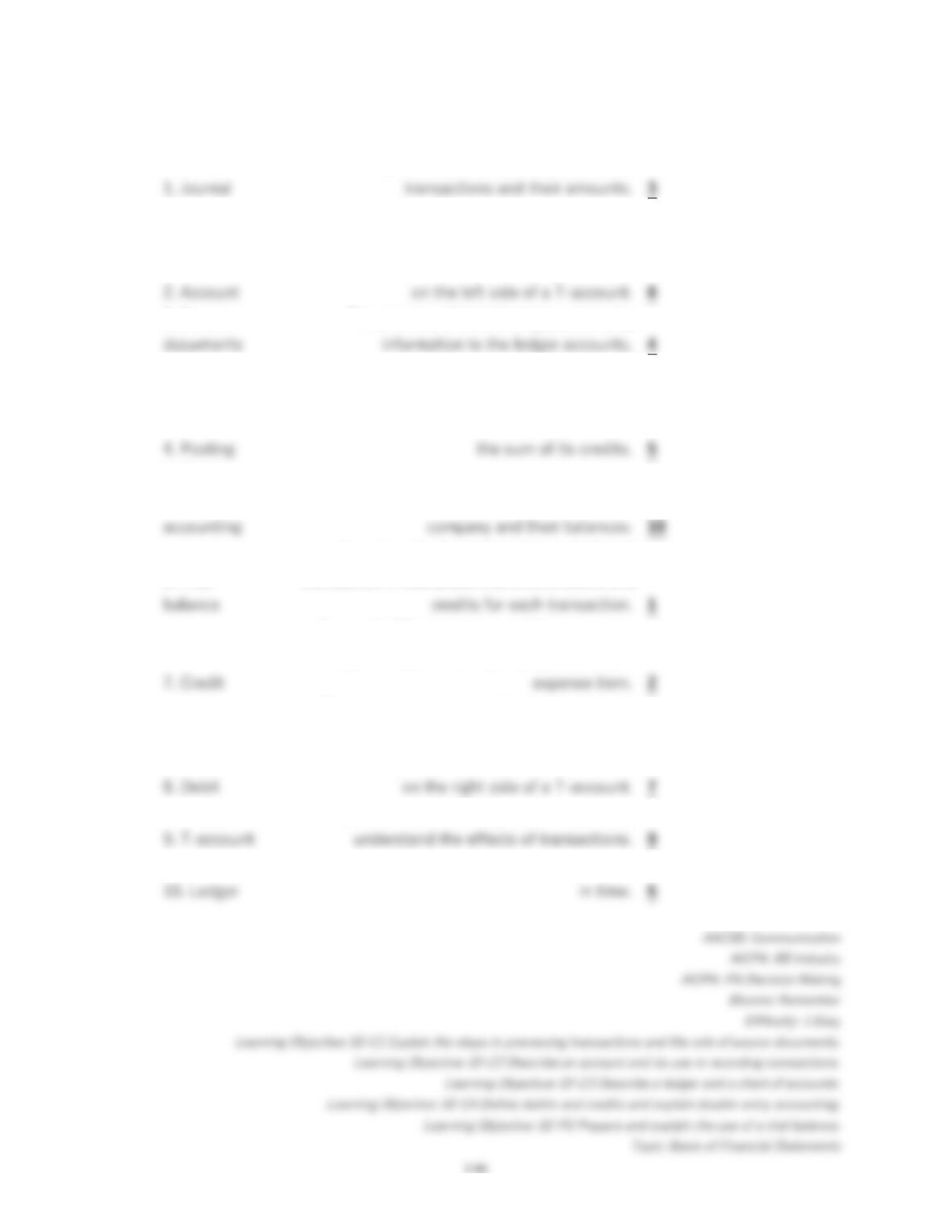
Match the following
Objective and reliable evidence about
An increase in an asset and expense account,
and decrease in a liability, contributed capital,
retained earnings, and revenue account; recorded
3. Source
The process of transferring journal entry
An accounting system where each transaction
affects and is recorded in at least two accounts;
the sum of the debits for each entry must equal
5. Double-
entry
A record containing all the accounts of a
6. Trial
A company’s chronological record of each
transaction in one place that shows debits and
A record of the increases and decreases in a
specific asset, liability, equity, revenue, or
Decrease in an asset, and expense account,
and increase in a liability, contributed capital,
retained earnings and revenue account; recorded
A representation of a ledger account used to
A list of accounts and their balances at a point
171.
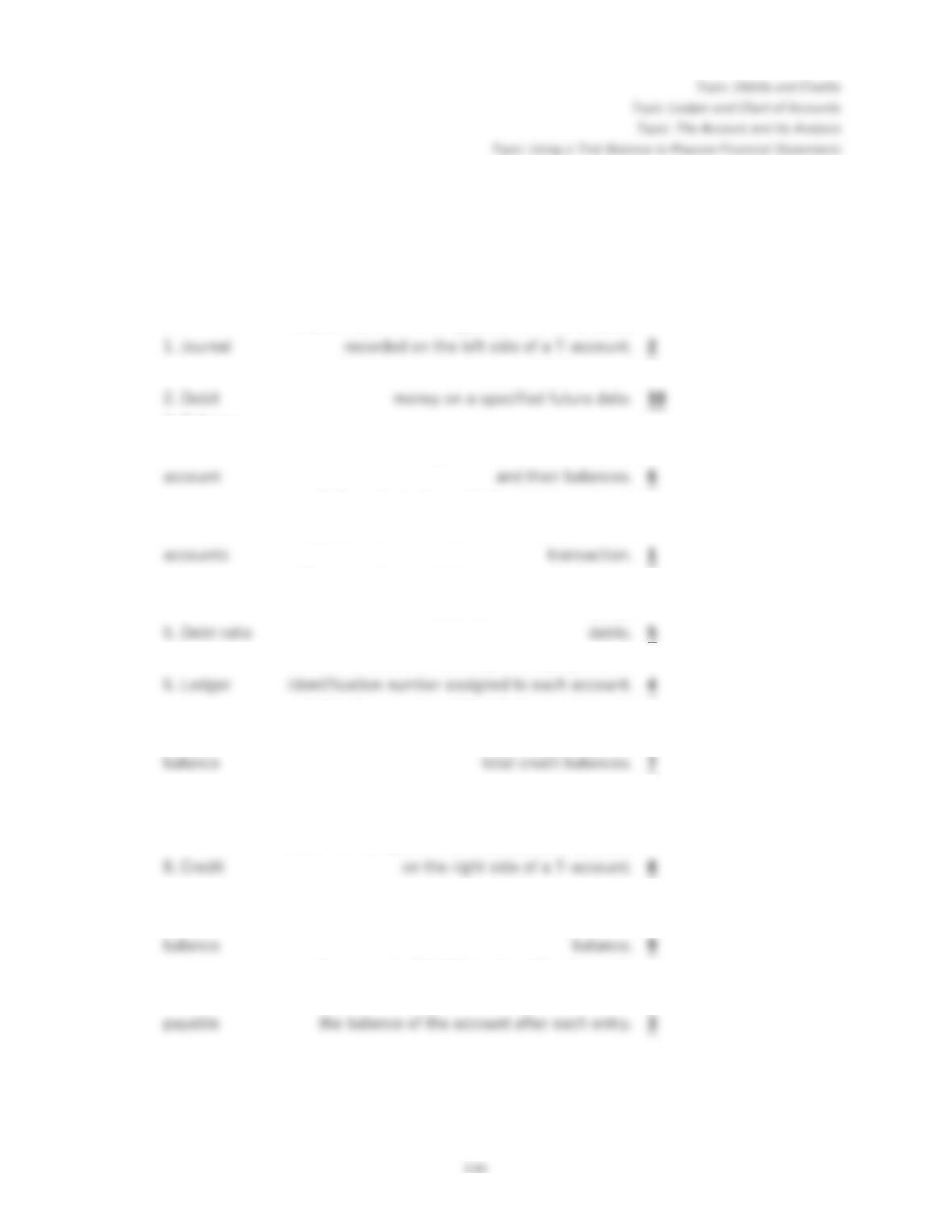
Match the following
An increase in an asset, dividend, and expense
account, and a decrease in a liability, contributed
capital, retained earnings, and revenue account;
A written promise to pay a definite sum of
3. Balance
column
A record containing all accounts of a company
4. Chart of
A chronological record of each transaction in
one place that shows debits and credits for each
The ratio of total liabilities to total assets; used
to reflect the risk associated with the company’s
A list of all accounts used by a company and the
7. Trial
A list of accounts and their balances at a point
in time; the total debit balances should equal the
A decrease in an asset and expense account,
and an increase in a liability, contributed capital,
retained earnings, and revenue account; recorded
9. Account
The difference between total debits and total
credits for an account including the beginning
10. Note
An account with debit and credit columns for
recording entries and another column for showing
172.
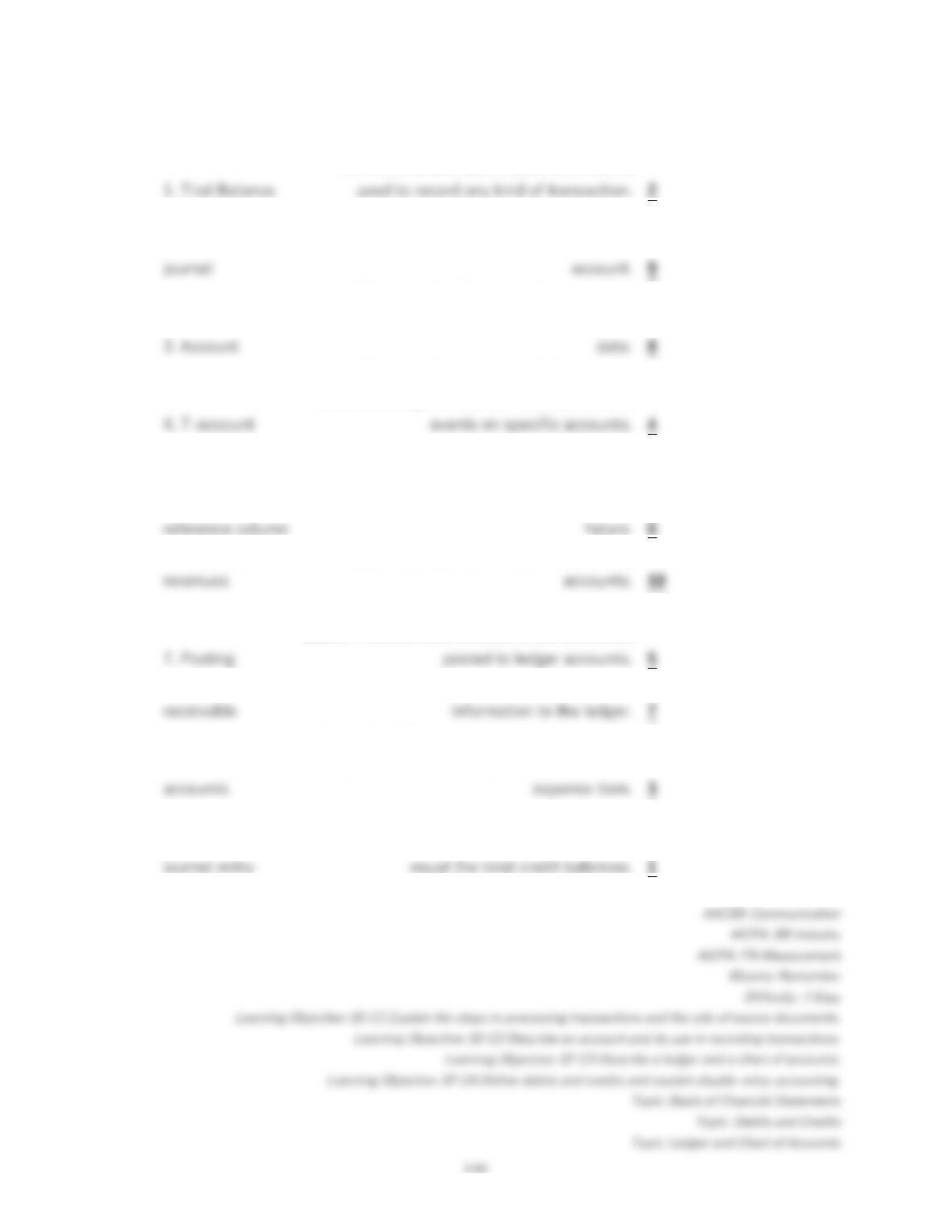
Match the following
The most flexible type of journal, it can be
2. General
A list of all accounts used by a company and
the identification number assigned to each
A written promise from a customer to pay a
definite sum of money on a specified future
A simple form used as a helpful tool in
understanding the effect of transactions and
5. Posting
Liabilities created when customers pay in
advance for products or services; satisfied by
delivering the products or services in the
6. Unearned
A journal entry that affects at least three
A column in journals where individual
account numbers are entered when entries are
8. Note
The process of transferring journal entry
9. Chart of
A record of the increases and decreases in a
specific asset, liability, equity, revenue, or
10. Compound
A list of accounts and their balances at a
point in time; the total debit balances should
Topic: The Account and Its Analysis
Short Answer Questions
173.
Identify each of the following accounts as a revenue (R), expense (E), asset (A), liability (L), or
equity (SE) by placing initials (R,E,A,L or SE) in the blanks.
____ 1. Salary Expense
____ 2. Cash
____ 3. Equipment
____ 4. Common Stock
____ 5. Fees Revenue
____ 6. Accounts Receivable
____ 7. Accounts Payable
____ 8. Dividends
____ 9. Supplies
____ 10. Unearned Revenue
____ 11. Prepaid Insurance
____ 12. Office Furniture
174.
Review the transactions below and identify with an “X” those that would be posted as a
credit
in the ledger (The first one has been done for you):
X 1. Salary Payable was increased
____ 2. Cash was decreased
____ 3. Equipment was increased
____ 4. Common Stock was increased
____ 5. Salaries Expense was increased
____ 6. Accounts Receivable was decreased
____ 7. Unearned Revenue was increased
____ 8. Dividends was increased
____ 9. Supplies was increased
____ 10. Building was increased
____ 11. Utilities Expense was increased
____ 12. Service Revenue was increased
175.
The following accounts appear on either the Income Statement (IS) or Balance Sheet (BS). In
the space to the left of each account, write the letters, IS or BS to identify the statement on
which the account appears.
____ 1. Office Equipment
____ 2. Rent Expense
____ 3. Unearned Fees Revenues
____ 4. Rent Expense
____ 5. Accounts Payable
____ 6. Common Stock
____ 7. Fees Revenue
____ 8. Cash
____ 9. Notes Receivable
____ 10. Wages Payable
2-96
176.
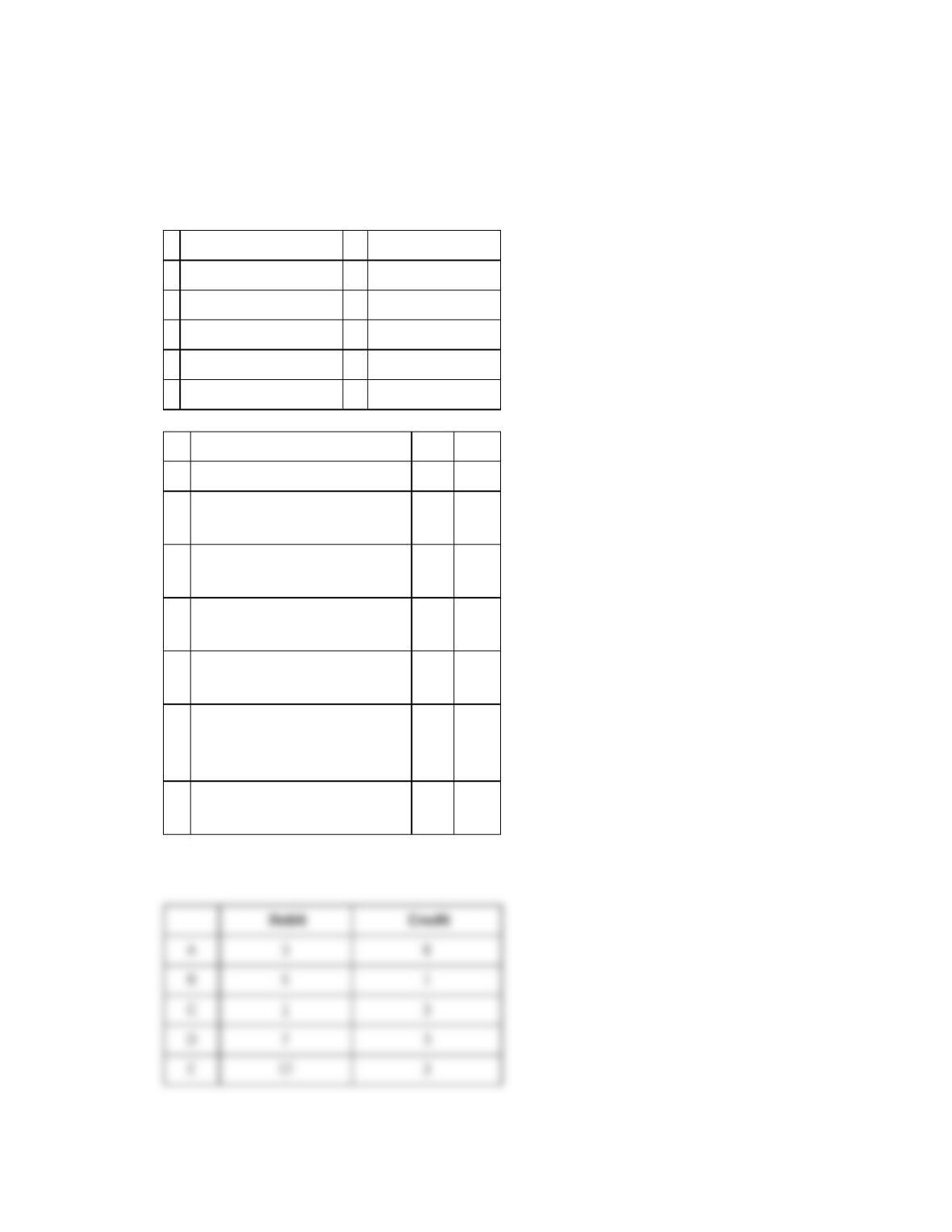
Miley Block, Inc. is a building consultant. Shown below are (a) several accounts in her ledger
with each account preceded by an identification number, and (b) several transactions
completed by Block. Indicate the accounts debited and credited when recording each
transaction by placing the proper account identification numbers to the right of each
transaction.
1.
Accounts Payable
7.
Telephone Expense
2.
Accounts Receivable
8.
Unearned Revenue
3.
Cash
9.
Common Stock
4.
Consulting Fees Earned
10.
Dividends
5.
Office Supplies
11.
Insurance Expense
6.
Office Supplies Expense
12.
Prepaid Insurance
Debit
Credit
Example:
Completed consulting work for a
client who will pay at a later date
2
4
A.
Received cash in advance from a
customer for designing a building
B.
Purchased office supplies on
credit
C.
Paid for the supplies purchased
in B
D.
Received the telephone bill of
the business and immediately
paid it
E.
Paid for a 3-year insurance
policy

2-97
177.
Drew Castle, Inc. is an insurance appraiser. Shown below are (a) several accounts in his
ledger with each account preceded by an identification number, and (b) several transactions
completed by Castle. Indicate the accounts debited and credited when recording each
transaction by placing the proper account identification numbers to the right of each
transaction.
1.
Accounts Payable
8.
Office Supplies
Expense
2.
Accounts Receivable
9.
Prepaid Insurance
3.
Appraisal Fees
Earned
10.
Salaries Expense
4.
Cash
11.
Telephone Expense
5.
Insurance Expense
12.
Unearned Appraisal
Fees
6.
Office Equipment
13.
Common Stock
7.
Office Supplies
14.
Dividends
Debit
Credit
Example:
Completed an appraisal for a
client who promised to pay at a
later date
2
3
A.
Received cash in advance for
appraising a hail damage claim
B.
Purchased office supplies on
credit
C.
The company paid cash in
dividends to the Drew Castle (sole
shareholder)
D.
Received the telephone bill of the
business and immediately paid it
E.
Paid the salary of the office
assistant
F.
Paid for the supplies purchased in
transaction B
G.
Completed an appraisal for a
client and immediately collected
cash for the work done
178.
List the steps necessary to get from transactions and events to financial statements.
179.
Describe what source documents are and the purpose they serve in a business.
180.
Explain how accounts are used in recording information about a business’s transactions.
181.
Explain the difference between a general ledger and a chart of accounts.
182.
Explain debits and credits and their role in the accounting system of a business.