
Name:
Class:
Date:
chapter 2
Indicate whether the statement is true or false.
1. Journalizing always eliminates fraudulent activity.
a.
True
b.
False
2. Accounts payable are accounts that you expect will be paid to you.
a.
True
b.
False
3. The T account got its name because it resembles the letter “T.”
a.
True
b.
False
4. A proof of the equality of debits and credits in the ledger at the end of an accounting period is called a balance sheet.
a.
True
b.
False
5. When an account payable is paid with cash, the owner’s equity in the business decreases.
a.
True
b.
False
6. The totals at the bottom of the trial balance and the totals at the bottom of the balance sheet both show equality and
balancing and therefore should be equal.
a.
True
b.
False
7. Withdrawals decrease owner’s equity and are listed on the income statement as a deduction from revenue.
a.
True
b.
False
8. Consuming goods and services in the process of generating revenues results in expenses.
a.
True
b.
False
9. The right side of a T account is known as a debit and the left side is known as a credit.
a.
True
b.
False
10. Normal account balances are on the increase side of the accounts.
a.
True
b.
False
11. A chart of accounts is a listing of accounts that make up the journal.
a.
True
b.
False

Name:
Class:
Date:
chapter 2
12. A notation in the Post. Ref. column of the general journal indicates that the amount has been posted to the ledger.
a.
True
b.
False
13. Journal entries can have more than two accounts as long as the debits equal the credits.
a.
True
b.
False
14. The process of transferring the debits and credits from the journal entries to the accounts is known as posting.
a.
True
b.
False
15. The increase side of an account is also the side of the normal balance.
a.
True
b.
False
16. When a business purchases supplies on account, no entry should be made until the invoice is paid.
a.
True
b.
False
17. The balance of an account can be determined by adding all of the debits, adding all of the credits, and adding the
amounts together.
a.
True
b.
False
18. For a month’s transactions for a typical medium-sized business, the salary expense account is likely to have only credit
entries.
a.
True
b.
False
19. Revenue accounts are increased by credits.
a.
True
b.
False
20. The chart of accounts should be the same for each business.
a.
True
b.
False
21. A transaction that is recorded in the journal is called a journal entry.
a.
True
b.
False
22. The process of transferring data from the journal to the ledger accounts is called posting.
a.
True
b.
False

Name:
Class:
Date:
chapter 2
23. To determine the balance in an account, always subtract credits from debits.
a.
True
b.
False
24. For a month’s transactions for a typical medium-sized business, the accounts payable account is likely to have only
credit entries.
a.
True
b.
False
25. A trial balance determines the accuracy of the numbers.
a.
True
b.
False
26. All owner’s equity accounts record increases to the accounts with credits.
a.
True
b.
False
27. The drawing account is an expense.
a.
True
b.
False
28. Assets are increased with debits and decreased with credits.
a.
True
b.
False
29. When an owner invests assets in the business, the capital account increases due to revenue being earned.
a.
True
b.
False
30. The order of the flow of accounting data is (1) record in the ledger, (2) record in the journal, and (3) prepare the
financial statements.
a.
True
b.
False
31. If the trial balance is in balance, it can be assumed that all journal entries were posted correctly and no errors were
made.
a.
True
b.
False
32. The process of recording a transaction in the journal is called journalizing.
a.
True
b.
False
33. Posting the credit part of a journal entry to the wrong account will cause the trial balance totals to be unequal.
a.
True

Name:
Class:
Date:
chapter 2
b.
False
34. Revenues are equal to the difference between cash receipts and cash payments.
a.
True
b.
False
35. Transactions are listed in the journal chronologically.
a.
True
b.
False
36. The posting reference notation used in the ledger is the account number.
a.
True
b.
False
37. Accounts are records of increases and decreases in individual financial statement items.
a.
True
b.
False
38. The normal balance of an expense account is a credit.
a.
True
b.
False
39. The erroneous moving of an entire number one or more spaces to the right or left, such as writing $85 as $850, is
called a transposition.
a.
True
b.
False
40. The normal balance of the drawing account is a debit.
a.
True
b.
False
41. A group of related accounts that make up a complete unit is called a trial balance.
a.
True
b.
False
42. The posting reference notation used in the journal is the page number.
a.
True
b.
False
43. An account in its simplest form has three parts to it: a title, an increase side, and a decrease side.
a.
True
b.
False
44. Liabilities are increased with debits and decreased with credits.
a.
True
b.
False

Name:
Class:
Date:
chapter 2
45. Journalizing transactions using the double-entry bookkeeping system will eliminate fraud.
a.
True
b.
False
46. Expense accounts are increased by credits.
a.
True
b.
False
47. The recording of cash receipts to the cash account will be done by debiting the account.
a.
True
b.
False
48. The cash account will always be debited.
a.
True
b.
False
49. Depending on the account title, the right side of the account is referred to as the credit side.
a.
True
b.
False
50. Liabilities are debts owed by the business entity.
a.
True
b.
False
51. The accounts payable account is listed in the chart of accounts as an asset.
a.
True
b.
False
52. The double-entry accounting system records each transaction twice.
a.
True
b.
False
53. Liability accounts are increased by debits.
a.
True
b.
False
54. A debit entry to the cash account will increase the account.
a.
True
b.
False
55. The unearned revenue account is an example of a liability.
a.
True
b.
False
56. A drawing account represents the amount of withdrawals made by the owner.

Name:
Class:
Date:
chapter 2
a.
True
b.
False
57. Expenses result from using up assets or consuming services in the process of generating revenues.
a.
True
b.
False
58. Accounts in the ledger are usually maintained in alphabetical order.
a.
True
b.
False
59. A debit is abbreviated as Db and a credit is abbreviated as Cr.
a.
True
b.
False
60. The erroneous arrangement of digits, such as writing $45 as $54, is called a slide.
a.
True
b.
False
61. Postings made to four-column account forms show a new balance after each entry.
a.
True
b.
False
62. Journalizing a transaction with both the debit and the credit for $69 instead of $96 will cause the trial balance to be out
of balance.
a.
True
b.
False
63. Owner’s equity will be reduced by the amount in the drawing account.
a.
True
b.
False
64. Prepaid expenses are an example of an expense.
a.
True
b.
False
65. When an account receivable is collected in cash, the total assets of the business increase.
a.
True
b.
False
66. Journal entries include both debit and credit accounts for each transaction.
a.
True
b.
False
67. Even when a trial balance is in balance, there may be errors in the individual accounts.

Name:
Class:
Date:
chapter 2
a.
True
b.
False
68. Debits will increase unearned revenues and revenues.
a.
True
b.
False
69. Journalizing is the process of entering amounts in the ledger.
a.
True
b.
False
70. The normal balance of revenue accounts is a credit.
a.
True
b.
False
71. The normal balance of a capital account is a debit.
a.
True
b.
False
72. A credit entry to the cash account will increase the account.
a.
True
b.
False
73. Transactions are initially entered into a record called a journal.
a.
True
b.
False
74. The recording of cash payments from the cash account is done by entering the amount as a credit.
a.
True
b.
False
Indicate the answer choice that best completes the statement or answers the question.
75. An account is said to have a debit balance if
a.
the amount of the debits exceeds the amount of the credits
b.
there are more entries on the debit side than on the credit side
c.
there are more entries on the credit side than on the debit side
d.
the first entry of the accounting period was posted on the debit side
76. Which of the following accounts would be increased with a credit?
a.
Land; Accounts Payable; Drawing
b.
Accounts Payable; Unearned Revenue; Collins, Capital
c.
Collins, Capital; Accounts Receivable; Unearned Revenue
d.
Cash; Accounts Receivable; Collins, Capital

Name:
Class:
Date:
chapter 2
Copyright Cengage Learning. Powered by Cognero.
Page 8
77. The trial balance is out of balance and the accountant suspects that a transposition or slide error has occurred. What
will the accountant do to confirm this suspicion?
a.
Determine the amount of the error and look for that amount on the trial balance.
b.
Determine the amount of the error and divide by 2, then look for that amount on the trial balance.
c.
Determine the amount of the error and refer to the journal entries for that amount.
d.
Determine the amount of the error and divide by 9. If the result is evenly divided, then this type of error is
likely.
78. Owner’s equity will be reduced by all of the following except
a.
revenues
b.
expenses
c.
withdrawals
d.
All of these choices
79. Which of the following owner’s equity accounts follows the same debit and credit rules as liabilities?
a.
expense accounts only
b.
drawing accounts only
c.
revenue accounts only
d.
expense and drawing accounts
80. Which of the following types of accounts have a normal credit balance?
a.
assets and liabilities
b.
liabilities and expenses
c.
revenues and capital
d.
capital and drawing
81. Which of the following is an internal report that will determine if debit balances equal credit balances in the ledger?
a.
chart of accounts
b.
income statement
c.
trial balance
d.
account reconciliation
82. The following accounts appear in the ledger of Monroe Entertainment Co. All accounts have normal balances.
Accounts Payable
$1,500
Fees Earned
$3,600
Accounts Receivable
1,800
Insurance Expense
1,300
Prepaid Insurance
2,000
Land
3,000
Cash
3,200
Wages Expense
1,400
Drawing
1,200
Capital
8,800
Total assets are
a.
$10,000
b.
$8,000
c.
$9,700
d.
$9,800

Name:
Class:
Date:
chapter 2
83. Which of the following entries records the acquisition of office supplies on account?
a.
Office Supplies, debit; Cash, credit
b.
Cash, debit; Office Supplies, credit
c.
Office Supplies, debit; Accounts Payable, credit
d.
Accounts Receivable, debit; Office Supplies, credit
84. The process of transferring the debits and credits from the journal entries to the accounts is called
a.
sliding
b.
transposing
c.
journalizing
d.
posting
85. Which of the following entries records the payment of an account payable?
a.
debit Cash; credit Accounts Payable
b.
debit Accounts Receivable; credit Cash
c.
debit Cash; credit Supplies Expense
d.
debit Accounts Payable; credit Cash
86. A credit balance in which of the following accounts would likely indicate an error?
a.
Fees Earned
b.
Salary Expense
c.
Janet James, Capital
d.
Accounts Payable
87. When a transposition error is made on the trial balance, the difference between the debit and credit totals on the trial
balance will be
a.
zero
b.
twice the amount of the transposition
c.
one-half the amount of the transposition
d.
divisible by 9
88. Which of the following abbreviations is correct?
a.
Debit, “Dr”; Credit, “Cd”
b.
Debit, “Db”; Credit, “Cr”
c.
Debit, “Db”; Credit, “Cd”
d.
Debit, “Dr”; Credit, “Cr”
89. Which group of accounts is comprised of only assets?
a.
Cash, Accounts Payable, Buildings
b.
Accounts Receivable, Revenue, Cash
c.
Prepaid Expenses, Buildings, Patents
d.
Unearned Revenue, Prepaid Expenses, Cash
90. Office supplies were sold by Janer’s Cleaning Service at cost to another repair shop, with cash received. Which of the
following entries for Janer’s Cleaning Service records this transaction?

Name:
Class:
Date:
chapter 2
a.
Office Supplies, debit; Cash, credit
b.
Office Supplies, debit; Accounts Payable, credit
c.
Cash, debit; Office Supplies, credit
d.
Accounts Payable, debit; Office Supplies, credit
91. Which of the following entries records the receipt of cash from clients on account?
a.
Accounts Payable, debit; Fees Earned, credit
b.
Accounts Receivable, debit; Fees Earned, credit
c.
Accounts Receivable, debit; Cash, credit
d.
Cash, debit; Accounts Receivable, credit
92. Which of the following is not a useful step in finding errors on the trial balance?
a.
Determine the difference between debits and credits and look for the amount.
b.
Determine the difference between debits and credits and change any account to make the trial balance correct.
c.
Determine the difference between debits and credits, divide the amount by 2, and look for the amount.
d.
Determine the difference between debits and credits, divide the amount by 9, and if it divides evenly, look for
a transposition or slide error.
93. That the total dollar amount of the debits equals the total dollar amount of the credits in the ledger accounts can be
verified through a(n)
a.
chart of accounts
b.
trial balance
c.
income statement
d.
balance sheet
94. Which of the following entries records the withdrawal of cash by Sally Anderson, owner of a proprietorship, for
personal use?
a.
debit Sally Anderson, Capital; credit Cash
b.
debit Sally Anderson, Drawing; credit Cash
c.
debit Salaries Expense; credit Cash
d.
debit Salaries Expense; credit Salaries Payable
95. Which of the following errors would cause the trial balance totals to be unequal?
a.
A transaction was not posted.
b.
A payment of $67 for insurance was posted as a debit of $76 to Prepaid Insurance and a credit of $76 to Cash.
c.
A payment of $4,450 to a creditor was posted as a debit of $4,500 to Accounts Payable and a credit of $450 to
Cash.
d.
Cash received from customers on account was posted as a debit of $720 to Cash and a credit of $720 to
Accounts Payable.
96. The balance of an account is determined by
a.
adding all of the debits to all of the credits
b.
always subtracting the debits from the credits
c.
always subtracting the credits from the debits
d.
adding all of the debits, adding all of the credits, and then subtracting the smaller sum from the larger sum
Name:
Class:
Date:
chapter 2
97. Expenses can result from
a.
increasing owner’s equity
b.
consuming services
c.
using up liabilities
d.
purchasing assets
The chart of accounts for Corning Company includes the following:
Account Name
Account Number
Cash
11
Accounts Receivable
13
Prepaid Insurance
15
Accounts Payable
21
Unearned Revenue
24
Corning, Capital
31
Corning, Drawing
32
Fees Earned
41
Salaries Expense
54
Rent Expense
56
Page 3 of the journal contains the following entry:
Prepaid Insurance
1,530
Cash
1,530
98. What is the posting reference that will be found in the prepaid insurance account?
a.
11
b.
15
c.
3
d.
13
99. The gross increases in owner’s equity attributable to business activities are called
a.
assets
b.
liabilities
c.
revenues
d.
expenses
100. A credit signifies a decrease in
a.
assets
b.
liabilities
c.
capital
d.
revenue
101. The process of recording a transaction in the journal is called
a.
ledgerizing
Name:
Class:
Date:
chapter 2
b.
journalizing
c.
posting
d.
summarizing
102.
May
23
Cash
22,000
Scott Clark, Capital
22,000
Invested cash in business.
This journal entry will
a.
increase Capital and decrease Cash
b.
increase Cash and decrease Capital
c.
increase Cash and increase Capital
d.
decrease Cash and decrease Capital
103. Which of the following entries records the investment of cash by Taylor Thomas, owner of a proprietorship?
a.
debit Taylor Thomas, Capital; credit Accounts Receivable
b.
debit Cash; credit Taylor Thomas, Capital
c.
debit Taylor Thomas, Drawing; credit Cash
d.
debit Cash; credit Taylor Thomas, Drawing
104. Which of the following entries records the payment of insurance for the current month?
a.
Cash, debit; Insurance Expense, credit
b.
Insurance Expense, debit; Cash, credit
c.
Insurance Expense, debit; Accounts Receivable, credit
d.
Prepaid Insurance, debit; Cash, credit
105. In accordance with the debit and credit rules, which of the following is true?
a.
Debits increase assets.
b.
Credits increase assets.
c.
Debits increase both assets and capital.
d.
Credits increase both assets and liabilities.
106. The chart of accounts is designed to
a.
alphabetize the accounts to make reading easier for financial statement users
b.
organize accounts in order of dollar amount to simplify the accounting information for users
c.
summarize the transactions and determine ending account balances
d.
meet the information needs of a company’s managers and other users of its financial statements
107.
Apr.
14
Equipment
15,000
Cash
5,000
Notes Payable
10,000
????????????
Which is the best explanation for this journal entry?
Name:
Class:
Date:
chapter 2
a.
Purchased equipment; paid cash of $5,000, with the remainder to be paid in the future.
b.
Purchased equipment; paid cash of $10,000, with the remainder to be received in the future.
c.
Purchased equipment with cash.
d.
Purchased equipment on account.
108.
Mar.
6
Cash
2,500
Unearned Fees
2,500
????????????
What is the best explanation for this journal entry?
a.
Received cash for services performed.
b.
Received cash for services to be performed in the future.
c.
Paid cash in advance for services to be performed.
d.
Performed services for which cash is owed.
109. In which of the following types of accounts are decreases recorded by credits?
a.
liabilities
b.
owner’s equity
c.
assets
d.
revenues
The chart of accounts for Corning Company includes the following:
Account Name
Account Number
Cash
11
Accounts Receivable
13
Prepaid Insurance
15
Accounts Payable
21
Unearned Revenue
24
Corning, Capital
31
Corning, Drawing
32
Fees Earned
41
Salaries Expense
54
Rent Expense
56
Page 3 of the journal contains the following entry:
Prepaid Insurance
1,530
Cash
1,530
110. What is the posting reference that will be found in the cash account?
a.
11
b.
15
c.
3
d.
13
Name:
Class:
Date:
chapter 2
111. The chart of accounts for Miguel Company includes the following:
Account Name
Account Number
Cash
11
Accounts Receivable
13
Prepaid Insurance
15
Accounts Payable
21
Unearned Revenue
24
Miguel, Capital
31
Miguel, Drawing
32
Fees Earned
41
Salaries Expense
54
Rent Expense
56
Page 3 of the journal contains the following transaction:
Cash
640
Fees Earned
640
What posting references will be found in the journal entry?
a.
41, 3
b.
3, 11
c.
11, 41
d.
11, 3
112. Which of the following describes the classification and normal balance of the fees earned account?
a.
asset, credit
b.
liability, credit
c.
owner’s equity, debit
d.
revenue, credit
113. The purchase of supplies on account was recorded and posted as a debit to Supplies for $500 and a credit to Accounts
Receivable for $500. The correcting entry would include a
a.
credit to Accounts Receivable for $500
b.
credit to Accounts Receivable for $1,000
c.
credit to Accounts Payable for $500
d.
credit to Accounts Payable for $1,000
114. Which of the following accounts are debited to record increases?
a.
assets and liabilities
b.
drawing and liabilities
c.
expenses and liabilities
d.
assets and expenses
115. A debit signifies a decrease in
a.
assets
b.
expenses
Name:
Class:
Date:
chapter 2
c.
drawing
d.
revenues
116. The debit side of an account
a.
depends on whether the account is an asset, liability, or owner’s equity
b.
can be either side of the account depending on how the accountant set up the system
c.
is the right side of the account
d.
is the left side of the account
117. The chart of accounts for Miguel Company includes the following:
Account Name
Account Number
Cash
11
Accounts Receivable
13
Prepaid Insurance
15
Accounts Payable
21
Unearned Revenue
24
Miguel, Capital
31
Miguel, Drawing
32
Fees Earned
41
Salaries Expense
54
Rent Expense
56
Page 5 of the journal contains the following transaction:
Salaries Expense
525
Cash
525
What is the posting reference that will be found in the salaries expense account?
a.
5
b.
11
c.
54
d.
21
118. Which of the following is true regarding normal balances of accounts?
a.
All accounts have a normal debit balance.
b.
The normal balance of all accounts will have either a positive or negative balance.
c.
Accounts that have a normal debit balance will only have debit entries, never credit entries.
d.
The normal balance is on the increase side of the account.
119. Which of the following transactions increases owner’s equity?
a.
Earn revenue
b.
Withdraw money for personal use
c.
Pay expenses
d.
Receive cash from customers on account
120. The posting process will include the transfer of which of the following data from the journal to the ledger?

Name:
Class:
Date:
chapter 2
127.
a.
date, amount (debit or credit)
b.
date, amount (debit or credit), journal page number
c.
amount (debit or credit), account number
d.
date, amount (debit or credit) account number
121. A debit balance in which of the following accounts would likely indicate an error?
a.
Salaries Expense
b.
Notes Payable
c.
Edgar Martin, Drawing
d.
Supplies
122. Which of the following groups of accounts have a normal debit balance?
a.
revenues, liabilities, and capital
b.
capital and assets
c.
liabilities and capital
d.
assets and expenses
123. Which of the following accounts is an owner’s equity account?
a.
Cash
b.
Accounts Payable
c.
Prepaid Insurance
d.
Ross Morris, Capital
124. A trial balance is prepared to
a.
prove that there were no errors made in recording transactions into the journal
b.
prove that no errors were made in posting to the ledger
c.
prove that each account balance is correct
d.
discover errors that affect the equality of debits and credits
125. Which of the following applications of the rules of debit and credit is true?
a.
decrease Prepaid Insurance with a credit and the normal balance is a credit
b.
increase Accounts Payable with a credit and the normal balance is a debit
c.
increase Equipment with a debit and the normal balance is a debit
d.
decrease Cash with a debit and the normal balance is a credit
126. Which of the following statements regarding a horizontal analysis is false?
a.
A horizontal analysis is used to compare an item in a current statement with the same item in prior statements.
b.
A horizontal analysis can be performed on a balance sheet and income statement, but not on a statement of
cash flows.
c.
If Fees Earned in Year 1 is $125,000 and Fees Earned in Year 2 is $143,750, a horizontal analysis will indicate
a 15% increase over this period.
d.
When two statements are compared in horizontal analysis, the earlier statement is used as the base for
computing the amount and the percent of change.
Name:
Class:
Date:
chapter 2
May
24
Land
105,000
Cash
105,000
Purchased land for business.
What effects does this journal entry have on the accounts?
a.
increase Cash and increase Land
b.
increase Land and decrease Cash
c.
decrease Cash and decrease Land
d.
increase Cash and decrease Land
128. Which of the following groups of accounts is increased with a debit?
a.
assets, liabilities, owner’s equity
b.
assets, drawing, expenses
c.
assets, revenues, expenses
d.
assets, liabilities, revenues
129. The process of initially recording a business transaction is called
a.
closing
b.
posting
c.
journalizing
d.
balancing
130. In which order are the accounts listed in the chart of accounts?
a.
assets, expenses, liabilities, owner’s equity, revenues
b.
owner’s equity, assets, liabilities, revenues, expenses
c.
assets, liabilities, owner’s equity, revenues, expenses
d.
assets, liabilities, revenues, expenses, owner’s equity
131. Which of the following is true about T accounts?
a.
The left side of a T account is called the debit side.
b.
The left side of a T account is called the credit side.
c.
The right side of a T account is called the debit side.
d.
Transactions are first recorded in T accounts and then posted to the journal.
132. Which of the following entries records the collection of cash from cash customers?
a.
Fees Earned, debit; Cash, credit
b.
Fees Earned, debit; Accounts Receivable, credit
c.
Cash, debit; Fees Earned, credit
d.
Accounts Receivable, debit; Fees Earned, credit
133. Which of the following entries records the payment of an insurance premium covering the next year?
a.
debit Prepaid Insurance; credit Cash
b.
debit Insurance Payable; credit Accounts Receivable
c.
debit Accounts Payable; credit Cash
d.
debit Cash; credit Prepaid Insurance
Name:
Class:
Date:
chapter 2
134. Which of the following statements is not true about liabilities?
a.
Liabilities are debts owed to outsiders.
b.
Account titles of liabilities often include the term “payable.”
c.
Cash received before a service is performed creates a liability.
d.
Liabilities do not include wages owed to employees of the company.
135.
Mar.
10
Accounts Payable
800
Cash
800
Paid creditors on account.
What effects does this journal entry have on the accounts?
a.
decrease Accounts Payable, increase Cash
b.
increase Cash, decrease Accounts Payable
c.
increase Accounts Payable, increase Cash
d.
decrease Accounts Payable, decrease Cash
136. Gently Laser Clinic purchased laser equipment for $8,500 and paid $2,250 down, with the remainder to be paid later.
The correct journal entry would be
a.
Equipment 2,250
Cash 2,250
b.
Cash 2,250
Accounts Payable 6,250
Equipment 8,500
c.
Equipment Expense 8,500
Accounts Payable 2,250
Cash 6,250
d.
Equipment 8,500
Accounts Payable 6,250
Cash 2,250
137. Cash was paid by Janer’s Cleaning Service to creditors on account. Which of the following entries for Janer’s
Cleaning Service records this transaction?
a.
Cash, debit; Debbi Janer, Capital, credit
b.
Accounts Payable, debit; Cash, credit
c.
Accounts Receivable, debit; Cash, credit
d.
Accounts Payable, debit; Accounts Receivable, credit
138. Accounts are classified in the ledger
a.
chronologically
b.
alphabetically
c.
in accordance with their appearance in the financial statements
d.
with the accounts used most often listed first
139. Which of the following is not true with a double-entry accounting system?
a.
The accounting equation remains in balance.
b.
The sum of all debits is always equal to the sum of all credits in each journal entry.

Name:
Class:
Date:
chapter 2
c.
Each business transaction will have two debits.
d.
Every transaction affects at least two accounts.
140. Which of the following transactions increases owner’s equity?
a.
Purchase supplies on account
b.
Provide services on account
c.
Receive cash from customers on account
d.
Receive utility bill to be paid next month
141. A transaction can first be found in the accounting records in the
a.
chart of accounts
b.
income statement
c.
balance sheet
d.
journal
142. The payment for the monthly rent will require which of the following entries?
a.
debit Cash and debit Rent Expense
b.
credit Cash and credit Rent Expense
c.
debit Rent Expense and credit Cash
d.
credit Rent Expense and debit Cash
143. A client has a massage and asks the company bookkeeper to mail her the bill. The bookkeeper should make which
entry to record the invoice?
a.
no entry until the cash is received
b.
Fees Earned, debit; Accounts Receivable, credit
c.
Cash, debit; Fees Earned, credit
d.
Accounts Receivable, debit; Fees Earned, credit
144. Accounts
a.
do not reflect money amounts
b.
are not used by entities that manufacture products
c.
are records of increases and decreases in individual financial statement items
d.
are only used by large entities with many transactions
145. A list of the accounts used by a business is called the
a.
journal
b.
chart of accounts
c.
T chart
d.
debit listing
146. Which of the following is not considered to be a liability?
a.
Wages Payable
b.
Accounts Receivable
c.
Unearned Revenue

Name:
Class:
Date:
chapter 2
d.
Accounts Payable
147. Proof that the dollar amount of the debits equals the dollar amount of the credits in the ledger means
a.
all of the information from the journal was correctly transferred to the ledger
b.
all accounts have their correct balances in the ledger
c.
only the journal is accurate; the ledger may be incorrect
d.
only that the debit dollar amounts equal the credit dollar amounts
148. A chart of accounts is
a.
the same as a balance sheet
b.
usually a listing of accounts in alphabetical order
c.
usually a listing of accounts in financial statement order
d.
used in place of a ledger
149. Which of the following is true about assets?
a.
Assets include both physical and intangible items.
b.
Assets include only physical items.
c.
Assets are the personal property of the owner of the company.
d.
Assets are the result of selling products or services to customers.
150. Joshua Scott invests $40,000 into his new business. How would this transaction be entered in the journal?
a.
Cash 40,000
Joshua Scott, Capital 40,000
Invested cash in business.
b.
Cash 40,000
Joshua Scott, Loan 40,000
Invested cash in business.
c.
Joshua Scott, Capital 40,000
Cash 40,000
Invested cash in business.
d.
Joshua Scott, Loan 40,000
Cash 40,000
Invested cash in business.
151. The classification and normal balance of the drawing account are
a.
expense, credit balance
b.
expense, debit balance
c.
liability, credit balance
d.
owner’s equity, debit balance
152. The following accounts appear in the ledger of Monroe Entertainment Co. All accounts have normal balances.
Accounts Payable
$1,500
Fees Earned
$3,600
Accounts Receivable
1,800
Insurance Expense
1,300
Cash
3,200
Kim Monroe, Capital
8,800
Kim Monroe, Drawing
1,200
Land
3,000
Prepaid Insurance
2,000
Wages Expense
1,400
Name:
Class:
Date:
chapter 2
When a trial balance is prepared, the total of the debits will be
a.
$13,900
b.
$11,200
c.
$12,700
d.
$9,700
153. Assume that you are creating a chart of accounts for a company. Each account number will have two digits. The first
digit indicates the major account group to which the account belongs. Which of the following correctly identifies the
major account groups typically represented by the numbers 1 through 5?
a.
1-Assets, 2-Liabilities, 3-Owner’s Equity, 4-Expenses, 5-Revenues
b.
1-Assets, 2-Liabilities, 3-Owner’s Equity, 4-Revenues, 5-Expenses
c.
1-Assets, 2-Owner’s Equity, 3-Revenues, 4-Expenses, 5-Drawing
d.
1-Owner’s Equity, 2-Drawing, 3-Revenues, 4-Expenses
154. In which of the following types of accounts are decreases recorded by debits?
a.
assets
b.
liabilities
c.
expenses
d.
drawing
155. McNally Industries has a condensed income statement as shown.
Year 2
Year 1
Sales
$198,000
$165,500
Total operating expenses
163,000
147,500
Net income
$ 35,000
$ 18,000
Using horizontal analysis, compute the amount and percent change for sales. Round to one decimal place.
a.
$32,500, 19.6%
b.
$18,000, 10.9%
c.
$35,000, 17.7%
d.
$17,000, 9.4%
156. All of the following accounts are increased with a debit except
a.
Unearned Revenue
b.
Land
c.
Accounts Receivable
d.
Cash
157. Which of the following entries records the receipt of cash for two months’ rent? The cash was received in advance of
providing the service.
a.
Prepaid Rent, debit; Rent Revenue, credit
b.
Cash, debit; Unearned Rent, credit
c.
Cash, debit; Prepaid Rent, credit
d.
Cash, debit; Rent Expense credit
Name:
Class:
Date:
chapter 2
158. Office supplies purchased by Janer’s Cleaning Service on account were returned. Which of the following entries for
Janer’s Cleaning Service records this transaction?
a.
Cash, debit; Office Supplies, credit
b.
Office Supplies, debit; Accounts Receivable, credit
c.
Accounts Payable, debit; Office Supplies, credit
d.
Office Supplies, debit; Accounts Payable, credit
159. Expenses follow the same debit and credit rules as
a.
revenues
b.
the drawing account
c.
the capital account
d.
liabilities
160. Which side of the account increases the cash account?
a.
credit
b.
neither a debit nor a credit
c.
debit
d.
either a debit or a credit
161. Randomly listed steps for preparing a trial balance are as follows:
(1)
Verify that the total of the Debit column equals the total of the Credit column.
(2)
List the accounts from the ledger and enter their debit or credit balance in the Debit or
Credit column of the trial balance.
(3)
List the name of the company, the title of the trial balance, and the date the trial balance
is prepared.
(4)
Total the Debit and Credit columns of the trial balance.
What is the proper order of these steps?
a.
(3), (2), (4), (1)
b.
(2), (3), (4), (1)
c.
(3), (2), (1), (4)
d.
(4), (3), (2), (1)
The chart of accounts for Corning Company includes the following:
Account Name
Account Number
Cash
11
Accounts Receivable
13
Prepaid Insurance
15
Accounts Payable
21
Unearned Revenue
24
Corning, Capital
31
Corning, Drawing
32
Fees Earned
41
Salaries Expense
54
Rent Expense
56
Page 3 of the journal contains the following entry:

Name:
Class:
Date:
chapter 2
Prepaid Insurance
1,530
Cash
1,530
162. What posting references will be found in the journal entry?
a.
15, 11
b.
15, 3
c.
11, 3
d.
3, 15
163. If the two totals of a trial balance are not equal, it could be due to
a.
failure to record a transaction
b.
recording the same erroneous amount for both the debit and the credit parts of a transaction
c.
an error in determining the account balances, such as a balance being incorrectly computed
d.
recording the same transaction more than once
164. Which of the following groups of accounts is increased with a credit?
a.
capital, revenues, expenses
b.
assets, capital, revenues
c.
liabilities, capital, revenues
d.
None of these choices.
165. The Posting Reference columns are used to trace transactions from the ledger to the journal. What will be entered in
the Posting Reference column of (1) the journal and (2) the ledger?
a.
(1) the amount of the debit or credit and (2) the journal page number
b.
(1) the journal page number and (2) the date of the transaction
c.
(1) the journal page number and (2) the account number
d.
(1) the account number and (2) the journal page number
166. An overpayment error was discovered in computing and paying the wages of a Jamison Tree Trimming employee.
When Jamison receives cash from the employee for the amount of the overpayment, which of the following entries will
Jamison make?
a.
Cash, debit; Wages Expense, credit
b.
Wages Payable, debit; Wages Expense, credit
c.
Wages Expense, debit; Cash, credit
d.
Cash, debit; Wages Payable, credit
167. Which of the following is not a correct rule of debits and credits?
a.
Assets, expenses, and withdrawals are increased by debits.
b.
Assets are decreased by credits and have a normal debit balance.
c.
Liabilities, revenues, and owner’s equity are increased by credits.
d.
The normal balance for revenues and expenses is a credit.
168. In the chart of accounts, the balance sheet accounts are normally listed in which order?

Name:
Class:
Date:
chapter 2
a.
liabilities, assets, owner’s equity
b.
assets, liabilities, owner’s equity
c.
owner’s equity, assets, liabilities
d.
assets, owner’s equity, liabilities
169. The classification and normal balance of the accounts payable account are
a.
asset, credit balance
b.
liability, credit balance
c.
owner’s equity, credit balance
d.
revenue, credit balance
170. A debit may signify a(n)
a.
decrease in asset accounts
b.
decrease in liability accounts
c.
increase in the capital account
d.
decrease in the drawing account
171. Which of the following errors will cause the trial balance totals to be unequal?
a.
posting the debit portion of a journal entry incorrectly when the credit portion of the entry is correctly posted
b.
failure to record a transaction or to post a transaction
c.
recording the same transaction more than once
d.
recording the same erroneous amount for both the debit and the credit parts of a transaction
172. Which of the following statements is not a purpose for the journal?
a.
to show increases and decreases in accounts
b.
to show a chronological order by date
c.
to show a complete transaction in one place
d.
to help locate errors
173. A cash payment is recorded in the cash account as
a.
neither a debit nor a credit
b.
a credit
c.
a debit
d.
either a debit or a credit
174. Which are the parts of the T account?
a.
title, date, total
b.
date, debit side, credit side
c.
title, debit side, credit side
d.
title, debit side, total
175. Richardson Company has a condensed income statement as shown.
Year 2
Year 1
Sales
$150,000
$165,500

Name:
Class:
Date:
chapter 2
Total operating expenses
133,000
147,500
Net income
$ 17,000
$ 18,000
Using horizontal analysis, compute the amount and percent change for sales. Round to one decimal place.
a.
$(17,000), (11.3%)
b.
$(15,500), (10.3%)
c.
$(18,000), (10.9%)
d.
$(15,500), (9.4%)
176. In which of the following types of accounts are increases recorded by credits?
a.
revenues and liabilities
b.
drawing and assets
c.
liabilities and drawing
d.
expenses and liabilities
177. Which statement(s) concerning cash is (are) true?
a.
Cash will always have more debits than credits.
b.
Cash will never have a credit balance.
c.
Cash is increased by debiting.
d.
All of these choices.
Match each of the following accounts with its proper account group.
a.
Assets
b.
Liabilities
c.
Owner’s Equity
d.
Revenue
e.
Expenses
178. Unearned Rent
179. Prepaid Insurance
180. Fees Earned
181. Patents
182. Chris Clark, Drawing
Match each of the following accounts to the side of the T account on which its normal balance would appear.
a.
Debit side
b.
Credit side
183. John Smith, Capital
184. Accounts Receivable

Name:
Class:
Date:
chapter 2
185. Accounts Payable
186. Fees Earned
187. Copyrights
188. Utilities Expense
189. Notes Payable
190. Unearned Revenues
191. John Smith, Drawing
Several types of errors can be made during the journalizing and posting process. Match each of the following errors with
an error type.
a.
Trial balance preparation errors
b.
Account balance errors
c.
Posting errors
192. Balance incorrectly computed
193. Debit or credit posting omitted
194. Wrong amount posted to an account
195. Column incorrectly added
196. Balance entered on wrong side of account
197. Amount incorrectly entered on trial balance
198. Balance entered in wrong column or omitted
199. Debit posted as credit, or vice versa
Match each of the following transactions to its effect on the accounting equation. A letter may be used more than once,
and not all letters will be used.
a.
Assets, Dr.; Assets, Cr.
b.
Assets, Dr.; Owner’s Equity (Investment), Cr.
c.
Assets, Dr.; Liabilities, Cr.
d.
Assets, Dr.; Owner’s Equity (Revenue), Cr.
e.
Liabilities, Dr.; Assets, Cr.
f.
Owner’s Equity (Drawing), Dr.; Assets, Cr.
g.
Owner’s Equity (Expense), Dr.; Assets, Cr.
h.
Owner’s Equity (Expense), Dr.; Liabilities, Cr.
200. Paid $725 to a vendor for supplies purchased previously on account.
Name:
Class:
Date:
chapter 2
201. Performed $850 of services and billed the customer.
202. Paid utility bill of $395.
203. Withdrew $145 of supplies for personal use.
204. Paid $315 in salaries.
205. Collected $730 from customers on account.
206. All nine transactions for Dalton Survey Company for September, the first month of operations, are recorded in the
following T accounts:
Cash
Michael Dalton, Capital
(1)
20,000
(3)
7,500
(1)
20,000
(7)
6,900
(5)
2,600
(9)
4,700
(6)
5,500
(8)
2,000
Accounts Receivable
Michael Dalton, Drawing
(4)
4,900
(9)
4,700
(8)
2,000
Supplies
Fees Earned
(3)
7,500
(4)
4,900
(7)
6,900
Equipment
Operating Expenses
(2)
4,500
(6)
5,500
Accounts Payable
(5)
2,600
(2)
4,500
Indicate the following for each debit and credit:
(a)
The type of account affected (asset, liability, capital, drawing, revenue, or
expense).
(b)
The effect on the account, using “+” for increase and “−” for decrease.
Present your answers in the following form:
Account Debited
Account Credited
Transaction
Type
Effect
Type
Effect
207. The unadjusted trial balance for Dawson Designs Co. follows.
Name:
Class:
Date:
chapter 2
Required
(1) Identify the errors in the trial balance. All accounts have normal balances.
(2) Prepare a corrected trial balance.
Dawson Designs Co.
Unadjusted Trial Balance
For the Month of January
Debit Balances
Credit Balances
Cash
23,000
Accounts Receivable
49,700
Prepaid Insurance
11,300
Equipment
150,500
Accounts Payable
6,050
Salaries Payable
4,250
Tim Dawson, Capital
110,000
Tim Dawson, Drawing
18,500
Service Revenue
236,600
Salary Expense
98,930
Miscellaneous Expense
4,970
424,020
424,020
208. On January 31, the cash account balance was $96,750. During January, cash receipts totaled $305,000 and cash
payments totaled $375,880. Determine the cash balance on January 1.
209. The following select accounts are from the ledger of Garrison Company. For each account, indicate the following:
(a) The type of account, using the following abbreviations
Asset – A
Revenue – R
Liability – L
Expense – E
None of these choices – N
(b) The side of the T account in which an increase entry would appear (Dr. or Cr.)
Account
Type of
Account
Increase Side
(1)
Supplies
_______
________
(2)
Notes Receivable
_______
________
(3)
Fees Earned
_______
________
(4)
Garrison, Drawing
_______
________
(5)
Accounts Payable
_______
________
(6)
Salaries Expense
_______
________
(7)
Garrison, Capital
_______
________
(8)
Accounts Receivable
_______
________
(9)
Equipment
_______
________
(10)
Notes Payable
_______
________
210. On October 12, fees earned on account were $14,600. Journalize this transaction. Omit explanation.
Exhibit 2-1
Name:
Class:
Date:
chapter 2
All nine transactions for Ralston Sports Co. for September, the first month of operations, are recorded in the following T
accounts:
Cash
James Ralston, Capital
(1)
25,000
(3)
12,500
(1)
25,000
(7)
11,900
(5)
7,600
(9)
9,700
(6)
10,500
(8)
7,000
Accounts Receivable
James Ralston, Drawing
(4)
9,900
(9)
9,700
(8)
7,000
Supplies
Fees Earned
(3)
12,500
(4)
9,900
(7)
11,900
Equipment
Operating Expenses
(2)
9,500
(6)
10,500
Accounts Payable
(5)
7,600
(2)
9,500
211. Refer to Exhibit 2-1. Prepare a trial balance, listing the accounts in their proper order.
212. The following two situations are independent of each other.
(a) On June 1, the cash account balance was $45,750. During June, cash payments totaled $243,910, and the June 30
balance was $53,200. Determine the cash receipts during June and show your calculation.
(b) On March 1, the supplies account balance was $1,800. During March, supplies of $2,450 were purchased, and
supplies of $630 were on hand as of March 31. Determine the supplies expense for March and show your calculation.
213. Journalize the following selected transactions of Mirmax Rentals. Omit explanations.
Aug.
1
Purchased two new saws on credit at $425 each. The saws
are added to Mirmax’s rental inventory. Payment is due in 30
days.
8
Accepted advance deposits of $125 for tool rentals that will
be applied to the cash rental when the tools are returned.
20
Charged customers $1,250 on account for tool rentals.
Payment is due within 30 days.
31
Paid utility bill for the month, $180.
31
Received $600 in payments from the customers that were
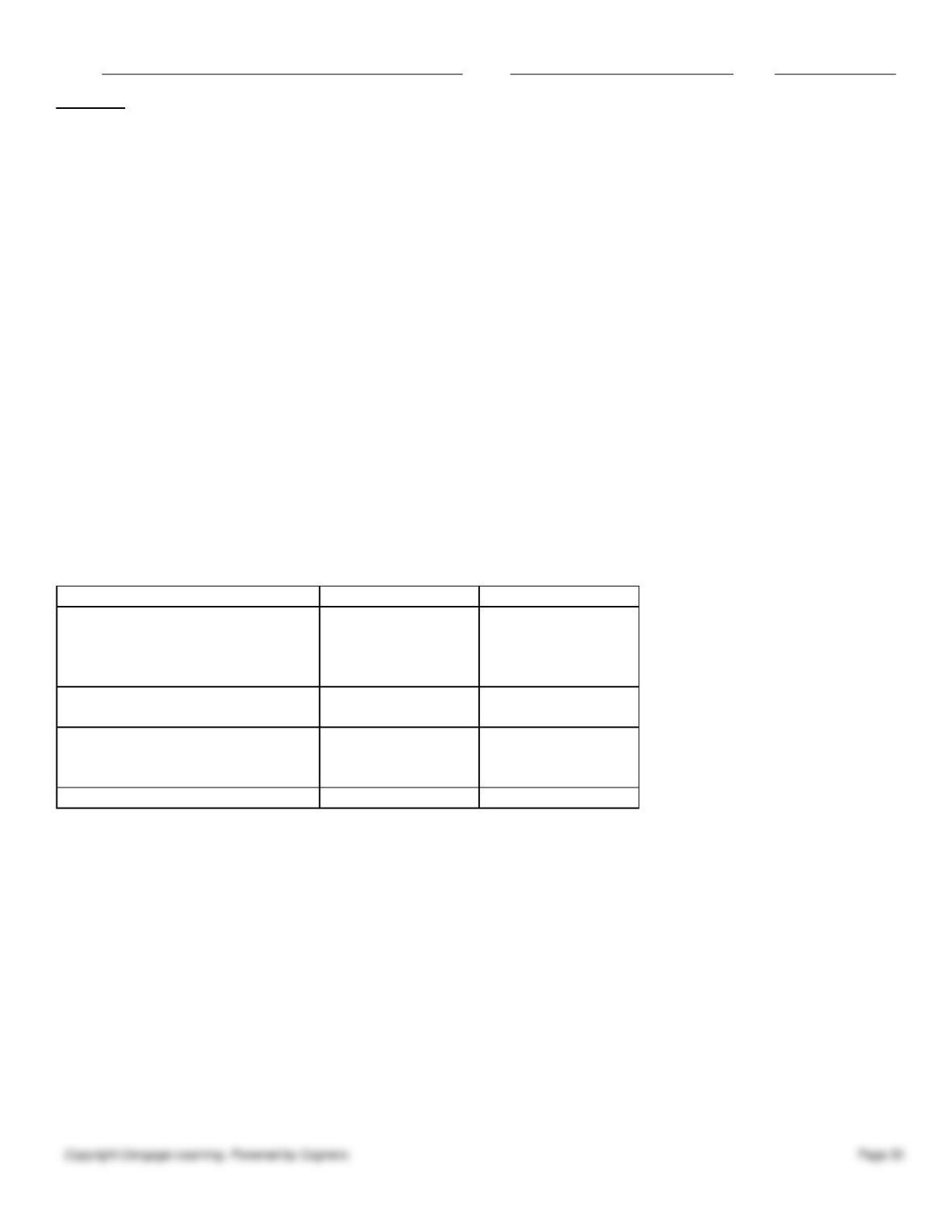
Name:
Class:
Date:
chapter 2
billed for rentals on August 20.
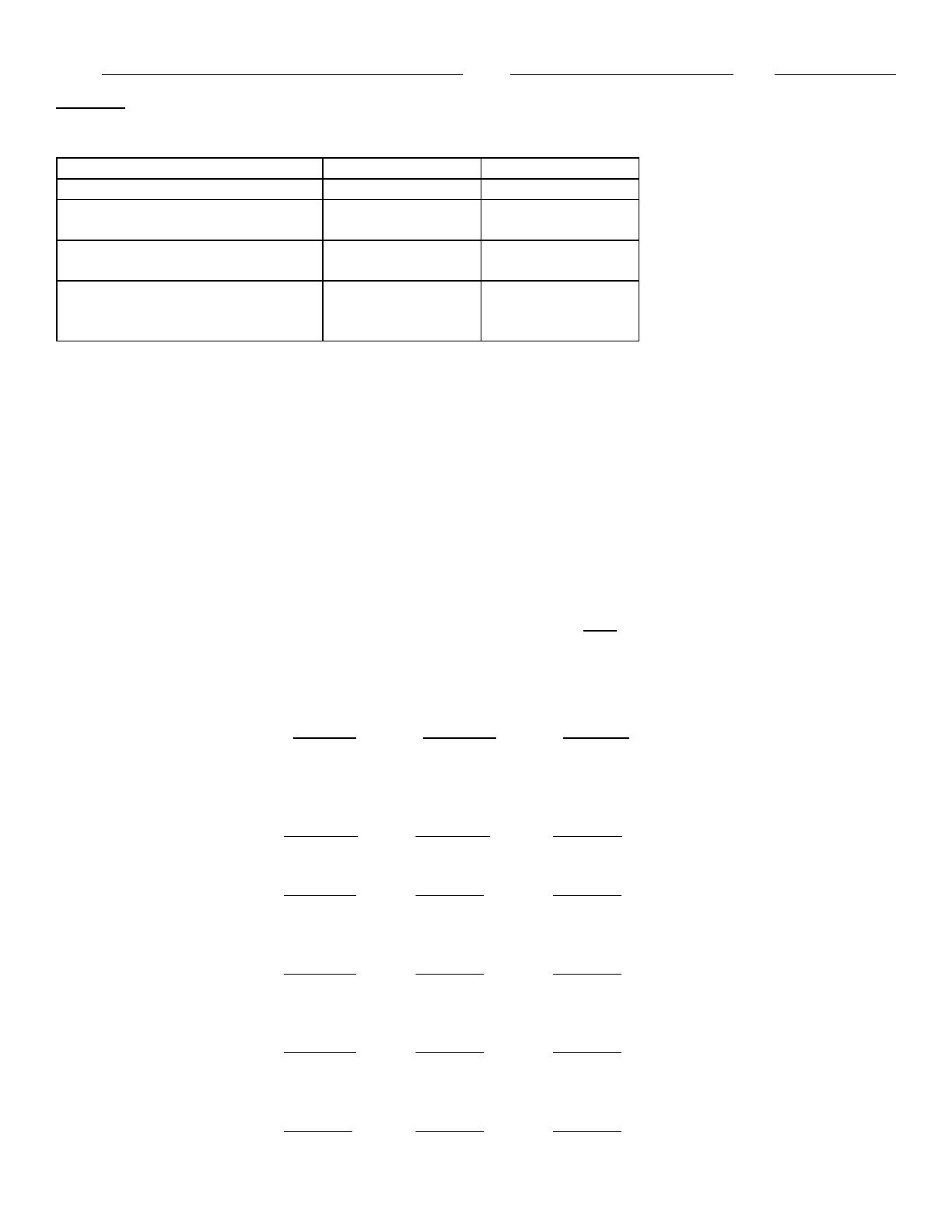
214. On January 1, Merry Walker established a catering service. The accounts to use for transactions (a) through (d), each
identified by a number, are listed. Following this list are the transactions that occurred during the first month of
operations. For each transaction, indicate the accounts that should be debited and credited by their account number(s).
11.
Cash
12.
Accounts Receivable
14.
Supplies
15.
Prepaid Insurance
17.
Equipment
18.
Truck
21.
Accounts Payable
22.
Notes Payable
31.
Merry Walker, Capital
32.
Merry Walker, Drawing
41.
Fees Earned
51.
Wages Expense
52.
Supplies Expense
53.
Rent Expense
54.
Utilities Expense
55
Truck Expense
59.
Miscellaneous Expense
Transactions
Account(s) Debited
Account(s) Credited
a. Merry transferred cash from
a personal bank account to an
account to be used for the
business.
b. Paid rent for the period of January
3 to the end of the month.
c. Purchased truck for $30,000 with
a cash down payment of $5,000
and the remainder on a note.
d. Purchased equipment on account.
215. On November 10, JumpStart provides $2,900 in services to clients. At the time of service, the clients paid $600 in
cash and put the balance on account.
(a) Journalize this event.
(b) On November 20, JumpStart’s clients paid an additional $900 on their accounts due. Journalize this event.
(c) Compute the accounts receivable balance on November 30.
216. Prepare a trial balance, listing the following accounts in proper sequence. The accounts (all normal balances) were
taken from the ledger of Sophie Designs Co. on April 30.
Accounts Payable
$ 4,100
Salary Expense
$14,000
Accounts Receivable
3,450
Sophie Dawson, Capital
17,800
Cash
6,700
Sophie Dawson, Drawing
7,500
Equipment
14,500
Supplies
3,125
Fees Earned
45,245
Supplies Expense
1,700

Name:
Class:
Date:
chapter 2
Miscellaneous Expense
850
Utilities Expense
4,000
Rent Expense
11,500
217. Answer the following questions for each of the errors listed, considered individually:
(a)
Did the error cause the trial balance totals to be unequal?
(b)
What is the amount of the difference between the trial balance totals (where
applicable)?
(c)
Which of the trial balance totals, debit or credit, is the larger (where
applicable)?
Present your answers in columnar form, using the following headings:
Error
Totals
Difference in Totals
Larger of Totals
(identifying number)
(equal or unequal)
(amount)
(debit or credit)
Errors:
(1)
A withdrawal of $3,000 cash by the owner was recorded by a debit of $3,000
to Salary Expense and a credit of $3,000 to Cash.
(2)
A $650 purchase of supplies on account was recorded as a debit of $1,650 to
Equipment and a credit of $1,650 to Accounts Payable.
(3)
A purchase of equipment for $3,450 on account was not recorded.
(4)
An $870 receipt on account was recorded as an $870 debit to Cash and a $780
credit to Accounts Receivable.
(5)
A payment of $1,530 cash on account was recorded only as a credit to Cash.
(6)
Cash sales of $8,500 were recorded as a credit of $8,500 to Cash and a credit
of $8,500 to Fees Earned.
(7)
The debit to record a $4,000 cash receipt on account was posted twice; the
credit was posted once.
(8)
The credit to record a $300 cash payment on account was posted twice; the
debit was posted once.
(9)
The debit balance of $7,400 in Accounts Receivable was recorded in the trial
balance as a debit of $7,200.
218. On October 10, Nickle Company purchased supplies for $1,800 on account. On October 25, Nickle Company paid
the invoice. Journalize the entries required for these transactions
219. State for each account whether it is likely to have (a) debit entries only, (b) credit entries only, or (c) both debit and
credit entries when recording business transactions during the month. Also, indicate the normal balance of each account.
1.
Fees Earned
4.
Supplies
2.
Utilities Expense
5.
Cash
3.
Accounts Payable
6.
Accounts Receivable
220. On January 7, Damien Lawson invested $45,000 cash to initiate the operation of his business, JumpStart. Journalize
the entry required for this transaction.
221. On January 1, Cassie Harris established a catering service. She would like to open the following accounts in the
general ledger. List the accounts in the order in which they should appear in the ledger and propose a two-digit account
numbering scheme that is consistent with the rules of a proper chart of accounts.
1.
Cash
2.
Supplies

Name:
Class:
Date:
chapter 2
Copyright Cengage Learning. Powered by Cognero.
Page 32
3.
Equipment
4.
Accounts Payable
5.
Cassie Harris, Capital
6.
Wages Expense
7.
Rent Expense
8.
Truck
9.
Utilities Expense
10.
Cassie Harris, Drawing
11.
Truck Expense
12.
Prepaid Insurance
13.
Fees Earned
14.
Miscellaneous Expense
15.
Insurance Expense
16.
Notes Payable
17.
Accounts Receivable
222. On November 1, Nickle Company made a cash payment of $200,000 on a note payable that was generated in the
purchase of a building and land. Journalize the entry required for this transaction.
223. On January 1, Merry Walker established a catering service. The accounts to use for transactions (a) through (f), each
identified by a number, are listed. Following this list are the transactions that occurred in Walker’s first month of
operations. For each transaction, indicate the accounts that should be debited and credited by their account number(s).
11.
Cash
12.
Accounts Receivable
14.
Supplies
15
Prepaid Insurance
17.
Equipment
18.
Truck
21.
Accounts Payable
22.
Notes Payable
31.
Merry Walker, Capital
32.
Merry Walker, Drawing
41.
Fees Earned
51.
Wages Expense
52
Supplies Expense
53.
Rent Expense
54.
Utilities Expense
55.
Truck Expense
56.
Insurance Expense
57.
Miscellaneous Expense
Transactions
Account(s) Debited
Account(s) Credited
a. Recorded jobs completed on
account and sent invoices to
customers.
b. Received an invoice for truck
expenses to be paid in February.
c. Paid utilities expense
d. Received cash from customers on
account.
e. Paid employee wages.

Name:
Class:
Date:
chapter 2
f. Withdrew cash for personal use.
224. Journalize the transaction for the purchase of a truck on April 4 for $85,700, paying $15,000 cash and the remainder
on account. Omit explanation.
225. Journalize the entries to correct the following errors:
(a)
A purchase of supplies for $500 on account was recorded and posted as a debit to
Supplies for $200 and as a credit to Accounts Receivable for $200.
(b)
A receipt of $2,500 for fees earned was recorded and posted as a debit to Fees
Earned for $2,500 and a credit to Cash for $2,500.
226. Journalize the following five transactions for Nexium & Associates, Inc. Omit explanations.
Mar.
1
Invoiced client for services provided on account, $800.
9
Purchased office furniture ($1,060) and office supplies ($160) on
account from Corner Office, Inc., receiving an invoice for $1,220.
15
Paid Corner Office, Inc. for the furniture and office supplies
delivered on March 9.
23
Paid utility bill for the month, $430.
31
Paid salaries of $850 are paid to employees.
227. On October 17, Nickle Company purchased a building and a plot of land for $750,000. The building was valued at
$500,000, while the land carried a value of $250,000. Nickle paid $300,000 down in cash and signed a note payable for
the balance. Journalize the entry required for this transaction.
228. On January 1, Merry Walker established a catering service. The accounts to use for transactions (a) through (f), each
identified by a number, are listed. Following this list are the transactions that occurred in Walker’s first month of
operations. For each transaction, indicate the accounts that should be debited and credited by their account number(s).
11.
Cash
12.
Accounts Receivable
14.
Supplies
15
Prepaid Insurance
17.
Equipment
18.
Truck
21.
Accounts Payable
22.
Notes Payable
23
Unearned Revenue
31.
Merry Walker, Capital
32.
Merry Walker, Drawing
41.
Fees Earned
51.
Wages Expense
52
Supplies Expense
53.
Rent Expense
54.
Utilities Expense
55.
Truck Expense
56.
Insurance Expense
Name:
Class:
Date:
chapter 2
Copyright Cengage Learning. Powered by Cognero.
Page 34
57.
Miscellaneous Expense
Transactions
Account(s) Debited
Account(s) Credited
a. Purchased supplies on account.
b. Paid the invoice previously
recorded in transaction (a).
c. Bought a three-year insurance
policy and paid in full.
d. Received $7,000 from a contract to
perform accounting services over the
next two years.
229. Journalize the following selected transactions for January. Explanations may be omitted.
Jan.
1
Received cash from the investment made by the owner, $14,000.
2
Received cash for providing accounting services, $9,500.
3
Billed customers on account for providing services, $4,200.
4
Paid advertising expense, $700.
5
Received cash from customers on account, $2,500.
6
Owner withdrew $1,010.
7
Received telephone bill, $900.
8
Paid telephone bill, $900.
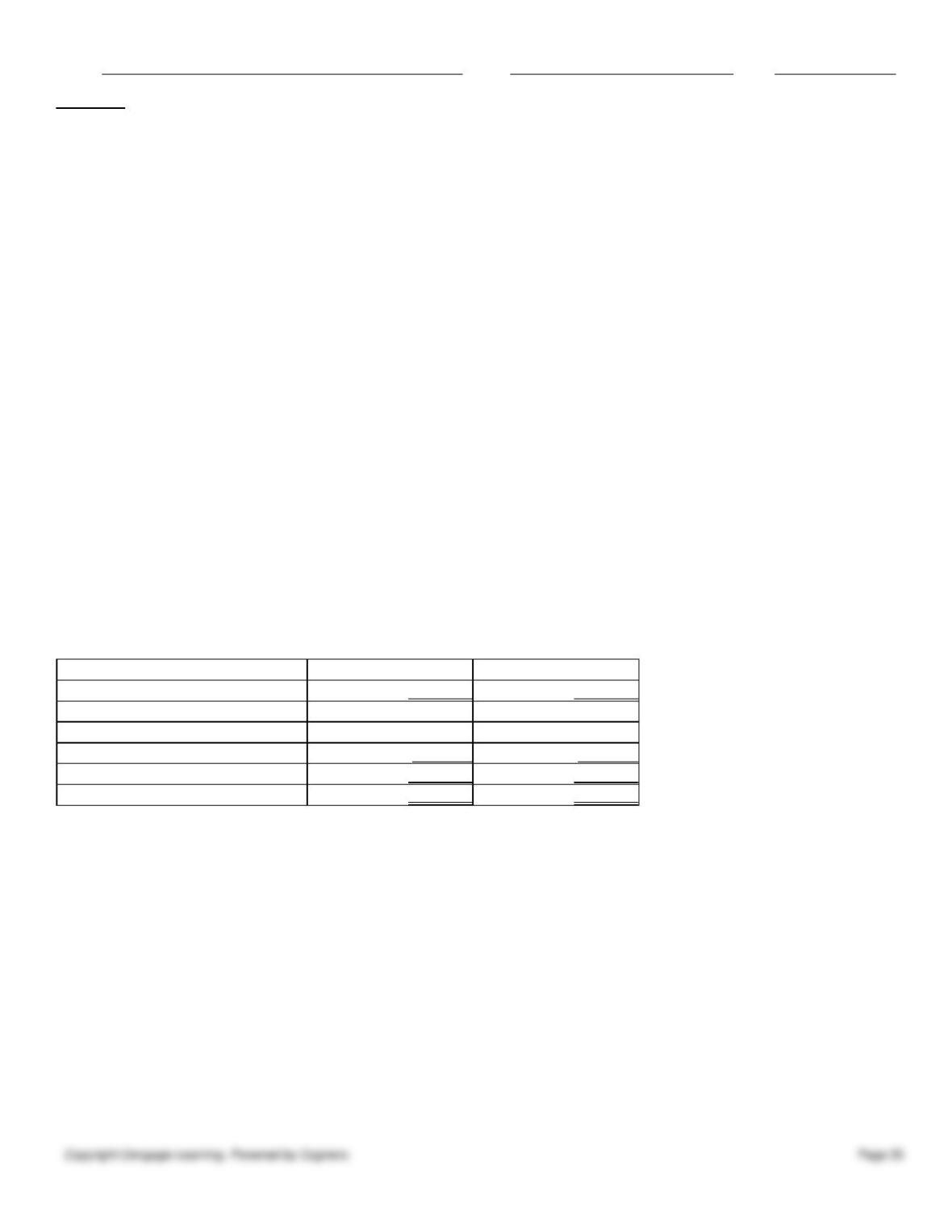
230. Several transactions are shown, with the accounting equation stated to the right side of each. Use the following
identification codes to indicate the effects of each transaction on the accounting equation. Write your answers in the space
provided under the accounting equation. You need an identification code for each element of the accounting equation. An
example is given before the first transaction.
I – Increase
D – Decrease
NE – No Effect
Assets
=
Liabilities
+
Owner’s
Equity
Example
John Smith invests in
his new business by
giving it his personal
drill press valued at
$3,500.
I
NE
I
(a)
Cash sales are made.
(b)
Equipment is
purchased on credit.
(c)
Payment is made for
the equipment
purchased on credit in
(b).
(d)
The company sold
excess supplies to
another company on
credit.
(e)
Cash is collected
from customers for
accounts receivable
balances.
Name:
Class:
Date:
chapter 2
231. On June 1, the cash account balance was $96,750. During June, cash receipts totaled $305,000 and the June 30
balance was $75,880. Determine the cash payments made during June.
232. On January 12, JumpStart purchased $870 in office supplies.
(a) Journalize this transaction as if JumpStart paid cash.
(b) Journalize this transaction as if JumpStart made the purchase on account.
(c) Assuming Jumpstart made the purchase on account, journalize the full payment on January 18.
233. On September 1, Erika Company purchased land for $47,500 cash. Provide the journal entry for this transaction.
234. For each of the following errors, considered individually, indicate whether the error would cause the trial balance
totals to be unequal. If the error would cause the trial balance totals to be unequal, indicate whether the debit or credit total
is higher and by how much.
(a)
Payment of a cash withdrawal of $6,800 was journalized and posted as a debit
of $8,600 to Salaries Expense and a credit of $8,600 to Cash.
(b)
A fee of $9,780 earned was debited to Accounts Receivable for $7,980 and
credited to Fees Earned for $9,780.
(c)
A payment of $3,000 to a creditor was posted as a credit of $3,000 to Accounts
Payable and a credit of $3,000 to Cash.
235. Lewis Company has the following condensed income statement:
Year 2
Year 1
Sales
$178,400
$162,500
Wages expense
$100,000
$ 92,500
Rent expense
33,000
30,000
Utilities expense
30,000
25,000
Total operating expenses
$163,000
$147,500
Net income
$ 15,400
$ 15,000
Required
Prepare a horizontal analysis of Lewis Company’s income statements. Comment on the changes as favorable or
unfavorable.
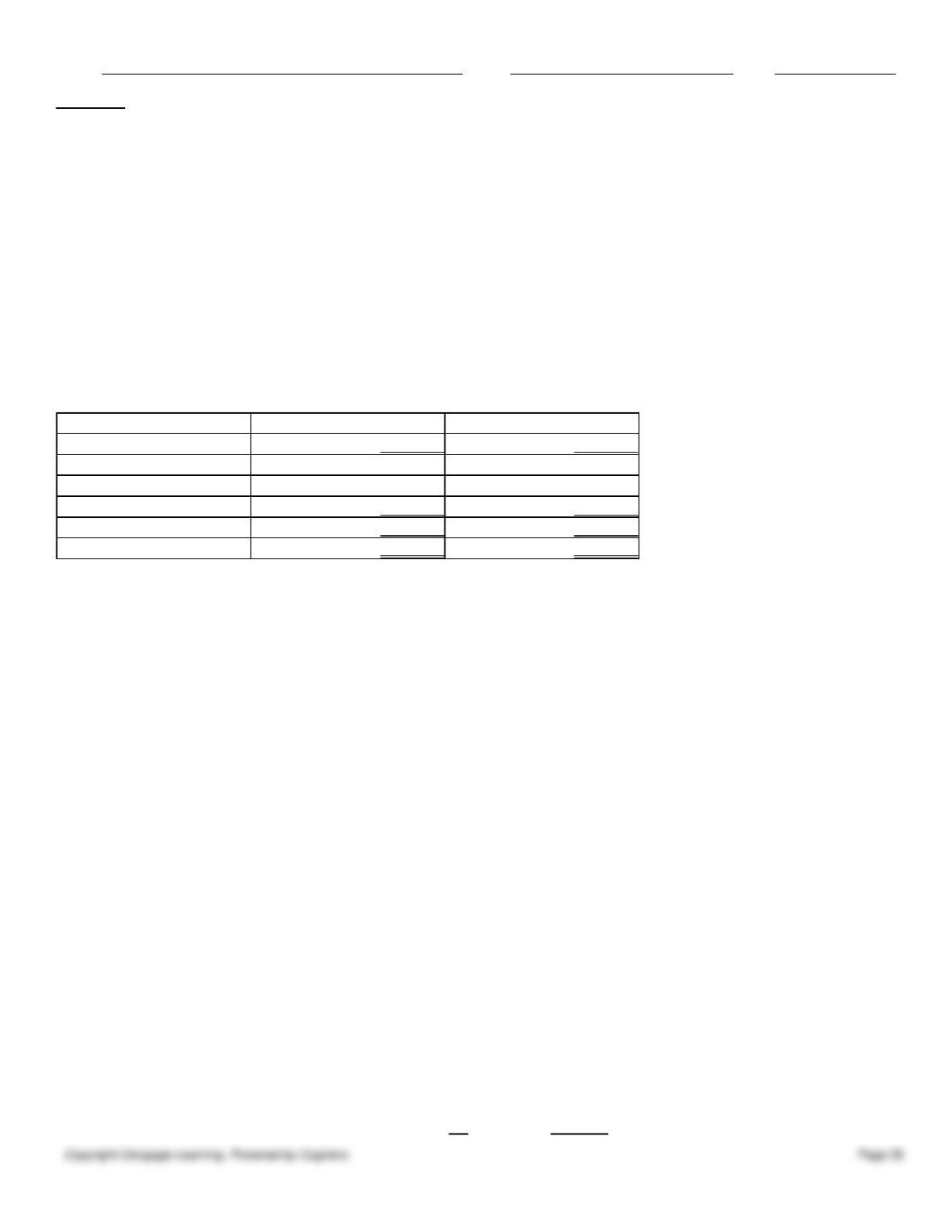
236. Journalize the following selected transactions for Long Company’s first month of operations in a two-column
journal, identifying each entry by letter. Omit explanations.
(a)
Received $18,000 from Katie Long, owner, as an investment in the business.
(b)
Purchased equipment for $27,000, paying $10,000 in cash and giving a note
payable for the remainder.
(c)
Paid $2,300 for rent for April.
(d)
Purchased $1,500 of supplies on account.
(e)
Recorded $9,800 of fees earned on account.
(f)
Received $7,500 in cash for fees earned.
(g)
Paid $1,200 to creditors on account.
(h)
Paid wages of $3,425.
Name:
Class:
Date:
chapter 2
(i)
Received $7,900 from customers on account.
(j)
Recorded owner’s withdrawal of $1,875.
237. The following errors took place in journalizing and posting transactions:
(a)
A withdrawal of $5,000 by Stan Norton, owner of the business, was recorded
as a debit to Office Expense and a credit to Cash.
(b)
A receipt of $7,800 cash from a customer on account was recorded as a debit
to Cash and a credit to Fees Earned.
Journalize the entries to correct the errors. Omit the explanations.
238. Nebraska Technologies has the following condensed income statement:
Year 2
Year 1
Sales
$158,400
$162,500
Wages expense
$ 80,000
$ 92,500
Rent expense
28,000
30,000
Utilities expense
30,000
25,000
Total operating expenses
$138,000
$147,500
Net income
$ 20,400
$ 15,000
Required
Prepare a horizontal analysis of Nebraska Technologies’ income statements. Comment on the changes as favorable or
unfavorable.
239. Compute the following:
(a)
Determine the cash receipts for April based on the following data:
Cash payments during April
$63,000
Cash account balance, April 1
25,500
Cash account balance, April 30
31,750
(b)
Determine the cash received from customers on account during April based on
the following data:
Accounts receivable account balance, April 1
$22,500
Accounts receivable account balance, April 30
15,250
Fees billed to customers during April
45,000
240. On January 8, Jumpstart purchased several pieces of office equipment at a clearance price of $20,000, paying cash.
The equipment was originally priced at $35,000. Journalize the entry required for this transaction.
241. Increases and decreases in various types of accounts follow. In each case, indicate by “Dr.” or “Cr.” (a) whether the
change in the account would be recorded as a debit or a credit and (b) whether the normal balance of the account is a debit
or a credit.
(a)
(b)
Recorded
As
Normal
Balance

Name:
Class:
Date:
chapter 2
(1)
Increase in Denice Dickenson, Capital
________
_______
(2)
Increase in Denice Dickenson, Drawing
________
_______
(3)
Decrease in Accounts Receivable
________
_______
(4)
Increase in Notes Payable
________
_______
(5)
Increase in Accounts Payable
________
_______
(6)
Decrease in Supplies
________
_______
(7)
Decrease in Salaries Expense
________
_______
(8)
Increase in Accounts Receivable
________
_______
(9)
Increase in Cash
________
_______
(10)
Decrease in Land
________
_______
242. The bookkeeper for Brockton Industries prepared the following journal entries and posted the entries to the general
ledger as indicated in the T accounts presented. Assume that the dollar amounts and the descriptions of the entries are
correct.
July
3
Accounts Receivable
1,000
Service Revenue
1,000
Customers were billed for services
completed.
11
Cash
500
Accounts Receivable
500
Payment is received from a customer
billed for services on July 3.
12
Office Supplies
600
Accounts Payable
600
Purchased office supplies on credit;
payment is due in 30 days.
25
Office Furniture
700
Cash
700
Payment is made for office furniture
received on July 25.
Accounts Receivable
Service Revenue
7/3
1,000
7/3
1,000
7/11
500
Cash
Accounts Payable
7/11
500
7/25
700
7/12
600
Office Supplies
Office Furniture
7/12
600
7/25
700
Required
If you assume that all journal entries have been recorded correctly, use the given information to:
(1) Identify the postings to the general ledger that were made incorrectly.
Name:
Class:
Date:
chapter 2
(2) Describe how each incorrect posting should have been made.
243. Organize the following accounts into the usual sequence of a chart of accounts.
Alecia Morris, Capital
Alecia Morris, Drawing
Accounts Payable
Accounts Receivable
Cash
Fees Earned
Miscellaneous Expense
Prepaid Rent
Salaries Expense
Unearned Revenue
244. On January 1, Merry Walker established a catering service. The accounts to use for transactions (a) through (e), each
identified by a number, are listed. Following this list are the transactions that occurred in Walker’s first month of
operations. For each transaction, indicate the accounts that should be debited and credited by their account number(s).
11.
Cash
12.
Accounts Receivable
14.
Supplies
15.
Prepaid Insurance
17.
Equipment
18.
Truck
21.
Accounts Payable
22.
Notes Payable
31.
Merry Walker, Capital
32.
Merry Walker, Drawing
41.
Fees Earned
51.
Wages Expense
52.
Supplies Expense
53.
Rent Expense
54.
Utilities Expense
55
Truck Expense
56.
Insurance Expense
59.
Miscellaneous Expense
Transactions
Account(s) Debited
Account(s) Credited
a. Purchased supplies for cash.
b. Paid the annual premiums on
property and casualty insurance.
c. Received cash for a job previously
recorded on account.
d. Paid a creditor a portion of the
amount owed for equipment
previously purchased on account.
e. Received cash for a completed
job.
245. On December 1, JumpStart provides $2,800 in services to clients.
(a) Journalize this event as if the clients had paid cash at the time the services were rendered.

Name:
Class:
Date:
chapter 2
(b) Journalize this event as if the clients received the services on account.
(c) Assuming that the clients received the services on account, journalize $1,200 in payments received from the clients on
December 30.
246. The following trial balance was prepared for Winslow’s Auto Body on April 30.
(a)
List the errors in the trial balance. Assume all accounts have normal balances.
(b)
What would be the new totals in the Debit and Credit columns after errors are
corrected? What would be the balance of Accounts Receivable?
Winslow’s Auto Body
Trial Balance
For Month Ending April 30
Debit
Balances
Credit
Balances
Cash
19,475
Accounts Receivable
?
Supplies
1,000
Equipment
15,000
Prepaid Insurance
500
Accounts Payable
2,500
Thad Winslow, Capital
17,000
Thad Winslow, Drawing
1,000
Fees Earned
49,600
Salary Expense
14,500
Rent Expense
9,000
Utilities Expense
1,400
Supplies Expense
3,900
Miscellaneous Expense
250
55,000
81,575
247. On October 30, Damien Lawson withdraws $3,330 from JumpStart for personal use. Journalize this event.
248. The chart of accounts classifies the accounts to make identification of the accounts easier. Describe the numbering
system businesses use in setting up the chart of accounts.
249. On August 30, JumpStart paid the following expenses: rent, $2,300; utilities, $525; wages, $1,750, and
miscellaneous, $275. Journalize these payments as one entry.
250. On November 30, Damien Lawson is informed by his accountant that $550 of a transaction recording the purchase of
office supplies was really office equipment. Prepare the journal entry to correct this situation.
Name:
Class:
Date:
chapter 2
Answer Key
Name:
Class:
Date:
chapter 2
Name:
Class:
Date:
chapter 2
Name:
Class:
Date:
chapter 2
Name:
Class:
Date:
chapter 2
Name:
Class:
Date:
chapter 2
Name:
Class:
Date:
chapter 2
Name:
Class:
Date:
chapter 2
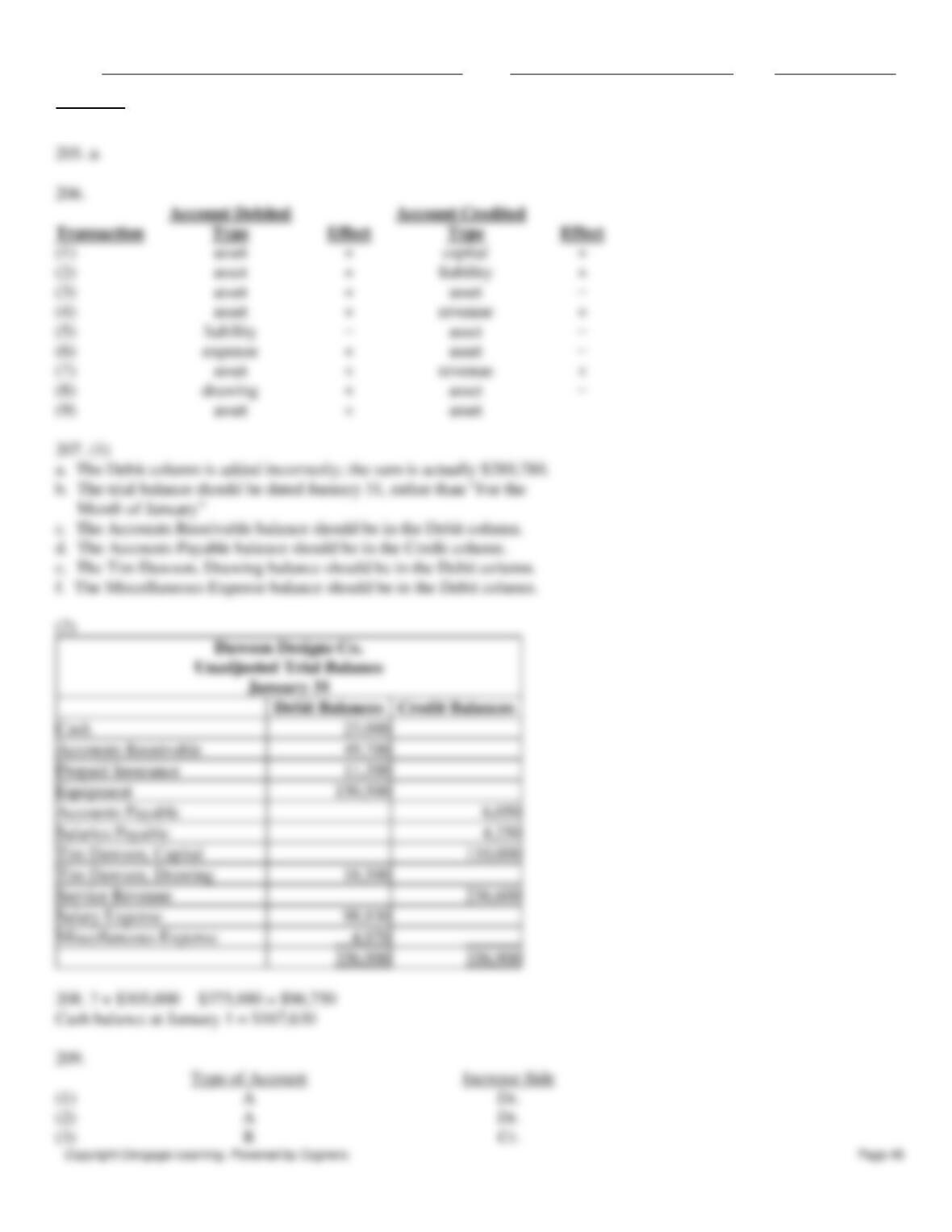
Name:
Class:
Date:
chapter 2
Name:
Class:
Date:
chapter 2
Name:
Class:
Date:
chapter 2
Name:
Class:
Date:
chapter 2
Name:
Class:
Date:
chapter 2
Name:
Class:
Date:
chapter 2
Name:
Class:
Date:
chapter 2
Name:
Class:
Date:
chapter 2
Name:
Class:
Date:
chapter 2
Name:
Class:
Date:
chapter 2