
120
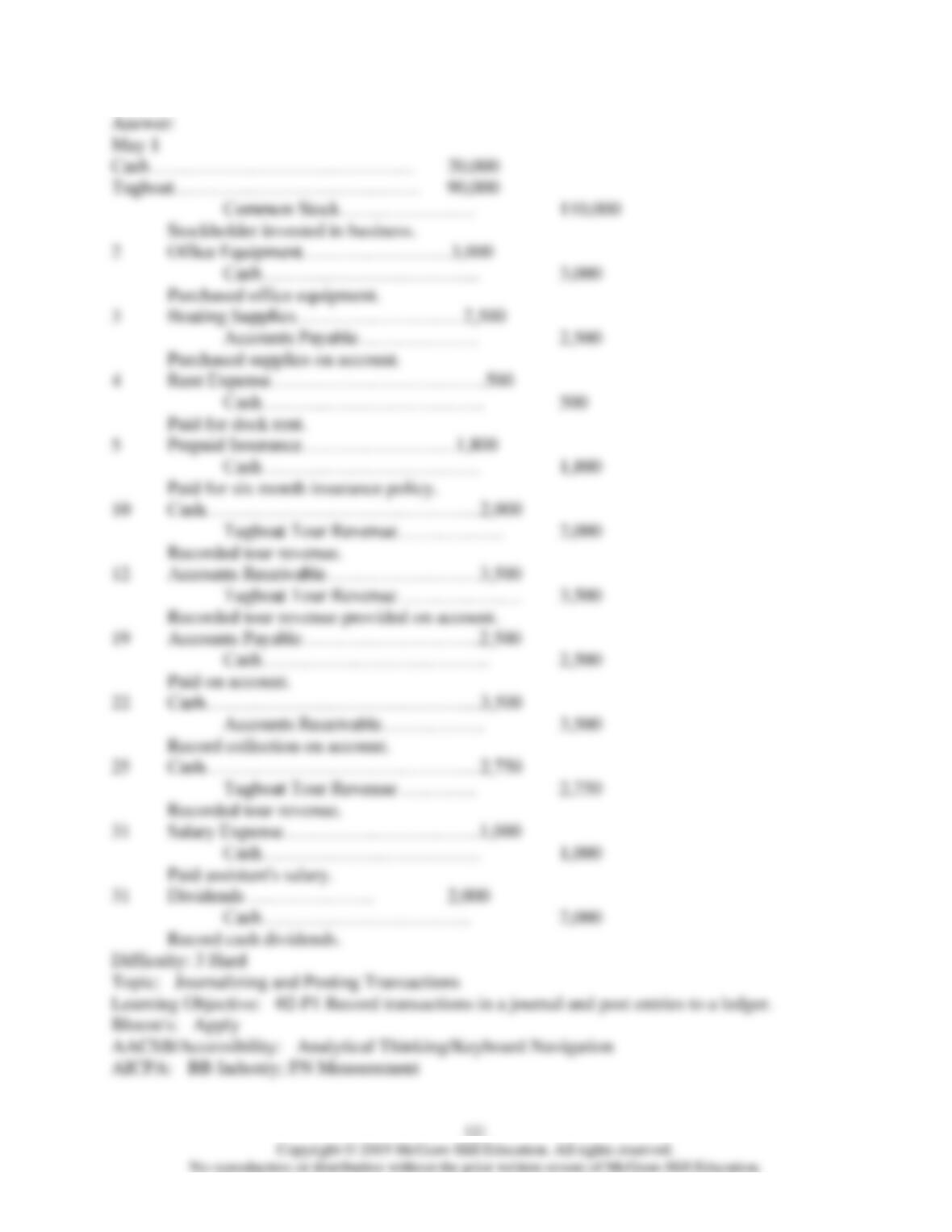
224) George Butler, the sole stockholder, opened a business that provides day tugboat tours to
tourists along the Mississippi River. Prepare journal entries to record the following transactions.
May 1 Butler invested $20,000 cash and a tugboat valued at $90,000 in exchange for
common stock.
May 2 Butler paid $3,000 cash for office equipment.
May 3 Butler bought boating supplies costing $2,500 on credit.
May 4 Butler paid $500 cash for the first month’s dock rental.
May 5 Butler paid $1,800 cash for a six-month insurance policy.
May 10 Butler gave a client a tour and immediately received $2,000 cash.
May 12 Butler provided a $3,500 tour on credit, the customer agreed to pay within
10 days
May 19 Butler paid for the boating supplies originally purchased on May 3.
May 22 Butler receives payment on the account from the client entry on May 12.
May 25 Butler received $2,750 cash for tours that he completed that day.
May 31 Butler paid his crew member a salary of $1,000.
May 31 The company paid $2,000 in cash dividends.

122
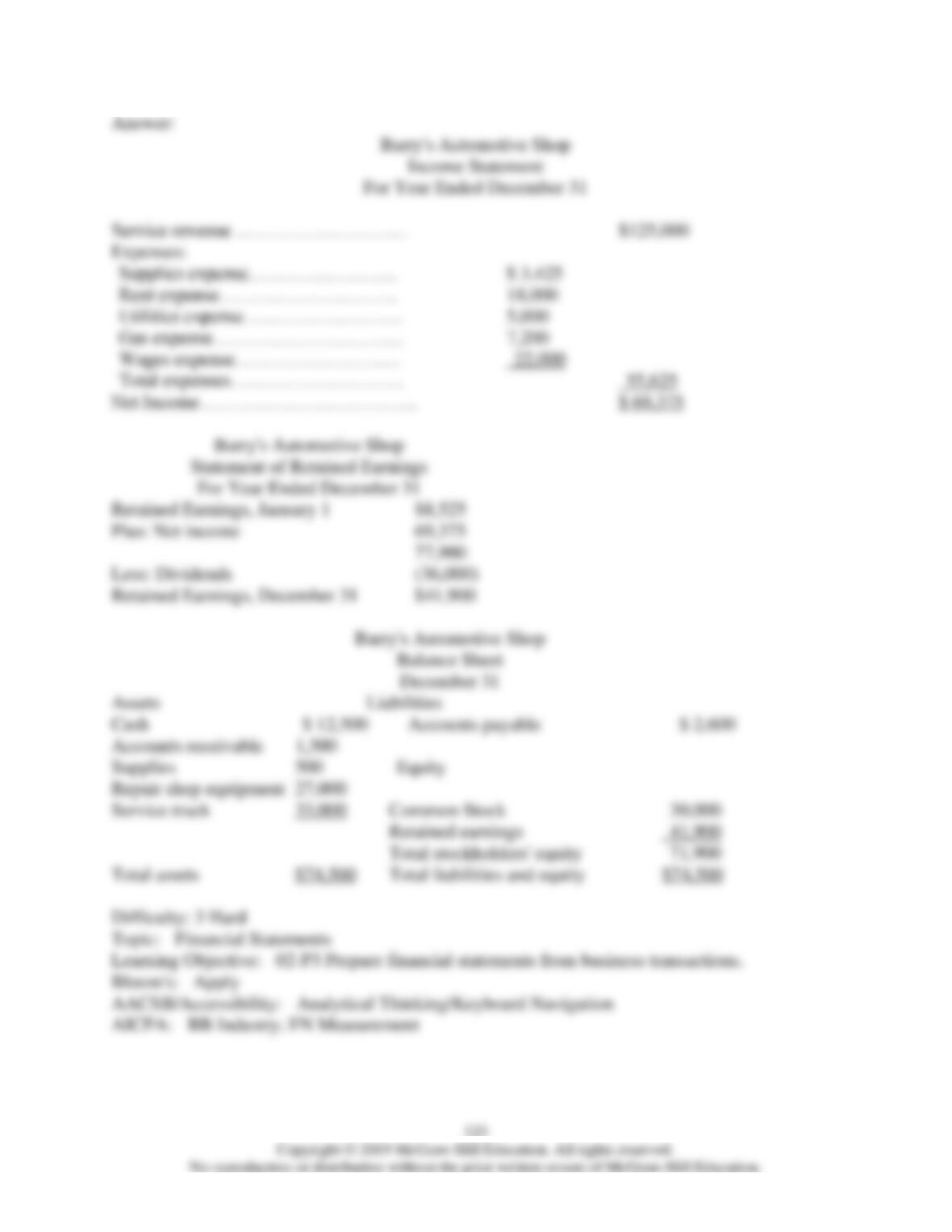
225) Based on the following trial balance for Barry’s Automotive Shop, prepare an income
statement, statement of retained earnings, and a balance sheet. There were no additional stock
issuances during the year.
Barry’s Automotive Shop
Trial Balance
December 31
Cash
$ 12,500
Accounts receivable
1,500
Supplies
500
Repair shop equipment
27,000
Service truck
33,000
Accounts payable
$2,600
Common Stock
30,000
Retained Earnings
8,525
Dividends
36,000
Service revenue
125,000
Supplies expense
3,425
Rent expense
18,000
Utilities expense
5,000
Gas expense
7,200
Wages expense
22,000
Totals
$166,125
$166,125
226) For each of the accounts in the following table (1) identify the type of account as an asset,
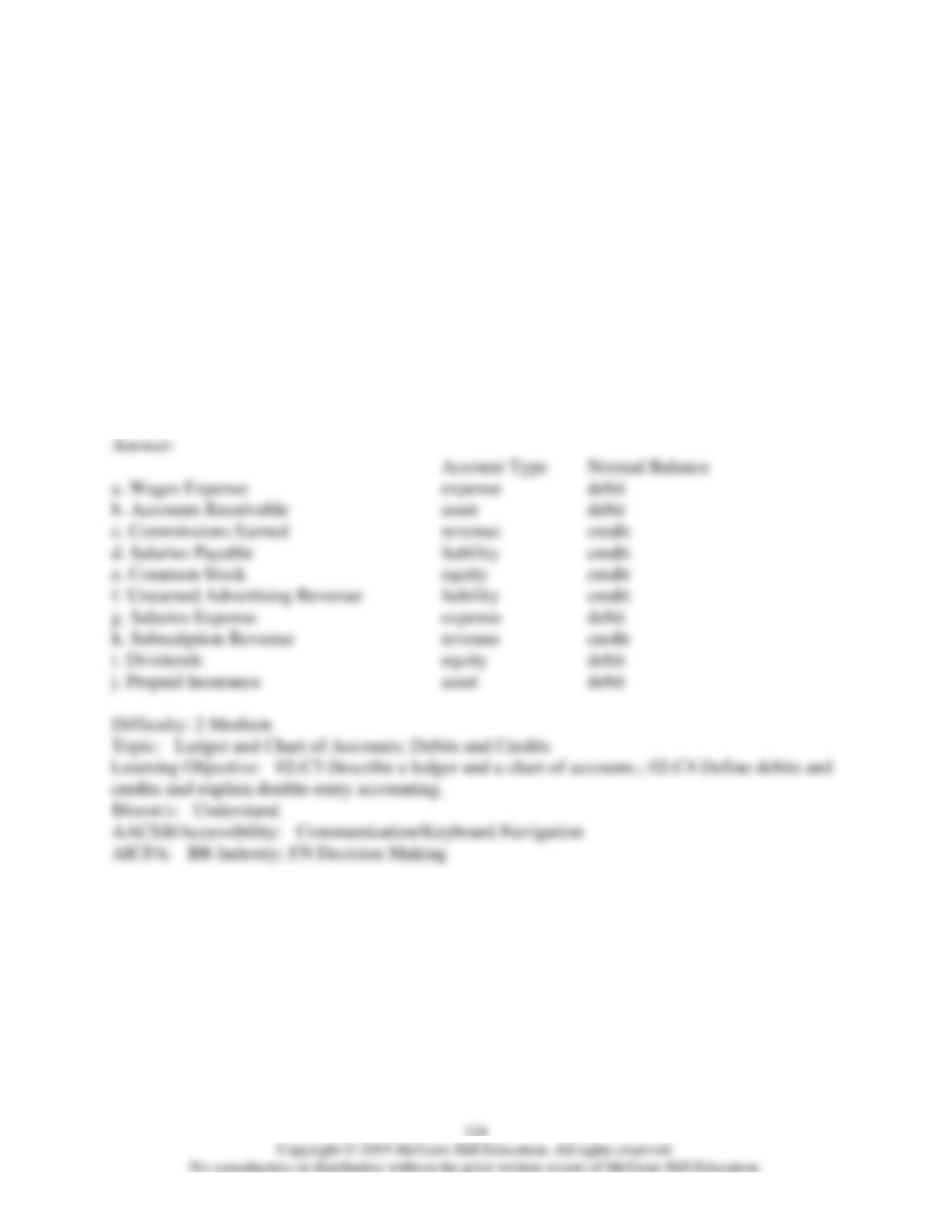
liability, equity, revenue, or expense, and (2) identify the normal balance of the account.
Account Type
Normal Balance
a. Wages Expense
b. Accounts Receivable
c. Commissions Earned
d. Salaries Payable
e. Common Stock
f. Unearned Advertising Revenue
g. Salaries Expense
h. Subscription Revenue
i. Dividends
j. Prepaid Insurance
Account Type
Normal Balance
a. Wages Expense
expense
debit
b. Accounts Receivable
debit
c. Commissions Earned
revenue
credit
d. Salaries Payable
liability
credit
e. Common Stock
equity
credit
f. Unearned Advertising Revenue
liability
credit
g. Salaries Expense
expense
debit
h. Subscription Revenue
revenue
credit
i. Dividends
equity
debit
j. Prepaid Insurance
debit
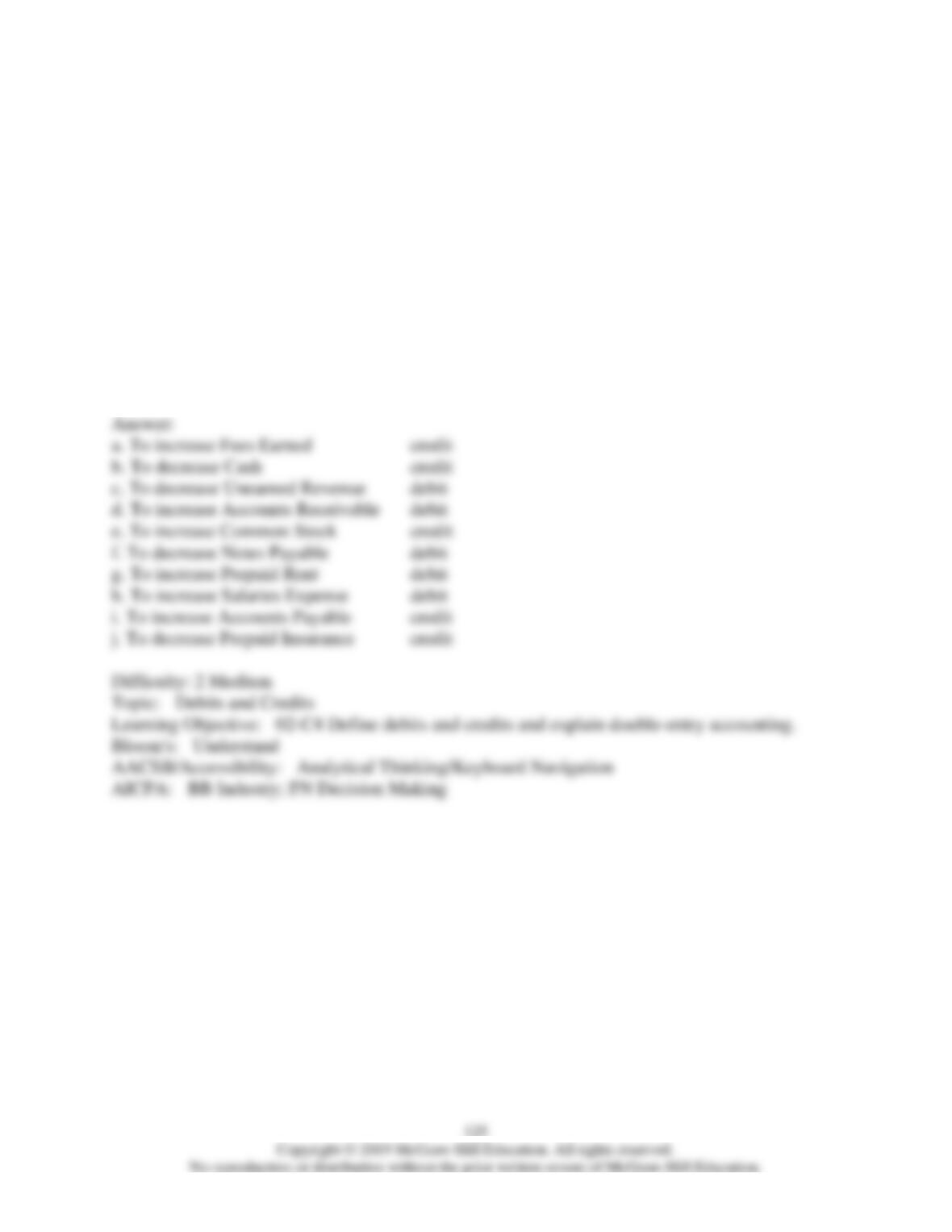
227) For each of the following accounts, identify whether a debit or credit yields the indicated
change
a. To increase Fees Earned
b. To decrease Cash
c. To decrease Unearned Revenue
d. To increase Accounts Receivable
e. To increase Common Stock
f. To decrease Notes Payable
g. To increase Prepaid Rent
h. To increase Salaries Expense
i. To increase Accounts Payable
j. To decrease Prepaid Insurance
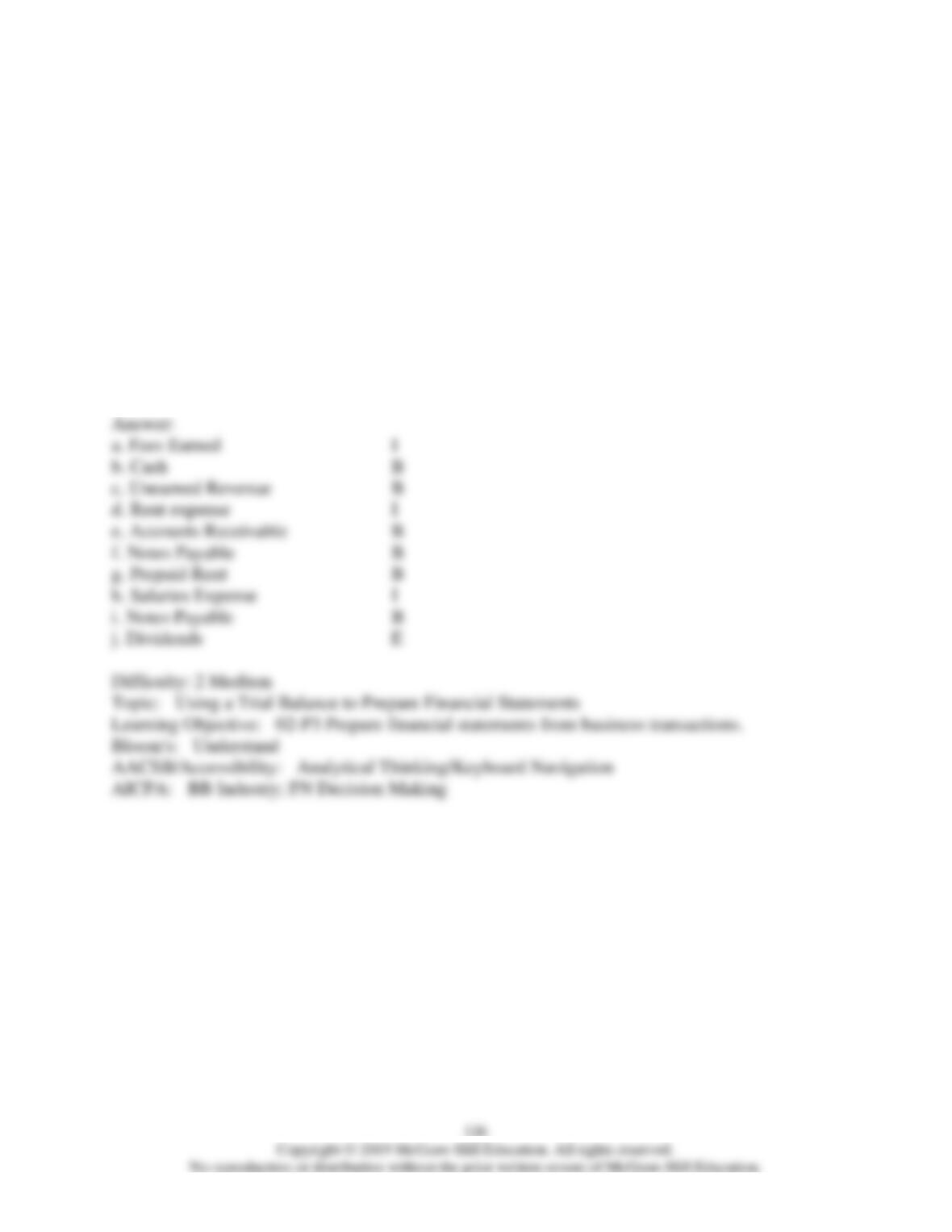
228) Indicate on which financial statement each of the following items appears. Use I for income
statement, E for statement of retained earnings and B for balance sheet.
a. Fees Earned
b. Cash
c. Unearned Revenue
d. Rent expense
e. Accounts Receivable
f. Notes Payable
g. Prepaid Rent
h. Salaries Expense
i. Notes Payable
j. Dividends
a. Fees Earned
I
b. Cash
B
c. Unearned Revenue
B
d. Rent expense
I
e. Accounts Receivable
B
f. Notes Payable
B
g. Prepaid Rent
B
h. Salaries Expense
I
i. Notes Payable
B
j. Dividends
E
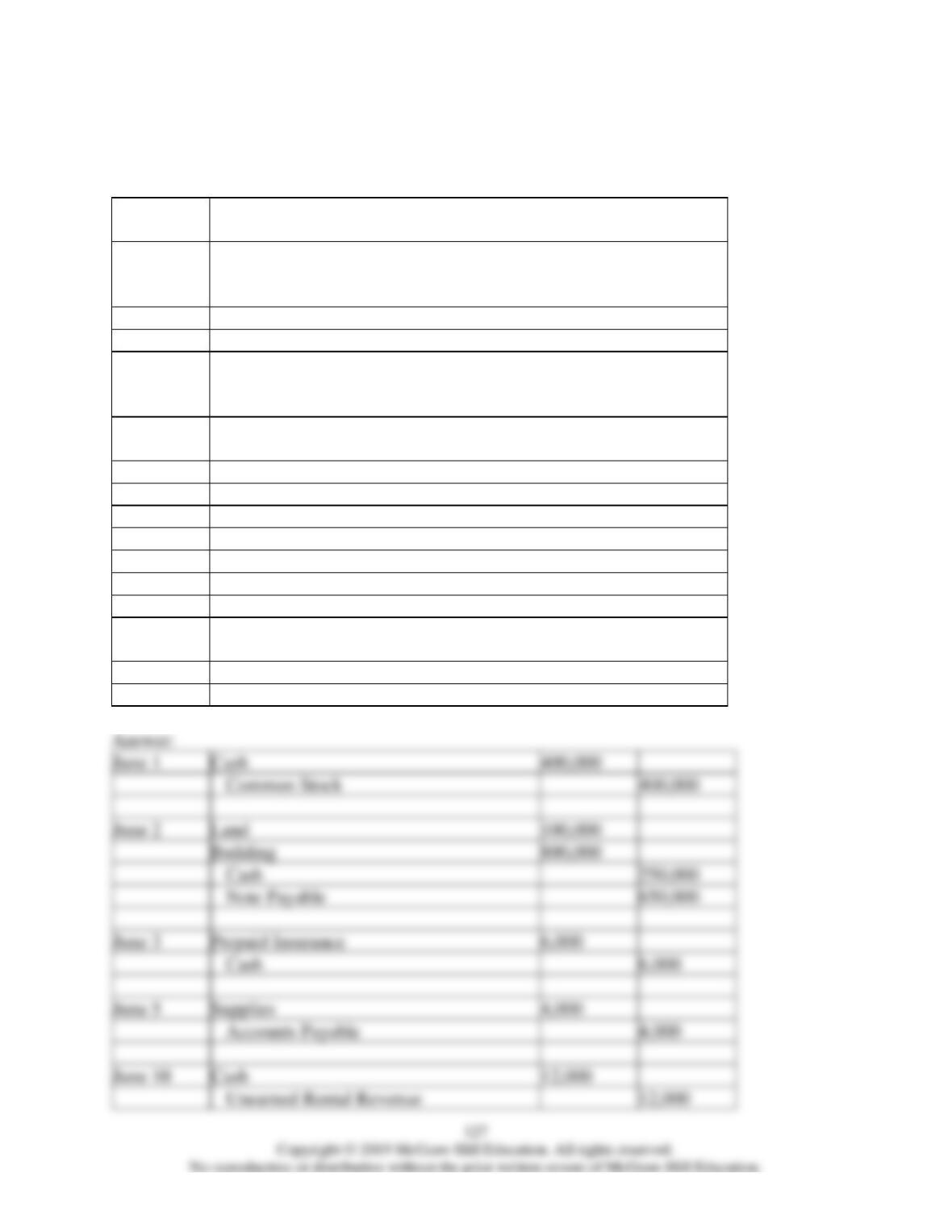
229) Jason Hope opened a hotel. Prepare journal entries to record the following transactions.
Hope uses the accounts Room Rental Revenue and Event Revenue. All expenses for special
events are recorded as Event Expense. (Omit explanations.)
June 1
Hope invested $400,000 cash into the business in exchange for
common stock.
June 2
Hope purchased a hotel building for $800,000 and land for
$100,000. Hope paid $250,000 in cash and signed note payable for
$650,000.
June 3
Paid $6,000 for a six month insurance policy on the hotel.
June 5
Purchased supplies costing $4,000 on account.
June 10
Received advance payments of $12,000 from customers that will be
staying at the hotel in July. Payments will be refunded if the
customer cancels within 7 days of their scheduled arrival time.
June 14
Received cash payments of $13,000 from current customers staying
at the hotel in June.
June 15
Paid $2,000 cash for staff salaries.
June 16
Paid $500 for maintenance expense.
June 17
Received $10,000 payment for a wedding reception hosted that day.
June 18
Paid $2,500 for catering expenses.
June 18
Paid event expenses of $1,000 for table and chair rentals.
June 19
Paid event expenses of $2,000 for flowers.
June 24
Paid for the supplies purchased on June 5.
June 25
Recorded an additional $5,000 cash received from current hotel
customers for June.
June 30
Paid $2,000 cash for staff salaries.
June 30
The company paid $4,000 in cash dividends.
June 1
Cash
400,000
400,000
June 2
Land
100,000
Building
800,000
250,000
650,000
June 3
Prepaid Insurance
6,000
6,000
June 5
Supplies
4,000
4,000
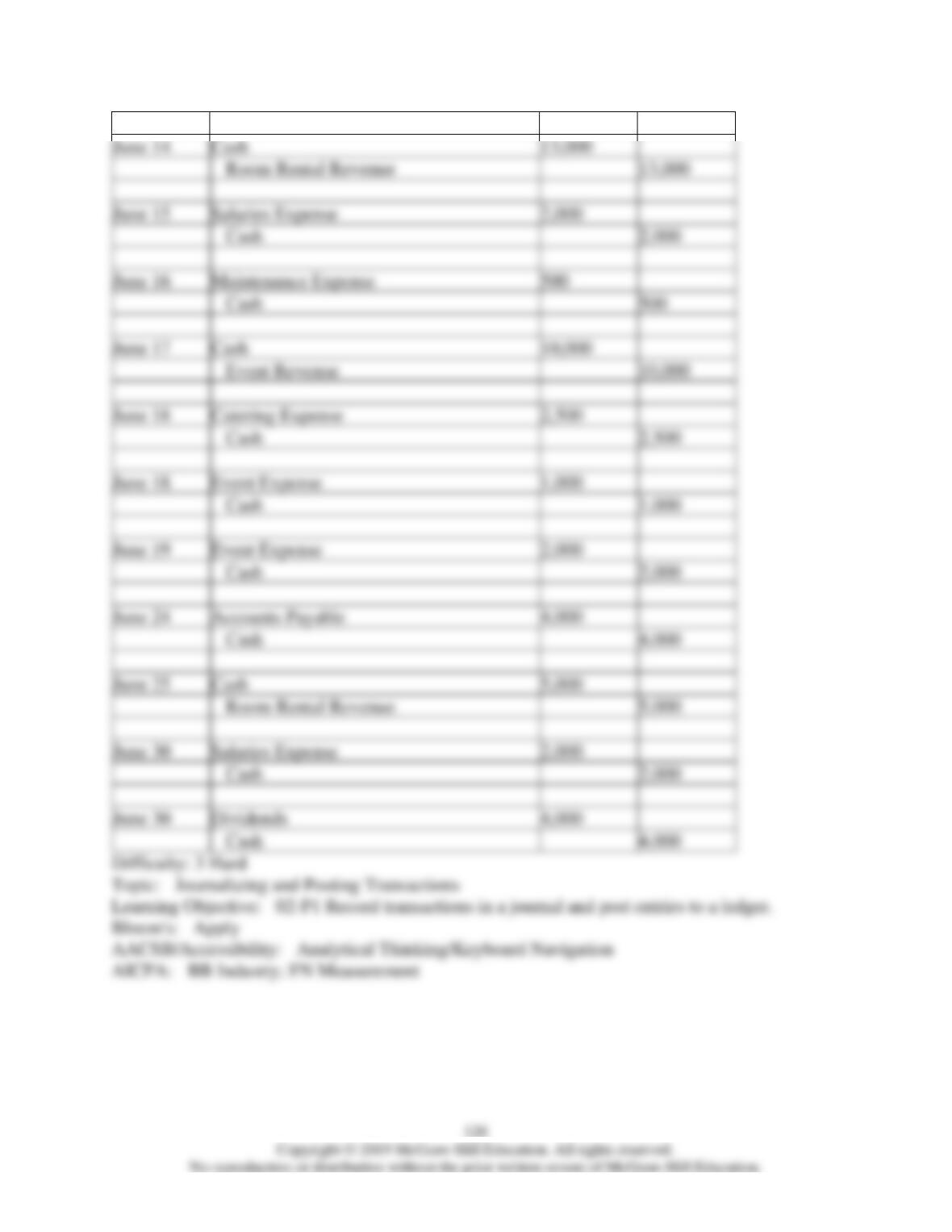
June 14
Cash
13,000
13,000
June 15
Salaries Expense
2,000
2,000
June 16
Maintenance Expense
500
500
June 17
Cash
10,000
10,000
June 18
Catering Expense
2,500
2,500
June 18
Event Expense
1,000
1,000
June 19
Event Expense
2,000
2,000
June 24
Accounts Payable
4,000
4,000
June 25
Cash
5,000
5,000
June 30
Salaries Expense
2,000
2,000
June 30
Dividends
4,000
4,000
230) For each of the following accounts, (1) identify the account as an asset, liability, equity,
revenue, or expense, and (2) indicate the normal balance of the account.
Account Title
Account Type
Normal Balance
(Debit or Credit)
a. Prepaid Insurance
b. Accounts Payable
c. Common Stock
d. Utilities Expense
e. Land
f. Services Revenue
g. Notes Receivable
h. Advertising Expense
i. Unearned Revenue
j. Service Revenue
Account Title
Account Type
Normal Balance
a. Prepaid Insurance
debit
b. Accounts Payable
liability
credit
c. Common Stock
equity
credit
d. Utilities Expense
expense
debit
e. Land
debit
f. Services Revenue
revenue
credit
g. Notes Receivable
debit
h. Advertising Expense
expense
debit
i. Unearned Revenue
liability
credit
j. Service Revenue
revenue
credit
231) The steps in the accounting process focus on analyzing and recording financial transactions
and events within a company. Those steps are shown below. Using the number system of 1 as the
first step and 4 as the last step in the process, number the steps in the correct order in which they
would occur (1 thru 4).
_____ Analyze transactions using the accounting equation.
_____ Record journal entry.
_____ Post entry to ledger.
_____ Identify transactions and source documents.
232) ________ and ________ are the starting points for the analyzing and recording process.
233) The third step in the analyzing and recording process is to record each transaction
chronologically in a________.
234) The fourth step in the analyzing and recording process is to transfer (or post) entries from
the journal to the ________.
235) ________ documents identify and describe transactions and events entering the accounting
system.
236) Revenues and expenses are two categories of ________ accounts.
237) The ________ is a collection of all accounts and their balances.
238) In a seller’s accounting records, ________ are promises of payment waiting to be received
from customers.
239) Unearned revenue is classified as a(an) ________ on a business’s balance sheet.
240) The four categories of equity accounts are ________, ________, ________, and ________.
241) A ________ is a list of all the accounts used by a company and their identification codes
but does not contain the balances.
242) A record containing all the separate accounts for a company as well as all of their balances
is called the________
243) ________ requires that each transaction affect, and be recorded in, at least two accounts. It
also means that total amounts debited must equal total amounts credited for each transaction.
244) The ________ is found by determining the difference between total debits and total credits
for an account, including any beginning balance.
245) Assets would be increased with a ________ entry and liabilities would be increased with
a________ entry.
246) Funky Music purchased $25,000 of equipment for cash. The asset account, Equipment, is
________ for $25,000 and the Cash account is ________ for $25,000.
247) Jackson Brown Footwear had total liabilities of $127.5 million and total assets of $375
million. Its debt ratio was ________.
248) ________ is the process of transferring journal entry information from the journal to the
ledger.
249) A ________ gives a complete chronological record of each transaction in one place, and
shows debits and credits for each transaction.
250) A more structured format that is similar to a T-account in that it has columns for debits and
credits, but that is different in that it has columns for transaction date, explanation, and the
account balance is the ________.
251) The posting process is the link between the ________ and the ________.
252) You increase the Service Revenue account on the ________ side of its account.
253) You decrease the Accounts Payable account on the ________ side of its account.