Chapter 2 – Basic Cost Management Concepts and Accounting for Mass Customization Operations
2-56
114. Miao Manufacturing, which began operations on January 1 of the current year, produces
an industrial scraper that sells for $325 per unit. Information related to the current year’s
activities follows.
Number of scrapers produced
20,000
Number of scrapers sold
17,000
Variable costs per unit:
Direct materials
$25
Direct labor
35
Manufacturing overhead
60
Annual fixed costs:
Manufacturing overhead
$400,000
Selling and administrative
140,000
Miao carries its finished-goods inventory at the average unit cost of production. There was no
work in process at year-end.
Required:
A. Compute the company’s average unit cost of production.
B. Determine the cost of the December 31 finished-goods inventory.
C. Compute the company’s cost of goods sold.
D. If next year’s production increases to 23,000 units and general cost behavior patterns do
not change, what is the likely effect on:
1. The direct-labor cost of $35 per unit? Why?
2. The fixed manufacturing overhead cost of $400,000? Why?
Chapter 2 – Basic Cost Management Concepts and Accounting for Mass Customization Operations
2-57
Solution:
115. Portland Manufacturing had the following data for the period just ended:
Work in process, Jan. 1
$ 21,000
Work in process, Dec. 31
40,000
Finished goods, Jan. 1
70,000
Finished goods, Dec. 31
61,000
A.
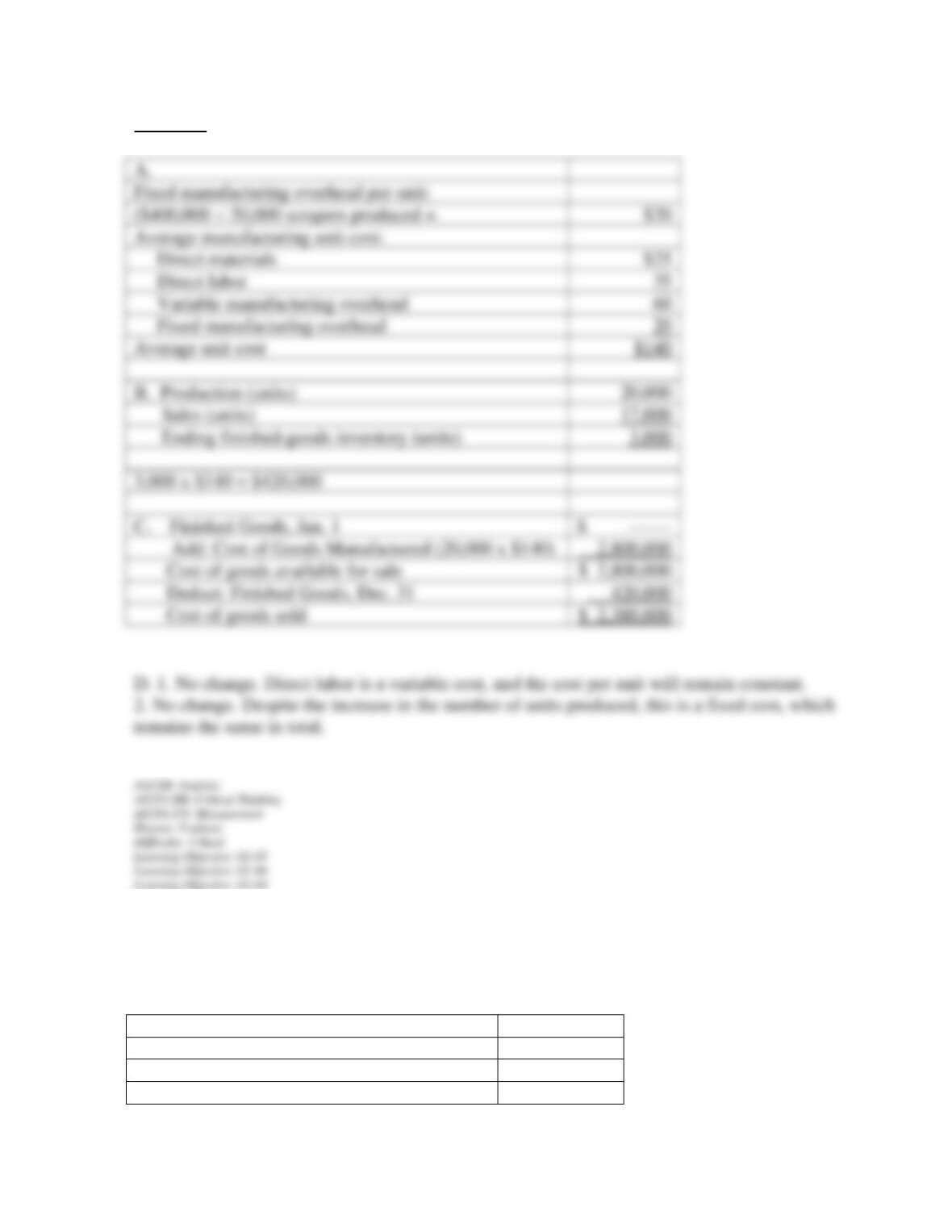
Fixed manufacturing overhead per unit:
($400,000 ÷ 20,000 scrapers produced =
Average manufacturing unit cost:
Direct materials
Direct labor
Variable manufacturing overhead
Fixed manufacturing overhead
Average unit cost
$140
B. Production (units)
Sales (units)
Ending finished-goods inventory (units)
3,000 x $140 = $420,000
C. Finished Goods, Jan. 1
$ ——-
Add: Cost of Goods Manufactured (20,000 x $140)
Cost of goods available for sale
Deduct: Finished Goods, Dec. 31
Cost of goods sold
Chapter 2 – Basic Cost Management Concepts and Accounting for Mass Customization Operations
2-58
Direct materials used
126,000
Direct labor
260,000
Factory depreciation
80,000
Sales
945,000
Advertising expense
52,000
Factory utilities
27,000
Indirect materials
19,000
Indirect labor
35,000
Required:
A. Calculate Portland’s cost of goods manufactured.
B. Calculate Portland’s cost of goods sold.
A.
Direct material used
Direct labor
260,000
Manufacturing overhead:
Factory Depreciation
Factory Utilities
Indirect materials
Indirect labor
Total manufacturing costs
Add: Work in process, Jan. 1
$568,000
Deduct: Work in process, Dec. 31
Cost of goods Manufactured
B. Finished Goods, Jan. 1
Add: Cost of Goods Manufactured
Cost of goods available for sale
Finished Goods, Dec. 31
Cost of goods sold
2-59
116. Tao Company had the following inventory balances at the beginning and end of the year:
January 1
December 31
Raw material
$50,000
$35,000
Work in process
130,000
170,000
Finished goods
280,000
255,000
During the year, the company purchased $100,000 of raw material and incurred $340,000 of
direct labor costs. Other data: manufacturing overhead incurred, $450,000; sales, $1,560,000;
selling and administrative expenses, $90,000; income tax rate, 30%.
Required:
A. Calculate cost of goods manufactured.
B. Calculate cost of goods sold.
C. Determine Tao’s net income.
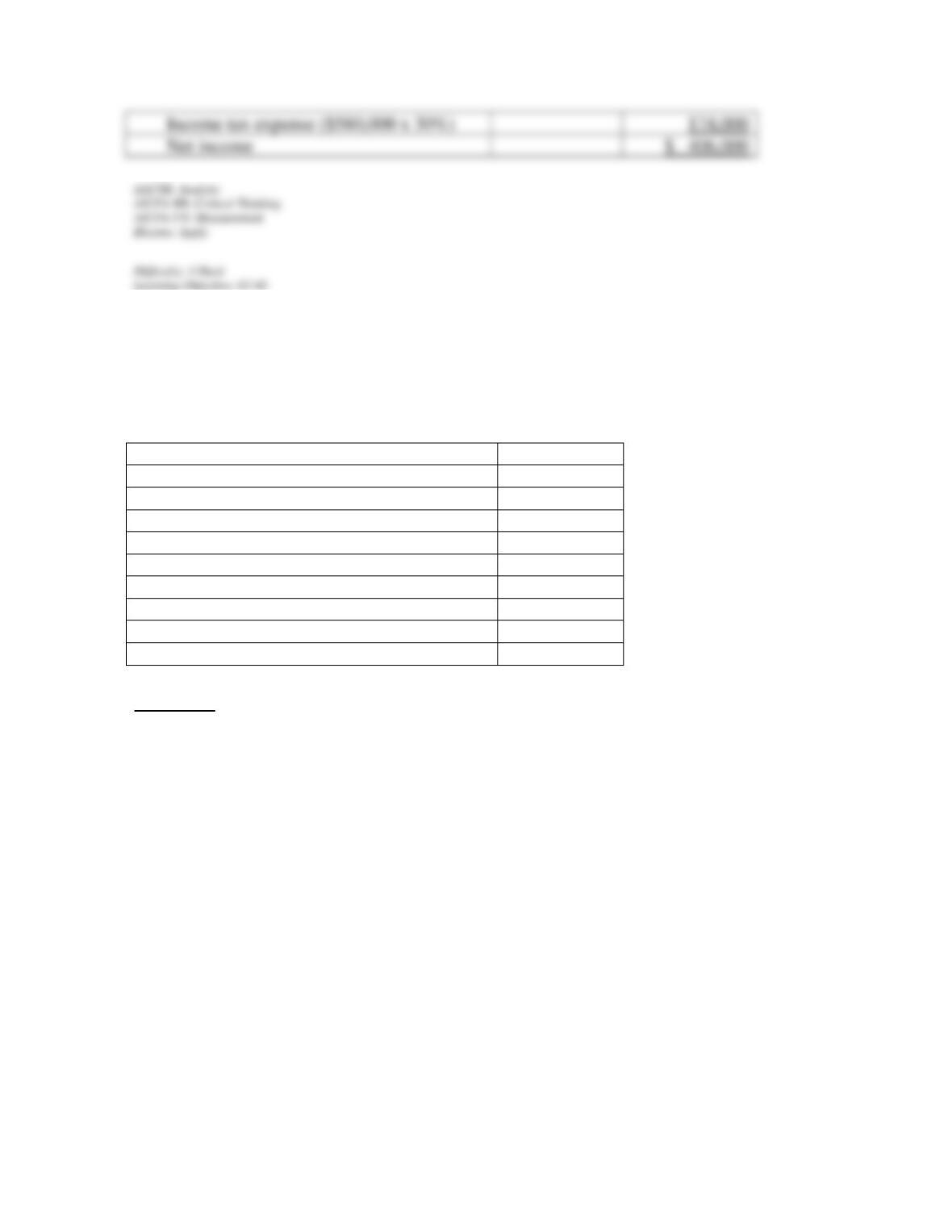
A. Direct materials used:
Raw materials, Jan. 1
Add: Purchases
Raw materials available for use
Deduct: Raw material, Dec. 31
Raw material used
Direct labor
Manufacturing overhead
Total manufacturing costs
Add: Work in process, Jan. 1
Deduct: Work in process, Dec. 31
Cost of goods manufactured
B. Finished Goods, Jan. 1
Add: Cost of Goods Manufactured
Cost of goods available for sale
Finished Goods, Dec. 31
Cost of goods sold
C. Sales Revenue
Less: Cost of goods sold
Gross Margin
Chapter 2 – Basic Cost Management Concepts and Accounting for Mass Customization Operations
2-60
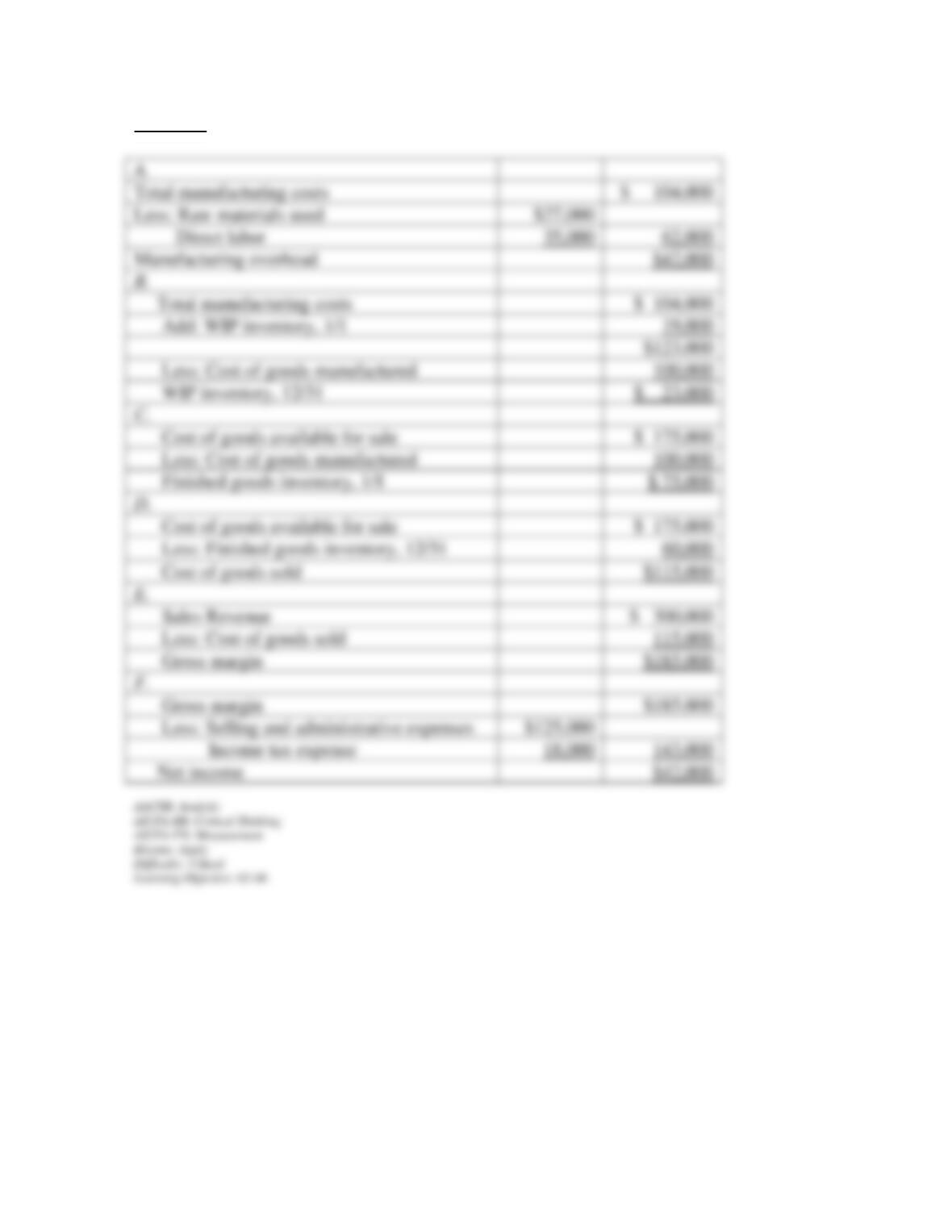
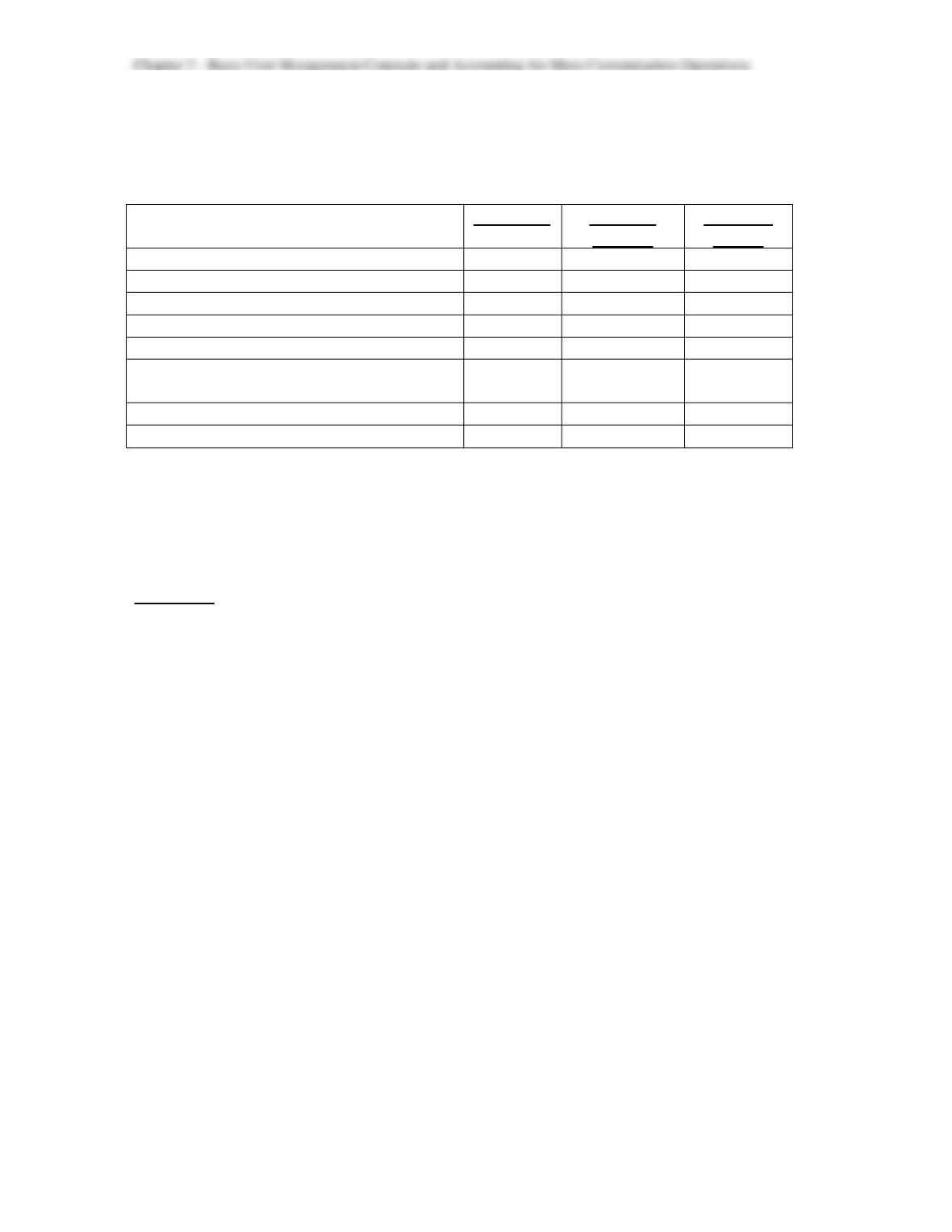
117. The selected amounts that follow were taken from Hawk Corporation’s accounting
records:
Raw materials used
$ 27,000
Direct labor
35,000
Total manufacturing costs
104,000
Work-in-process inventory, Jan. 1
19,000
Cost of Goods Manufactured
100,000
Cost of goods available for sale
175,000
Finished goods inventory, Dec. 31
60,000
Sales revenue
300,000
Selling and administrative expenses
125,000
Income tax expense
18,000
Required:
Compute the following:
A. Manufacturing overhead.
B. Work-in-process inventory, 12/31.
C. Finished-goods inventory, 1/1.
D. Cost of goods sold.
E. Gross margin.
F. Net income.
Net income
$ 406,000
Chapter 2 – Basic Cost Management Concepts and Accounting for Mass Customization Operations
2-61
Solution:
2-62
118. The Enrique Company recorded the following transactions for February 20×1:
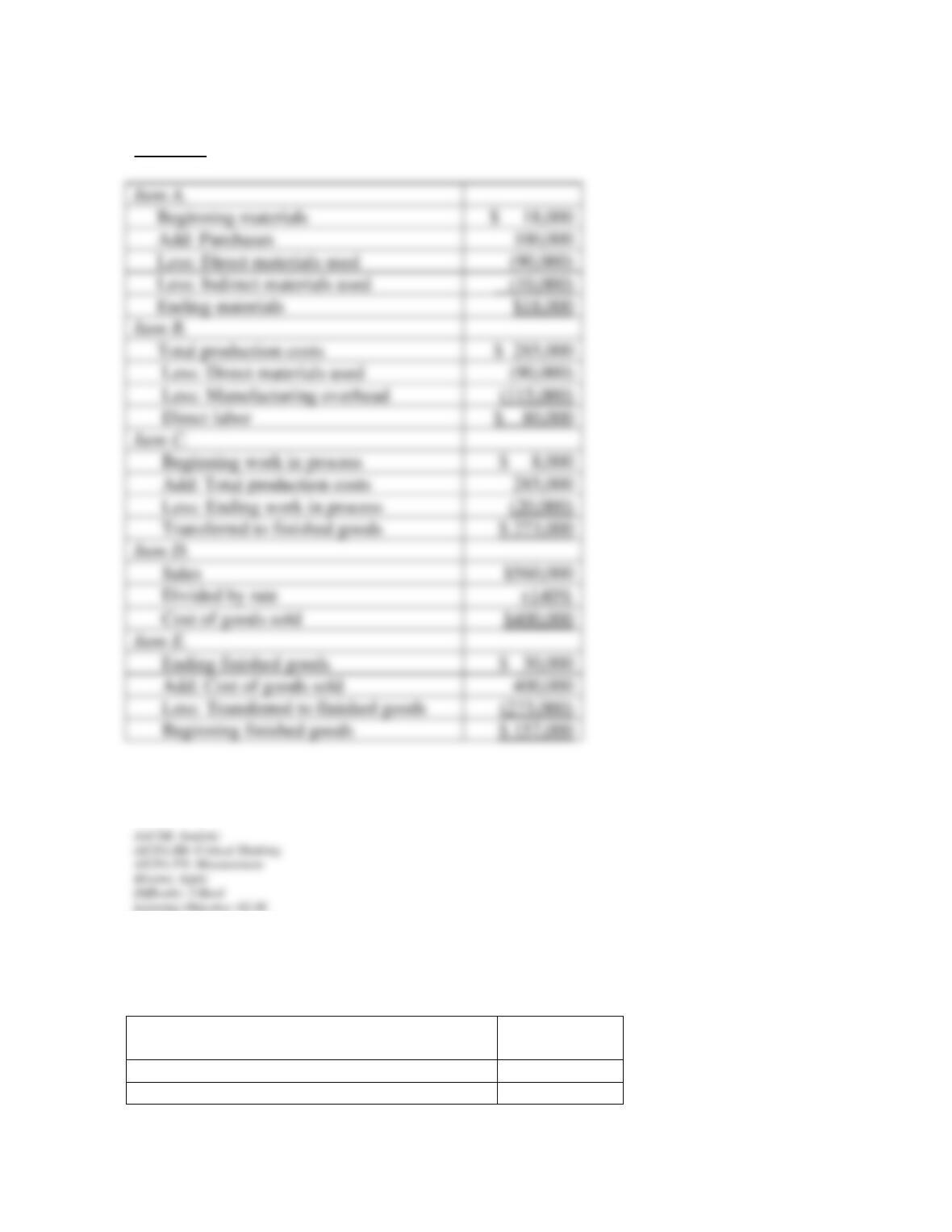
Materials
Work in
Process
Finished
Goods
Purchases
$100,000
Beginning inventory
180,000
$ 8,000
$ E
Ending inventory
A
30,000
30,000
Direct materials used
90,000
Direct labor
B
Manufacturing overhead (includes indirect
materials used of $10,000)
115,000
Transferred to finished goods
C
Cost of goods sold
D
Sales were $560,000, with sales prices determined by adding a 40% markup to the firm’s
manufacturing cost. The total cost of direct materials used, direct labor, and manufacturing
overhead during the month was $285,000.
Note: The materials account includes both direct materials and indirect materials.
Required:
Calculate the missing values.
Chapter 2 – Basic Cost Management Concepts and Accounting for Mass Customization Operations
2-63
Solution:
119. Sylvia Corporation sold 12,500 units of its single product during the year, reporting a
cost of goods sold that totaled $250,000. A review of the company’s accounting records
disclosed the following information:
Cost of goods sold as a percentage of sales
revenue
40%
Finished goods, Jan. 1
$87,000
Work-in-process, Dec. 31
55,000
Beginning materials
Add: Purchases
Less: Direct materials used
Less: Indirect materials used
Ending materials
Total production costs
Less: Direct materials used
Less: Manufacturing overhead
Direct labor
Beginning work in process
Add: Total production costs
Less: Ending work in process
Transferred to finished goods
Sales
Cost of goods sold
Ending finished goods
Add: Cost of goods sold
Less: Transferred to finished goods
Beginning finished goods
Chapter 2 – Basic Cost Management Concepts and Accounting for Mass Customization Operations
2-64
Cost of Goods Manufactured
241,000
Raw materials used
40,000
Direct labor
74,000
Manufacturing overhead
122,000
Selling and administrative expenses
310,000
Sylvia is subject to a 30% income tax rate.
Required:
A. Determine the selling price per unit.
B. Management established a goal at the beginning of the year to reduce the company’s
investment in finished-goods inventory and work-in-process inventory.
1. Analyze cost of goods sold and determine if management’s goal was achieved with respect
to finished-goods inventory. Show computations.
2. Analyze the firm’s manufacturing costs and determine if management’s goal was achieved
with respect to work-in-process inventory. Show computations.
C. Is the company profitable? Show calculations.
Solution:
1.
Cost of goods sold:
Finished goods, Jan. 1
Add: Cost of goods manufactured
Cost of good available for sale
Deduct: Finished goods, Dec. 31
Cost of goods sold
2.
Cost of goods manufactured:
Raw materials used
Direct labor
Manufacturing overhead
Total manufacturing costs
Add: Work in process, Jan. 1
Chapter 2 – Basic Cost Management Concepts and Accounting for Mass Customization Operations
2-65
120. Hernandez Systems began business on January 1 of the current year, producing a single
product that is popular with home builders. Demand was very strong, allowing the company
to sell its entire manufacturing output of 80,000 units. The following unit costs were incurred:
Manufacturing costs:
Direct materials
$15
Direct labor
8
Variable overhead
11
Fixed overhead
6
Selling and administrative
costs:
Variable
5
Fixed
2
Hernandez anticipates an increase in productive output to 100,000 units and sales of 95,000
units in the next accounting period. The company uses appropriate drivers to determine cost
behavior and estimates.
Required:
A. Assuming that present cost behavior patterns continue, compute the total expected costs in
the upcoming accounting period.
Sales Revenue
Less: Cost of Goods sold
Gross Margin
Less: Selling and administrative expenses
Income before taxes
Income tax expense ($65,000 x 30%)
Net income
Yes, the company is profitable.
Chapter 2 – Basic Cost Management Concepts and Accounting for Mass Customization Operations
B. Jan Compton is about to prepare a graph that shows the unit cost behavior for variable
selling and administrative cost. If the graph’s horizontal axis is volume and the vertical axis is
dollars, briefly describe what Compton’s graph should look like.
C. Determine whether the following costs are variable or fixed in terms of behavior:
1. Yearly lease payments for a state-of-the-art cutting machine.
2. A fee paid to a consultant who provided advice about quality issues. The fee was based on
the number of consulting hours provided.
3. Cost of an awards dinner for “star” salespeople.
Solution:
2-67
121. Sebastian Muffler, Inc. operates an automobile service facility. The table below shows
the cost incurred during a month when 500 mufflers were replaced.
Number of Muffler Replacements
400
500
600
Total costs:
Fixed costs
A
$9,000
C
Variable costs
B
6,000
D
Total costs
E
$15,000
F
Cost per muffler replacement:
Fixed cost
G
H
I
Variable cost
J
K
L
Total cost per muffler replacement
M
N
O
Required:
Fill in the missing amounts, labeled A through O, in the table above.
Number of Muffler Replacements
400
500
600
Total costs:
Fixed costs
$9,000
$9,000
Variable costs
4,800
6,000
7,200
Total costs
$15,000
$16,200
Cost per muffler replacement:
Fixed cost
$18.00
$15.00
Variable cost
12.00
12.00
12.00
Total cost per muffler replacement
$30.00
$27.00
2-68
122. In discussing the operation of her automobile, Dr. Lawson once observed that gasoline is
a fixed cost because the cost per gallon is relatively stable. Insurance, on the other hand, is a
variable cost because the cost per mile varies inversely with the number of miles driven.
Comment on the Dr. Lawson’s observation.
Solution:
123. The following terms are used to describe various economic characteristics of costs:
Opportunity cost
Differential cost
Out-of-pocket cost
Marginal cost
Sunk cost
Average cost
Chapter 2 – Basic Cost Management Concepts and Accounting for Mass Customization Operations
2-69
Required:
Choose one of the preceding terms to characterize each of the amounts described below. Each
term may be used only once.
A. The cost of including one extra child in a day-care center.
B. The cost of merchandise inventory purchased five years ago. The goods are now obsolete.
C. The cost of feeding 300 children in a public school cafeteria is $450 per day, or $1.50 per
child per day. What economic term describes this $1.50 cost?
D. The management of a high-rise office building uses 3,000 square feet of space in the
building for its own administrative functions. This space could be rented for $30,000. What
economic term describes this $30,000 of lost rental revenue?
E. The cost of building an automated assembly line in a factory is $700,000; a manually
operated assembly line would cost $250,000. What economic term is used to describe the
$450,000 variation between these two amounts?
F. Refer to the preceding question and assume that the firm is currently building the assembly
line for $700,000. What economic term is used to describe the $700,000 construction cost?
Solution:
124. Describe the economic characteristics of sunk costs and opportunity costs, and explain
the impact that these costs may have on decisions.
Solution: