Chapter 02 – Investing and Financing Decisions and the Balance Sheet
105. For each of the following accounts, indicate whether the account is an asset (A), liability
(L), or stockholders’ equity (SE) and whether the account usually has a debit (Dr) or credit
(Cr) balance.
106. For each of the accounts listed below, indicate whether the typical or normal balance is a
debit or credit.

Chapter 02 – Investing and Financing Decisions and the Balance Sheet
107. The ABC Corporation was formed on January 1, 2010. The three initial owners invested
$100,000 cash and received shares of stock. Below are selected transactions that were
completed during January, 2010.
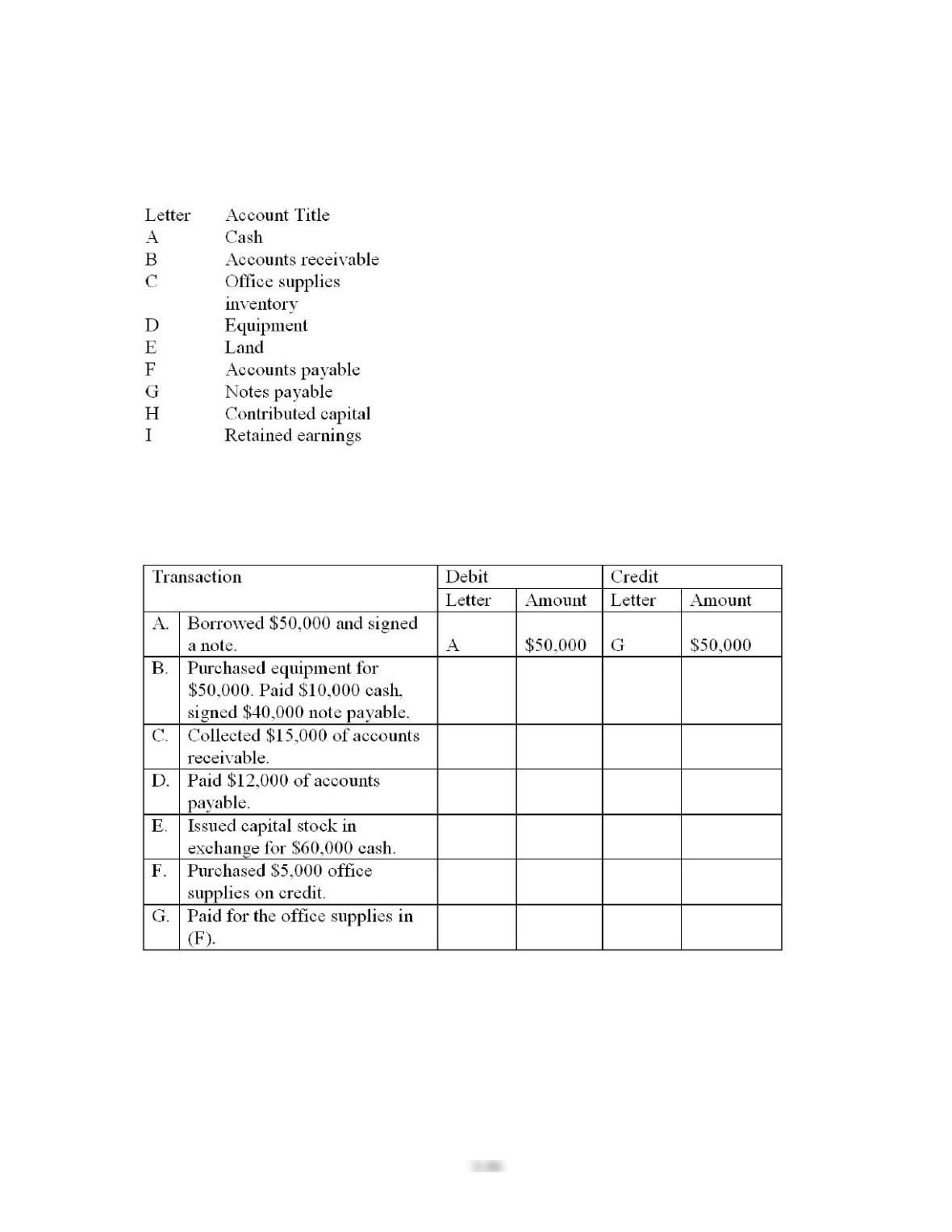
1. Sold stock to the owners.
2. Borrowed $80,000 on a one-year note payable.
3. Purchased land by signing a $70,000 note payable.
4. Paid $10,000 of accounts payable.
5. Purchased two service vehicles for cash at a cost of $24,000 each.
6. Purchased $2,000 of supplies on credit.
Prepare the journal entry on ABC’s books for each transaction.
Chapter 02 – Investing and Financing Decisions and the Balance Sheet
Chapter 02 – Investing and Financing Decisions and the Balance Sheet
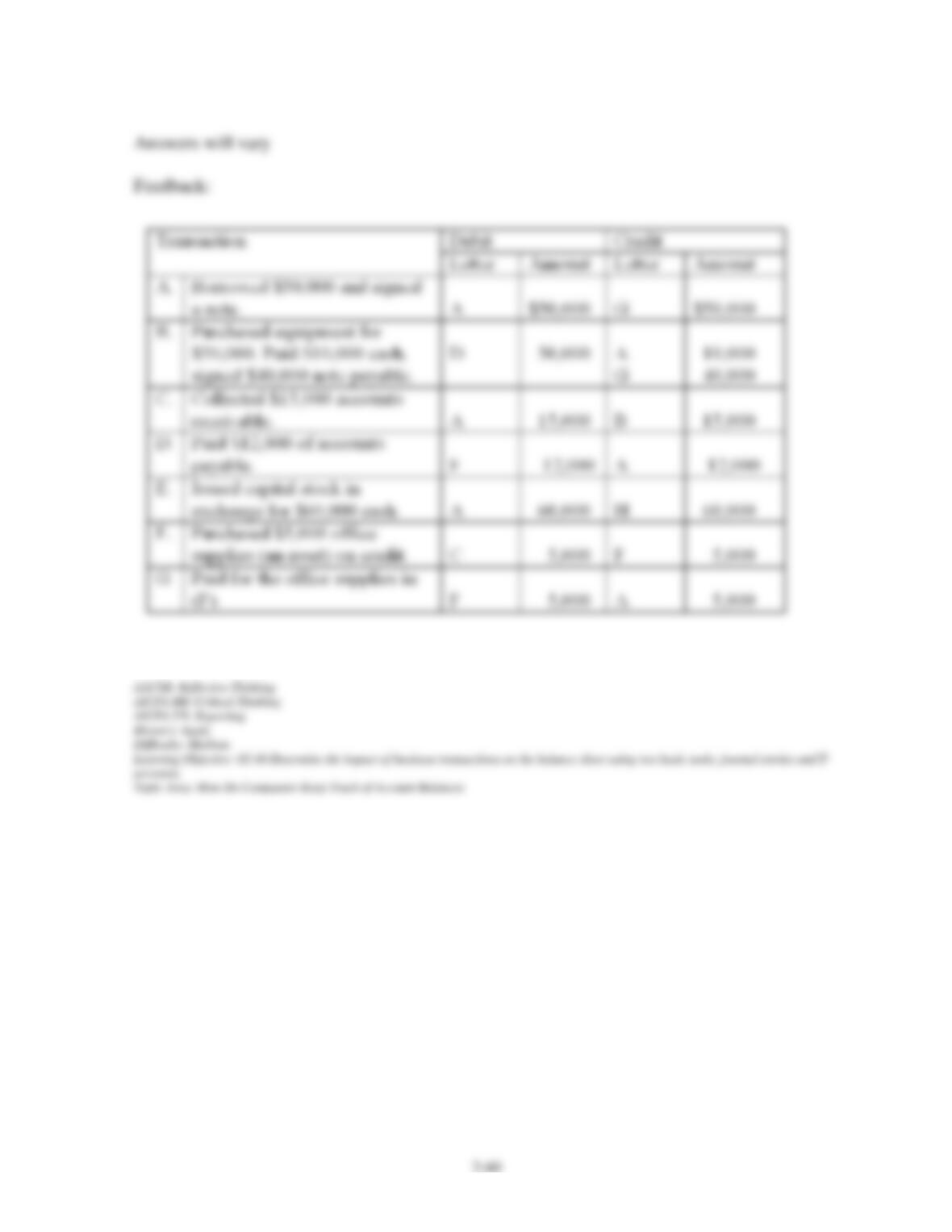
108. The accounts with identification letters for Ward Company are listed below.
During 2010, the company completed the transactions given below. You are to indicate the
appropriate journal entry for each transaction by giving the account letter and amount. Some
entries may need three letters. The first transaction is given as an example.
Chapter 02 – Investing and Financing Decisions and the Balance Sheet
Chapter 02 – Investing and Financing Decisions and the Balance Sheet
109. Describe the general journal and the general ledger.
Chapter 02 – Investing and Financing Decisions and the Balance Sheet
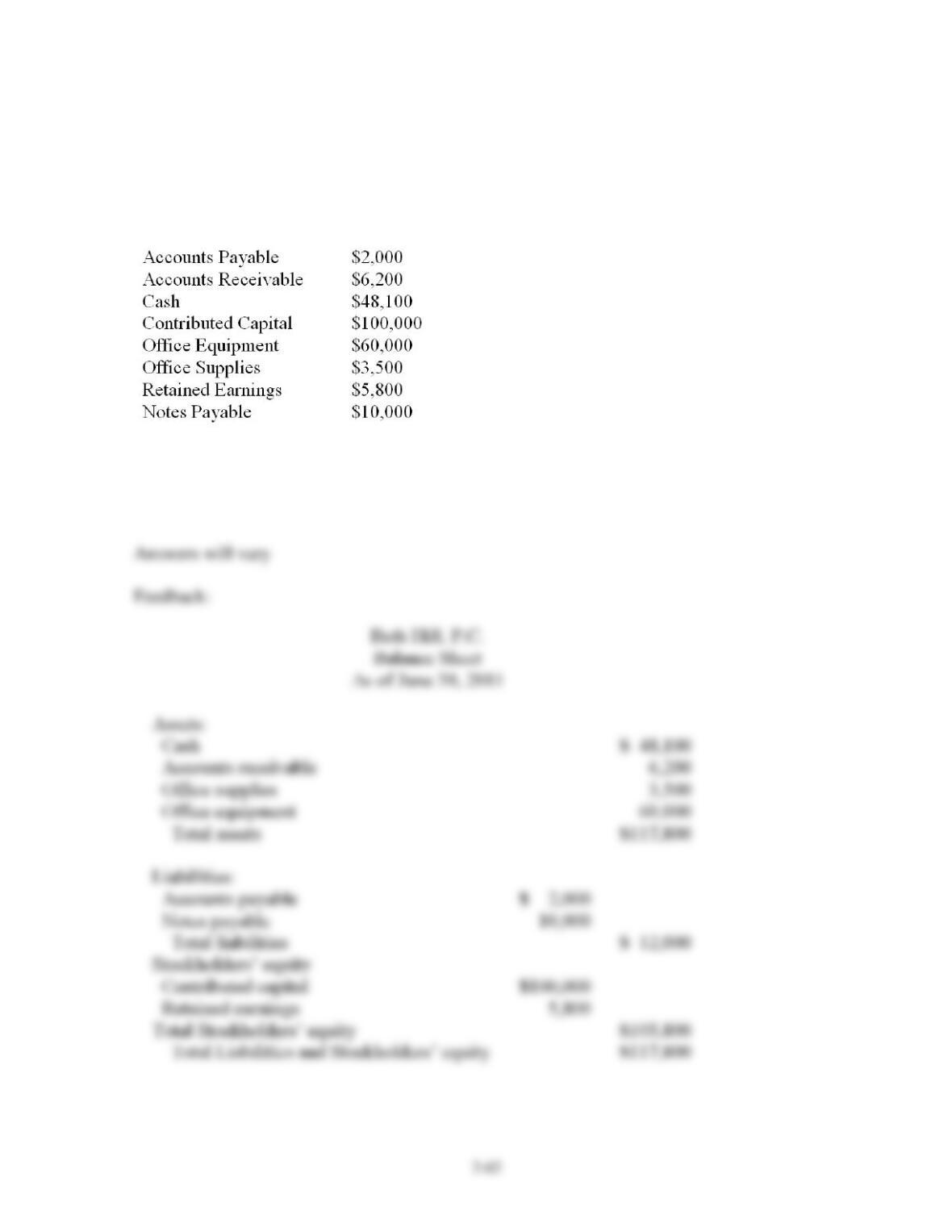
110. On January 1, 2011, Dr. Beth Hill started a new professional corporation, Beth Hill, P.C.,
to practice medicine with an initial investment of $100,000. On June 30, 2011, the accounting
records showed the following amounts:
Requirement:
Prepare a balance sheet as of June 30, 2011.
Chapter 02 – Investing and Financing Decisions and the Balance Sheet
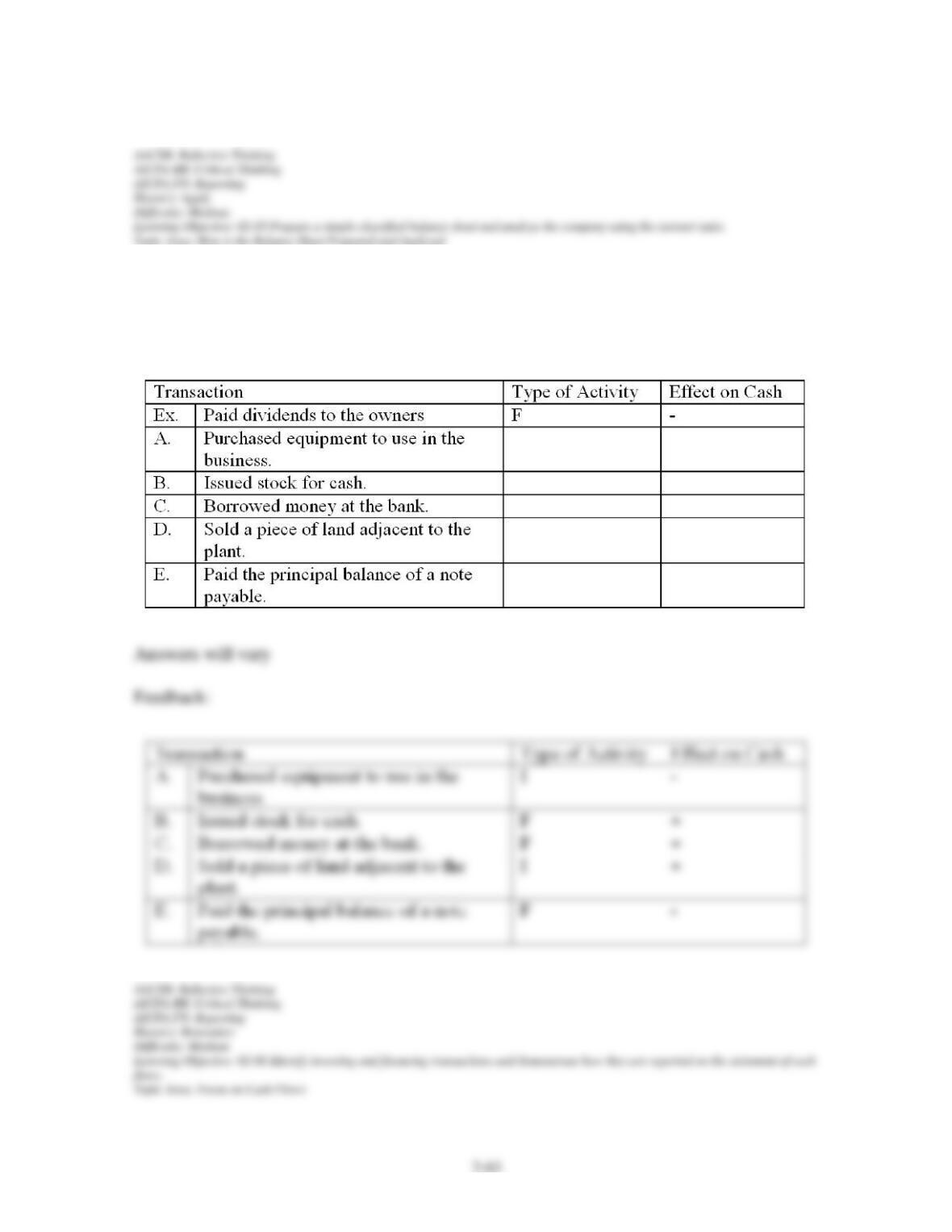
111. For each of the transactions listed below, indicate whether it is an investing (I) or
financing (F) activity on the statement of cash flows. Also, indicate if the transaction
increases (+) or decreases (-) cash.
Chapter 02 – Investing and Financing Decisions and the Balance Sheet
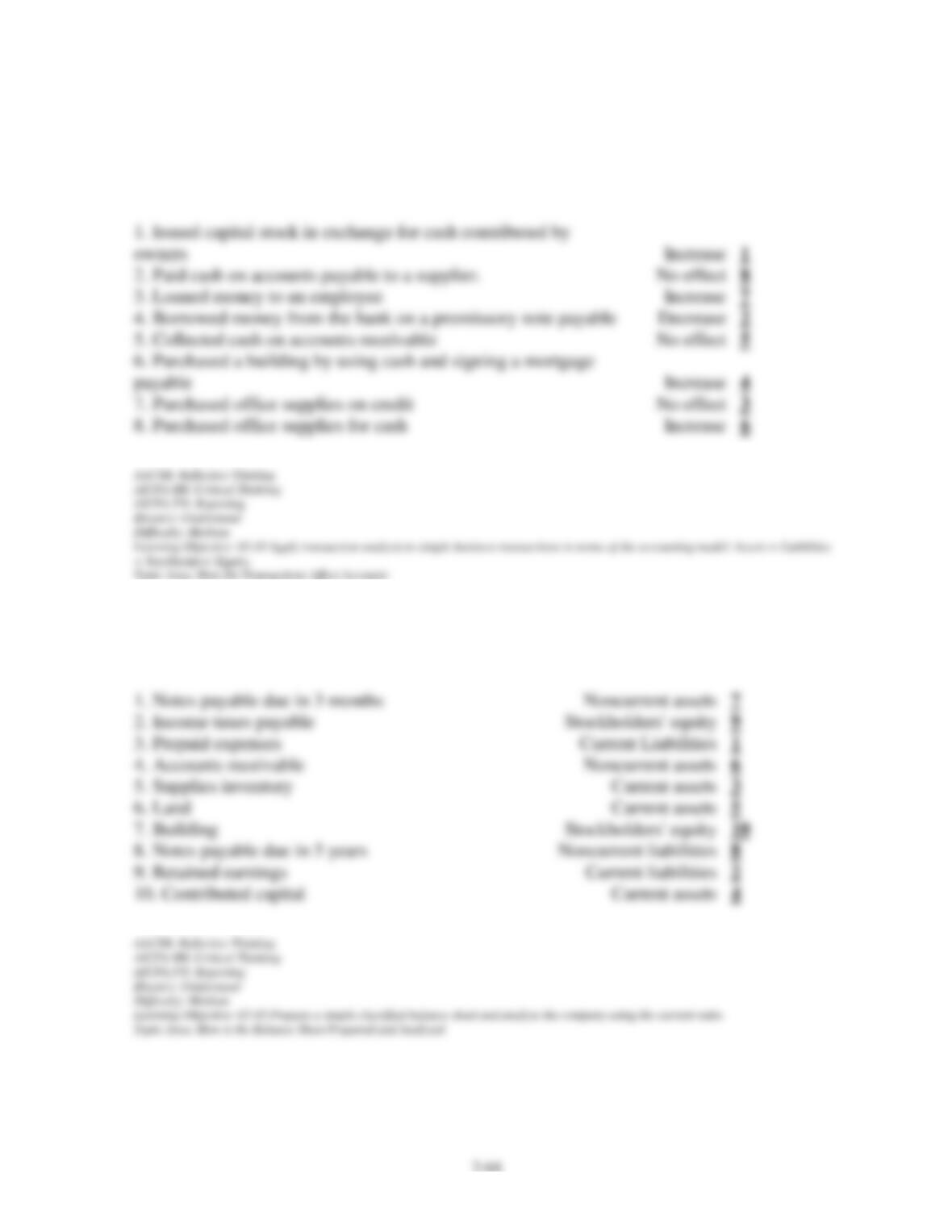
112. The Alex Company, a consulting firm, recorded the following selected business
transactions during May, 2011. Indicate whether each transaction would increase, decrease, or
have no effect on the total assets of the company.
113. Classify the following balance sheet accounts by as current assets, noncurrent assets,
current liabilities, noncurrent liabilities or stockholders’ equity
Chapter 02 – Investing and Financing Decisions and the Balance Sheet
2-65
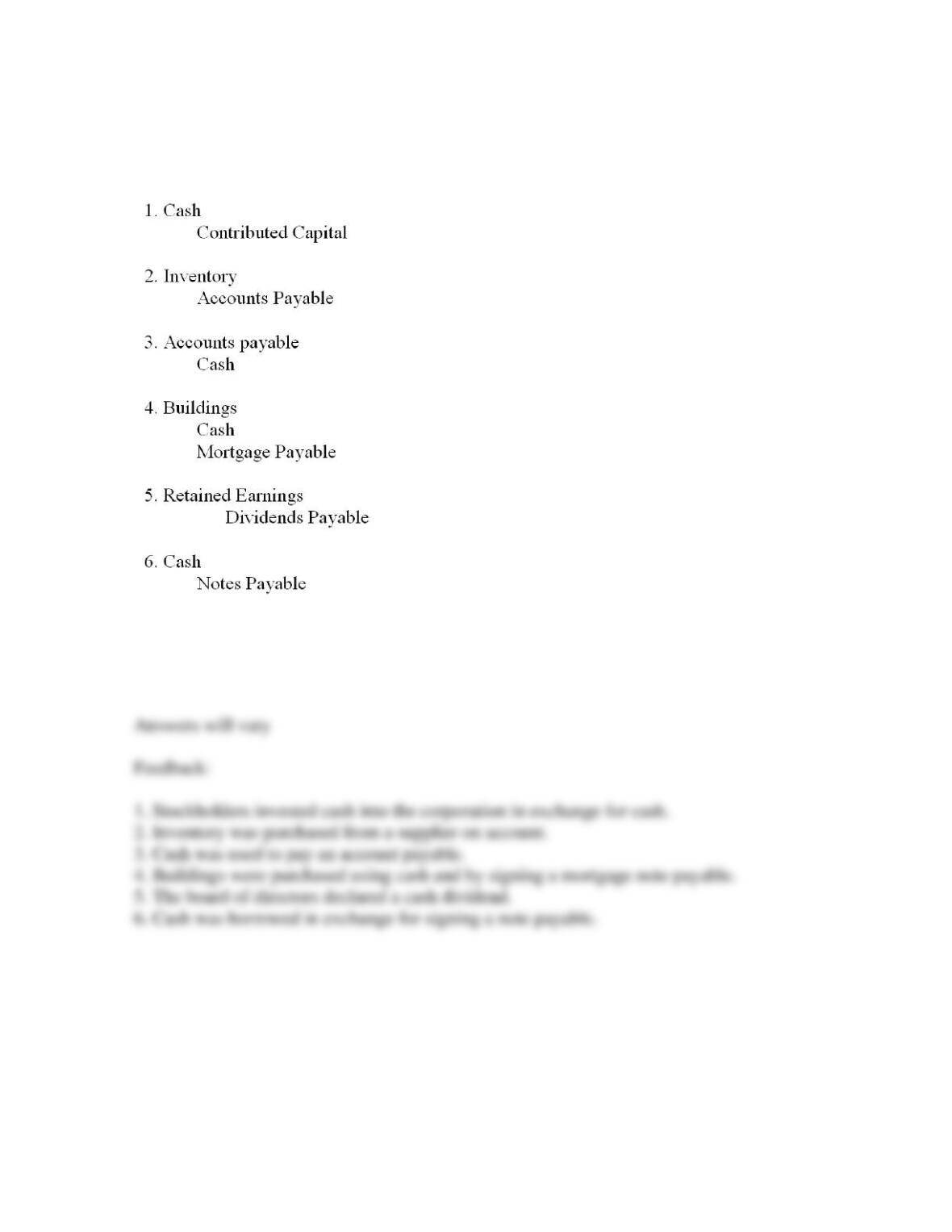
114. The following journal entries with the amounts omitted were taken from the records of
Lena Company:
Requirement:
Write a brief explanation for each of the above transactions.
Chapter 02 – Investing and Financing Decisions and the Balance Sheet
115. What is the primary objective of financial reporting?
116. How is the current ratio calculated and what does it measure?
Chapter 02 – Investing and Financing Decisions and the Balance Sheet
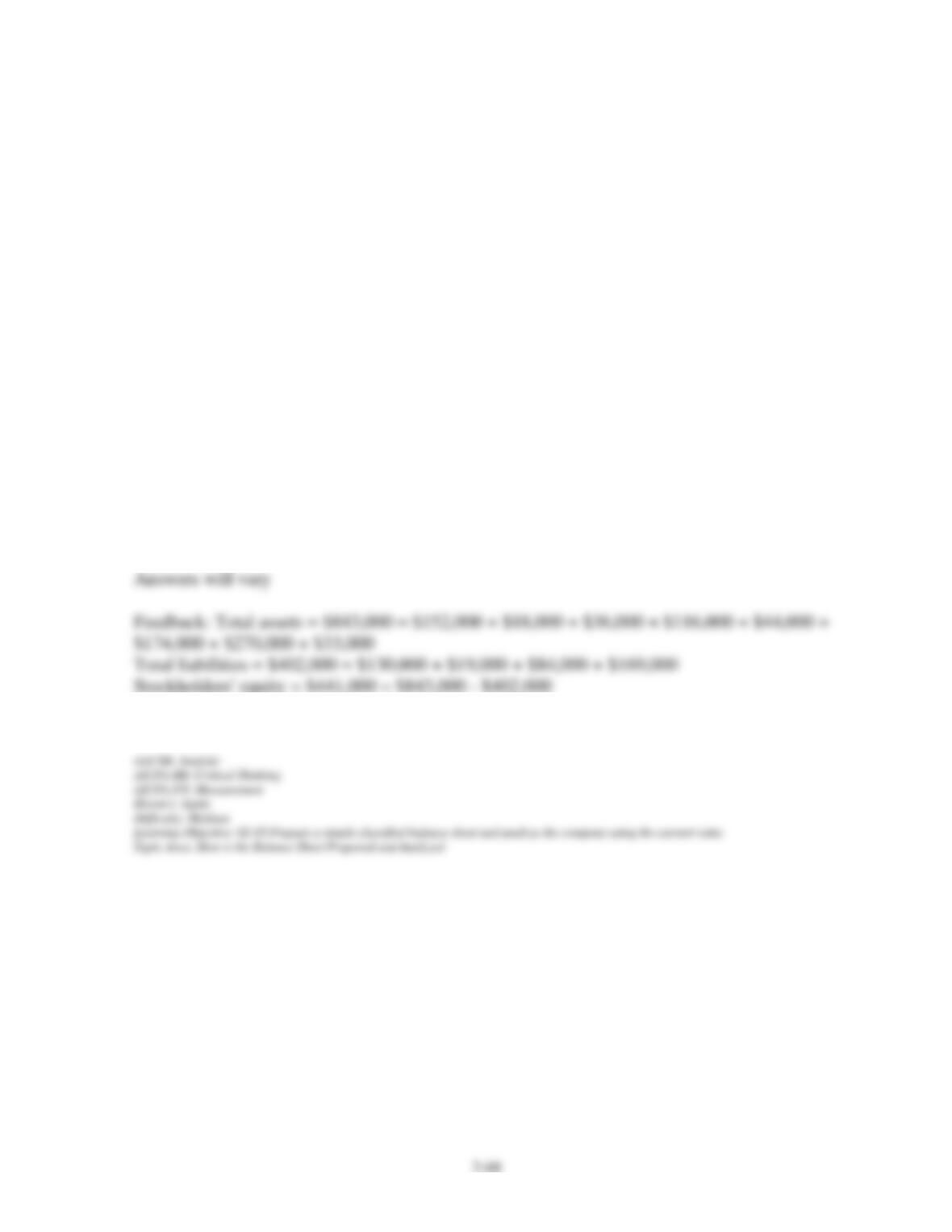
117. The Lake Company has provided the following account balances:
Cash $76,000;
Short-term investments $8,000;
Accounts receivable $12,000;
Inventory $96,000;
Long-term notes receivable $4,000;
Equipment $192,000;
Factory Building $360,000;
Intangible assets $12,000;
Accounts payable $90,000;
Accrued liabilities payable $12,000;
Short-term notes payable $42,000;
Long-term notes payable $184,000.
Requirement:
What is Lake’s current ratio?
Chapter 02 – Investing and Financing Decisions and the Balance Sheet
118. The Superior Company has provided the following account balances:
Cash $152,000;
Short-term investments $18,000;
Accounts receivable $36,000;
Inventory $116,000;
Long-term notes receivable $44,000;
Equipment $174,000;
Factory Building $270,000;
Intangible assets $33,000;
Accounts payable $130,000;
Accrued liabilities payable $19,000;
Short-term notes payable $84,000;
Long-term notes payable $169,000.
Requirement:
What is Superior’s stockholders’ equity?
Chapter 02 – Investing and Financing Decisions and the Balance Sheet
119. The Smith Corporation has provided the following information:
Cash dividend payments were $25,000.
Long-term investments were sold for $79,000 cash.
A building costing $198,000 was purchased using $19,800 cash, the balance was financed
with a mortgage note payable.
Stock was issued to stockholders in exchange for $110,000 cash.
A $44,000 loan was made to a local inventory supplier; the loan will be repaid in twelve
months.
Equipment used in operations was sold for $37,000.
Shares of Smith Corporation stock were acquired from stockholders for $92,000 cash.
Cash received from bank loans totaled $71,000.
Land costing $57,000 was purchased in exchange for a long-term note payable.
Requirement:
Determine Smith’s investing activities and financing activities cash flows to be reported on
the cash flow statement.
Chapter 02 – Investing and Financing Decisions and the Balance Sheet
120. Describe both the investing activities and financing activities section of the cash flow
statement. Provide some examples of each activity.