Chapter 2 – Basic Cost Management Concepts and Accounting for Mass Customization Operations
91. Which of the following would not be characterized as a cost object?
92. Costs that can be easily traced to a specific department are called:
93. Which of the following would not be considered a direct cost with respect to the service
department of a new car dealership?
94. Indirect costs:
95. Which two terms below best describe the wages paid to security guards that monitor a
factory 24 hours a day?
96. Which one of the following costs would not be considered an indirect cost of serving a
customer at a fast food restaurant?
97. The salary that is sacrificed by a college student who pursues a degree full time is a(n):
98. The tuition that will be paid next semester by a college student who pursues a degree is
a(n):
99. Which of the following costs should be ignored when choosing among alternatives?
100. If the total cost of alternative A is $50,000 and the total cost of alternative B is $34,000,
then $16,000 is termed the:
Use the following information to answer Questions 101 and 102.
Play Time is a nursery school for pre-kindergarten children. The school has determined that
the following biweekly revenues and costs occur at different levels of enrollment:
Number of Students
Enrolled
Total Revenue
Total Costs
10
$3,000
$2,100
15
4,500
2,700
16
4,800
2,800
20
6,000
3,200
21
6,300
3,255
101. The marginal cost when the twenty-first student enrolls in the school is:
102. The average cost per student when 16 students enroll in the school is:
103. The costs that follow all have applicability for a manufacturing enterprise. Which of the
choices listed correctly denotes the costs’ applicability for a service provider?
Period Cost
Uncontrollable Cost
Opportunity
Cost
104. Travon and Tony (T & T) Enterprises has a single facility that it uses for manufacturing,
sales, and administrative activities. Should the company’s building depreciation charge be
expensed in its entirety or is a different accounting procedure appropriate? Explain.
Solution:
105. Manufacturers have established a cost classification called product costs. Define the term
“product cost” and note where these costs appear in the financial statements. Be specific.
Solution:
106. Consider the three firms that follow: (1) a regional airline, (2) an automobile
manufacturer, and (3) a discount retail store. These firms, examples of service providers,
manufacturers, and merchandisers, tend to have different characteristics with respect to costs
and financial-statement disclosures.
Required:
Determine which of the preceding firms (1, 2, and/or 3) would likely:
A. Disclose operating expenses on the income statement.
B. Have product costs.
C. Have period costs.
D. Disclose cost of goods sold on the income statement.
E. Have no meaningful investment in inventory.
F. Maintain raw-material, work-in-process, and finished-goods inventories.
G. Have variable and fixed costs.
Solution:
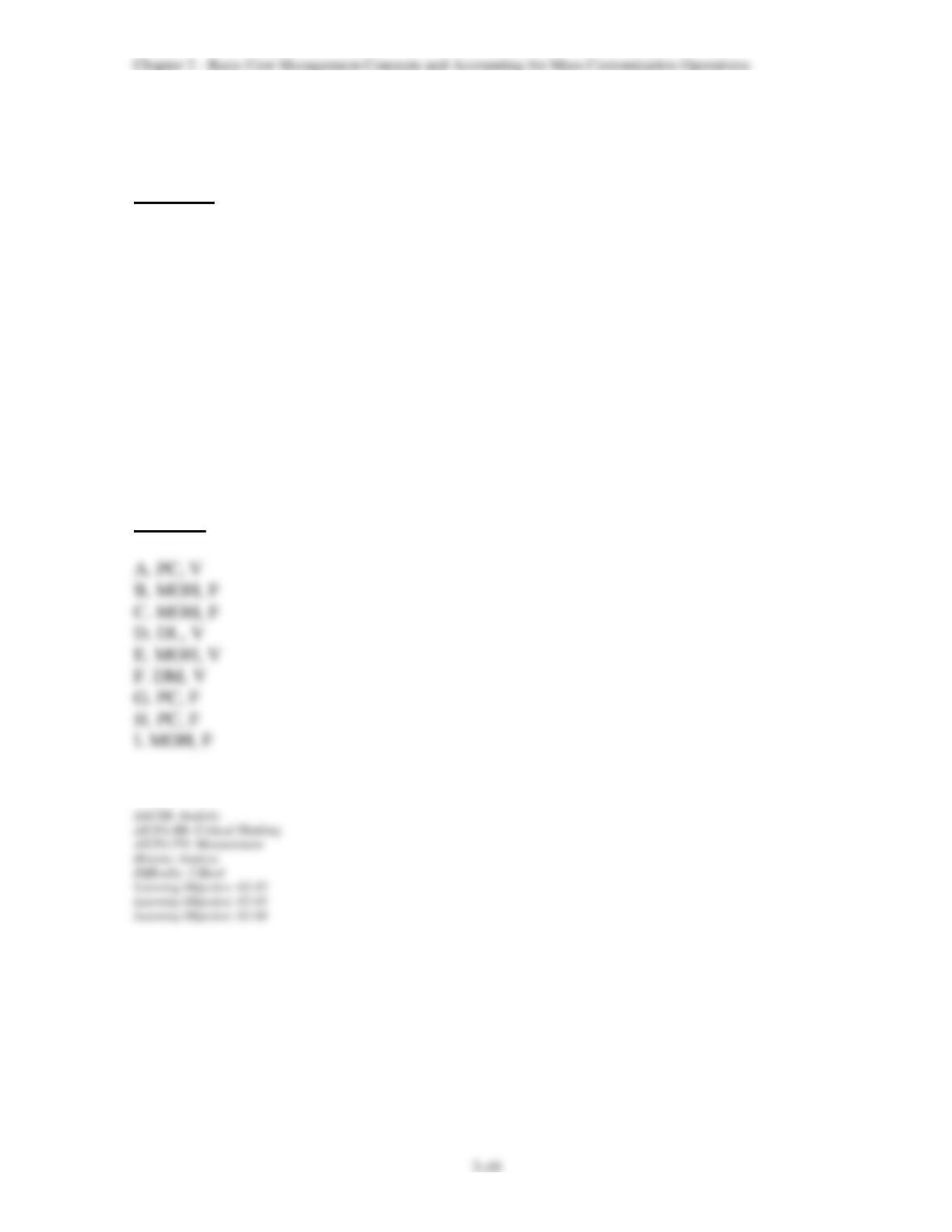
107. Colton Manufacturing produces small electric engines.
Required:
Identify the following costs as direct materials (DM), direct labor (DL), manufacturing
overhead (MOH), or a period cost (PC). Also indicate whether the cost is variable (V) or fixed
(F) with respect to behavior.
A. Commissions paid to salespeople
B. Straight-line depreciation on the factory building
C. Salary of the plant supervisor
D. Wages of the assembly-line workers
E. Machine lubricant used in production activities
F. Engine casings used in production activities
G. Advertising placed in trade journals
H. Lease payments for the president’s automobile
I. Property taxes paid on the factory facilities
Solution:
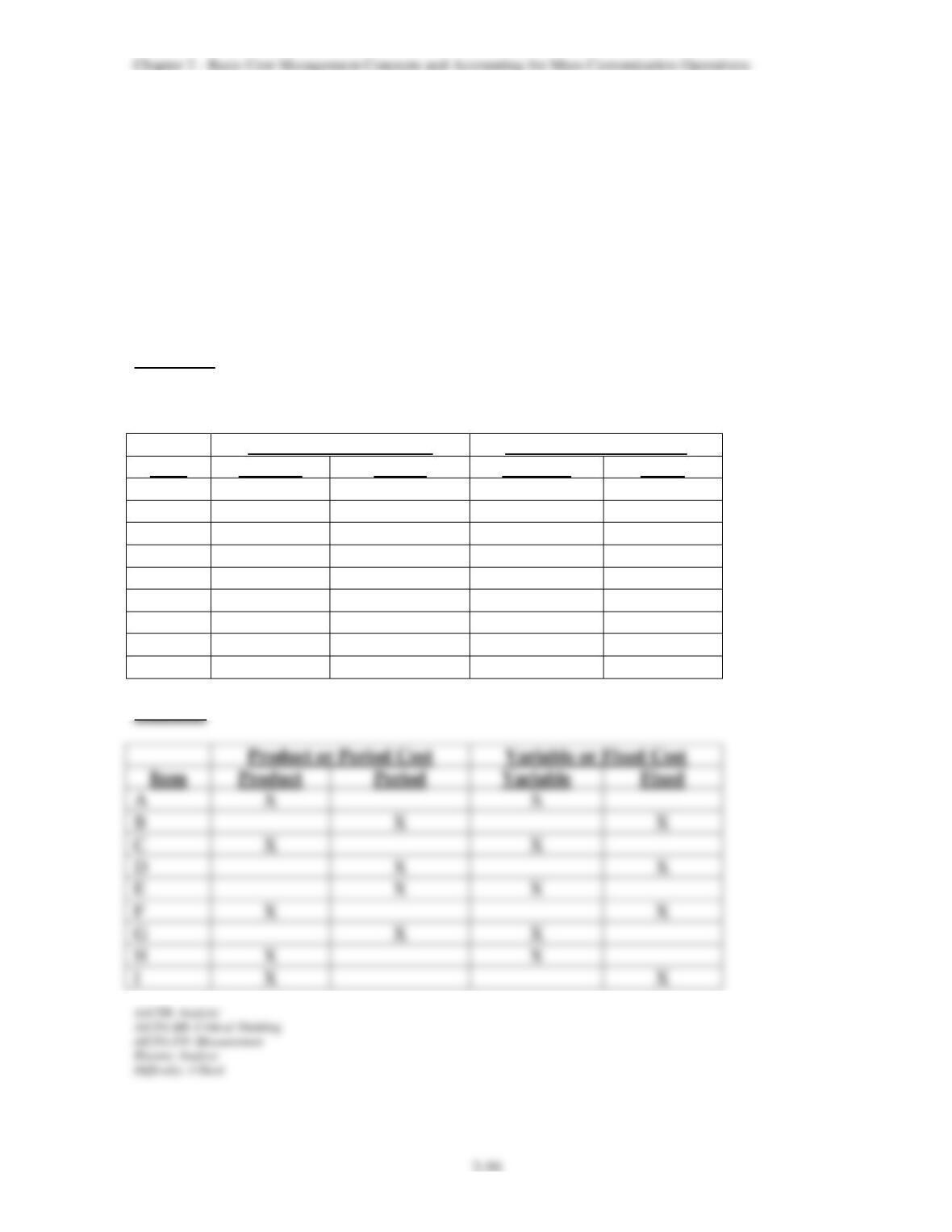
108. Consider the following items:
A. Tomatoes used in the manufacture of ketchup
B. Administrative salaries of executives employed by a regional airline
C. Wages of assembly-line workers at an automobile manufacturing plant
D. Marketing expenditures of the major league baseball club
E. Commissions paid to the salespeople working for a soft drink company
F. Straight-line depreciation on manufacturing equipment owned by a computer manufacturer
G. Shipping charges incurred by office supplies retailer on out-going orders
H. Speakers used in a consumer electronics company’s home-theater systems
I. Insurance costs related to a cosmetics manufacturing plant
Required:
Complete the table that follows and classify each of the costs listed as (1) a product or period
cost and (2) a variable or fixed cost by placing an “X” in the appropriate column.
Product or Period Cost
Variable or Fixed Cost
Item
Product
Period
Variable
Fixed
A
B
C
D
E
F
G
H
I
Solution:
Product or Period Cost
Variable or Fixed Cost
Item
Product
Period
Variable
Fixed
A
B
C
D
E
F
G
H
I
2-51
109. The following selected costs were extracted from the accounting records of Louisiana
Machining (LAM):
1. Direct materials used in production
2. Wages of machine operators
3. Factory utilities
4. Sales commissions
5. Salary of LAM’s president
6. Factory depreciation
7. Wages of plant security guards
8. Uncollectible accounts expense
9. Machine lubricant used in production
A. 1, 2, 3, 6, 7, 9
B. 3, 6, 7, 9
C. 4, 5, 8
D. 2, 3, 6, 7, 9
E. 8
F. 1, 2, 3, 6, 7, 9
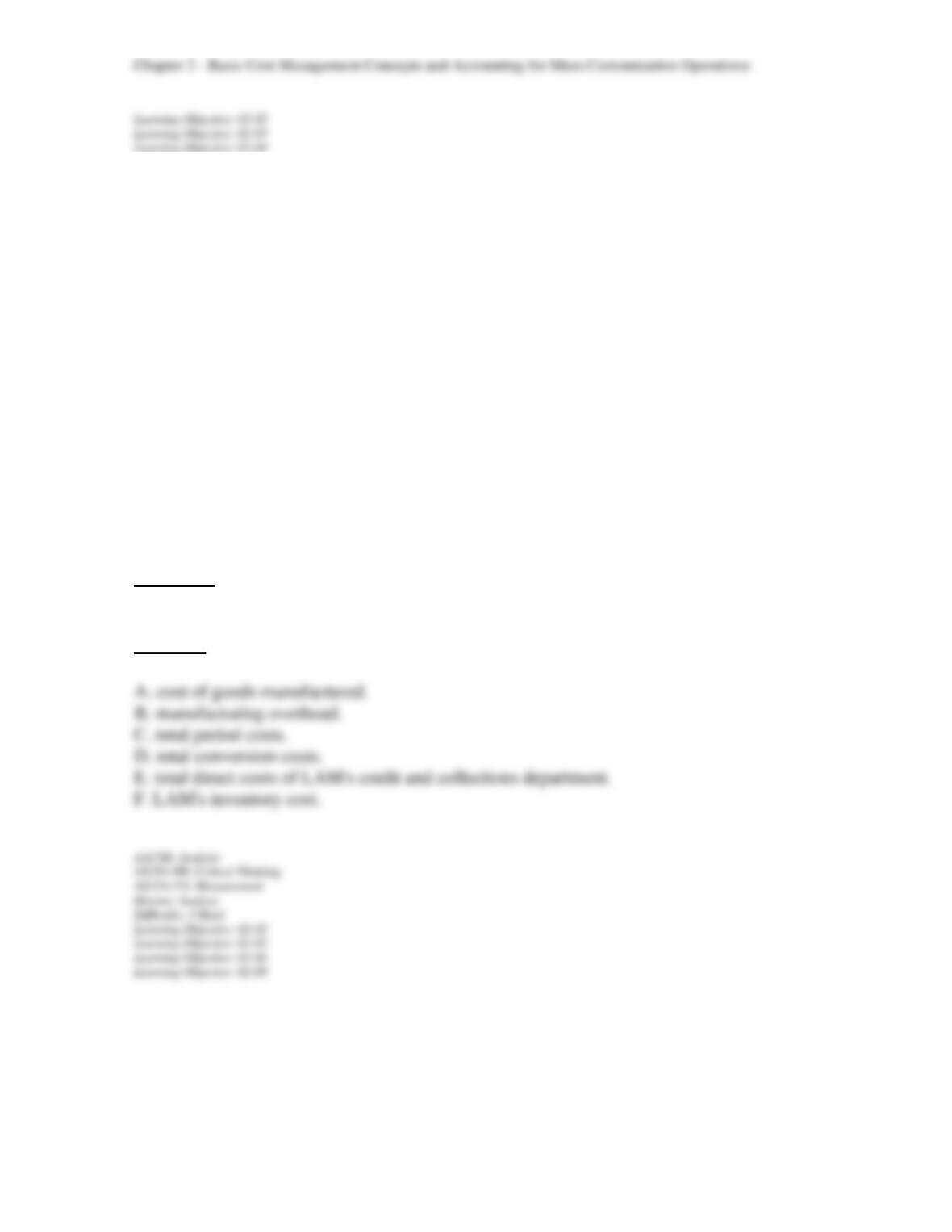
Required:
By the use of numbers, identify the costs that would be used to calculate:
Solution:
2-52
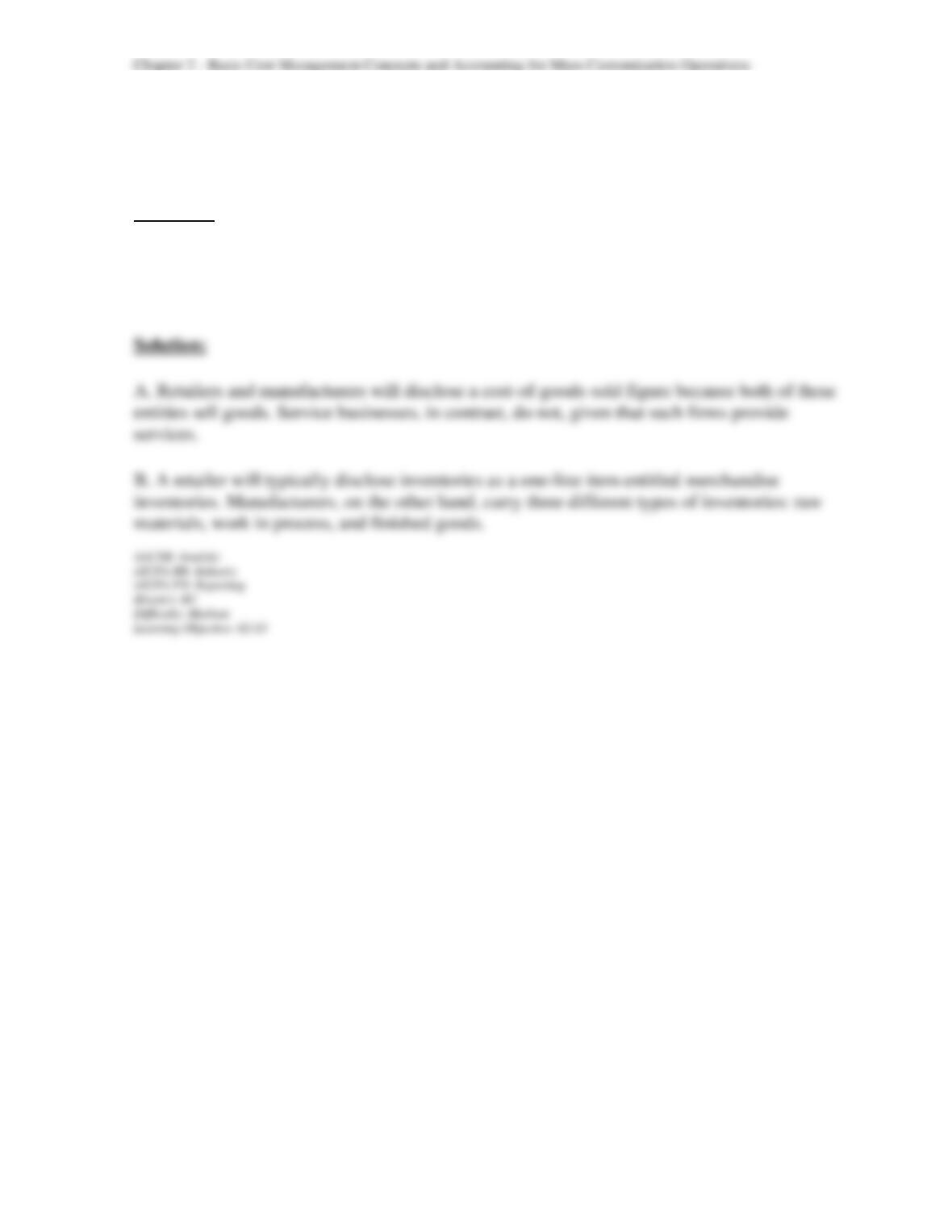
110. The income statements and balance sheets of service, retailing, and manufacturing
businesses tend to differ.
Required:
A. Which of these businesses will disclose a cost-of-goods-sold figure on the income
statement? Why?
B. Briefly describe the difference between a retailing firm and a manufacturer’s disclosure of
inventories on the balance sheet.
2-53
111. Consider the following cost items:
1. Sales commissions earned by a company’s sales force.
2. Raw materials purchased during the period.
3. Current year’s depreciation on a firm’s manufacturing facilities.
4. Year-end completed production of a carpet manufacturer.
5. The cost of products sold to customers of an apparel store.
6. Wages earned by machine operators in a manufacturing plant.
7. Income taxes incurred by an airline.
8. Marketing costs of an electronics manufacturer.
9. Indirect labor costs incurred by a manufacturer of office equipment.
Required:
A. Evaluate the costs just cited and determine whether the associated dollar amounts would
appear on the firm’s balance sheet, income statement, or schedule of cost of goods
manufactured.
B. What major asset will normally be insignificant for service enterprises and relatively
substantial for retailers, wholesalers, and manufacturers? Briefly discuss.
C. Briefly explain the similarity and difference between the merchandise inventory of a
retailer and the finished-goods inventory of a manufacturer.
2-54
112. Briefly define and discuss the terms in each of the pairs that follow.
A. Direct and indirect costs
B. Direct materials and indirect materials
C. Manufacturing overhead and direct labor
2-55
113. The following selected information was extracted from the 20×3 accounting records of
Farrina Products:
Raw materials used
$284,000
Direct labor
178,000
Indirect labor
35,000
Selling and administrative salaries
250,000
Building depreciation*
330,000
Other selling and administrative expenses
80,000
Other factory costs
620,000
*Seventy percent of the company’s building was devoted to production activities; the
remaining 30% was used for selling and administrative functions.
Farrina’s beginning and ending work-in-process inventories amounted to $306,000 and
$245,000, respectively. The company’s beginning and ending finished-goods inventories were
$450,000 and $440,000, respectively.
Required:
A. Calculate Farrina’s manufacturing overhead for the year.
B. Calculate Farrina’s cost of goods manufactured.
C. Compute Farrina’s cost of goods sold.