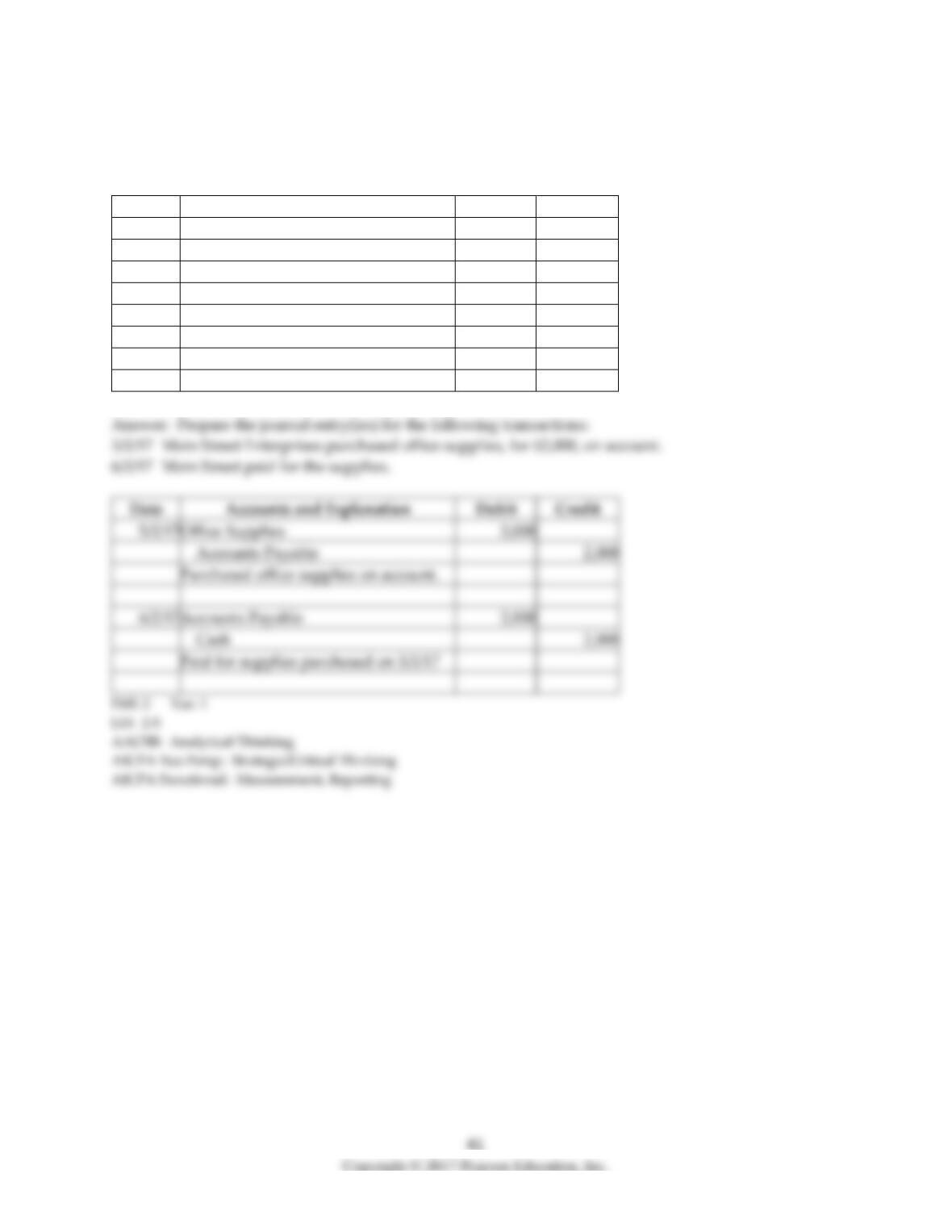
50) Prepare the journal entry(ies) for the following transactions:
5/2/17 Main Street Enterprises purchased office supplies, for $2,000, on account.
6/2/17 Main Street paid for the supplies.
Date
Accounts and Explanation
Debit
Credit
Office Supplies
Purchased office supplies on account.
Accounts Payable
Paid for supplies purchased on 5/2/17
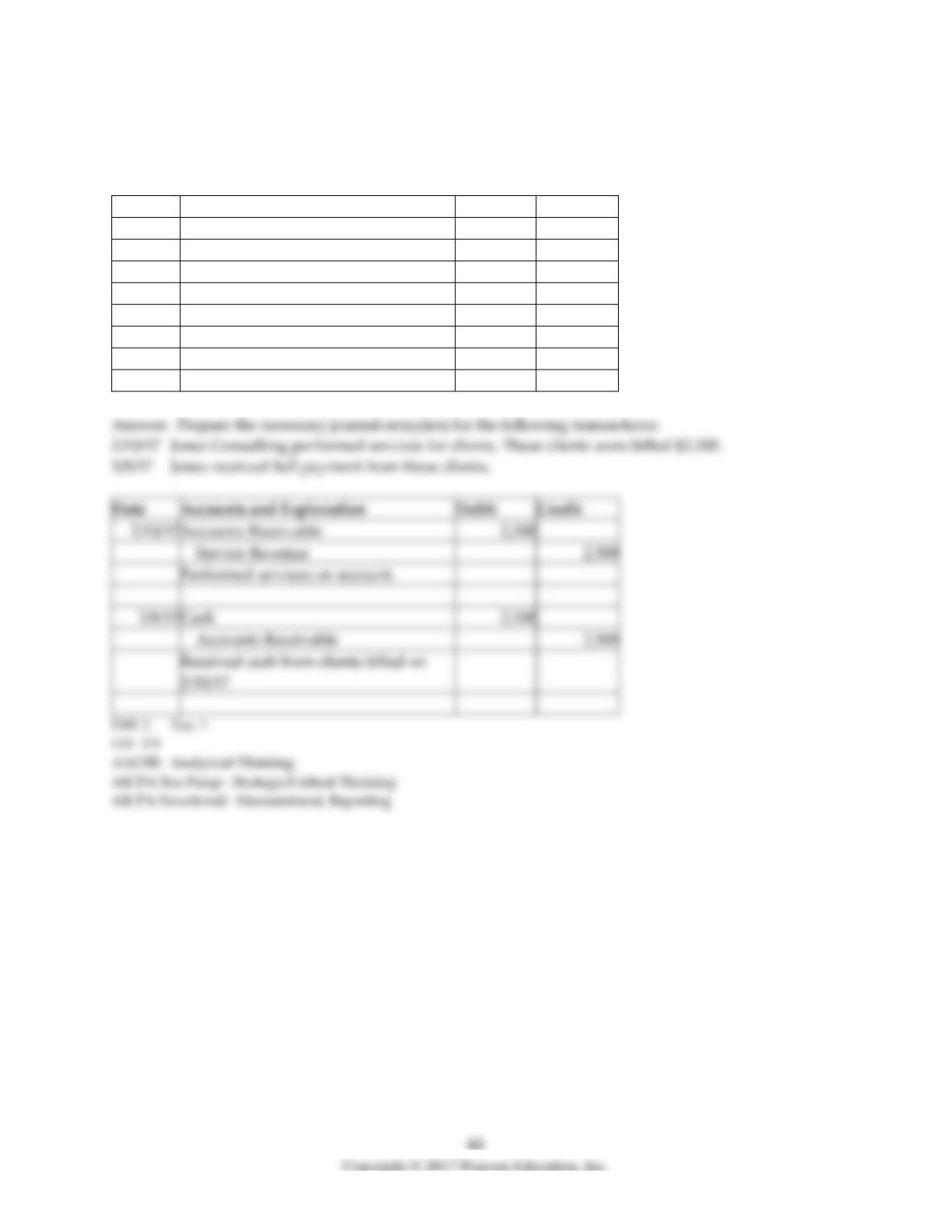
51) Prepare the necessary journal entry(ies) for the following transactions:
2/10/17 Jones Consulting performed services for clients. These clients were billed $2,500.
3/8/17 Jones received full payment from these clients.
Date
Accounts and Explanation
Debit
Credit
Date
Accounts and Explanation
Debit
Credit
Accounts Receivable
Performed services on account.
Cash
2/10/17
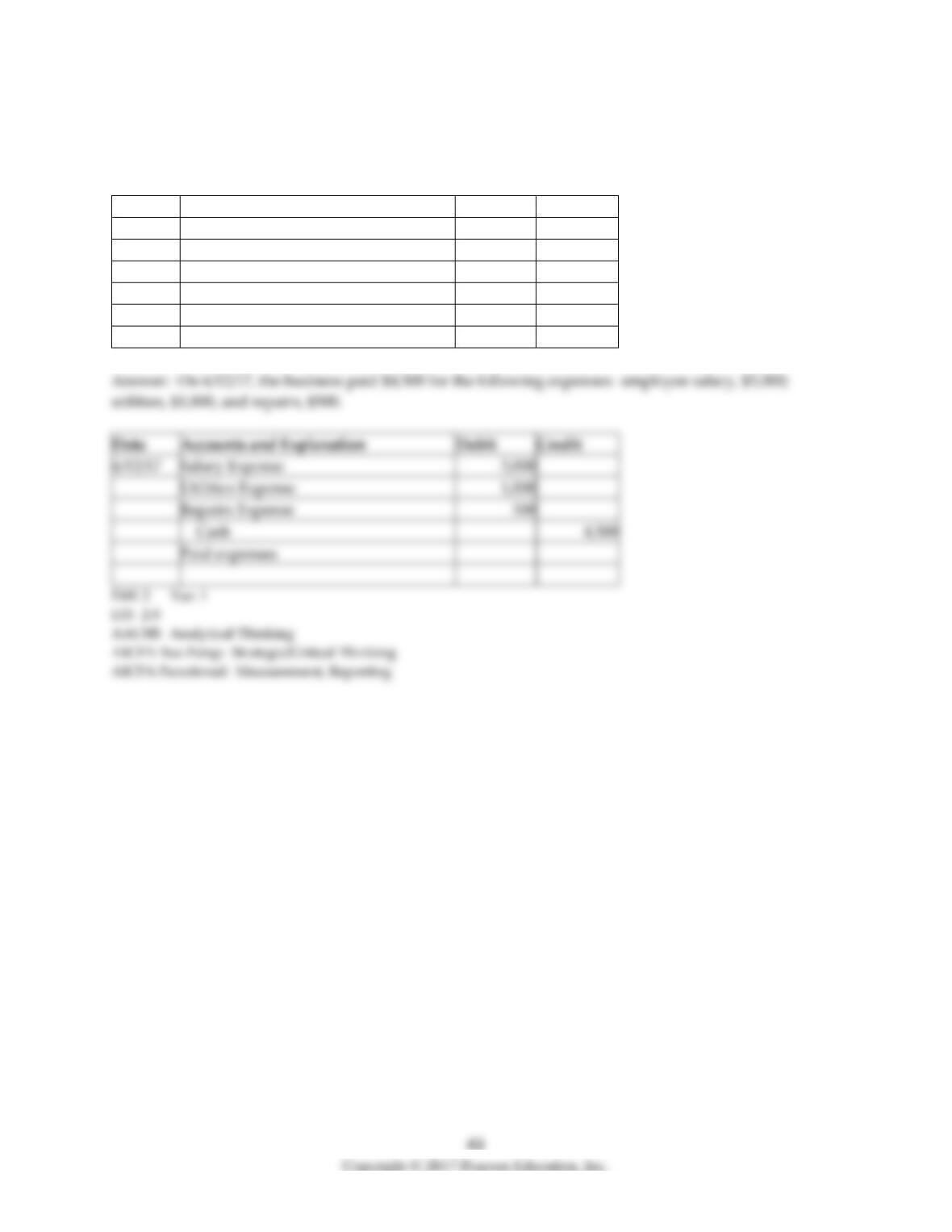
52) Prepare the journal entry for the following transaction:
On 6/12/17, the business paid $4,500 for the following expenses: employee salary, $3,000; utilities,
$1,000, and repairs, $500.
Date
Accounts and Explanation
Debit
Credit
6/12/17
Salary Expense
Utilities Expense
Repairs Expense
Paid expenses

44
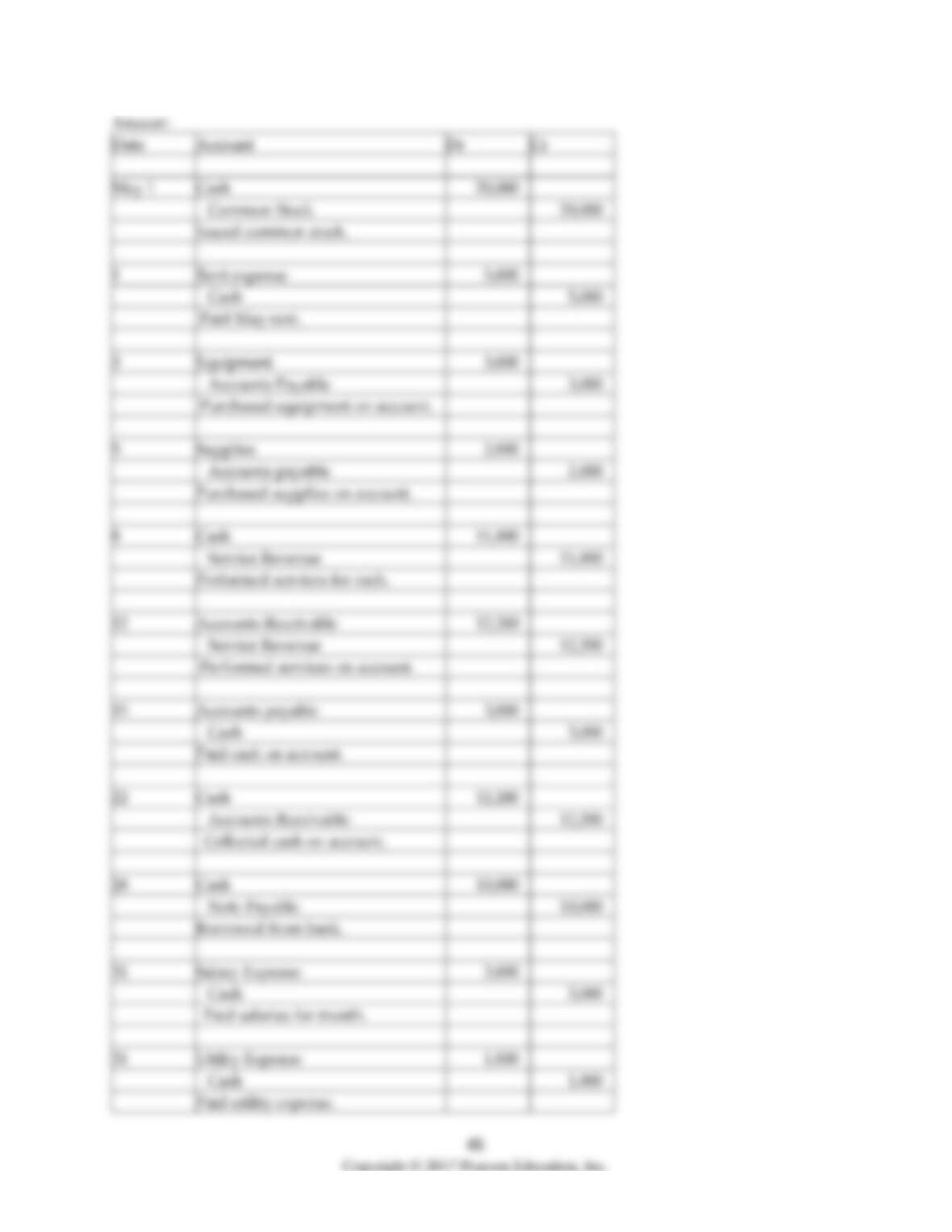
53) Latinovich Legal Services had the following transactions during its first month of operations:
May 1 Latinovich Legal Services received $20,000 cash and issued common stock to the stockholders.
May 1 Paid the May rent, $5,000.
May 3 Purchased equipment on account for $3,000.
May 5 Purchased supplies for $2,000 on account.
May 8 Performed services for a client and received cash of $11,800.
May 12 Performed services for a client and billed the client $12,200. The client promised to pay within
10 days.
May 15 Paid for the equipment purchased May 3 on account.
May 22 Received payment from a client on account, $12,200.
May 28 Borrowed $10,000, by signing a promissory note, from First National Bank for use in the
business.
May 31 Employees were paid $3,000 for working during the current month.
May 31 Received and paid the utility bill of $1,800.
Required: Record the transactions of the business in a journal. Include an explanation for each entry.
6 Learning Objective 2-6
1) Accounts are listed in random order in a trial balance.
2) A trial balance is a required financial statement.
3) Although a trial balance can be prepared at any time, the most common time is at the end of the
accounting period.
4) The trial balance summarizes all the account balances for the financial statements and shows whether
total debits equal total credits.
5) The trial balance for James Corporation shows that the total debits equal the total credits. This
indicates that all of the accounts are free from errors.
6) When a trial balance is out of balance due to a transposition error, the difference between total debits
and total credits will be evenly divisible by 2.
7) When a trial balance is out of balance due to a slide–type error, the difference between total debits
and total credits will be evenly divisible by 9.
8) A bookkeeper posted the same journal entry twice. This will cause the trial balance to be out of
balance.
9) The financial statements can be prepared from the trial balance.
10) An account with a normal debit balance is most often an asset or revenue account.
11) The normal balance of an expense account is a ________ because expenses decrease ________.
A) debit; assets
B) debit; expenses
C) debit; retained earnings
D) credit; retained earnings
12) The normal balance of an account:
A) falls on the side where decreases are recorded.
B) falls on the side where increases are recorded.
C) must be computed after every transaction.
D) cannot be computed in a manual accounting system.
13) The normal balance of a revenue account is a ________ because revenues increase ________.
A) credit; assets
B) debit; expenses
C) debit; retained earnings
D) credit; retained earnings
14) When computing the normal balance of an account:
A) salaries expense should have a credit balance.
B) accounts payable should have a credit balance.
C) equipment should have a credit balance.
D) notes payable should have a debit balance.
15) Which error will be uncovered by a trial balance?
A) The bookkeeper recorded the same journal entry three times.
B) The bookkeeper forgot to record a journal entry for a large amount.
C) The bookkeeper recorded both the debit and credit of a journal entry as $200 instead of $700.
D) The bookkeeper recorded a journal entry with a debit of $400 and a credit of $400, as a debit of $400
and a credit of $40.
16) The trial balance is used to determine if:
A) total assets equal total liabilities.
B) total debits of all the accounts equal total credits of all the accounts.
C) total debits of the income statement accounts equal the total credits of the income statement
accounts.
D) total debits of the balance sheet accounts equal the total credits of the balance sheet accounts.
17) A bookkeeper forgot to post a credit to Accounts Receivable, but did post the debit part of the
journal entry correctly. Then:
A) the trial balance would still balance.
B) total debits would exceed total credits on the trial balance.
C) total credits would exceed total debits on the trial balance.
D) total debits and total credits would both be incorrect on the trial balance.
18) If a posting error has occurred whereby a debit is treated as a credit, then the out–of-balance amount
on the trial balance will be evenly divisible by:
A) 11.
B) 9.
C) 2.
D) 5.
19) If the trial balance does not balance, several steps can be taken to find the error. Which step will
probably NOT help you find the error?
A) Tracing each account back and forth from the journal to the ledger.
B) Divide the out-of-balance amount by 2.
C) Divide the out-of-balance amount by 9.
D) Divide the out-of-balance amount by 5.
20) A chart of accounts:
A) is used by an organization to determine the balance in all of their accounts.
B) lists all of the accounts of an organization in alphabetical order.
C) must be the same for all organizations.
D) lists all of an organization’s accounts and account numbers.
21) Which of the following statements regarding a trial balance is TRUE?
A) A trial balance may be prepared at any time during the accounting period.
B) A trial balance is a list of all accounts used in a business with their balances.
C) A trial balance shows whether total debits equal total credits.
D) All of the above are true.
22) A trial balance has which of the following features?
A) Totals for balance sheet accounts only.
B) Totals for income statement accounts only.
C) Totals for all accounts listed in the ledger.
D) Accounts are listed in alphabetical order.
23) Which of the following is a CORRECT statement about a chart of accounts?
A) It lists the income statement accounts first.
B) It can be used to determine the balance in an account.
C) It is a tool used by accountants to help prepare the financial statements.
D) It lists the balance sheet accounts first.
24) Which account has a normal debit balance?
A) Salaries Payable
B) Common Stock
C) Advertising Expense
D) Service Revenue
25) The normal balance of the Accounts Receivable account is a ________ because it is a(n) ________
account.
A) credit; liability
B) debit; stockholders’ equity
C) credit; expense
D) debit; asset
26) When using a four-column ledger account format, the pair of columns on the far right is used to
show the:
A) names of the accounts being debited and credited.
B) transaction dates and journal reference.
C) account balance.
D) debit and credit amounts posted from journal entries.
27) Andy Company had a cash balance on May 1 of $29,000. At the end of May, the cash balance has
decreased to $30,000. During the month of May, Andy received cash of $47,000 from various sources.
Based on this information, cash payments for the month of May were:
A) $29,000.
B) $30,000.
C) $46,000.
D) $76,000.
28) Yellow Company had a balance of $33,000 in Accounts Payable at the beginning of June, and
purchased $101,000 of merchandise on account during the month. At the end of June, Yellow’s Account
Payable balance was $29,000. What amount did Yellow pay on account during June?
A) $39,000
B) $72,000
C) $101,000
D) $105,000
29) The Accounts Receivable account for Johnny’s Mechanic Shop had a beginning balance of $35,000.
During the month, Johnny made sales on account of $42,000. The ending balance in the Accounts
Receivable account is $32,000. What are cash collections for the month?
A) $35,000
B) $42,000
C) $45,000
D) $77,000
30) The Diamond Store began business on June 1. During the month of June, Diamond had cash
payments of $11,000. At the end of June, it had a $23,000 cash balance. Based on this information, the
cash receipts for the month of June were:
A) $12,000.
B) $23,000.
C) $34,000.
D) $45,000.
31) Simmons Company began the month with a balance of $84,000 in Accounts Receivable. An analysis
of the account determined that sales on account for the month totaled $112,000. At the end of the month,
the balance in Accounts Receivable was $85,000. From this information, it can be determined that
Simmons Company had collections from customers on account of:
A) $28,000.
B) $57,000.
C) $113,000.
D) $111,000.