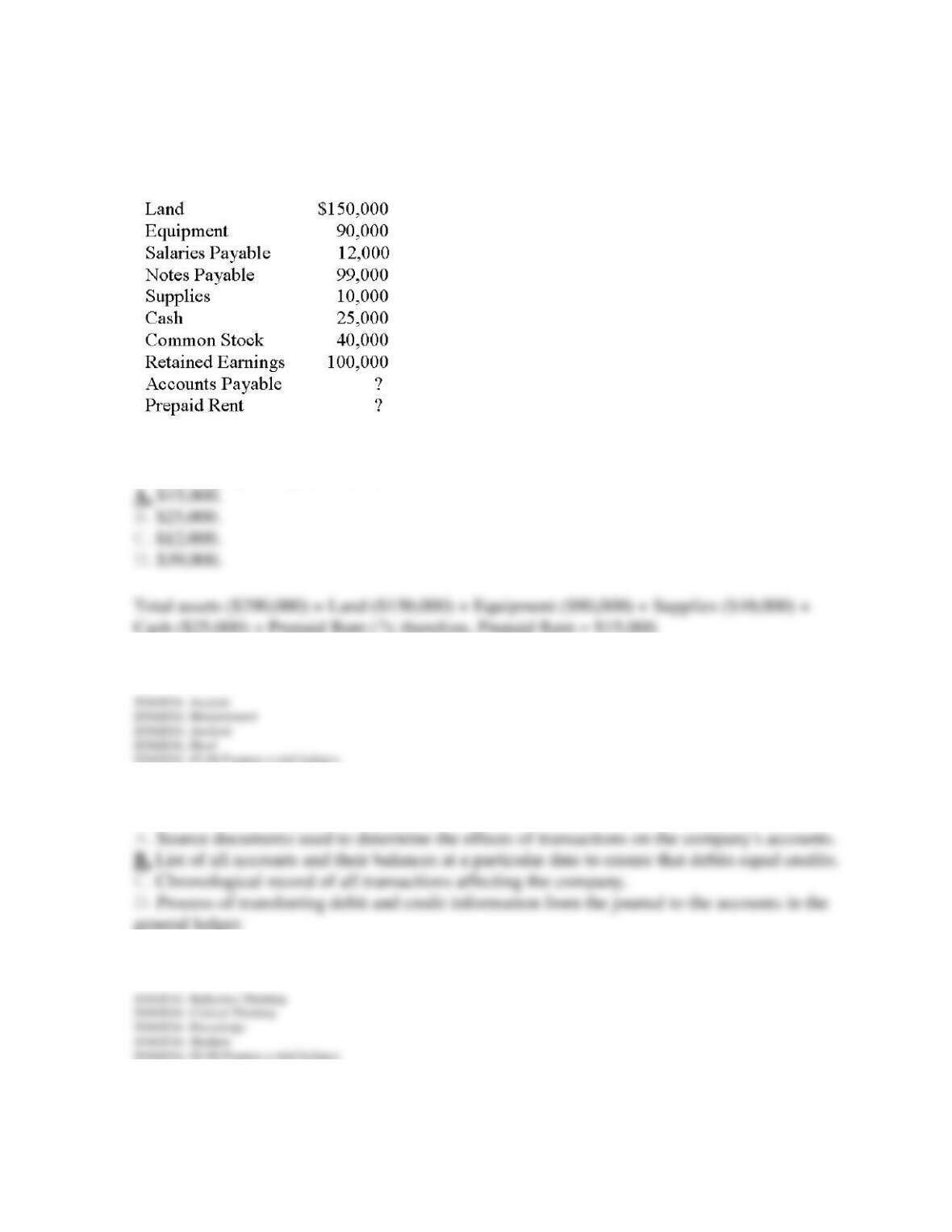
95. Finnish Motors has the following balance sheet accounts:
If the company has total liabilities and stockholders’ equity of $290,000, what is the balance
of the company’s Prepaid Rent account?
96. A trial balance represents the:
97. External transactions are transactions the firm conducts with a separate economic entity,
such as selling products to a customer, purchasing supplies from a vendor, paying salaries to
an employee, and borrowing money from a bank.
98. Internal transactions are events that affect the financial position of the company but do not
include an exchange with a separate economic entity. Examples are using supplies on hand
and earning revenues after having received cash in advance from a customer.
99. A list of all account names used to record transactions of a company is referred to as a T–
account.
100. After recording each transaction, total assets must equal total liabilities plus stockholders’
equity.
101. If a transaction causes total assets of the company to increase by $2,000, then liabilities
plus stockholders’ equity also increases by $2,000.
102. If a transaction causes total assets of the company to increase by $5,000 and total
liabilities to increase by $3,000, then stockholders’ equity increases by $8,000.
103. Borrowing cash from the bank causes assets to increase and liabilities to increase.
104. Purchasing equipment using cash causes assets to increase.
105. Providing services to customers for cash causes stockholders’ equity to increase.
106. Incurring employees’ salaries but not paying them causes no change to stockholders’
equity.
107. Paying dividends to its stockholders causes a company’s stockholders’ equity to
decrease.
108. Selling common stock for cash causes assets to increase and stockholders’ equity to
decrease.
109. Purchasing office supplies on account causes assets to increase and liabilities to
increase.
110. Providing services to customers on account causes assets to increase and stockholders’
equity to increase.
111. Receiving cash in advance from a customer for services to be provided in the future
causes assets to increase and stockholders’ equity to increase.
112. Paying for one year of rent in advance does not affect the accounting equation.
113. Purchasing supplies on account increases the balance of the Accounts Receivable
account.
114. Amounts owed from customers are recorded in the Accounts Receivable account.
115. The two components of stockholders’ equity are Debits and Credits.
116. Revenues have the effect of increasing retained earnings.
117. Expenses have the effect of decreasing retained earnings.
118. Receiving cash in advance from customers increases the Service Revenue account.
119. Unearned Revenue is a liability account.
120. Liability accounts increase with a debit and decrease with a credit.
121. Liability accounts increase with a credit and decrease with a debit.
122. Common Stock increases with a credit and decreases with a debit.
123. Revenue accounts increase with a debit and decrease with a credit.
124. Expense accounts increase with a debit and decrease with a credit.
125. The Dividends account increases with a credit and decreases with a debit.
126. A debit to an account balance always results in the balance increasing.
127. A credit to an account balance always results in the balance decreasing.
128. A journal provides a chronological record of all transactions affecting a firm.
129. For each transaction, there must be at least one debit amount and one credit amount.
130. For each transaction, the total debit amounts must equal the total credit amounts.
131. Selling common stock for cash is recorded with a debit to common stock.
132. Borrowing cash from the bank is recorded with a debit to cash.
133. Purchasing office supplies is recorded with a credit to office supplies.
134. Paying employees’ salaries for the current period is recorded with a debit to Salaries
Expense.
135. Providing services to customers is recorded with a debit to Service Revenue.
136. The general ledger includes all accounts used to record the company’s transactions.
137. The process of transferring the debit and credit information from the journal to individual
accounts in the general ledger is called journalizing.
138. After we’ve posted transactions to the general ledger accounts, the sum of the accounts
with debit balances should equal the sum of the accounts with credit balances.
139. A trial balance is a list of all accounts and their balances at a particular date, showing
that assets equal liabilities.
140. If total debits equal total credits in the trial balance, then all balances are correct.
141. Below are the steps in the measurement process of external transactions. Arrange them
from first (1) to last (6).
be.
142. Describe the difference between external events and internal events and give two
examples of each.
143. Describe the six steps in the measurement process of external transactions.
144. A company received a utility bill of $600 but did not pay it. Indicate the amount of
increases and decreases in the accounting equation.
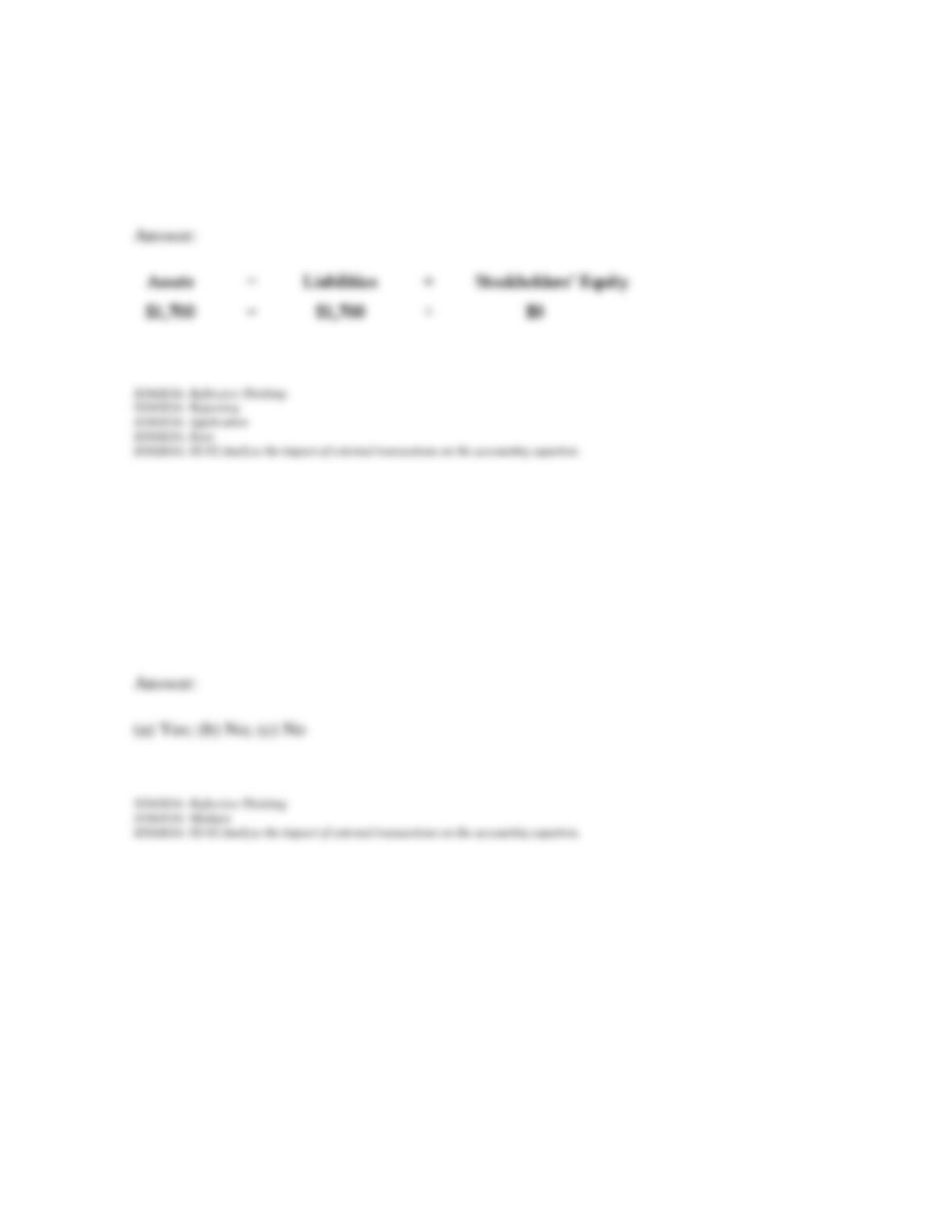
145. A company purchases supplies on account for $1,700. Indicate the amount of increases
and decreases in the accounting equation.
146. Using the notion that the accounting equation (Assets = Liabilities + Stockholders’
Equity) must remain in balance, indicate whether each of the following transactions is
possible.
(a) Cash decreases; Accounts Payable decreases.
(b) Salaries Expense increases; Salaries Payable decreases.
(c) Accounts Receivable decreases; Service Revenue increases.
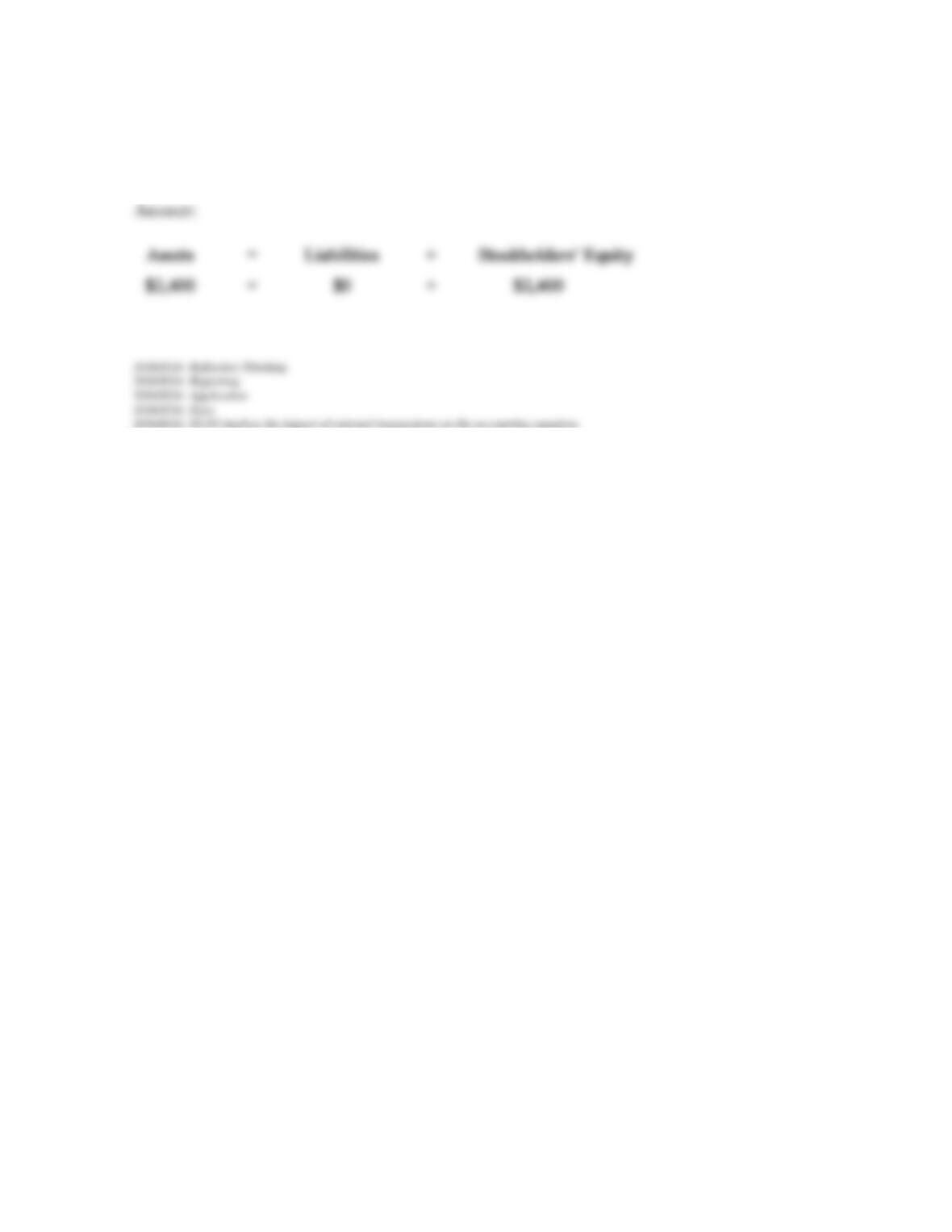
147. A company provides services to customers on account for $2,400. Indicate the amount of
increases and decreases in the accounting equation.
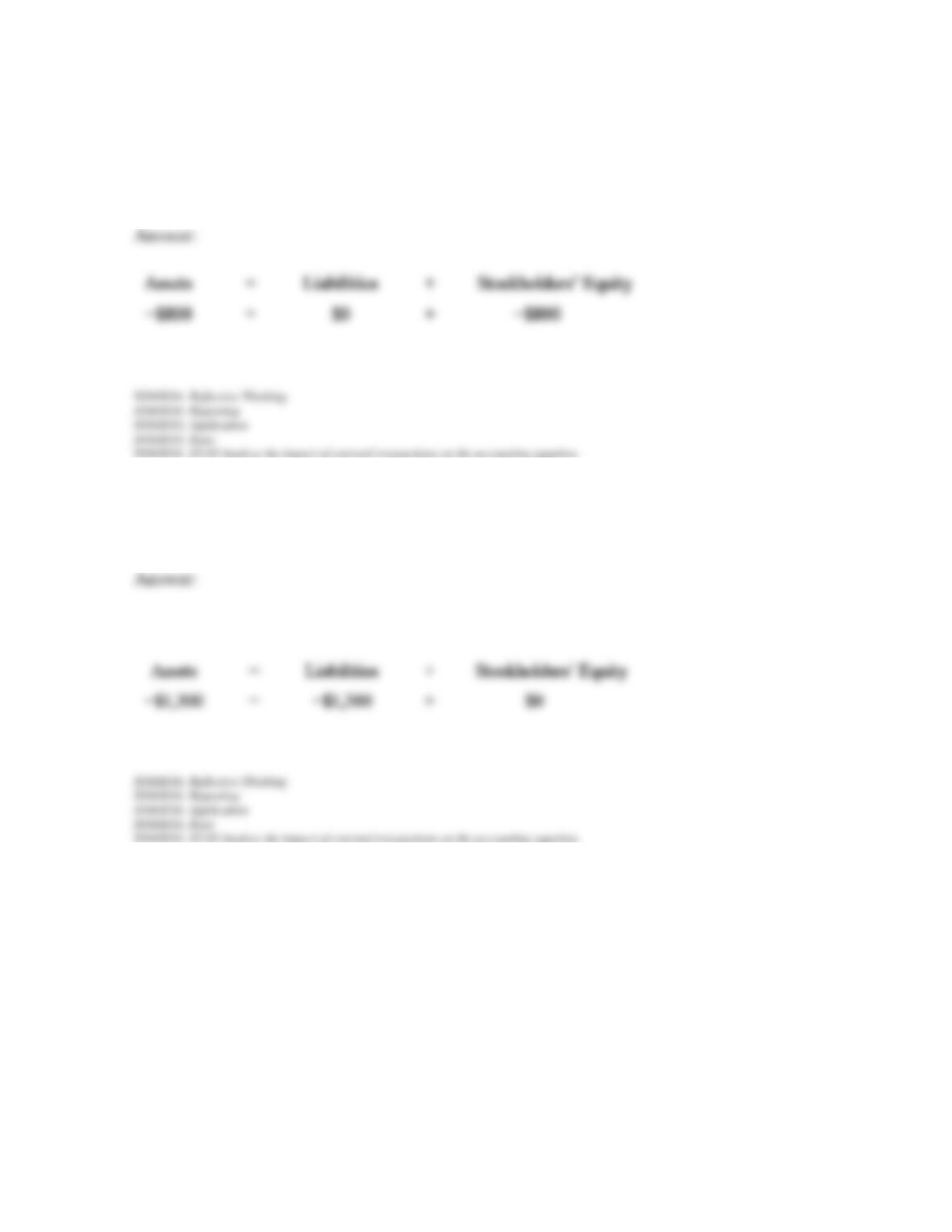
148. A company pays $800 dividends to stockholders. Indicate the amount of increases and
decreases in the accounting equation.
149. A company pays $1,300 on account for supplies previously purchased on account.
Indicate the amount of increases and decreases in the accounting equation.
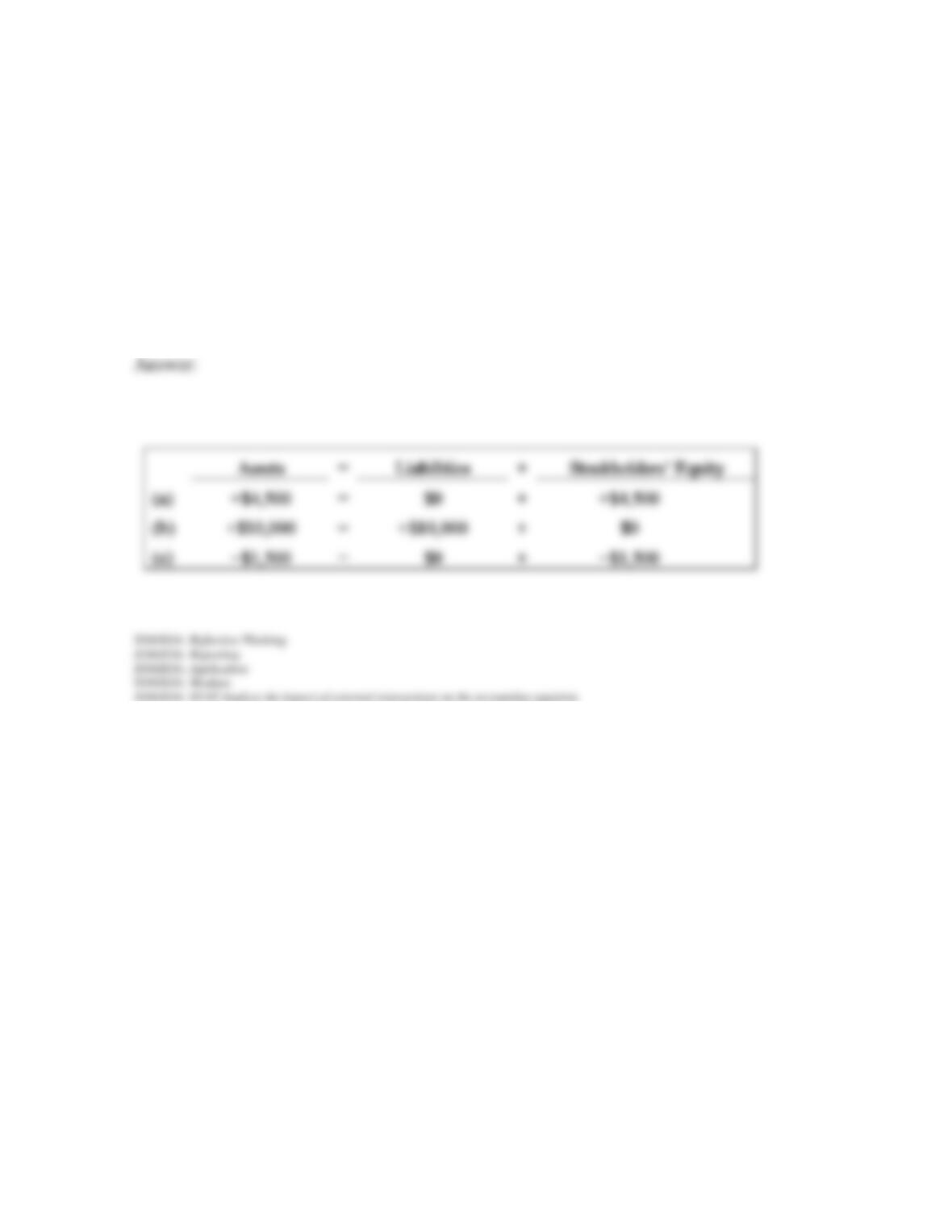
150. The following transactions occur for the Hamilton Manufacturers.
(a) Provide services to customers on account for $4,500.
(b) Purchase equipment by signing a note with the bank for $10,000.
(c) Pay advertising of $1,500 for the current month.
Analyze each transaction and indicate the amount of increases and decreases in the accounting
equation.