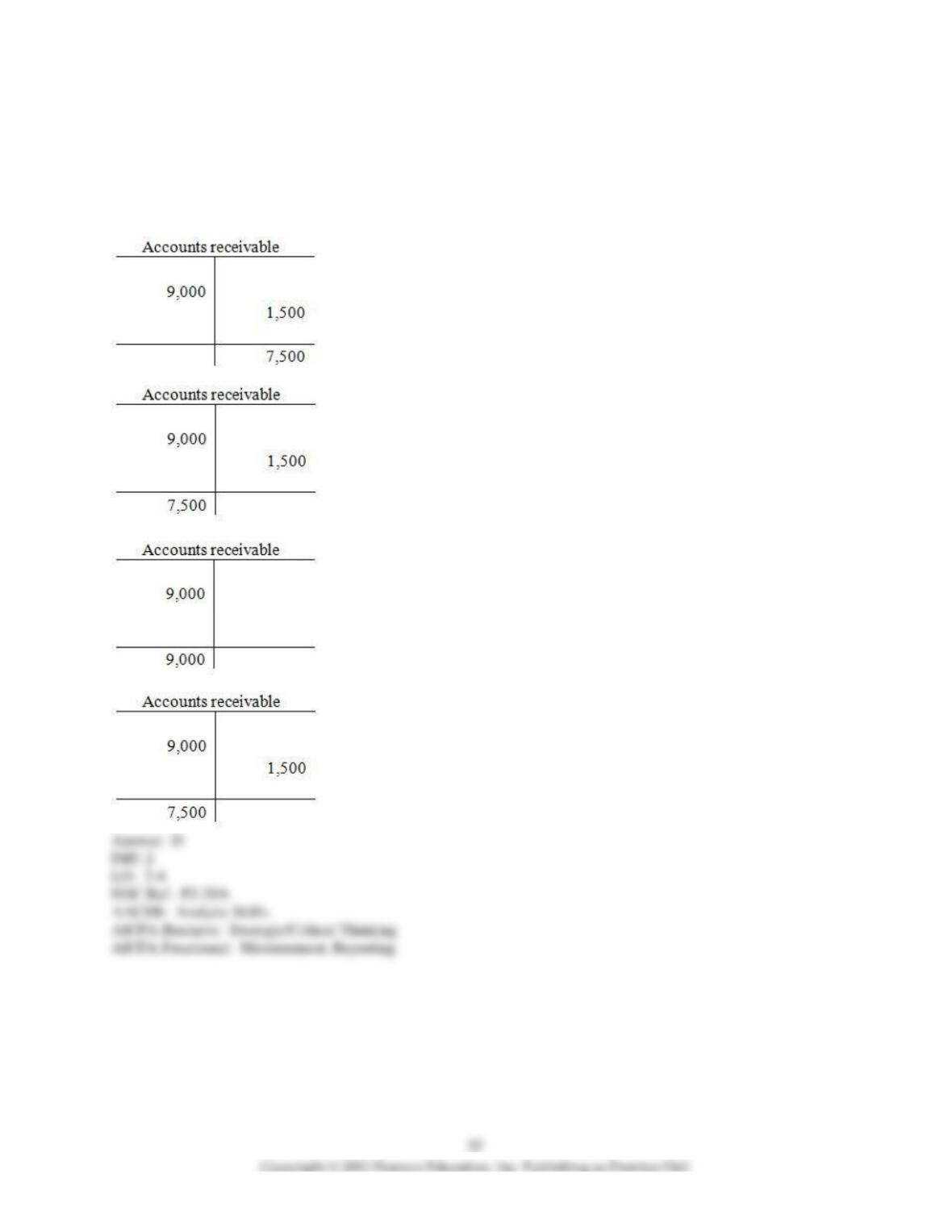
59) A business has the following transactions: the business is started by receiving $20,000 from the owner. The
business purchases $500 of supplies on account. The business purchases $2,000 of furniture on account. The
business renders services to various clients totaling $9,000 on account. The business pays out $2,000 for Salary
expense and $3,000 for Rent expense. Business pays $500 to supplier for the supplies purchased earlier. The
business collects $1,500 from one of its clients for services rendered earlier in the month. At the end of the month,
all journal entries are posted to the ledger. The Accounts receivable account will appear as follows:
A)
B)
C)
D)
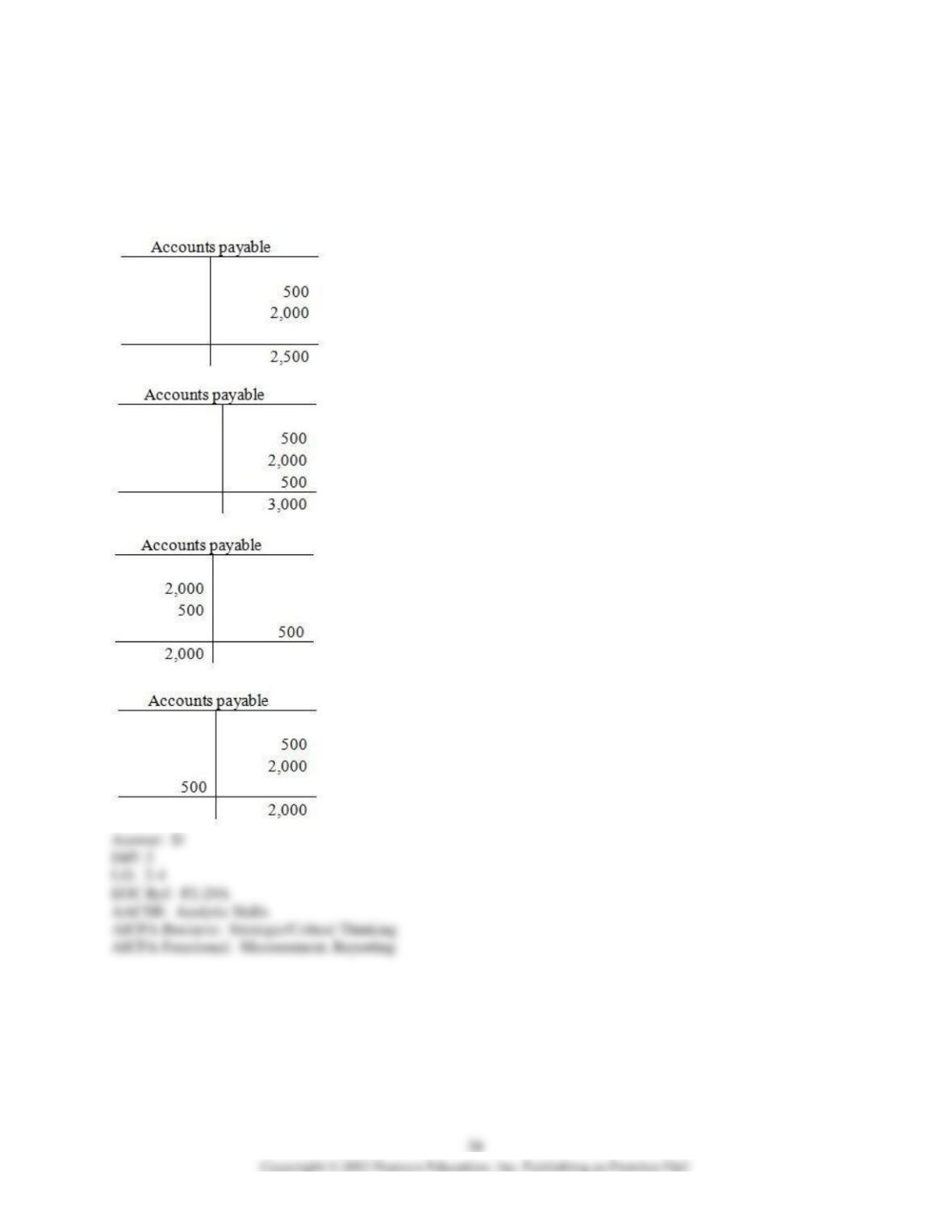
60) A business has the following transactions: The business is started by receiving $20,000 from the owner. The
business purchases $500 of supplies on account. The business purchases $2,000 of furniture on account. The
business renders services to various clients totaling $9,000 on account. The business pays out $2,000 for Salary
expense and $3,000 for Rent expense. The business pays $500 to supplier for the supplies purchased earlier. The
business collects $1,500 from one of its clients for services rendered earlier in the month. At the end of the month,
all journal entries are posted to the ledger. The Accounts payable account will appear as follows:
A)
B)
C)
D)
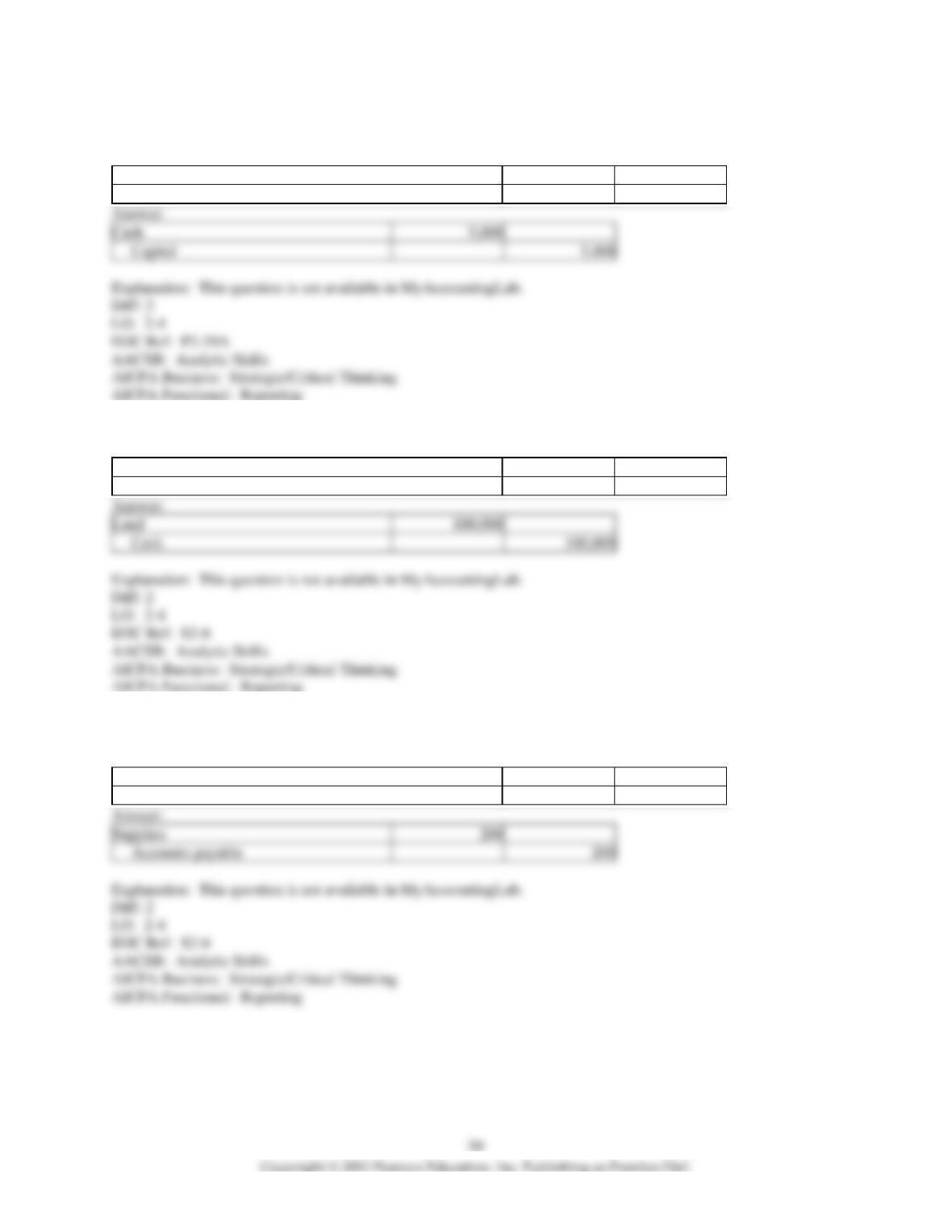
61) A business is started by receiving $5,000 cash from the owner. Please provide the journal entry (debits first,
credits second.)
Cash
62) A business purchases land for $100,000 cash. Please provide the journal entry (debits first, credits second.)
Land
63) A business purchases supplies for $200 on account. Please provide the journal entry (debits first, credits
second.)
Supplies
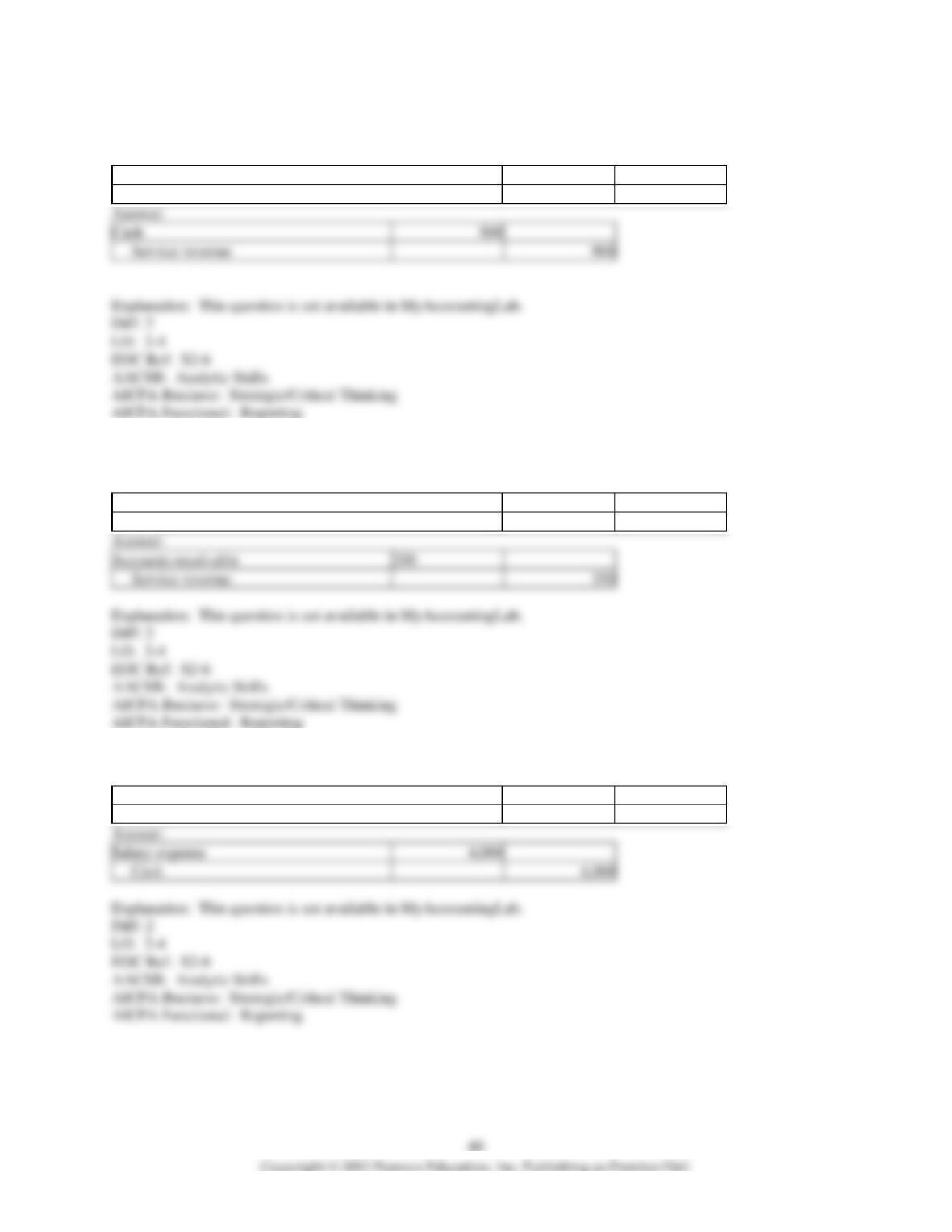
64) A business renders services to its customer and collects $900 cash. Please provide the journal entry (debits first,
credits second.)
Cash
65) A business renders services to its customer for $350 on account. Please provide the journal entry (debits first,
credits second.)
Accounts receivable
66) A business pays salary expense of $4,000 in cash. Please provide the journal entry (debits first, credits second.)
Salary expense
67) In a previous month, the business purchased supplies for $800 on account. Now the business makes a cash
payment of $800 to the supplier. Please provide the journal entry (debits first, credits second.)
Accounts payable
68) In a previous month, the business rendered services of $5,000 to a client on account. Now the business receives
$5,000 cash from the client. Please provide the journal entry (debits first, credits second.)
Cash
69) At the end of the month, the business receives a bill for utility expenses of $800 incurred during the month. The
business will pay the bill during the following month. Please provide the journal entry (debits first, credits second.)
Utilities expense
70) At the end of the month, the business owner takes a withdrawal of $10,000. Please provide the journal entry
(debits first, credits second.)
Drawing
Learning Objective 2-5
1) In a trial balance, total debits are always equal to total credits.
2) The trial balance is generally used only inside the business and is not published with the other financial
statements.
3) A trial balance summarizes a ledger by listing all the accounts with their ending balances.
4) Data from a trial balance is used to prepare the three basic financial statements.
5) The trial balance is one of the three basic financial statements.
6) The trial balance shows total amounts for assets, liabilities, and equity.
7) Which of the following statements is TRUE?
A) A trial balance is in the same format as a balance sheet.
B) A trial balance presents data in debit and credit format, but a balance sheet does not.
C) A trial balance shows total amounts for assets, liabilities, and equity.
D) A trial balance is created after the balance sheet is prepared.
8) Which of the following statements is FALSE?
A) A trial balance shows total debits and total credits.
B) A trial balance presents data in debit and credit format, but a balance sheet does not.
C) A trial balance shows total amounts for assets, liabilities, and equity.
D) A trial balance is created before the balance sheet is prepared.
9) Which of the following is a method used to detect errors when the two columns of the trial balance are NOT
equal?
A) Compute the difference in the columns and search the trial balance for a transposition error or a slide error if the
difference is evenly divisible by 9.
B) Compute the difference in the columns, divide the difference between total debits and total credits by 2 and
search for a debit shown as a credit, or vice versa.
C) Compute the difference in the columns and search for a missing account with that balance.
D) All of the above are suggested methods for detecting errors.
10) A journal entry for a $75 payment for Rent expense was posted as a debit to Salary expense and a credit to Cash.
This error will cause which of the following conditions on the trial balance?
A) The sum of the credits will equal the sum of the debits.
B) The sum of the debits will exceed the sum of the credits by $75.
C) The sum of the debits will exceed the sum of the credits by $150.
D) The sum of the credits will exceed the sum of the debits by $150.
11) A journal entry for a $250 payment to purchase supplies was erroneously recorded as a debit to Supplies for
$520 and a credit to Cash for $250. Which of the following statements about the trial balance is TRUE?
A) The sum of the credits will exceed the sum of the debits by $270.
B) The sum of the debits will exceed the sum of the credits by $250.
C) The sum of the debits will exceed the sum of the credits by $270.
D) The trial balance will be in balance; the sum of the credits will equal the sum of the debits.
12) A trial balance lists accounts in which order?
A) Assets, Liabilities, Revenues, Expenses, Owner’s equity
B) Assets, Expenses, Liabilities, Revenues, Owner’s equity
C) Assets, Revenues, Liabilities, Expenses, Owner’s equity
D) Assets, Liabilities, Owner’s equity, Revenues, Expenses
13) When is a trial balance usually prepared?
A) After each entry is journalized
B) Before financial statements are prepared
C) After financial statements are published
D) At the beginning of an accounting period
14) Which of the following statements CORRECTLY describes a trial balance?
A) A trial balance is the first step in the accounting cycle.
B) A trial balance is also known as a balance sheet.
C) A trial balance is a list of all accounts with their balances.
D) A trial balance is also known as the chart of accounts.
15) The last step before preparing financial statements is to:
A) post all entries.
B) record all transactions in the journal.
C) prepare the trial balance.
D) review source documents.
16) On a trial balance, which accounts are listed last?
A) Expenses
B) Revenues
C) Liabilities
D) Assets
17) The following are the ending month’s balances for Toys Galore, before preparing the trial balance.
Accounts payable
$6,790
Revenues
8,680
Cash
4,500
Expenses
1,050
Furniture
8,370
Accounts receivable
7,710
Capital
???
Notes payable
5,230
What amount should be shown for Capital on the trial balance?
A) $930
B) $16,190
C) $42,330
D) $21,165
18) The following are the ending month’s balances for Toys Galore.
Accounts payable
$6,790
Revenue
8,680
Cash
4,500
Expenses
1,050
Furniture
8,370
Accounts receivable
7,710
Capital
930
Notes payable
5,230
What is the total amount of credits for the trial balance?
A) $21,630
B) $16,400
C) $20,580
D) $30,310
19) The following are the ending month’s balances for Toys Galore.
Accounts payable
$6,790
Revenue
8,680
Cash
4,500
Expenses
1,050
Furniture
8,370
Accounts receivable
7,710
Capital
930
Notes payable
5,230
What is the total amount of debits for the trial balance?
A) $21,630
B) $16,400
C) $20,580
D) $30,310
20) The following are the ending month’s balances for Toys Galore.
Accounts payable
$6,790
Revenue
8,680
Cash
4,500
Expenses
1,050
Furniture
8,370
Accounts receivable
7,710
Capital
930
Notes payable
5,230
What is the net income for Toys Galore for September?
A) $8,680
B) $1,050
C) $7,630
D) $970
21) The following are the ending month’s balances for Toys Galore.
Accounts payable
$6,790
Revenue
8,680
Cash
4,500
Expenses
1,050
Furniture
8,370
Accounts receivable
7,710
Capital
930
Notes payable
5,230
What would be the last account listed on the trial balance for Toys Galore?
A) Revenue
B) Expenses
C) Cash
D) Accounts payable
22) The following are the ending month’s balances for Toys Galore.
Accounts payable
$6,790
Revenue
8,680
Cash
4,500
Expenses
1,050
Furniture
8,370
Accounts receivable
7,710
Capital
930
Notes payable
5,230
What would be the first account listed on the trial balance for Toys Galore?
A) Revenue
B) Expenses
C) Cash
D) Accounts payable
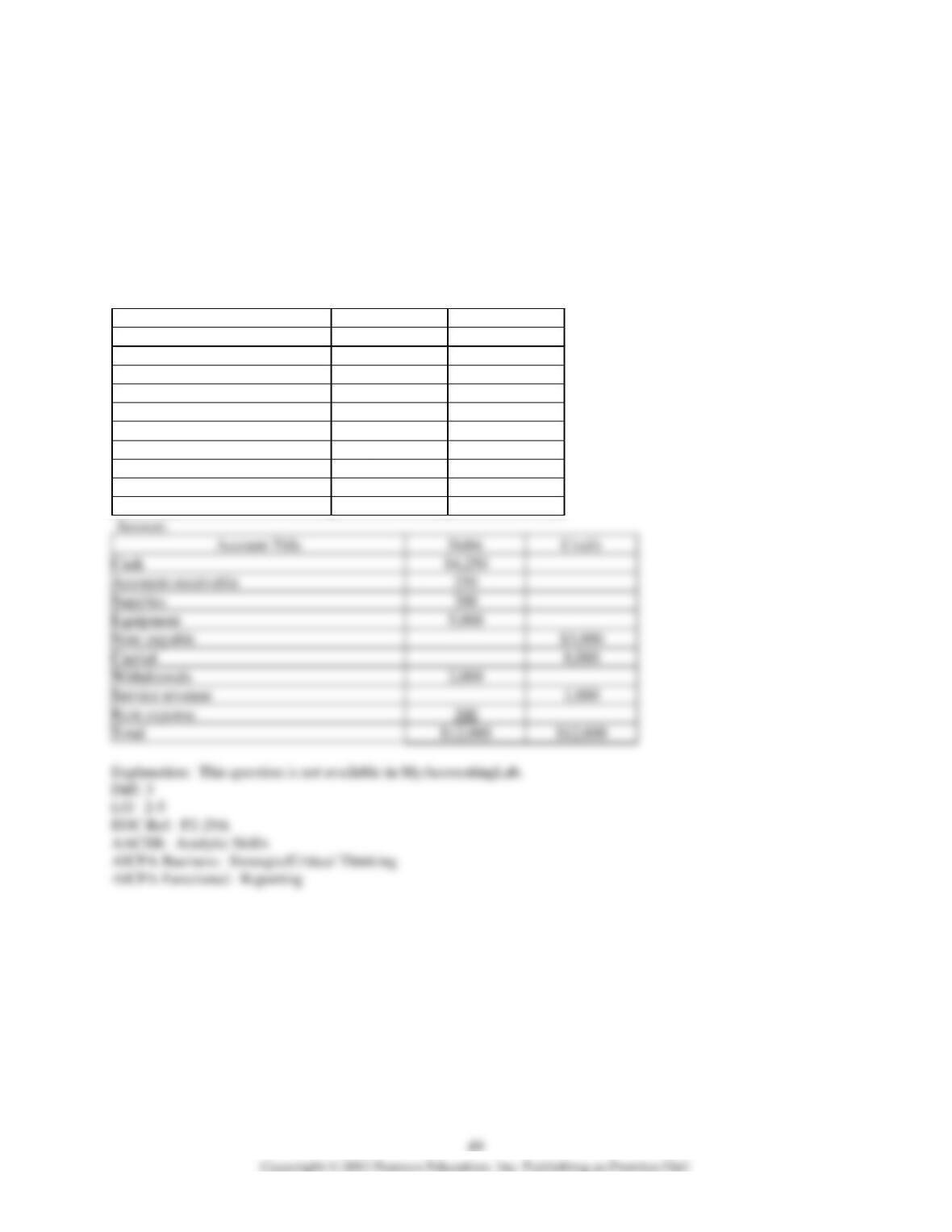
23) The following transactions have been journalized and posted to the proper accounts. Prepare a trial balance in
good form.
a. Edward Wilson invested $8,000 cash in his new landscaping business.
b. The business paid the first month’s rent with $300 cash.
c. The business purchased equipment by paying $2,000 cash and executing a note payable for $3,000.
d. The business purchased supplies for $200 cash.
e. The business billed clients for a total of $1,000 for design services rendered.
f. The business received $750 cash from clients for services rendered above.
g. The owner took a withdrawal of $2,000.
Account Title
Debit
Credit
Cash
$4,250
Accounts receivable
Supplies
Equipment
Note payable
Capital
8,000
Withdrawals
Service revenue
1,000
Rent expense
Total
50
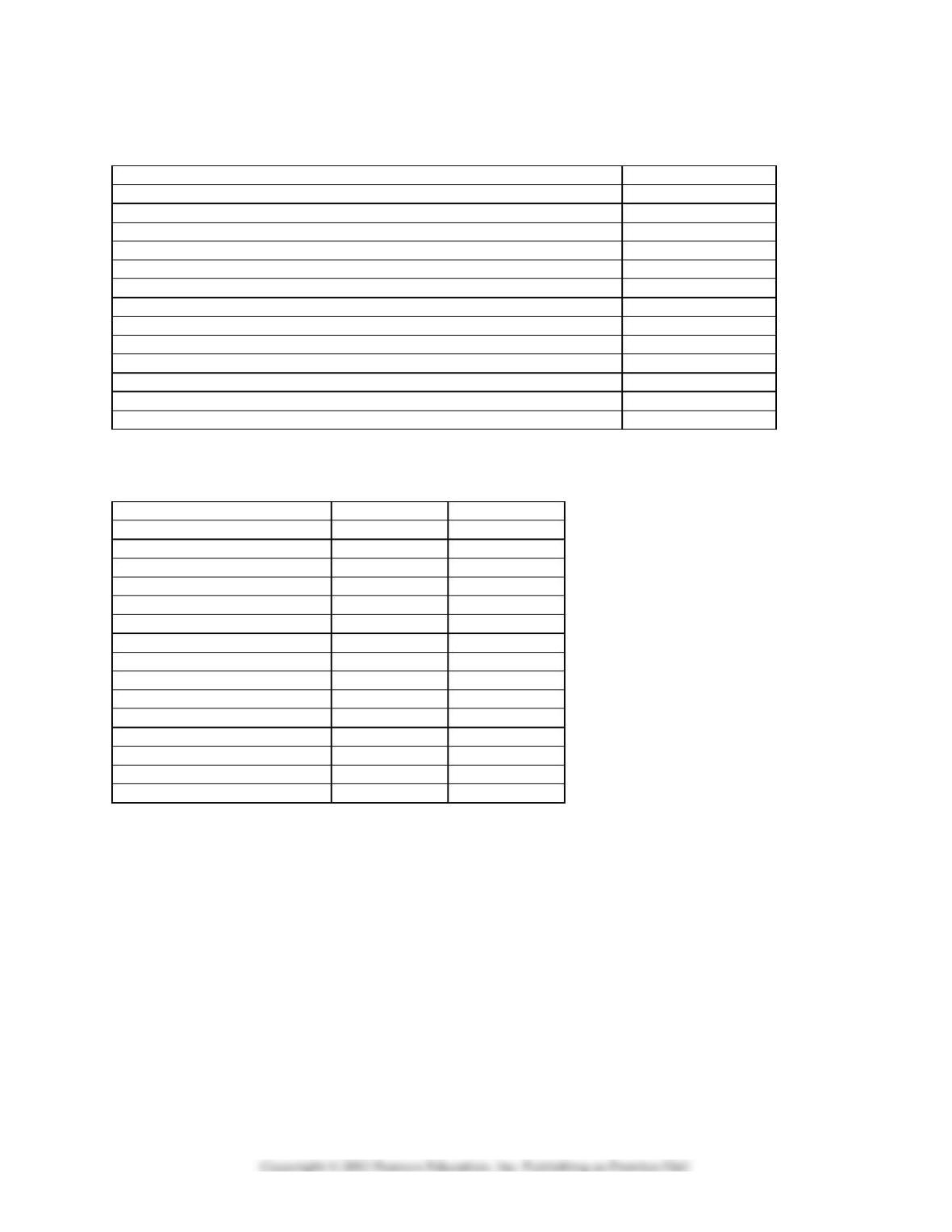
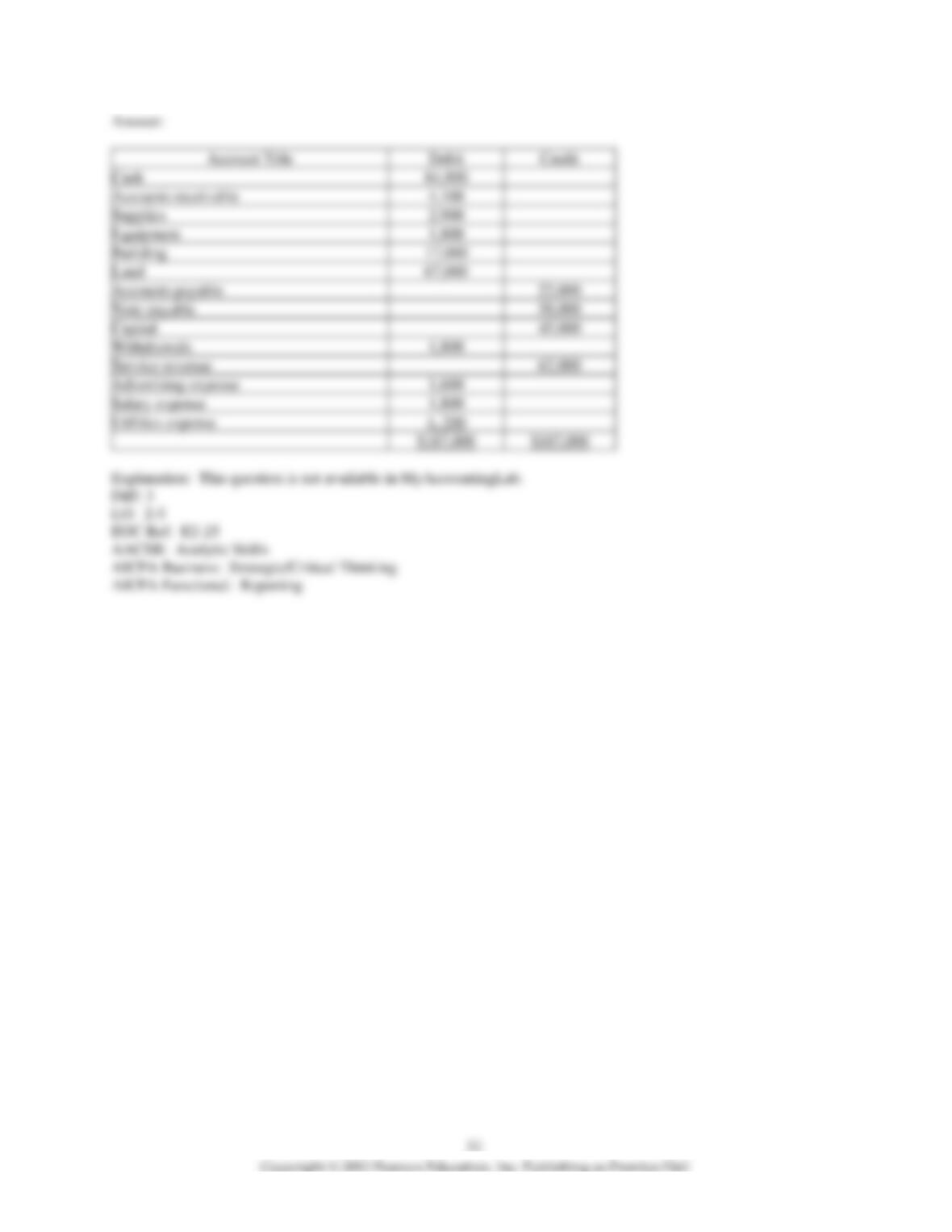
24) Thermo HVAC is a heating and air conditioning service business. On December 31, 2010, after its first month of
business, Thermo HVAC had the following balances in its accounts, listed alphabetically.
Accounts receivable
4, 100
Accounts payable
22, 000
Advertising expense
1, 600
Building
17, 000
Cash
???
Capital
45, 000
Withdrawals
1, 800
Equipment
1, 800
Land
67, 000
Note payable
58, 000
Salary expense
1, 800
Service revenue
62, 000
Supplies
2, 900
Utilities expense
4, 200
Determine the balance in the cash account and prepare a trial balance using proper format.
Account Title
Debit
Credit
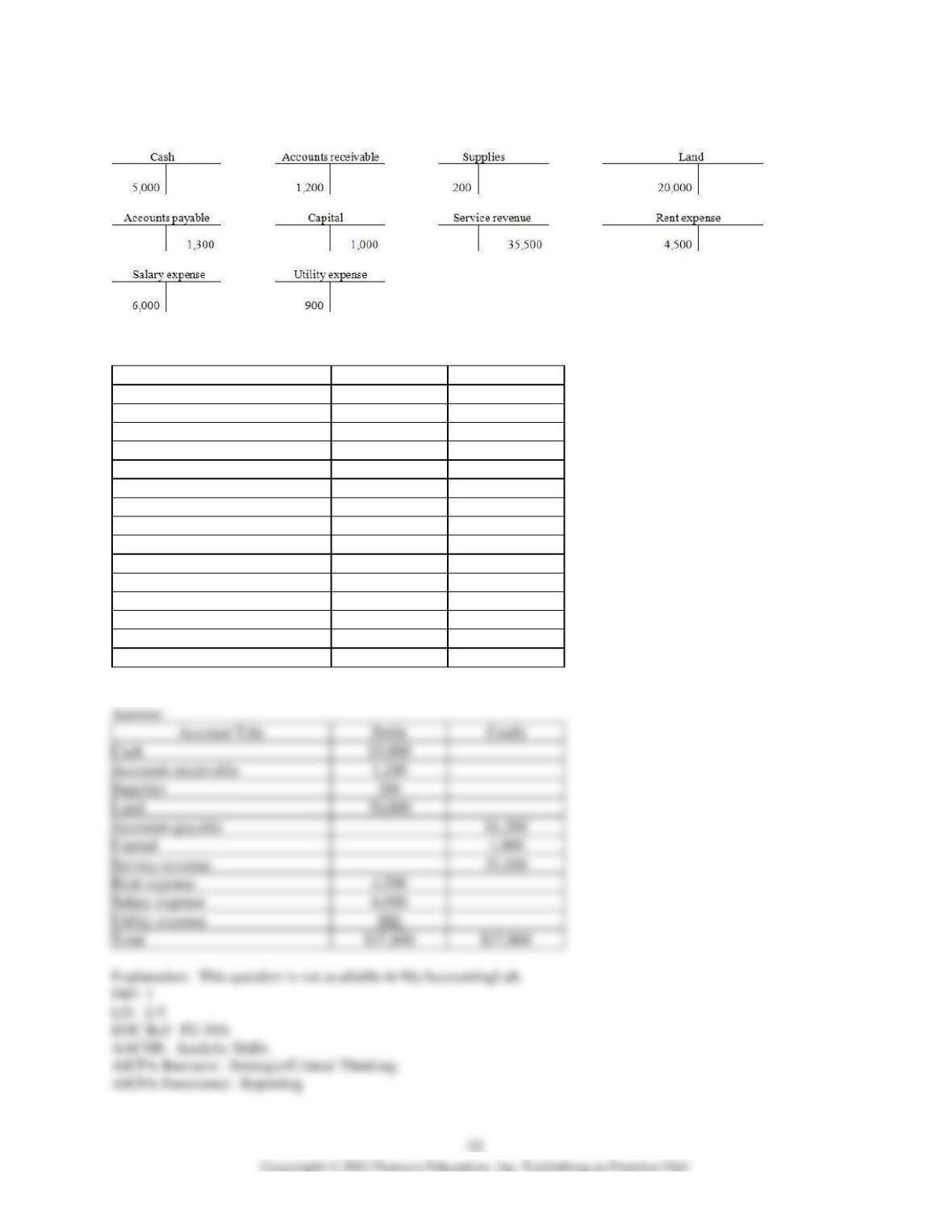
25) At the end of a month, a business shows the following balances in its ledger.
Please use this data to prepare a trial balance.
Account Title
Debit
Credit
Account Title
Debit
Credit
Cash
Accounts receivable
Supplies
Land
Accounts payable
Capital
Service revenue
Rent expense
Salary expense
Utility expense
Total