
397
283) Bierce Corporation has two manufacturing departments—Machining and Finishing. The
company used the following data at the beginning of the year to calculate predetermined
overhead rates:
Machining
Finishing
Total
Estimated total machine-hours (MHs)
4,000
1,000
5,000
Estimated total fixed manufacturing overhead
cost
$20,000
$2,100
$22,100
Estimated variable manufacturing overhead
cost per MH
$1.40
$2.80
During the most recent month, the company started and completed two jobs—Job B and Job K.
There were no beginning inventories. Data concerning those two jobs follow:
Job B
Job K
Direct materials
$12,800
$7,900
Direct labor cost
$24,700
$6,400
Machining machine-hours
2,700
1,300
Finishing machine-hours
400
600
Required:
a. Assume that the company uses a plantwide predetermined manufacturing overhead rate based
on machine-hours. Calculate that overhead rate.
b. Assume that the company uses a plantwide predetermined manufacturing overhead rate based
on machine-hours. Calculate the amount of manufacturing overhead applied to Job B.
c. Assume that the company uses a plantwide predetermined manufacturing overhead rate based
on machine-hours. Calculate the amount of manufacturing overhead applied to Job K.
d. Assume that the company uses departmental predetermined overhead rates with machine-
hours as the allocation base in both departments. What is the departmental predetermined
overhead rate in the Machining department?
e. Assume that the company uses departmental predetermined overhead rates with machine-
hours as the allocation base in both production departments. What is the departmental
predetermined overhead rate in the Finishing department?
f. Assume that the company uses departmental predetermined overhead rates with machine-
hours as the allocation base in both production departments. How much manufacturing overhead
will be applied to Job B?
g. Assume that the company uses departmental predetermined overhead rates with machine-
hours as the allocation base in both production departments. How much manufacturing overhead
will be applied to Job K?

400
284) Gercak Corporation has two production departments, Forming and Assembly. The company
uses a job-order costing system and computes a predetermined overhead rate in each production
department. The Forming Department’s predetermined overhead rate is based on machine-hours
and the Assembly Department’s predetermined overhead rate is based on direct labor-hours. At
the beginning of the current year, the company had made the following estimates:
Forming
Assembly
Machine-hours
16,000
11,000
Direct labor-hours
2,000
7,000
Total fixed manufacturing overhead cost
$100,800
$76,300
Variable manufacturing overhead per machine-hour
$1.70
Variable manufacturing overhead per direct labor-hour
$3.10
During the current month the company started and finished Job X560. The following data were
recorded for this job:
Job X560:
Forming
Assembly
Machine-hours
50
30
Direct labor-hours
30
40
Required:
a. Calculate the estimated total manufacturing overhead for the Assembly Department.
b. Calculate the predetermined overhead rate for the Forming Department.
c. Calculate the total amount of overhead applied to Job X560 in both departments.

402
285) Sonneborn Corporation has two manufacturing departments—Molding and Customizing.
The company used the following data at the beginning of the year to calculate predetermined
overhead rates:
Molding
Customizing
Total
Estimated total machine-hours (MHs)
1,000
9,000
10,000
Estimated total fixed manufacturing
overhead cost
$5,100
$23,400
$28,500
Estimated variable manufacturing overhead
cost per MH
$1.50
$2.50
During the most recent month, the company started and completed two jobs—Job D and Job G.
There were no beginning inventories. Data concerning those two jobs follow:
Job D
Job G
Direct materials
$14,700
$9,100
Direct labor cost
$18,800
$8,300
Molding machine-hours
700
300
Customizing machine-hours
3,600
5,400
Required:
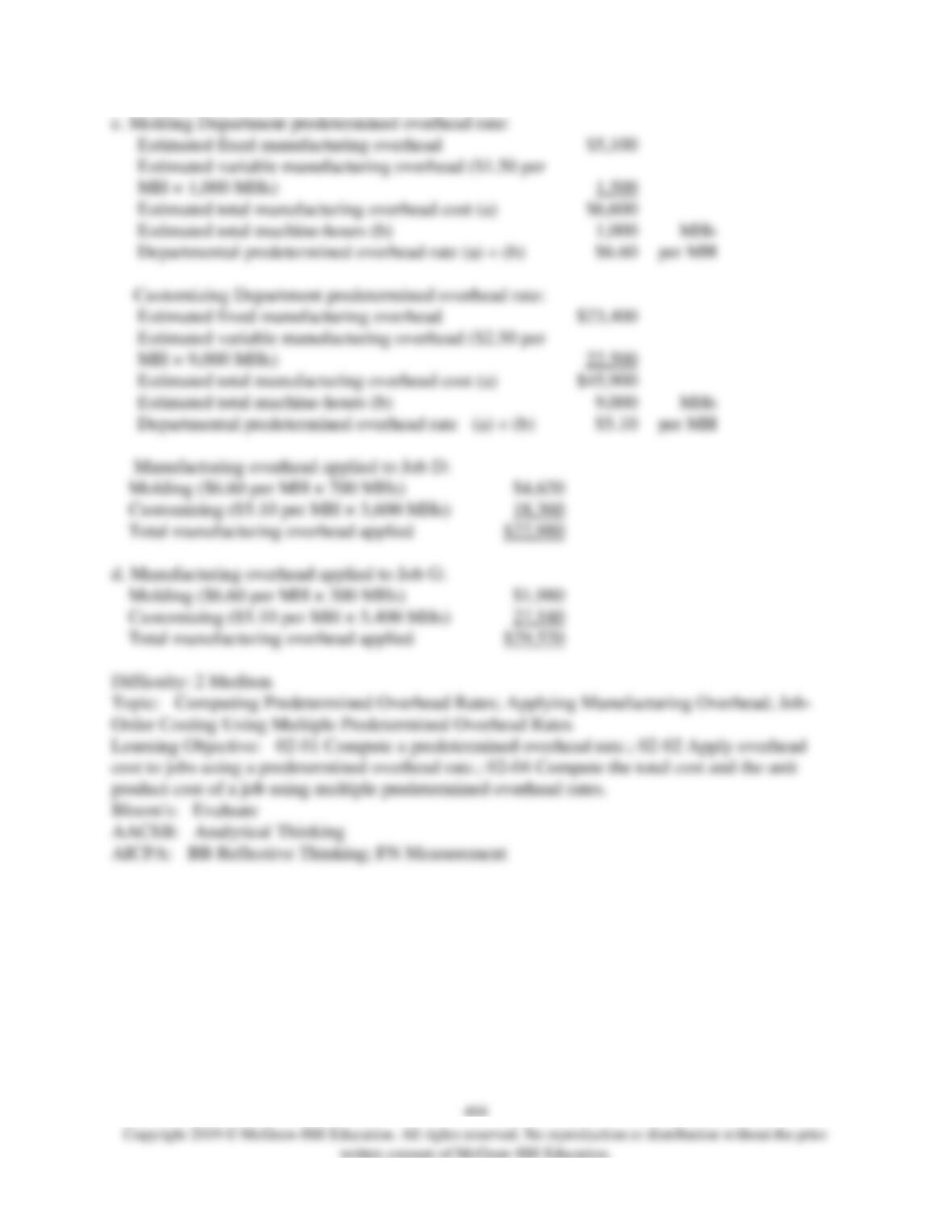
a. Assume that the company uses a plantwide predetermined manufacturing overhead rate based
on machine-hours. Calculate the amount of manufacturing overhead applied to Job D.
b. Assume that the company uses a plantwide predetermined manufacturing overhead rate based
on machine-hours. Calculate the amount of manufacturing overhead applied to Job G.
c. Assume that the company uses departmental predetermined overhead rates with machine-
hours as the allocation base in both production departments. How much manufacturing overhead
will be applied to Job D?
d. Assume that the company uses departmental predetermined overhead rates with machine-
hours as the allocation base in both production departments. How much manufacturing overhead
will be applied to Job G?
286) Rocher Corporation has two production departments, Casting and Finishing. The company
uses a job-order costing system and computes a predetermined overhead rate in each production
department. The Casting Department’s predetermined overhead rate is based on machine-hours
and the Finishing Department’s predetermined overhead rate is based on direct labor-hours. At
the beginning of the current year, the company had made the following estimates:
Casting
Finishing
Machine-hours
17,000
13,000
Direct labor-hours
4,000
6,000
Total fixed manufacturing overhead cost
$124,100
$52,200
Variable manufacturing overhead per machine-hour
$2.30
Variable manufacturing overhead per direct labor-hour
$4.00
During the current month the company started and finished Job A394. The following data were
recorded for this job:
Job A394:
Casting
Finishing
Machine-hours
80
20
Direct labor-hours
10
40
Required:
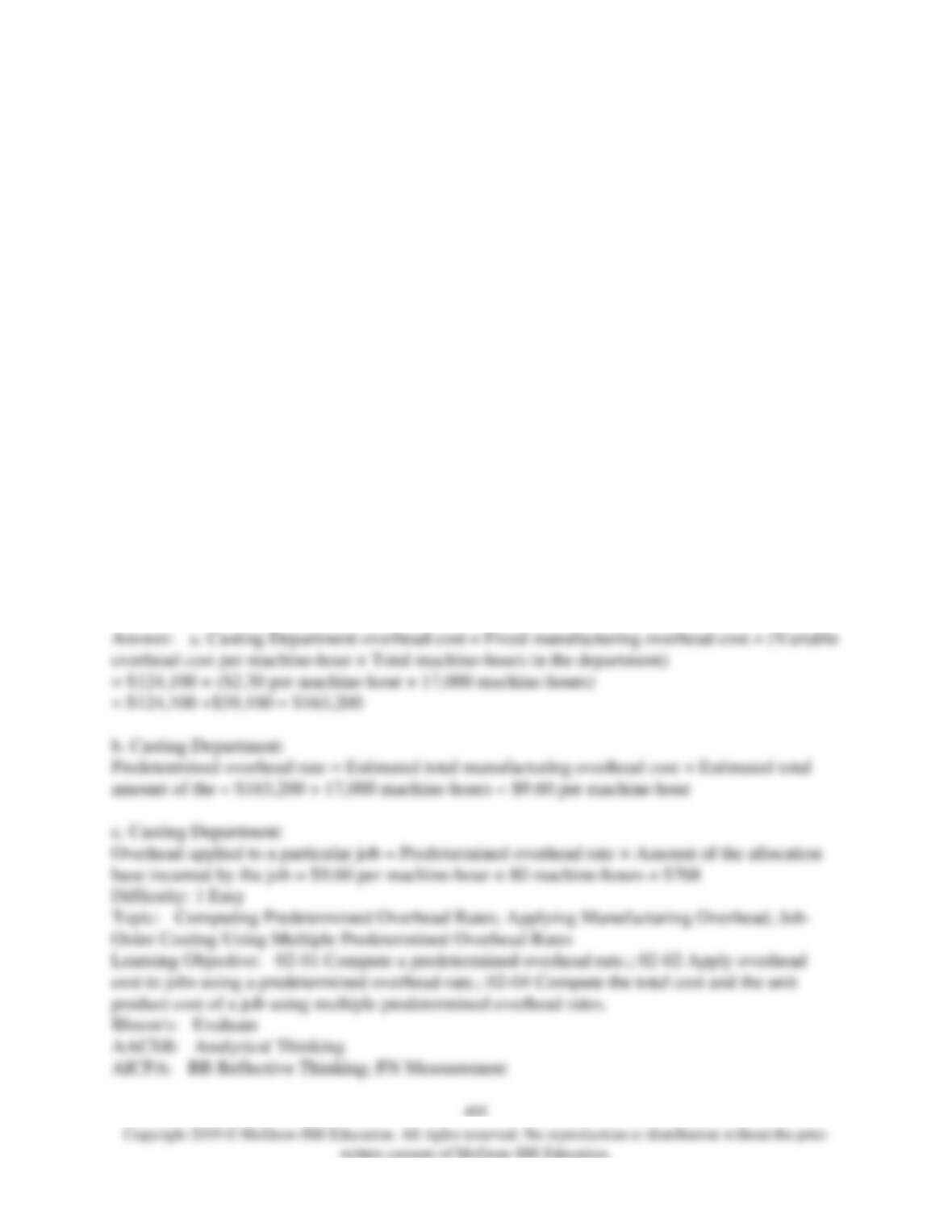
a. Calculate the estimated total manufacturing overhead for the Casting Department.
b. Calculate the predetermined overhead rate for the Casting Department.
c. Calculate the amount of overhead applied in the Casting Department to Job A394.
287) Marius Corporation has two production departments, Casting and Finishing. The company
uses a job-order costing system and computes a predetermined overhead rate in each production
department. The Casting Department’s predetermined overhead rate is based on machine-hours
and the Finishing Department’s predetermined overhead rate is based on direct labor-hours. At
the beginning of the current year, the company had made the following estimates:
Casting
Finishing
Machine-hours
18,000
12,000
Direct labor-hours
4,000
6,000
Total fixed manufacturing overhead cost
$118,800
$57,600
Variable manufacturing overhead per machine-hour
$2.20
Variable manufacturing overhead per direct labor-hour
$4.00
During the current month the company started and finished Job K895. The following data were
recorded for this job:
Job K895:
Casting
Finishing
Machine-hours
70
30
Direct labor-hours
20
60
Required:
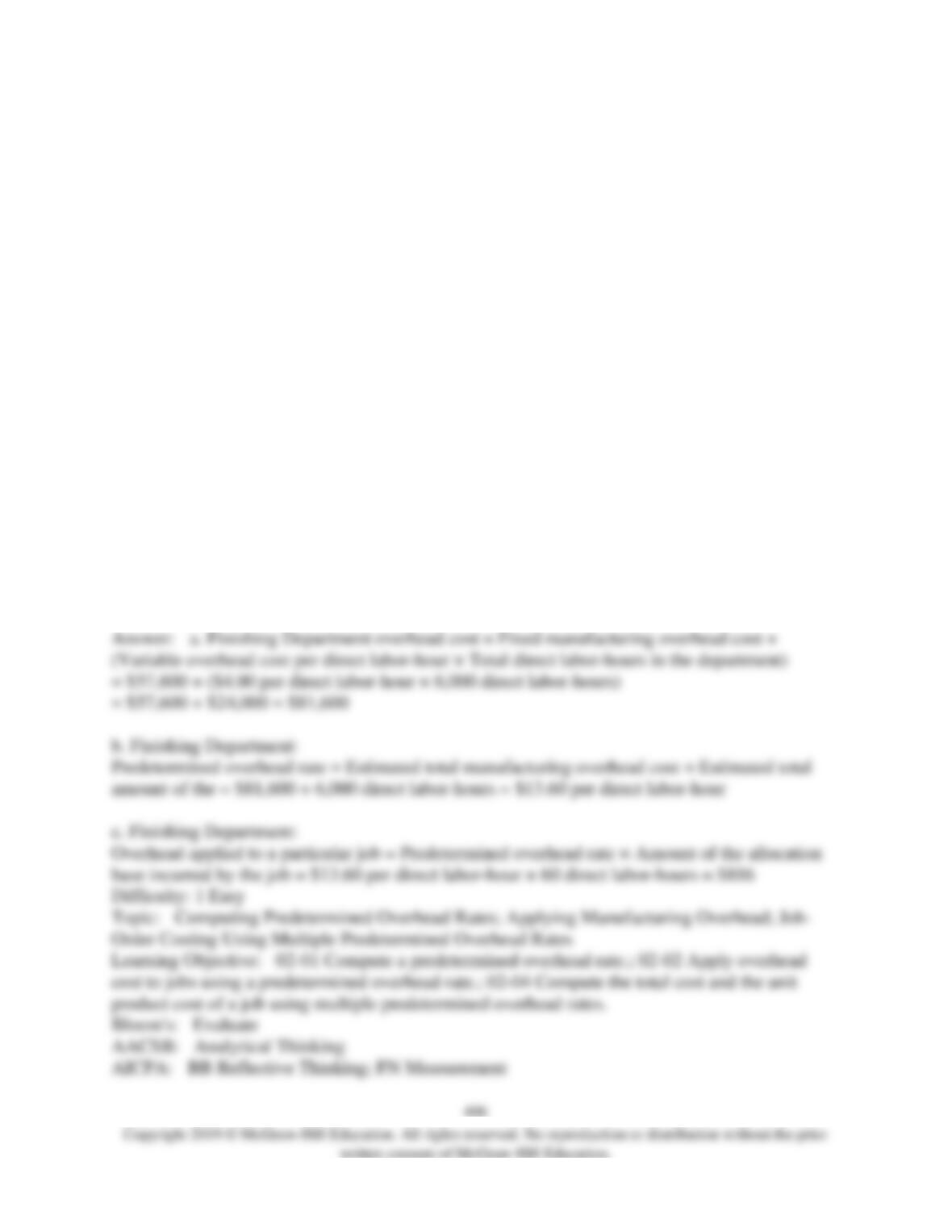
a. Calculate the estimated total manufacturing overhead for the Finishing Department.
b. Calculate the predetermined overhead rate for the Finishing Department.
c. Calculate the amount of overhead applied in the Finishing Department to Job K895.

407
288) Madole Corporation has two production departments, Forming and Customizing. The
company uses a job-order costing system and computes a predetermined overhead rate in each
production department. The Forming Department’s predetermined overhead rate is based on
machine-hours and the Customizing Department’s predetermined overhead rate is based on direct
labor-hours. At the beginning of the current year, the company had made the following
estimates:
Forming
Customizing
Machine-hours
19,000
12,000
Direct labor-hours
4,000
8,000
Total fixed manufacturing overhead cost
$119,700
$67,200
Variable manufacturing overhead per machine-hour
$2.00
Variable manufacturing overhead per direct labor-hour
$4.20
During the current month the company started and finished Job K973. The following data were
recorded for this job:
Job K973:
Forming
Customizing
Machine-hours
50
20
Direct labor-hours
20
50
Required:
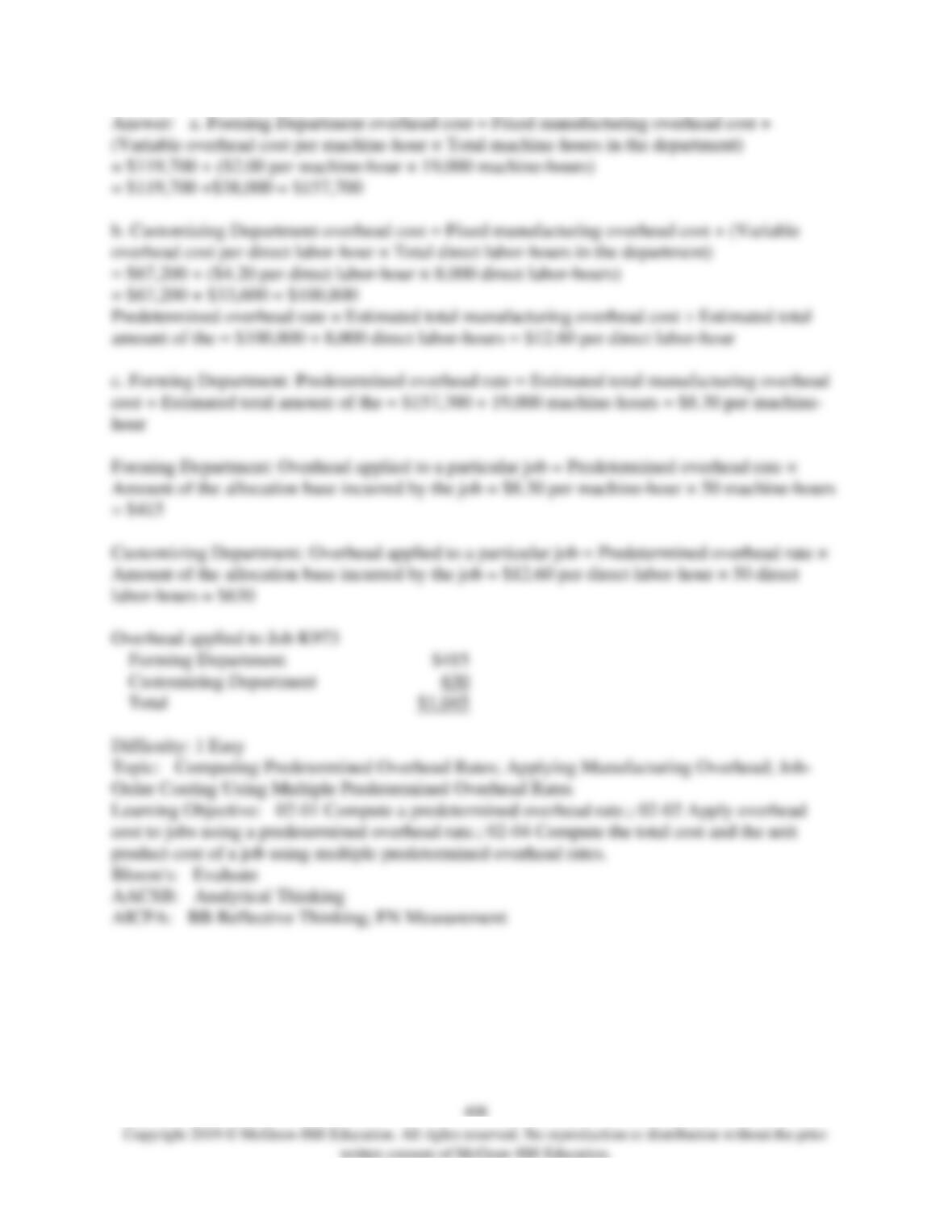
a. Calculate the estimated total manufacturing overhead for the Forming Department.
b. Calculate the predetermined overhead rate for the Customizing Department.
c. Calculate the total overhead applied to Job K973 in both departments.
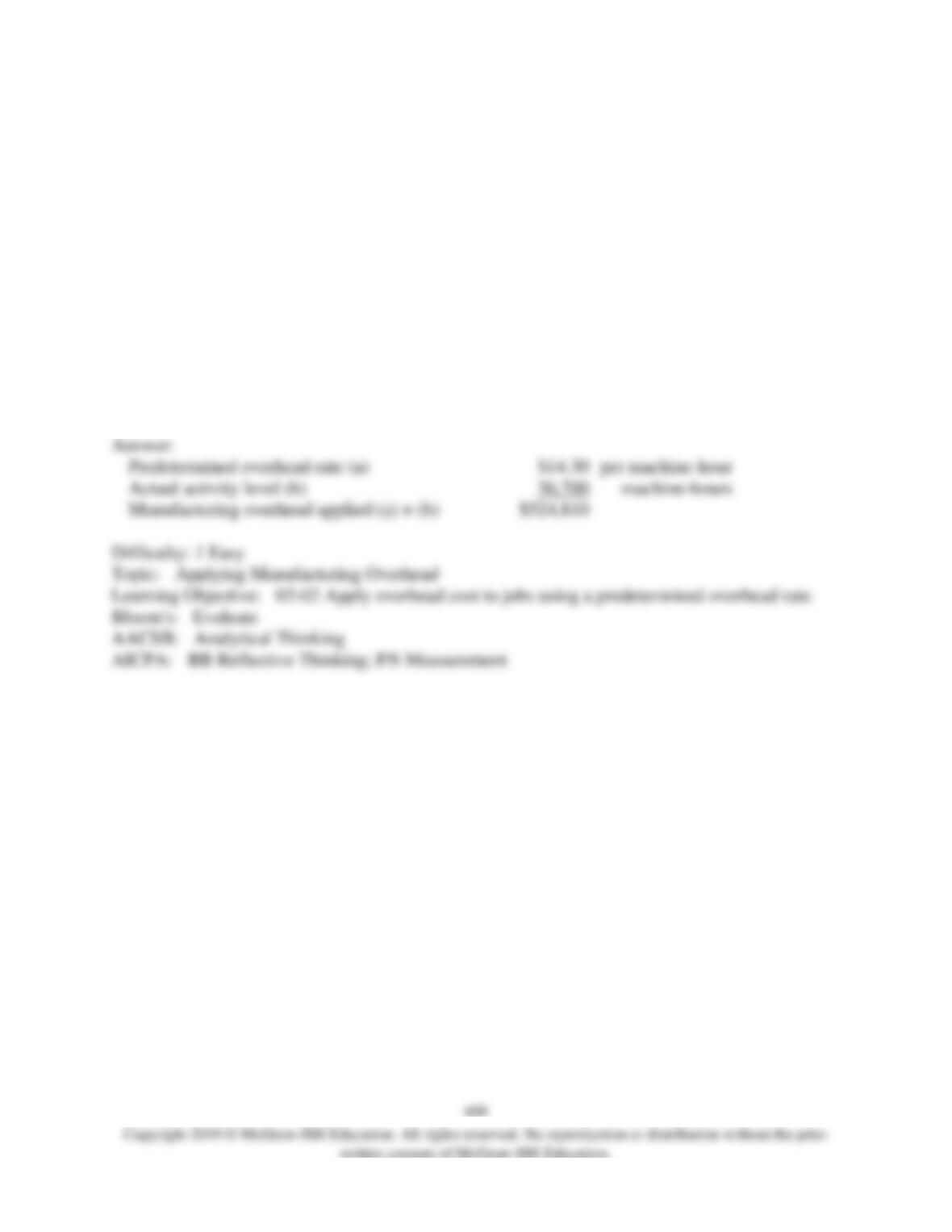
289) Sullen Corporation uses a predetermined overhead rate base on machine-hours that it
recalculates at the beginning of each year. The company has provided the following data for the
most recent year.
Predetermined overhead rate
$14.30
per machine-hour
Estimated total fixed manufacturing overhead from the
beginning of the year
$572,000
Estimated activity level from the beginning of the year
40,000
machine-hours
Actual total fixed manufacturing overhead
$605,000
Actual activity level
36,700
machine-hours
Required:
Determine the amount of manufacturing overhead that would have been applied to all jobs
during the period.
Predetermined overhead rate (a)
$14.30
Actual activity level (b)
36,700
Manufacturing overhead applied (a) × (b)
$524,810
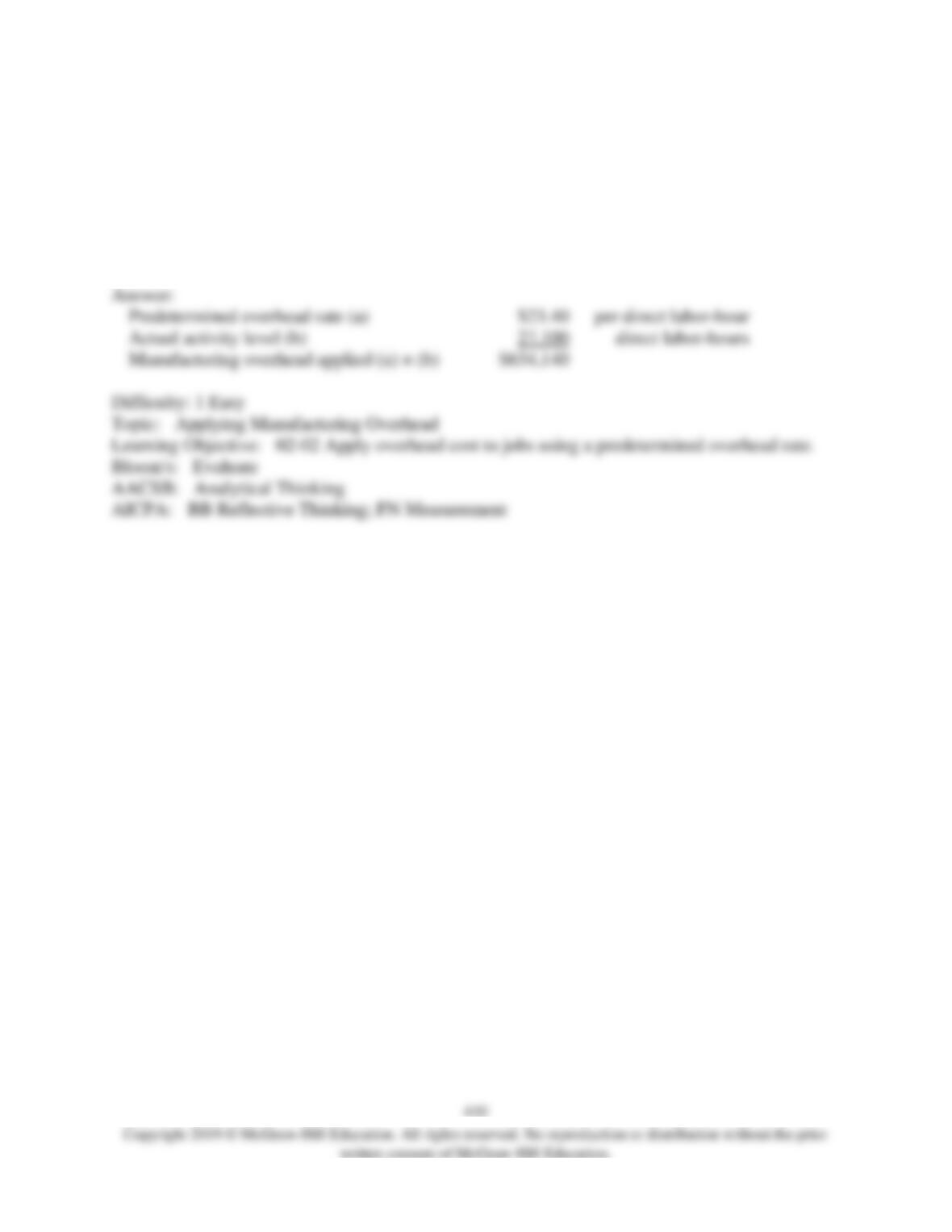
290) Levi Corporation uses a predetermined overhead rate of $23.40 per direct labor-hour. This
predetermined overhead rate was based on estimated total fixed manufacturing overhead of
$702,000 and 30,000 direct labor-hours for the period. The company incurred actual total fixed
manufacturing overhead of $738,000 and 27,100 total direct labor-hours during the period.
Required:
Determine the amount of manufacturing overhead that would have been applied to all jobs
during the period.
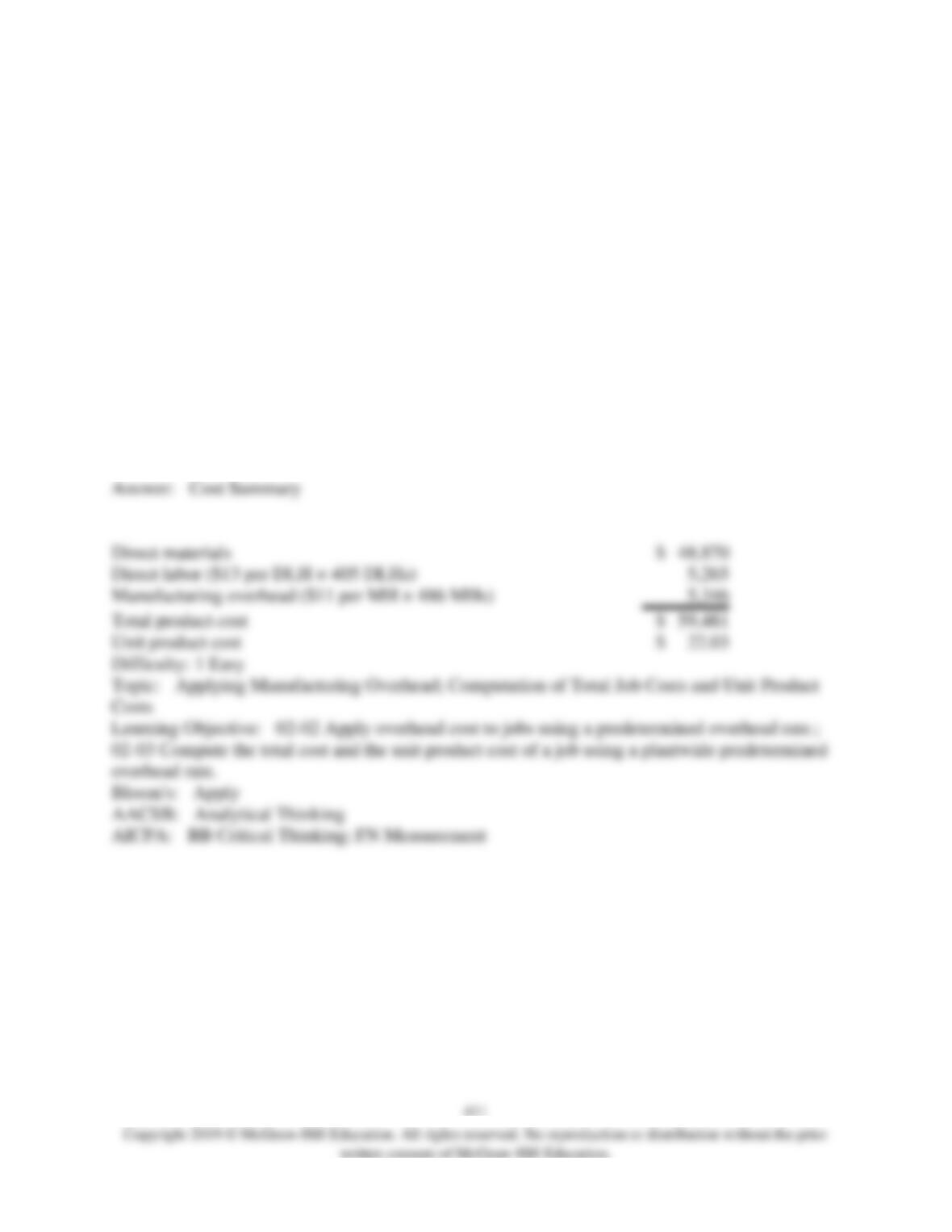
291) Job 243 was recently completed. The following data have been recorded on its job cost
sheet:
Direct materials
$
48,870
Direct labor-hours
405
labor-hours
Direct labor wage rate
$
13
per labor-hour
Machine-hours
486
machine-hours
Number of units completed
2,700
units
The company applies manufacturing overhead on the basis of machine-hours. The predetermined
overhead rate is $11 per machine-hour.
Required:
Compute the unit product cost that would appear on the job cost sheet for this job.
Direct materials
48,870
Direct labor ($13 per DLH × 405 DLHs)
Manufacturing overhead ($11 per MH × 486 MHs)
Total product cost
59,481
Unit product cost
$
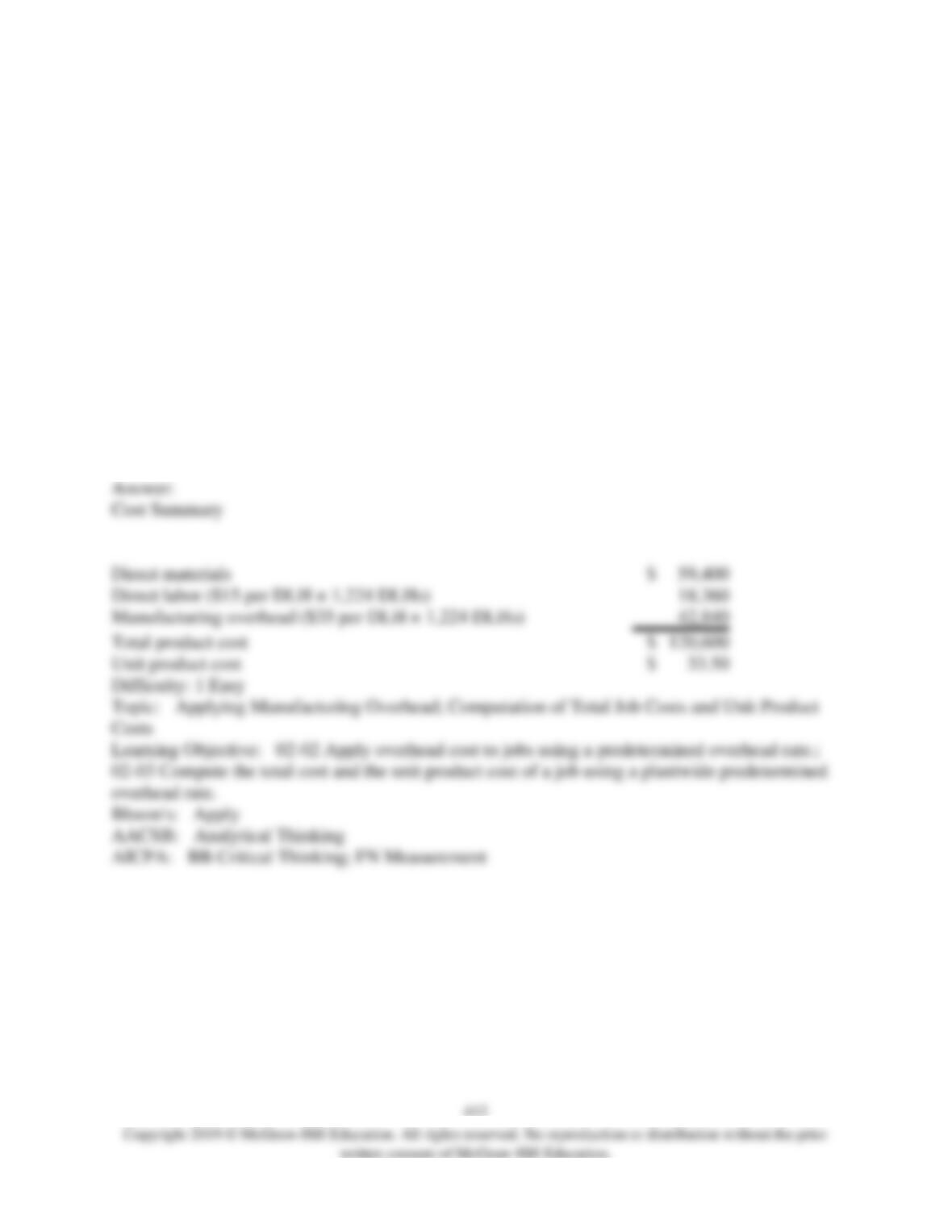
292) Job 652 was recently completed. The following data have been recorded on its job cost
sheet:
Direct materials
$
59,400
Direct labor-hours
1,224
DLHs
Direct labor wage rate
$
15
per DLH
Number of units completed
3,600
units
The company applies manufacturing overhead on the basis of direct labor-hours. The
predetermined overhead rate is $35 per direct labor-hour.
Required:
Compute the unit product cost that would appear on the job cost sheet for this job.
Direct materials
$
59,400
Direct labor ($15 per DLH × 1,224 DLHs)
18,360
Manufacturing overhead ($35 per DLH × 1,224 DLHs)
42,840
Total product cost
$
120,600
Unit product cost
$