81. Which of the following statements is false?
A. Value chain activities need to be closely coordinated.
82. The correct sequence of elements leading to an “available to promise” (ATP) is
A. item is not committed to another customer, item is on shelf, determine pricing, check customer credit limit
83. The four Ws of capturing data do not include
84. A basic unit of data such as a letter, number, or special character is known as a
85. A collection of related characters that comprise an attribute such as a customer number or name is known as
a
86. A collection of related data fields pertaining to a particular entity or event is known as a
87. The correct sequence of events for entering a customer order is
88. Steps in the sales and distribution process include all of the following except
89. Steps in the materials management process include all of the following except
90. The ____ module plays a central role in the SAP system by collecting business events from other modules.
91. The ____ module of the SAP system handles internal accounting including cost center accounting, activity–
based accounting, and budgeting.
92. The ____ module of the SAP system handles payroll processing.
93. Which of the following is included in the first step in the order-to-cash process?
94. What is the correct sequence of the order-to-cash process?
A. sales order processing; pick and pack; shipping; billing; payment; responding to customer inquiries
95. What is the first step in the purchase-to-pay process?
96. What is the correct sequence of the purchase-to-pay process?
97. ______________________________ integrate the business process functionality and information from all
of an organization’s functional areas, such as marketing and sales, cash receipts, purchasing, cash
disbursements, human resources, production and logistics, and business reporting (including financial
reporting).
98. ______________________________ are software packages that can be used for the core systems necessary
to support enterprise systems.
99. ______________________________ software builds and maintains an organization’s customer-related
database.
100. ______________________________ software allows an organization’s customers to complete an inquiry,
perform a task (including sales), or troubleshoot problems, without the aid of an organization’s employees.
101. ______________________________ software automates sales tasks such as order processing, contact
management, inventory monitoring, order tracking, and employee performance evaluation.
102. ______________________________ software helps plan and execute the steps in an organization’s supply
chain including demand planning; acquiring inventory; and manufacturing, distributing, and selling the
103. ______________________________ software manages the interactions with the organizations that supply
the goods and services to an enterprise.
104. ______________________________ software manages product data during a product’s life, beginning
with the design of the product, continuing through manufacture, and culminating in the disposal of the product
at the end of its life.
105. ______________________________ is the dominant player in the ERP market for large businesses.
106. ______________________________ includes integration of business processes, software, standards, and
hardware to link two or more systems together allowing them to act as one.
107. The ______________________________ approach combines modules from various vendors to create an
information system that better meets an organization’s needs than a standard ERP system.
108. A(n) ______________________________ is a means for connecting to a system or application provided
by the developer of that application.
109. ______________________________ usually includes a design environment for modeling and
documenting business processes. This is often integrated with the process engine to support iterative design and
implementation efforts for maximum process agility
110. ______________________________ is an approach to designing and building enterprise systems in which
business events trigger messages to be sent by middleware between independent software modules that are
completely unaware of each other.

111. ______________________________ is communications-broker software that uses standardized protocols
to let event-driven applications communicate in a less expensive manner than can the tightly coupled,
synchronous EAI platforms.
112. Primary activities of the ______________________________ include activities directly involved with
marketing, producing, selling, and delivering the product or service to the customer.
113. The ______________________________ of the value chain include functions such as moving raw
materials into and around the organization, producing and delivering goods to the customer, and performing
services such as installation and after-sales support.
114. The ______________________________ of the value chain are those that provide infrastructure and
include functions such as procurement, information technology, human resources and accounting.
115. Telling the customer when the item will be received is known as ______________________________.
116. A(n) ______________________________ is a basic unit of data such as a letter, number, or special
character.
117. A(n) ______________________________ is a collection of related characters that comprise an attribute,
such as a customer number or name.

118. A(n) ______________________________ is a collection of related data fields pertaining to a particular
entity or event.
119. The existence of the customer record, including the ______________________________, provides the
basic authorization required to accept and record the customer order.
120. The ______________________________ process includes the events surrounding the sale of goods to a
customer, the recognition of revenue, and the collection of the customer payment.
121. The ______________________________ process includes events surrounding the purchase of goods from
a vendor, the recognition of the cost of those goods, and the payment to the vendor
122. ______________________________ are older systems that may exist in an organization when a newer
system, such as an ERP, is installed.
123. Business events are “pushed” immediately and simultaneously to all interested parties in
______________________________ architecture.
124. The four Ws of capturing data are ______________________________,
______________________________, ______________________________, and
______________________________.
125. Edit order, record sales order, update inventory, notify warehouse is the sequence of events for entering
a(n) ______________________________.
126. The steps in the ______________________________ process include creating the purchase order,
receiving the goods and services, recording the vendor invoice
127. The module that handles internal accounting including cost center accounting, activity based accounting,
and budgeting is ______________________________.
128. The module that handles payroll processing is ______________________________.
129. The first step in the order-to-cash process is ______________________________.
130. The first step in the purchase-to-pay process is ______________________________.
131. ______________________________ include any meaningful change in the state of an enterprise, such as
creating a new employee record, submitting a purchase order to a vendor, receiving a payment from a customer,
picking goods from a warehouse and delivering them to the shipping department, and revaluing inventory.
132. Third-party modules are connected to the ERP system using ______________________________, a
software product that connects two or more separate applications or software modules.
133. Define enterprise resource planning (ERP) systems and give some examples of common ERP add-on
modules.
134. What are the primary activities of the value chain and what are some of the main functions included in the
value chain?
135. List and describe the 6 steps in the order-to-cash process.
136. List and describe the 5 steps in the purchase-to-pay process.
137. Describe 5 of the pros of an enterprise system.
138. Describe 3 of the cons of an enterprise system.
139. Why might a firm decide to implement only certain modules in an ERP system rather than a complete
implementation?
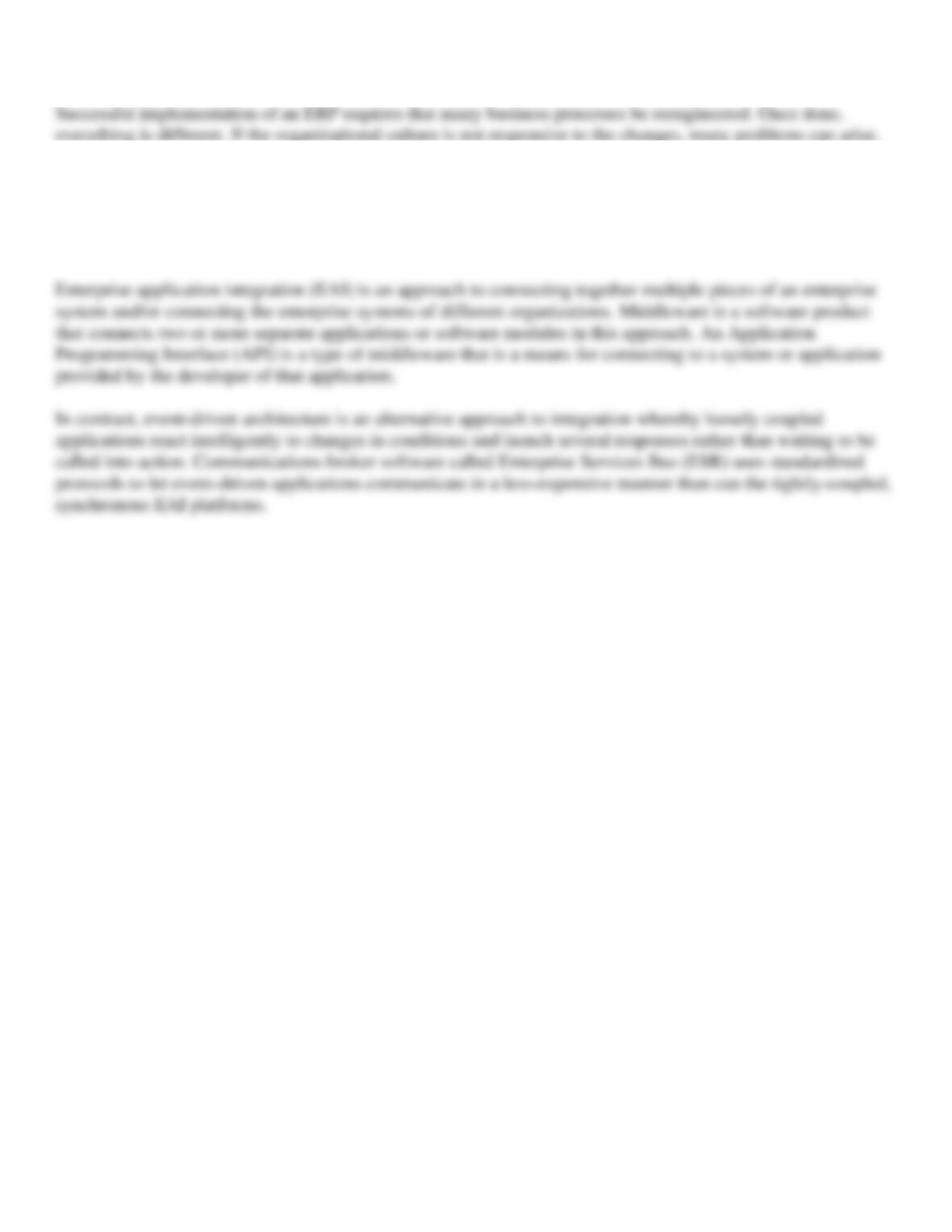
140. Why must an organization expect the implementation of an ERP to disrupt operations?
141. Describe and explain these concepts and their relationship to one another: enterprise application
integration, middleware, application programming interface, event-driven architecture, enterprise services bus.