51) Transaction analysis and the accounting equation have been used to record several transactions for a
company. The transactions are now recorded on a multi-column spreadsheet. When preparing a
balance sheet with this spreadsheet, which column(s) would be used?
A) final balances of asset columns only
B) final balances of liability columns only
C) final balances of stockholders’ equity columns only
D) all of the above
52) A multistep income statement reports different types of income that include:
A) sales revenue and service revenue.
B) income tax expense, utilities expense, rent expense.
C) operating income, income before income taxes, and net income.
D) cost of goods sold and operating expenses.
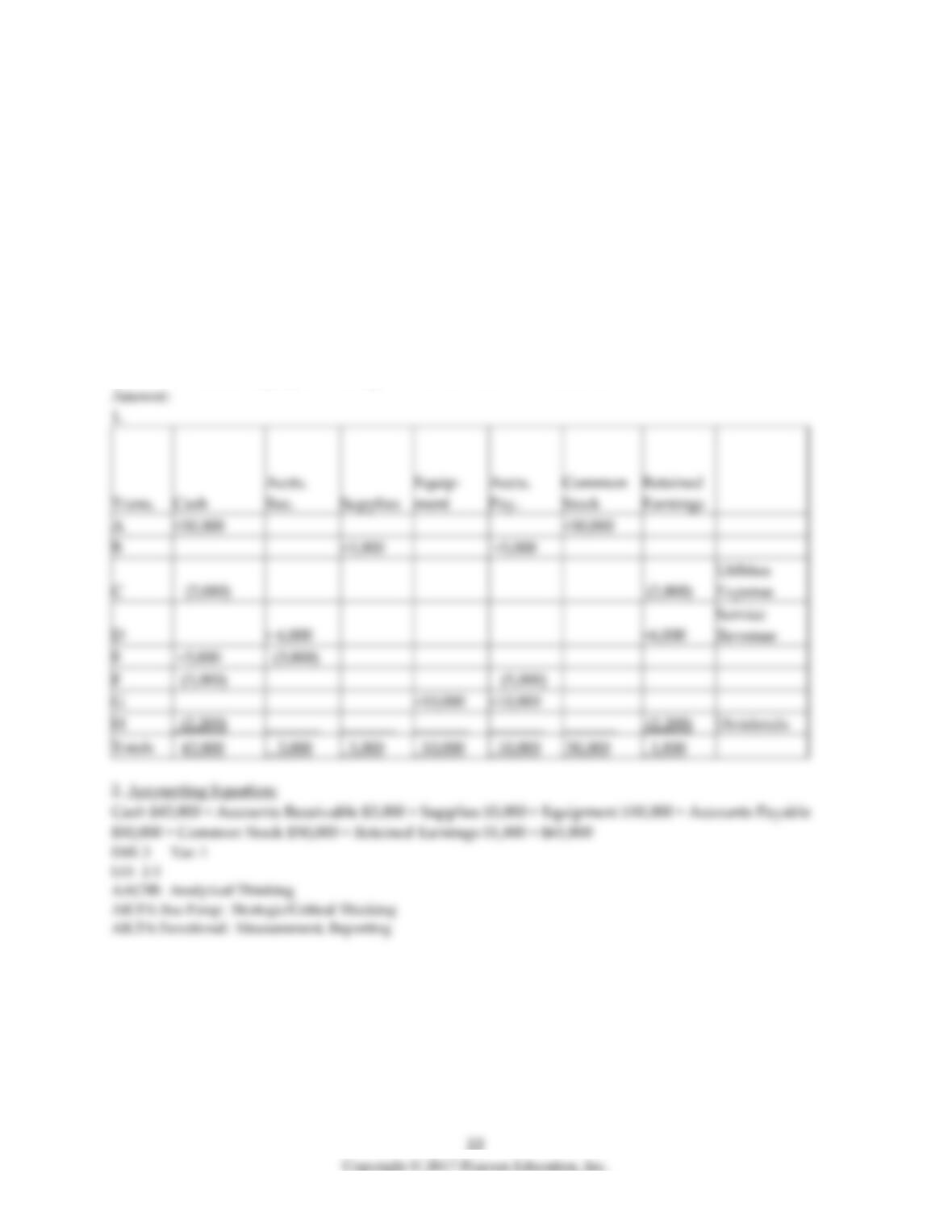
53) Beckowsik Company began business in June and completed the following transactions:
A) Received $50,000 cash and issued common stock to the stockholders.
B) Purchased supplies for $5,000 on account.
C) Received and paid utilities bill of $2,000 for the month.
D) Performed services for a customer and billed the customer $6,000.
E) Received $3,000 from the customer on account.
F) Paid for the supplies purchased on account.
G) Purchased equipment for $10,000 on account.
H) Declared and paid dividends of $2,200.
Required:
1. Record the effects of the above transactions on the accounting equation.
2. Prove the accounting equation using the final balances in the accounts.
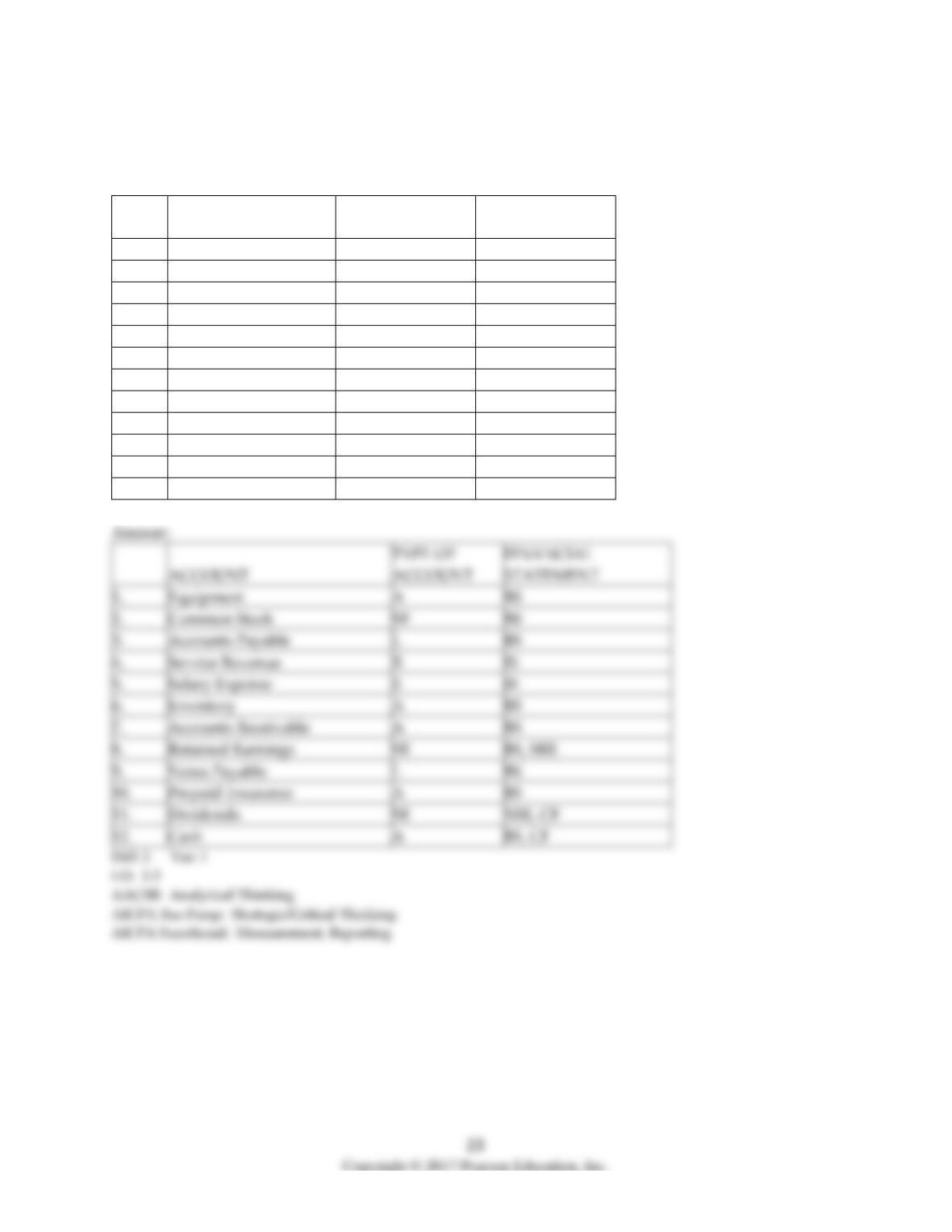
54) Indicate whether the account is an asset (A), liability (L), stockholders’ equity (SE), revenue (R) or
expense (E) account. Also indicate if the account would appear on the Balance Sheet (BS), Income
Statement (IS), Statement of Cash Flows (CF) or the Statement of Retained Earnings (SRE).
ACCOUNT
TYPE OF
ACCOUNT
FINANCIAL
STATEMENT
1.
Equipment
2.
Common Stock
3.
Accounts Payable
4.
Service Revenue
5.
Salary Expense
6.
Inventory
7.
Accounts Receivable
8.
Retained Earnings
9.
Notes Payable
10.
Prepaid Insurance
11.
Dividends
12.
Cash
ACCOUNT
TYPE OF
ACCOUNT
FINANCIAL
STATEMENT
1.
Equipment
A
2.
Common Stock
3.
Accounts Payable
L
4.
Service Revenue
R
5.
Salary Expense
E
6.
Inventory
A
7.
Accounts Receivable
A
8.
Retained Earnings
BS, SRE
9.
Notes Payable
L
10.
Prepaid Insurance
A
11.
Dividends
SRE, CF
12.
Cash
A
BS, CF
4 Learning Objective 2-4
1) The double-entry system of accounting records the dual effects of transactions on the entity.
2) When using the double-entry system of accounting each transaction affects only two accounts.
3) The difference between the total credits and the total debits is the balance in the account.
4) The left hand side of a T account is the debit side and the right hand side is the credit side.
5) Accounts Receivable is increased with a credit.
6) Every business transaction involves both at least one debit and at least one credit.
7) Assets, revenues, and dividends are all increased with debits.
8) Common stock and retained earnings are increased with debits.
9) If the sum of the credits to an account exceed the sum of the debits to the account, the account will
have a credit balance.
10) The left side of a T-account is always the:
A) increase side.
B) decrease side.
C) debit side.
D) credit side.
11) When working with T accounts, an important rule to remember is:
A) when an account is debited, an amount is entered on the right-hand side on the T account.
B) an increase to accounts payable will be recorded as a debit.
C) to credit an account means to enter an amount on the right-hand side of the T account.
D) the debit side of a T account is on the right-hand side of the T account for assets and expenses.
12) Which of the following statements, regarding the rules of debits and credits, is CORRECT?
A) An asset is increased by a credit.
B) Dividends are decreased by debits.
C) A liability is increased by a debit.
D) Revenue is increased by a credit.
13) Decreases in stockholders’ equity that result from the cost of operating the business are:
A) assets.
B) revenues.
C) expenses.
D) liabilities.
14) An important rule of debits and credits is:
A) credits increase revenue accounts.
B) debits decrease asset accounts.
C) debits increase liability accounts.
D) credits increase expense accounts.
15) Which accounts are increased by debits?
A) Cash and Accounts Payable.
B) Salaries Expense and Common Stock.
C) Accounts Receivable and Utilities Expense.
D) Accounts Payable and Service Revenue.
16) Company A received cash and issued stock to a new stockholder. In recording this transaction:
A) Cash would be debited.
B) Common Stock would be debited.
C) Cash would be credited.
D) Retained Earnings would be credited.
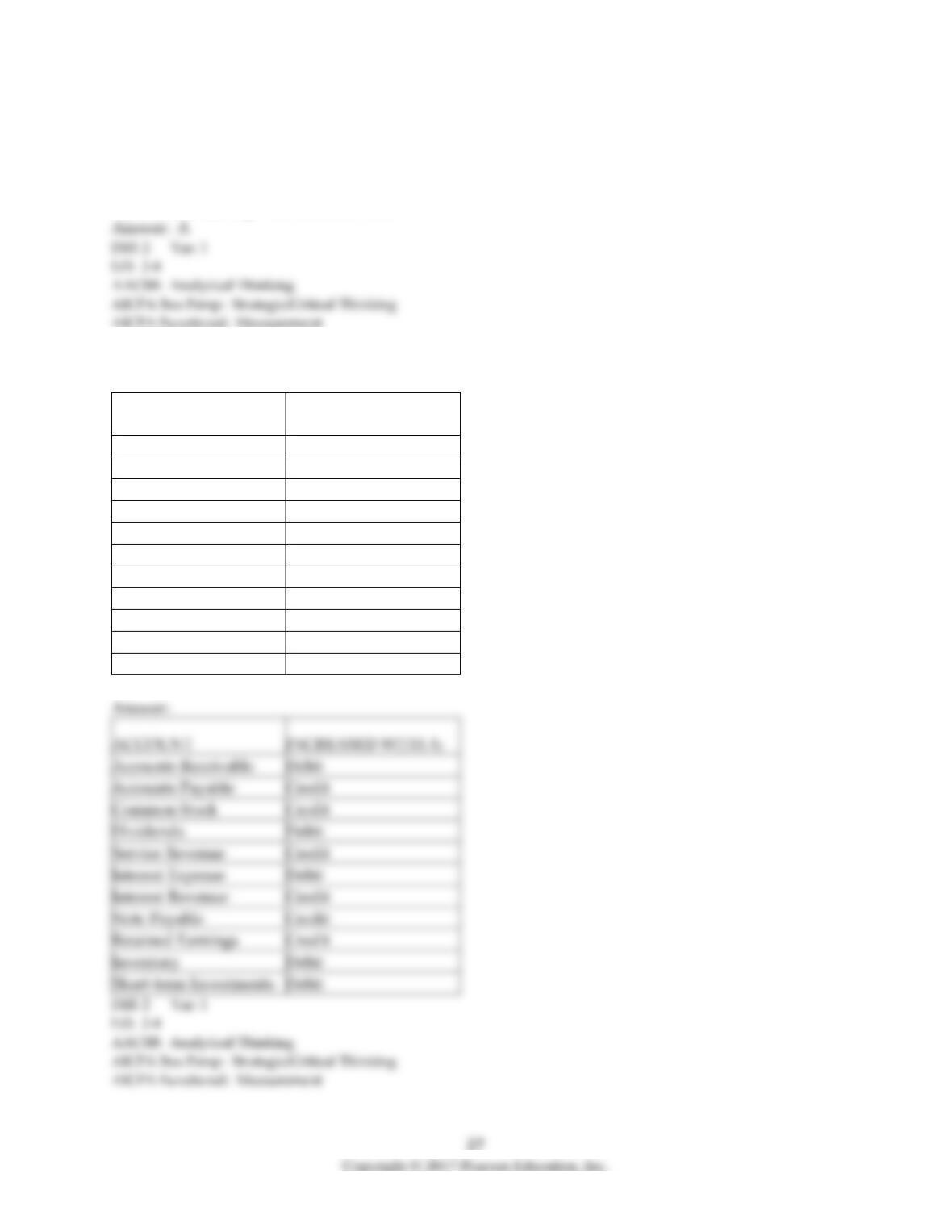
17) Complete the following chart indicating if the account is increased with a debit or a credit.
ACCOUNT
INCREASED WITH A:
Accounts Receivable
Accounts Payable
Common Stock
Dividends
Service Revenue
Interest Expense
Interest Revenue
Note Payable
Retained Earnings
Inventory
Short-term Investments
ACCOUNT
INCREASED WITH A:
Accounts Receivable
Debit
Accounts Payable
Credit
Common Stock
Credit
Dividends
Debit
Service Revenue
Credit
Interest Expense
Debit
Interest Revenue
Credit
Note Payable
Retained Earnings
Credit
Inventory
Debit
Short-term Investments
Debit
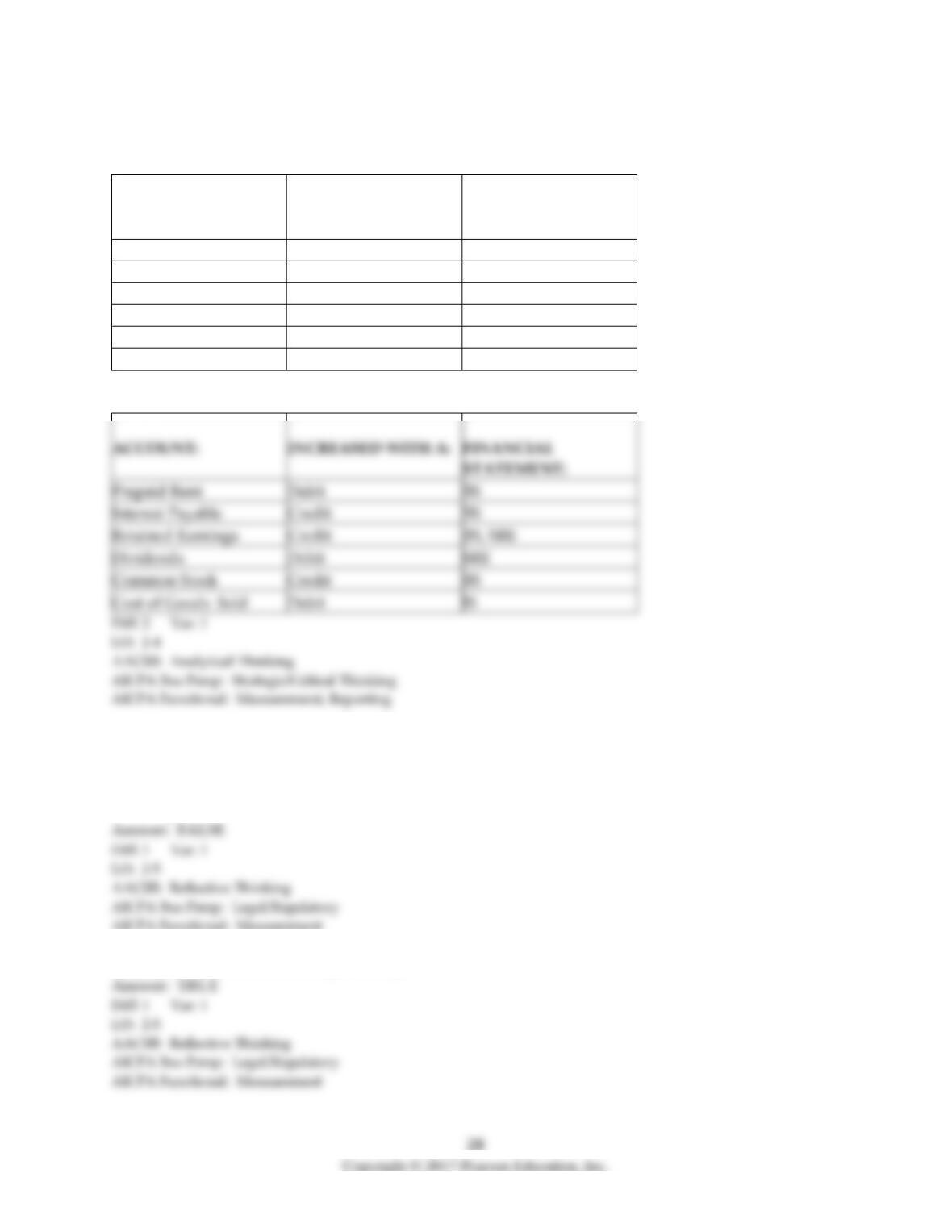
18) Indicate whether the account is increased with a debit or a credit. Also indicate if the account would
appear on the Balance Sheet (BS), Income Statement (IS), or the Statement of Retained Earnings (SRE).
ACCOUNT:
INCREASED WITH A:
FINANCIAL
STATEMENT:
Prepaid Rent
Interest Payable
Retained Earnings
Dividends
Common Stock
Cost of Goods Sold
Answer:
ACCOUNT:
INCREASED WITH A:
FINANCIAL
STATEMENT:
Prepaid Rent
Debit
Interest Payable
Credit
Retained Earnings
Credit
BS, SRE
Dividends
Debit
SRE
Common Stock
Cost of Goods Sold
Debit
5 Learning Objective 2-5
1) In the journalizing process, the credit side is entered on the left margin, and the debit side is indented
to the right.
2) The journal is the book of original entry.
3) Posting is the process of copying data from the ledger to the journal.
4) The total debits to an account must equal the total credits to the account.
5) In a journal entry, the sum of the debits must always equal the sum of the credits.
6) Journal entries can have more than two accounts as long as the total debits equal the total credits.
7) Each journal entry should contain a brief description of the transaction.
8) The balance of an account is the difference between the account’s total debits and total credits.
9) Entering a transaction in the journal is also known as booking the journal entry.
10) The journal is a grouping of all the T-accounts, with their balances.
11) Posting accounting transactions avoids the necessity of journalizing transactions.
12) Accounting transactions are initially recorded in the:
A) T-account.
B) ledger.
C) journal.
D) financial statements.
13) The first step in recording a transaction in the journal is:
A) determining whether each account is increased or decreased by the transaction.
B) copying the information from the journal to the ledger.
C) entering the debit side of the journal entry on the left margin and the credit side, which is indented to
the right.
D) specifying each account affected by the transaction and classifying the account by type.
14) The process of copying the information from the journal to the trial balance is:
A) called posting.
B) not undertaken.
C) called journalizing.
D) used to prepare the financial statements.
15) In order to see a complete transaction in one place, you would need to look at the:
A) trial balance.
B) ledger.
C) journal.
D) financial statements.
16) Entries are listed in the journal:
A) alphabetically.
B) chronologically.
C) with income statement accounts first and then balance sheet accounts.
D) in order of importance.
17) An account will have a debit balance if:
A) the amount of the credits exceeds the amount of the debits.
B) the amount of the debits exceeds the amount of the credits.
C) the account has more debit entries than credit entries.
D) it is a liability account.
18) What is the last step in the journalizing process?
A) Record the transaction in the journal.
B) Post the transaction to the ledger.
C) Determine whether each account is increased or decreased by the transaction.
D) Specify each account affected by the transaction and classify each account by type.
19) Which of the following items would NOT be included in the journal entry for a transaction?
A) the names of the employees involved in recording the transaction
B) the date the transaction occurred
C) the titles of the accounts debited
D) the dollar amount of the transaction
20) The proper order for the accounting process is:
A) posting, transaction occurs, journalizing.
B) transaction occurs, posting, journalizing.
C) transaction occurs, transaction analyzed, journalizing, and posting.
D) transaction occurs, posting, transaction analyzed, journalizing.
21) The ledger:
A) is a grouping of all of the balance sheet accounts only.
B) is a grouping of all the income statement accounts only.
C) contains all the accounts used by a business.
D) contains only the permanent accounts used by a business.
22) Posting is:
A) copying the information from the journal to the trial balance.
B) entering the data into the journal.
C) copying the information from the journal to the ledger.
D) copying the information from the ledger to the financial statements.
23) Every journal entry:
A) must increase at least one account and decrease at least one account.
B) must debit at least one account and credit at least one account.
C) is recorded in either the journal or the ledger.
D) affects both an income statement account and a balance sheet account.
24) In order to determine the balance in an account, you must look at the:
A) source documents.
B) journals.
C) ledger.
D) book of original entry.
25) When an expense account is increased:
A) an amount is entered on the credit side of the expense account.
B) an amount is entered on the debit side of the expense account.
C) cash must always be credited.
D) stockholders’ equity is not affected.
26) The entry to record the purchase of supplies on account includes a credit to:
A) Supplies.
B) Accounts Payable.
C) Supplies Expense.
D) Cash.
27) Which of the following transactions includes a credit to cash?
A) the purchase of supplies on account
B) the payment of an accounts payable
C) the collection of cash from an accounts receivable
D) receipt of cash from a customer when service is provided
28) If a journal entry includes a debit to Accounts Payable and a credit to Cash:
A) Cash will have a credit balance.
B) Accounts Payable is increased.
C) Cash is increased.
D) Accounts Payable is decreased.
29) On March 31, Baker Company received a bill and paid for advertising costs for the current month.
This payment results in a:
A) debit to Cash.
B) debit to Prepaid Advertising.
C) debit to Advertising Expense.
D) credit to Advertising Revenue.
30) A journal entry that debits Cash and credits Accounts Receivable indicates that:
A) payment was received on account.
B) payment was made on account.
C) revenue increased.
D) revenue decreased.
31) An owner makes an investment of cash into the business and receives shares of stock. This
transaction is recorded as a:
A) debit to Common Stock and a credit to Cash.
B) debit to Cash and a credit to Common Stock.
C) debit to Cash and a credit to Retained Earnings.
D) debit to Cash and a credit to Stockholder Revenue.
32) A transaction that includes a debit to an expense and a credit to a liability indicates that:
A) revenues increased.
B) expenses decreased.
C) liabilities increased.
D) liabilities decreased.
33) The purchase of equipment, involving a cash down payment and a promise to pay the balance in the
future, includes:
A) a debit to Cash and a credit to Equipment.
B) a debit to Note Payable and a credit to Cash.
C) a credit to Cash and a credit to Accounts Payable.
D) a debit to Cash and a debit to Note Payable.
34) The purchase of office computers for cash includes a debit to:
A) Cash and a credit to Office Equipment.
B) Office Equipment and a credit to Accounts Payable.
C) Accounts Receivable and credit to Office Equipment.
D) Office Equipment and a credit to Cash.
35) A company sold land for the same price that they paid for it last year. When entering this
transaction in the journal, there will be a:
A) credit to Land.
B) debit to Land.
C) debit to Accounts Payable.
D) credit to Accounts Receivable.
36) A partner in Sturm Company purchased a new yacht, for personal use, with his own funds. Sturm
Company would:
A) debit an asset account.
B) credit a revenue account.
C) credit a liability account.
D) not record the transaction in its books.
37) Jaye Company purchased a new building by signing a note for $21,000. The entry to record the
transaction is:
A)
Cash
21,000
Note Payable
21,000
B)
Building
21,000
Cash
21,000
C)
Note Payable
21,000
Cash
21,000
D)
Building
21,000
Notes Payable
21,000
38) When posting a journal entry to the ledger, transfer:
A) the dollar amount of debits in the journal entry to the appropriate accounts.
B) the dollar amounts of credits in the journal entry to the appropriate accounts.
C) the name of the person who prepared the journal entry.
D) A and B.
39) A business paid $48,000 cash to purchase equipment. The business would:
A) debit Equipment for $48,000 and credit Accounts Payable for $48,000.
B) debit Equipment for $48,000 and credit Cash for $48,000.
C) debit Cash for $48,000 and credit Notes Payable for $48,000.
D) debit Accounts Payable for $48,000 and credit Cash for $48,000.
40) A business purchased office supplies of $29,000 by signing a note. The business would:
A) debit Supplies for $29,000 and credit Accounts Payable for $29,000.
B) debit Supplies for $29,000 and credit Notes Payable for $29,000.
C) debit Notes Receivable for $29,000 and credit Supplies for $29,000.
D) debit Notes Payable for $29,000 and credit Supplies Expense for $29,000.
41) A business purchased office supplies of $10,000 on account. The business would:
A) debit Accounts Receivable for $10,000 and credit Supplies for $10,000.
B) debit Supplies for $10,000 and credit Cash for $10,000.
C) debit Accounts Payable for $10,000 and credit Supplies for $10,000.
D) debit Supplies for $10,000 and credit Accounts Payable for $10,000.
42) A business paid $1900 on account. The journal entry would:
A) debit Accounts Receivable for $1900 and credit Revenue for $1900.
B) debit Accounts Payable for $1900 and credit Cash for $1900.
C) debit Cash for $1900 and credit Retained Earnings for $1900.
D) debit Cash for $1900 and credit Accounts Payable for $1900.
43) Two employees worked one week and were paid salaries of $1600. The journal entry would:
A) debit Cash for $1600 and credit Salaries Payable for $1600.
B) debit Cash for $1600 and credit Salary Expense for $1600.
C) debit Accounts Payable for $1600 and credit Salary Payable for $1600.
D) debit Salary Expense for $1600 and credit Cash for $1600.
44) A business sold equipment for $40,300 cash. The equipment was purchased one month earlier for
$40,300 but the plans for the equipment changed.
A) Debit Equipment for $40,300 and credit Cash for $40,300.
B) Debit Equipment for $40,300 and credit Retained Earnings for $40,300.
C) Debit Cash for $40,300 and credit Equipment for $40,300.
D) Debit Retained Earnings for $40,300 and credit Equipment for $40,300.
45) On May 1, a business provided legal services to a client and billed the client $3700. The client
promised to pay the business in one month. Which journal entry should the business record on May 1?
A) Debit Cash for $3700 and credit Service Revenue for $3700.
B) Debit Cash for $3700 and credit Retained Earnings for $3700.
C) Debit Accounts Receivable for $3700 and credit Service Revenue for $3700.
D) Debit Accounts Payable for $3700 and credit Service Revenue for $3700.
46) On May 10, a business collected $3300 on account. What journal entry is needed on that date?
A) Debit Cash for $3300 and credit Revenue for $3300.
B) Debit Accounts Receivable for $3300 and credit Revenue for $3300.
C) Debit Cash for $3300 and credit Accounts Receivable for $3300.
D) Debit Accounts Payable for $3300 and credit Revenue for $3300.
47) A business received the current month’s utility bill for $1625, and immediately paid it. Which
journal entry is prepared?
A) Debit Accounts Payable for $1625 and credit Cash for $1625.
B) Debit Utilities Payable for $1625 and credit Cash for $1625.
C) Debit Utilities Expense for $1625 and credit Cash for $1625.
D) Debit Operating Expense for $1625 and credit Accounts Payable for $1625.
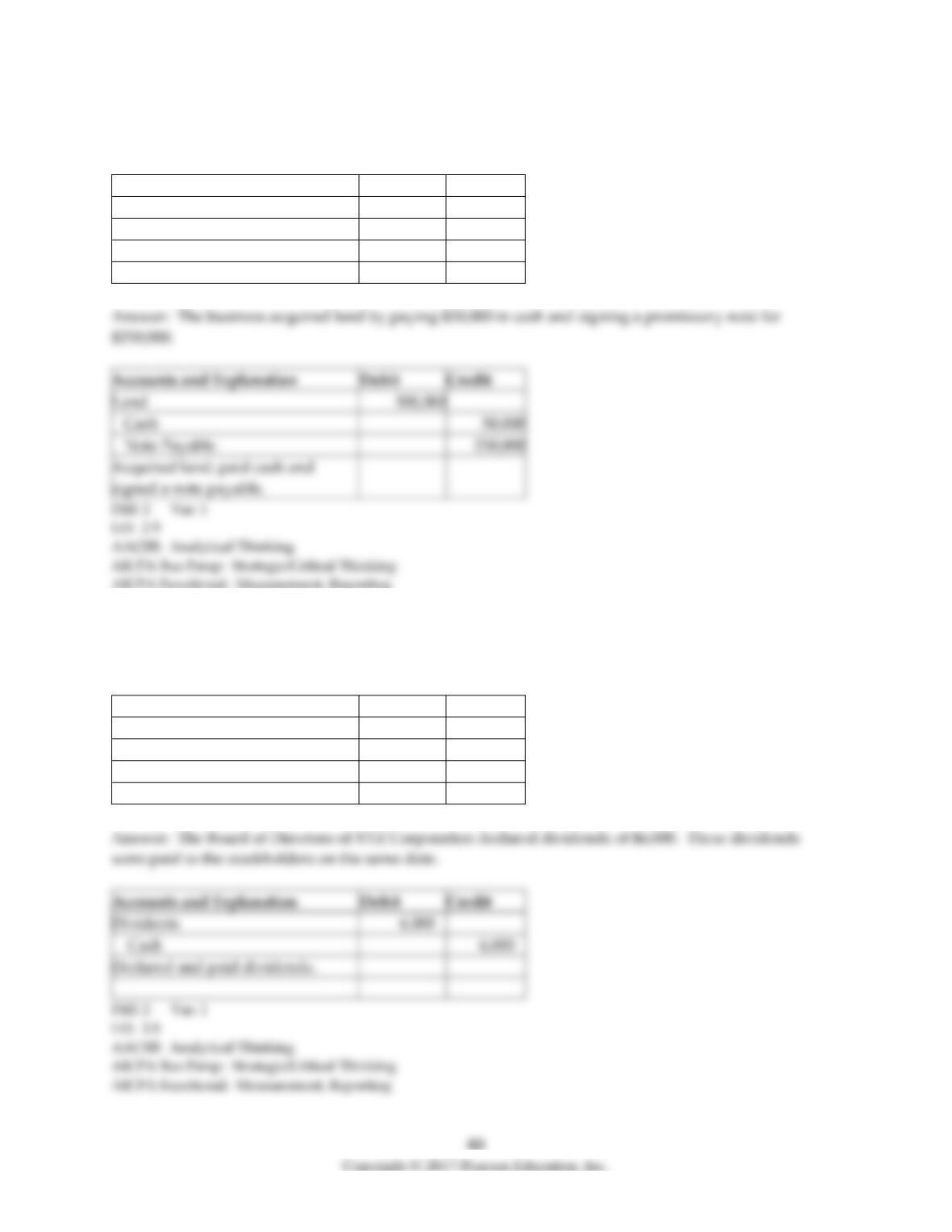
48) Prepare the journal entry for the following transaction:
The business acquired land by paying $50,000 in cash and signing a promissory note for $250,000.
Accounts and Explanation
Debit
Credit
Accounts and Explanation
Debit
Credit
Land
signed a note payable.
49) Prepare the journal entry for the following transaction:
The Board of Directors of XYZ Corporation declared dividends of $6,000. These dividends were paid to
the stockholders on the same date.
Accounts and Explanation
Debit
Credit
Dividents
Declared and paid dividends.