21
19) A business makes a cash payment to a supplier “on account” (for supplies which were purchased earlier.) Which
account is debited?
A) Cash
B) Accounts payable
C) Supplies
D) Service revenue
20) A business makes a cash payment to a supplier “on account” (for supplies which were purchased earlier.) Which
account is credited?
A) Cash
B) Accounts payable
C) Supplies
D) Service revenue
21) A business collects cash from a customer in payment of accounts receivable. Which account is debited?
A) Cash
B) Accounts receivable
C) Service revenue
D) Supplies
22) A business collects cash from a customer in payment of accounts receivable. Which account is credited?
A) Cash
B) Accounts receivable
C) Service revenue
D) Supplies
22
23) A business borrows cash by signing a note payable. Which account is debited?
A) Notes payable
B) Accounts payable
C) Accounts receivable
D) Cash
24) A business borrows cash by signing a note payable. Which account is credited?
A) Notes payable
B) Accounts payable
C) Accounts receivable
D) Cash
25) A business repays the amount borrowed on a note payable. Which account is debited?
A) Cash
B) Equipment
C) Notes payable
D) Notes receivable
26) A business repays the amount borrowed on a note payable. Which account is credited?
A) Cash
B) Equipment
C) Notes payable
D) Notes receivable
23
27) A business makes a cash payment for advertising expense. Which account is debited?
A) Cash
B) Service revenue
C) Accounts receivable
D) Advertising expense
28) A business makes a cash payment for advertising expense. Which account is credited?
A) Cash
B) Service revenue
C) Accounts receivable
D) Advertising expense
29) A business pays cash back to the owner. Which account is debited?
A) Cash
B) Drawing
C) Accounts payable
D) Service revenue
30) A business pays cash back to the owner. Which account is credited?
A) Cash
B) Drawing
C) Accounts payable
D) Service Revenue
24
31) A business makes a payment of $1,200 on a note payable, consisting of a $200 interest payment and a $1,000
principal payment. Which of the following journal entries would be recorded?
A) Cash is credited for $1,000; Interest expense is credited for $200; and Notes payable is debited for $1,200.
B) Notes payable is credited for $1,000; Cash is credited for $200; and Interest expense is debited for $1,200.
C) Cash is credited for $1,200; Notes payable is debited for $1,000; and Interest expense is debited for $200.
D) Notes payable is credited for $1,200; Cash is debited for $1,000; and Interest expense is debited for $200.
32) A business purchases equipment by paying cash of $8,000 and issuing a note payable of $12,000. Which of the
following occurs?
A) Cash is credited for $8,000; Equipment is credited for $20,000; and Notes payable is debited for $12,000.
B) Cash is credited for $8,000; Equipment is debited for $20,000; and Notes payable is credited for $12,000.
C) Cash is debited for $8,000; Equipment is debited for $12,000; and Notes payable is credited for $20,000.
D) Cash is credited for $8,000; Equipment is credited for $12,000; and Notes payable is debited for $4,000.
33) Which of the following journal entries would be recorded if a business purchased $200 of supplies on account?
A)
Accounts payable
200
Supplies
200
B)
Supplies
200
Accounts payable
200
C)
Supplies
200
Cash
200
D)
Cash
200
Supplies
200
25
34) Which of the following journal entries would be recorded if a business renders service and receives cash of $400
from the customer?
A)
Service revenue
400
Cash
400
B)
Service revenue
400
Accounts payable
400
C)
Cash
400
Service revenue
400
D)
Service revenue
400
Accounts receivable
400
35) Which of the following journal entries would be recorded if a business makes a cash payment to a supplier of
$600 “on account” (the business had purchased supplies on account in the previous month)?
A)
Cash
600
Accounts payable
600
B)
Accounts payable
600
Cash
600
C)
Cash
600
Supplies
600
D)
Accounts payable
600
Supplies
600
26
36) Which of the following journal entries would be recorded if Jane Brown started a business, and then deposited
cash of $6,000 into the business’s bank account?
A)
Cash
6,000
Jane Brown, capital
6,000
B)
Accounts payable
6,000
Cash
6,000
C)
Jane Brown, capital
6,000
Cash
6,000
D)
Jane Brown, capital
6,000
Accounts payable
6,000
37) Which of the following journal entries would be recorded if a business purchased equipment for $3,000 cash?
A)
Cash
3,000
Equipment
3,000
B)
Equipment
3,000
Cash
3,000
C)
Cash
3,000
Accounts payable
3,000
D)
Equipment
3,000
Accounts payable
3,000
27
38) Which of the following journal entries would be recorded if a business collects $1,000 cash on account from a
customer for services performed at an earlier date?
A)
Cash
1,000
Service revenue
1,000
B)
Accounts receivable
1,000
Service revenue
1,000
C)
Cash
1,000
Accounts receivable
1,000
D)
Service revenue
1,000
Accounts receivable
1,000
39) Which of the following journal entries would be recorded if a business purchases equipment for $2,500 cash and
supplies for $450 cash?
A)
Equipment
2,950
Cash
2,500
Supplies
450
B)
Cash
2,500
Equipment
450
Accounts receivable
2,950
C)
Cash
2,950
Equipment
2,500
Supplies
450
D)
Equipment
2,500
Supplies
450
Cash
2,950
28
40) A business makes a payment of $1,200 on a note payable, consisting of a $200 interest payment and a $1,000
principal payment. Which of the following journal entries would be recorded?
A)
Notes payable
1,000
Interest expense
200
Cash
1,200
B)
Cash
1,200
Notes payable
1,000
Interest expense
200
C)
Notes payable
1,200
Cash
1,000
Interest expense
200
D)
Cash
1,000
Notes payable
1,200
Interest expense
200
41) A business purchases equipment by paying $8,000 in cash and issuing a note payable of $12,000. Which of the
following journal entries would be recorded?
A)
Equipment
20,000
Notes payable
12,000
Cash
8,000
B)
Cash
8,000
Notes payable
12,000
Equipment
20,000
C)
Cash
8,000
Notes payable
4,000
Equipment
12,000
D)
Equipment
8,000
Notes payable
4,000
Cash
12,000
29
42) The following transactions have been journalized and posted to the proper accounts.
1. Mark Call invested $7,000 cash in his new design services business.
2. The business paid the first month’s rent of $700.
3. The business purchased equipment by paying $2,000 cash and executing a note payable for $4,500.
4. The business purchased supplies for $850 cash.
5. The business billed a client for $4,000 of design services completed.
6. The business received $3,000 of the account for the completed services.
What is the balance in Cash?
A) $7,850
B) $6,450
C) $8,450
D) $8,150
43) Which of the following journal entries would be recorded if a business purchased $200 of supplies by paying
cash?
A)
Cash
200
Supplies
200
B)
Accounts payable
200
Supplies
200
C)
Supplies
200
Cash
200
D)
Supplies
200
Accounts payable
200
30
44) A business purchased a building by paying part of the purchase price in cash as a down payment and signing a
mortgage note for the remainder. The business should:
A) debit the mortgage note payable for the amount of the mortgage.
B) debit the building account for the amount of the mortgage.
C) debit cash for the amount paid on the down payment.
D) credit the mortgage note payable for the amount of the mortgage.
45) A company received $75,000 from a customer “on account.” The journal entry would be to:
A) debit Accounts receivable and credit Sales revenue.
B) debit Accounts receivable and credit Cash.
C) debit Cash and credit Accounts receivable.
D) debit Sales revenue and credit Accounts receivable.
46) ABC Services reported the following transactions for September, 2013.
A) The owner opened the business with a capital contribution of $23,500 cash. It was credited to Capital.
B) The business purchased office equipment for $11,500. The business paid $2,500 down and put the balance on a
note payable.
C) The business paid a utility bill for $980 cash.
D) The business paid $2,000 cash for September rent.
E) The business had sales of $15,000 in September. Of these sales, 60% were cash sales, and the balance was
credit sales.
F) The business paid $9,700 cash for office furniture.
What is the net income for September, 2013?
A) $12,020
B) $9,000
C) $6,020
D) $5,300
31
47) ABC Services reported the following transactions for September, 2013.
A) The owner opened the business with a capital contribution of $23,500 cash. It was credited to Capital.
B) The business purchased office equipment for $11,500. The business paid $2,500 cash down and put the balance
on a note payable.
C) The business paid insurance expense of $1,350 cash.
D) The business paid a utility bill for $980 cash.
E) The business paid $2,000 cash for September rent.
F) The business had sales of $12,000 in September. Of these sales, 60% were cash sales, and the balance was
credit sales.
G) The business paid $9,700 cash for office furniture.
What are the total liabilities at the end of September, 2013?
A) $980
B) $2,330
C) $9,000
D) $4,800
48) ABC Services reported the following transactions for September, 2013.
A) The owner opened the business with a capital contribution of $23,500 cash. It was credited to Capital.
B) The business purchased office equipment for $11,500. The business paid cash of $2,500 down and put the
balance on a note payable.
C) The business purchased $1,350 of supplies on account.
D) The business paid a utility bill for $980 cash.
E) The business paid $2,000 cash for September rent.
F) The business had sales of $20,000 in September. Of these sales, 60% were cash sales, and the balance was
credit sales.
G) The business paid $9,700 cash for office furniture.
What is the total amount in the Cash account at the end of September, 2013?
A) $15,520
B) $20,320
C) $28,320
D) $18,970
49) The following transactions have been journalized and posted to the proper accounts.
1. Mark Call invested $7,000 cash in his new design services business.
2. The business paid the first month’s rent with $700 cash.
3. The business purchased equipment by paying $2,000 down and executing a note payable for $4,500.
4. The business purchased supplies for $850 cash.
5. The business billed its clients a total of $4,000 for design services rendered.
6. The business collected $3,000 on account from one of its clients.
What is the balance in Accounts receivable?
A) $8,500
B) $1,000
C) $7,000
D) $4,000
50) The following transactions have been journalized and posted to the proper accounts.
1. Mark Call invested $7,000 cash in his new design services business.
2. The business paid the first month’s rent with $700 cash.
3. The business purchased equipment by paying $2,000 down and executing a note payable for $4,500.
4. The business purchased supplies for $850 cash.
5. The business billed its clients a total of $4,000 for design services rendered.
6. The business collected $3,000 on account from one of its clients.
What is the total amount of assets after all the above transactions have been completed?
A) $7,800
B) $13,800
C) $12,800
D) $14,800
51) The following transactions have been journalized and posted to the proper accounts.
1. Mark Call invested $7,000 cash in his new design services business.
2. The business paid the first month’s rent with $700 cash.
3. The business purchased equipment by paying $2,000 down and executing a note payable for $4,500.
4. The business purchased supplies for $850 cash.
5. The business billed its clients a total of $4,000 for design services rendered.
6. The business collected $3,000 on account from one of its clients.
What is the balance in Service revenue?
A) $1,000
B) $3,000
C) $4,000
D) $3,150
52) The following transactions have been journalized and posted to the proper accounts.
1. Mark Call invested $7,000 cash in his new design services business.
2. The business paid the first month’s rent with $700 cash.
3. The business purchased equipment by paying $2,000 down and executing a note payable for $4,500.
4. The business purchased supplies for $850 cash.
5. The business billed its clients a total of $4,000 for design services rendered.
6. The business collected $3,000 on account from one of its clients.
How much was net income?
A) $700
B) $300
C) $3,300
D) $2,450
53) The following entries were made by the accountant of Patel Pastries during its first month of operation:
1. James Patel, the owner, deposited $3,000 in the business’s new checking account.
2. Patel Pastries paid the first month’s rent of $400 in cash.
3. Patel Pastries purchased equipment by signing a note payable of $11,000.
4. Cash sales for the month were $4,500.
5. Patel Pastries purchased cooking supplies for $1,400 cash.
After the accountant posts these entries to the general ledger, what is the balance in the Cash account?
A) $7,500
B) $7,100
C) $5,700
D) $16,700
54) The following entries were made by the accountant of Patel Pastries during its first month of operation.
1. James Patel, the owner, deposited $3,000 in the business’s new checking account.
2. Patel Pastries paid the first month’s rent of $400 in cash.
3. Patel Pastries purchased equipment by signing a note payable of $11,000.
4. Cash sales for the month were $4,500.
5. Patel Pastries purchased cooking supplies for $1,400 cash.
After the accountant posts these entries to the general ledger, how much are total assets?
A) $16,700
B) $18,100
C) $7,100
D) $6,100
35
55) Equipment is purchased for cash. Which of the following would be TRUE?
A) There is an increase in total assets.
B) There is a decrease in both total assets and total liabilities.
C) There is an increase in total assets and a decrease in total liabilities.
D) There is no effect on total assets.
56) A business owner took a withdrawal. Which of the following would be TRUE?
A) Net income would decrease.
B) Total assets would increase.
C) There would be no effect on total assets.
D) Owner’s equity would decrease.
57) A utility bill is received for expenses incurred. It will be paid in the following accounting period. Which of the
following would be TRUE as a result of the receipt of the utility bill?
A) Net income will increase.
B) Owner’s equity will decrease.
C) Total liabilities will decrease.
D) There will be no effect on total liabilities.
36
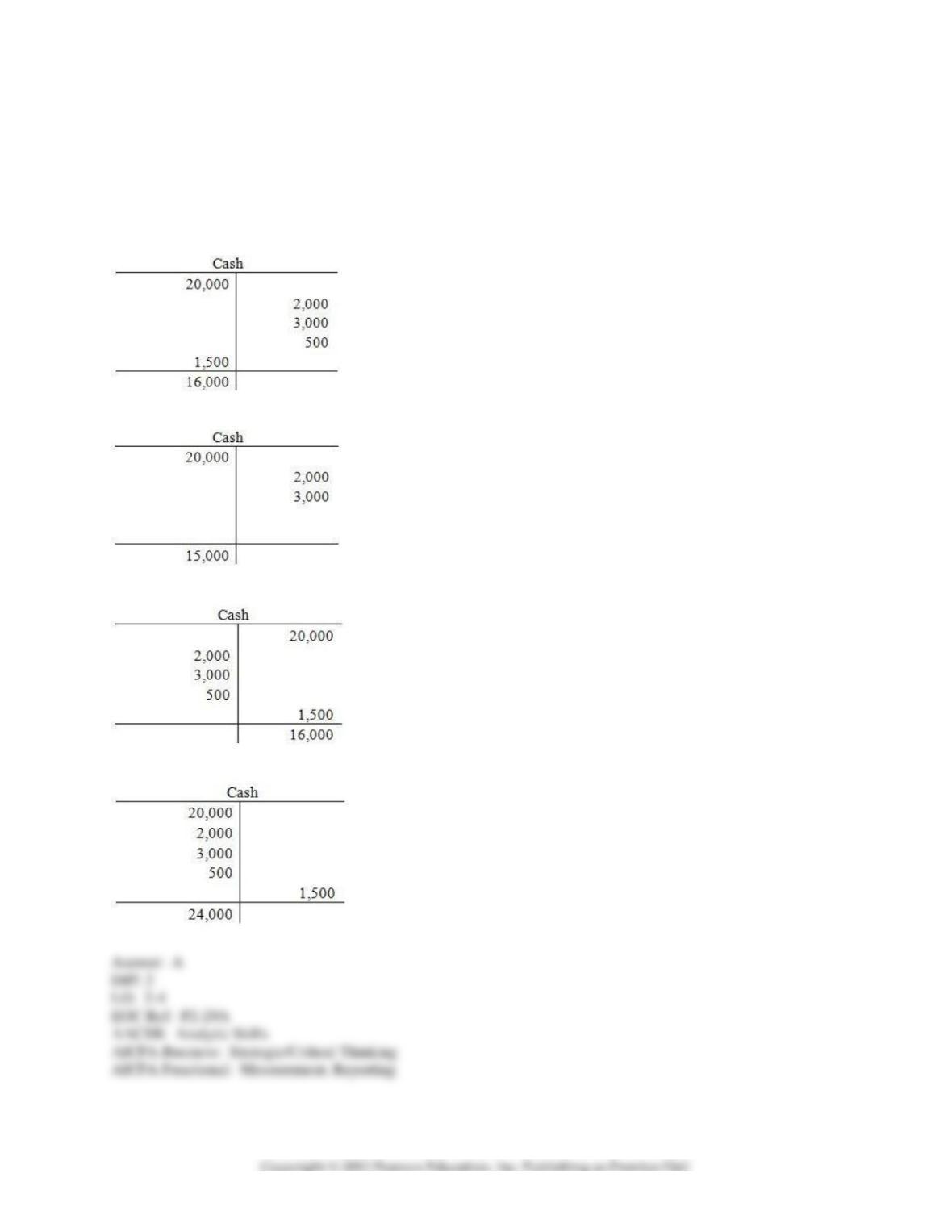
58) A business has the following transactions: The business is started by receiving $20,000 from the owner. The
business purchases $500 of supplies on account. The business purchases $2,000 of furniture on account. The
business renders services to various clients totaling $9,000 on account. The business pays out $2,000 for Salary
expense and $3,000 for Rent expense. The business pays $500 to a supplier for the supplies purchased earlier. The
business collects $1,500 from one of its clients for services rendered earlier in the month. At the end of the month,
all journal entries are posted to the ledger. The Cash account will appear as follows:
A)
B)
C)
D)