1. The cost of an item is the sacrifice of resources made to acquire it.
2. An expense is an expired cost matched with revenues in a specific accounting period.
3. An asset is a cost matched with revenues in a future accounting period.
4. Accounting systems typically record opportunity costs as assets and treat them as
intangible items on the financial statements.
5. Total cost of goods purchased
minus
beginning merchandise inventory
plus
ending
merchandise inventory
equals
cost of goods sold.
6. Cost of goods sold includes the actual costs of the goods sold and the cost of selling them
to the customer.
7. Period costs are those costs assigned to units of production in the period in which they
are incurred.
8. Only direct costs can be classified as product costs; indirect costs are classified as period
costs.
9. The three categories of product costs are direct materials, direct labor, and manufacturing
overhead.
10. The first step in determining whether a cost is direct or indirect is to specify the cost
allocation rule.
11. Total work-in–process during the period is the sum of the beginning work–in-process
inventory and the total manufacturing costs incurred during the period.
12. Cost of goods sold
plus
the ending finished goods inventory
minus
the beginning finished
goods inventory
equals
the cost of goods manufactured.
13. If the cost of goods manufactured during the period exceeds the cost of goods sold, the
ending balance of Finished Goods Inventory account increased.
14. Total variable costs change inversely with changes in the volume of activity.
15. Fixed costs per unit change inversely with changes in the volume of activity.
16. The range within which fixed costs remain constant as volume of activity varies is known
as the relevant range.
17. The term
full
cost
refers to the cost of manufacturing and selling a unit of product and
includes both fixed and variable costs.
18. Variable marketing and administrative costs are included in determining full absorption
costs.
19. Revenue
minus
cost of goods sold
equals
contribution margin.
20. The primary goal of the cost accounting system is to provide managers with information to
prepare their annual financial statements.
21. Which of the following statements is (are) true?
(1). An asset is a cost that will be matched with revenues in a future accounting period.
(2). Opportunity costs are recorded as intangible assets in the current accounting period.
23. Which of the following best distinguishes an opportunity cost from an outlay cost?
24. Which of the following accounts would be a period cost rather than a product cost?
25. A company which manufactures custom-made machinery routinely incurs sizable
telephone costs in the process of taking sales orders from customers. Which of the following is a
proper classification of this cost?
26. For a manufacturing company, which of the following is an example of a period cost rather
than a product cost?
27. XYZ Company manufactures a single product. The product’s prime costs consist of
28. Which of the following costs is both a prime cost and a conversion cost?
29. Marketing costs include all of the following except:
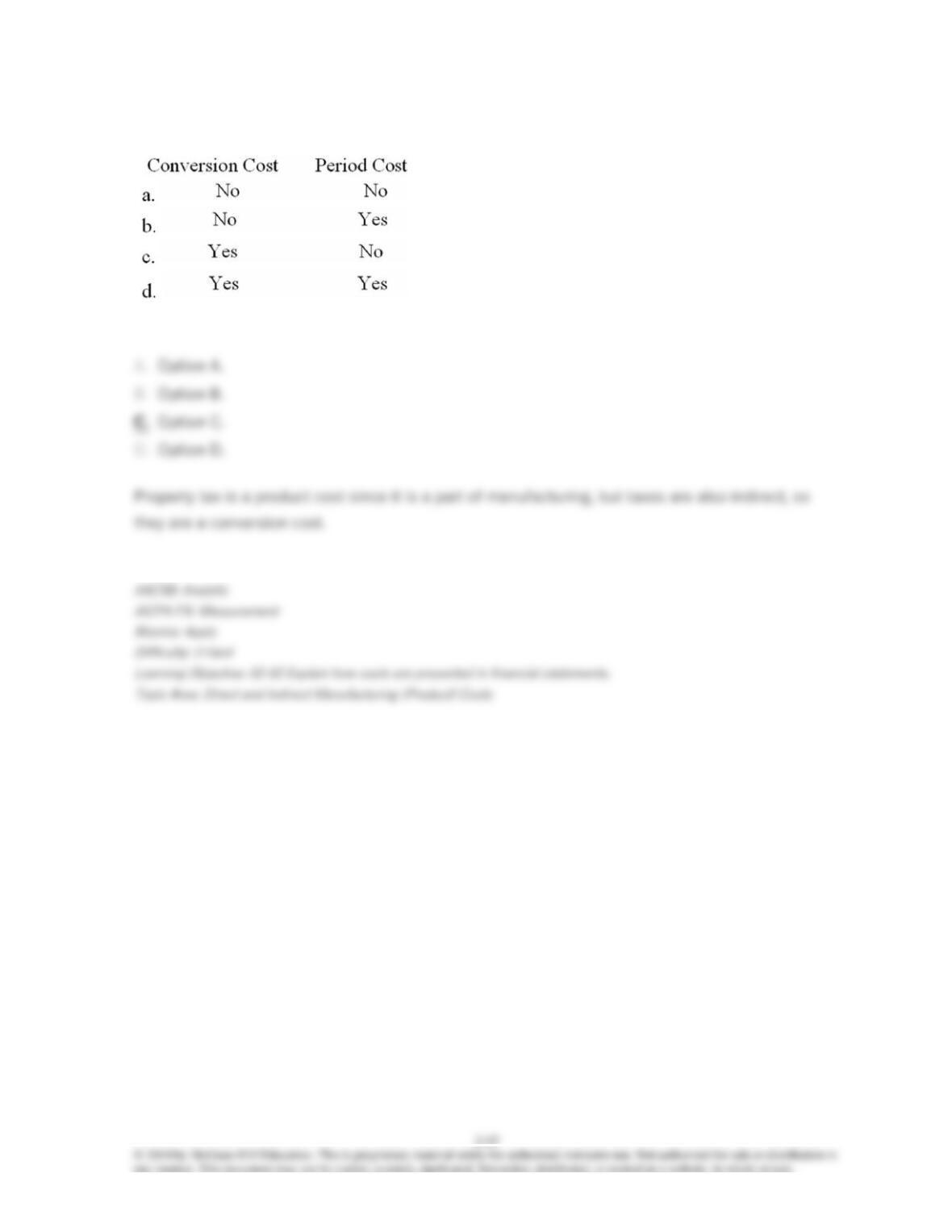
30. Property taxes on the manufacturing facility are an element of
31. Classifying a cost as either direct or indirect depends upon
32. The beginning Work–in-Process inventory plus the total of the manufacturing costs
equals
33. The cost of the direct labor will be treated as an expense on the income statement when
the resulting:
34. Inventoriable costs:
35. A product cost is deducted from revenue when
36. The amount of direct materials issued to production is found by
37. The beginning Finished Goods Inventory plus the cost of goods manufactured equals
38. Direct labor would be part of the cost of the ending inventory for which of these
accounts?
39. The Work-in-Process Inventory of the Rapid Fabricating Corp. was $3,000 higher on
December 31, 2012 than it was on January 1, 2012. This implies that in 2012
40. Which of the following is
not
a product cost under full-absorption costing?