Chapter 02 Job-Order Costing Answer Key
True / False Questions
1.
The use of a predetermined overhead rate in a job-order cost system makes it possible to
compute the total cost of a job before production is begun.
2.
If direct labor-hours is used as the allocation base in a job-order costing system, but
overhead costs are not caused by direct-labor hours, then jobs with high direct labor
requirements will tend to be undercosted relative to jobs with low direct labor
requirements.
3.
The formula for computing the predetermined overhead rate is:
Predetermined overhead rate = Estimated total manufacturing overhead cost ÷ Estimated
total amount of the allocation base
4.
When the predetermined overhead rate is based on direct labor-hours, the amount of
overhead applied to a job is proportional to the estimated amount of direct labor-hours for
the job.
5.
The cost of a completed job in a job-order costing system typically consists of the actual
direct materials cost of the job, the actual direct labor cost of the job, and the
manufacturing overhead cost applied to the job.
6.
Job cost sheets are used to record the costs of preparing routine accounting reports.
7.
In a job-order cost system, direct labor is assigned to a job using information from the
employee time ticket.
8.
The cost categories that appear on a job cost sheet include selling expense,
manufacturing expense, and administrative expense.
9.
When completed goods are sold, the transaction is recorded as a debit to Cost of Goods
Sold and a credit to Finished Goods.
10.
The following entry would be used to record depreciation on manufacturing equipment:
Work in Process
XXX
Accumulated Depreciation
XXX
11.
The sum of all amounts transferred from the Work in Process account to the Finished
Goods account represents the Cost of Goods Sold for the period.
12.
Indirect materials are charged to specific jobs.
13.
When a job is completed, the goods are transferred from the production department to the
finished goods warehouse and the journal entry would include a debit to Work in Process.
14.
Manufacturing overhead is overapplied if actual manufacturing overhead costs for a period
are greater than the amount of manufacturing overhead cost that was charged to Work in
Process.
15.
If the actual manufacturing overhead cost for a period exceeds the manufacturing
overhead cost applied, then manufacturing overhead would be considered to be
underapplied.
Multiple Choice Questions
16.
Emco Company uses direct labor cost as a basis for computing its predetermined
overhead rate. In computing the predetermined overhead rate for last year, the company
misclassified a portion of direct labor cost as indirect labor. The effect of this
misclassification will be to:
17.
Departmental overhead rates are generally preferred to plant-wide overhead rates when:
18.
In computing its predetermined overhead rate, Brady Company included its factory
insurance cost twice. This error will result in:
19.
Which of the following entries would correctly record the application of overhead cost?
20.
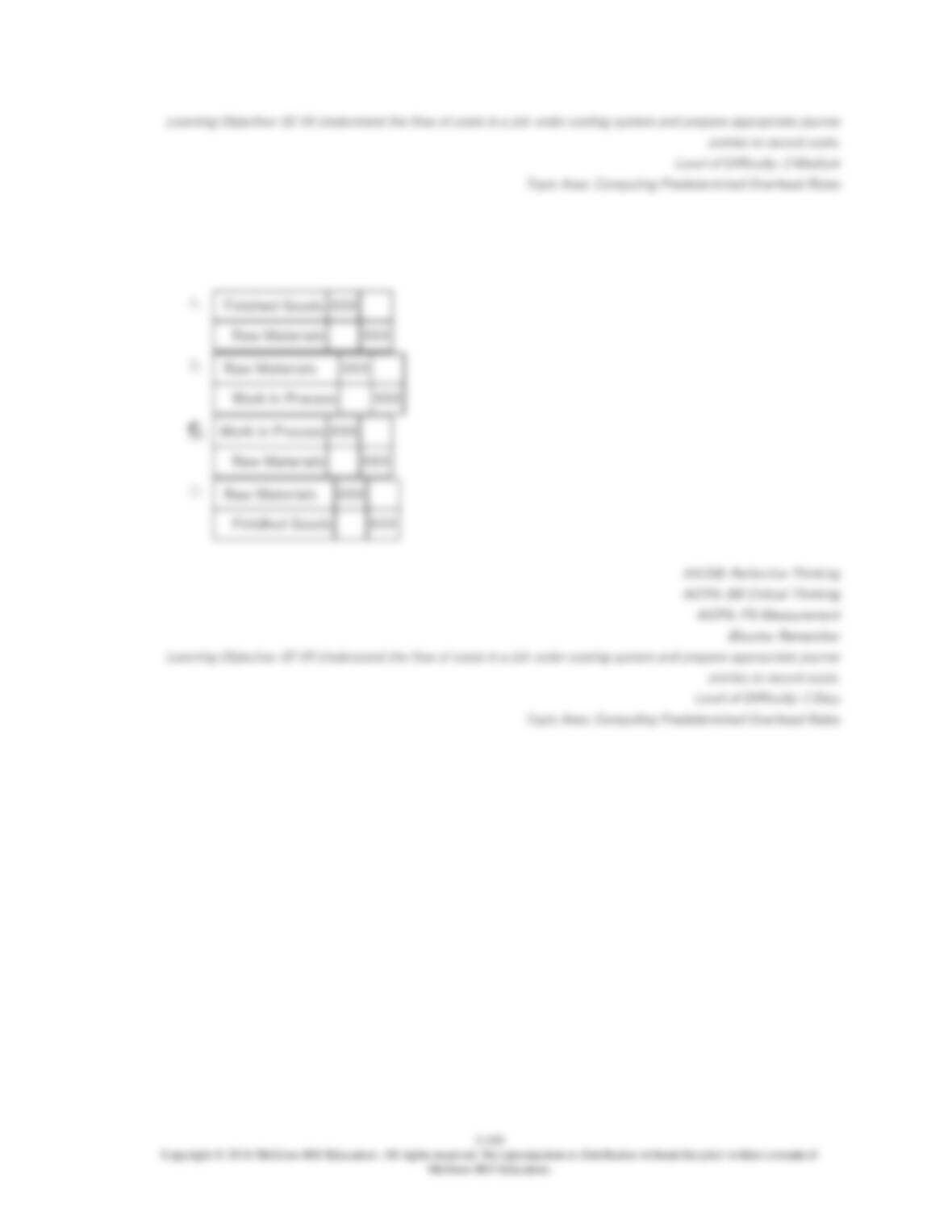
What journal entry is made in a job-order costing system when $8,000 of materials are
requisitioned for general factory use instead of for use in a particular job?
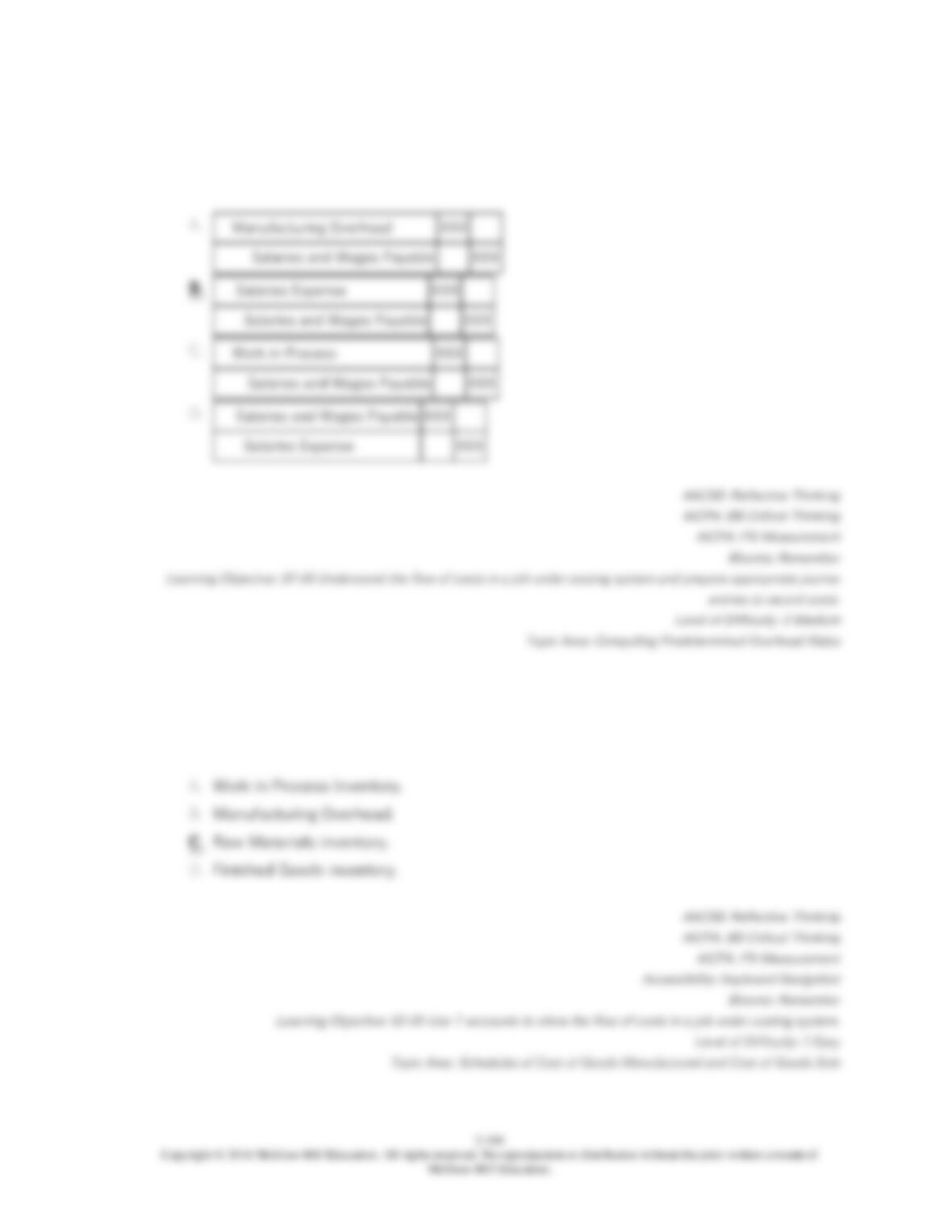
21.
A proper journal entry to record issuing raw materials to be used on a job would be:
22.
Which of the following entries would record correctly the monthly salaries earned by the
top management of a manufacturing company?
23.
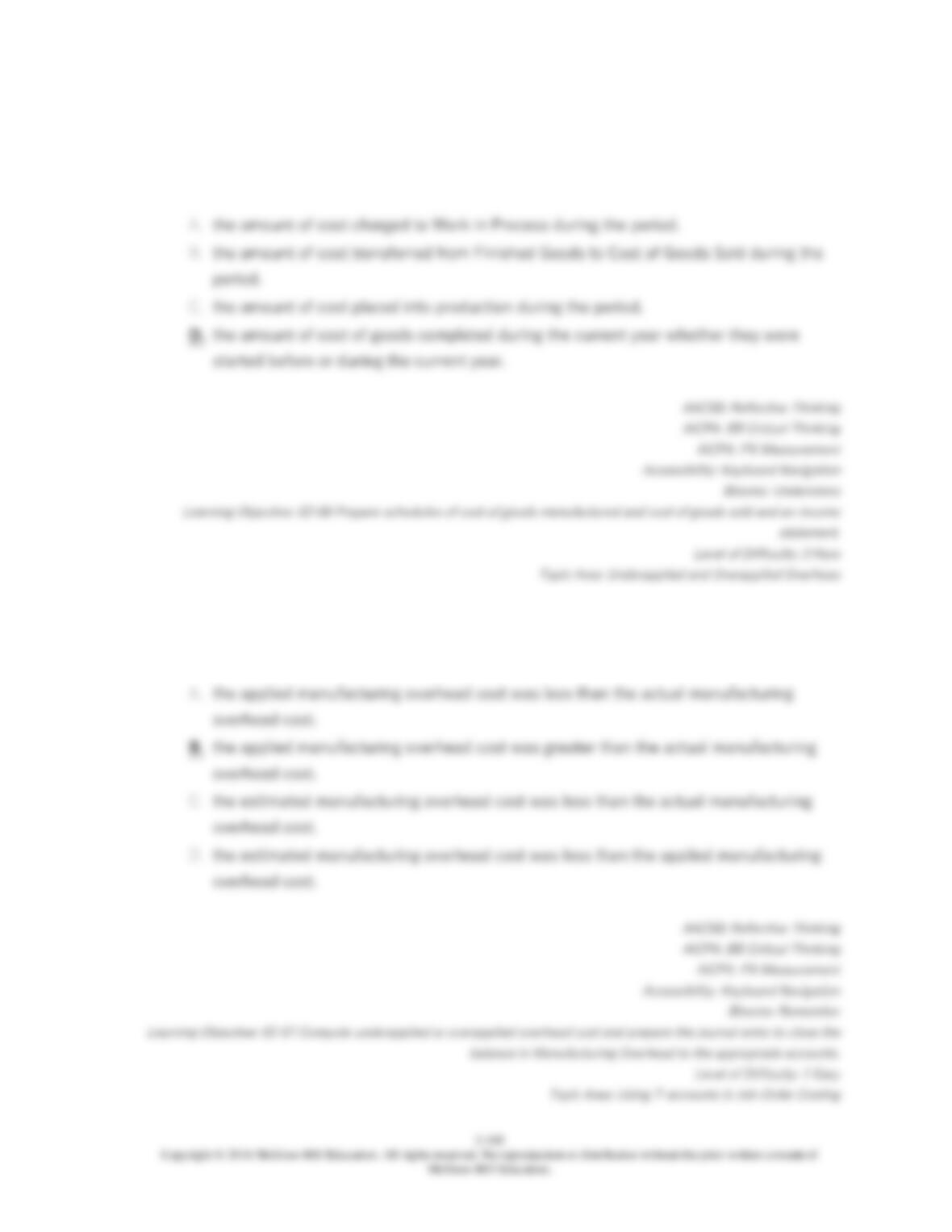
In a job-order costing system, the use of indirect materials that have been previously
purchased is recorded as a credit to:
24.
On the Schedule of Cost of Goods Manufactured, the final Cost of Goods Manufactured
figure represents:
25.
Overapplied manufacturing overhead means that:
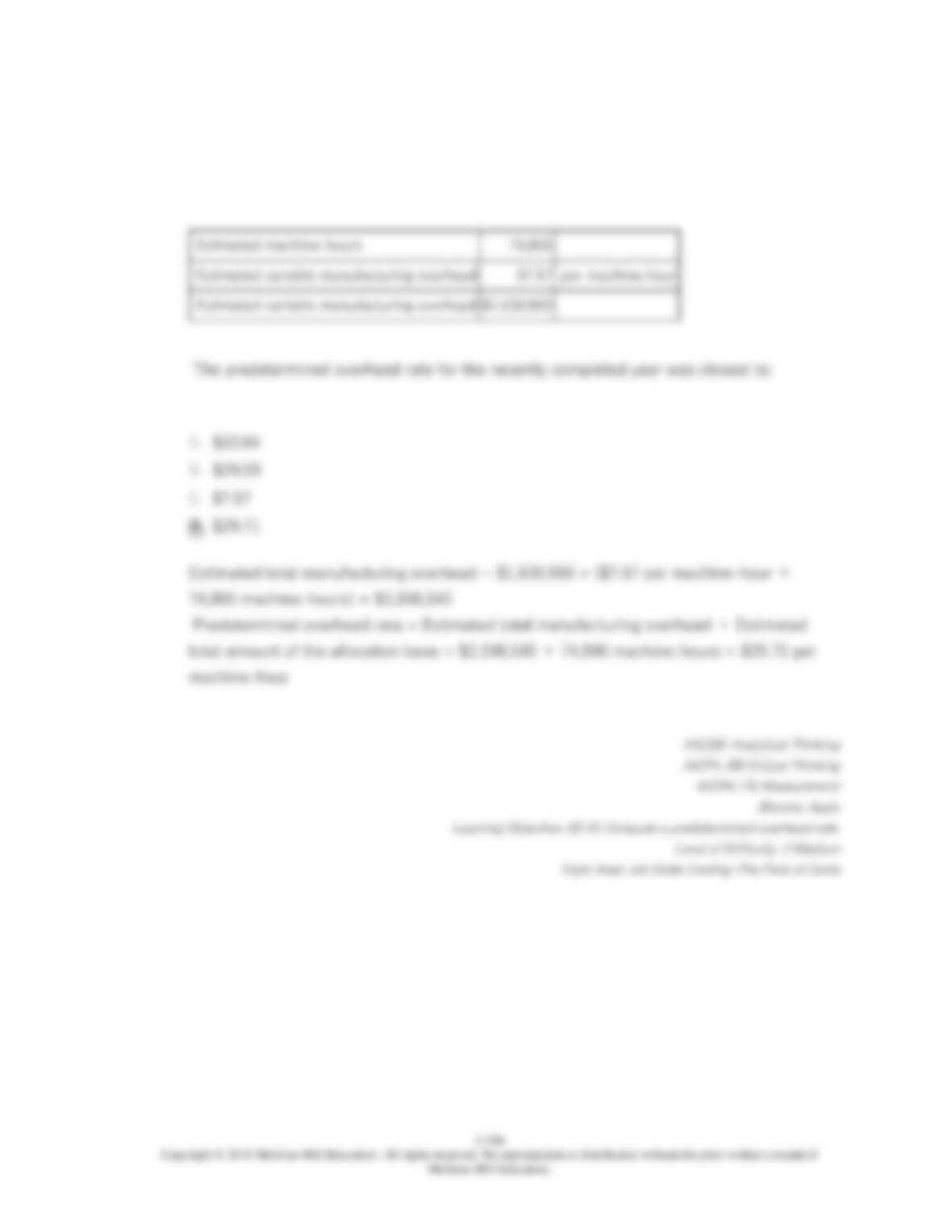
26.
Buker Corporation bases its predetermined overhead rate on the estimated machine-hours
for the upcoming year. Data for the upcoming year appear below:
27.
Hibshman Corporation bases its predetermined overhead rate on the estimated machine-
hours for the upcoming year. At the beginning of the most recently completed year, the
Corporation estimated the machine-hours for the upcoming year at 10,000 machine-hours.
The estimated variable manufacturing overhead was $6.82 per machine-hour and the
estimated total fixed manufacturing overhead was $230,200. The predetermined overhead
rate for the recently completed year was closest to:
28.
CR Corporation has the following estimated costs for the next year:
Direct materials
$4,000
Direct labor
$20,000
Rent on factory building
$15,000
Sales salaries
$25,000
Depreciation on factory equipment
$8,000
Indirect labor
$10,000
Production supervisor’s salary
$12,000
CR Corporation estimates that 20,000 labor-hours will be worked during the year. If
overhead is applied on the basis of direct labor-hours, the overhead rate per hour will be:
Rent on factory building
$15,000
Depreciation on factory equipment
Indirect labor
10,000
Production supervisor’s salary
12,000
Total manufacturing overhead
$45,000

29.
Jameson Corporation uses a predetermined overhead rate based on direct labor-hours to
apply manufacturing overhead to jobs. The Corporation has provided the following
estimated costs for the next year:
Direct materials
$5,000
Direct labor
$19,000
Rent on factory building
$16,000
Sales salaries
$24,000
Depreciation on factory equipment
$7,000
Indirect labor
$11,000
Production supervisor’s salary
$14,000
Jameson estimates that 24,000 direct labor-hours will be worked during the year. The
predetermined overhead rate per hour will be:
Rent on factory building
$16,000
Depreciation on factory equipment
Indirect labor
11,000
Production supervisor’s salary
14,000
Manufacturing overhead
$48,000

2-111
Copyright © 2016 McGraw-Hill Education. All rights reserved. No reproduction or distribution without the prior written consent of
McGraw-Hill Education.
30.
Paulson Corporation uses a predetermined overhead rate based on machine-hours to
apply manufacturing overhead to jobs. The Corporation has provided the following
estimated costs for next year:
Direct materials
$25,000
Direct labor
$22,000
Advertising expense
$15,000
Rent on factory building
$13,500
Depreciation on factory equipment
$6,500
Indirect materials
$10,000
Sales salaries
$28,000
Insurance on factory equipment
$12,000
Paulson estimated that 40,000 direct labor-hours and 20,000 machine-hours would be
worked during the year. The predetermined overhead rate per machine-hour will be:
Rent on factory building
Depreciation on factory equipment
Indirect materials
Insurance on factory equipment
Manufacturing overhead
31.
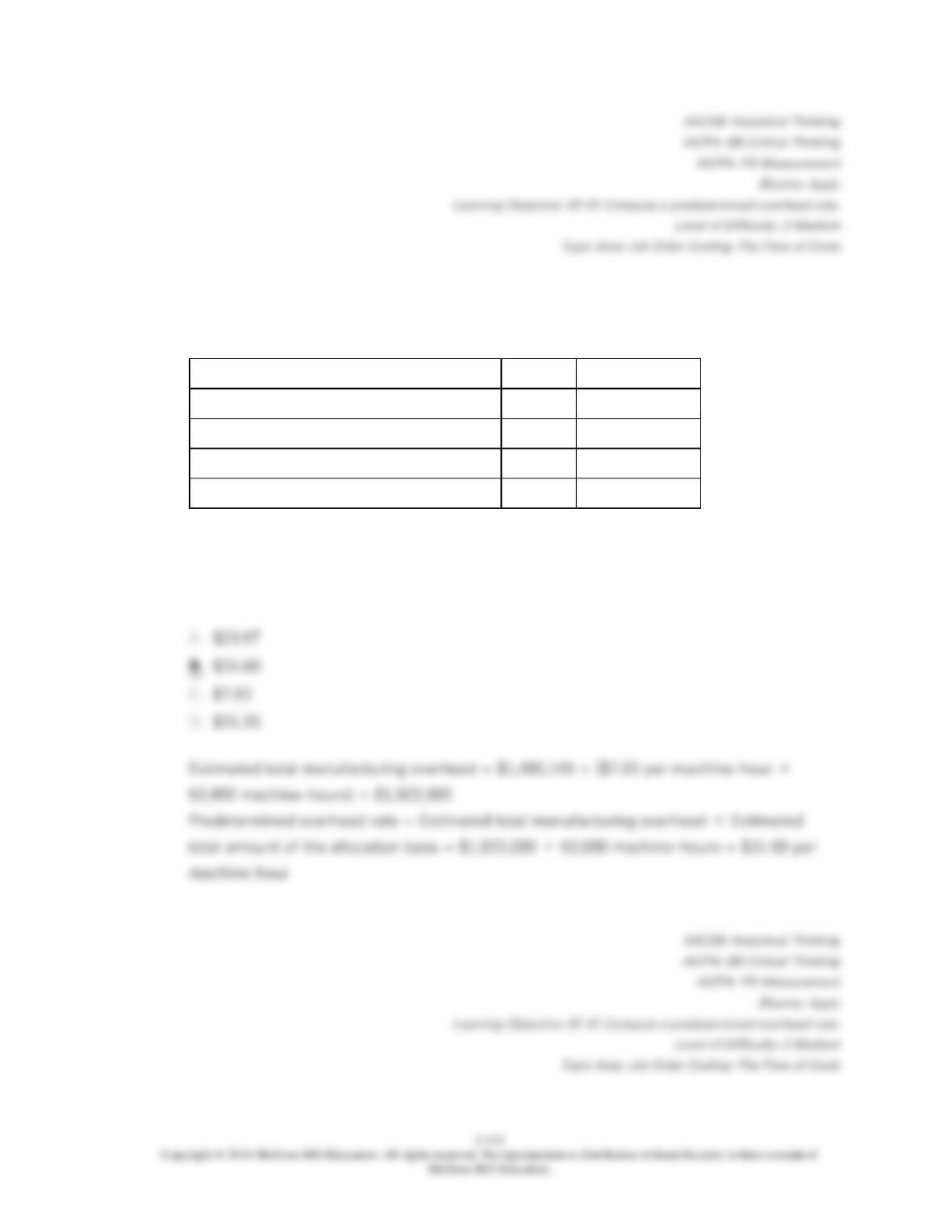
Aksamit Corporation bases its predetermined overhead rate on the estimated machine-
hours for the upcoming year. Data for the most recently completed year appear below:
Estimates made at the beginning of the year:
Estimated machine-hours
62,000
Estimated variable manufacturing overhead
$7.03
per machine-hour
Estimated total fixed manufacturing overhead
$1,486,140
Actual machine-hours for the year
61,100
The predetermined overhead rate for the recently completed year was closest to:
32.
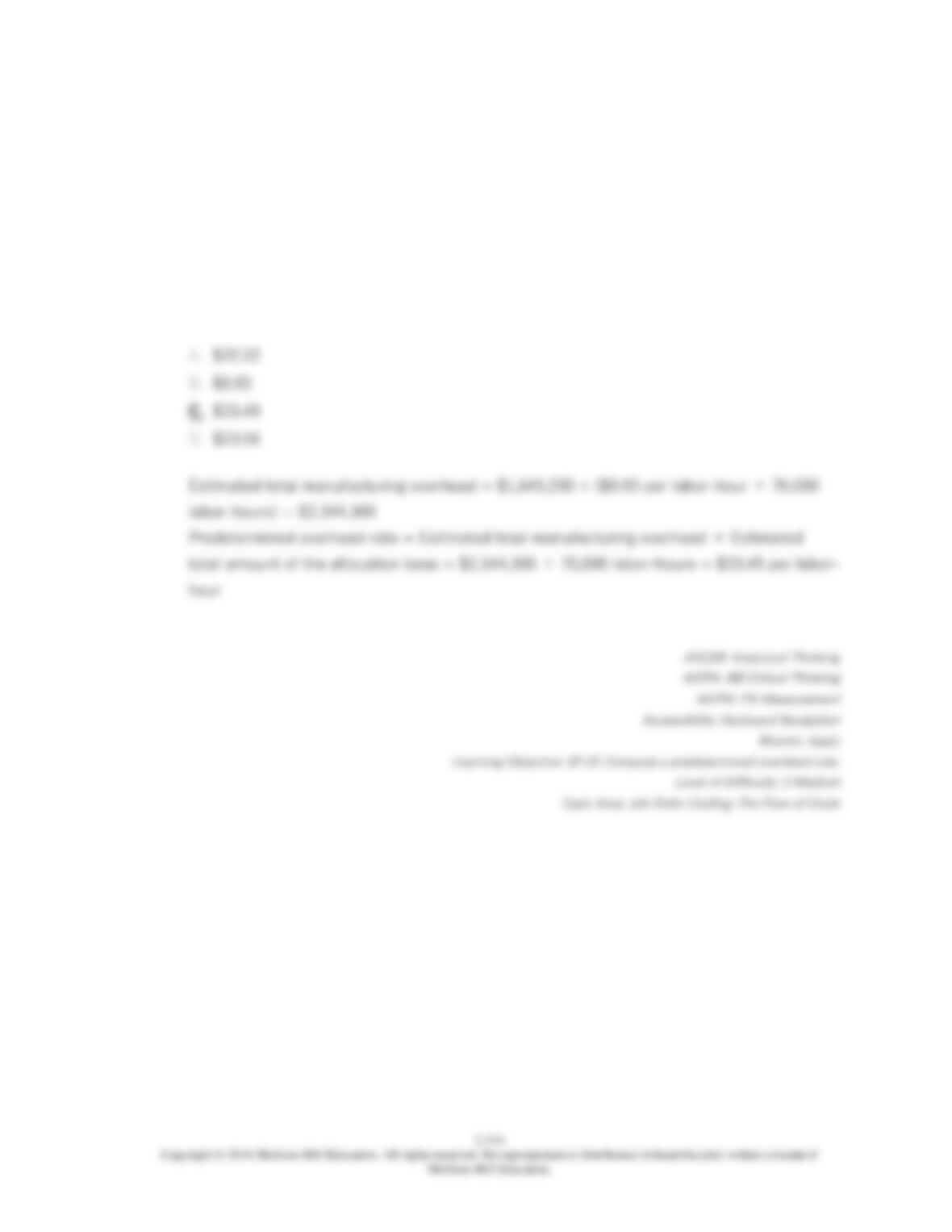
Sirmons Corporation bases its predetermined overhead rate on the estimated labor-hours
for the upcoming year. At the beginning of the most recently completed year, the
Corporation estimated the labor-hours for the upcoming year at 70,000 labor-hours. The
estimated variable manufacturing overhead was $9.93 per labor-hour and the estimated
total fixed manufacturing overhead was $1,649,200. The actual labor-hours for the year
turned out to be 74,000 labor-hours. The predetermined overhead rate for the recently
completed year was closest to: