Financial Accounting, 11e (Harrison/Horngren/Thomas)
Chapter 2 Transaction Analysis
1 Learning Objective 2-1
1) A transaction is any event that has a financial impact on the business and that can be measured
reliably.
2) Business events are recorded even if the financial impact cannot be measured.
3) Transactions provide objective information about the financial impact of an exchange on an entity.
4) Which of the following is NOT a business transaction?
A) A company buys goods on account.
B) A company sells land for cash.
C) A company fired 10 percent of the employees due to lackluster sales.
D) A company borrows money from the bank.
5) Which of the following is a business transaction?
A) A company signs a contact for services to be provided during the first quarter of the next fiscal year.
B) A company pays its employees a year-end bonus.
C) A company hires a new marketing manager.
D) A company applies for a mortgage that will be used to purchase a new office building.
2 Learning Objective 2-2
1) The account is the basic summary device of accounting.
2) An accounts receivable represents the promise of the business to pay a debt.
3) Prepaid rent is an expense because the payment provides a future benefit of the company.
4) Assets include cash, land, and accounts payable.
5) Cost of goods sold is an example of a revenue account.
6) An accrued liability is a liability for an expense that has not yet been paid.
7) A prepaid expense is an asset.
8) A record of all the changes in a particular asset during a period of time is found in a(n):
A) transaction.
B) trial balance.
C) prior period’s balance sheet.
D) account.
9) All of the following accounts would be considered assets EXCEPT for:
A) Cash.
B) Retained Earnings.
C) Prepaid Expenses.
D) Notes Receivable.
10) Which account includes balances in multiple checking accounts?
A) Accounts Receivable
B) Notes Receivable
C) Cash
D) Prepaid Expenses
11) Which of the following is a CORRECT statement?
A) Shareholders’ equity is also called proprietorship equity.
B) A proprietorship has more than one capital account.
C) A partnership has a separate owner’s equity account for each partner.
D) Retained earnings is the owner’s investment in the corporation.
12) Interest payable, income tax payable and salary payable are all examples of:
A) accrued liabilities.
B) prepaid expenses.
C) expenses of future periods.
D) retained earnings.
13) Which transaction increases stockholders’ equity?
A) sale of common stock
B) dividends that are declared and paid
C) expenses greater than revenues for the period
D) payment of operating expenses
14) Which transaction decreases stockholders’ equity?
A) sale of common stock
B) cash purchase of land
C) total revenues greater than total expenses for the period
D) total expenses greater than total revenues for the period
15) Which transaction decreases stockholders’ equity?
A) Inventory was purchased on account.
B) Services were performed on account.
C) Services were performed and cash was immediately received from the customers.
D) Employees worked one week and were paid at the end of the week.
16) List and briefly discuss the three major components of stockholders’ equity.
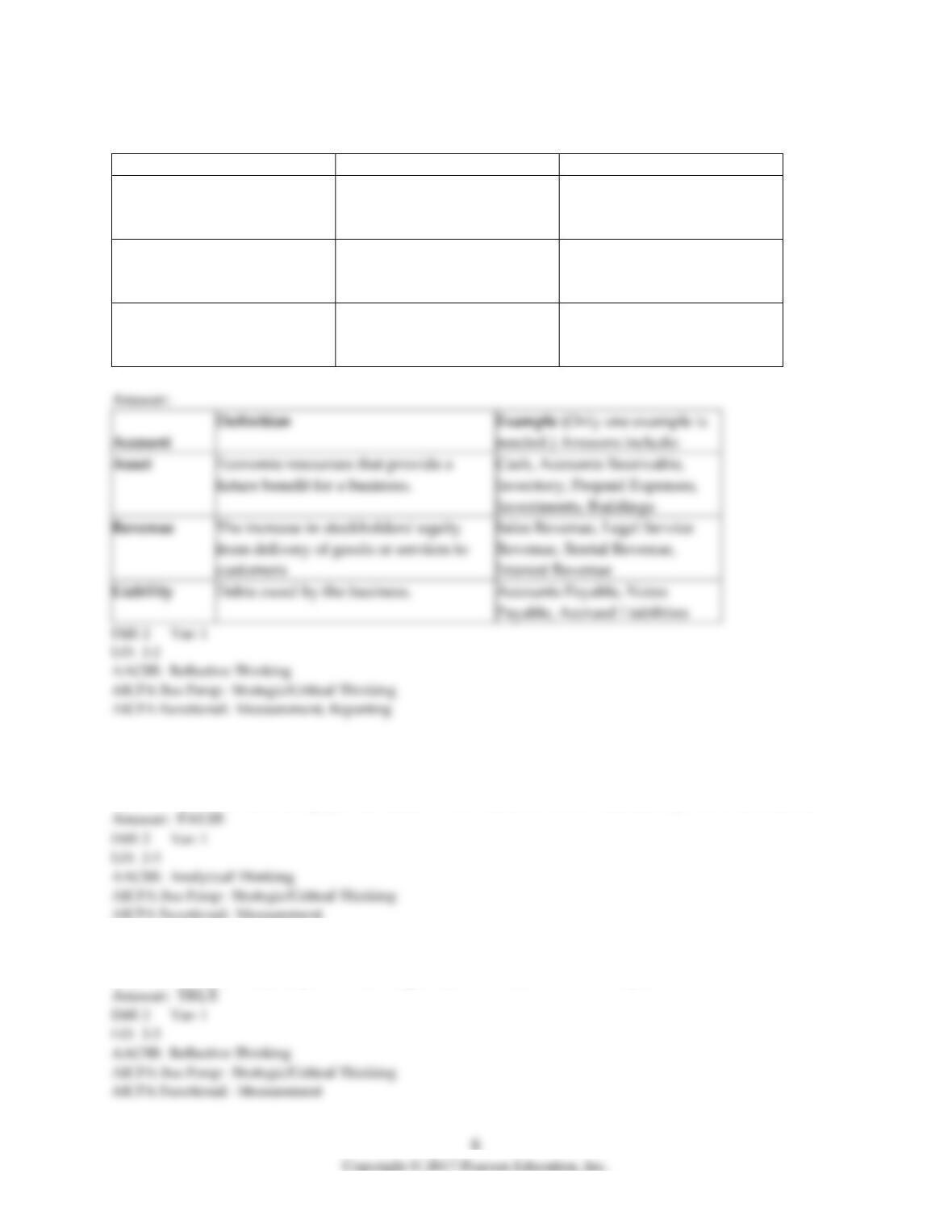
17) Define and provide an example of each of the following.
Account
Definition
Example
Asset
Revenue
Liability
needed.) Answers include:
Economic resources that provide a
future benefit for a business.
Cash, Accounts Receivable,
Inventory, Prepaid Expenses,
Investments, Buildings
from delivery of goods or services to
customers
Revenue, Rental Revenue,
Interest Revenue
Debts owed by the business.
Accounts Payable, Notes
Payable, Accrued Liabilities
3 Learning Objective 2-3
1) If a company declares and pays a dividend to its stockholders, both cash and expenses will decrease.
2) Each transaction has either an equal effect on both the left– and right-sides of the accounting equation,
or an offsetting effect (both positive and negative) on the same side of the equation.
3) If a company performs services on account, the revenue is not earned until the cash is collected.
4) An account payable is recorded when a formal promissory note is signed.
5) As a practical matter most companies prepare financial statements:
A) after every transaction.
B) only when both the balance sheet and income statement are affected.
C) at the end of the accounting period.
D) at the close of every business day.
6) When services are performed on account:
A) cash is increased.
B) revenue will not be recorded until the cash is received from the customer.
C) accounts receivable is increased.
D) accounts payable is increased.
7) A company received cash in exchange for issuing stock. This transaction increased assets and:
A) increased expenses.
B) increased revenues.
C) increased liabilities.
D) increased stockholders’ equity.
8) When a business purchases land with a note payable:
A) both assets and stockholders’ equity are increased.
B) assets are decreased and stockholder’s equity is increased.
C) both assets and liabilities are increased.
D) assets are increased and liabilities are decreased.
9) The debt created by a business when it makes a purchase of inventory on account is a(n):
A) revenue.
B) account receivable.
C) note payable.
D) account payable.
10) Which of the following transactions will increase stockholders’ equity?
A) The company pays a dividend to its shareholders.
B) The company issues common stock to new shareholders.
C) The company purchases equipment.
D) The company makes a payment on account.
11) Which of the following transactions will increase one asset and decrease another asset?
A) the purchase of office supplies on account
B) the performance of services on account
C) the purchase of equipment for cash
D) the performance of services for cash
12) A company performed services for a customer for cash. This transaction increased assets and:
A) decreased stockholders’ equity.
B) increased liabilities.
C) increased expenses.
D) increased revenues.
13) A company receives an utility bill and immediately pays it. With this transaction:
A) stockholders’ equity is decreased.
B) expenses are decreased.
C) assets are increased.
D) liabilities are increased.
14) Company Z sells land for the same amount it paid for it three years ago. When the company records
this transaction:
A) assets and stockholders’ equity are increased.
B) one asset is increased and another asset is decreased.
C) one liability is increased and another liability is decreased.
D) assets are increased and liabilities are decreased.
15) When a company borrows money from the bank, which type of account(s) is(are) increased?
A) asset account only
B) retained earnings only
C) liability account only
D) both asset and liability accounts
16) A company performs services for a client on account. When the company receives the cash from the
customer one month later:
A) a revenue account is increased.
B) a liability account is decreased.
C) there is no change in total assets.
D) an expense account is decreased.
17) When a company borrows cash from the bank:
A) total assets remain the same.
B) liabilities are increased.
C) retained earnings is decreased.
D) total liabilities remain the same.
18) When a company pays an amount it owes a creditor:
A) assets are decreased and net income is decreased.
B) assets are decreased and liabilities are increased.
C) liabilities are decreased and net income is increased.
D) assets are decreased and liabilities are decreased.
19) Muddle Company performs a service for one of its customers and immediately collects the cash.
This transaction will:
A) have no effect on liabilities.
B) decrease net income.
C) decrease Retained Earnings.
D) increase Accounts Receivable.
20) Purchasing supplies on account would:
A) increase total assets and decrease total liabilities.
B) increase total liabilities and decrease total assets.
C) increase total assets and increase total liabilities.
D) increase total liabilities and increase stockholders’ equity.
21) Paying a repair bill as soon as it was received would:
A) increase expenses.
B) increase liabilities.
C) increase stockholders’ equity.
D) decrease revenues.
22) If a company buys inventory on account:
A) cash decreases.
B) accounts payable increases.
C) net income increases.
D) total assets remain the same.
23) Receiving a payment from a customer on account:
A) increases stockholders’ equity.
B) has no effect on total assets.
C) decreases stockholders’ equity.
D) decreases liabilities.
24) Which of the following transactions would decrease an asset and decrease stockholders’ equity?
A) payment of an accounts payable
B) performance of a service for a client on account
C) borrowing money from the bank for thirty days
D) declaration and payment of a dividend to the shareholders
25) Performing services on account:
A) decreases both assets and liabilities.
B) increases assets and decreases stockholders’ equity.
C) decreases revenues and decreases stockholders’ equity.
D) increases both net income and stockholders’ equity.
26) To compute the ending balance of retained earnings:
A) the beginning balance in retained earnings will be negative for a new business.
B) net loss for the period is subtracted from the beginning balance of retained earnings.
C) dividends are added to the beginning balance of retained earnings.
D) common stock sold during the period is added to the beginning balance of retained earnings.
27) To compute ending balance of retained earnings on the statement of retained earnings:
A) net loss is added to the beginning balance of retained earnings and dividends that were declared and
paid are subtracted from the beginning balance of retained earnings.
B) net income and dividends are both added to the beginning balance of retained earnings.
C) net loss and dividends are both added to the beginning balance of retained earnings.
D) net income is added to the beginning balance of retained earnings.
28) For a new business, the beginning balance of retained earnings equals:
A) cash invested by the stockholders.
B) beginning balance of the common stock account.
C) zero.
D) budgeted net income for the first year.
29) When preparing the financial statements from a spreadsheet that shows the results of a transaction
analysis:
A) a statement of retained earnings is not required.
B) the balance sheet reports the beginning balance of retained earnings.
C) assets, liabilities, and stockholders’ equity are reported on the balance sheet.
D) revenues, expenses, and dividends are reported on the income statement.
30) Lori Nichols started an engineering firm, Engineering Enterprises P.C. During its first month of
operations, the following transactions were completed:
I. Lori invested $35,000 in the business, which in turn issued common stock to her.
II. The business purchased equipment on account for $10,000.
III. The business provided engineering services on account, $13,000.
IV. The business paid salaries to the receptionist, $4000.
V. The business received cash from a customer as payment on account $11,000.
VI. The business borrowed $13,000 from the bank, issuing a note payable.
At the end of the month, cash equals:
A) $35,000.
B) $44,000.
C) $55,000.
D) $86,000.
31) Linda Keller opened a consulting firm, Keller Consulting P.C. During its first month of operations,
the following transactions were completed:
I. Linda invested $30,000 in the business, which in turn issued common stock to her.
II. The business purchased equipment on account for $63,000.
III. The business provided consulting services on account, $12,000.
IV. The business paid salaries to the receptionist, $2,000.
V. The business received cash from a customer as payment on account $6,000.
VI. The business borrowed $13,000 from the bank, issuing a note payable.
At the end of the month, total liabilities are:
A) $13,000.
B) $63,000.
C) $76,000.
D) $75,000.
32) A company completed the following transactions during the month of October:
I. Purchased office supplies on account, $5600.
II. Provided services for cash, $22,000.
III. Provided services on account, $36,000.
IV. Collected cash from a customer on account, $27,000.
V. Paid the monthly rent of $3800.
What was the company’s total revenue for the month?
A) $22,000
B) $36,000
C) $58,000
D) $85,000
33) A company completed the following transactions during the month of October:
I. Purchased office supplies on account, $4800.
II. Provided services for cash, $22,000.
III. Provided services on account, $12,000.
IV. Collected cash from a customer on account, $7400.
V. Paid the monthly rent of $18,000.
What was the company’s net income for the month?
A) $12,000
B) $16,000
C) $34,000
D) $52,000
34) A company had credit sales of $33,000 and cash sales of $23,000 during the month of May. Also
during May, the company paid wages of $26,000 and utilities of $12,000. It also received payments from
customers on account totaling $5200. What was the company’s net income for the month?
A) $23,000
B) $18,000
C) $56,000
D) $94,000
35) A company had credit sales of $46,000 and cash sales of $12,000 during the month of May. Also
during May, the company paid wages of $16,000 and utilities of $5800. It also received payments from
customers on account totaling $7000. At the beginning of May, the company had a cash balance of
$25,000. What is the company’s cash balance at the end of May?
A) $15,200
B) $22,200
C) $37,000
D) $44,000
36) Jenkins Company began business in June when stockholders invested $85,000 in the business, which
in turn issued its common stock to them. Jenkins Company then purchased a building for $40,000 cash
and inventory for $21,000 cash, performed services for clients for $10,000 cash, purchased supplies for
$10,000 cash, and paid utilities of $7000 cash. What is the amount of cash at the end of June?
A) $24,000
B) $17,000
C) $34,000
D) $38,000
37) A company received $33,000 cash and issued common stock in exchange. How does this transaction
affect the accounting equation?
A) Add $33,000 to Cash and add $33,000 to Retained Earnings.
B) Add $33,000 to Cash and add $33,000 to Revenue.
C) Add $33,000 to Dividends and subtract $33,000 from Retained Earnings.
D) Add $33,000 to Cash and add $33,000 to Common Stock.
38) A company purchased supplies of $5000 on account. How does this transaction affect the accounting
equation?
A) Add $5000 to Supplies and add $5000 to Notes Payable.
B) Add $5000 to Supplies and subtract $5000 from Cash.
C) Add $5000 to Supplies Expense and add $5000 to Notes Payable.
D) Add $5000 to Supplies and add $5000 to Accounts Payable.
39) A company performed tax services for a client on account. The amount billed to the client was
$22,000. How does this transaction affect the accounting equation?
A) Add $22,000 to Cash and add $22,000 to Service Revenue.
B) Add $22,000 to Cash and add $22,000 to Retained Earnings.
C) Add $22,000 to Accounts Receivable and add $22,000 to Retained Earnings.
D) Add $22,000 to Accounts Payable and add $22,000 to Service Revenue.
40) On May 1, a company provided legal services for a new client. The legal fee was $2500 and the client
paid, by check, before leaving the office that day. How does this transaction affect the accounting
equation?
A) Add $2500 to Cash and add $2500 to Service Revenue.
B) Add $2500 to Cash and add $2500 to Retained Earnings.
C) Add $2500 to Cash and subtract $2500 from Accounts Receivable.
D) Add $2500 to Cash and subtract $2500 from Accounts Payable.
41) A company paid $3900 for supplies that were purchased earlier in the month on account. How does
this transaction affect the accounting equation?
A) Add $3900 to Supplies and add $3900 to Supplies Expense.
B) Add $3900 to Supplies Expense and subtract $3900 from Cash.
C) Add $3900 to Supplies Expense and add $3900 to Cash.
D) Subtract $3900 from Accounts Payable and subtract $3900 from Cash.
42) On August 15, a customer paid $5000 for services provided a month earlier. The customer was billed
on August 1. How does this transaction affect the accounting equation?
A) Add $5000 to Cash and add $5000 to Service Revenue.
B) Add $5000 to Cash and add $5000 to Retained Earnings.
C) Add $5000 to Cash and subtract $5000 from Accounts Receivable.
D) Add $5000 to Accounts Payable and add $5000 to Cash.
43) A company received a utility bill for $1000 and decided to pay it next month due to a shortage of
cash. How does this transaction affect the accounting equation?
A) Add $1000 to Utilities Expense and add $1000 to Cash.
B) Subtract $1000 from Cash and add $1000 to Accounts Payable.
C) Add $1000 to Accounts Receivable and subtract $1000 from Retained Earnings.
D) Add $1000 to Accounts Payable and subtract $1000 from Retained Earnings.
44) A company borrowed $24,000 from the bank by signing a long-term note. How does this transaction
affect the accounting equation?
A) Add $24,000 to Cash and add $24,000 to Accounts Payable.
B) Add $24,000 to Cash and add $24,000 to Notes Payable.
C) Add $24,000 to Cash and add $24,000 to Retained Earnings.
D) Add $24,000 to Accounts Receivable and add $24,000 to Accounts Payable.
45) A receptionist worked one month and was paid $3900 on the last day of the month. How does this
transaction affect the accounting equation?
A) Add $3900 to Cash and add $3900 to Accounts Payable.
B) Add $3900 to Accounts Receivable and subtract $3900 from Cash.
C) Add $3900 to Salary Expense and subtract $3900 from Retained Earnings.
D) Subtract $3900 from Cash and subtract $3900 from Retained Earnings.
46) A company declared and paid dividends of $1800. How does this transaction affect the accounting
equation?
A) Add $1800 to Revenue and add $1800 to Cash.
B) Add $1800 to Dividends and add $1800 to Accounts Receivable.
C) Subtract $1800 from Retained Earnings and subtract $1800 from Cash.
D) Add $1800 to Dividend Expense and subtract $1800 from Cash.
47) In transaction analysis, revenues and expenses that arise in different transactions are recorded in the
________ column of the accounting equation.
A) Multistep
B) Common Stock
C) Dividends
D) Retained Earnings
48) In transaction analysis, the declaration and payment of dividends is recorded in the ________ and
________ columns of the accounting equation.
A) Dividends; Cash
B) Expenses; Accounts Receivable
C) Expenses; Accounts Payable
D) Retained Earnings; Cash
49) Transaction analysis and the accounting equation have been used to record several transactions for a
company. The transactions are now recorded on a multi-column spreadsheet. When preparing an
income statement with this spreadsheet, which column would be used?
A) Cash
B) Accounts Payable
C) Dividends
D) Retained Earnings
50) Transaction analysis and the accounting equation have been used to record several transactions for a
company. The transactions are now recorded on a multi-column spreadsheet. When preparing a
statement of cash flows with this spreadsheet, which column would be used?
A) Cash
B) Accounts Receivable
C) Retained Earnings
D) Revenue