Accounting, 9e (Horngren)
Chapter 2 Recording Business Transactions
Learning Objective 2-1
1) An account is the detailed record of the changes in a particular asset, liability, or owner’s equity.
2) A chart of accounts is the book holding all of the company’s accounts.
3) A trial balance is the list of all a company’s accounts along with their account numbers.
4) A journal is a chronological record of transactions.
5) In a typical chart of accounts, liabilities appear before assets.
6) A trial balance is a list of all of the accounts with their balances.
7) Expenses are increases in owner’s equity caused by providing goods or services for customers.
8) Which of the following accounts is NOT an example of an asset?
A) Accounts receivable
B) Cash
C) Building
D) Notes payable
9) Which of the following accounts is NOT an example of a liability?
A) Wages payable
B) Notes payable
C) Accounts payable
D) Accounts receivable
10) Which of the following accounts is an example of an owner’s equity account?
A) Accounts payable
B) Equipment
C) Cash
D) Drawing
11) Accountants first record transactions in the:
A) chart of accounts.
B) trial balance.
C) journal.
D) ledger.
12) Which of the following accounts is an asset?
A) Salary expense
B) Accounts payable
C) Service revenue
D) Prepaid expenses
13) Which of the following accounts is a liability?
A) Accounts payable
B) Prepaid expenses
C) Salary expense
D) Service revenue
14) Which of the following accounts is an owner‘s equity account?
A) Accrued liability
B) Accounts payable
C) Prepaid expense
D) Capital
15) Prepaid expenses are recorded as:
A) assets.
B) liabilities.
C) debits and credits.
D) owner’s equity.
16) In a typical chart of accounts, what information is provided along with the account name?
A) Account balance
B) Account number
C) Dates of transactions
D) Transaction amounts
17) Which of the following are accrued liabilities?
A) Taxes payable
B) Interest payable
C) Salary payable
D) All of the above
18) Which of the following accounts is an example of a liability?
A) Service revenue
B) Building
C) Accounts receivable
D) Notes payable
19) A listing of all account titles in numerical order is a(n):
A) ledger.
B) journal.
C) income statement.
D) chart of accounts.
20) Which of the following accounts is an asset?
A) Cash
B) Notes payable
C) Drawing
D) Expenses
21) Which of the following is NOT part of owner’s equity?
A) Accounts receivable
B) Capital
C) Notes payable
D) Both A and C
22) A book holding all of the accounts is called the:
A) ledger.
B) journal.
C) income statement.
D) balance sheet.
23) Which of the following is the detailed record of the changes in a particular asset, liability, or owner’s equity?
A) Journal
B) Trial balance
C) Ledger
D) Account
Learning Objective 2-2
1) Debit refers to the right side of the T-account, and credit refers to the left side.
2) In the standard accounting system, we use double entry accounting, which means we record the dual effects
of each transaction.
3) An asset account is increased by a debit.
4) The owner‘s capital account is increased by a debit.
5) The drawing (withdrawals) account is increased by a debit.
6) A liability account is increased by a debit.
7) Which of the following accounts increases with a credit?
A) Cash
B) Capital
C) Accounts receivable
D) Prepaid expenses
8) Which of the following accounts decreases with a credit?
A) Cash
B) Capital
C) Accounts payable
D) Notes Payable
9) Which of the following accounts increases with a debit?
A) Cash
B) Interest payable
C) Accounts payable
D) Capital
10) Which of the following accounts decreases with a debit?
A) Notes payable
B) Prepaid insurance
C) Cash
D) Land
Learning Objective 2-3
1) An account that normally has a debit balance may occasionally have a credit balance.
2) Assets, Drawing, and Expenses have a normal balance on the debit side.
3) For assets and expenses, a debit increases the account.
4) For liabilities and revenues, a debit increases the account.
5) When recording a transaction in a journal, the credit side is entered first, followed by the debit side.
6) Both the date of the transaction and a brief description are included in a journal entry.
7) The process of copying from the journal to the ledger is called posting.
8) A journal entry includes BOTH debit and credit amounts.
9) In the accounting system, the first place that transactions are recorded is the ledger.
10) Which of the following groups of accounts BOTH normally have a debit balance?
A) Assets and Expenses
B) Revenues and Expenses
C) Liabilities and Owner’s equity
D) Assets and Liabilities
11) Which of the following groups of accounts BOTH normally have a credit balance?
A) Assets and Expenses
B) Revenues and Expenses
C) Liabilities and Owner’s equity
D) Assets and Liabilities
12) Journalizing a transaction means:
A) calculating the balance in an account.
B) finding the account number in the chart of accounts.
C) recording the transaction, including a brief explanation.
D) copying the information from the journal to the ledger.
13) Posting a transaction means:
A) calculating the balance in an account.
B) finding the account number in the chart of accounts.
C) recording the transaction including a brief explanation.
D) copying the information from the journal to the ledger.
14) Which of the following statements about expenses is CORRECT?
A) Expenses increase owner’s equity, so an expense account’s normal balance is a credit balance.
B) Expenses decrease owner’s equity, so an expense account’s normal balance is a credit balance.
C) Expenses increase owner’s equity, so an expense account’s normal balance is a debit balance.
D) Expenses decrease owner’s equity, so an expense account’s normal balance is a debit balance.
15) The balance of an account is the:
A) amount remaining in an account.
B) account number, as shown in the chart of accounts.
C) sum of the debits only.
D) sum of the credits only.
16) For Accounts receivable, the category of account and its normal balance are:
A) Owner’s equity and a credit balance.
B) Assets and a debit balance.
C) Liabilities and a credit balance.
D) Assets and a credit balance.
17) For Accounts payable, the category of account and its normal balance are:
A) Owner’s equity and a credit balance.
B) Assets and a debit balance.
C) Liabilities and a credit balance.
D) Assets and a credit balance.
18) For Cash, the category of account and its normal balance are:
A) Assets and a debit balance.
B) Liabilities and a credit balance.
C) Owner’s equity and a credit balance.
D) Assets and a credit balance.
19) For Capital, the category of account and its normal balance are:
A) Owner’s equity and a credit balance.
B) Assets and a debit balance.
C) Liabilities and a credit balance.
D) Owner’s equity and a debit balance.
20) For Supplies, the category of account and its normal balance are:
A) Owner’s equity and a credit balance.
B) Assets and a debit balance.
C) Liabilities and a credit balance.
D) Assets and a credit balance.
21) For Salary Payable, the category of account and its normal balance are:
A) Owner’s equity and a credit balance.
B) Assets and a debit balance.
C) Liabilities and a credit balance.
D) Assets and a credit balance.
22) For Expenses, the category of account and its normal balance are:
A) Owner’s equity and a credit balance.
B) Assets and a debit balance.
C) Liabilities and a credit balance.
D) Owner’s equity and a debit balance.
23) For Revenues, the category of account and its normal balance are:
A) Owner’s equity and a credit balance.
B) Assets and a debit balance.
C) Liabilities and a credit balance.
D) Owner’s equity and a debit balance.
24) For Capital, the category of account and its normal balance are:
A) Owner’s’ equity and a credit balance.
B) Assets and a debit balance.
C) Liabilities and a credit balance.
D) Assets and a credit balance.
25) For Drawing, the category of account and its normal balance are:
A) Owner’s equity and a credit balance.
B) Owner’s equity and a debit balance.
C) Liabilities and a credit balance.
D) Assets and a credit balance.
26) After initially recording a transaction, the data is then copied, or posted, to the:
A) chart of accounts.
B) ledger.
C) trial balance.
D) journal.
27) The accounting process of copying a transaction from the journal to the ledger is called:
A) journalizing.
B) posting.
C) proofing.
D) footing.
28) The first step of journalizing an entry is to:
A) post the accounts to the ledger.
B) identify each account affected and its type.
C) determine whether each account is increased or decreased.
D) record the transaction in the journal, including a brief explanation.
29) Which of the following is the order of steps to journalize an entry?
A) Identify each account affected, determine increase or decrease in each account, record the transaction.
B) Identify each account affected, record the transaction, determine increase or decrease in each account.
C) Record the transaction, identify each account affected, determine increase or decrease in each account.
D) Determine increase or decrease in each account, identify each account affected, record the transaction.
30) Which of the following is the last step of journalizing an entry?
A) Post the accounts to the ledger.
B) Identify each account affected and its type.
C) Record the transaction in the journal, including a brief explanation.
D) Determine whether each account has increased or decreased.
31) The normal sequence of information flow in an accounting system is:
A) ledger, journal, source document.
B) journal, source document, ledger.
C) source document, journal, ledger.
D) source document, ledger, journal.
32) Which of the following is NOT an example of a source document?
A) Journal
B) Sales invoice
C) Bank deposit slip
D) Purchase invoice
33) Which of the following statements about revenue is CORRECT?
A) Revenues decrease owner’s equity, so a revenue account’s normal balance is a credit balance.
B) Revenues decrease owner’s equity, so a revenue account’s normal balance is a debit balance.
C) Revenues increase owner’s equity, so a revenue account’s normal balance is a debit balance.
D) Revenues increase owner’s equity, so a revenue account’s normal balance is a credit balance.
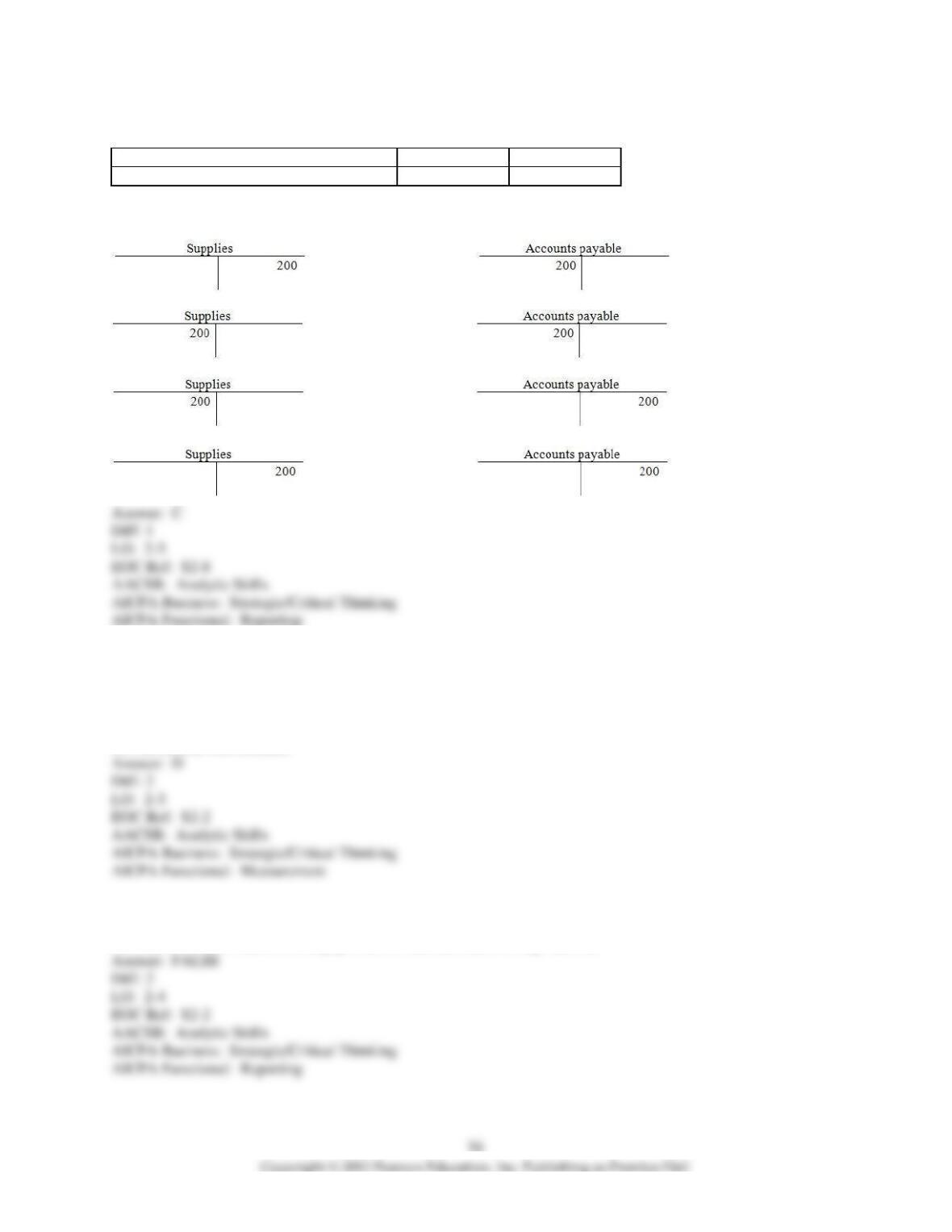
34) A business purchased $200 of supplies on account and recorded the following journal entry:
Supplies
200
Accounts payable
200
Which of the following sets of ledger accounts reflect the posting of this transaction?
A)
B)
C)
D)
35) A business renders service to a client and sends out a sales invoice. The amount will be collected from the
customer at a later time. Which of the following would be TRUE at the time when the invoice is sent out?
A) Owner’s equity will decrease.
B) Total liabilities will increase.
C) Total assets will decrease.
D) Net income will increase.
Learning Objective 2-4
1) When a business makes a cash payment, the cash account is always debited.
2) When a business collects cash, the cash account is always debited.
3) When a business records an expense incurred, the expense account is always credited.
4) When a business records revenue earned, the revenue account is always credited.
5) An owner invests $20,000 in her new business by depositing the cash in the business’s checking account. Which
account is debited?
A) Accounts receivable
B) Cash
C) Capital
D) Accounts payable
6) An owner invests $20,000 in her new business by depositing the cash in the business’s checking account. Which
account is credited?
A) Accounts receivable
B) Cash
C) Capital
D) Accounts payable
7) A business purchases equipment for cash in the amount of $8,000. Which account is debited?
A) Cash
B) Accounts payable
C) Utilities expense
D) Equipment
8) A business purchases equipment for cash in the amount of $8,000. Which account is credited?
A) Cash
B) Accounts payable
C) Utilities expense
D) Equipment
9) A business makes a cash payment of $12,000 to a creditor. Which account is debited?
A) Cash
B) Accounts payable
C) Service revenue
D) Accounts receivable
10) A business makes a cash payment of $12,000 to a creditor. Which account is credited?
A) Cash
B) Accounts payable
C) Service revenue
D) Accounts receivable
11) A business renders services to a customer for $16,000 on account. Which account is debited?
A) Cash
B) Accounts receivable
C) Service revenue
D) Accounts payable
12) A business renders services to a customer for $16,000 on account. Which account is credited?
A) Cash
B) Accounts receivable
C) Service revenue
D) Accounts payable
13) A business renders services for $16,000 and collects cash from the customer. Which account is debited?
A) Cash
B) Accounts receivable
C) Service revenue
D) Accounts payable
14) A business renders services for $16,000 and collects cash from the customer. Which account is credited?
A) Cash
B) Accounts receivable
C) Service revenue
D) Accounts payable
15) A business pays $500 cash for supplies. Which account is debited?
A) Cash
B) Accounts payable
C) Supplies
D) Service revenue
16) A business pays $500 cash for supplies. Which account is credited?
A) Cash
B) Accounts payable
C) Supplies
D) Service revenue
17) A business buys $500 of supplies on account. Which account is debited?
A) Cash
B) Accounts payable
C) Supplies
D) Service revenue
18) A business buys $500 of supplies on account. Which account is credited?
A) Cash
B) Accounts payable
C) Supplies
D) Service revenue