Accounting for Income Taxes
19 – 37
BRIEF EXERCISES
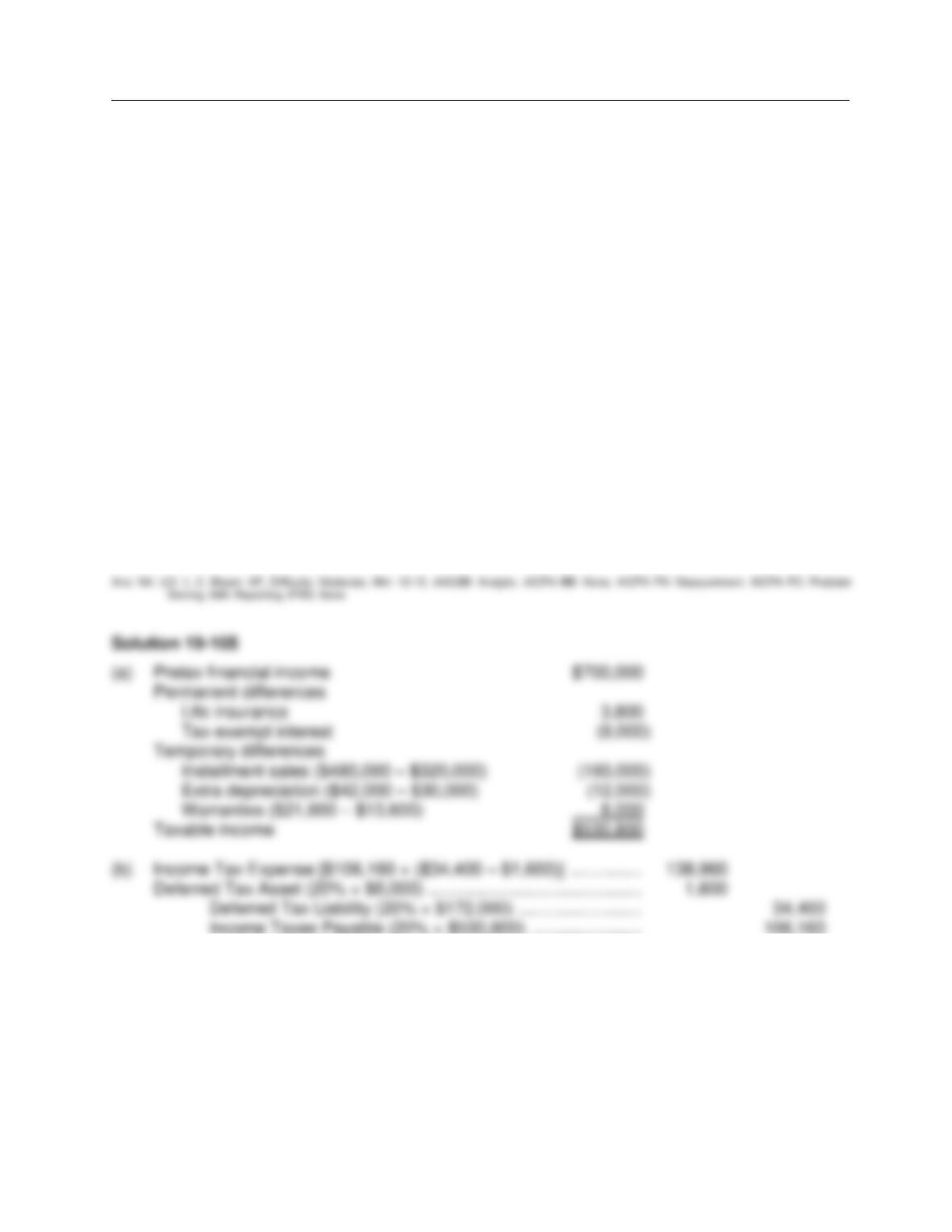
BE. 19–105—Computation of taxable income.
The records for Bosch Co. show this data for 2021:
• Gross profit on installment sales recorded on the books was $480,000. Gross profit from
collections of installment receivables was $320,000.
• Life insurance on officers was $3,800.
• Machinery was acquired in January for $300,000. Straight-line depreciation over a ten-year
life (no salvage value) is used. For tax purposes, MACRS depreciation is used and Bosch
may deduct 14% for 2021.
• Interest received on tax exempt Iowa State bonds was $9,000.
• The estimated warranty liability related to 2021 sales was $21,600. Repair costs under
warranties during 2021 were $13,600. The remainder will be incurred in 2022.
• Pretax financial income is $700,000. The tax rate is 20%.
•
Instructions
(a) Prepare a schedule starting with pretax financial income and compute taxable income.
(b) Prepare the journal entry to record income taxes for 2021.
Test Bank for Intermediate Accounting, Seventeenth Edition
19 – 38
BE. 19–106—Future taxable and deductible amounts.
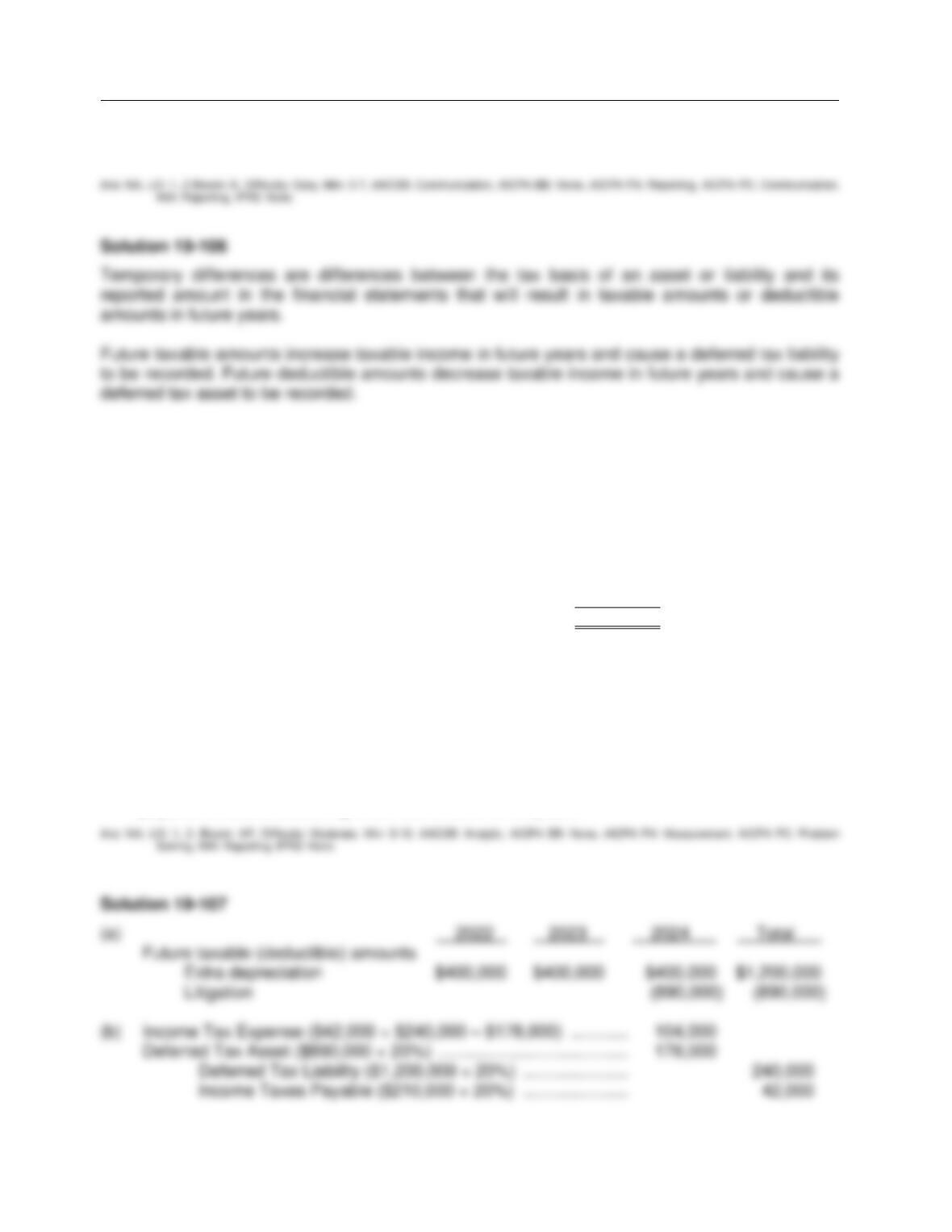
Define temporary differences, future taxable amounts, and future deductible amounts.
BE. 19–107—Deferred income taxes.
Pole Co. at the end of 2021, its first year of operations, prepared a reconciliation between pretax
financial income and taxable income as follows:
Pretax financial income $ 520,000
Extra depreciation taken for tax purposes (1,200,000)
Estimated expenses deductible for taxes when paid 890,000
Taxable income $ 210,000
Use of the depreciable assets will result in taxable amounts of $400,000 in each of the next three
years. The estimated litigation expenses of $890,000 will be deductible in 2024 when settlement
is expected.
Instructions
(a) Prepare a schedule of future taxable and deductible amounts.
(b) Prepare the journal entry to record income tax expense, deferred taxes, and income taxes
payable for 2021, assuming a tax rate of 20% for all years.
Accounting for Income Taxes
19 – 39
EXERCISES
Ex. 19-108—Deferred income taxes.
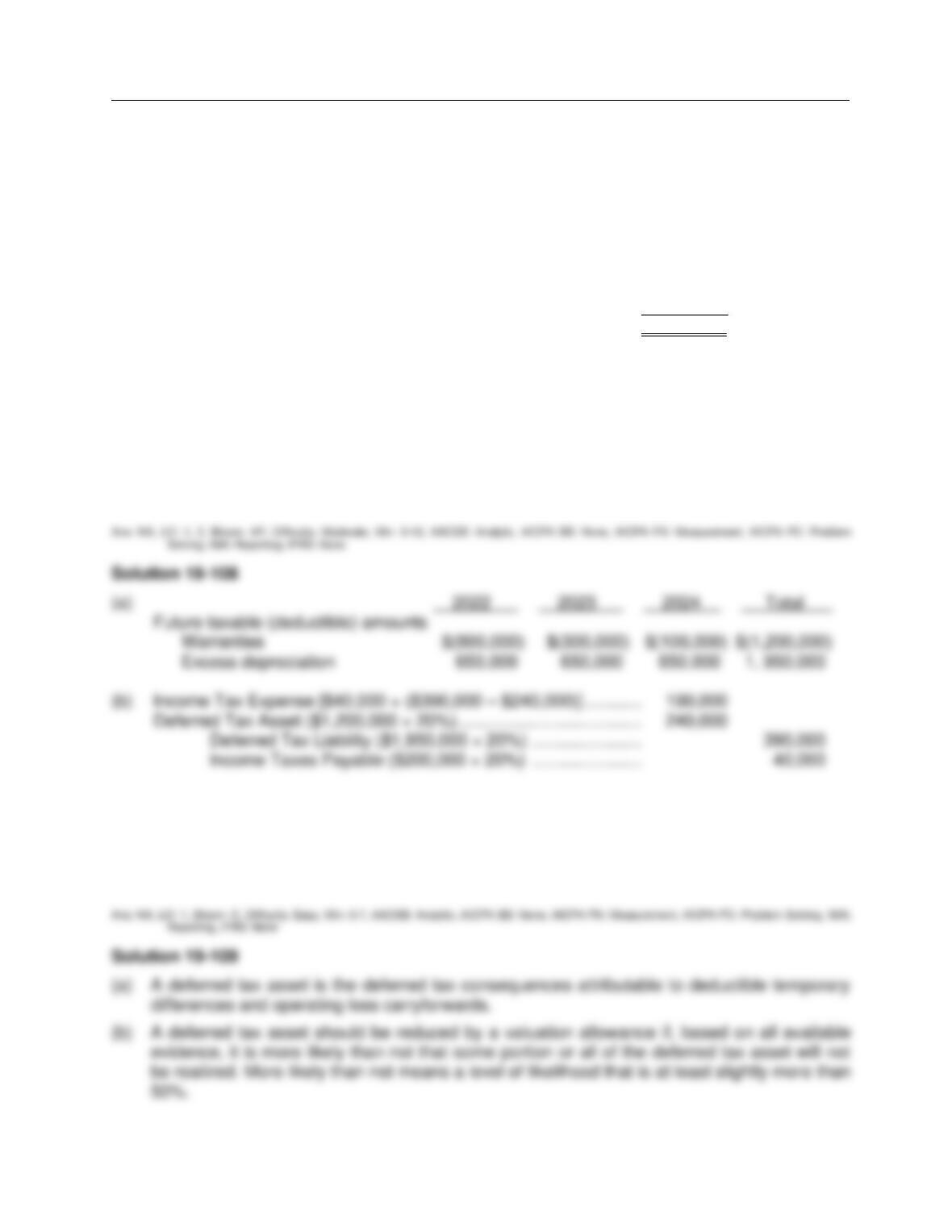
Hunt Co. at the end of 2021, its first year of operations, prepared a reconciliation between pretax
financial income and taxable income as follows:
Pretax financial income $ 950,000
Estimated warranty expenses deductible for taxes when paid 1,200,000
Extra depreciation (1,950,000)
Taxable income $ 200,000
Estimated warranty expense of $800,000 will be deductible in 2022, $300,000 in 2023, and
$100,000 in 2024. The use of the depreciable assets will result in taxable amounts of $650,000 in
each of the next three years.
Instructions
(a) Prepare a table of future taxable and deductible amounts.
(b) Prepare the journal entry to record income tax expense, deferred income taxes, and income
taxes payable for 2021, assuming an income tax rate of 20% for all years.
Ex. 19–109—Recognition of deferred tax asset.
(a) Describe a deferred tax asset.
(b) When should a deferred tax asset be reduced by a valuation allowance?
Test Bank for Intermediate Accounting, Seventeenth Edition
19 – 40
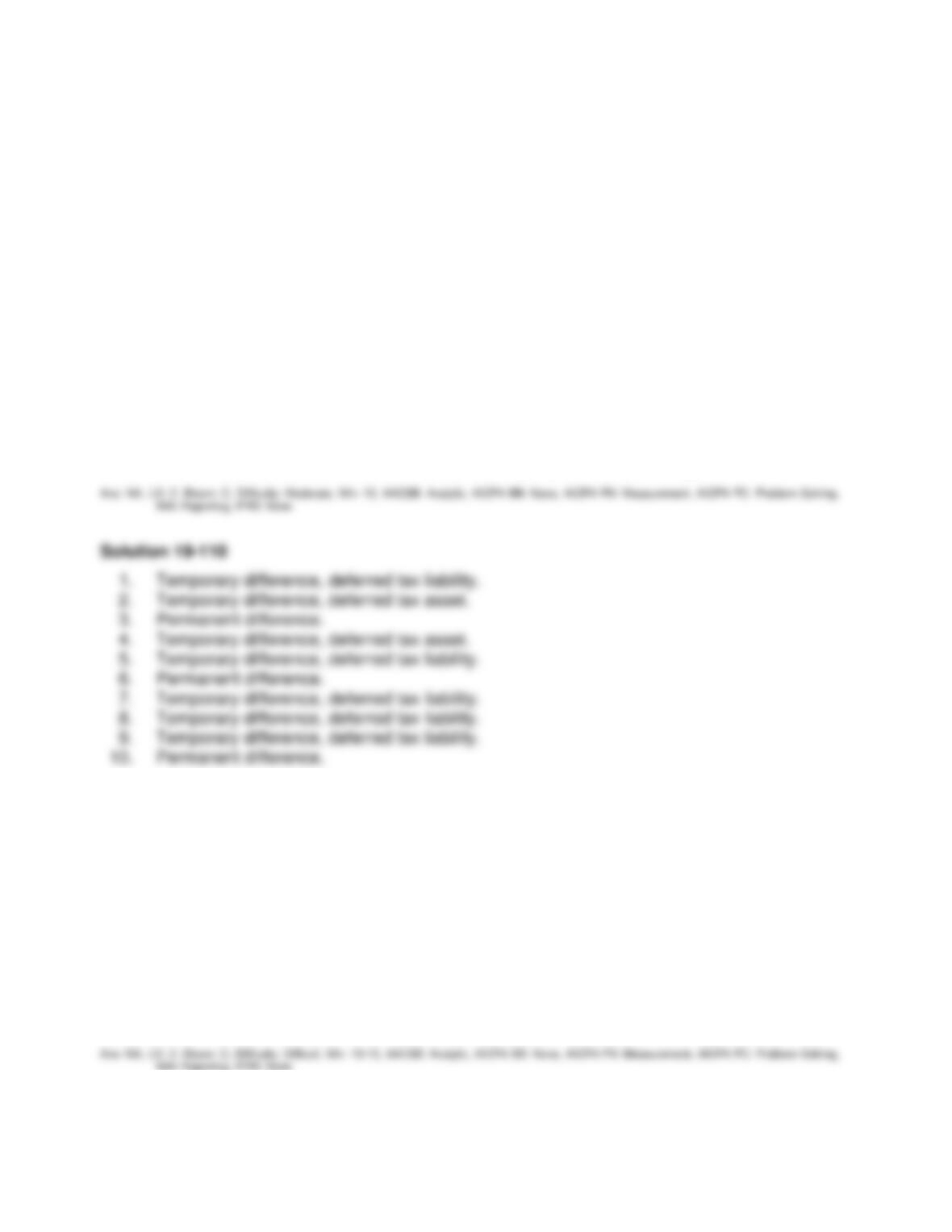
Ex. 19-110—Permanent and temporary differences.
Listed below are items that are treated differently for accounting purposes than they are for tax
purposes. Indicate whether the items are permanent differences or temporary differences. For
temporary differences, indicate whether they will create deferred tax assets or deferred tax
liabilities.
1. Investments accounted for by the equity method (ignore dividends received deduction).
2. Advance rental receipts.
3. Fine for polluting.
4. Estimated future warranty costs.
5. Excess of contributions over pension expense.
6. Expenses incurred in obtaining tax-exempt revenue.
7. Installment sales.
8. Excess tax depreciation over accounting depreciation.
9. Long-term construction contracts.
10. Premiums paid on life insurance of officers (company is the beneficiary).
Ex. 19-111—Permanent and temporary differences.
Indicate and explain whether each of the following independent situations should be treated as a
temporary difference or a permanent difference.
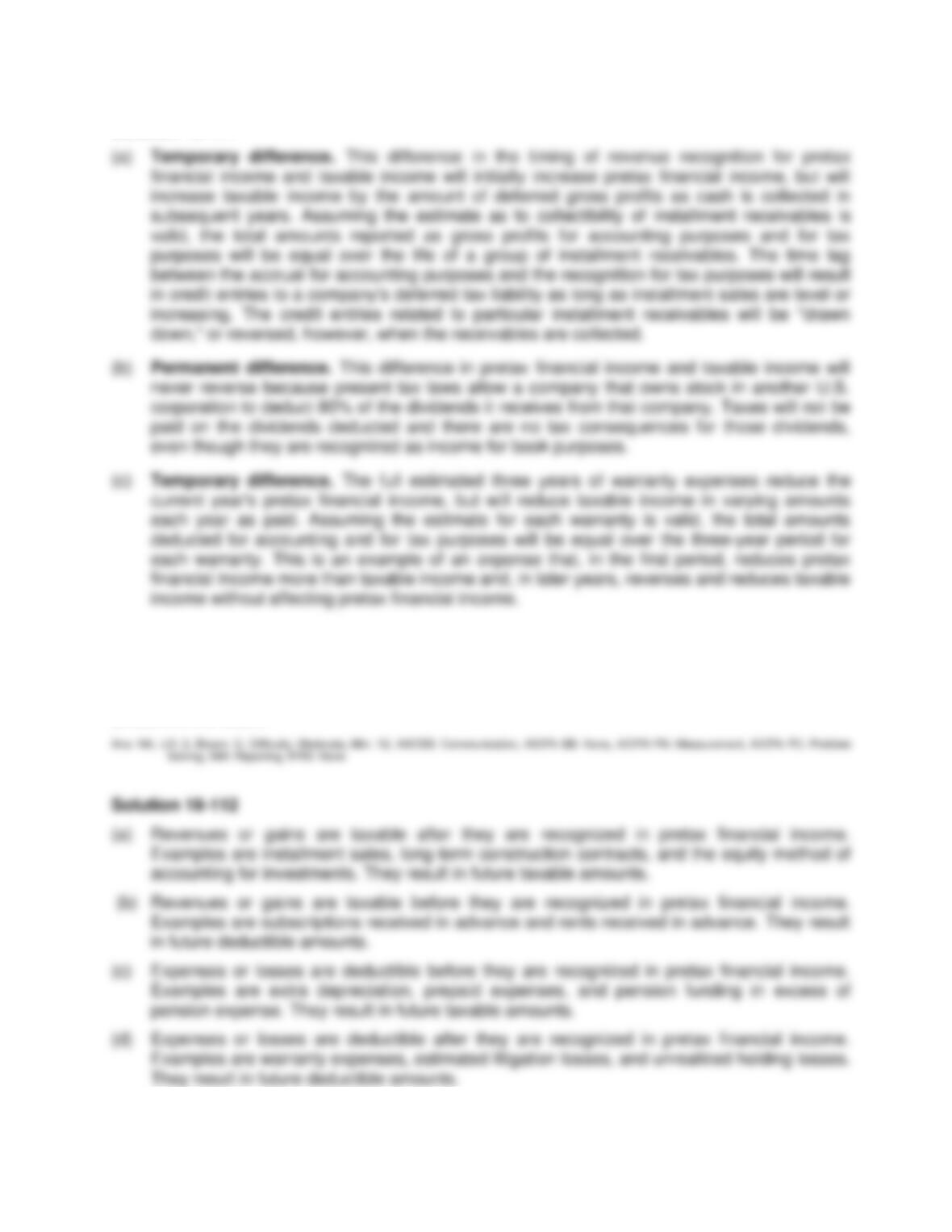
(a) For accounting purposes, a company reports revenue from installment sales on the accrual
basis. For income tax purposes, it reports the revenues by the installment-sales method,
deferring recognition of gross profit until cash is collected.
(b) Pretax accounting income and taxable income differ because 80% of dividends received
from U.S. corporations was deducted from taxable income, while 100% of the dividends
received was reported for financial statement purposes.
(c) Estimated warranty costs (covering a three-year warranty) are expensed for accounting
purposes at the time of sale but deducted for income tax purposes when paid.
Accounting for Income Taxes
19 – 41
Solution 19-111
Ex. 19-112—Temporary differences.
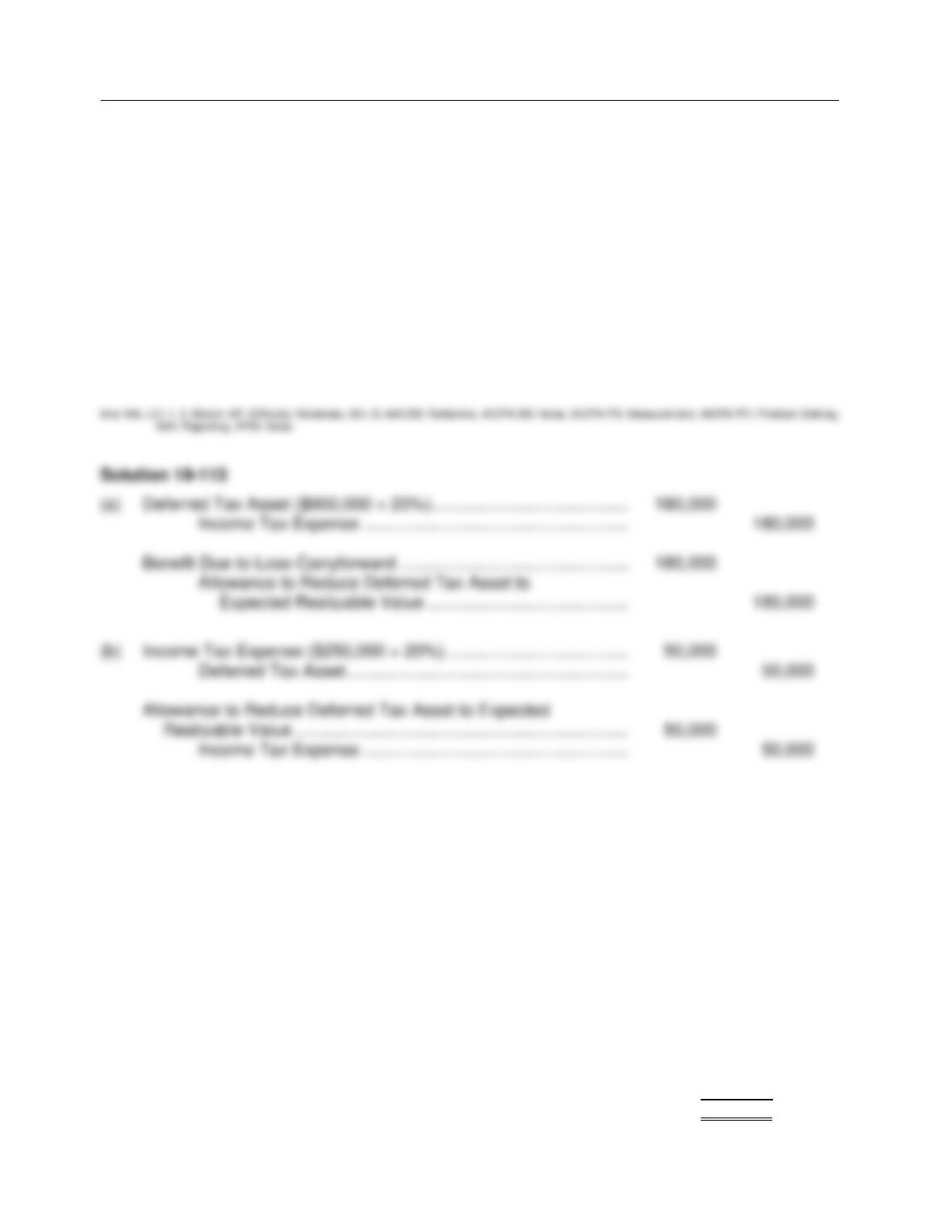
There are four types of temporary differences. For each type: (1) indicate the type and cause of
the difference, (2) give an example, and (3) indicate whether it will create a taxable or deductible
amount in the future.
Test Bank for Intermediate Accounting, Seventeenth Edition
19 – 42
Ex. 19-113—Operating loss carryforward.
In 2021, its first year of operations, Kimble Corp. has a $900,000 net operating loss when the tax
rate is 20%. In 2022, Kimble has $250,000 taxable income and the tax rate remains 20%.
Instructions
Assume the management of Kimble Corp. thinks that it is more likely than not that the loss
carryforward will not be realized in the near future because it is a new company (this is before
results of 2022 operations are known).
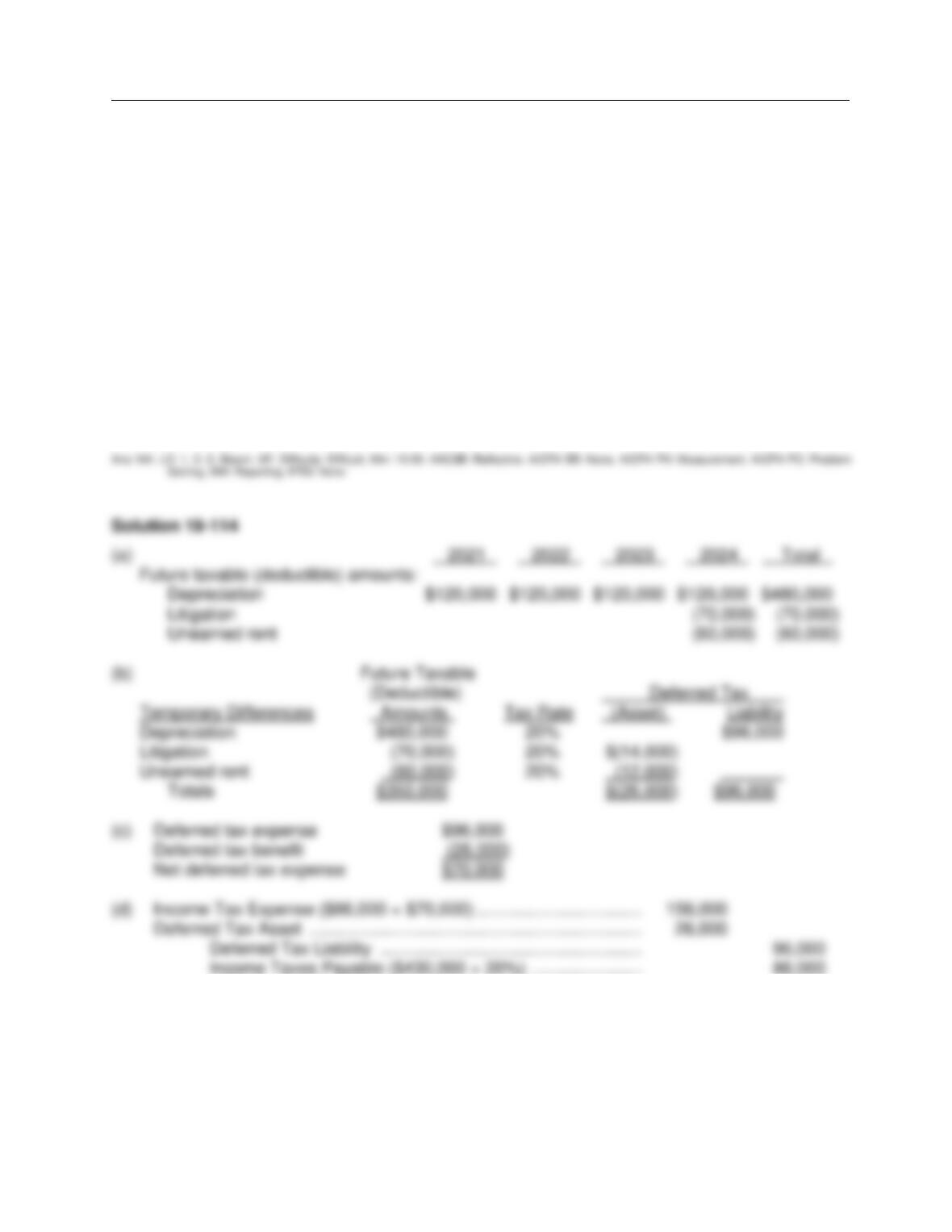
(a) What are the entries in 2021 to record the tax effects of the loss carryforward?
(b) What entries would be made in 2022 to record the current and deferred income taxes and to
recognize the loss carryforward? (Assume that at the end of 2022 it is more likely than not
that the deferred tax asset will be realized.)
PROBLEMS
*Pr. 19-114—Differences between accounting and taxable income and the effect on deferred
taxes.
The following differences enter into the reconciliation of financial income and taxable income of
Abbott Company for the year ended December 31, 2020, its first year of operations. The enacted
income tax rate is 20% for all years.
Pretax accounting income $800,000
Excess tax depreciation (480,000)
Litigation accrual 70,000
Unearned rent revenue deferred on the books but appropriately
recognized in taxable income 60,000
Interest income from New York municipal bonds (20,000)
Taxable income $430,000
Accounting for Income Taxes
19 – 43
Pr. 19-114 (cont.)
1. Excess tax depreciation will reverse equally over a four-year period, 2021–2024.
2. It is estimated that the litigation liability will be paid in 2024.
3. Rent revenue will be recognized during the last year of the lease, 2024.
4. Interest revenue from the New York bonds is expected to be $20,000 each year until their
maturity at the end of 2024.
Instructions
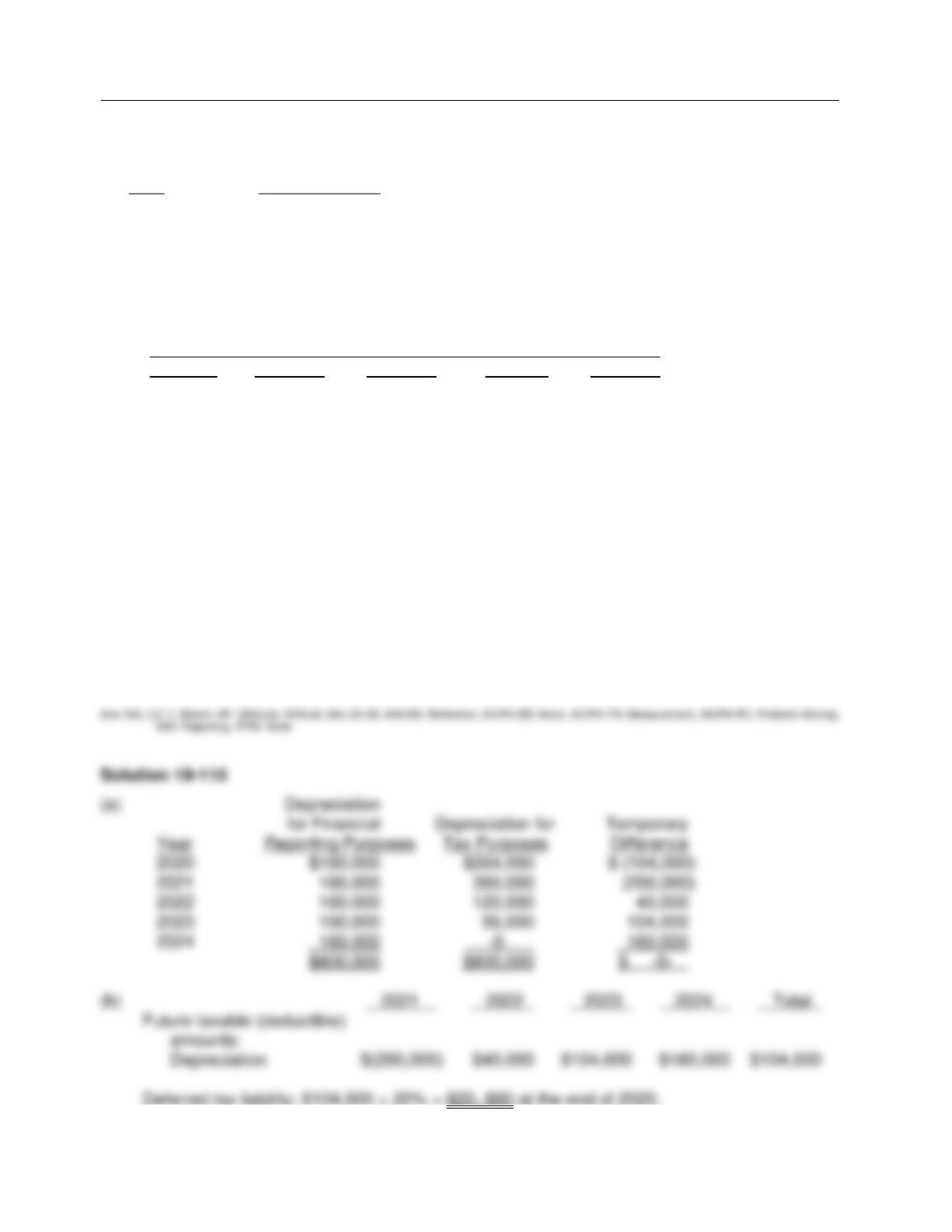
(a) Prepare a schedule of future taxable and (deductible) amounts.
(b) Prepare a schedule of the deferred tax (asset) and liability at the end of 2020.
(c) Since this is the first year of operations, there is no beginning deferred tax asset or liability.
Compute the net deferred tax expense (benefit).
(d) Prepare the journal entry to record income tax expense, deferred taxes, and the income
taxes payable for 2020.
Test Bank for Intermediate Accounting, Seventeenth Edition
19 – 44
Pr. 19-115—Multiple temporary differences.
The following information is available for the first three years of operations for Cooper Company:
1. Year Taxable Income
2020 $500,000
2021 375,000
2022 400,000
2. On January 2, 2020, heavy equipment costing $800,000 was purchased. The equipment had
a life of 5 years and no salvage value. The straight-line method of depreciation is used for
book purposes and the tax depreciation taken each year is listed below:
Tax Depreciation
2020 2021 2022 2023 Total
$264,000 $360,000 $120,000 $56,000 $800,000
3. On January 2, 2021, $360,000 was collected in advance for rental of a building for a three–
year period. The entire $360,000 was reported as taxable income in 2021, but $240,000 of
the $360,000 was reported as unearned revenue at December 31, 2021 for book purposes.
4. The enacted tax rates are 20% for all years.
Instructions
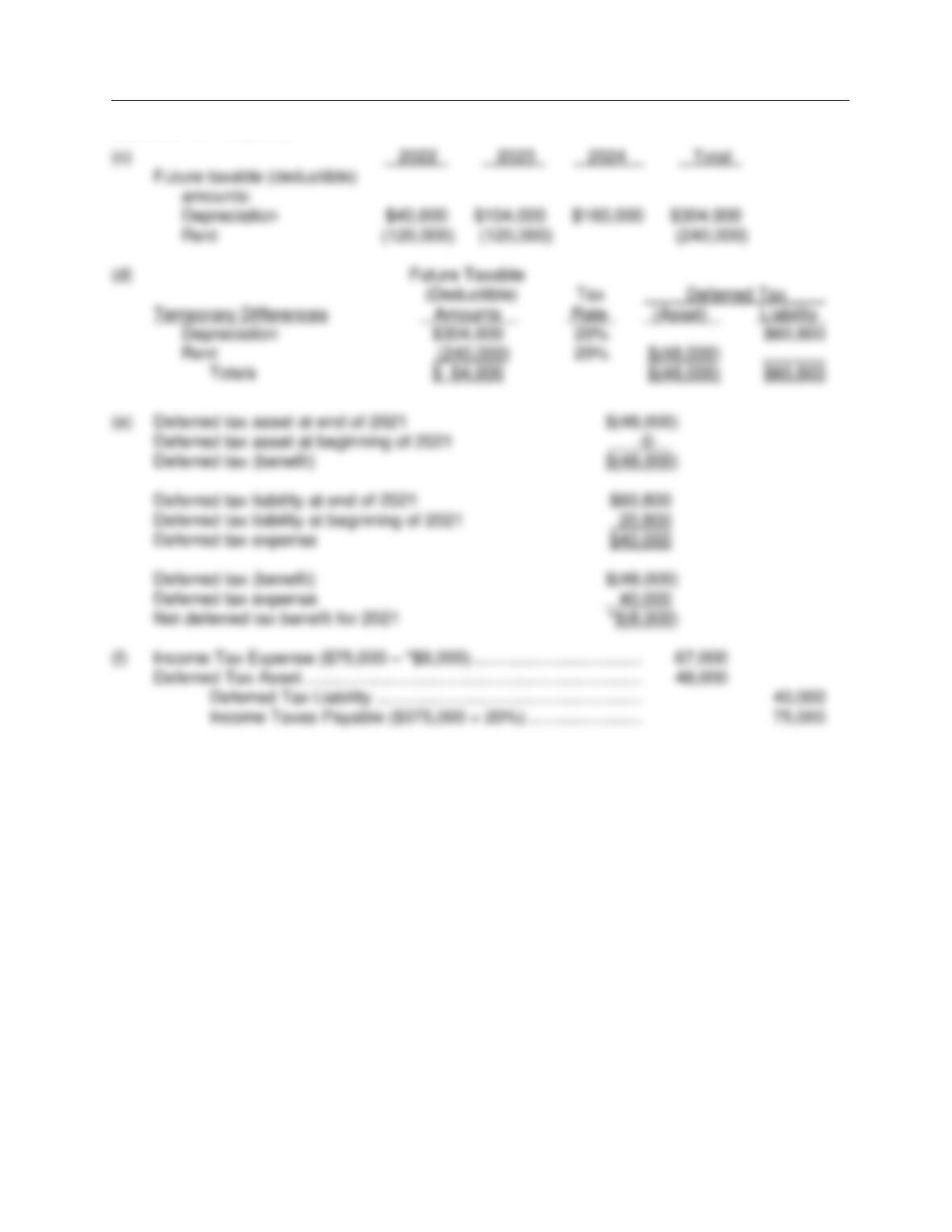
(a) Prepare a schedule comparing depreciation for financial reporting and tax purposes.
(b) Determine the deferred tax (asset) or liability at the end of 2020.
(c) Prepare a schedule of future taxable and (deductible) amounts at the end of 2021.
(d) Prepare a schedule of the deferred tax (asset) and liability at the end of 2021.
(e) Compute the net deferred tax expense (benefit) for 2021.
(f) Prepare the journal entry to record income tax expense, deferred income taxes, and income
tax payable for 2021.
Accounting for Income Taxes
19 – 45
Solution 19-115 (cont.)
*Pr. 19-116—Deferred tax asset.
Farmer Inc. began business on January 1, 2021. Its pretax financial income for the first 2 years
was as follows:
2021 $240,000
2022 560,000
The following items caused the only differences between pretax financial income and taxable
income.
1. In 2021, the company collected $420,000 of rent; of this amount, $140,000 was earned in
2021; the other $280,000 will be earned equally over the 2022–2023 period. The full
$420,000 was included in taxable income in 2021.
2. The company pays $10,000 a year for life insurance on officers.
Test Bank for Intermediate Accounting, Seventeenth Edition
19 – 46
Pr. 19-116 (cont.)
3. In 2022, the company terminated a top executive and agreed to $90,000 of severance pay.
The amount will be paid $30,000 per year for 2022–2024. The 2022 payment was made. The
$90,000 was expensed in 2022. For tax purposes, the severance pay is deductible as it is
paid.
The enacted tax rates existing at December 31, 2021 are:
2021 20% 2023 30%
2022 25% 2024 30%
Instructions
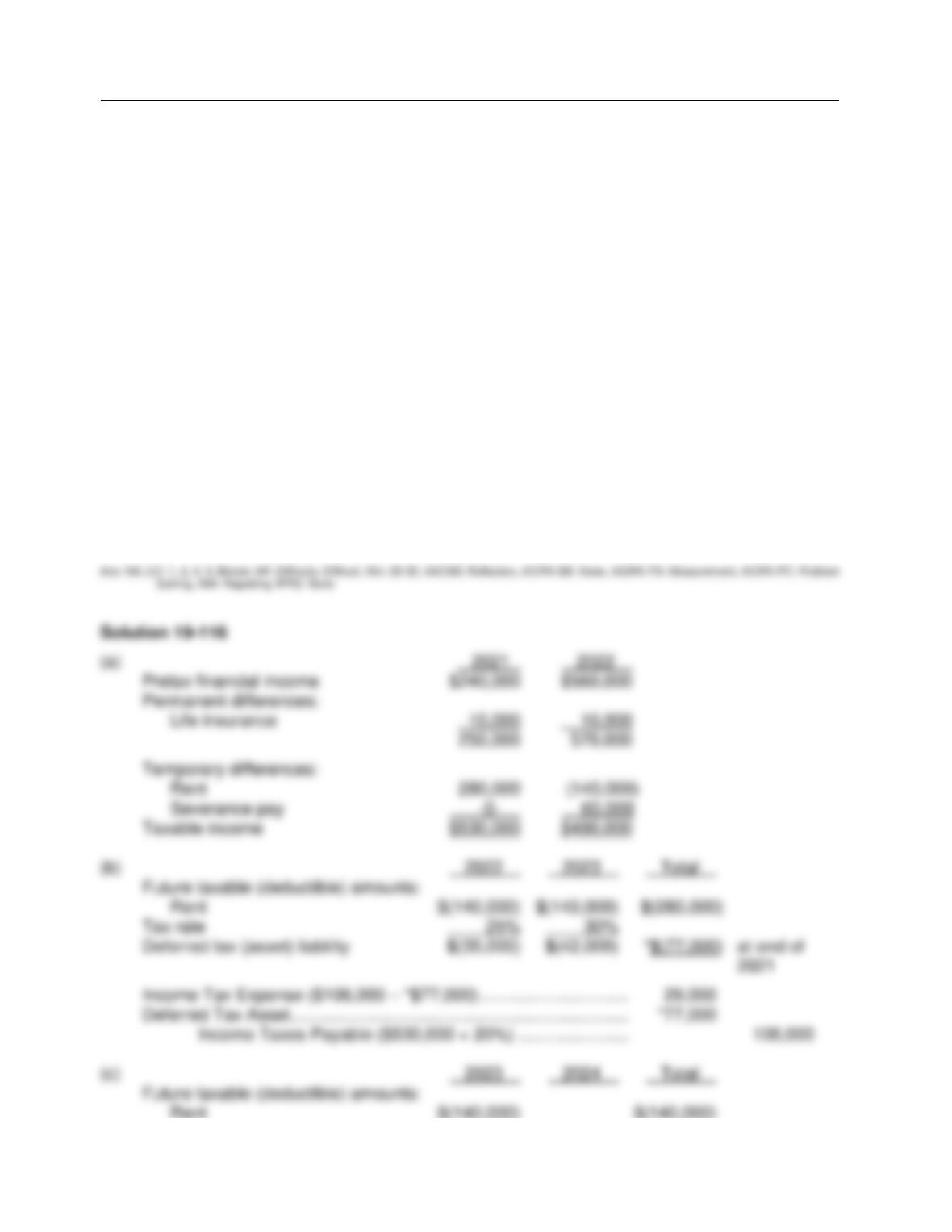
(a) Determine taxable income for 2021 and 2022.
(b) Determine the deferred income taxes at the end of 2021, and prepare the journal entry to
record income taxes for 2021.
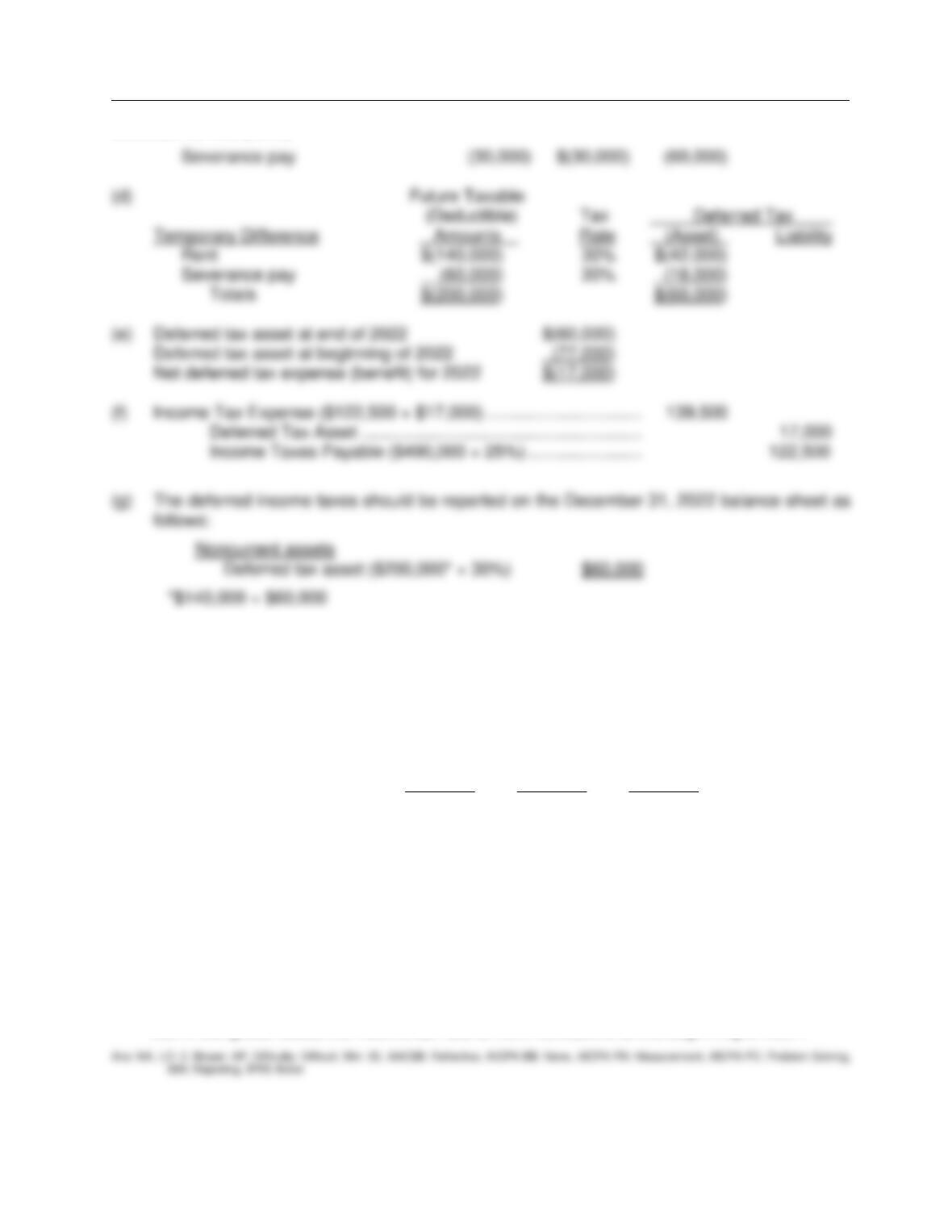
(c) Prepare a schedule of future taxable and (deductible) amounts at the end of 2022.
(d) Prepare a schedule of the deferred tax (asset) and liability at the end of 2022.
(e) Compute the net deferred tax expense (benefit) for 2022.
(f) Prepare the journal entry to record income taxes for 2022.
(g) Show how the deferred income taxes should be reported on the balance sheet at December
31, 2022.
Accounting for Income Taxes
19 – 47
Solution 19-116 (cont.)
Pr. 19-117—Interperiod tax allocation with change in enacted tax rates.
Murphy Company purchased equipment for $450,000 on January 2, 2020, its first day of
operations. For book purposes, the equipment will be depreciated using the straight-line method
over three years with no salvage value. Pretax financial income and taxable income are as
follows:
2020 2021 2022
Pretax financial income $224,000 $260,000 $300,000
Taxable income 184,000 260,000 340,000
The temporary difference between pretax financial income and taxable income is due to the use
of accelerated depreciation for tax purposes.
Instructions
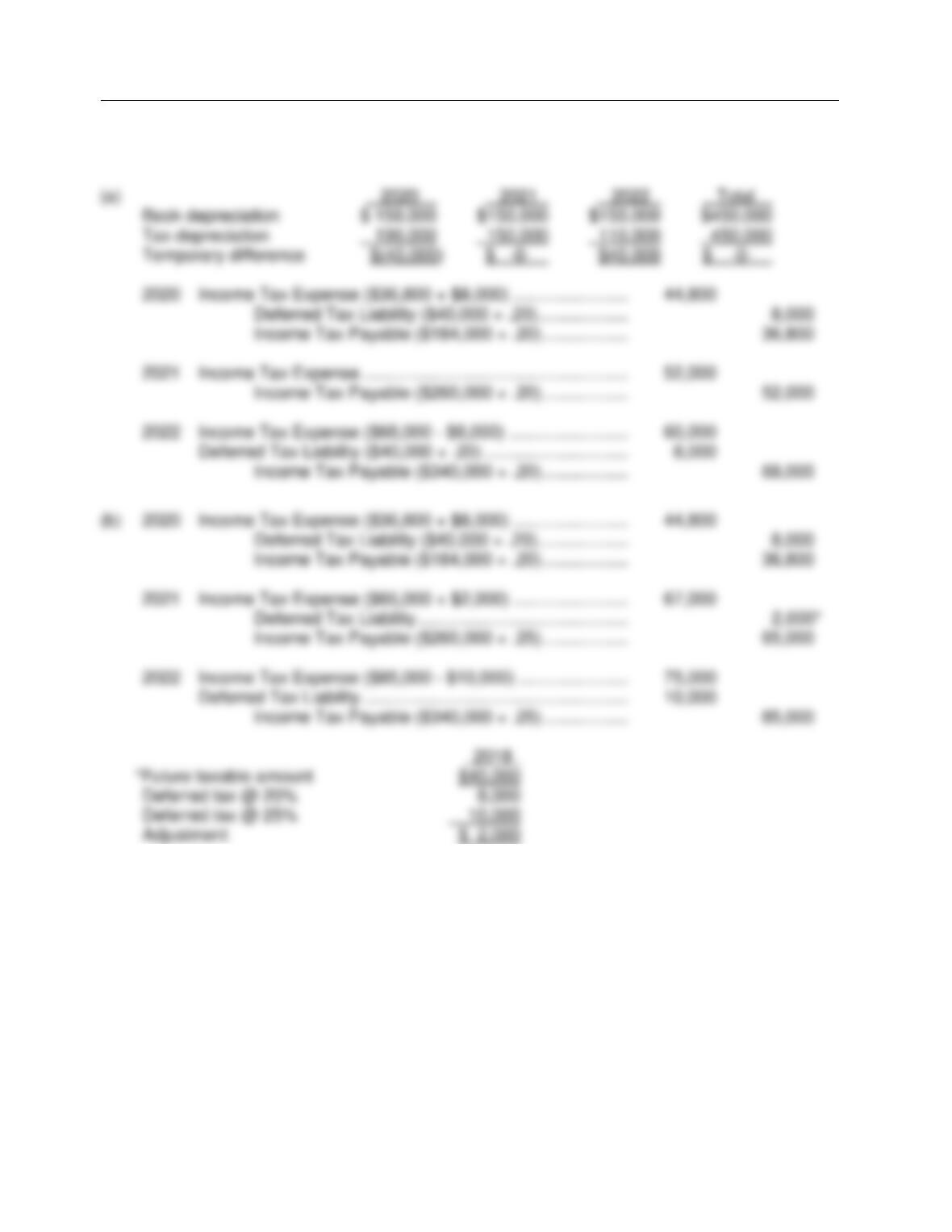
(a) Prepare the journal entries to record income taxes for all three years (expense, deferrals,
and liabilities) assuming that the enacted tax rate applicable to all three years is 20%.
(b) Prepare the journal entries to record income taxes for all three years (expense, deferrals,
and liabilities) assuming that the enacted tax rate as of 2020 is 20% but that in the middle of
2021, Congress raises the income tax rate to 25% retroactive to the beginning of 2021.
Test Bank for Intermediate Accounting, Seventeenth Edition
19 – 48
Solution 19-117
Accounting for Income Taxes
19 – 49
IFRS QUESTIONS
True/False Questions
*1. Under IFRS an affirmative judgment approach is used for recognizing deferred tax assets up
to the amount that is probable to be realized.
*2. Under GAAP, the rate used to compute deferred taxes is either the enacted tax rate, or a
substantially enacted tax rate (virtually certain).
*3. Under IFRS, a deferred tax liability is classified as current or noncurrent based on the
classification of the asset or liability to which it relates.
*4. Under IFRS, all tax effects are charged or credited to income.
*5. Under IFRS, all potential liabilities associated with uncertain tax positions are recognized.
Answers to True/False:
Multiple Choice Questions
*6. Which of the following is false regarding accounting for deferred taxes under IFRS?
a. A deferred tax liability is classified as current or noncurrent based on the classification
of the asset or liability to which it relates.
b. A deferred tax asset is recognized up to the amount that is probable to be realized.
c. Tax effects of certain items are recognized in equity.
d. The rate used to compute deferred taxes is either the enacted tax rate, or a
substantially enacted tax rate (virtually certain).

Test Bank for Intermediate Accounting, Seventeenth Edition
19 – 50
*7. Jerome Co. has the following deferred tax liabilities at December 31, 2021:
Amount
Related to
$100,000
Installment sales, expected to be collected in 2022
$350,000
Fixed asset, 10-year remaining useful life, 2021 tax depreciation exceeds
book depreciation
$90,000
Prepaid insurance related to 2022
What amount would Jerome Co. report as a noncurrent deferred tax liability under IFRS and
under GAAP?
IFRS GAAP
a. $0 $450,000
b. $540,000 $540,000
c. $350,000 $350,000
d. $540,000 $350,000
*8. With regard to recognition of deferred tax assets, IFRS requires
Approach
Recognition
a.
Affirmative judgment
Recognize an asset up to the amount that is probable
to be realized
b.
Impairment approach
Recognize asset in full, reduced by valuation
allowance if it’s more likely than not that all or a
portion of the asset won’t be realized
c.
Affirmative judgment
Recognize asset in full, reduced by valuation
allowance if it’s more likely than not that all or a
portion of the asset won’t be realized
d.
Impairment approach
Recognize an asset up to the amount that is probable
to be realized
*9. Match the approach, IFRS or GAAP, with the location where tax effects are reported:
Approach
Location
a.
IFRS
Charge or credit only taxable temporary differences to income
b.
GAAP
Charge or credit certain tax effects to equity
c.
IFRS
Charge or credit certain tax effects to equity
d.
GAAP
Charge or credit only deductible temporary differences to
income

Accounting for Income Taxes
19 – 51
*10.Alice, Inc. has the following deferred tax assets at December 31, 2020:
Amount
Related to
$180,000
Rent revenue collected in advance related to 2021
$75,000
Warranty liability, expected to be paid in 2021
$255,000
Accrued liability related to a lawsuit expected to settle in 2024
What amount would Alice, Inc. report as a current deferred tax asset under IFRS and under
GAAP?
_IFRS_ GAAP
a $510,000 $510,000
b. $0 $0
c. $255,000 $510,000
d. $510,000 $255,000
Answers to Multiple Choice:
Test Bank for Intermediate Accounting, Seventeenth Edition
19 – 52
Short Answer:
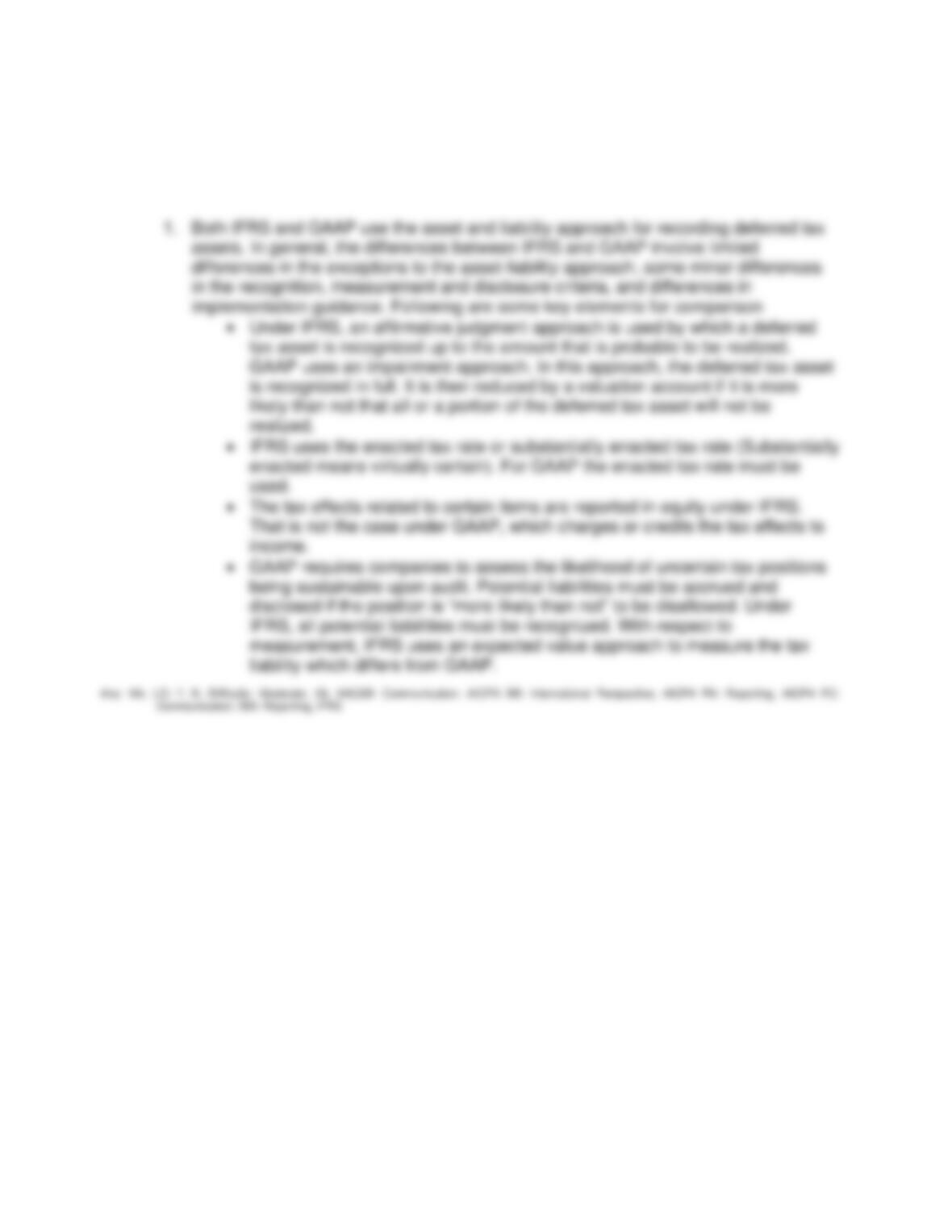
*11. Briefly describe some of the similarities and differences between GAAP and IFRS with
respect to income tax accounting.