196)
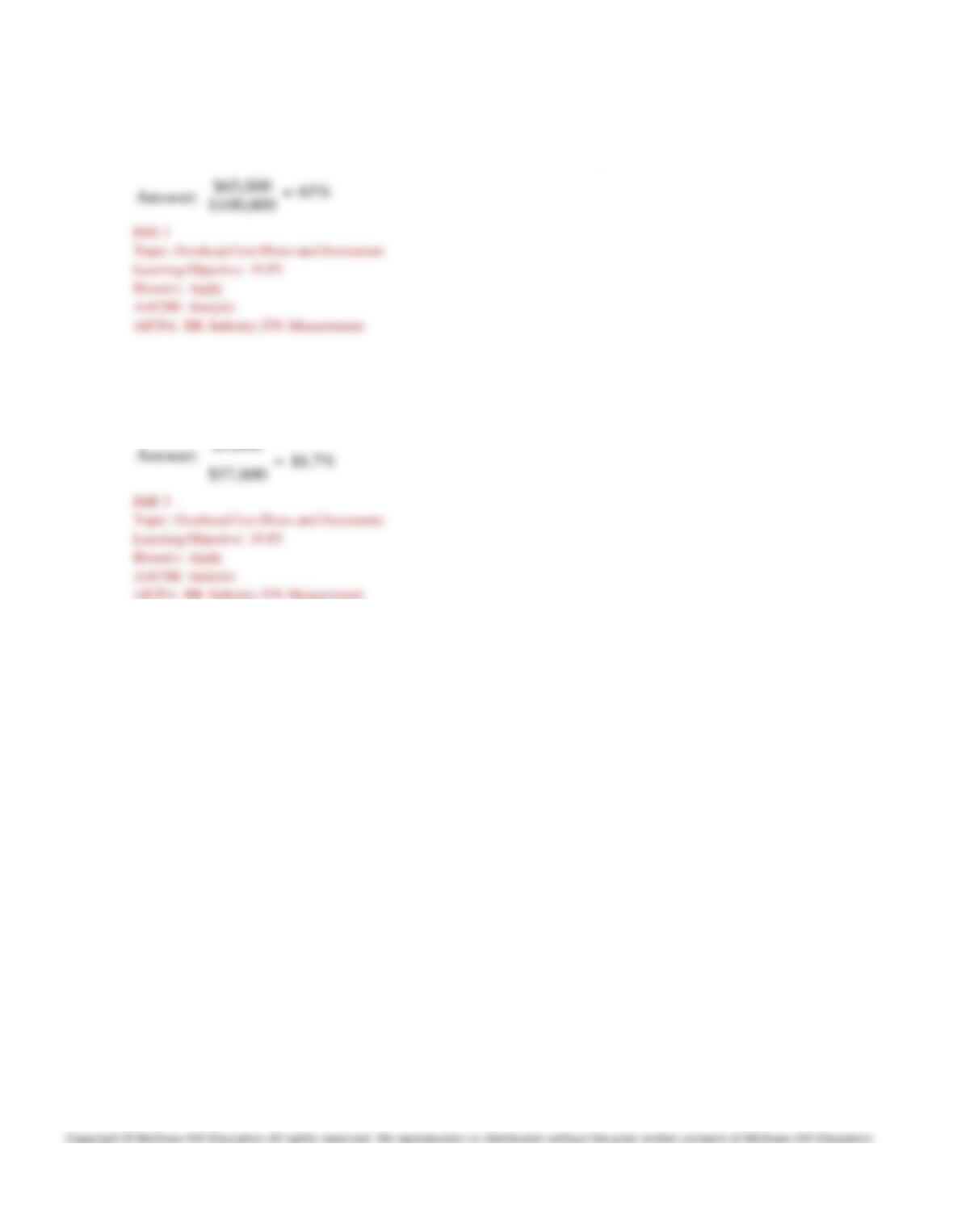
Nutley Company uses a job order cost system and last period incurred $70,000 of overhead and
$100,000 of direct labor. Nutley estimates that its overhead next period will be $65,000. The
company also expects to incur $100,000 of direct labor. If Nutley bases its overhead applied on
direct labor cost, what should be the overhead rate for the next period?
197)
A company’s job order costing system applies overhead based on direct labor cost. The company’s
estimated production costs for were: direct labor, $57,600; direct materials, $76,800; and factory
overhead, $9,600. Calculate the company’s overhead rate.
198)
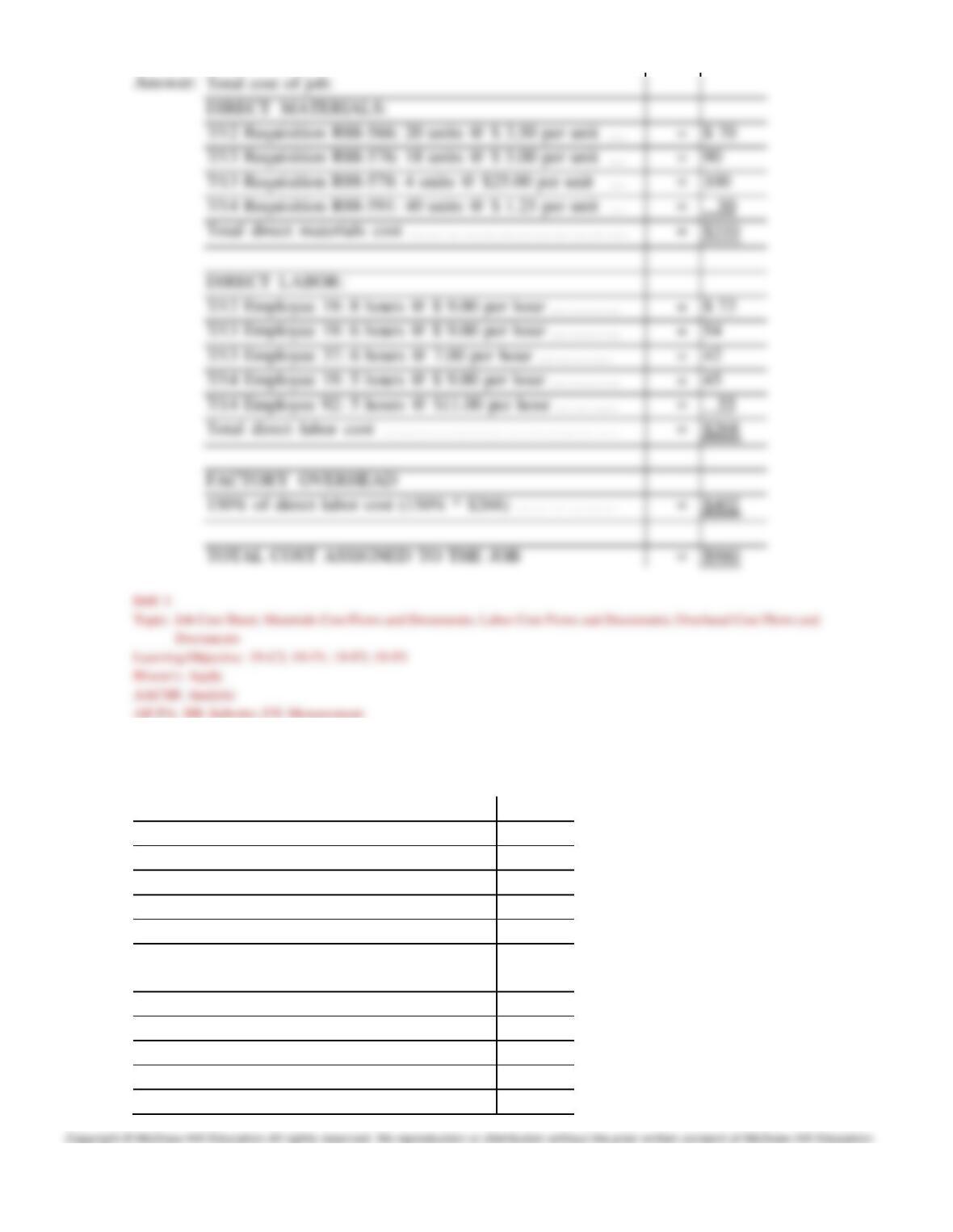
The job cost sheet for Job number 83-421 includes the following information:
DIRECT MATERIALS:
7/12 Requisition R88-566: 20 units @ $ 3.50 per unit
7/13 Requisition R88-576: 18 units @ $ 5.00 per unit
7/13 Requisition R88-578: 4 units @ $25.00 per unit
7/14 Requisition R88-591: 40 units @ $ 1.25 per unit
DIRECT LABOR:
7/12 Employee 19: 8 hours @ $ 9.00 per hour
7/13 Employee 19: 6 hours @ $ 9.00 per hour
7/13 Employee 37: 6 hours @ $ 7.00 per hour
7/14 Employee 19: 5 hours @ $ 9.00 per hour
7/14 Employee 92: 5 hours @ $11.00 per hour
FACTORY OVERHEAD: Assigned at 150% of direct labor cost.
What is the total cost of Job number 83-421?
135
DIRECT MATERIALS:
7/12 Requisition R88-566: 20 units @ $ 3.50 per unit …
$ 70
7/13 Requisition R88-576: 18 units @ $ 5.00 per unit …
7/13 Requisition R88-578: 4 units @ $25.00 per unit …
7/14 Requisition R88-591: 40 units @ $ 1.25 per unit …
50
7/12 Employee 19: 8 hours @ $ 9.00 per hour …………
$ 72
7/13 Employee 19: 6 hours @ $ 9.00 per hour …………
7/14 Employee 19: 5 hours @ $ 9.00 per hour …………
7/14 Employee 92: 5 hours @ $11.00 per hour ………..
55
FACTORY OVERHEAD
199)
The following calendar year information about the Tchulahota Corporation is available on December
31:
Advertising expense……………………………
$ 28,800
Depreciation of factory equipment……………
42,320
Depreciation of office equipment……………..
10,800
Direct labor……………………………………
142,600
Factory utilities…………………………………
35,650
Interest expense…………………………………
6,650
Inventories, January 1:
Raw materials……………………………
3,450
Work in Process…………………………
17,250
Finished goods……………………………
35,600
Inventories, December 31:
Raw materials……………………………
136
..
2,300
137
Raw materials……………………………..
2,300
Work in Process…………………………..
20,700
Finished goods……………………………
31,050
Raw materials purchases………………………
132,450
Rent on factory building………………………
41,400
Indirect labor…………………………………..
51,750
Sales commissions……………………………..
16,500
The company applies overhead on the basis of 125% of direct labor costs. Calculate the amount of
over- or underapplied overhead.
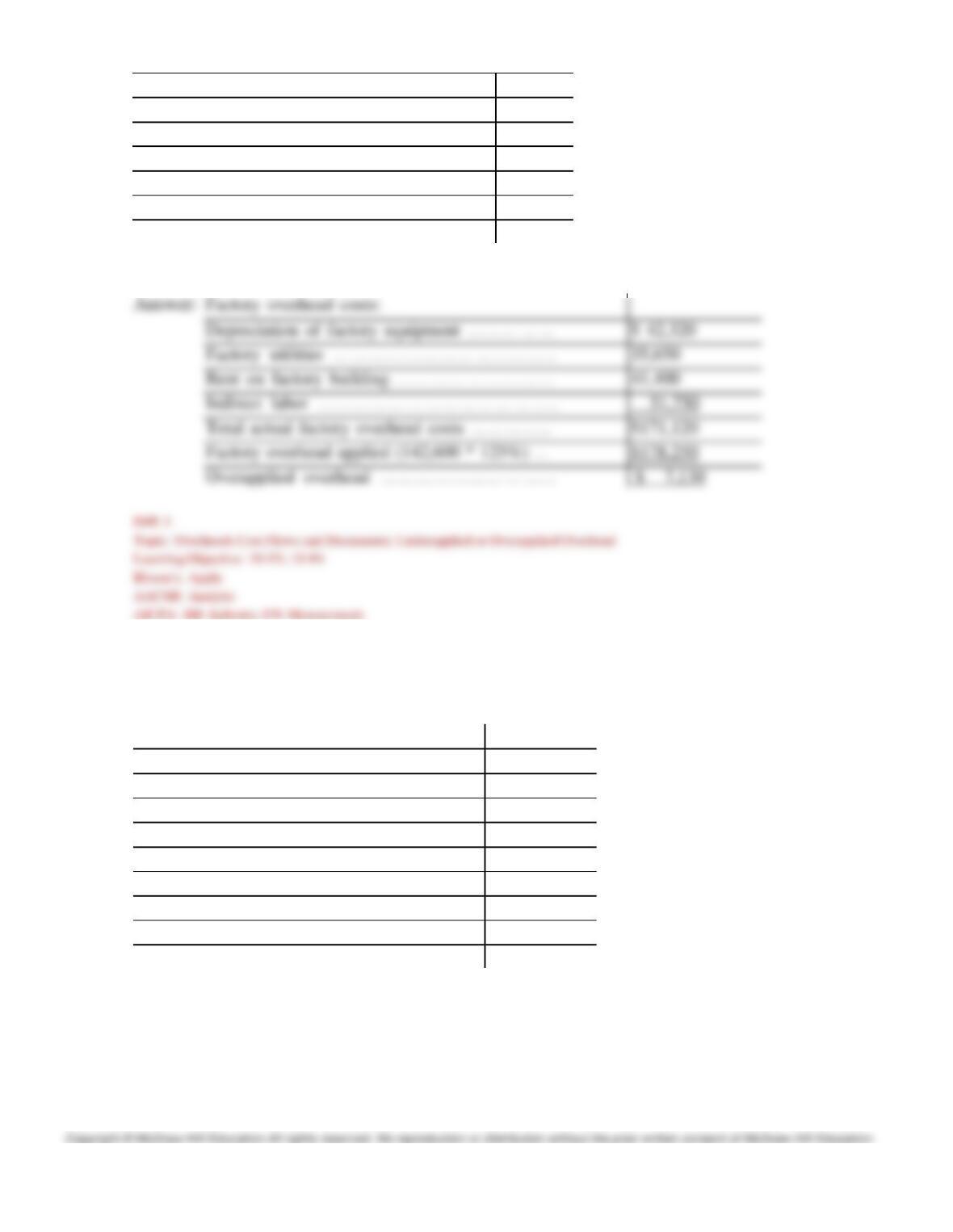
Factory overhead costs:
Depreciation of factory equipment ……………
$ 42,320
Factory utilities ………………………………..
35,650
Rent on factory building ………………………
41,400
Indirect labor …………………………………..
51,750
Total actual factory overhead costs …………..
$171,120
Factory overhead applied (142,600 * 125%) …
$178,250
200)
The predetermined overhead rate for Foster, Inc., is based on estimated direct labor costs of $400,000
and estimated factory overhead of $500,000. Actual costs incurred were:
Direct materials……………………………..
$240,000
Direct labor…………………………………..
410,000
Indirect materials……………………………
55,000
Indirect labor………………………………..
125,000
Sales commissions………………………….
55,000
Factory depreciation…………………………
170,000
Property taxes, factory………………………
15,000
Factory utilities……………………………..
35,000
Advertising…………………………………..
62,500
Factory equipment rental……………………
110,000
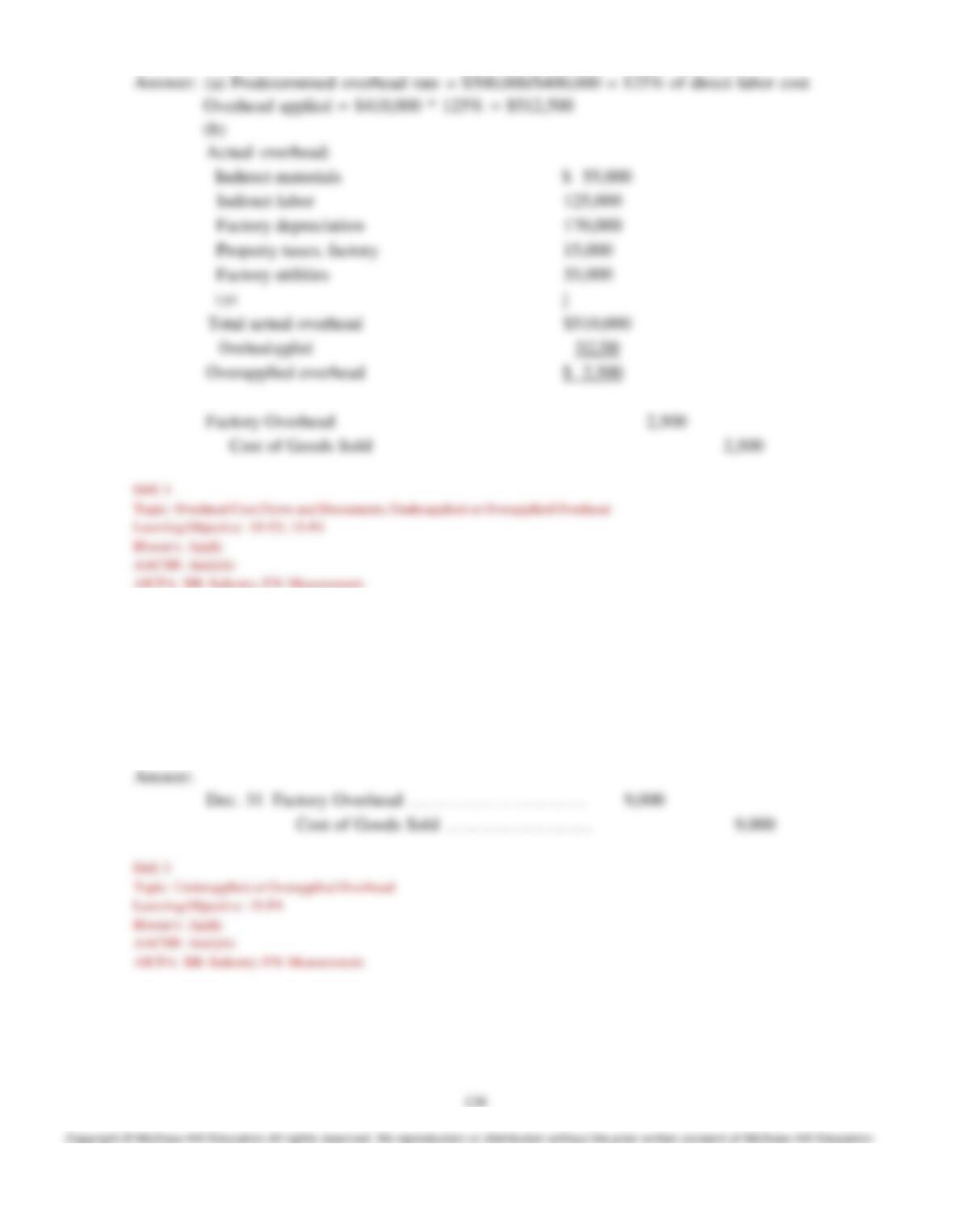
(a) Calculate the predetermined overhead rate and calculate the overhead applied during the year.
(b) Determine the amount of over- or underapplied overhead and prepare the journal entry to
eliminate the over- or underapplied overhead assuming that it is not material in amount.
201)
A company charged the following amounts of overhead to jobs during the current year: $12,000 to
jobs still in process, $42,000 to jobs completed but not sold, and $66,000 to jobs finished and sold.
At year-end, the company‘s Factory Overhead account has a credit balance of $9,000, which is not
a material amount. What entry (if any) should the company make at year-end related to this
overhead balance?
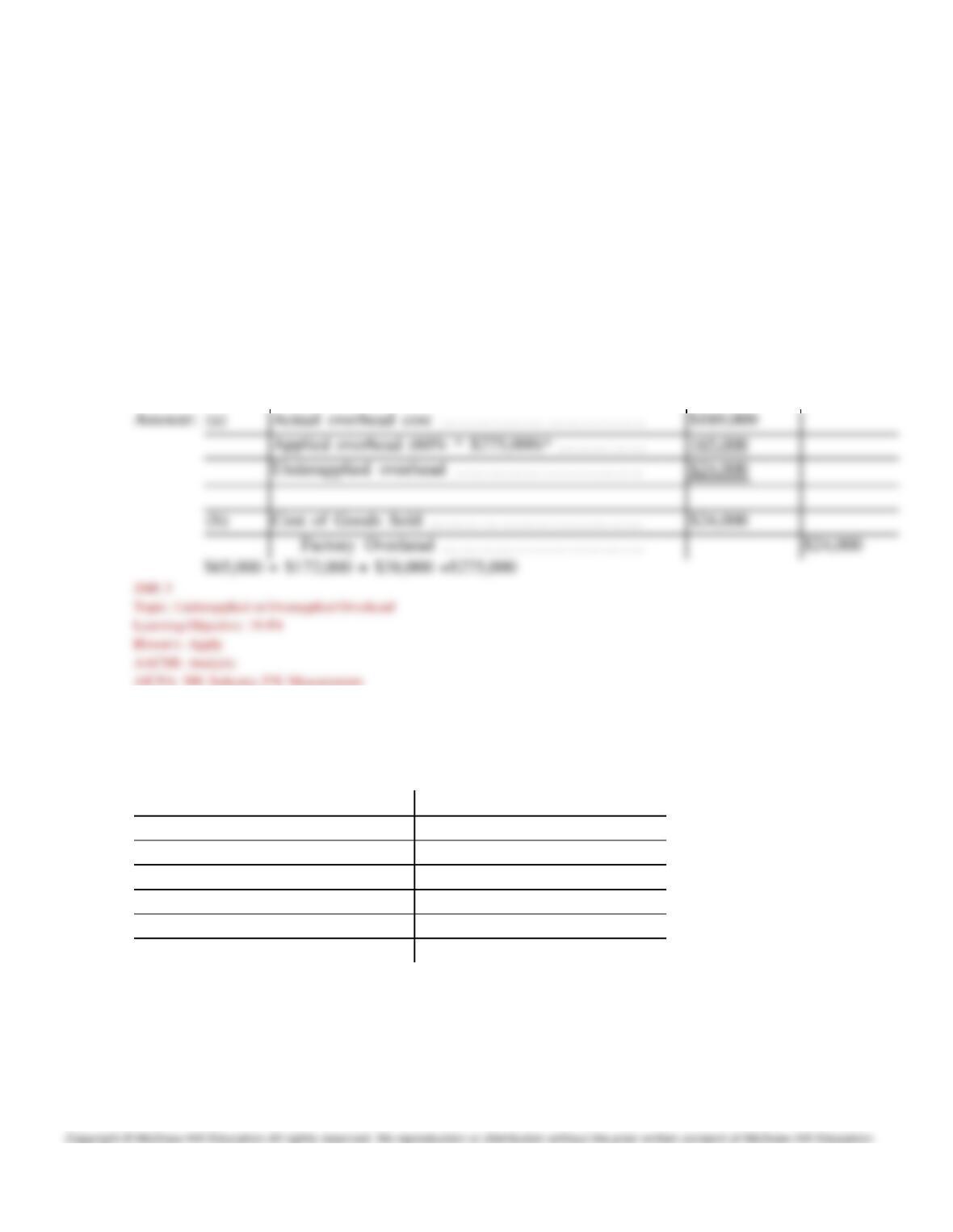
139
Applied overhead (60% * $275,000)* ……………
165,000
Cost of Goods Sold ………………………………
$24,000
202)
Oddley Corp. uses a job order costing system. The following is selected information pertaining to
costs applied to jobs during the year:
Jobs still in process at the end of the year:
$167,000, which includes $65,000 direct labor costs.
Jobs finished and sold during the year:
$395,000, which includes $172,000 direct labor costs.
Jobs finished but unsold during the year:
$103,000, which includes $38,000 direct labor costs.
Oddley Corp.’s predetermined overhead rate is 60% of direct labor cost. At the end of the year, the
company’s records show that $189,000 of factory overhead has been incurred.
(a) Determine the amount of overapplied or underapplied overhead.
(b) Prepare the necessary journal entry to close the Factory Overhead account assuming that any
remaining balance is not material.
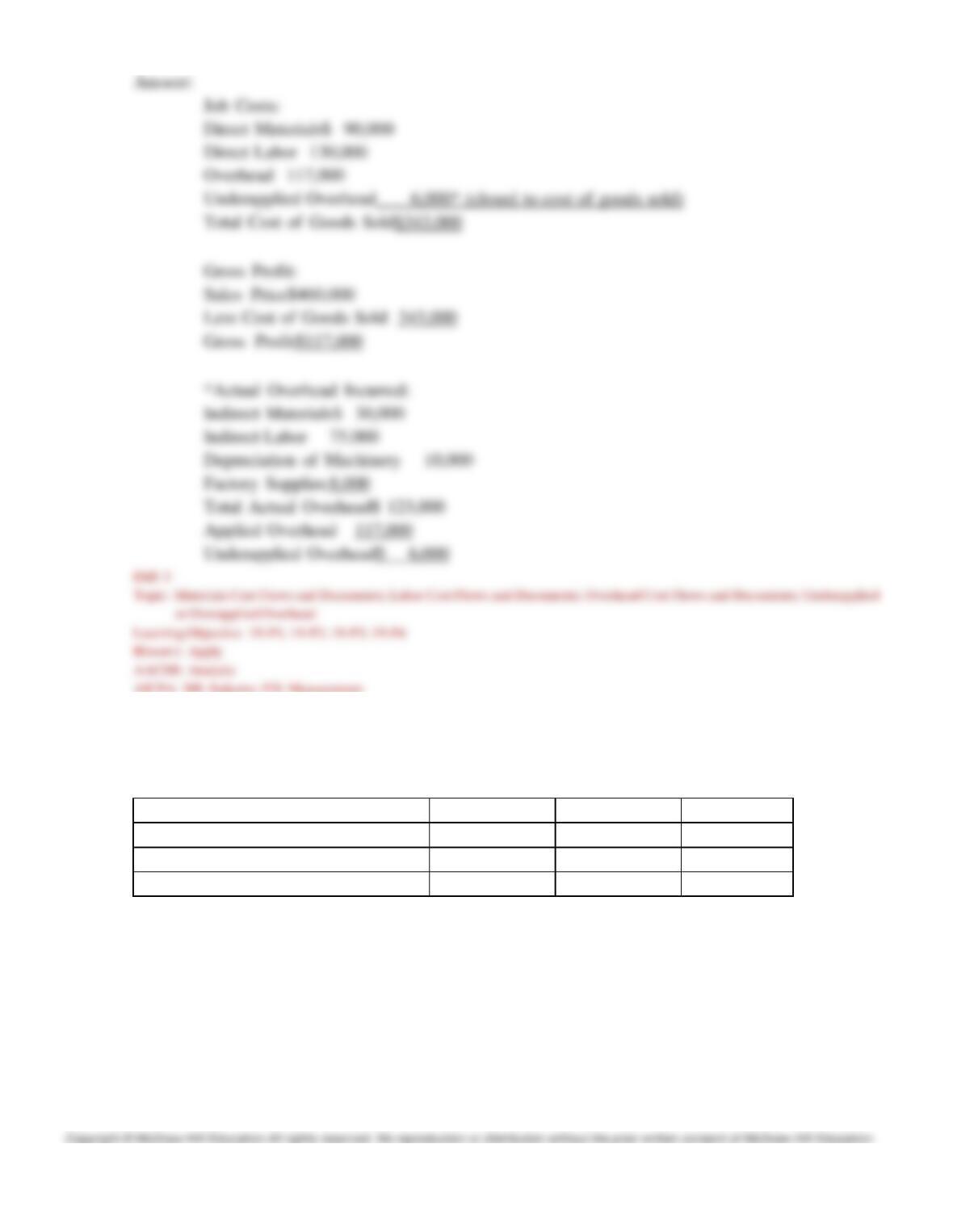
203)
Taylor Corp. uses a job order costing system and worked only on Job 101 during the current period.
Job 101 was sold for $460,000. The following information pertains to costs incurred for Job 101.
Direct Materials
$90,000
Indirect Materials
$30,000
Direct Labor
$130,000
Indirect Labor
$75,000
Depreciation of Machinery
$10,000
Factory Supplies
$8,000
Overhead Application Rate
90% of direct labor
After adjusting for the amount of over or underapplied overhead, determine the amount of gross
profit earned on Job 101.
140
204)
At the end of June, the job cost sheets for Kennedy Manufacturing show the following total costs
accumulated on three custom jobs.
Job 203
Job 204
Job 205
Direct materials
$32,000
$47,000
$43,000
Direct labor
18,000
22,000
25,000
Overhead
26,100
31,900
36,250
Job 203 was started in production in May and the following costs were assigned to it in May: direct
materials, $12,000; direct labor, $6,000; and overhead $8,700. Jobs 204 and 205 are started in June.
Overhead cost is applied with a predetermined rate based on direct labor cost. Jobs 203 and 204 are
finished in June, and Job 205 will be finished in July. No raw materials are used indirectly in June.
Using this information, answer the following questions assuming the company’s predetermined
overhead rate did not change.
a. What is the cost of the raw materials requisitioned in June for each of the three jobs?
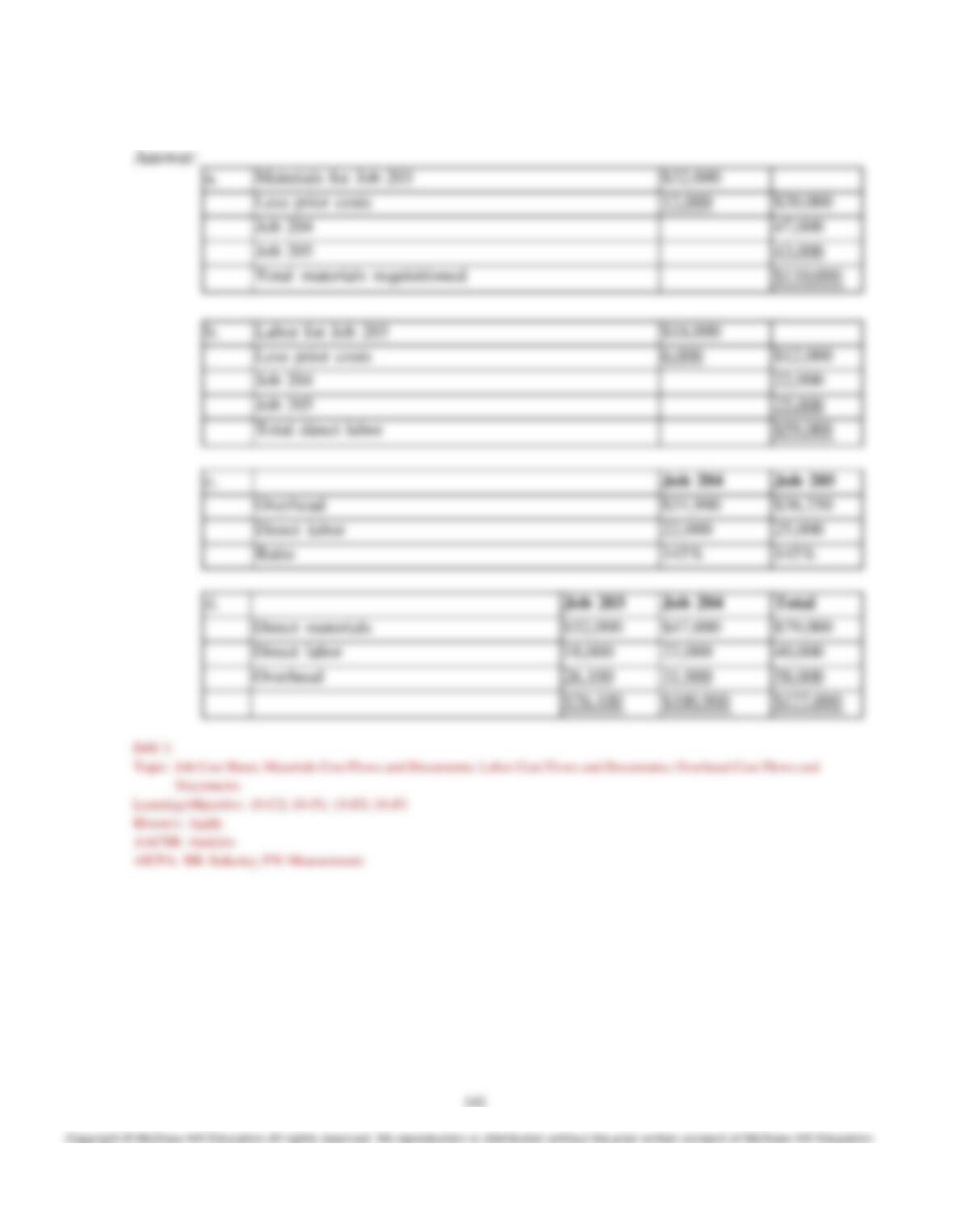
b. How much direct labor cost is incurred during June for each of the three jobs?
c. What predetermined overhead rate is used during June?
d. How much total cost is transferred to finished goods during June?
205)
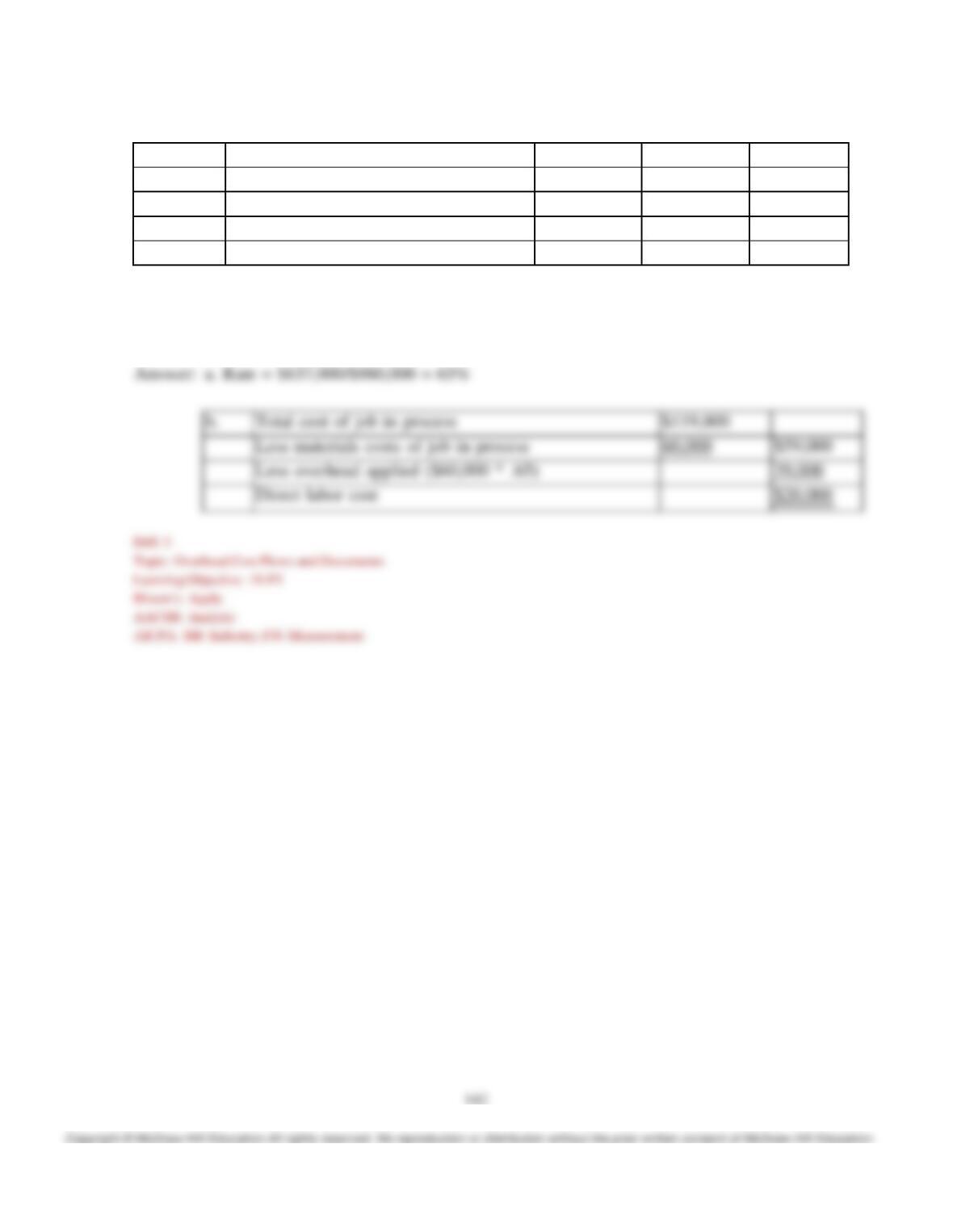
Booth Manufacturing uses a job order costing system that charges overhead to jobs on the basis of
direct material cost. At year-end, the Work in Process Inventory account shows the following.
Date
Explanation
Debit
Credit
Balance
Dec. 31
Direct materials cost
980,000
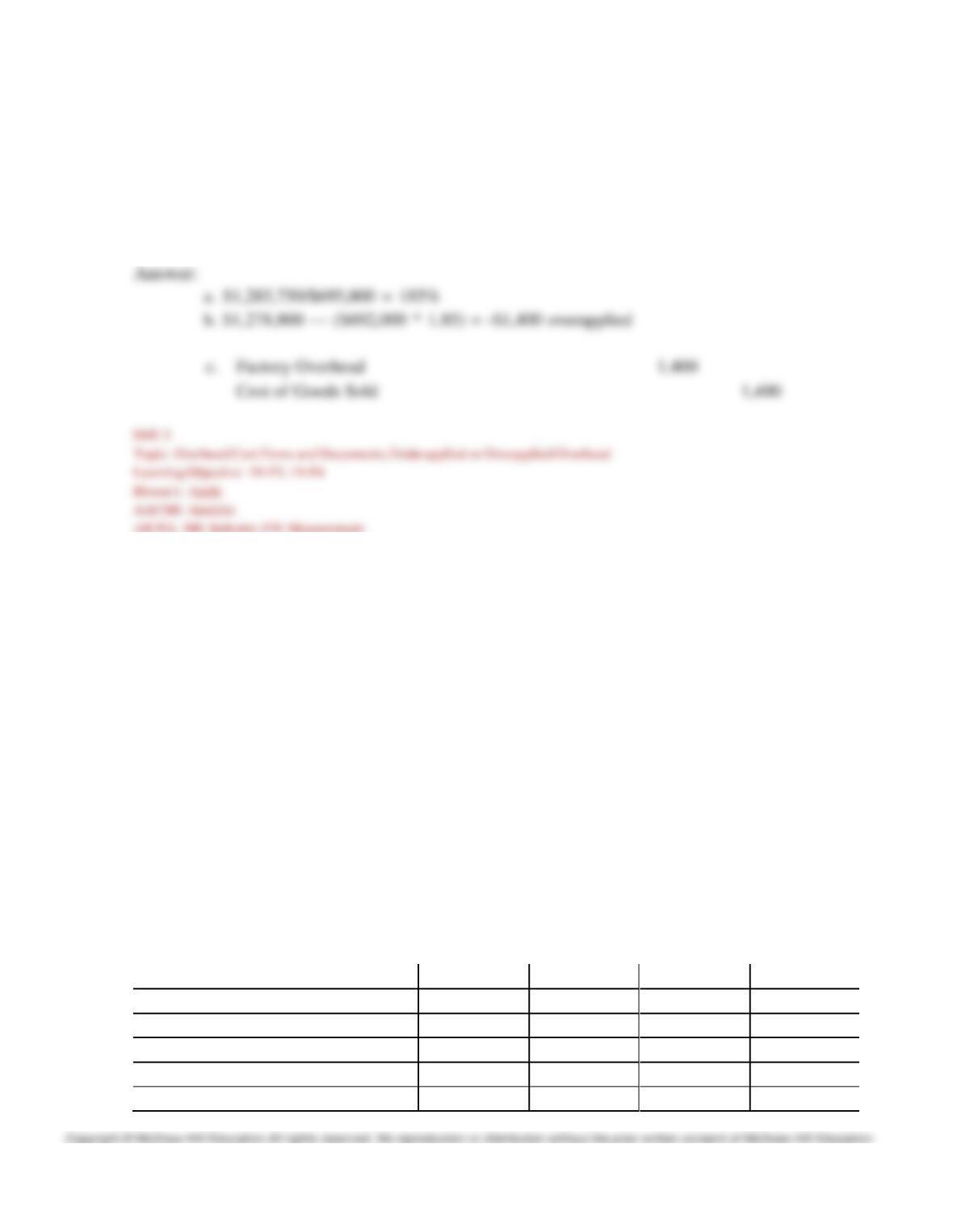
980,000
31
Direct labor cost
320,000
1,300,000
31
Overhead costs
637,000
1,937,000
31
To finished goods
1,818,000
119,000
a. Determine the overhead rate used (based on direct material cost).
b. Only one job remained in the Work in Process inventory at December 31. Its direct materials cost
is $60,000. How much direct labor cost and overhead cost are assigned to it?
Total cost of job in process
$119,000
Less materials costs of job in process
60,000
$59,000
Less overhead applied ($60,000 * .65)
39,000
206)
Franklin Manufacturing uses a job order costing system that charges overhead to jobs on the basis
of direct labor cost. Franklin used the following cost predictions: overhead costs $1,285,750, and
direct labor costs of $695,000. At year-end, the company’s records show that actual overhead costs
for the year are $1,278,800, and actual direct labor costs are $692,000.
a. Determine the predetermined overhead rate for the year.
b. Compute the amount of overapplied or underapplied overhead.
c. Prepare the adjusting entry to allocate the over- or underapplied overhead assuming the amount is
immaterial.
207)
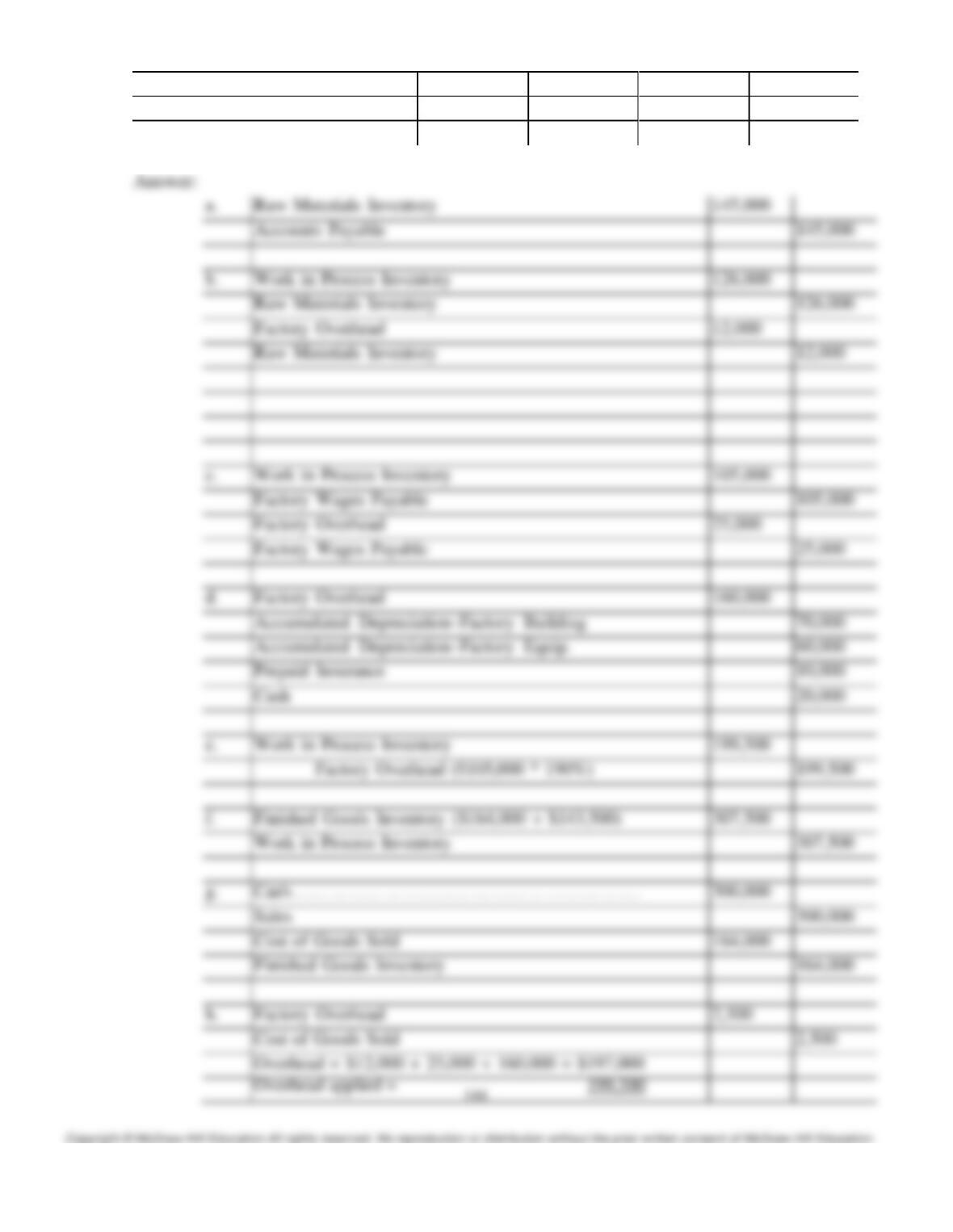
Drop Anchor takes special orders to manufacture sail boats for high end customers. Complete the job
cost sheets for Drop Anchor for September based on the following information. Prepare journal
entries to record the transactions as well as post to the job cost sheets.
a. Purchased raw materials on credit, $145,000.
b. Materials requisitions: Job 240, $48,000; Job 241, $36,000; Job 242, $42,000; indirect materials
were $12,000.
c. Time tickets used to charge labor to jobs: Job 240, $40,000; Job 241, $30,000; Job 242, $35,000,
indirect labor is $25,000.
d. The company incurred the following additional overhead costs: depreciation of factory building,
$70,000; depreciation of factory equipment, $60,000; expired factory insurance, $10,000; utilities
and maintenance cost of $20,000 were paid in cash.
e. Applied overhead to all three jobs. The predetermined overhead rate is 190% of direct labor cost.
f. Transferred jobs 240 and 242 to Finished Goods Inventory.
g. Sold job 240 for $300,000 for cash.
h. Closed the under- or over-applied overhead account balance.
Job Cost Sheets
240
241
242
Total
For the current month
Direct materials
Direct labor
Applied overhead
143
Applied overhead
Total costs
Accounts Payable
145,000
Raw Materials Inventory
126,000
Cost of Goods Sold
164,000
Factory Overhead
2,500
Cost of Goods Sold
2,500
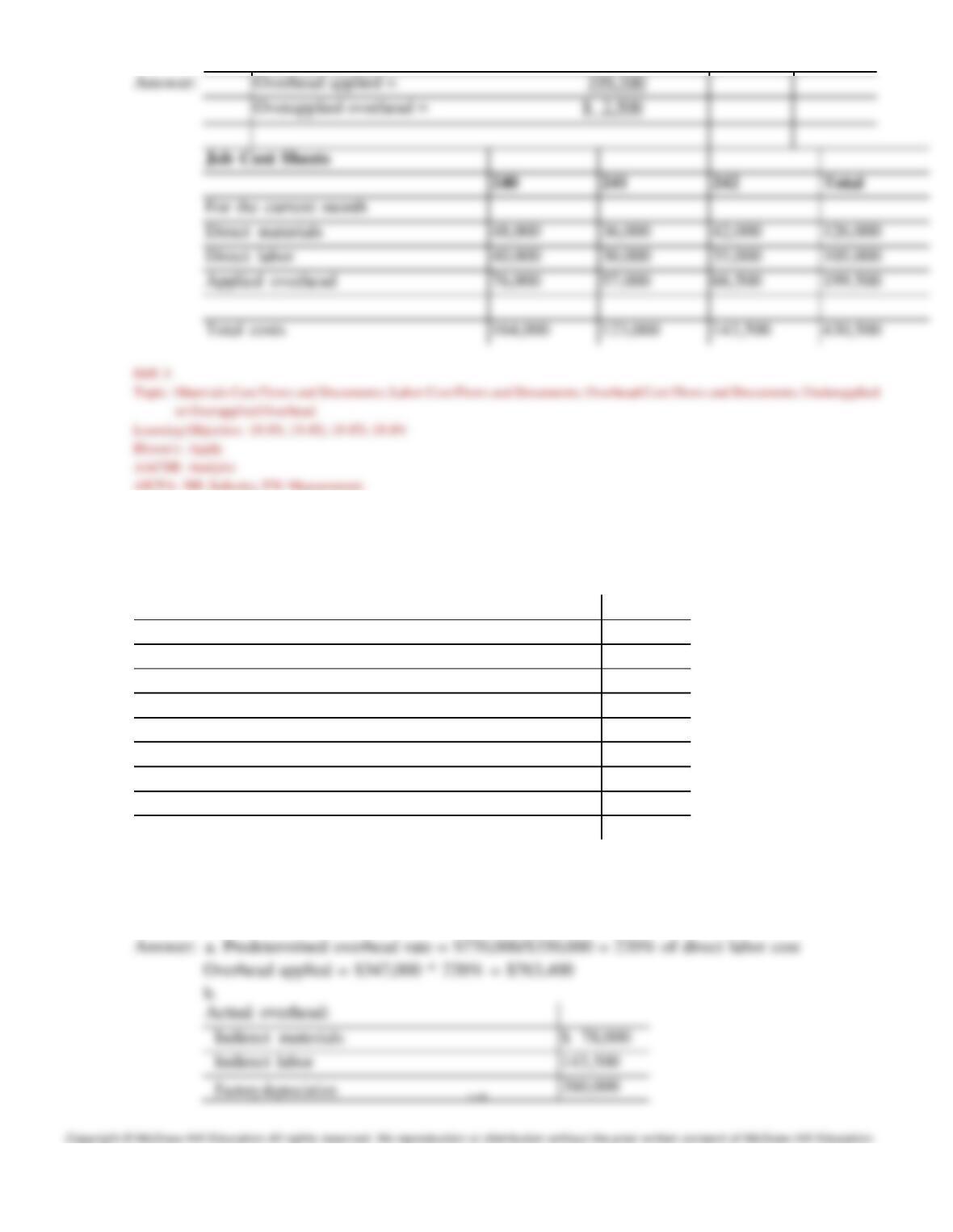
Overhead applied = 199,500
For the current month
Direct materials
48,000
36,000
42,000
126,000
Direct labor
40,000
30,000
35,000
105,000
Applied overhead
76,000
57,000
66,500
199,500
208)
The predetermined overhead rate for Shilling Manufacturing is based on estimated direct labor costs
of $350,000 and estimated factory overhead of $770,000. Actual costs incurred were:
Direct materials
$475,000
Direct labor
347,000
Indirect materials
78,000
Indirect labor
143,500
Sales commissions
150,000
Factory depreciation
260,000
Property taxes, factory
35,000
Factory utilities
65,000
Advertising
62,500
Factory supervision
185,000
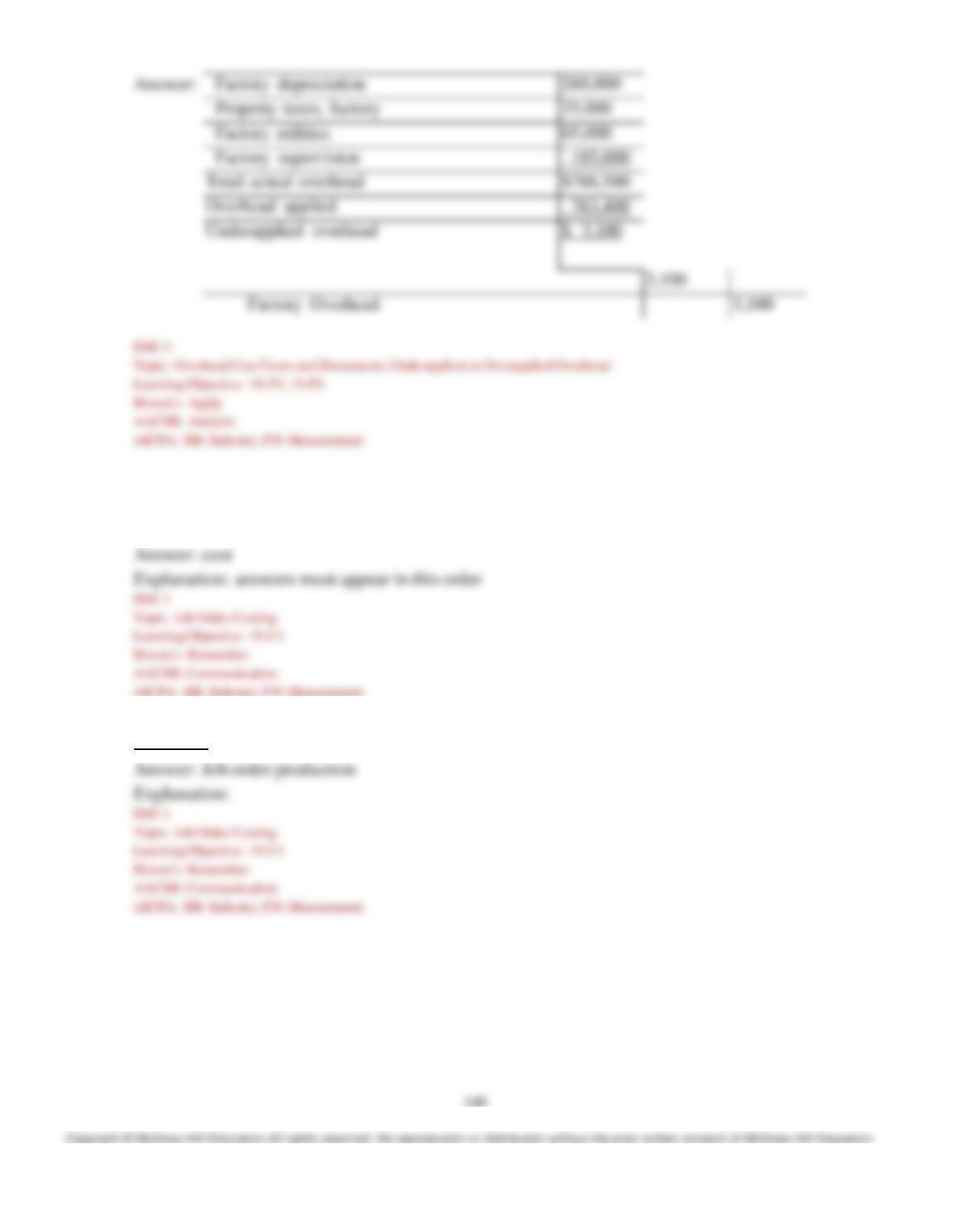
a. Calculate the predetermined overhead rate and calculate the overhead applied during the year.
b. Determine the amount of over- or underapplied overhead and prepare the journal entry to
eliminate the over- or underapplied overhead assuming that it is not material in amount.
143,500
SHORT ANSWER QUESTIONS
209)
A ________ accounting system records production activities using a perpetual inventory system.
210)
, or customized production, produces products in response to customer orders.
211)
A ________ is a separate record maintained for each job.
212)
The collection of job cost sheets for all jobs in process makes up the subsidiary ledger controlled
by the Inventory.
213)
In a job order costing system, raw materials requisitioned as direct materials are debited to
________; indirect materials are debited to ________.
214)
When factory payroll is assigned to specific jobs, ________ is debited.
215)
When factory payroll for indirect labor is assigned, ________ is debited.
216)
A is calculated by relating total estimated factory overhead to an allocation factor such
as total estimated direct labor cost, and is used to allocate factory overhead to specific jobs.
217)
When the actual overhead incurred during an accounting period is more than the overhead applied
to jobs, the overhead is said to be ________.
218)
Immaterial amounts of overapplied overhead should be ________ to the ________ account when
closed.