47) Prepare the following stock dividend journal entries for Tamera, Inc.
June 19 Declared a 5% stock dividend to common stockholders. The stock has a par value of $13 and a
current market value of $15. There are 50,000 shares of common stock outstanding.
July 2 The stock dividend is issued.
48) Explain some possible reasons a company may declare a stock dividend instead of a cash dividend.
Using the following accounts:
[1] Cash
[2] Dividends payable
[3] Preferred stock
[4] Common stock
[5] Common Stock dividend distributable
[6] Paid-in capital in excess of par value-common
[7] Paid-in capital in excess of par value – preferred
[8] Paid-in capital from treasury stock
[9] Retained earnings
[10] Treasury stock
[11] Paid-in capital in excess of par value-Stock dividend
Indicate the account(s) to be debited and credited to record the following transactions.
49) Issuance of stock dividend.
Debit ________ Credit ________
50) Declared a cash dividend.
Debit ________ Credit ________
51) Paid a cash dividend.
Debit ________ Credit ________
52) Declared a stock dividend when the market price was above par.
Debit ________ Credit ________ & ________
19.3 Learning Objective 19-3
1) Which of the following is NOT a reason why a corporation would reacquire previously issued stock?
A) A need to issue more stock for stock option plans
B) A need to issue more stock for use in acquiring other corporations
C) A desire to reduce the number of shares of stock outstanding
D) All of the above are correct reasons.
2) What is the correct journal entry for the following transaction? Airline Express acquired 290 shares of
its own $8 par common stock for $21.
A) Debit Treasury Stock-Common for $2,320 and credit Cash for $2,320
B) Debit Treasury Stock-Common for $6,090 and credit Cash for $6,090
C) Debit Cash for $2,320 and credit Treasury Stock-Common for $2,320
D) Debit Cash for $6,090 and credit Treasury Stock-Common for $6,090
3) 40 of the 200 treasury shares that April Corporation acquired at $6 par per common stock that were
originally issued at $24 par per share, were reissued for $8 per share. What is the journal entry for the
reissued shares?
A) Debit Cash for $320; debit Paid-In Capital from Treasury Stock for $640; credit Treasury Stock–
Common for $960.
B) Debit Cash for $960; credit Paid-In Capital from Treasury Stock for $640; credit Treasury Stock-
Common for $320.
C) Debit Treasury Stock-Common for $320; credit Cash for $320.
D) Debit Treasury Stock-Common for $960; credit Cash for $640; credit Paid-In Capital from Treasury
Stock for $320.
4) Which of the following is NOT a characteristic of treasury stock?
A) The purchase of treasury stock does not change the amount of issued stock.
B) Treasury stock is the same thing as common and preferred stock.
C) Treasury stock does not have dividends or voting rights.
D) Treasury stock is a contra-stockholders’ equity account.
5) Treasury stock is:
A) common stock that is issued in a stock dividend.
B) common or preferred stock that has been reacquired by the corporation.
C) previously issued common stock that has been canceled.
D) unissued, but authorized common stock.
6) What is the correct journal entry for the following transaction? Melton Industries acquired 360 shares
of its own $12 par common stock for $23.
A) Debit Treasury Stock-Common for $8,280 and Credit Cash for $8,280
B) Debit Treasury Stock-Common for $4,320 and Credit Cash for $4,320
C) Debit Cash for $8,280 and Credit Treasury Stock–Common for $8,280
D) Debit Cash for $4,320 and Credit Treasury Stock-Common for $4,320
7) Which of the following statements is true about treasury stock?
A) It carries no right to dividends.
B) It carries no right to vote.
C) It is stock that is outstanding.
D) A and B are correct.
8) To record the purchase of treasury stock:
A) debit Treasury Stock-Common (par value); credit Cash (same).
B) debit Treasury Stock-Common (purchase price); credit Cash (same).
C) debit Treasury Stock-Common (par value); debit any difference to Paid-in Capital; credit Cash
(purchase price).
D) None of these answers is correct.
9) 70 of the 350 treasury shares that Miles Inc. acquired at $4 par per common stock for $22, were reissued
for $8 per share. What is the journal entry for the reissued shares?
A) Credit Cash for $560, Debit Treasury Stock-Common for $560.
B) Debit Cash for $1,540, Credit Paid-In Capital from Treasury Stock for $980, Credit Treasury Stock–
Common for $560.
C) Debit Cash for $560, Debit Paid-In Capital from Treasury Stock for $980, Credit Treasury Stock-
Common for $1,540.
D) Credit Cash for $980, Debit Treasury Stock-Common for $1,540, Credit Paid-In Capital from Treasury
Stock for $560.
10) Which of the following decrease when treasury stock is purchased?
A) Issued shares
B) Outstanding shares
C) Authorized shares
D) None of these answers is correct.
11) When treasury stock is reissued for more than cost, the journal entry would include a:
A) credit to Cash
B) credit to Common Stock.
C) debit to Treasury Stock.
D) credit to Paid-in Capital from Treasury Stock.
12) Farm and Supply reissued 120 shares of treasury stock at $24 that had been reacquired for $11 per
share. What is the entry?
A) Debit Cash $2,880; Credit Treasury Stock-Common $1,320, Credit Paid-In Capital from Treasury Stock
$1,560
B) Debit Cash $2,880; Credit Treasury Stock-Common $2,880
C) Debit Cash $1,320; Debit Paid-In Capital from Treasury Stock $1,560, Credit Treasury Stock-Common
$2,880
D) None of these answers is correct.
13) When O’Rourke Corporation sells treasury stock for more than the original cost:
A) stockholders’ equity decreases.
B) paid-in capital increases.
C) retained earnings may increase.
D) retained earnings may decrease.
14) Barkley’s Resort had 2,800 shares of $21 par value common stock outstanding. On June 1, Barkley’s
purchased 230 shares of treasury stock for $29 per share and later reissued them for $26 per share. What
amount of profit from the reissuance will be reported on the income statement?
A) $1,150
B) $690
C) $1,840
D) $0
15) Treasury stock should usually be recorded at:
A) par or stated value.
B) cost.
C) original issue price.
D) net realizable value.
16) If treasury stock is reissued at a price less than its cost, the debit entry could include:
A) Paid-in Capital from Treasury Stock.
B) Retained Earnings.
C) Treasury Stock.
D) Both A and B
17) A corporation purchased 110 shares of treasury stock for $45. The entry to record the transaction
would include a:
A) debit to Cash for $4,950.
B) credit to Treasury Stock for $4,950.
C) debit to Treasury Stock for $4,950.
D) None of these answers is correct.
18) A corporation sold 70 shares of $21 par value treasury stock for $40 per share. The treasury stock cost
$32 per share to acquire. The entry to record the transaction would include a:
A) credit to Paid-in Capital from Treasury Stock for $2,240.
B) debit to Treasury Stock for $2,800.
C) credit to Paid-in Capital from Treasury Stock for $560.
D) debit to Common Stock for $1,470.
19) If treasury stock is sold for less than cost, the entry to record the transaction would include a:
A) debit to Treasury Stock.
B) credit to Treasury Stock.
C) debit to Common Stock.
D) None of these answers is correct.
20) When treasury stock is sold, the Paid-in Capital in Excess of Par Value is increased.
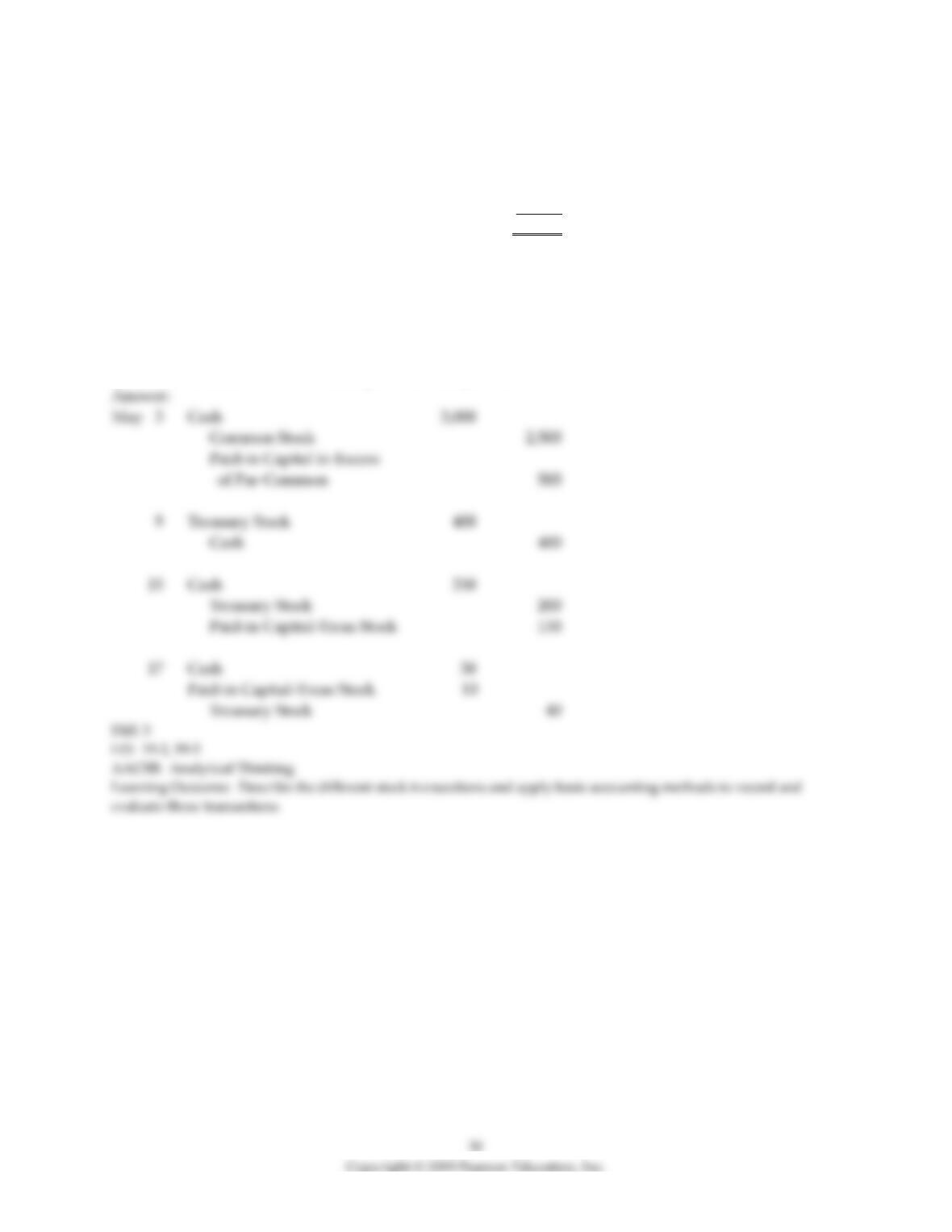
21) Curtis Corporation’s balance sheet included the following:
Common Stock, $5 par value, 5,000 shares issued
and outstanding $25,000
Retained Earnings 20,000
Total Stockholders’ Equity $45,000
Prepare journal entries for the following transactions:
May 3 Issued 500 shares at $6 per share.
9 Reacquired 100 shares at $4 per share.
15 Reissued 50 of the Treasury shares at $7 per share.
17 Reissued 10 of the Treasury shares at $3 per share.
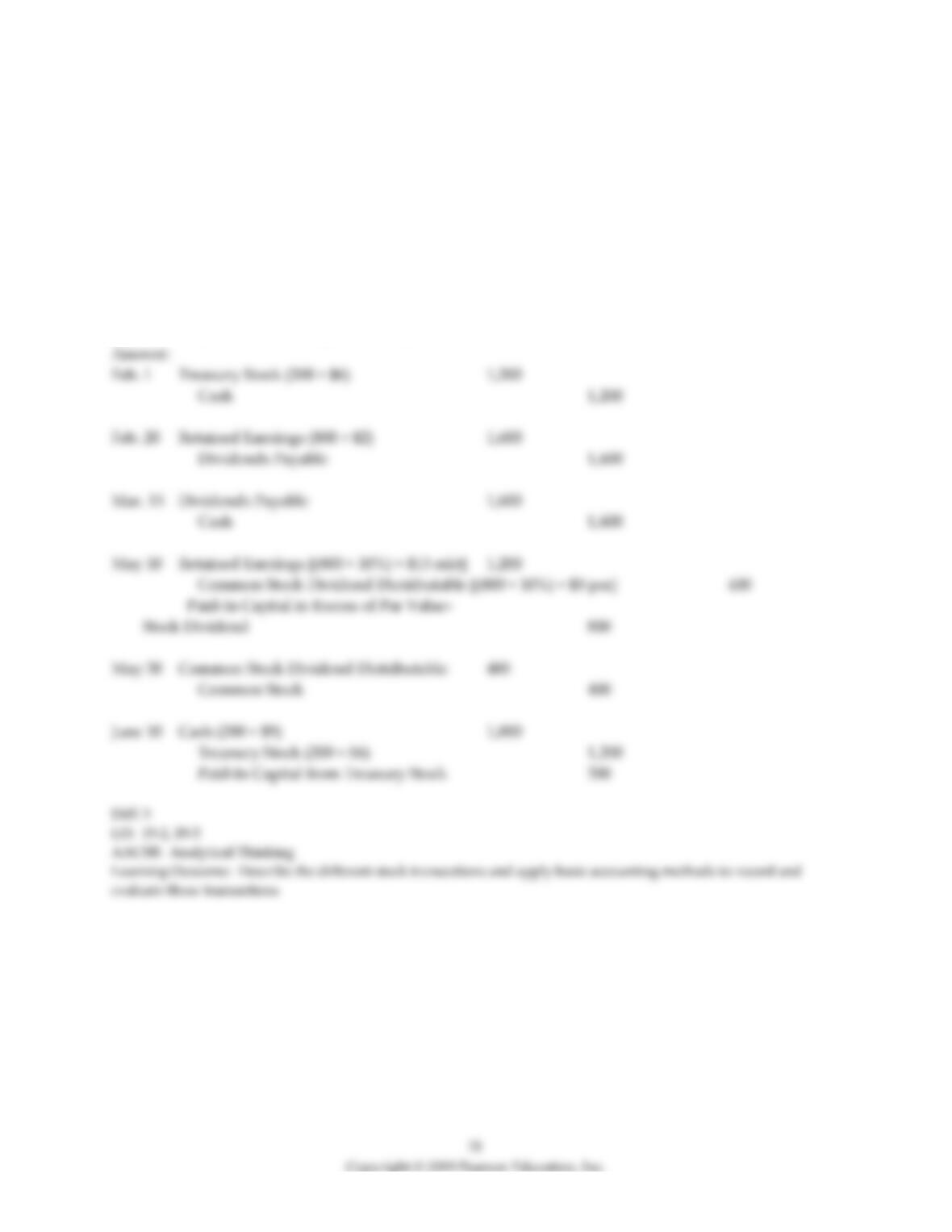
22) Baxter Corporation has 1,000 shares of $5 par value common stock issued and outstanding.
Journalize the following Baxter transactions for 20XX:
Feb. 1 Purchased 200 shares of treasury stock at $6.00.
20 Declared a $2.00 per share cash dividend payable on March 15
to stockholders of record March 1.
Mar. 15 Paid the cash dividend.
May 10 Declared a 10% stock dividend. The market value of the stock is $15.00 per share.
May 30 Distributed the stock dividend.
Jun 10 Reissued the treasury stock for $9.00.
Using the following accounts:
[1] Cash
[2] Dividends payable
[3] Preferred stock
[4] Common stock
[5] Common Stock dividend distributable
[6] Paid-in capital in excess of par value-common
[7] Paid-in capital in excess of par value – preferred
[8] Paid-in capital from treasury stock
[9] Retained earnings
[10] Treasury stock
[11] Paid-in capital in excess of par value-Stock dividend
Indicate the account(s) to be debited and credited to record the following transactions.
23) Sold treasury stock at a price equal to cost.
Debit ________ & Credit ________
24) Sold treasury stock at a price below cost when there was sufficient paid-in capital from treasury stock
to absorb the difference between cost and selling price.
Debit ________ & ________ Credit ________
25) Sold treasury stock at a price above cost.
Debit ________ Credit ________ & ________
26) Sold treasury stock at a price below cost when there was no paid-in capital from treasury stock to
absorb the difference between cost and selling price.
Debit ________ & ________ Credit ________
19.4 Learning Objective 19-4
1) The portion of Retained Earnings that is NOT available for dividends is:
A) Retained Earnings.
B) Dividends.
C) Appropriated Retained Earnings.
D) Net Loss.
2) What is the entry to restrict $40,000 for plant expansion?
A) Debit Retained Earnings; credit Cash
B) Debit Retained Earnings; credit Retained Earnings Appropriated for plant expansion
C) Debit Retained Earnings Appropriated for plant expansion; credit Retained Earnings
D) Debit Cash; credit Retained Earning Appropriated for plant expansion
3) Which of the following would be shown on the statement of retained earnings?
A) Purchase of treasury stock
B) Sale of common stock
C) Sale of preferred stock
D) Declaration of a cash dividend
4) A retained earnings appropriation is a restriction of retained earnings by:
A) accountants.
B) senior management.
C) stockholders.
D) the board of directors.
5) An entry to appropriate a portion of retained earnings to finance a future plant expansion would
include a credit to:
A) Paid-in Capital in Excess of Par.
B) Retained Earnings Appropriated for Plant Expansion.
C) Retained Earnings.
D) Unappropriated Retained Earnings.
6) Which of the following would require a debit to the Retained Earnings account for a corporation?
A) The initial investment of stockholders
B) Net income of the period
C) Net loss of the period
D) Contributions by new stockholders
7) Which of the following statements is true when appropriating retained earnings?
A) Appropriating retained earnings will increase the number of shares of stock available.
B) Appropriating retained earnings will allow the corporation to use its assets for dividends.
C) Appropriating retained earnings will increase cash and other assets.
D) Appropriating retained earnings will divide the retained earnings into two categories.
8) After the closing of its accounting books, Bear Company discovered that depreciation was understated
by $8,000, which meant that Net Income was overstated by $8,000. What entry is needed to record the
adjustment for the prior period’s error?
A) Debit Retained Earnings; credit Accumulated Depreciation
B) Debit Accumulated Depreciation; credit Retained Earnings
C) Debit Retained Earnings; credit Retained Earnings Appropriated
D) No adjusting entry is needed.
9) Appropriations to retained earnings can be:
A) contractual only.
B) an increase in retained earnings.
C) a decrease in total retained earnings.
D) None of these answers is correct.
10) Changes in retained earnings can result from:
A) purchasing equipment.
B) net income or net loss.
C) paying down debt.
D) All of these answers are correct.
11) A prior period adjustment would be necessary when:
A) a stock dividend is declared.
B) a stock dividend is paid.
C) depreciation expense was understated the prior year.
D) a cash dividend is declared.
12) A prior period adjustment for depreciation would affect what account in the stockholders’ equity
section?
A) Common Stock
B) Paid-in Capital in Excess of Par Value–Common
C) Retained Earnings
D) Appropriations
13) At the end of the accounting cycle, net income will be closed into:
A) Treasury Stock.
B) Paid-in Capital.
C) Cash.
D) Retained Earnings.
14) Appropriations to retained earnings are:
A) recorded as a contra-asset.
B) disclosed in the notes to the financial statements.
C) recorded as a contra-liability.
D) a contra-stockholders’ equity.
15) Ample Corporation’s balance in Retained Earnings is $130,000. The board of directors directs that
$65,000 be appropriated for future business expansion. This will cause total retained earnings to:
A) decrease by $65,000.
B) increase by $65,000.
C) remain at $130,000.
D) increase or decrease $65,000, as determined by the board.
16) Changes in retained earnings result from effects of prior period adjustments, net income or loss, or
dividends declared.
17) An error understating Net Income would overstate Retained Earnings.
18) An appropriation to retained earnings reduces total shareholders’ equity.
19) Most companies report restrictions of Retained Earnings by using a footnote to the Retained Earnings
account.
20) A prior period adjustment is corrected to the beginning balance of Retained Earnings.
21) Dividends declared is subtracted from the Statement of Retained Earnings.
22) In the closing process for corporations, net income is closed to the retained earnings account.
23) An error to an expense account in a prior period would adjust Retained Earnings in the new period.
24) Prepare a statement of retained earnings in proper form for Ember Corporation for the year ended
December 31, 20XX, from the following:
Retained Earnings, January 1, 20XX $7,000
Dividends declared during the year 2,200
Net income for the year 5,000
Correction of prior year error. Purchase
of land recorded as rent expense 1,000
25) Prepare a statement of retained earnings in proper form for Melon Corporation for the year ended
December 31, 20XX, from the following:
Retained Earnings, January 1, 20XX $8,500
Dividends declared during the year 2,600
Net income for the year 9,000
Correction of prior year error, Sales overstated 2,000