College Accounting, 14e (Slater)
Chapter 19 Corporations: Stock Values, Dividends, Treasury Stocks,
and Retained Earnings
19.1 Learning Objective 19-1
1) Market Value is defined as:
A) the price a corporation pays when it reserves the right to retire or redeem stock at a specific price.
B) the price at which shares are bought and sold on the open market.
C) the total stockholders‘ equity minus total amount assigned to preferred stock.
D) the total of stockholders’ equity (when only common stock exists) divided by the number of shares
issued.
2) Book Value per Share is defined as:
A) the price a corporation pays when it reserves the right to retire or redeem stock at a specific price.
B) the price at which shares are bought and sold on the open market.
C) the total stockholders‘ equity minus total amount assigned to preferred stock.
D) the total of stockholders’ equity (when only common stock exists) divided by the number of shares
issued.
3) Redemption Value is defined as:
A) the price a corporation pays when it reserves the right to retire or redeem stock at a specific price.
B) the price at which shares are bought and sold on the open market.
C) the total stockholders‘ equity minus total amount assigned to preferred stock.
D) the total of stockholders’ equity (when only common stock exists) divided by the number of shares
issued.
4) To calculate book value per share of preferred stock, the following is calculated:
A) redemption value and common stock par value.
B) redemption value and dividends in arrears.
C) common stock redemption value.
D) total stockholders’ equity.
5) If total stockholders‘ equity is $160,000 with 13,000 common shares outstanding, what is the book value
per share of common stock? (Assume no preferred stock is outstanding. Round your answer to the
nearest cent.)
A) $15.31
B) $36.92
C) $12.31
D) $9.31
6) If dividends in arrears are $1,500,000 preferred stock redemption value of 60,000, and 2,400 preferred
shares outstanding, what is the book value per share of preferred stock? (Round the final answer to the
nearest cent.)
A) $25.00
B) $2.50
C) $250.00
D) $12.50
7) Buck Company has $200,000 of preferred stock redemption value and $900,000 of dividends in arrears.
If 100,000 preferred shares are outstanding, what is the book value per share of preferred stock? (Round
the final answer to the nearest cent.)
A) $11.00 per share
B) $9.00 per share
C) $2.00 per share
D) $7.00 per share
8) Dexter Corporation has total paid-in capital of $180,000 and retained earnings of $130,000. It has 4,000
shares of $20 preferred stock outstanding with no dividends in arrears and 11,000 shares of $30 par value
common stock outstanding. The book value of each share of common stock is: (Round your answer to the
nearest cent.)
A) $20.91.
B) $2.09.
C) $28.18.
D) $20.67.
9) Patterson Research has 200 shares of 10%, $107 par value, preferred stock, and 2,000 shares of $17 par
value common stock outstanding. Total paid-in capital is $50,000, and retained earnings are $0. There are
one-year dividends in arrears on preferred stock. The book value per share on common stock is: (Round
your answer to the nearest cent.)
A) $13.23.
B) $23.93.
C) $25.00.
D) $22.73.
10) Ariel Investigations has total paid-in capital of $74,000 and retained earnings of $40,000. It has 300
shares of $100 par value common stock outstanding, and no preferred shares outstanding. The book
value of each share of common stock is: (Round your answer to the nearest cent.)
A) $133.33.
B) $246.67.
C) $380.00.
D) $280.00.
11) Before common stock per share is computed, preferred stock is considered.
12) Book value per share is not the same as par value per share.
13) Redemption value is determined at the time stock is issued.
14) Book value per share is found by dividing total assets by total stockholders’ equity.
15) Dividends in arrears are considered in the calculation for book value per share of preferred stock.
16) Redemption of stock allows the corporation to repurchase or retire stock at the issued price per share.
17) From the following, determine the book value per share for preferred and common stocks; no
dividends are in arrears on the preferred stock.
Stockholders’ Equity
Preferred Stock, 8% cumulative and
$8 par value, $12 redemption value
4,000 shares issued and outstanding $32,000
Common Stock, $1 par value, 30,000 shares
issued and outstanding 30,000
Retained Earnings 24,000
______
Total Stockholders’ Equity $86,000
18) Discuss and describe the major differences among the following common stock values:
a. Par value
b. Stated value
c. Redemption value
d. Market value
e. Book value
19) From the following, determine the book value per share for preferred and common stocks, assuming
$2,000 of dividends are in arrears on the preferred stock.
Stockholders’ Equity
Preferred Stock, 10% cumulative and
$20 par value, $21 redemption value
1,000 shares issued and outstanding $20,000
Common Stock, $10 par value, 4,000 shares
issued and outstanding 40,000
Retained Earnings 8,000
______
Total Stockholders’ Equity $68,000
19.2 Learning Objective 19-2
1) What are the annual dividends on preferred stock, $31 par, 2,200 shares authorized, 1,200 shares
issued, and a dividend rate of 3%? (Round your answer to the nearest dollar.)
A) $1,116
B) $30
C) $2,046
D) $930
2) What are the annual dividends on preferred stock, $20 par, 560 authorized, 310 shares issued, and a
dividend rate of 11%? (Round your answer to the nearest dollar.)
A) $682
B) $1,232
C) $550
D) $1,914
3) In the dividend process, the liability Dividend Payable is recognized on the:
A) date of declaration.
B) date of record.
C) date of payment.
D) date of stock issue.
4) Which of the following dividend dates gets a formal journal entry?
A) Date of payment
B) Date of claim
C) Date of record
D) All receive formal journal entries.
5) The date of record for cash dividends is:
A) the date the board of directors pays a dividend.
B) the date established by the board of directors that determines who will receive dividends.
C) the date that creates a liability for the company.
D) None of these answers is correct.
6) Declaration of a cash dividend causes:
A) a decrease in stockholders’ equity.
B) an increase in cash.
C) a decrease in liabilities.
D) None of these answers is correct.
7) Payment of a cash dividend causes:
A) a decrease in liabilities.
B) an increase in an asset.
C) an increase in stockholders’ equity.
D) All of the above are correct.
8) A distribution to stockholders in the form of stock is called a:
A) stock dividend.
B) stock split.
C) stock conversion.
D) cash dividend.
9) The journal entry to pay a cash dividend is to:
A) debit Retained Earnings; credit Dividends Payable.
B) debit Dividends Payable; credit Cash.
C) debit Retained Earnings; credit Cash.
D) debit Dividends Payable; credit Retained Earnings.
10) Malcolm Corporation declared a dividend of $5 per share on 2,200 shares. The entry to record the
transaction would be to:
A) debit Retained Earnings $11,000; credit Dividends Payable $11,000.
B) debit Retained Earnings $11,000; credit Cash $11,000.
C) debit Dividends Payable $11,000; credit Cash $11,000.
D) debit Dividends Expense $11,000; credit Cash $11,000.
11) The entry to record the payment of a cash dividend would include a:
A) debit to Dividends Payable.
B) debit to Retained Earnings.
C) credit to Cash.
D) Both A and C
12) On the date of record, the journal entry would include:
A) a debit to Dividend Payable.
B) a credit to Dividend Payable.
C) a credit to Cash.
D) No entry is required on date of record.
13) The journal entry to record the issuance of a stock dividend is to:
A) debit Common Stock Dividend Distributable; credit Common Stock.
B) debit Common Stock Dividends Distributable; credit Dividends Payable.
C) debit Retained Earnings; credit Common Stock Dividends Distributable; credit Paid-in Capital in
Excess of Par Value-Cash Dividend.
D) debit Common Stock Dividend Distributable; credit Cash.
14) Which of the following is the journal entry to record the declaration of a stock dividend?
A) Debit Common Stock Dividend Distributable (number of shares × par value common stock); credit
Common Stock (same)
B) Debit Common Stock Dividend Distributable (number of shares × market value common stock); credit
Common Stock (same)
C) Debit Retained Earnings (market value × number of shares); credit Common Stock Dividend
Distributable (number of shares × par value); credit Paid-In Capital in Excess of Par Value Stock Dividend
(market value – par value) × number of shares
D) Debit Common Stock (number of shares × par value); credit Cash
15) The liability account showing the amount of cash dividend owed is:
A) Dividends.
B) Dividends Payable.
C) Retained Earnings.
D) Cash.
16) The entry to record the distribution of the stock dividend would include:
A) a debit to Common Stock.
B) a debit to Common Stock Dividend Distributable.
C) a debit to Retained Earnings.
D) None of these answers is correct.
17) Michigan Steamers has 3,800 shares of $22 par value common stock outstanding. During the current
year, the company distributed a 4% stock dividend. The market value of the stock at that time was $17
per share. Bailey’s total stockholders’ equity should increase or decrease by:
A) $0.
B) $3,344.
C) $2,584.
D) $(760).
18) Before a four-for-one stock split, the shares outstanding were 7,000 shares at $12 par. After the split,
what was the par value per share and number of shares? (Round your answer to the nearest cent.)
A) 28,000 shares at $12 per share
B) 28,000 shares at $3.00 per share
C) 28,000 shares at $6.00 per share
D) 7,000 shares at $48 per share
19) ABC Corporation issued a two-for-one stock split. The number of outstanding shares before the split
was 20,000 and the par value was $24 per share. After the split, what was the par value per share and
number of shares? (Round your answer to the nearest cent.)
A) 40,000 shares and $24 per share
B) 40,000 shares and $6.00 per share
C) 40,000 shares and $12.00 per share
D) 40,000 shares and $48 per share
20) On March 8, Nunes Corporation declares a $3 cash dividend per share on 4,000 shares issued and
outstanding. What is the journal entry to record this transaction?
A) Debit to Cash and credit to Dividends Payable
B) Debit to Retained Earnings and credit to Cash
C) Debit to Retained Earnings and credit to Dividends Payable
D) Debit to Dividends Payable and credit to Cash
21) On June 7, Ramirez Incorporated paid a $6.25 cash dividend per share on 3,200 shares issued and
outstanding. What is the journal entry to record this transaction?
A) Increase to Dividends Payable and a decrease to cash for $20,000
B) Increase to Dividends Payable and a decrease to Retained Earnings for $20,000
C) Decrease to Cash and a decrease to Retained Earnings for $20,000
D) Decrease to Cash and a decrease to Dividends Payable for $20,000
22) The retained earnings section after a two-for-one stock split will:
A) be one-half as much after the split.
B) be double as much after the split.
C) not change after the split.
D) Cannot be determined from the information given.
23) May Corporation had 37,000 shares of $17 par value common stock outstanding with a market value
of $30 per share. Gino announced a three-for-one stock split. After the split, the par value of the stock:
(Round your answer to the nearest cent.)
A) remained the same as before the split.
B) was increased by $34.00 per share.
C) was reduced to $5.67 per share.
D) was reduced to $8.50 per share.
24) Under the legal capital approach, issuance of a stock dividend would:
A) increase Cash and decrease Common Stock.
B) decrease Common Stock Dividend Distributable and increase Common Stock.
C) increase Common Stock Dividend Distributable and increase Cash.
D) decrease Cash and increase Common Stock.
25) A corporation may issue a stock dividend for which of the following reasons?
A) May want to increase permanent capital in the business
B) May want to decrease market value
C) May be short of cash and unable to pay a cash dividend
D) All of the above are correct.
26) A dividend is declared by:
A) the board of directors.
B) president of the corporation.
C) CFO of the corporation.
D) stockholders.
27) A stock split:
A) increases the number of shares outstanding.
B) reduces the par or stated value in proportion.
C) is the same as a cash dividend.
D) Both A and B are correct.
28) The board of Marpa, Inc. declared a $3 per share cash dividend on common stock. The corporation
has 5,000 shares of common stock outstanding. The entry required to declare the dividend is:
A) debit Cash; credit Common Dividends Payable.
B) debit Cash Dividends; credit Common Dividends Payable.
C) debit Common Dividends Payable; credit Cash.
D) debit Retained Earnings; credit Dividends Payable.
29) On April 3, Jim’s Planters declares a $5 cash dividend per share on 6,000 shares issued and
outstanding. What is the journal entry to record this transaction?
A) Increase to Cash for $30,000 and decrease to Dividends Payable for $30,000
B) Decrease to Retained Earnings for $30,000 and increase to Dividends Payable for $30,000
C) Increase to Retained Earnings for $30,000 and increase to Cash for $30,000
D) Increase to Dividends Payable for $30,000 and decrease to Cash for $30,000
30) An exchange of one share of an old issue of stock for a multiple number of shares of a new issue of
stock with reduced par value is known as a:
A) property dividend.
B) stock dividend.
C) stock split.
D) liquidating dividend.
31) Lamar Industries uses the legal capital approach and issues a stock dividend worth $40,000. What
would be the journal entry to record this transaction?
A) $40,000 debit to Cash and credit Common Stock
B) $40,000 debit to Common Stock Dividend Distributable and credit to Cash
C) $40,000 debit to Common Stock Dividend Distributable and credit to Common Stock
D) $40,000 credit to Cash and debit to Retained Earnings
32) On May 3, Bunny Unlimited paid a $4 cash dividend per share on $5,000 shares issued and
outstanding. What is the journal entry to record this transaction?
A) A debit to Dividends Payable and a credit to Cash
B) A debit to Retained Earnings and a credit to Cash
C) A debit to Dividends Payable and a credit to Retained Earnings
D) A debit to Cash and a credit to Dividends Payable
33) Paid-In Capital in Excess of Par Value-Stock Dividend account is used when:
A) the stock’s par value is lower than market value.
B) the stock’s par value is higher than the market value.
C) the stock’s par value is the same as market value.
D) None of the above are correct.
34) After issuing a stock dividend, a stockholder will own a larger number of shares but:
A) the total ownership equity increases.
B) the total ownership equity decreases.
C) the total ownership equity stays the same.
D) None of the above are correct.
35) Distribution of earnings to stockholders may be in the form of cash or stock.
36) The date of record determines who receives the declared dividends.
37) Common Stock Dividend Distributable is a stockholders’ equity account that accumulates a stock
dividend that has been declared but not yet issued and distributed.
38) Issuing a stock dividend would show a debit to Common Stock and a credit to Common Stock
Dividends Distributable.
39) Common Stock Dividend Distributable is an asset account.
40) A stock split has no effect on retained earnings.
41) A cash dividend will reduce total stockholders‘ equity.
42) The date of payment is the date established by the board of directors that determines which
stockholders will receive the dividend.
43) Quinn Corporation has 4,500 shares of common stock issued and outstanding. The board of directors
declared a $3.25 per share cash dividend on January 25, payable on March 25, to stockholders of record
on February 25. Prepare the appropriate journal entries for the declaration and payment of the dividend.
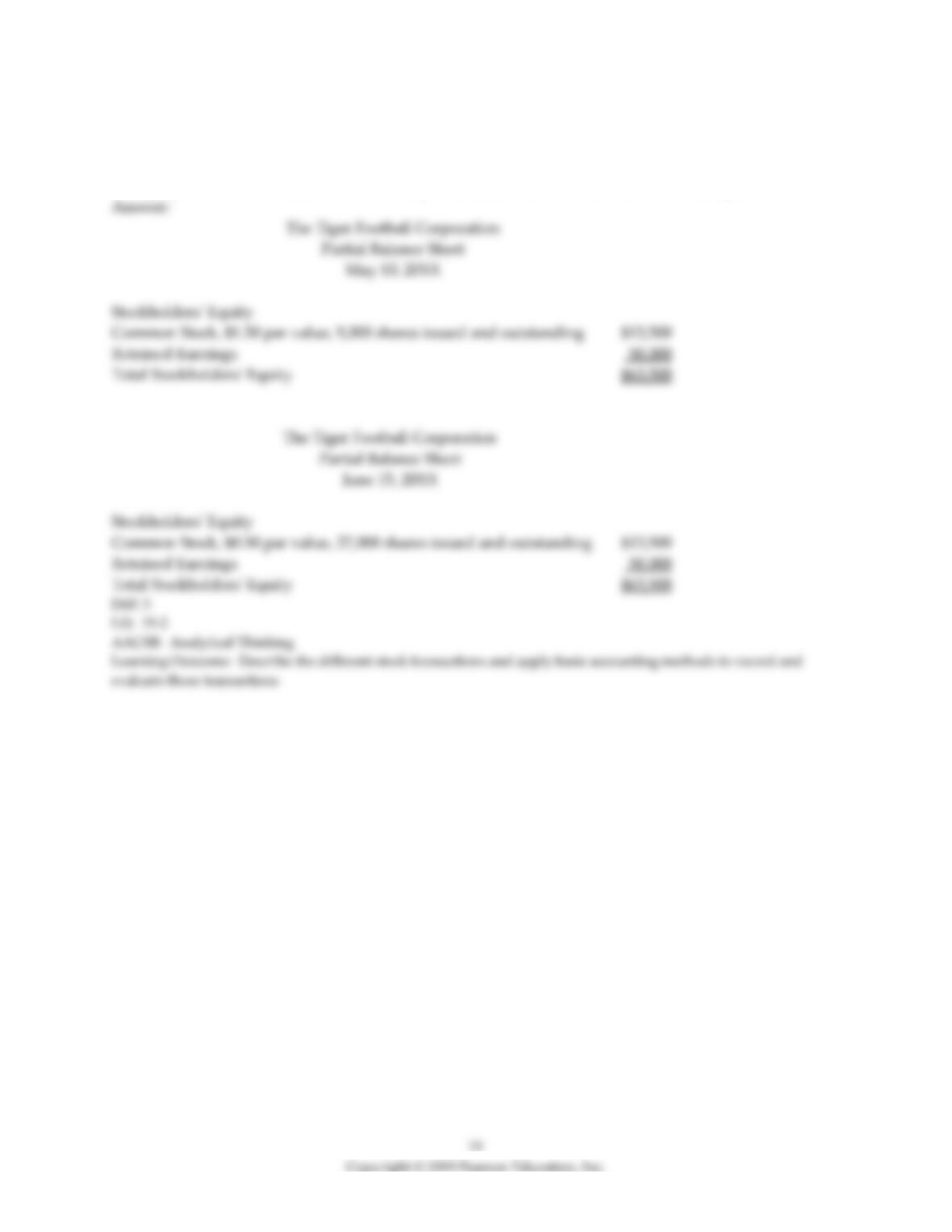
44) The Tiger Football Corporation has 9,000 shares of $1.50 par value common stock issued and
outstanding. The board of directors declared a 3-for-1 stock split May 10, distributable on June 15, to
stockholders of record on June 1. The Retained Earnings account balance is $50,000 on May 10. Prepare
the equity section of the balance sheet on May 10 and June 15, before and after the stock split.
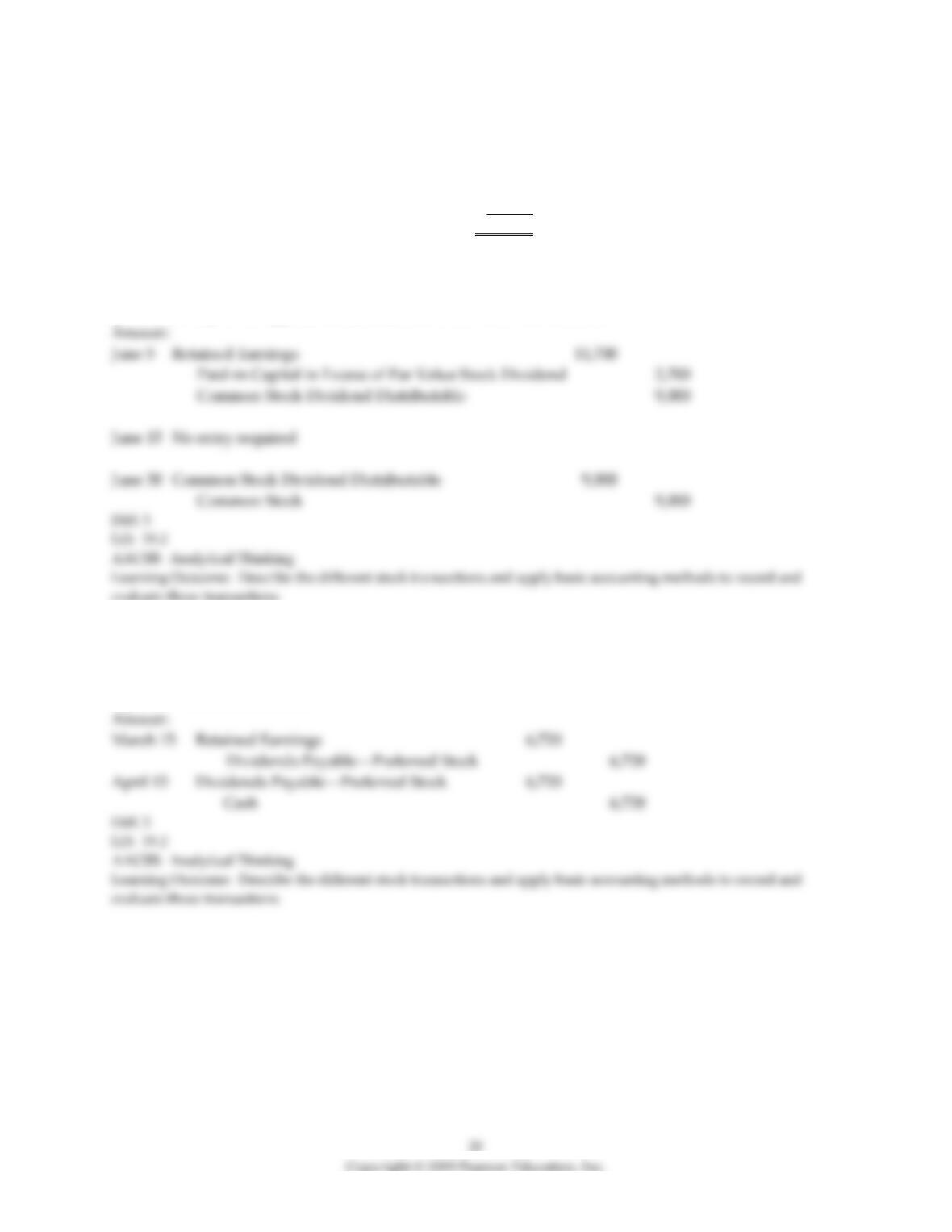
45) On May 31, Mason Corporation has the following stockholders’ equity:
Common Stock, $10 par value, 9,000 shares
issued and outstanding $90,000
Retained Earnings 30,000
Total Stockholders’ Equity $120,000
The board of directors declared a 10% stock dividend on June 5 to the stockholders of record on June 15.
The stock is to be distributed on June 30. On the date of declaration, the stock had a market value of $13
per share. Prepare the appropriate journal entries for these transactions.
46) Prepare the following journal entries for Complex Company.
March 15 Declared the stated dividend on 8,000 shares of $12 par, 7% preferred stock.
April 15 Paid the dividend.