98
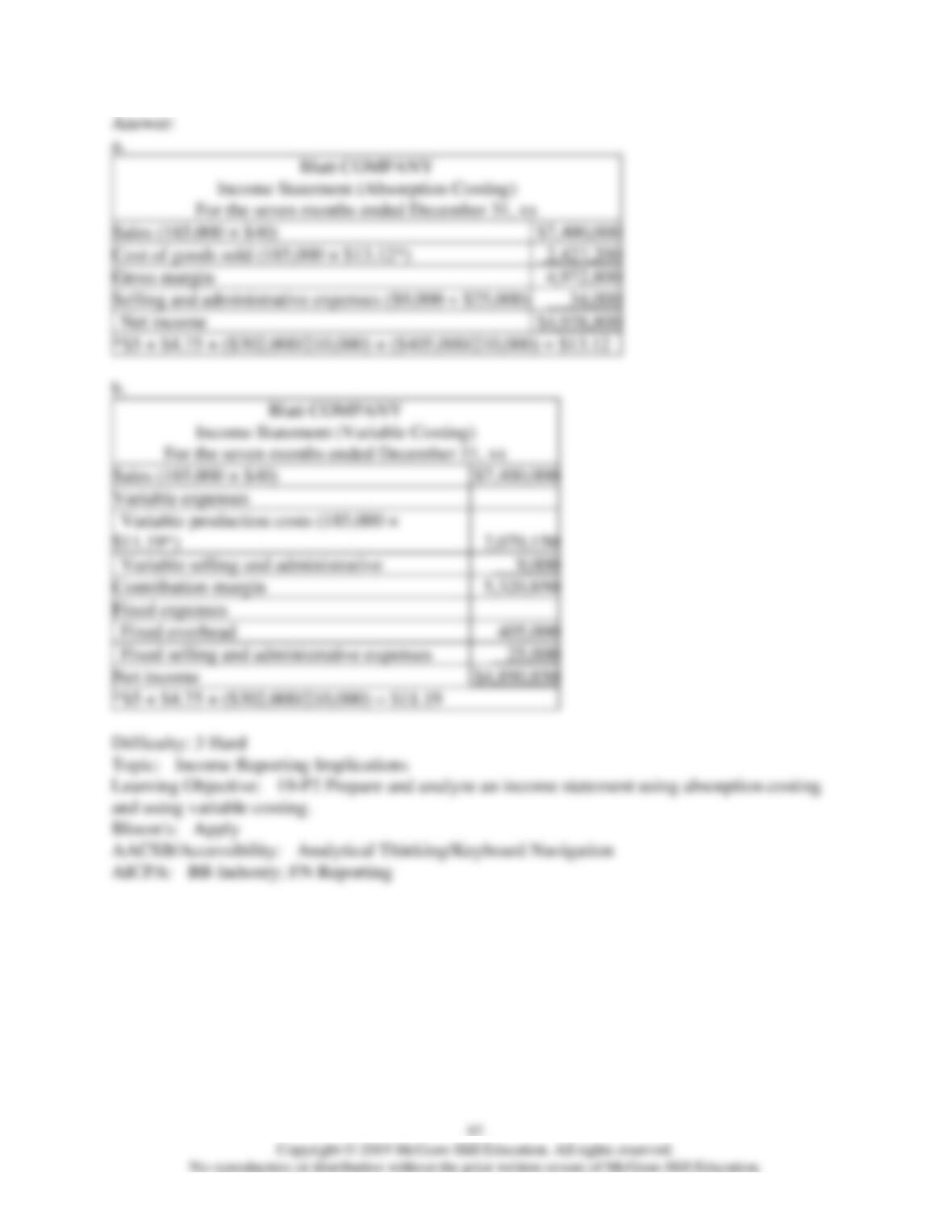
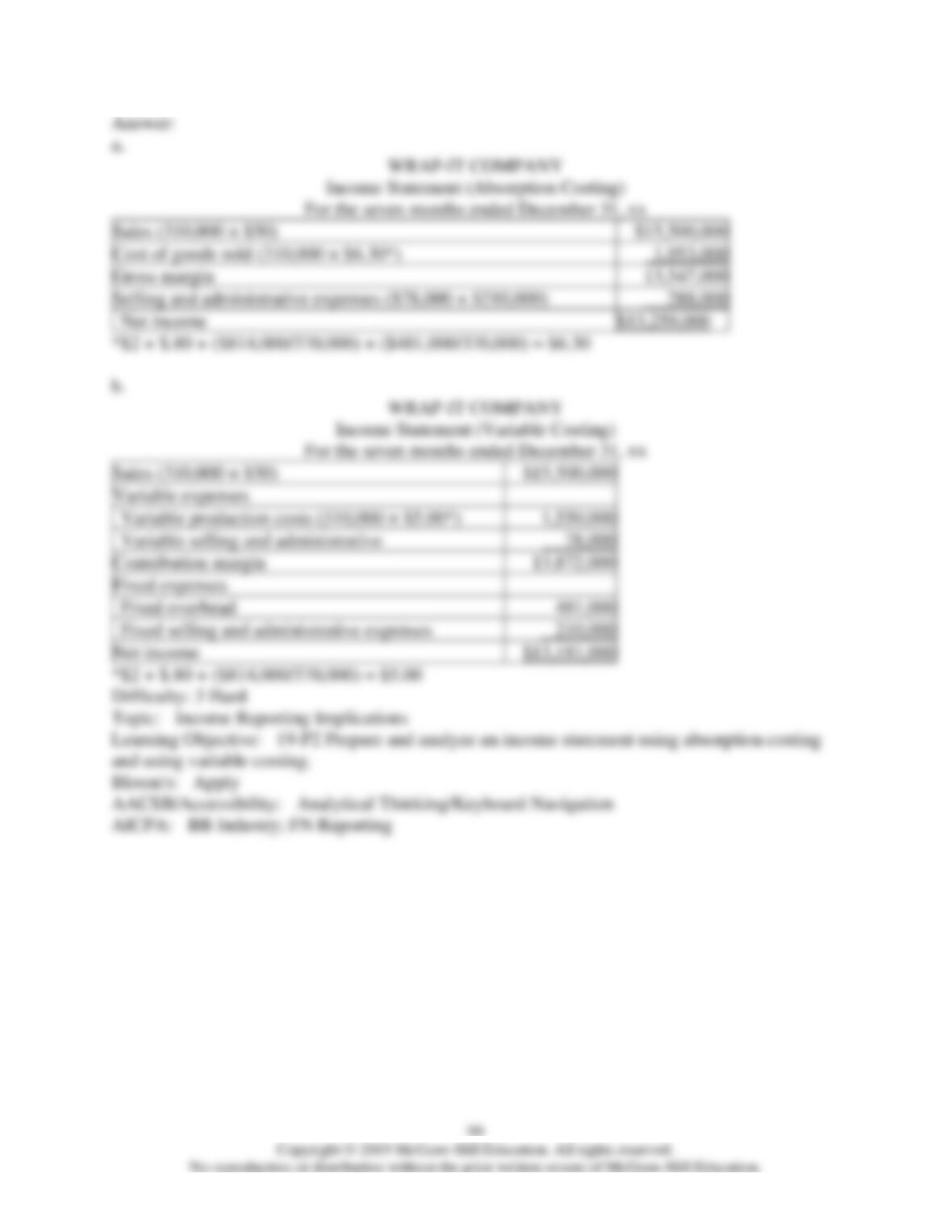
173) Wrap-It Company, a manufacturer of wrapping paper, began operations on June 1 of the
current year. During this time, the company produced 370,000 units and sold 310,000 units at a
sales price of $50 per unit. Cost information for this period is shown in the following table:
Production costs
Direct materials
$2.00 per unit
Direct labor
$.80 per unit
Variable overhead
$814,000 in total
Fixed overhead
$481,000 in total
Non production costs
Variable selling and administrative
$78,000 in total
Fixed selling and administrative
$210,000 in total
a. Prepare Wrap-It’s December 31st income statement for the current year under absorption
costing.
b. Prepare Wrap-It’s December 31st income statement for the current year under variable costing.
100
174) 32 Degrees, Inc., a manufacturer of frozen food, began operations on July 1 of the current
year. During this time, the company produced 140,000 units and sold 140,000 units at a sales
price of $125 per unit. Cost information for this period is shown in the following table:
Production costs
Direct materials
$13.00 per unit
Direct labor
$6.00 per unit
Variable overhead
$2,100,000 in total
Fixed overhead
$3,220,000 in total
Non production costs
Variable selling and administrative
$91,000 in total
Fixed selling and administrative
$458,000 in total
a. Prepare 32 Degree’s December 31st income statement for the current year under absorption
costing.
b. Prepare 32 Degree’s December 31st income statement for the current year under variable
costing.
175) State Industries has the following information for 20X1:
Units produced and sold
3,000 units
Selling Price
$260/unit
Direct materials
$20/unit
Direct labor
$40/unit
Fixed manufacturing overhead
$120,000/year
Fixed selling and administrative costs
$160,000/year
Variable manufacturing overhead
$35/unit
Variable selling and administrative costs
$25/unit
There are no beginning inventories. Prepare an income statement for the year under absorption
costing.
Sales(3,000 units × $260)
– Cost of Goods Sold
Gross Margin
– Selling and Administrative Costs
Operating Income
176) Maloney Co. provided the following information for the year 20X1:
Units produced and sold
4,400 units
Selling Price
$400/unit
Direct materials
$85/unit
Direct labor
$55/unit
Fixed manufacturing overhead
$130,000/year
Fixed selling and administrative costs
$165,000/year
Variable manufacturing overhead
$40/unit
There are no beginning inventories. Prepare an income statement using the variable costing
format.
Sales
– Variable Costs
Contribution Margin
– Fixed Costs
Operating Income
177) Materials Corporation sold 12,000 units of its product at a price of $67 per unit. Total
variable cost per unit is $54.94, consisting of $45.05 in variable production cost and $9.89 in
variable selling and administrative cost. Compute the total contribution margin.
178) Countdown Inc. sold 17,000 units of its product at a price of $81 per unit. Total variable
cost per unit is $72.09, consisting of $69.05 in variable production cost and $3.04 in variable
selling and administrative cost. Compute the total contribution margin.
179) Heather, Incorporated reports the following annual cost data for its single product:
Normal production and sales level
60,000 units
Direct materials
$9.00 per unit
Direct labor
$6.50 per unit
Variable overhead
$11.00 per unit
Fixed overhead
$720,000 in total
This product is normally sold for $56 per unit. If Heather increases its production to 80,000 units
while sales remain at the current 60,000 unit level, by how much would the company’s gross
margin increase or decrease under absorption costing? Assume the company has idle capacity to
increase current production.
180) Dataport Company reports the following annual cost data for its single product:
Normal production and sales level
89,000 units
Direct materials
$14 per unit
Direct labor
$21 per unit
Variable overhead
$27 per unit
Fixed overhead
$3,738,000 in total
This product is normally sold for $230 per unit. If Dataport increases its production to 100,000
units, while sales remain at the current 89,000 unit level, by how much would the company’s
gross margin increase or decrease under absorption costing? Assume the company has idle
capacity to increase current production.
181) Chilly Chips, Inc., a producer of ice cream, began operations this year. During this year, the
company produced 160,000 cartons of ice cream and sold 145,000. At year-end, the company
reported the following income statement using absorption costing:
Sales (145,000 × $6.50)
$942,500
Cost of goods sold (145,000 × $3.50)
507,000
Gross margin
$435,000
Selling and administrative expenses
252,000
Net income
$183,000
Production costs per carton total $3.50, which consists of $2.30 in variable production costs and
$1.20 in fixed production costs (based on the 160,000 units produced). Sixty percent of total
selling and administrative expenses are variable. Compute net income under variable costing.
182) Anchovy, Inc., a producer of frozen pizzas, began operations this year. During this year, the
company produced 16,000 cases of pizza and sold 15,000. At year-end, the company reported the
following income statement using absorption costing:
Sales (15,000 × $48)
$720,000
Cost of goods sold (15,000 × $19)
285,000
Gross margin
$435,000
Selling and administrative expenses
79,000
Net income
$356,000
Production costs per case total $19, which consists of $15.50 in variable production costs and
$3.50 in fixed production costs (based on the 16,000 units produced). Eight percent of total
selling and administrative expenses are variable. Compute net income under variable costing.
183) Toth, Inc. had net income of $950,000 based on variable costing. Beginning and ending
inventories were 60,000 units and 56,000 units, respectively. Assume the fixed overhead cost per
unit was $.85 for both the beginning and ending inventory. What is net income under absorption
costing?
184) Fanelli Company had net income of $678,000 based on variable costing. Beginning and
ending inventories were 5,000 units and 4,200 units, respectively. Assume the fixed overhead
cost per unit was $.50 for both the beginning and ending inventory. What is net income under
absorption costing?
185) Under variable costing, product costs consist of direct labor, direct materials, and
________.
186) ________ and ________ are product costs that can be directly traced to the product.
187) The product costing approach required by GAAP is referred to as ________.
188) The key difference between variable costing and absorption costing is the treatment of
________ costs.
189) ________ costing treats fixed overhead as a period cost.
190) ________ is a costing method that includes all manufacturing costs in unit product costs.
191) A per unit cost that is constant at all production levels is a ________ cost per unit.
192) When excess capacity exists, managers should accept a special order if the special order
price exceeds the ________.
193) ________ is equal to Sales minus Variable manufacturing costs.
194) Under variable costing, the product unit cost consists of ________, direct materials, and
variable overhead.
195) Under absorption costing, the product unit cost consists of direct labor, direct materials,
variable overhead, and ________.
196) On a contribution margin income statement, expenses are grouped according to ________.
197) ________ is the amount remaining from sales revenues after all variable expenses have
been deducted.
198) ________ is the amount remaining from sales revenues after cost of goods sold has been
deducted.
199) Reported income is identical under absorption costing and variable costing when the units
produced ________ the units sold.
200) ________ is the amount remaining from manufacturing margin after all variable selling,
general and administrative expenses have been deducted.
201) ________ costing is the only acceptable basis for both external reporting and tax reporting.
202) To convert variable costing net income to absorption costing net income, ________ the
fixed production cost in ending inventory and ________ the fixed production cost in beginning
inventory.