120) Swisher, Incorporated reports the following annual cost data for its single product:
Normal production level
30,000
units
Direct materials
$
6.40
per unit
Direct labor
$
3.93
per unit
Variable overhead
$
5.80
per unit
Fixed overhead
$
150,000
in total
This product is normally sold for $48 per unit. If Swisher increases its production to 50,000
units, while sales remain at the current 30,000 unit level, by how much would the company’s
income increase or decrease under absorption costing?
A) $60,000 decrease.
B) $90,000 decrease.
C) There is no change in income.
D) $90,000 increase.
E) $60,000 increase.
121) Swisher, Incorporated reports the following annual cost data for its single product:
Normal production level
30,000
units
Direct materials
$
6.40
per unit
Direct labor
$
3.93
per unit
Variable overhead
$
5.80
per unit
Fixed overhead
$
150,000
in total
This product is normally sold for $48 per unit. If Swisher increases its production to 50,000
units, while sales remain at the current 30,000 unit level, by how much would the company’s
income increase or decrease under variable costing?
A) $60,000 decrease.
B) $90,000 decrease.
C) There is no change in income.
D) $90,000 increase.
E) $60,000 increase.
122) Swola Company reports the following annual cost data for its single product.
Normal production level
75,000
units
Direct materials
$
1.25
per unit
Direct labor
$
2.50
per unit
Variable overhead
$
3.75
per unit
Fixed overhead
$
300,000
in total
This product is normally sold for $25 per unit. If Swola increases its production to 200,000 units,
while sales remain at the current 75,000 unit level, by how much would the company’s income
increase or decrease under absorption costing?
A) $187,500 increase.
B) $112,500 increase.
C) There will be no change in income.
D) $112,500 decrease.
E) $187,500 decrease.
123) Swola Company reports the following annual cost data for its single product.
Normal production level
75,000
units
Direct materials
$
1.25
per unit
Direct labor
$
2.50
per unit
Variable overhead
$
3.75
per unit
Fixed overhead
$
300,000
in total
This product is normally sold for $25 per unit. If Swola increases its production to 200,000 units,
while sales remain at the current 75,000 unit level, by how much would the company’s income
increase or decrease under variable costing?
A) $187,500 increase.
B) $112,500 increase.
C) There will be no change in income.
D) $112,500 decrease.
E) $187,500 decrease.
[The following information applies to the questions displayed below.]
Red and White Company reported the following monthly data:
Units produced
2,000
units
Sales price
$
25
per unit
Direct materials
$
1
per unit
Direct labor
$
2
per unit
Variable overhead
$
3
per unit
Fixed overhead
$
8,000
in total
124) What is Red and White’s contribution margin for this month if 980 units were sold?
A) $38,000
B) $18,620
C) $24,500
D) $50,000
E) $21,560
125) What is Red and White’s net income under absorption costing if 980 units are sold and
selling and administrative expenses are $12,000?
A) $(1,380)
B) $(2,000)
C) $2,700
D) $6,620
E) $10,620
126) What is Red and White’s net income under variable costing if 980 units are sold and
operating expenses are $12,000?
A) $(1,380)
B) $(2,000)
C) $2,700
D) $6,620
E) $10,620
127) Decko Industries reported the following monthly data:
Units produced
52,000
units
Sales price
$
33
per unit
Direct materials
$
1.50
per unit
Direct labor
$
2.50
per unit
Variable overhead
$
3.50
per unit
Fixed overhead
$
234,000
in total
What is the company’s contribution margin for this month if 50,000 units were sold?
A) $1,326,000
B) $1,716,000
C) $1,275,000
D) $1,650,000
E) $1,450,000
128) Tim’s Tools, a manufacturer of cordless drills, began operations this year. During this year,
the company produced 20,000 units and sold 18,000 units. At year-end, the company reported
the following income statement using absorption costing:
Sales (18,000 × $30)
$
540,000
Cost of goods sold (18,000 × $14)
252,000
Gross margin
$
288,000
Selling and administrative expenses
90,000
Net income
$
198,000
Production costs per unit total $14, which consists of $12.90 in variable production costs and
$1.10 in fixed production costs (based on the 20,000 units produced). 60% of total selling and
administrative expenses are variable. Compute net income under variable costing.
A) $307,800
B) $198,000
C) $195,800
D) $288,000
E) $220,000
129) Fields Cutlery, a manufacturer of gourmet knife sets, produced 20,000 sets and sold 23,000
units during the current year. Beginning inventory under absorption costing consisted of 3,000
units valued at $66,000 (Direct materials $12 per unit; Direct labor, $3 per unit; Variable
Overhead, $2 per unit, and Fixed overhead, $5 per unit.) All manufacturing costs have remained
constant over the 2-year period. At year-end, the company reported the following income
statement using absorption costing:
Sales (23,000 × $45)
$
1,035,000
Cost of goods sold (23,000 × $22)
506,000
Gross margin
$
529,000
Selling and administrative expenses
115,000
Net income
$
414,000
60% of total selling and administrative expenses are variable. Compute net income under
variable costing.
A) $414,000
B) $399,000
C) $529,000
D) $429,000
E) $644,000
130) Wind Fall, a manufacturer of leaf blowers, began operations this year. During this year, the
company produced 10,000 leaf blowers and sold 8,500. At year-end, the company reported the
following income statement using absorption costing:
Sales (8,500 × $45)
$
382,500
Cost of goods sold (8,500 × $20)
170,000
Gross margin
$
212,500
Selling and administrative expenses
60,000
Net income
$
152,500
Production costs per leaf blower total $20, which consists of $16 in variable production costs and
$4 in fixed production costs (based on the 10,000 units produced). Fifteen percent of total selling
and administrative expenses are variable. Compute net income under variable costing.
A) $146,500
B) $158,500
C) $237,500
D) $206,500
E) $246,500
131) Aces, Inc., a manufacturer of tennis rackets, began operations this year. The company
produced 6,000 rackets and sold 4,900. At year-end, the company reported the following income
statement using absorption costing.
Sales (4,900 × $90)
$
441,000
Cost of goods sold (4,900 × $38)
186,200
Gross margin
$
254,800
Selling and administrative expenses
75,000
Net income
$
179,800
Production costs per tennis racket total $38, which consists of $25 in variable production costs
and $13 in fixed production costs (based on the 6,000 units produced). Ten percent of total
selling and administrative expenses are variable. Compute net income under variable costing.
A) $194,100
B) $165,500
C) $311,000
D) $240,500
E) $233,000
132) Jeter Corporation had net income of $212,000 based on variable costing. Beginning and
ending inventories were 6,000 units and 10,000 units, respectively. Assume the fixed overhead
per unit was $4 for both the beginning and ending inventory. What is net income under
absorption costing?
A) $252,000
B) $228,000
C) $244,000
D) $276,000
E) $212,000
133) Kluber, Inc. had net income of $900,000 based on variable costing. Beginning and ending
inventories were 55,000 units and 52,000 units, respectively. Assume the fixed overhead per unit
was $1.25 for both the beginning and ending inventory. What is net income under absorption
costing?
A) $833,125
B) $903,750
C) $966,875
D) $896,250
E) $900,000
134) Pact Company had net income of $972,000 based on variable costing. Beginning and
ending inventories were 7,800 units and 5,200 units, respectively. Assume the fixed overhead per
unit was $3.61 for both the beginning and ending inventory. What is net income under
absorption costing?
A) $962,614
B) $1,018,923
C) $925,077
D) $969,400
E) $981,379
135) Front Company had net income of $72,500 based on variable costing. Beginning and
ending inventories were 800 units and 1,200 units, respectively. Assume the fixed overhead per
unit was $7.90 for both the beginning and ending inventory. What is net income under
absorption costing?
A) $69,340
B) $75,660
C) $88,300
D) $56,700
E) $72,900
136) Given the following data, calculate product cost per unit under variable costing.
Direct labor
$
8
per unit
Direct materials
$
3
per unit
Overhead
Total variable overhead
$
30,000
Total fixed overhead
$
85,000
Expected units to be produced
50,000
units
A) $7 per unit
B) $13.30 per unit
C) $11.00 per unit
D) $11.60 per unit
E) $16.50 per unit
137) Given the following data, calculate product cost per unit under absorption costing.
Direct labor
$
7
per unit
Direct materials
$
1
per unit
Overhead
Total variable overhead
$
20,000
Total fixed overhead
$
90,000
Expected units to be produced
40,000
units
A) $8 per unit
B) $8.50 per unit
C) $10.25 per unit
D) $10.75 per unit
E) $12 per unit
138) Given the following data, calculate the total product cost per unit under variable costing.
Direct labor
$
3.50
per unit
Direct materials
$
1.25
per unit
Overhead
Total variable overhead
$
41,400
Total fixed overhead
$
150,000
Expected units to be produced
18,000
units
A) $4.75 per unit
B) $7.05 per unit
C) $15.38 per unit
D) $13.08 per unit
E) $16 per unit
139) Given the following data, calculate the total product cost per unit under absorption costing.
Direct labor
$
3.50
per unit
Direct materials
$
1.25
per unit
Overhead
Total variable overhead
$
41,400
Total fixed overhead
$
150,000
Expected units to be produced
18,000
units
A) $4.75 per unit
B) $7.05 per unit
C) $13.08 per unit
D) $15.38 per unit
E) $16 per unit
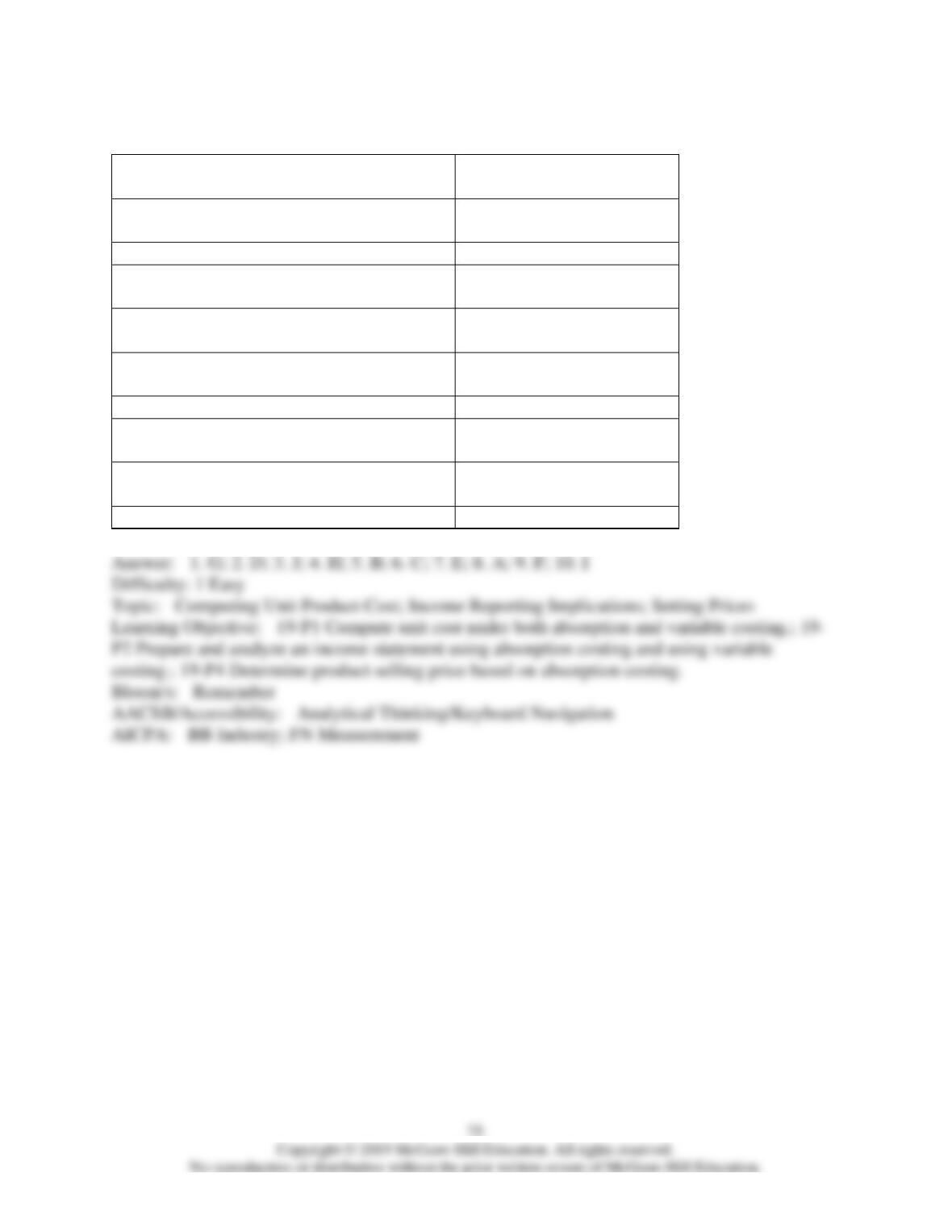
140) Match the following.
1.Direct labor, direct materials, and
manufacturing overhead.
a. Gross margin
2.Costs that are expensed in the period they
are incurred.
b.Controllable costs
3.Sales less variable expenses.
c. Manufacturing margin
4.Cost a manager can determine or greatly
affect the amount.
d. Absorption costing
5.A costing method that includes only
variable manufacturing costs.
e. Period costs
6.An income statement format that focuses
on cost behavior.
f. Contribution margin
7.Sales less cost of goods sold.
g. Variable costing
8.A costing method that includes all
manufacturing costs.
h. Product costs
9.Fixed costs divided by contribution margin
per unit.
i. Contribution format
10.Sales less variable production costs.
j. Break-even in units
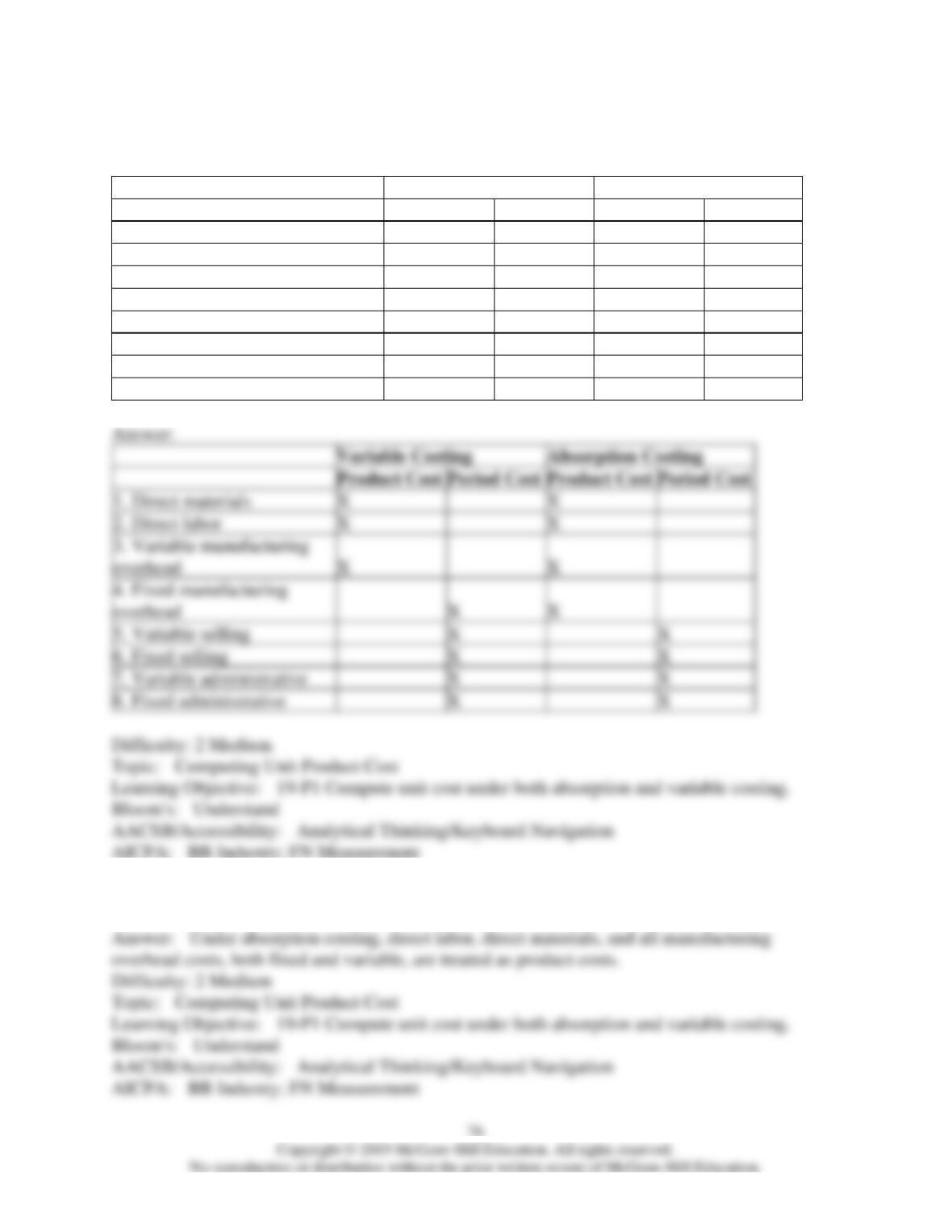
141) Identify the treatment of each of the following costs under variable costing and absorption
costing:
Variable Costing
Absorption Costing
Product Cost
Period Cost
Product Cost
Period Cost
1. Direct materials
2. Direct labor
3. Variable manufacturing overhead
4. Fixed manufacturing overhead
5. Variable selling
6. Fixed selling
7. Variable administrative
8. Fixed administrative
Variable Costing
Absorption Costing
Product Cost
Period Cost
Product Cost
Period Cost
1. Direct materials
X
X
2. Direct labor
X
X
overhead
X
X
overhead
X
X
5. Variable selling
X
X
6. Fixed selling
X
X
7. Variable administrative
X
X
8. Fixed administrative
X
X
142) What costs are treated as product costs under the absorption costing method?
143) What costs are treated as product costs under the variable costing method?
144) How can the use of absorption costing result in overproduction?
145) When excess capacity exists, what is the minimum special order price a manager should
accept to increase net income?
146) What is the benefit of using variable costing in short-term pricing decisions? Is this benefit
available under absorption costing?
147) What is the formula to compute manufacturing margin?
148) How does contribution margin differ from gross margin?
149) How will net income under variable costing compare to net income under absorption
costing in the following three situations? Explain briefly the cause of any differences.
(a) Units produced equal units sold
(b) Units produced exceed units sold
(c) Units produced are less than units sold
150) What is a contribution margin report?
151) What are the limitations of using variable costing?
152) What is the general procedure for converting variable costing net income to absorption
costing net income?
153) A company is currently operating at 60% capacity producing 10,000 units. Cost information
relating to this current production is shown in the following table:
Per Unit
Sales price
$21.00
Direct material
$6.00
Direct labor
$4.12
Variable overhead
$2.23
Fixed overhead
$0.80
The company has been approached by a customer with a request for a special order for 5,000
units. What is the minimum per unit sales price that management would accept for this order if
the company wishes to increase current profits?