CHAPTER 19
ACCOUNTING FOR INCOME TAXES
IFRS questions are available at the end of this chapter.
TRUE-FALSE—Conceptual
Answer No. Description
MULTIPLE CHOICE—Conceptual
Test Bank for Intermediate Accounting, Seventeenth Edition
19 – 2
MULTIPLE CHOICE—Conceptual (cont.)
Answer No. Description
MULTIPLE CHOICE—Computational
Answer No. Description
Accounting for Income Taxes
19 – 3
MULTIPLE CHOICE—Computational (cont.)
Answer No. Description
MULTIPLE CHOICE—CPA Adapted
Answer No. Description
BRIEF EXERCISES
Item Description
BE19-105 Computation of taxable income.
BE19-106 Future taxable and deductible amounts (essay).
BE19-107 Deferred income taxes.
EXERCISES
Item Description
E19-108 Deferred income taxes.
E19-109 Recognition of deferred tax asset.
E19-110 Permanent and temporary differences.
E19-111 Permanent and temporary differences.
E19-112 Temporary differences.
E19-113 Operating loss carryforward.

Test Bank for Intermediate Accounting, Seventeenth Edition
19 – 4
PROBLEMS
Item Description
*P19-114 Differences between accounting and taxable income and the effect on deferred
taxes.
P19-115 Multiple temporary differences.
*P19-116 Deferred tax asset.
P19-117 Interperiod tax allocation with change in enacted tax rates.
CHAPTER LEARNING OBJECTIVES
1. Describe the fundamentals of accounting for income taxes.
2. Identify additional issues in accounting for income taxes.
3. Explain the accounting for loss carryforwards.
4. Describe the presentation of deferred income taxes in financial statements.
*5. Apply the concepts and procedures of interperiod tax allocation.
*6. Explain the accounting for loss carrybacks.
*7. Compare the accounting for income taxes under GAAP and IFRS.

Accounting for Income Taxes
19 – 5
SUMMARY OF QUESTIONS BY LEARNING OBJECTIVES AND BLOOM’S TAXONOMY
Item
LO
BT
Item
LO
BT
Item
LO
BT
Item
LO
BT
Item
LO
BT
TRUE-FALSE STATEMENTS
1.
1
K
5.
1
C
9.
2
C
13.
2
K
17.
3
C
2.
1
K
6.
1
K
10.
2
K
14.
2
C
18.
4
K
3.
1
K
7.
1
C
11.
2
C
*15.
6
C
19.
4
K
4.
1
K
8.
1
K
12.
2
K
16.
3
C
20.
4
K
MULTIPLE CHOICE QUESTIONS
21.
1
C
38.
2
C
55.
1,2
AP
72.
2
AP
*89.
6
AP
22.
1,2
K
39.
2
K
56.
1,2
AP
73.
2
AP
90.
3
AP
23.
1
K
40.
2
K
57.
1,2
AP
74.
2
AP
*91.
6
AP
24.
1
C
41.
2
K
58.
1,2
AP
75.
2
AN
*92.
6
AP
25.
1
K
42.
3
K
59.
1,2
AP
76.
2
AP
93.
3
AP
26.
2
C
43.
4
C
60.
1,2
AP
77.
2
AP
94.
3
AP
27.
2
C
44.
4
K
61.
1
AN
78.
2
AP
95.
1,2
AP
28.
2
C
45.
4
K
62.
1,2
AP
79.
2
AP
96.
1,2
AP
29.
2
K
46.
4
K
63.
1,2
AP
80.
2
AP
97.
1,2
AP
30.
2
C
47.
4
K
64.
1,3
AP
81.
2
AP
98.
1,2
AP
31.
2
C
48.
4
K
65.
2
AP
82.
2
AP
99.
2
AP
32.
2
C
*49.
6
C
66.
2
AP
83.
2
AP
100.
2,4
AP
33.
2
C
50.
4
K
67.
2
AP
84.
2
AP
101.
2,4
AP
34.
2
C
51.
4
K
68.
2
AN
85.
2
AP
102.
2,4
AP
35.
2
C
52.
1
AP
69.
2
AP
86.
2
AN
103.
2,4
AP
36.
2
C
53.
1
AP
70.
2
AP
87.
2
AP
104.
4
AP
37.
2
C
54.
1
AP
71.
2
AP
*88.
6
AP
BRIEF EXERCISES
105.
1
AP
106.
1, 2
K
107.
1
AP
EXERCISES
108.
1
AP
110.
2
C
112.
2
C
109.
1
C
111.
2
C
113.
1, 3
AP
PROBLEMS
*11
4.
1, 2,
5
AP
115.
1
AP
*11
6.
1, 2,
4, 5
AP
117.
2
AP

Test Bank for Intermediate Accounting, Seventeenth Edition
19 – 6
TRUE-FALSE—Conceptual
1. Taxable income is a tax accounting term and is also referred to as income before taxes.
2. Pretax financial income is the amount used to compute income taxes payable.
3. Deferred tax expense is the increase in the deferred tax liability balance from the
beginning to the end of the accounting period.
4. A deferred tax liability represents the increase in taxes payable in future years as a result
of taxable temporary differences existing at the end of the current year.
5. Deductible amounts cause taxable income to be greater than pretax financial income in
the future as a result of existing temporary differences.
6. A deferred tax asset represents the increase in taxes refundable in future years as a result
of deductible temporary differences existing at the end of the current year.
7. A company reduces a deferred tax asset by a valuation allowance if it is probable that it
will not realize some portion of the deferred tax asset.
8. Companies should consider both positive and negative evidence to determine whether it
needs to record a valuation allowance to reduce a deferred tax asset.
9. A company should add a decrease in a deferred tax liability to income taxes payable in
computing income tax expense.
10. Taxable temporary differences will result in taxable amounts in future years when the
related assets are recovered.
11. Examples of taxable temporary differences are subscriptions received in advance and
advance rental receipts.
Accounting for Income Taxes
19 – 7
12. Permanent differences do not give rise to future taxable or deductible amounts.
13. Companies must consider presently enacted changes in the tax rate that become effective
in future years when determining the tax rate to apply to existing temporary differences.
14. When a change in the tax rate is enacted, the effect is reported as an adjustment to
income tax payable in the period of the change.
15. Under the loss carryback approach, companies must apply a current year loss to the most
recent year first and then to an earlier year.
16. The tax effect of a loss carryforward represents future tax savings and results in the
recognition of a deferred tax asset.
17. A possible source of taxable income that may be available to realize a tax benefit for loss
carryforwards is future reversals of existing taxable temporary differences.
18. Companies are permitted to offset any balances in income taxes payable against related
income tax refund receivable or prepaid income taxes balances.
19. Companies should classify deferred tax accounts on the balance sheet as current assets
or current liabilities.
20. The FASB believes that the deferred tax method is the most consistent method for
accounting for income taxes.
True-False Answers—Conceptual

Test Bank for Intermediate Accounting, Seventeenth Edition
19 – 8
MULTIPLE CHOICE—Conceptual
21. Taxable income of a corporation
a. differs from accounting income due to differences in intraperiod allocation between the
two methods of income determination.
b. differs from accounting income because companies use the full accrual method for
financial reporting but use the modified cash basis for tax reporting.
c. is based on generally accepted accounting principles.
d. is reported on the corporation’s income statement.
22 Taxable income of a corporation differs from pretax financial income because of
Permanent Temporary
Differences Differences
a. No No
b. No Yes
c. Yes Yes
d. Yes No
23. The deferred tax expense is the
a. increase in balance of deferred tax asset minus the increase in balance of deferred tax
liability.
b. increase in balance of deferred tax liability minus the increase in balance of deferred
tax asset.
c. increase in balance of deferred tax liability from the beginning to the end of the
accounting period.
d. decrease in balance of deferred tax asset minus the increase in balance of deferred
tax liability.
24. Machinery was acquired at the beginning of the year. Depreciation recorded during the life
of the machinery could result in
Future Future
Taxable Amounts Deductible Amounts
a. Yes Yes
b. Yes No
c. No Yes
d. No No

Accounting for Income Taxes
19 – 9
25. Recognizing a valuation allowance for a deferred tax asset requires that a company
a. consider all positive and negative information in determining the need for a valuation
allowance.
b. consider only the positive information in determining the need for a valuation
allowance.
c. take an aggressive approach in its tax planning.
d. pass a recognition threshold, after assuming that it will be audited by taxing
authorities.
P26. A temporary difference arises when a revenue item is reported for tax purposes in a
period
After it is reported Before it is reported
in financial income in financial income
a. Yes Yes
b. Yes No
c. No Yes
d. No No
Reporting, IFRS: None
S27. At the December 31, 2020 balance sheet date, Unruh Corporation reports an accrued
receivable for financial reporting purposes but not for tax purposes. When this asset is
recovered in 2021, a future taxable amount will occur and
a. pretax financial income will exceed taxable income in 2021.
b. Unruh will record a decrease in a deferred tax liability in 2021.
c. total income tax expense for 2021 will exceed current tax expense for 2021.
d. Unruh will record an increase in a deferred tax asset in 2021.
P28. Assuming a 40% statutory tax rate applies to all years involved, which of the following
situations will give rise to reporting a deferred tax liability on the balance sheet?
I. A revenue is deferred for financial reporting purposes but not for tax purposes.
II. A revenue is deferred for tax purposes but not for financial reporting purposes.
III. An expense is deferred for financial reporting purposes but not for tax purposes.
IV. An expense is deferred for tax purposes but not for financial reporting purposes.
a. item II only
b. items I and II only
c. items II and III only
d. items I and IV only

Test Bank for Intermediate Accounting, Seventeenth Edition
19 – 10
S29. A major distinction between temporary and permanent differences is
a. permanent differences are not representative of acceptable accounting practice.
b. temporary differences occur frequently, whereas permanent differences occur only
once.
c. once an item is determined to be a temporary difference, it maintains that status;
however, a permanent difference can change in status with the passage of time.
d. temporary differences reverse themselves in subsequent accounting periods, whereas
permanent differences do not reverse.
S30. Which of the following are temporary differences that are normally classified as expenses
or losses that are deductible after they are recognized in financial income?
a. Prepaid expenses that are deducted on the tax return in the period paid.
b. Product warranty liabilities.
c. Depreciable property.
d. Fines and expenses resulting from a violation of law.
S31. Which of the following is a temporary difference classified as a revenue or gain that is
taxable after it is recognized in financial income?
a. Subscriptions received in advance.
b. Prepaid royalty received in advance.
c. An installment sale accounted for on the accrual basis for financial reporting purposes
and on the installment (cash) basis for tax purposes.
d. Interest received on a municipal obligation.
S32. Which of the following differences would result in future taxable amounts?
a. Expenses or losses that are tax deductible after they are recognized in financial
income.
b. Revenues or gains that are taxable before they are recognized in financial income.
c. Revenues or gains that are recognized in financial income but are never included in
taxable income.
d. Expenses or losses that are tax deductible before they are recognized in financial
income.
Reporting, IFRS: None
33. Stuart Corporation’s taxable income differed from its accounting income computed for this
past year. An item that would create a permanent difference in accounting and taxable
incomes for Stuart would be
a. a balance in the Unearned Rent account at year end.
b. using accelerated depreciation for tax purposes and straight-line depreciation for book
purposes.
c. a fine resulting from violations of OSHA regulations.
d. making installment sales during the year.

Accounting for Income Taxes
19 – 11
34. An example of a permanent difference is
a. proceeds from life insurance on officers.
b. interest expense on money borrowed to invest in municipal bonds.
c. insurance expense for a life insurance policy on officers.
d. All of these answers are correct as they are all examples of permanent differences.
35. Which of the following will not result in a temporary difference?
a. Product warranty liabilities
b. Advance rental receipts
c. Installment sales
d. Interest received on municipal obligations.
36. A company uses the equity method to account for an investment for financial reporting
purposes. This would result in what type of difference and in what type of deferred income
tax?
Type of Difference Deferred Tax
a. Permanent Asset
b. Permanent Liability
c. Temporary Asset
d. Temporary Liability
37. A company records an unrealized loss on trading securities. This would result in what type
of difference and in what type of deferred income tax?
Type of Difference Deferred Tax
a. Temporary Liability
b. Temporary Asset
c. Permanent Liability
d. Permanent Asset
38. Which of the following temporary differences results in a deferred tax asset in the year the
temporary difference originates?
I. Accrual for product warranty liability.
II. Subscriptions received in advance.
III. Prepaid insurance expense.
a. I and II only.
b. II only.
c. III only.
d. I and III only.

Test Bank for Intermediate Accounting, Seventeenth Edition
19 – 12
39. Which of the following is not considered a permanent difference?
a. Interest received on municipal bonds.
b. Fines resulting from violating the law.
c. Premiums paid for life insurance on a company’s CEO when the company is the
beneficiary.
d. Stock-based compensation expense.
S40. When a change in the tax rate is enacted into law, its effect on existing deferred income
tax accounts should be
a. handled retroactively in accordance with the guidance related to changes in
accounting principles.
b. considered, but it should only be recorded in the accounts if it reduces a deferred tax
liability or increases a deferred tax asset.
c. reported as an adjustment to income tax expense in the period of change.
d. applied to all temporary or permanent differences that arise prior to the date of the
enactment of the tax rate change, but not subsequent to the date of the change.
41. Tax rates other than the current tax rate may be used to calculate the deferred income tax
amount on the balance sheet if
a. it is probable that a future tax rate change will occur.
b. it appears likely that a future tax rate will be greater than the current tax rate.
c. the future tax rates have been enacted into law.
d. it appears likely that a future tax rate will be less than the current tax rate.
42. Recognition of tax benefits in the loss year due to a loss carryforward requires
a. the establishment of a deferred tax liability.
b. the establishment of a deferred tax asset.
c. the establishment of an income tax refund receivable.
d. only a note to the financial statements.
43. Uncertain tax positions
I. Are positions for which the tax authorities may disallow a deduction in whole or
in part.
II. Include instances in which the tax law is clear and in which the company believes
an audit is likely.
III. Give rise to tax expense by increasing payables or increasing a deferred
tax liability.
a. I, II, and III.
b. I and III only.
c. II only.
d. I only.

Accounting for Income Taxes
19 – 13
44. With regard to uncertain tax positions, the FASB requires that companies recognize a tax
benefit when
a. it is probable and can be reasonably estimated.
b. there is at least a 51% probability that the uncertain tax position will be approved by
the taxing authorities.
c. it is more likely than not that the tax position will be sustained upon audit.
d. Any of these choices exist.
45. Major reasons for disclosure of deferred income tax information is (are)
a. better assessment of quality of earnings.
b. better predictions of future cash flows.
c. predicting future cash flows for operating loss carryforwards.
d. All of these answer choices are correct.
46. Accounting for income taxes can result in the reporting of deferred taxes as
a. a current asset.
b. a non current liability.
c. a contra-asset account.
d. a current liability.
47. Deferred taxes should be presented on the balance sheet
a. as either noncurrent or current.
b. as a noncurrent amount.
c. as a current amount.
d. as reductions of the related asset or liability accounts.
48. Companies are permitted to offset any balances in income taxes payable against
a. deferred tax assets balances.
b. deferred tax liabilities balances.
c. income tax expense.
d. related income tax refund receivable or prepaid income taxes balances.
*49. Tanner, Inc. incurred a financial and taxable loss for 2021. Tanner therefore decided to
use the carryback provisions as it had been profitable up to this year. How should the
amounts related to the carryback be reported in the 2021 financial statements?
a. The reduction of the loss should be reported as a prior period adjustment.
b. The refund claimed should be reported as a deferred charge and amortized over five
years.
c. The refund claimed should be reported as revenue in the current year.
d. The refund claimed should be shown as a reduction of income tax expense in 2021.
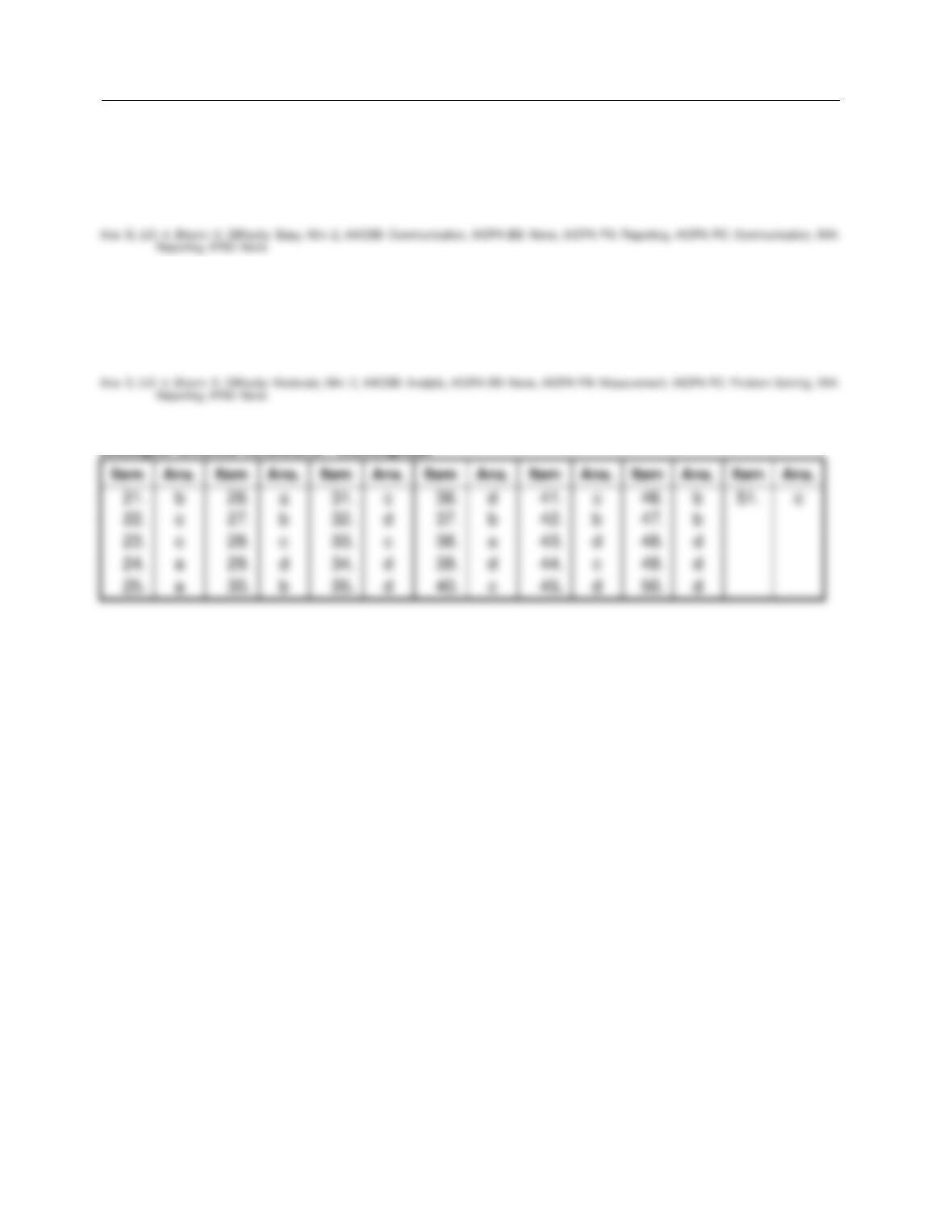
Test Bank for Intermediate Accounting, Seventeenth Edition
19 – 14
S50. Companies are required to disclose the total of each of the following except
a. all deferred tax assets.
b. all deferred tax liabilities.
c. the total valuation allowance.
d. All of these choices must be disclosed.
51. All of the following are procedures for the computation of deferred income taxes except to
a. identify the types and amounts of existing temporary differences.
b. measure the total deferred tax liability for taxable temporary differences.
c. measure the total deferred tax liability for deductible temporary differences.
d. determine taxes payable.
Multiple Choice Answers—Conceptual

Accounting for Income Taxes
19 – 15
MULTIPLE CHOICE—Computational
52. At the beginning of 2021, Pitman Co. purchased an asset for $1,800,000 with an
estimated useful life of 5 years and an estimated salvage value of $150,000. For financial
reporting purposes the asset is being depreciated using the straight-line method; for tax
purposes the double-declining-balance method is being used. Pitman Co.’s tax rate is
20% for 2021 and all future years.
At the end of 2021, what are the book basis and the tax basis of the asset?
Book basis Tax basis
a. $1,320,000 $ 930,000
b. $1,470,000 $ 930,000
c. $1,470,000 $1,080,000
d. $1,320,000 $1,080,000
53. At the beginning of 2021, Pitman Co. purchased an asset for $1,800,000 with an
estimated useful life of 5 years and an estimated salvage value of $150,000. For financial
reporting purposes the asset is being depreciated using the straight-line method; for tax
purposes the double-declining-balance method is being used. Pitman Co.’s tax rate is
20% for 2021 and all future years.
At the end of 2021, which of the following deferred tax accounts and balances is reported
on Pitman’s balance sheet?
Account _ Balance
a. Deferred tax asset $78,000
b. Deferred tax liability $78,000
c. Deferred tax asset $117,000
d. Deferred tax liability $117,000
54. Lehman Corporation purchased a machine on January 2, 2020, for $4,000,000. The
machine has an estimated 5-year life with no salvage value. The straight-line method of
depreciation is being used for financial statement purposes and the following MACRS
amounts will be deducted for tax purposes:
2020 $800,000 2023 $460,000
2021 1,280,000 2024 460,000
2022 768,000 2025 232,000
Assuming an income tax rate of 20% for all years, the net deferred tax liability that should
be reflected on Lehman’s balance sheet at December 31, 2021 be
a. $96,000
b. $89,600
c. $6,400
d. $0

Test Bank for Intermediate Accounting, Seventeenth Edition
19 – 16
55. Mathis Co. at the end of 2020, its first year of operations, prepared a reconciliation
between pretax financial income and taxable income as follows:
Pretax financial income $ 1,200,000
Estimated litigation expense 3,000,000
Installment sales (2,400,000)
Taxable income $ 1,800,000
The estimated litigation expense of $3,000,000 will be deductible in 2022 when it is
expected to be paid. The gross profit from the installment sales will be realized in the
amount of $1,200,000 in each of the next two years. The estimated liability for litigation is
classified as noncurrent and the installment accounts receivable are classified as
$1,200,000 current and $1,200,000 noncurrent. The income tax rate is 20% for all years.
The income tax expense is
a. $240,000.
b. $360,000.
c. $400,000.
d. $800,000.
56. Mathis Co. at the end of 2020, its first year of operations, prepared a reconciliation
between pretax financial income and taxable income as follows:
Pretax financial income $ 1,200,000
Estimated litigation expense 3,000,000
Installment sales (2,400,000)
Taxable income $ 1,800,000
The estimated litigation expense of $3,000,000 will be deductible in 2022 when it is
expected to be paid. The gross profit from the installment sales will be realized in the
amount of $1,200,000 in each of the next two years. The estimated liability for litigation is
classified as noncurrent and the installment accounts receivable are classified as
$1,200,000 current and $1,200,000 noncurrent. The income tax rate is 20% for all years.
The deferred tax asset to be recognized is
a. $0.
b. $120,000 current.
c. $600,000 current.
d. $600,000 noncurrent.

Accounting for Income Taxes
19 – 17
57. Mathis Co. at the end of 2020, its first year of operations, prepared a reconciliation
between pretax financial income and taxable income as follows:
Pretax financial income $ 1,200,000
Estimated litigation expense 3,000,000
Installment sales (2,400,000)
Taxable income $ 1,800,000
The estimated litigation expense of $3,000,000 will be deductible in 2022 when it is
expected to be paid. The gross profit from the installment sales will be realized in the
amount of $1,200,000 in each of the next two years. The estimated liability for litigation is
classified as noncurrent and the installment accounts receivable are classified as
$1,200,000 current and $1,200,000 noncurrent. The income tax rate is 20% for all years.
The deferred tax liability to be recognized is
a. $120,000.
b. $360,000.
c. $480,000.
d. $240,000.
58. Hopkins Co. at the end of 2020, its first year of operations, prepared a reconciliation
between pretax financial income and taxable income as follows:
Pretax financial income $3,000,000
Estimated litigation expense 4,000,000
Extra depreciation for taxes (6,000,000)
Taxable income $ 1,000,000
The estimated litigation expense of $4,000,000 will be deductible in 2021 when it is
expected to be paid. Use of the depreciable assets will result in taxable amounts of
$2,000,000 in each of the next three years. The income tax rate is 20% for all years.
Income taxes payable is
a. $0.
b. $200,000.
c. $600,000.
d. $900,000.
59. Hopkins Co. at the end of 2020, its first year of operations, prepared a reconciliation
between pretax financial income and taxable income as follows:
Pretax financial income $3,000,000
Estimated litigation expense 4,000,000
Extra depreciation for taxes (6,000,000)
Taxable income $ 1,000,000
The estimated litigation expense of $4,000,000 will be deductible in 2021 when it is
expected to be paid. Use of the depreciable assets will result in taxable amounts of
$2,000,000 in each of the next three years. The income tax rate is 20% for all years.
The deferred tax asset to be recognized is

Test Bank for Intermediate Accounting, Seventeenth Edition
19 – 18
a. $200,000.
b. $400,000.
c. $600,000.
d. $800,000.
60. Hopkins Co. at the end of 2020, its first year of operations, prepared a reconciliation
between pretax financial income and taxable income as follows:
Pretax financial income $3,000,000
Estimated litigation expense 4,000,000
Extra depreciation for taxes (6,000,000)
Taxable income $ 1,000,000
The estimated litigation expense of $4,000,000 will be deductible in 2021 when it is
expected to be paid. Use of the depreciable assets will result in taxable amounts of
$2,000,000 in each of the next three years. The income tax rate is 20% for all years.
The amount of deferred tax liability to be recognized is
a. $800,000
b. $600,000
c. $1,200,000
d. $1,000,000
61. Eckert Corporation’s partial income statement after its first year of operations is as follows:
Income before income taxes $3,750,000
Income tax expense
Current $1,035,000
Deferred 90,000 1,125,000
Net income $2,625,000
Eckert uses the straight-line method of depreciation for financial reporting purposes and
accelerated depreciation for tax purposes. The amount charged to depreciation expense
on its books this year was $2,800,000. No other differences existed between book income
and taxable income except for the amount of depreciation. Assuming a 20% tax rate, what
amount was deducted for depreciation on the corporation’s tax return for the current year?
a. $2,350,000
b. $1,125,000
c. $2,800,000
d. $3,250,000

Accounting for Income Taxes
19 – 19
62. Cross Company reported the following results for the year ended December 31, 2021, its
first year of operations:
2021
Income (per books before income taxes) $ 2,000,000
Taxable income 3,200,000
The disparity between book income and taxable income is attributable to a temporary
difference which will reverse in 2022. What should Cross record as a net deferred tax
asset or liability for the year ended December 31, 2021, assuming that the enacted tax
rates in effect are 30% in 2021 and 25% in 2022?
a. $360,000 deferred tax liability
b. $300,000 deferred tax asset
c. $360,000 deferred tax asset
d. $300,000 deferred tax liability
63. In 2021, Krause Company accrued, for financial statement reporting, estimated losses on
disposal of unused plant facilities of $3,600,000. The facilities were sold in March 2022
and a $3,600,000 loss was recognized for tax purposes. Also in 2021, Krause paid
$150,000 in premiums for a two-year life insurance policy in which the company was the
beneficiary. Assuming that the enacted tax rate is 20% in both 2021 and 2022, and that
Krause paid $1,170,000 in income taxes in 2021, the amount reported as net deferred
income taxes on Krause’s balance sheet at December 31, 2021, should be a
a. $680,000 asset.
b. $360,000 asset.
c. $360,000 liability.
d. $720,000 asset.
64. Horner Corporation has a deferred tax asset at December 31, 2022 of $200,000 due to
the recognition of potential tax benefits of an operating loss carryforward. The enacted tax
rates are as follows: 30% for 2019–2021; 25% for 2022; and 20% for 2023 and thereafter.
Assuming that management expects that only 50% of the related benefits will actually be
realized, a valuation account should be established in the amount of:
a. $100,000
b. $40,000
c. $35,000
d. $30,000

Test Bank for Intermediate Accounting, Seventeenth Edition
19 – 20
65. Watson Corporation prepared the following reconciliation for its first year of operations:
Pretax financial income for 2021 $2,700,000
Tax exempt interest (150,000)
Originating temporary difference (450,000)
Taxable income $2,100,000
The temporary difference will reverse evenly over the next two years at an enacted tax
rate of 30%. The enacted tax rate for 2021 is 20%. What amount should be reported in its
2021 income statement as the current portion of its provision for income taxes?
a. $420,000
b. $630,000
c. $540,000
d. $810,000
66. Mitchell Corporation prepared the following reconciliation for its first year of operations:
Pretax financial income for 2021 $ 1,800,000
Tax exempt interest (150,000)
Originating temporary difference (350,000)
Taxable income $1,300,000
The temporary difference will reverse evenly over the next two years at an enacted tax
rate of 30%. The enacted tax rate for 2021 is 25%.
What amount should be reported in its 2021 income statement as the deferred portion of
income tax expense?
a. $105,000 debit
b. $125,000 debit
c. $105,000 credit
d. $125,000 credit
67. Mitchell Corporation prepared the following reconciliation for its first year of operations:
Pretax financial income for 2021 $ 1,800,000
Tax exempt interest (150,000)
Originating temporary difference (350,000)
Taxable income $1,300,000
The temporary difference will reverse evenly over the next two years at an enacted tax
rate of 30%. The enacted tax rate for 2021 is 25%.
In Mitchell’s 2021 income statement, what amount should be reported for total income tax
expense?
a. $477,500
b. $450,000
c. $430,000
d. $325,000