55. The Brownwood Company reports the following for both pretax financial and taxable income:
Enacted
Year
Income (Loss)
Tax Rates
2010
$ 40,000
30%
2011
60,000
35%
2012
80,000
30%
2013
(200,000)
30%
Brownwood uses the carryback provision for net operating losses when possible. Congress has enacted a tax rate for 2014 and future years of 40%.
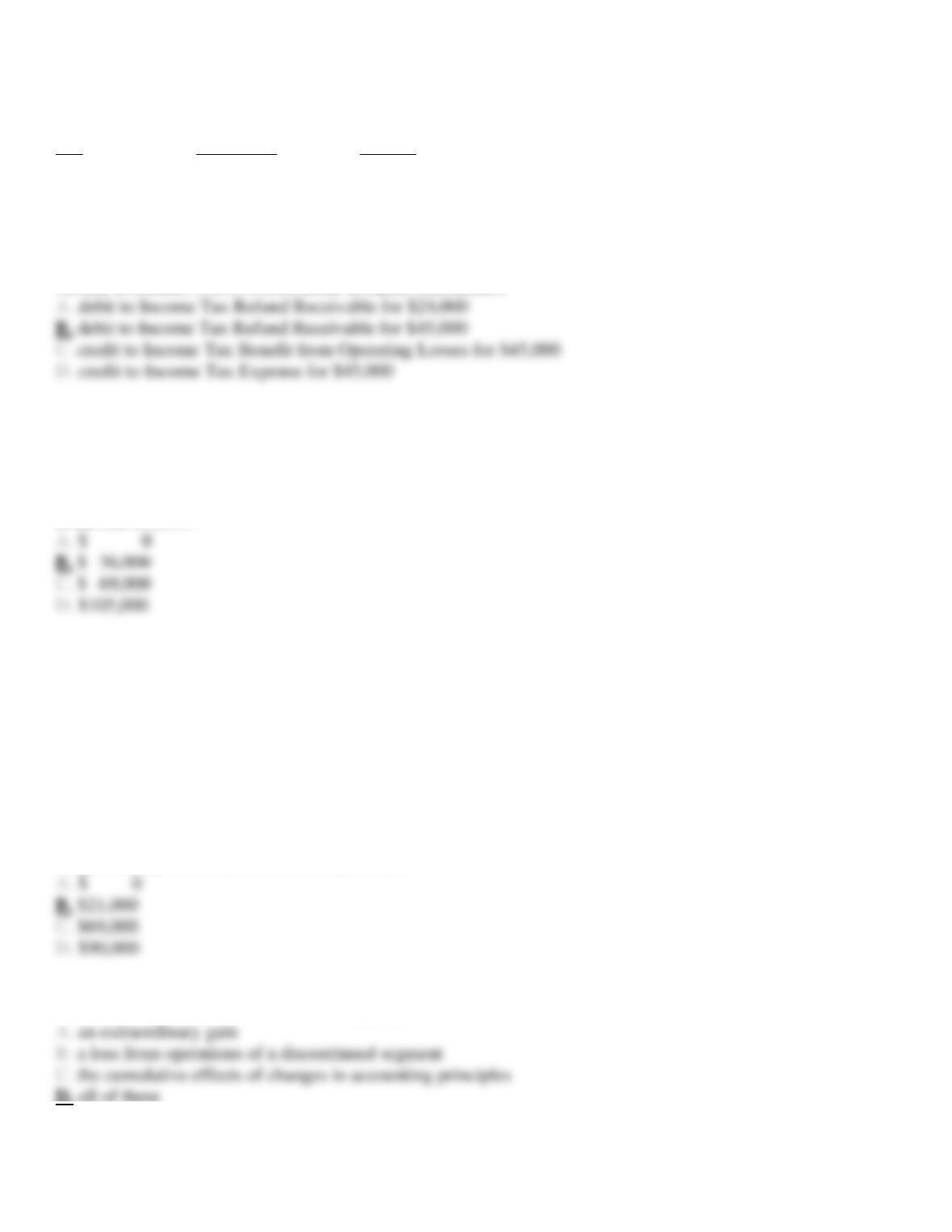
The entry on December 31, 2013, to record income tax expense would include a
56. The Pilot Point Company began operations in 2010 and, for that calendar year, reported an operating loss of
$230,000. Due to sufficient verifiable positive evidence, no valuation allowance was established to reduce the
deferred tax asset as of December 31, 2010. During 2011, Pilot Point reported pretax accounting income of
$350,000. Assuming an income tax rate of 30%, what should Pilot Point record in 2011 as income tax payable
at the end of 2011?
57. Harlingen Company reported the following operating results during its first three years of operations:
2010 Pretax operating loss
$ 30,000
2011 Pretax operating loss
$200,000
2012 Pretax operating income
$300,000
No permanent or temporary differences occurred during these fiscal periods. Assuming an income tax rate of 30%, Harlingen should report a current
income tax liability as of December 31, 2012, in the amount of
58. Intraperiod tax allocation would be appropriate for
59. In applying intraperiod income tax allocation to discontinued operations, extraordinary items, cumulative
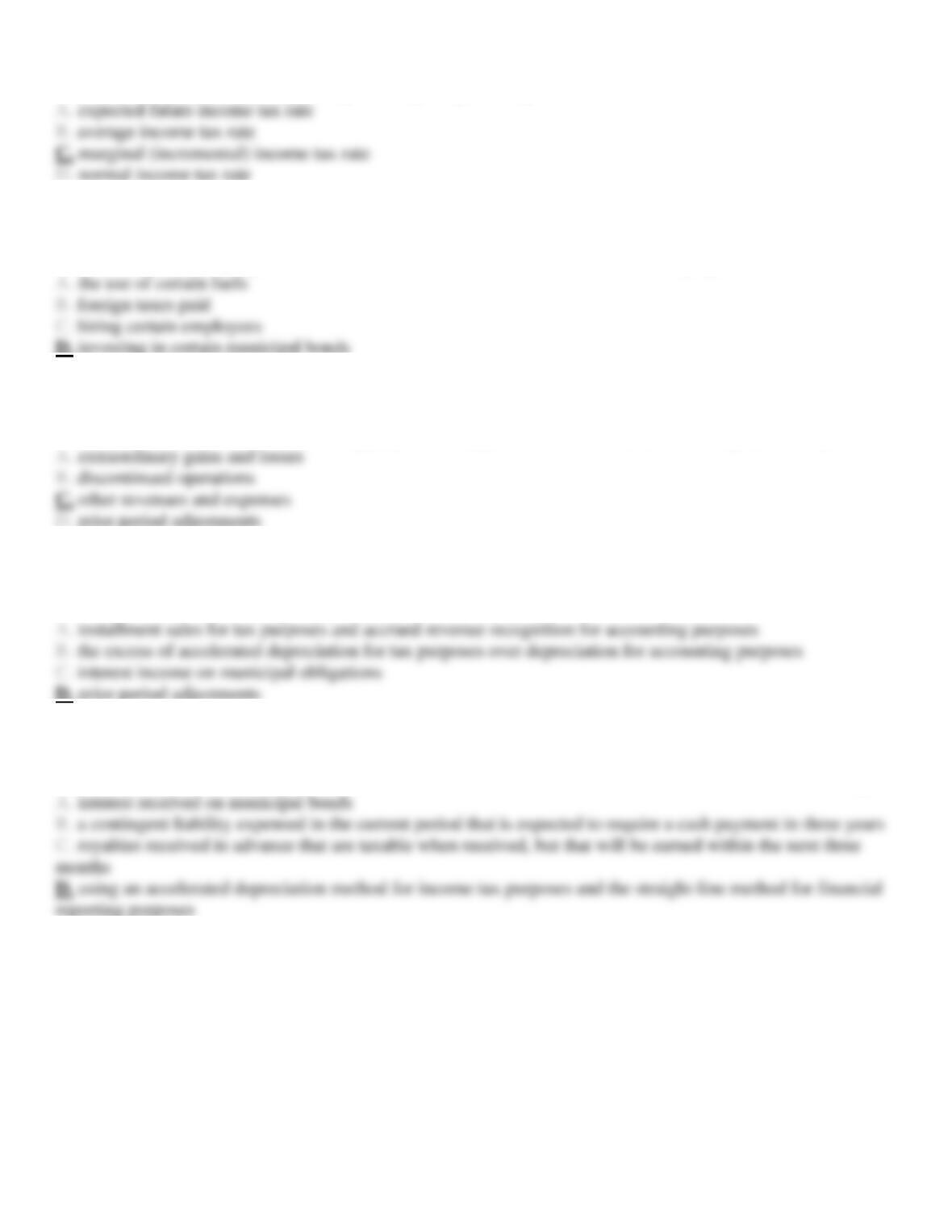
effects of changes in accounting principles, and prior period adjustments, what tax rate should be used?
60. Which of the following activities does not result in a “tax credit” for income tax purposes?
61. Income taxes for financial accounting purposes are apportioned to each of the following items except
62. Which one of the following requires intraperiod tax allocation?
63. Which one of the following transactions would result in the creation of a noncurrent deferred tax liability?

64. The recognition of gross profit on installment sales at point of sale for financial reporting purposes but
reporting the profit when the cash is received for income tax purposes results in deferred taxes reported in
which section of the balance sheet?
65. The acceptable balance sheet classifications for deferred tax assets and deferred tax liabilities under GAAP
and IFRS are
GAAP
IFRS
I.
current only
noncurrent only
II.
current and noncurrent, respectively
current and noncurrent, respectively
III.
noncurrent only
current only
IV.
current and noncurrent, respectively
noncurrent only
66. For each item listed below, indicate whether it involves a:
a.
permanent difference.
b.
temporary difference that will result in future deductible amounts (giving rise to deferred tax assets).
c.
temporary difference that will result in future taxable amounts (giving rise to deferred tax liabilities).
____
1.
Rent is collected in advance from a tenant. Rent is taxable when received.
____
2.
Warranty costs are accrued at the time of sale for accounting purposes, but are not deductible until paid for income tax
purposes.
____
3.
Interest revenue is recorded on municipal bonds.
____
4.
Installment sales are recognized at the point of sale for accounting purposes, but when the cash is received for income tax
purposes.
____
5.
A loss contingency is expensed for accounting purposes. The company expects to pay the amount involved in three years.
____
6.
Bad debt expense is estimated for accounting purposes, but is not deducted for income tax purposes until written off.
____
7.
The company paid a fine from the EPA for violation of environmental regulations.
Required:
Match each item to its descriptive phrase by placing the appropriate letter in the space provided.
67. Lubbock Company’s taxable income and other financial data for 2010 are presented below:
Taxable income
$500,000
Interest received on municipal bonds
75,000
Estimated bad debt expense (not written off)
40,000
Cash expenditures for product warranty expenses
108,000
Product warranty expense for accounting purposes
142,000
Gross profit on installment sales for 2010
180,000
Gross profit recognized in 2010 for tax purposes based on installment
sales in 2010
160,000
Required:
a.
Calculate Lubbock Company’s 2010 pretax financial income.
b.
For each item, explain why there is a difference, if any exists, between how it is treated for taxable income purposes and pretax
financial income.
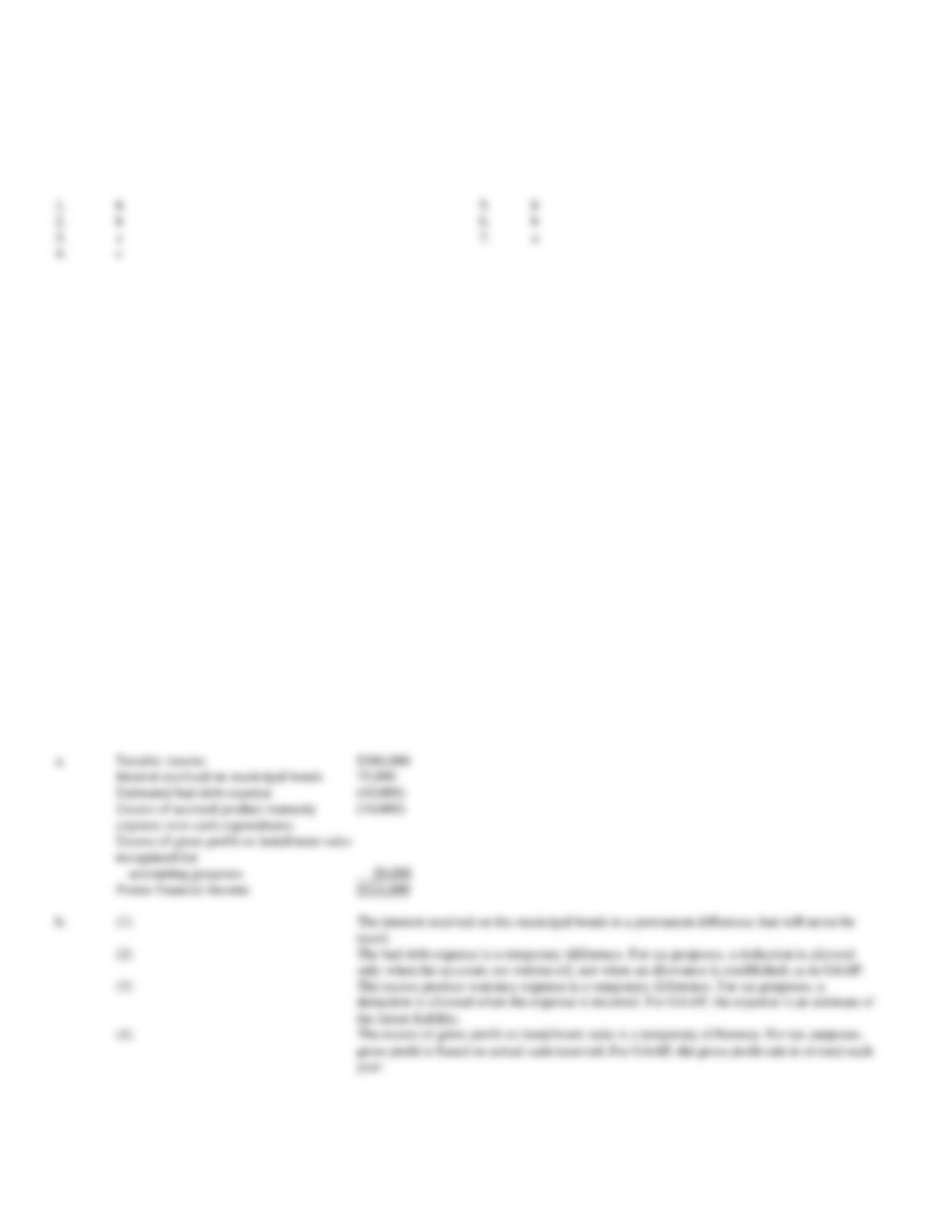
a.
Taxable income
$500,000
Interest received on municipal bonds
75,000
Estimated bad debt expense
(40,000)
Excess of accrued product warranty
(34,000)
accounting purposes
20,000
Pretax financial income
$521,000
b.
(1)
The interest received on the municipal bonds is a permanent difference that will never be
b
b
b
b
a
a
c
68. Dallas Company had financial and taxable incomes as follows:
2010
2011
2012
Pretax financial income
$150,000
$140,000
$135,000
Taxable income
115,000
140,000
170,000
The tax rate for all three years was 20%.
Required:
a.
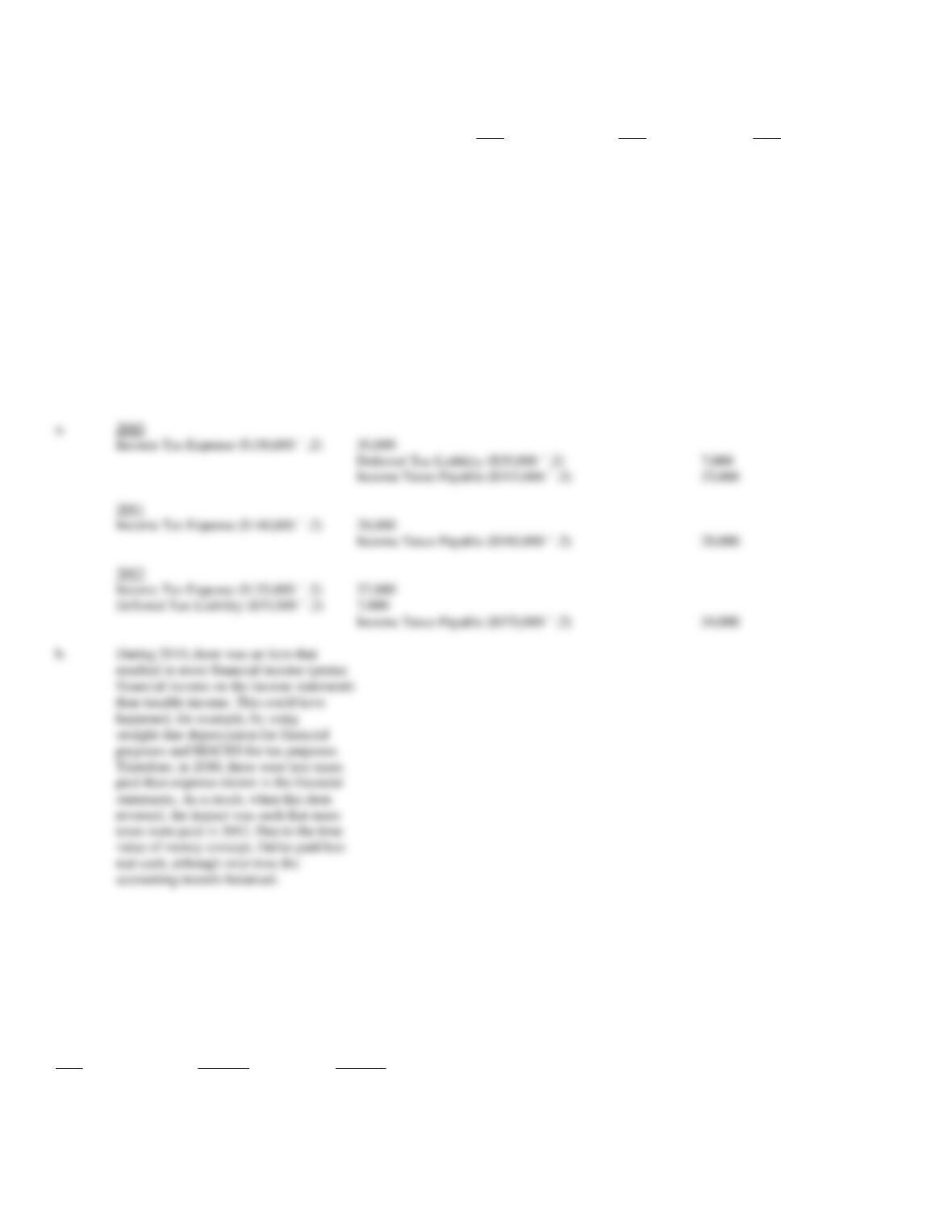
Prepare the journal entries to record income taxes for all three years.
b.
Explain why the taxes paid in 2012 are different from the tax return and the amount reported in the financial statements.
69. On December 31, 2009, Lake Jackson, Inc. reported a deferred tax liability of $1,875, based on the
following schedule of future taxable amounts and enacted tax rates:
Taxable
Enacted
Year
Amounts
Tax Rate
2010
$3,000
30%
2011
2,000
30%
2012
1,500
25%
a.
2010
Income Tax Expense ($150,000 ´ .2)
30,000
Deferred Tax Liability ($35,000 ´ .2)
7,000
Income Taxes Payable ($115,000 ´ .2)
23,000
2011
Income Tax Expense ($140,000 ´ .2)
28,000
Income Taxes Payable ($140,000 ´ .2)
28,000
2012
Income Tax Expense ($135,000 ´ .2)
27,000
Deferred Tax Liability ($35,000 ´ .2)
7,000
Income Taxes Payable ($170,000 ´ .2)
34,000
On February 7, 2010, Congress amended a previously passed tax law. The amendment changed the tax rate to 35% for 2010 and all future years.
Required:
Prepare the income tax journal entry for Lake Jackson, Inc. necessary on February 7, 2010.
70. On December 31, 2010, the South Padre Company had a deferred tax liability balance of $8,100, arising
from an excess of MACRS depreciation for tax purposes over straight-line depreciation for accounting
purposes. The tax effects of that timing difference are expected to reverse in the following years:
Timing
Enacted
Deferred
Year
Difference
Tax Rate
Tax Liability
2011
$ 6,000
30%
$1,800
2012
8,000
35%
2,800
2013
10,000
35%
3,500
$8,100
On January 27, 2011, Congress raised the effective income tax rate to 38% for all future years, including the current year, 2011.
Required:
Prepare the entry to record any adjustments necessary due to the income tax rate increase on January 27, 2011.
Expense
Deferred Tax Liability [($24,000 ´ .38) – $8,100]
1,020
71. At the end of its first year of operations on December 31, 2010, the Midland Company reported pretax
financial income of $100,000. An investigation of that income revealed the following items:
·
Bad debts expense of $12,000 was recognized. The accounts will be written off in 2011.
·
Installment sales of $50,000 were recognized in financial income. These sales were accounted for by the installment sales method for
income tax purposes. Only $20,000 was reported on the tax return.
·
Warranty expenses of $16,000 were accrued for financial reporting purposes, but were not expected to result in a cash payment until
2011.
·
Depreciation on the tax return exceeded depreciation for financial reporting purposes by $32,000.
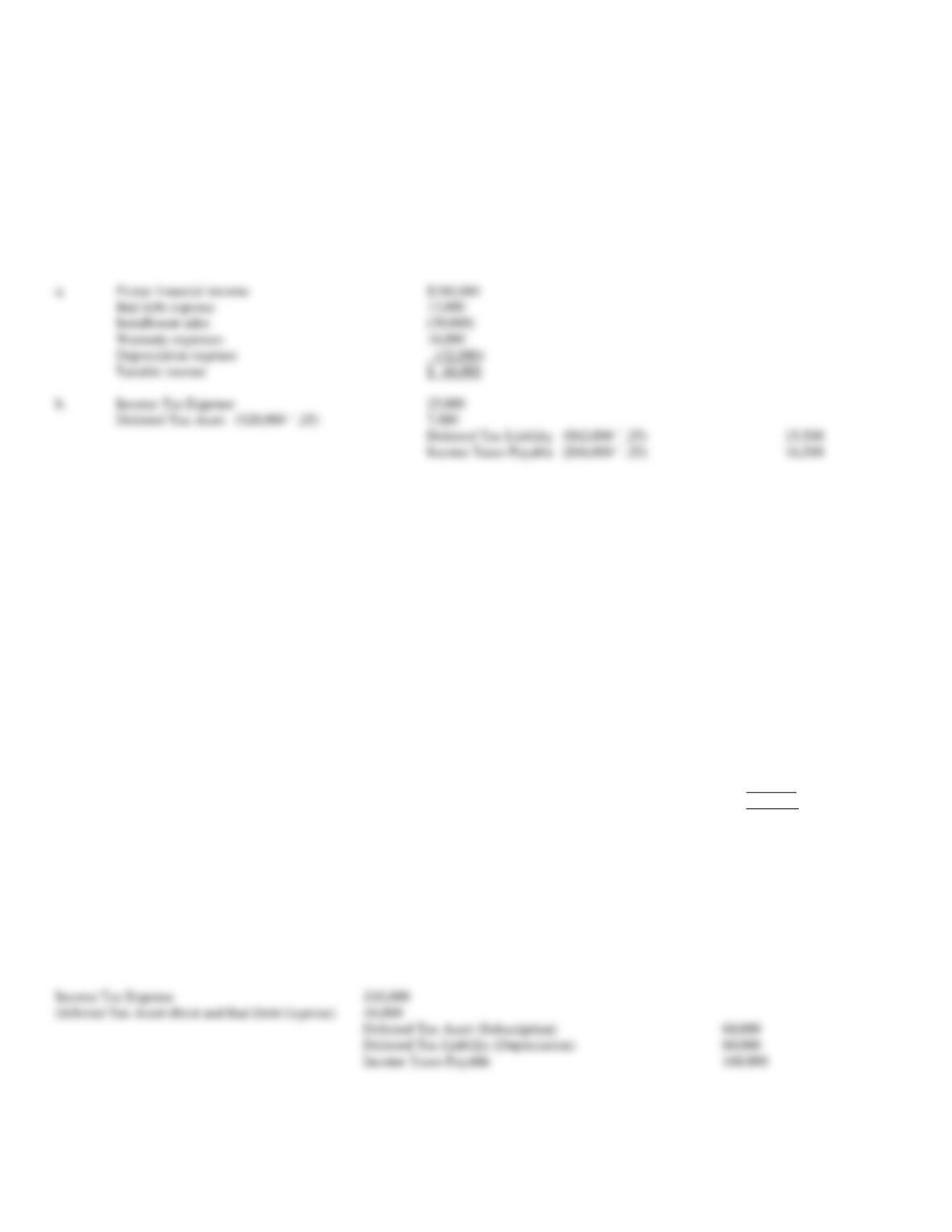
Deferred Tax Liability [($3,000 + $2,000) ´
(.35 – .30)] + [$1,500 ´ (.35 – .25)]
Assume that any deferred tax assets are considered more likely than not to be realized. The enacted income tax rate for all years is 25%.
Required:
a.
Compute taxable income.
b.
Prepare the entry to record income tax expense and any related assets and liabilities for Midland on December 31, 2010.
72. At December 31, 2010, the El Paso Company had a current deferred tax asset of $60,000, arising from cash
for magazine subscriptions received and taxed in 2010 but that will be recognized as income for accounting
purposes in 2011; a noncurrent deferred tax liability of $160,000 arising from an excess of MACRS tax
depreciation over straight-line accounting depreciation of plant assets; and a long-term deferred tax asset of
$80,000, arising from contingency expenses for accounting purposes that will be tax deductible when paid
(estimated to be in 2012). The 2011 pretax financial income and taxable income for El Paso are as follows:
Pretax financial income
$800,000
Estimated bad debt expense
60,000
Magazine subscriptions earned (cash received in 2010)
(200,000)
Rent received in advance
100,000
Excess of MACRS tax depreciation over straight-line accounting
depreciation
(200,000)
Taxable income
$560,000
The income tax rate for all years
30%
Required:
Prepare the income tax journal entry for the El Paso Company at the end of 2011.
Income Tax Expense
240,000
Deferred Tax Asset (Rent and Bad Debt Expense)
48,000
Deferred Tax Asset (Subscription)
60,000
Deferred Tax Liability (Depreciation)
60,000
Income Taxes Payable
168,000
a.
Pretax financial income
$100,000
Bad debt expense
12,000
Installment sales
(30,000)
Warranty expenses
16,000
Depreciation expense
(32,000)
Taxable income
$ 66,000
b.
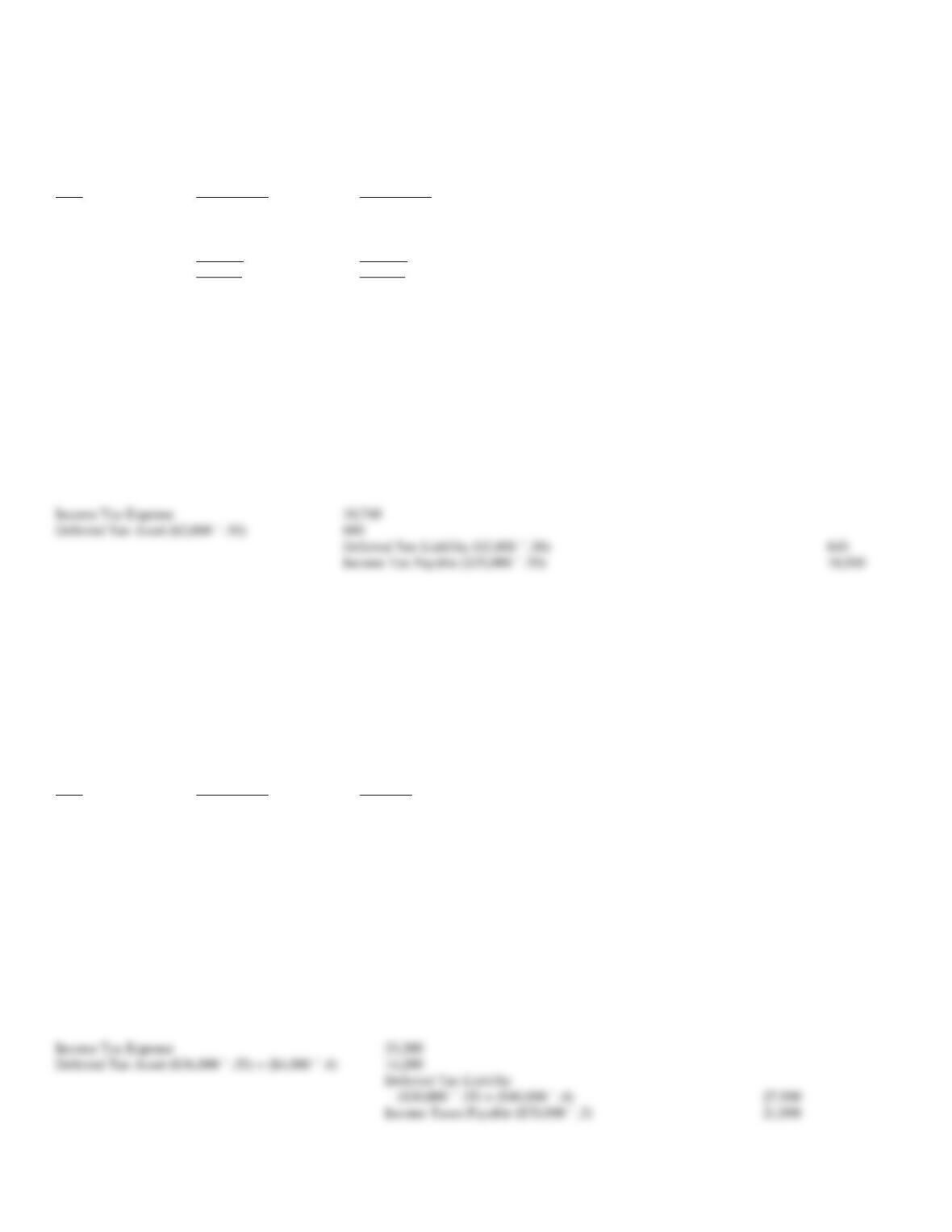
Income Tax Expense
25,000
Deferred Tax Asset ($28,000 ´ .25)
7,000
Deferred Tax Liability ($62,000 ´ .25)
15,500
Income Taxes Payable ($66,000 ´ .25)
16,500
73. Arlington Company had a balance in Deferred Tax Liability of $840 on December 31, 2010, resulting from
depreciation timing differences. Differences in tax and accounting depreciation for assets purchased on January
1, 2010, are as follows:
Financial
Tax
Year
Depreciation
Depreciation
2010
$ 4,000
$ 6,800
2011
4,000
5,200
2012
4,000
2,400
2013
4,000
1,600
$16,000
$16,000
In addition to the 2010 depreciation timing difference, Arlington Company expensed $2,000 of warranty costs that will be deducted for tax purposes
when paid in future years. Arlington’s taxable income in 2010 was $35,000. The 2010 income tax rate was 30%, and no changes in the tax rate for
future years have been enacted.
Required:
Prepare the income tax journal entry for the Arlington Company for December 31, 2010.
74. Austin Company, during its first year of operations in 2010, reported taxable income of $70,000 and pretax
financial income of $100,000. The difference between taxable income and pretax financial income was caused
by two timing differences: excess depreciation on tax return, $70,000; and warranty expenses in excess of
warranty payments, $40,000. These two timing differences will reverse in the next three years as follows:
Warranty
Year
Depreciation
Expenses
2011
$10,000
$20,000
2012
20,000
16,000
2013
40,000
4,000
Enacted tax rates are 30% for 2010, 35% for 2011 and 2012, and 40% for 2013.
Required:
Prepare the income tax journal entry for Austin Company for December 31, 2010.
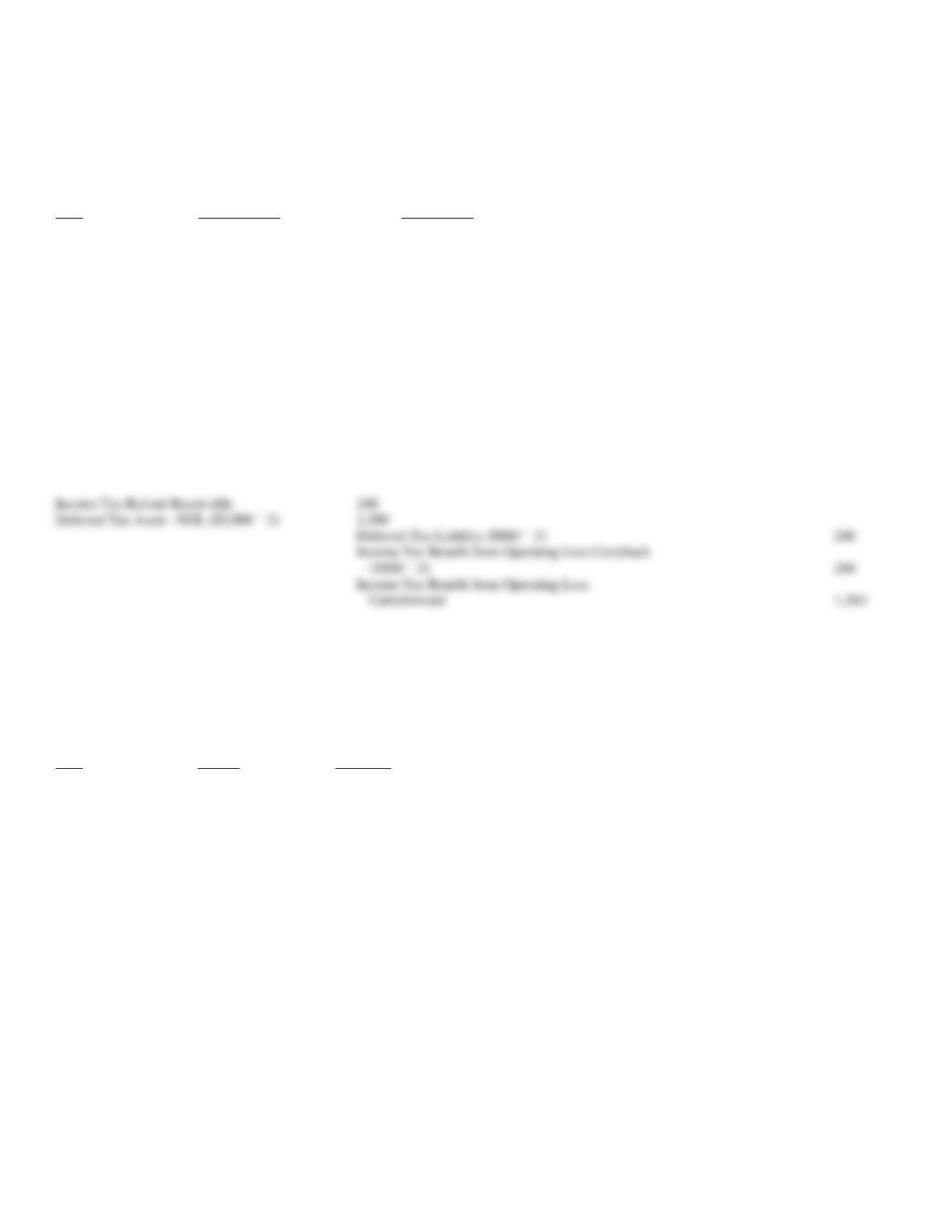
Income Tax Expense
33,300
Deferred Tax Asset ($36,000 ´ .35) + ($4,000 ´ .4)
14,200
Income Tax Expense
10,740
Deferred Tax Asset ($2,000 ´ .30)
Deferred Tax Liability ($2,800 ´ .30)
Income Tax Payable ($35,000 ´ .30)
75. Seguin, Inc. began operations on January 1, 2010. Depreciation temporary differences were the only
differences between pretax financial income (loss) and taxable income (loss) in any year. The income tax rate
was 30% in each year and no changes in income tax rates were expected. Pretax financial income (loss) and the
temporary differences due to depreciation were as follows:
Pretax Financial
Excess Tax
Year
Income (Loss)
Depreciation
2010
$1,000
$ 600
2011
3,000
2,600
2012
3,000
2,600
2013
(5,000)
800
2014
3,000
1,000
2015
6,000
800
Required:
Prepare the income tax journal entry for Seguin, Inc. for December 31, 2013, assuming no valuation allowance is required for Seguin’s deferred tax
assets.
76. The Amarillo Corporation reported the following income for both accounting and tax purposes:
Pretax
Enacted
Year
Income
Tax Rates
2010
$ 120,000
25%
2011
80,000
28%
2012
100,000
30%
2013
(360,000)
30%
Income Tax Refund Receivable
Deferred Tax Asset – NOL ($5,000 ´ .3)
1,500
Deferred Tax Liability ($800 ´ .3)
Income Tax Benefit from Operating Loss Carryback
($800 ´ .3)
Income Tax Benefit from Operating Loss
Carryforward
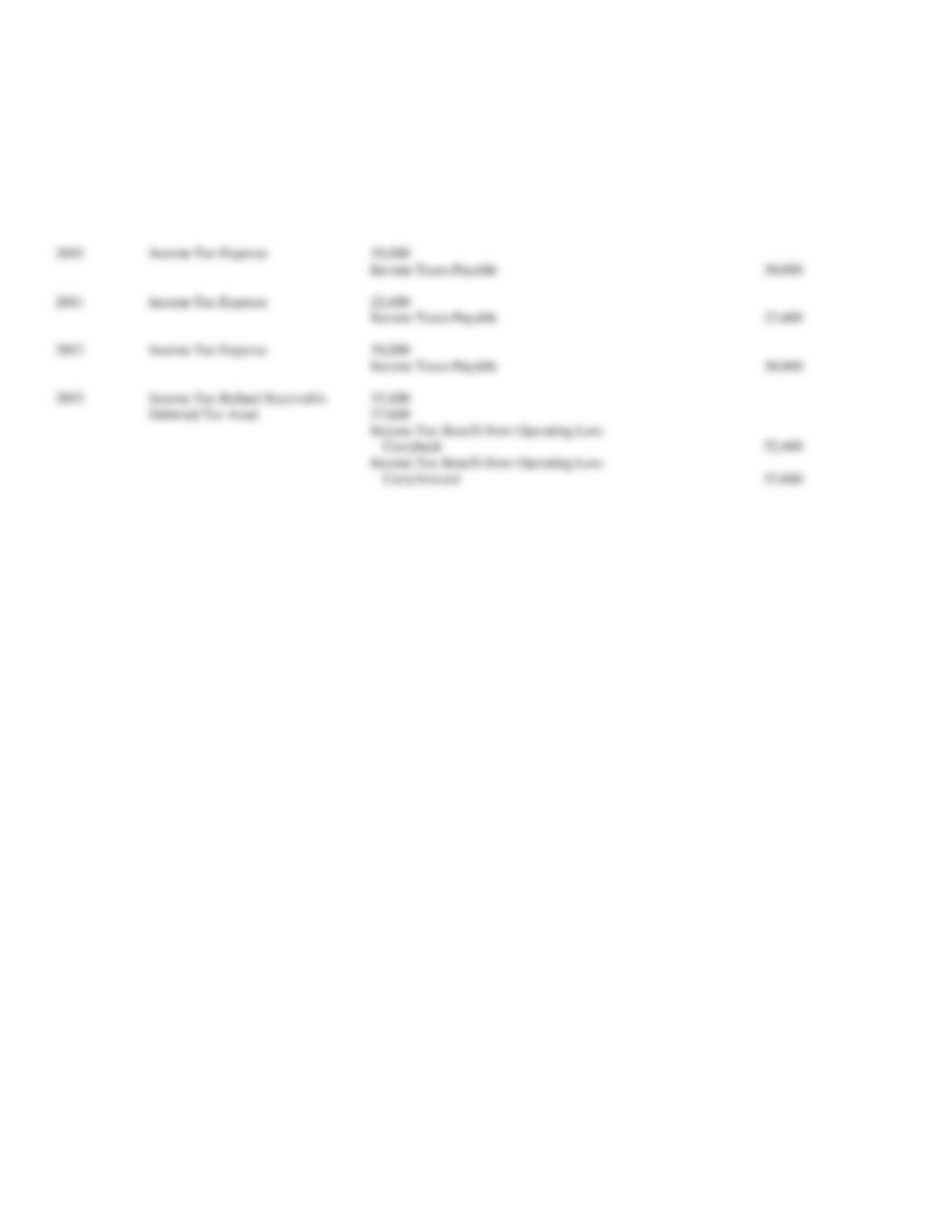
Amarillo Corporation uses the carryback provision for net operating losses when possible. The enacted tax rate for 2014 and future years is 32%.
Amarillo believes that sufficient verifiable positive evidence exists so that a valuation allowance is not necessary at the end of 2014.
Required:
Prepare the entries for income tax expense and related assets and liabilities for the Amarillo Corporation for the years 2010 through 2014.
77. At the end of its first year of operations on December 31, 2010, the Denton Company reported taxable
income of $30,000 and a pretax financial loss of $40,000. Differences between taxable income and pretax
financial income included estimated bad debt expense for which accounts were expected to be written off in
2011, $20,000, and warranty costs expensed for accounting purposes in excess of cash paid for warranty claims,
$50,000. The warranty costs are expected to be paid in 2011. The enacted tax rate for 2010 and 2011 is 30%.
Required:
a.
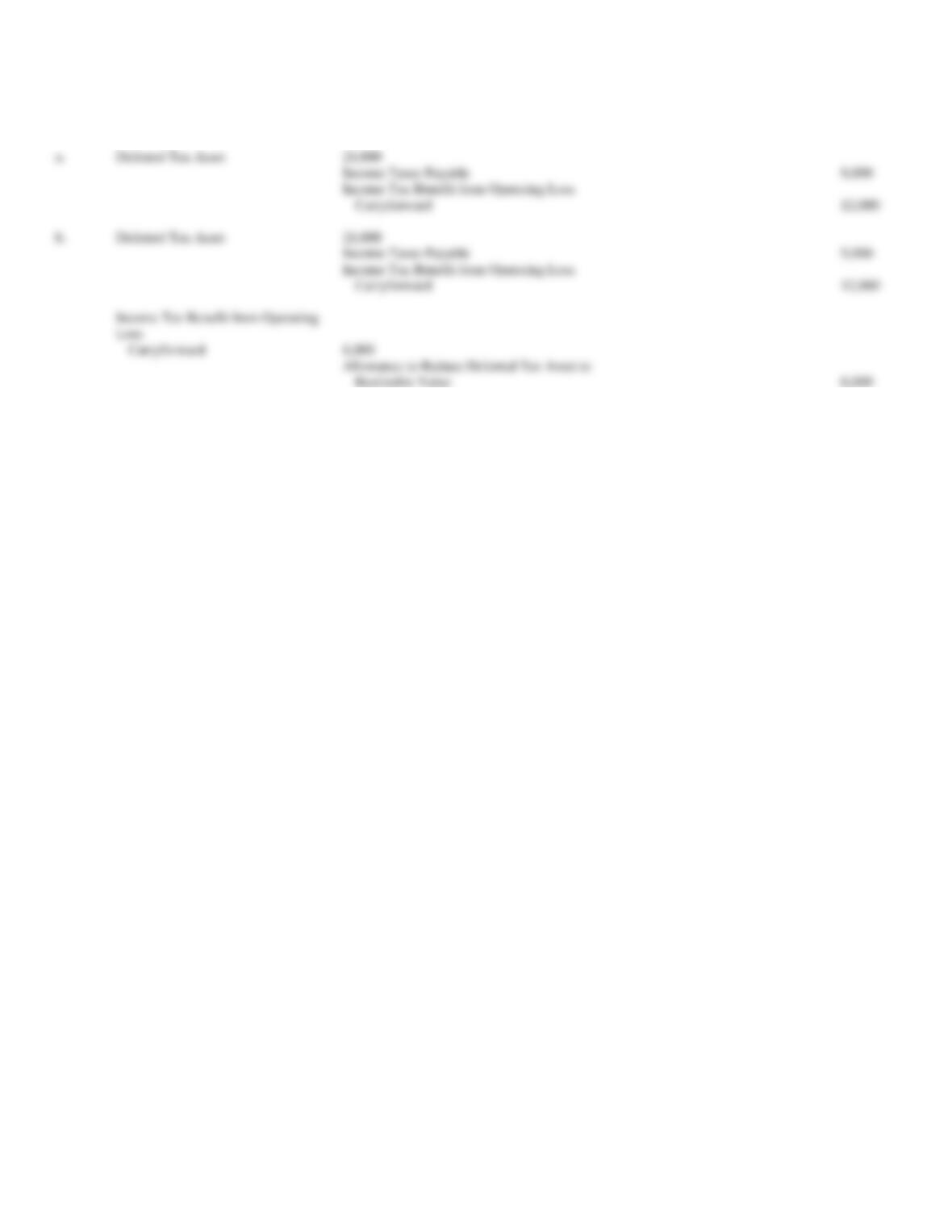
Prepare the income tax journal entry for the Denton Company on December 31, 2010, assuming that it is more likely than not that the
deferred tax asset will be realized.
b.
Prepare the income tax journal entry for the Denton Company on December 31, 2010, assuming that it is more likely than not that 40%
of the deferred tax asset from the warranty costs will not be realized.
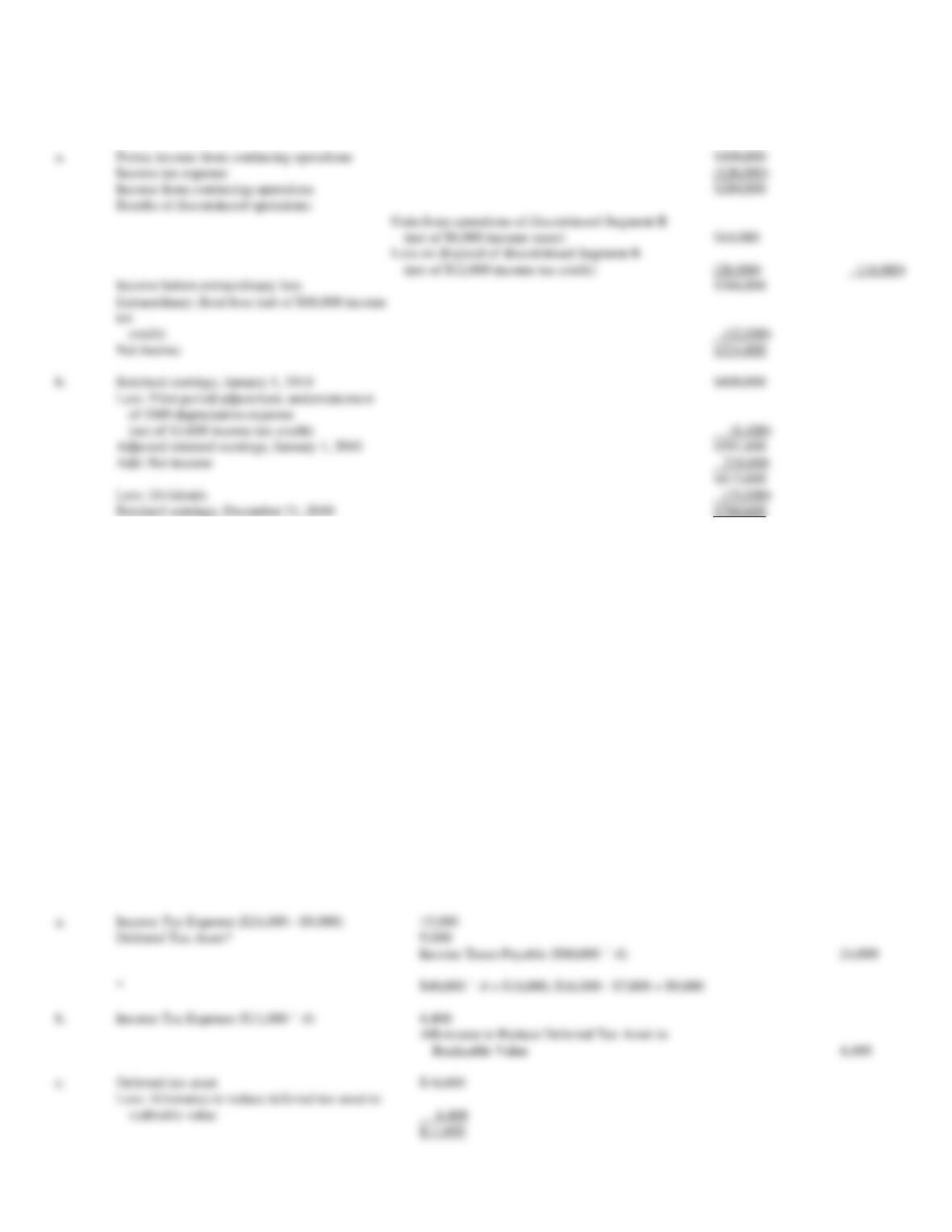
78. Corpus Christi Corporation reported the following pretax (and taxable) information for 2010:
Income from continuing operations
$400,000
Loss on disposal of Segment B
40,000
Extraordinary flood loss
60,000
Prior period adjustment-Depreciation was understated in 2009
12,000
Gain from operations of discontinued Segment B
20,000
Income tax rate
30%
Required:
a.
Prepare the lower portion of Corpus Christi’s 2010 income statement, beginning with pretax income for continuing operations. (Omit
the heading.)
b.
Prepare Corpus Christi’s 2010 statement of retained earnings, assuming that retained earnings at January 1, 2010, was $600,000 and the
company paid $35,000 of dividends in 2010. (Omit the heading.)
Deferred Tax Asset
21,000
Income Taxes Payable
Income Tax Benefit from Operating Loss
Carryforward
Deferred Tax Asset
21,000
Income Taxes Payable
Income Tax Benefit from Operating Loss
Carryforward
Income Tax Benefit from Operating
Loss
Carryforward
6,000
Allowance to Reduce Deferred Tax Asset to
Realizable Value
6,000
79. At the beginning of 2010, Temple Company had a deferred tax asset of $7,000 related to the warranty
liability on its balance sheet. At the end of 2010, the company estimates that its ending warranty liability is
$40,000. Taxable income is $60,000, and the tax rate is 40%.
Required:
a.
Prepare the journal entry to record income taxes for the year.
b.
Assume the company decides at the end of the year that it is “more likely than not” that $11,000 of the deductible temporary difference
will not be realized. Prepare the appropriate journal entry.
c.
Show how the deferred tax asset would be reported on the balance sheet for 2010.
a.
Income Tax Expense ($24,000 – $9,000)
15,000
Deferred Tax Asset*
9,000
Income Taxes Payable ($60,000 ´ .4)
*
$40,000 ´ .4 = $16,000; $16,000 – $7,000 = $9,000
Income Tax Expense ($11,000 ´ .4)
4,400
Allowance to Reduce Deferred Tax Asset to
Realizable Value
realizable value
4,400
a.
Pretax income from continuing operations
$400,000
Income tax expense
(120,000)
Income from continuing operations
$280,000
Results of discontinued operations:
Gain from operations of discontinued Segment B
(net of $6,000 income taxes)
$14,000
Loss on disposal of discontinued Segment B
(net of $12,000 income tax credit)
(28,000)
Income before extraordinary loss
$266,000
Extraordinary flood loss (net of $18,000 income
tax
credit)
(42,000)
Net income
$224,000
Retained earnings, January 1, 2010
$600,000
Less: Prior period adjustment, understatement
of 2009 depreciation expense
(net of $3,600 income tax credit)
(8,400)
Adjusted retained earnings, January 1, 2010
$591,600
Add: Net income
224,000
$815,600
Less: Dividends
(35,000)
Retained earnings, December 31, 2010
$780,600
80. Tyler, Inc. reports the following deferred tax items at the end of 2010:
Item
Account Balance
Classification
1
$24,000 (dr.)
Current asset
2
10,000 (cr.)
Noncurrent liability
3
14,000 (cr.)
Noncurrent liability
4
16,000 (cr.)
Current liability
5
8,000 (dr.)
Noncurrent asset
6
2,000 (cr.)
Current liability
Required:
Show how the deferred tax items will be reported on the December 31, 2010 balance sheet.
81. FASB Statement No. 109 addressed both interperiod and intraperiod tax allocation issues. Discuss both
interperiod and intraperiod tax allocation methods.
82. FASB Statement No. 109 allows the recognition of a deferred tax asset, subject to an asset impairment test.
Discuss what criteria a company should employ to determine whether a deferred tax asset is considered
impaired.
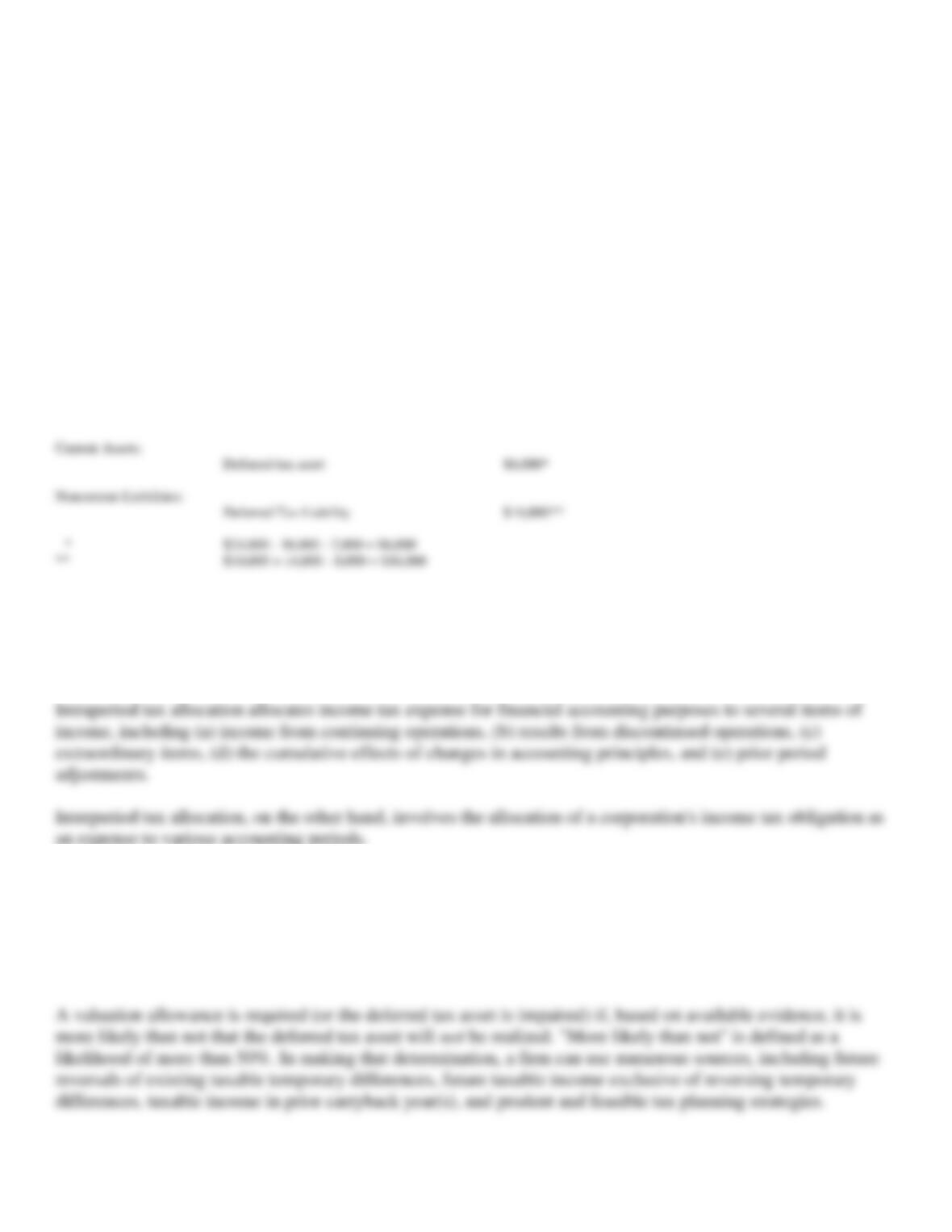
Current Assets:
Deferred tax asset
Noncurrent Liabilities:
Deferred Tax Liability
*
$24,000 – 16,000 – 2,000 = $6,000
$10,000 + 14,000 – 8,000 = $16,000
83. FASB Statement No. 109 discussed deferred tax asset measurement in the context of the FASB Conceptual
Framework.
Required:
Identify the three essential characteristics of an asset and explain how deferred tax assets meet these
characteristics.
84. Deferred tax liabilities and deferred tax assets must be reported on the balance sheet.
Required:
Explain the process of classifying and reporting deferred tax liabilities and deferred tax assets.
85. Briefly describe the four major differences between IFRS and GAAP in the measurement procedures used
in accounting for deferred income taxes.