81
Listed below are five terms followed by a list of phrases that describe or characterize each of the
terms. Match each phrase with the correct term.
A) Assumption used for options, rights, and warrants.
B) Dual presentation of EPS does not apply.
C) Applies to both convertible debt and convertible equity securities.
D) Approximation of EPS assuming potential common shares became common stock.
E) Add after-tax interest to EPS numerator.
143) Convertible bonds
144) Diluted EPS
145) Simple capital structure
146) Treasury stock method
147) If-converted method
83
Listed below are five terms followed by a list of phrases that describe or characterize each of the
terms. Match each phrase with the correct term.
A) Factored into EPS if the stock is cumulative.
B) Handled retroactively in computing current and prior years’ EPS.
C) Omitted from the EPS numerator under the “if converted” method.
D) Expresses the market value of a stock as a multiple of EPS.
E) Included in diluted EPS when performance criterion is met.
148) Stock dividends and splits
149) Contingently issuable
150) Undeclared preferred dividends
84
151) Convertible preferred stock dividends
152) Price-earnings ratio
85
Listed below are five terms followed by a list of phrases that describe or characterize each of the
terms. Match each phrase with the correct term.
A) Decrease in the EPS numerator.
B) Time-weighted increase in the basic EPS denominator.
C) Does not affect and is not affected by EPS calculations.
D) Potentially dilutive debt.
E) Time-weighted decrease in the basic EPS denominator.
153) Antidilutive security
154) Issuance of new shares
155) Reacquired shares
86
156) Preferred dividends
157) Convertible bonds
87
Listed below are five terms followed by a list of phrases that describe or characterize each of the
terms. Match each phrase with the most correct term.
A) Expensed as compensation in the period earned
B) Benefit period over which stock option compensation expense is spread.
C) Paid-in capital effectively renamed under the fair value approach
D) Shares given for achieving financial goals
E) A right to buy shares of stock in the future.
158) Stock option
159) Performance condition plans
160) Vesting period
161) Bonuses
162) Expired options
88
Listed below are five terms followed by a list of phrases that describe or characterize each of the
terms. Match each phrase with the most correct term.
A) Require(s) compensation expense regardless of condition satisfaction.
B) Date on or after which employees can buy stock with options.
C) An important factor in option pricing models.
D) Date on which options are awarded.
E) The amount paid to convert the option into stock.
163) Option exercise price
164) Option exercise date
165) Grant date
166) Stock volatility
167) Market condition plans
89
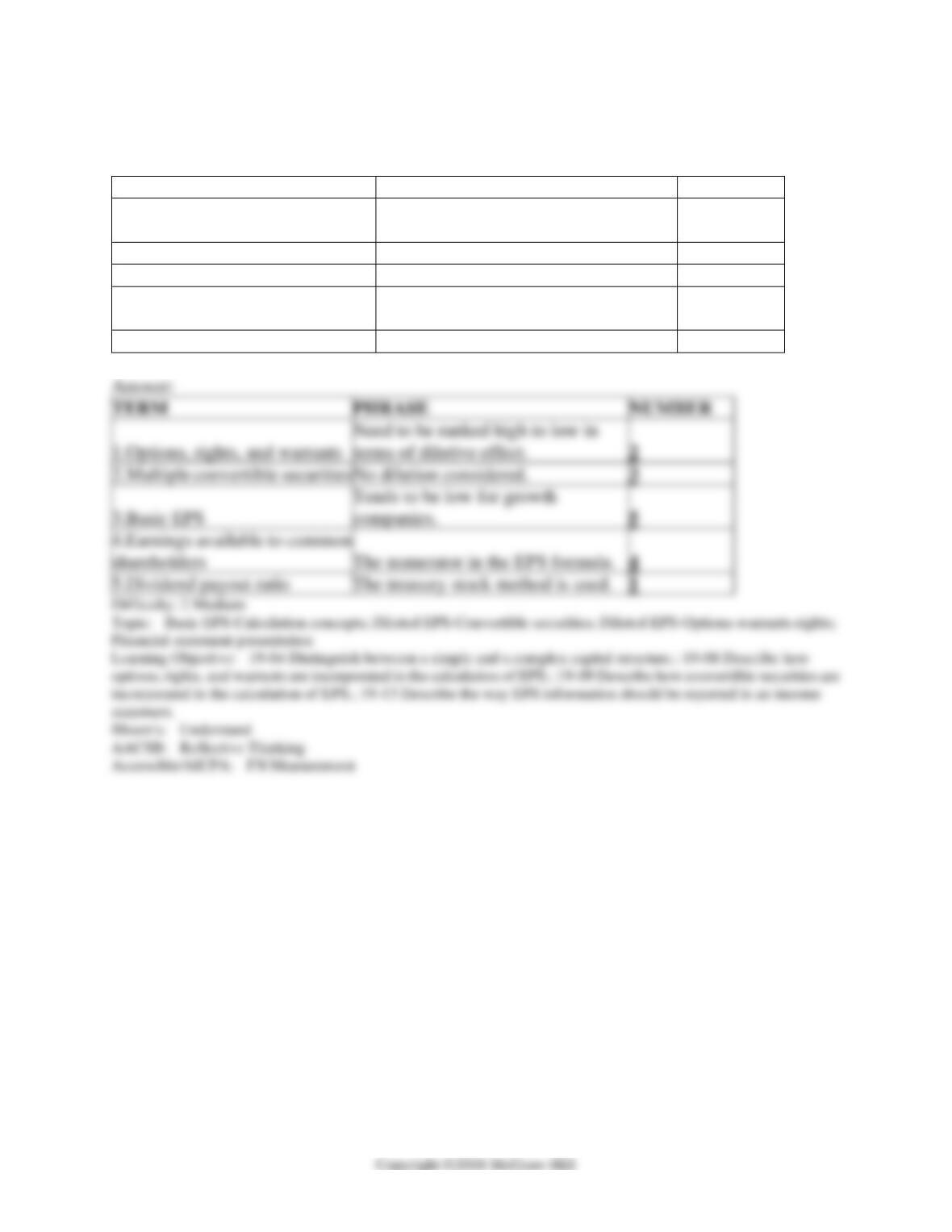
168) Listed below are five terms followed by a list of phrases that describe or characterize each
of the terms. Match each phrase with the number for the correct term.
TERM
PHRASE
NUMBER
1.Options, rights, and warrants
Need to be ranked high to low in terms
of dilutive effect.
2.Multiple convertible securities
No dilution considered.
3.Basic EPS
Tends to be low for growth companies.
4.Earnings available to common
shareholders
The numerator in the EPS formula.
5.Dividend payout ratio
The treasury stock method is used.
TERM
PHRASE
NUMBER
1.Options, rights, and warrants
Need to be ranked high to low in
terms of dilutive effect.
2
2.Multiple convertible securities
No dilution considered.
3
3.Basic EPS
Tends to be low for growth
companies.
5
4.Earnings available to common
shareholders
The numerator in the EPS formula.
4
5.Dividend payout ratio
The treasury stock method is used.
1
90
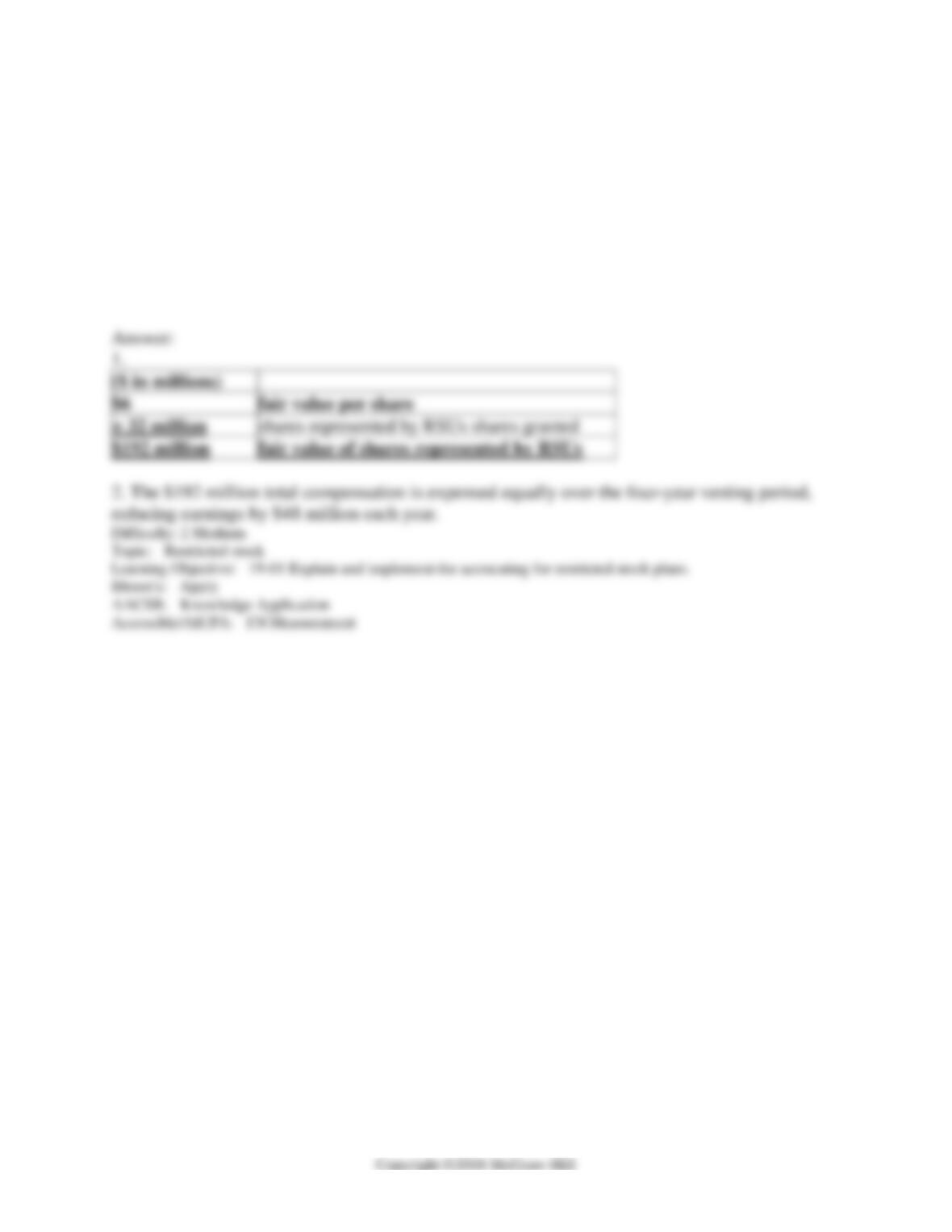
169) EG Corporation granted restricted stock units (RSUs) representing 32 million of its $1 par
common shares to executives, subject to forfeiture if employment is terminated within four
years. After the recipients of the RSUs satisfy the vesting requirement, the company will
distribute the shares. The common shares had a market price of $6 per share on the grant date.
Required:
(1.) Ignoring taxes, determine the total compensation cost pertaining to the restricted stock units.
(2.) What is the effect on earnings in the year after the shares are granted to executives?

91
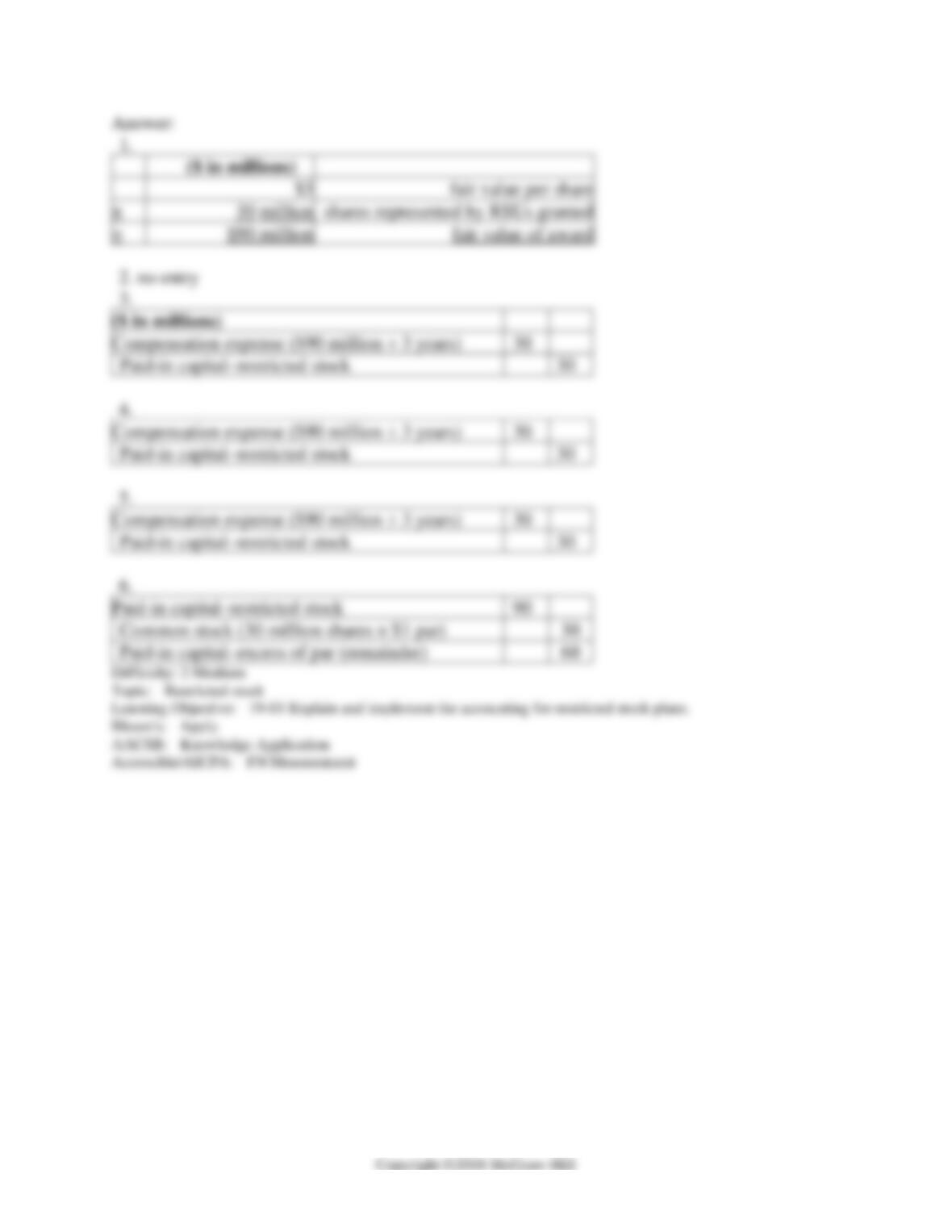
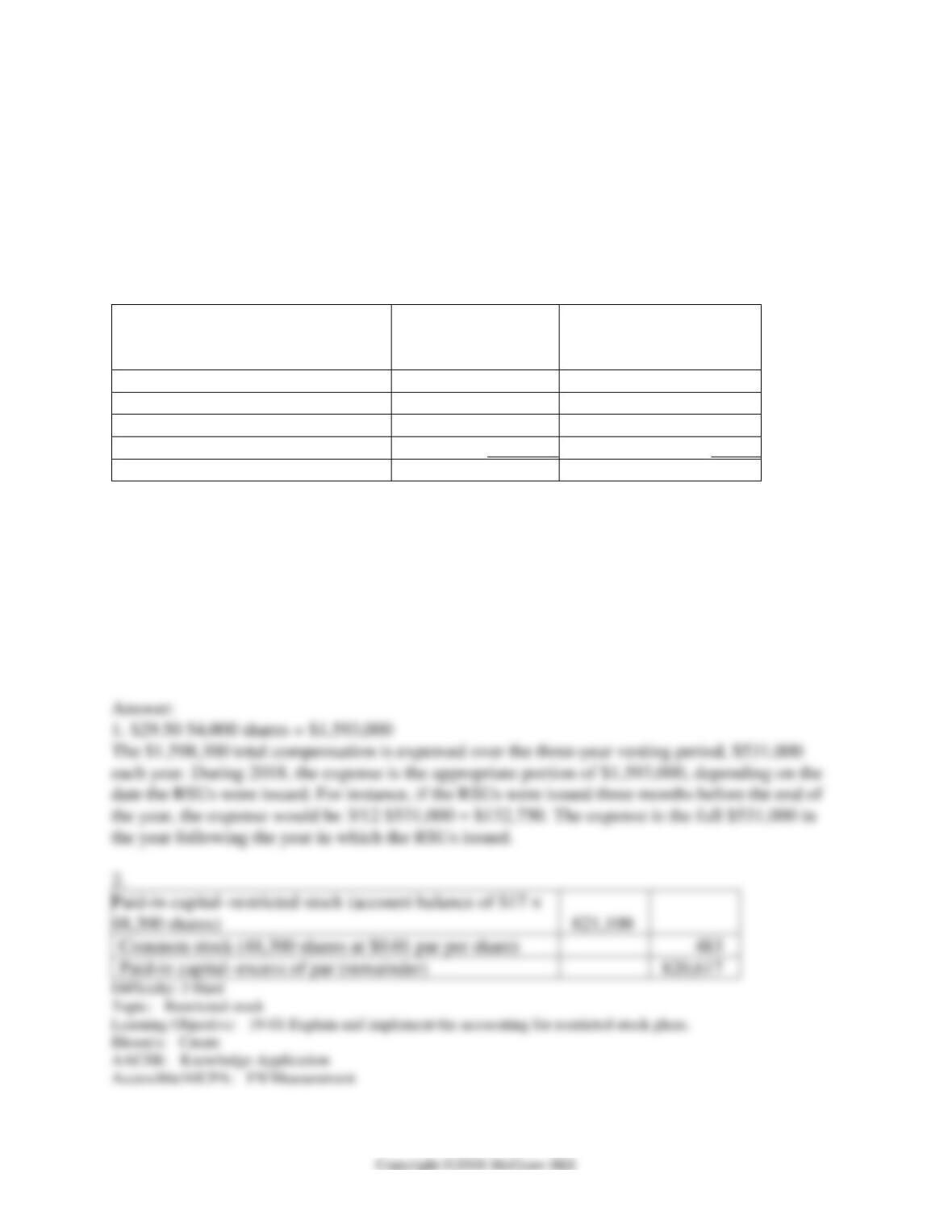
170) On January 1, 2018, Cobbler Corporation awarded restricted stock units (RSUs)
representing 30 million of its $1 par common shares to key personnel, subject to forfeiture if
employment is terminated within three years. After the recipients of the RSUs satisfy the vesting
requirement, the company will distribute the shares. On the grant date, the shares had a market
price of $3 per share.
Required:
(1.) Determine the total compensation cost pertaining to the RSUs.
(2.) Prepare the appropriate journal entry to record the award of RSUs on January 1, 2018.
(3.) Prepare the appropriate journal entry to record compensation expense on December 31,
2018.
(4.) Prepare the appropriate journal entry to record compensation expense on December 31,
2019.
(5.) Prepare the appropriate journal entry to record compensation expense on December 31,
2020.
(6.) Prepare the appropriate journal entry to record the lifting of restrictions on the RSUs and
issuing shares at December 31, 2020.
92
93
171) Tweet Inc. included the following disclosure note in an annual report:
Share-Based Compensation (in part)
compensation expense related to these grants is based on the grant date fair value of the RSUs
and is recognized on a straight-line basis over the applicable three-year vesting period.
The following table summarizes the activities for our unvested RSUs for the year ended
December 31, 2018:
Number of
Shares
Weighted Average
Grant Date Fair Value
Unvested at December 31, 2017
110,000
$21.40
Granted
54,000
29.50
Vested
(48,300)
17.00
Forfeited
(14,800)
25.30
Unvested at December 31, 2018
100,900
$27.30
Required:
(1.) Ignoring taxes, determine compensation expense Tweet reported in the year ended
December 31, 2019, for the restricted stock units granted during the year ended December 31,
2018.
(2.) Based on the information provided in the disclosure note, prepare the journal entry that
summarizes the vesting of RSUs during the year ended December 31, 2018. (Tweet’s common
shares have a par amount per share of $0.01.)
48,300 shares)
Common stock (48,300 shares at $0.01 par per share)
Paid-in capital–excess of par (remainder)

94
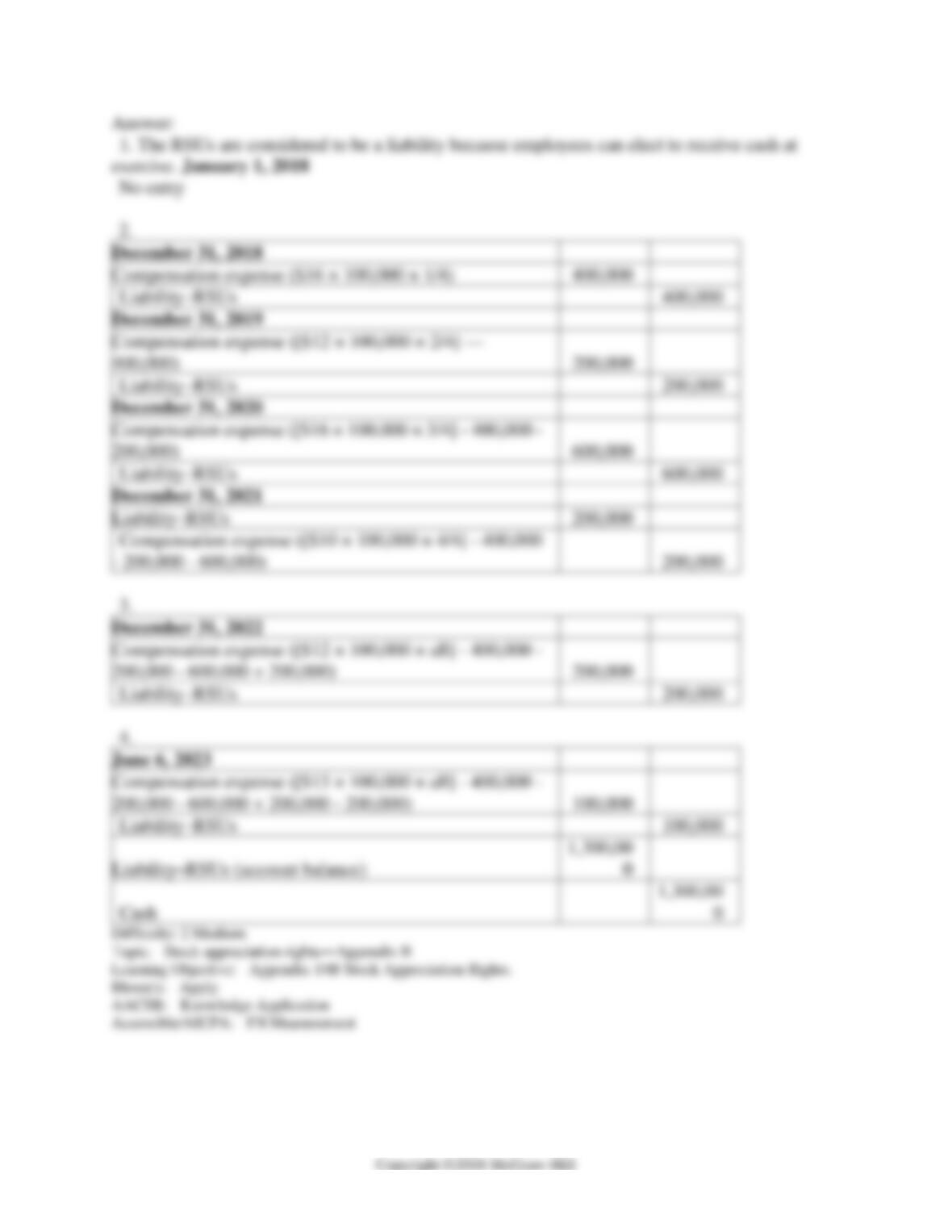
172) As part of its stock-based compensation package, on January 1, 2018, Weldon Well
Supplies granted restricted stock units (RSUs) representing 100,000 $1 par common shares. At
exercise, holders of the RSUs are entitled to receive cash or stock equal in value to the market
price of those shares at exercise. The RSUs cannot be exercised until the end of 2021 (vesting
date) and expire at the end of 2023. The $1 par common shares have a market price of $6 per
share on the grant date. The fair value at December 31, 2018, 2019, 2020, 2021, and 2022, is
$16, $12, $16, $10, and $12, respectively. All recipients are expected to remain employed
through the vesting date.
Required:
(1.) Prepare the appropriate journal entry to record the award of RSUs on January 1, 2018.
(2.) Prepare the appropriate journal entries pertaining to the RSUs on December 31,
2018-December 31, 2021.
(3.) The RSUs remain unexercised on December 31, 2022. Prepare the appropriate journal entry
on that date.
(4.) The RSUs are exercised on June 6, 2023, when the share price is $13, and executives choose
to receive cash. Prepare the appropriate journal entry(s) on that date.
95
96
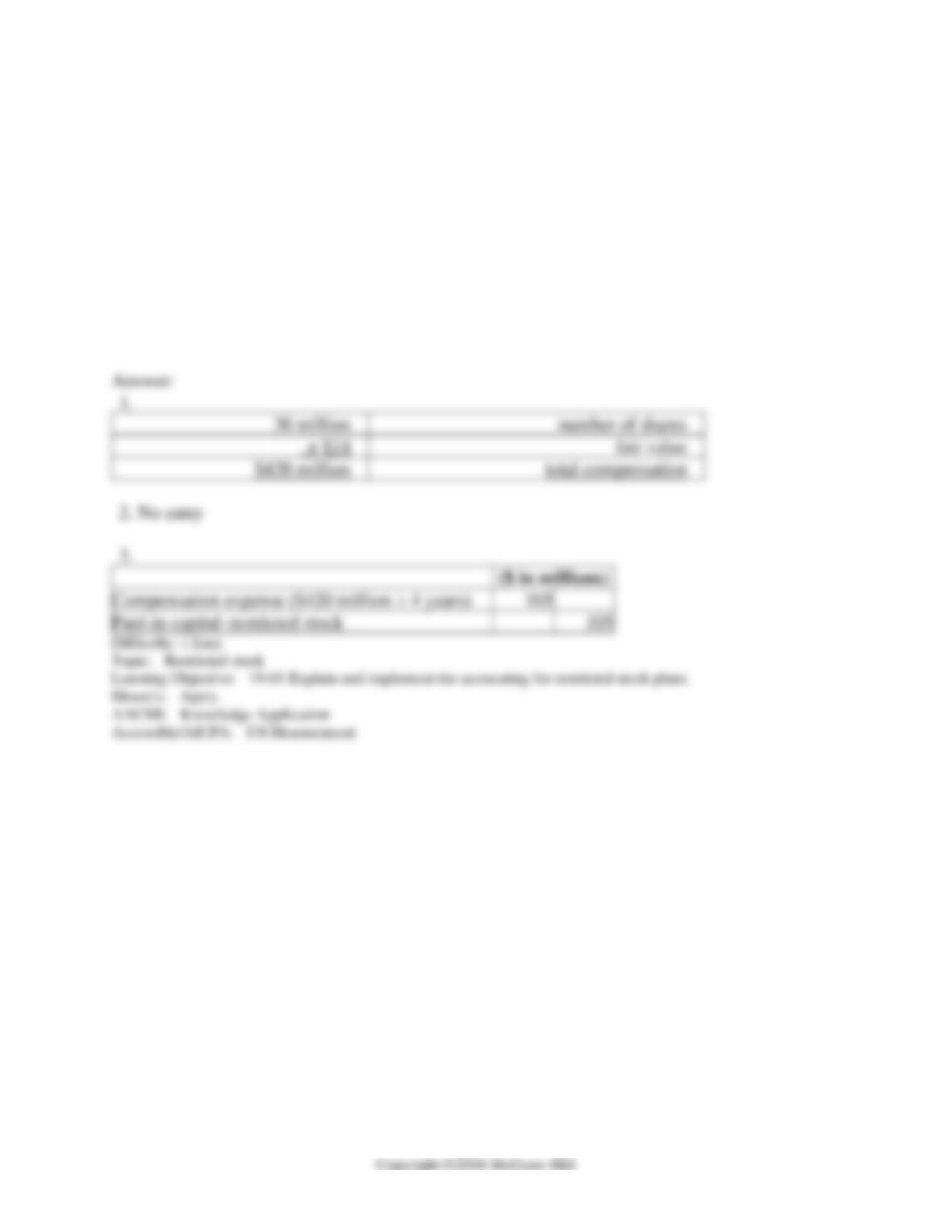
173) The Peach Corporation provides restricted stock to certain executives. Under the plan, the
company granted 30 million shares on January 1, 2018, which vest in four years. The fair value
of the shares is $14. No forfeitures are anticipated. Ignore taxes.
Required:
1. Determine the total compensation cost pertaining to the restricted stock.
2. Prepare the appropriate journal entry (if any) to record the award of restricted stock on
January 1, 2018.
3. Prepare the appropriate journal entry (if any) to record compensation expense on December
31, 2018.
97
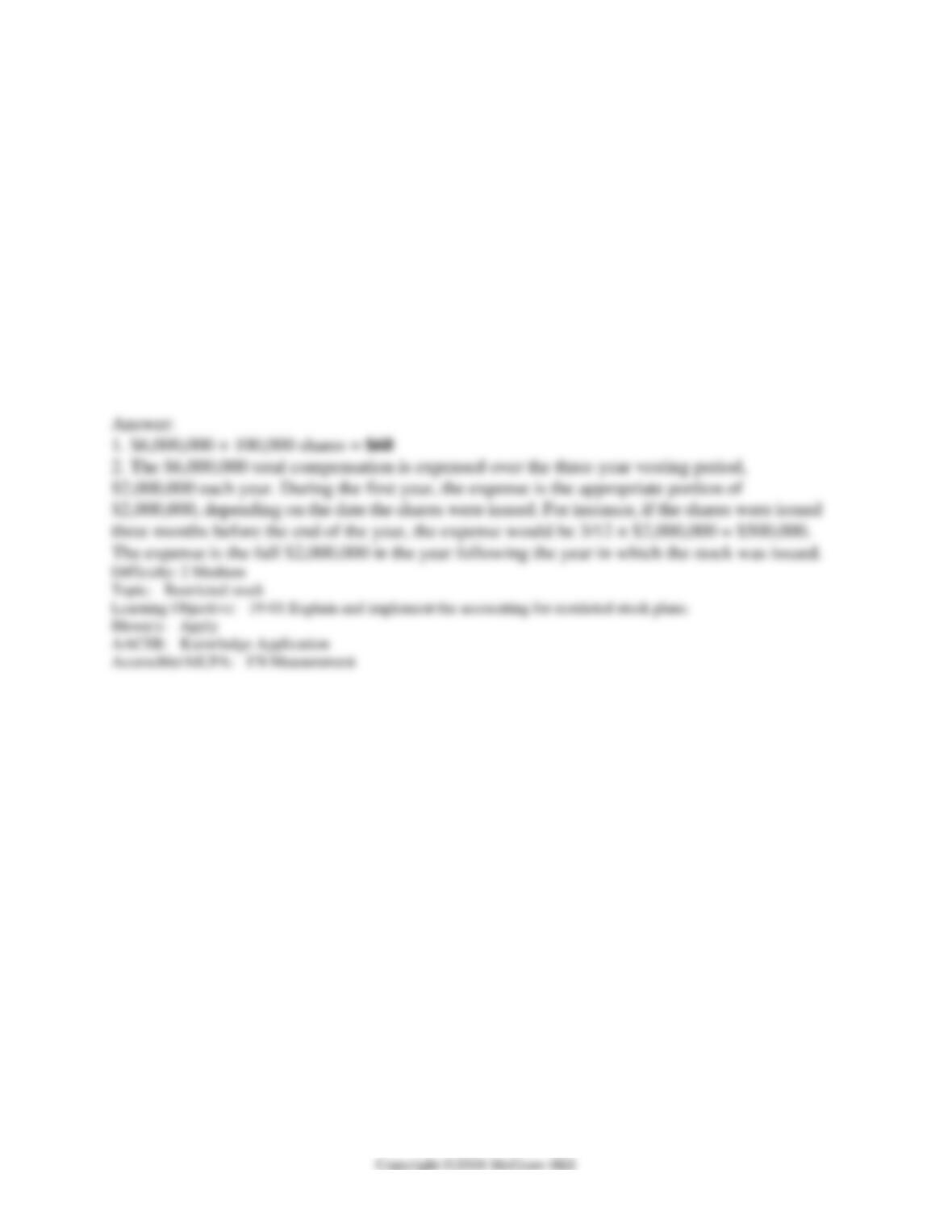
174) Jmart Corporation included the following disclosure note in a recent annual report:
RESTRICTED STOCK (in part)
we issued 100,000 shares of restricted stock at market prices ranging from $46.00 to $60.
The restricted stock generally vests over three years, during which time we will recognize total
compensation expense of approximately $6 million.
Required:
1. Based on the information provided in the disclosure note, determine the weighted average
market price of the restricted stock issued.
2. How much compensation expense did Jmart report for the year following the year in which
the restricted stock was issued?
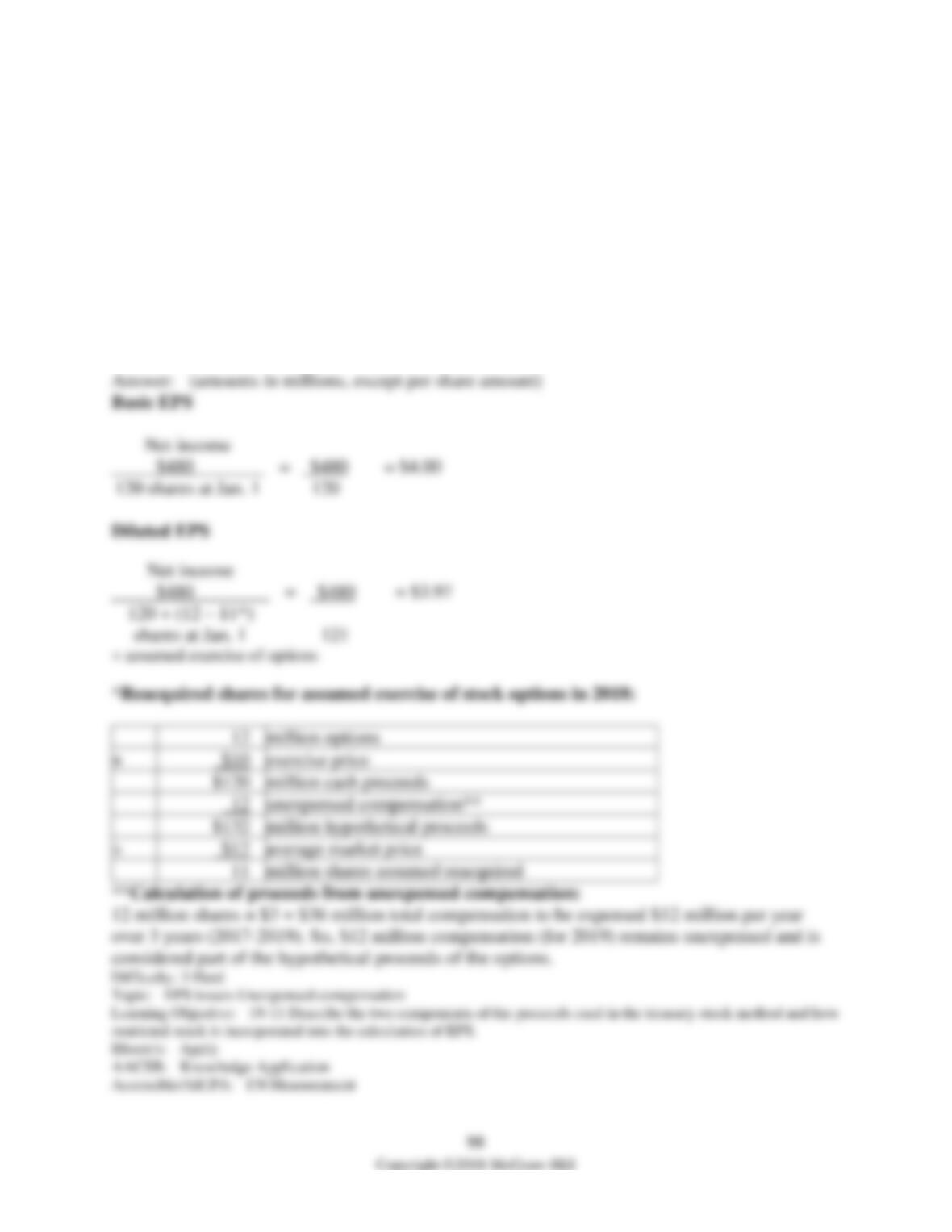
175) DJ Co. is a calendar-year firm with 120 million common shares outstanding throughout
2018. As part of its executive compensation plan, at January 1, 2017, the company had issued 12
million executive stock options permitting executives to buy 12 million shares of stock for $10
each within the next eight years, but not prior to January 1, 2020. The fair value of the options
was estimated on the grant date to be $3 per option. The stock options qualify for tax purposes as
an incentive plan. The company’s net income was $480 million in 2018. Its income tax rate is
40%. The average market price of the stock during 2018 was $12 per share.
Required:
Determine basic and diluted earnings per share (rounded to two decimal places) for DJ in 2018.

99
176) JD Co. is a calendar-year firm with 600 million common shares outstanding throughout
2018 and 2019. As part of its executive compensation plan, at January 1, 2017, the company had
issued 60 million executive stock options permitting executives to buy 60 million shares of stock
for $10 per share within the next eight years, but not prior to January 1, 2020. The fair value of
the options was estimated on the grant date to be $3 per option.
In 2018, JD began granting employees stock awards rather than stock options as part of its
equity compensation plans and granted 30 million restricted common shares to senior executives
at January 1, 2018. The shares vest four years later. The fair value of the stock was $12 per share
on the grant date. The average market price of the common shares was $12 and $15 during 2018
and 2019, respectively.
The stock options qualify for tax purposes as an incentive plan. The restricted stock does not.
The company’s income before tax was $400 million and $500 million, and the net income was
$240 million and $300 million, in 2018 and 2019, respectively.
Required:
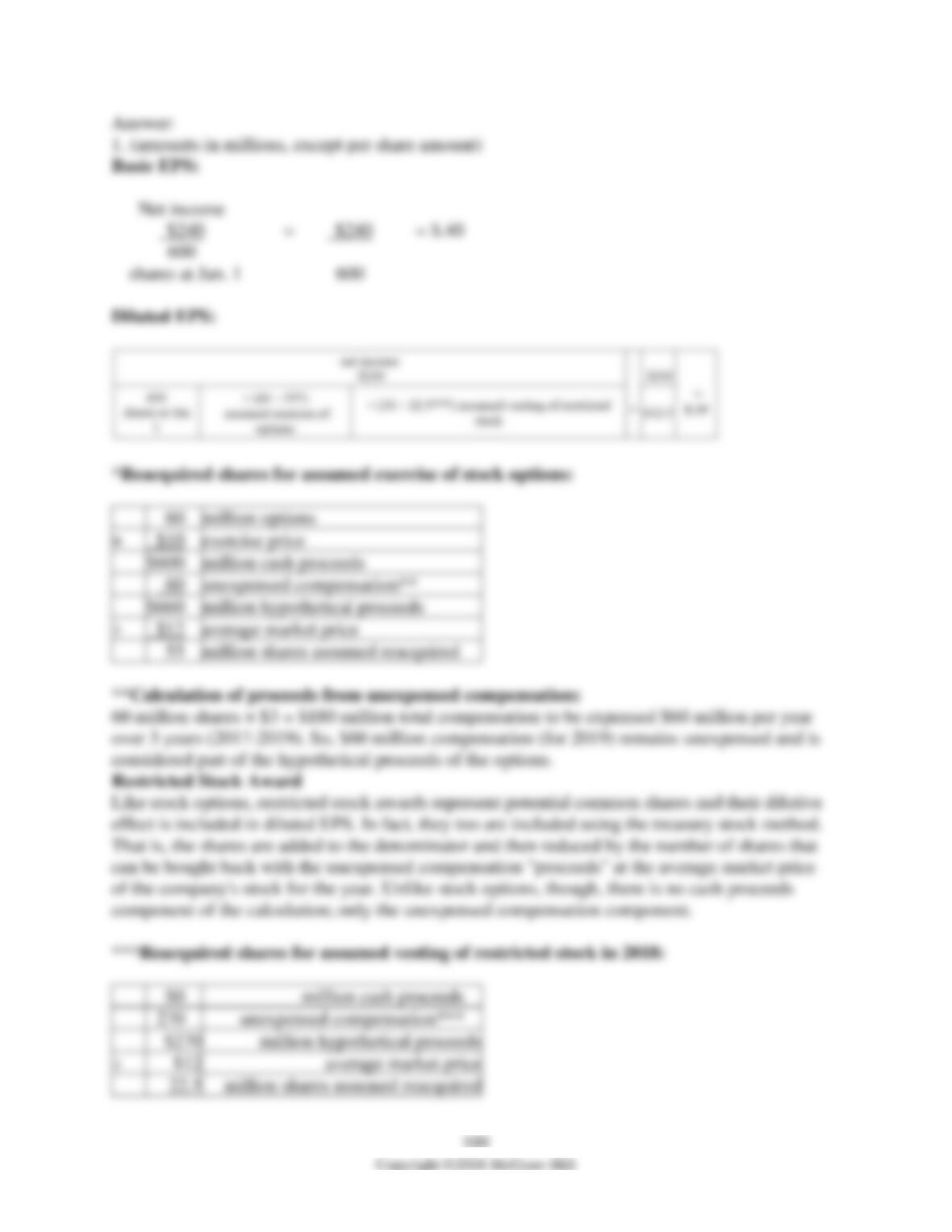
1. Determine basic and diluted earnings per share (rounded to 2 decimal places) for JD in 2018.
2. Determine basic and diluted earnings per share for JD (rounded to 2 decimal places) in 2019.