
Name:
Class:
Date:
chapter 19
Indicate whether the statement is true or false.
1. A law firm would use a job order cost system to accumulate all of the costs associated with a particular client
engagement, such as lawyer time, copying charges, filing fees, and overhead.
a.
True
b.
False
2. If factory overhead applied exceeds the actual factory overhead costs, the factory overhead account will have a credit
balance.
a.
True
b.
False
3. The inventory accounts generally maintained by a manufacturing firm are only finished goods and materials.
a.
True
b.
False
4. Factory overhead is applied to production using a predetermined overhead rate.
a.
True
b.
False
5. The materials requisition serves as the source document for debiting the accounts in the materials ledger.
a.
True
b.
False
6. Job order cost systems can be used to compare unit costs of similar jobs to determine if costs are staying within
expected ranges.
a.
True
b.
False
7. Nonmanufacturing costs are generally classified into two categories: selling and administrative.
a.
True
b.
False
8. A job order cost accounting system provides for a separate record of the cost of each particular quantity of product that
passes through the factory.
a.
True
b.
False
9. In the job order cost system, the finished goods account is the controlling account for the factory overhead ledger.
a.
True
b.
False
10. Information about costs developed through a job order cost system cannot be used to evaluate an organization’s cost
performance.
a.
True
b.
False

Name:
Class:
Date:
chapter 19
11. A process cost accounting system provides product costs for each of the departments or processes within the factory.
a.
True
b.
False
12. In a factory with several processing departments, a single factory overhead rate may not provide accurate product
costs and effective cost control.
a.
True
b.
False
13. Cost accounting systems measure, record, and report product costs.
a.
True
b.
False
14. Each account in the work in process subsidiary ledger in a job order cost system is called a job cost sheet.
a.
True
b.
False
15. A process cost accounting system provides for a separate record of the cost of each particular quantity of product that
passes through the factory.
a.
True
b.
False
16. If the underapplied factory overhead amount is immaterial, it is transferred to Cost of Goods Sold at the end of the
fiscal year.
a.
True
b.
False
17. Generally accepted accounting principles require companies to use only one factory overhead rate for product costing.
a.
True
b.
False
18. Perpetual inventory controlling accounts and subsidiary ledgers are maintained for materials, work in process, and
finished goods in job order cost systems.
a.
True
b.
False
19. A process cost accounting system is best used by manufacturers of like units of product that are not distinguishable
from each other during a continuous production process.
a.
True
b.
False
20. On the balance sheet for a manufacturing business, the cost of direct materials, direct labor, and factory overhead,
which have entered into the manufacturing process but are associated with products that have not been finished, are
reported as direct materials inventory.
a.
True
b.
False

Name:
Class:
Date:
chapter 19
21. A job order cost system would be appropriate for a crude oil refining business.
a.
True
b.
False
22. Job order cost accounting systems may be used to evaluate a company’s efficiency.
a.
True
b.
False
23. The job order cost system may be used by service firms to determine revenues, expenses, and ultimately profit.
a.
True
b.
False
24. In a job order cost accounting system for a service business, materials costs are normally included as part of overhead.
a.
True
b.
False
25. Interim financial statements for a manufacturing business would report overapplied factory overhead as a deferred
item on the balance sheet.
a.
True
b.
False
26. Job cost sheets can be used to analyze the possible reasons for increased materials costs for a type of job.
a.
True
b.
False
27. The debit to Factory Overhead for the cost of indirect materials is obtained from the summary of the materials
requisitions.
a.
True
b.
False
28. The document that serves as the basis for recording direct labor on a job cost sheet is the clock card.
a.
True
b.
False
29. The document that serves as the basis for recording direct labor on a job cost sheet is the time ticket.
a.
True
b.
False
30. When goods are sold, their costs are transferred from Work in Process to Finished Goods.
a.
True
b.
False
31. The job order cost and process cost systems are the same in how they accumulate and record costs.
a.
True
b.
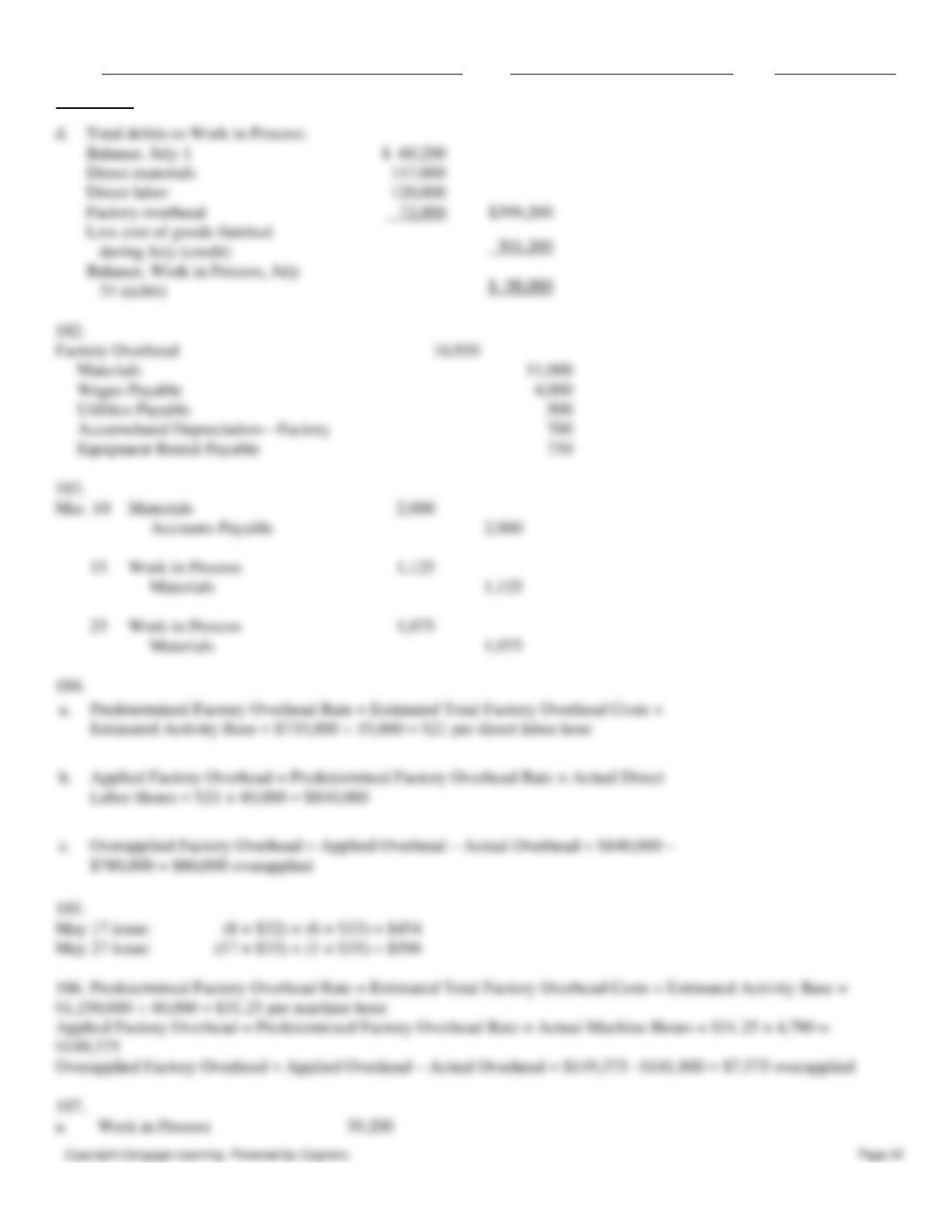
False

Name:
Class:
Date:
chapter 19
32. As product costs are incurred in the manufacturing process, they are accounted for as assets and reported on the
balance sheet as inventory.
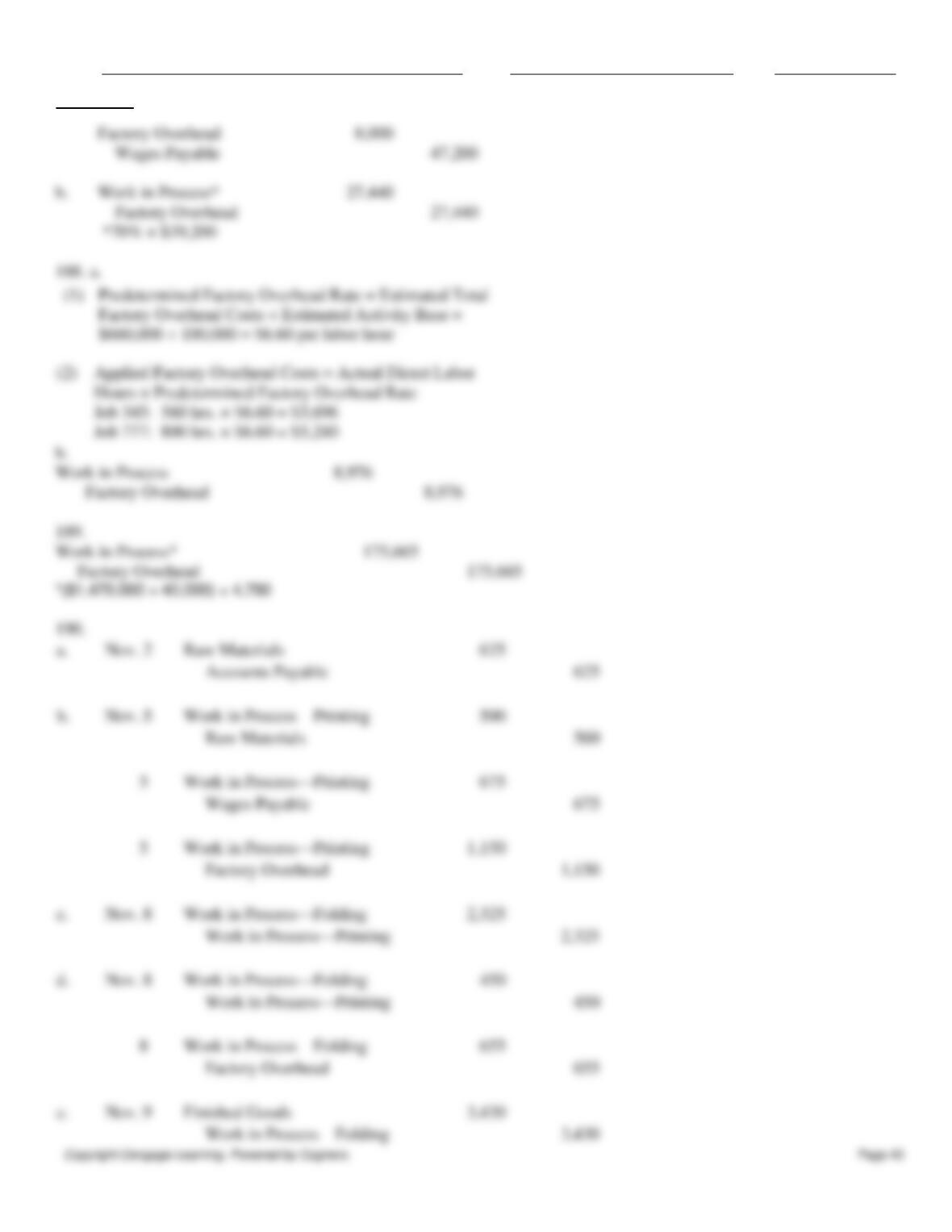
a.
True
b.
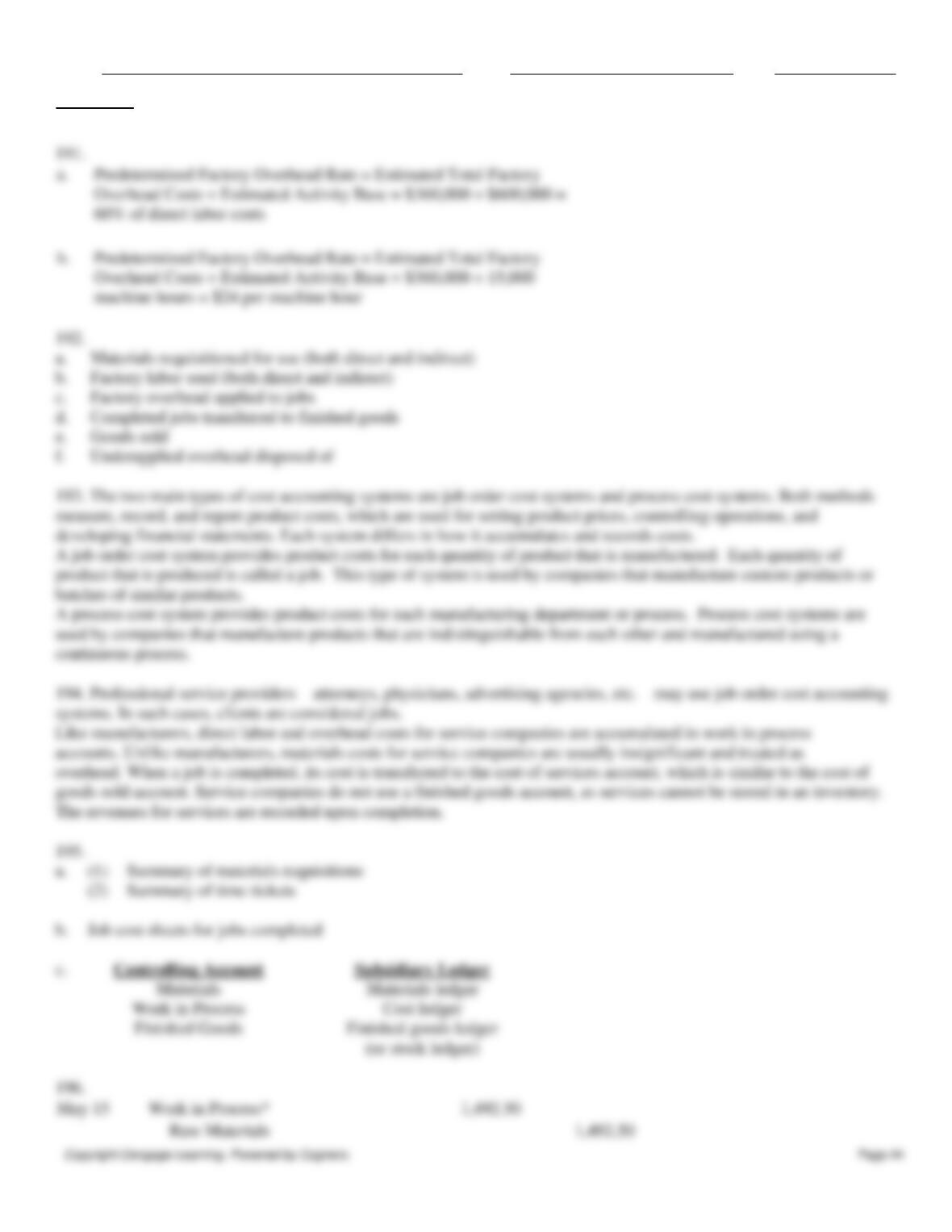
False
33. Activity-based costing is a method of accumulating and allocating costs by department.
a.
True
b.
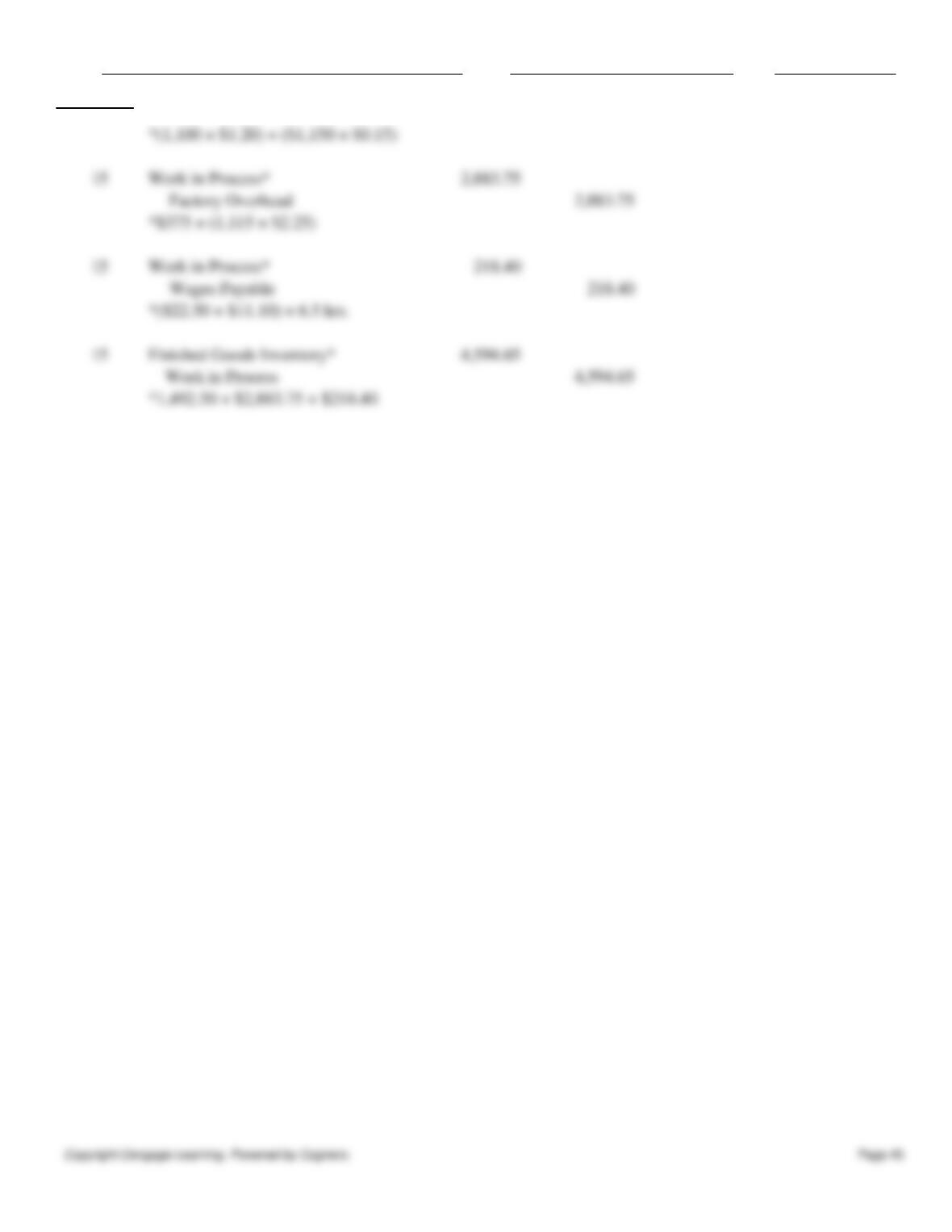
False
34. If factory overhead applied exceeds the actual costs, overhead is said to be underapplied.
a.
True
b.
False
35. The job order cost system is not used by service organizations.
a.
True
b.
False
36. The direct labor and overhead costs of providing services to clients are accumulated in a work in process account.
a.
True
b.
False
37. The current year’s advertising costs are normally considered period costs.
a.
True
b.
False
38. Depreciation expense on factory equipment is part of factory overhead cost.
a.
True
b.
False
39. Using the job order cost system, service organizations are able to bill customers on a weekly or monthly basis, even
when the job has not been completed.
a.
True
b.
False
40. The process cost system is appropriate where few products are manufactured and each product is made to customers’
specifications.
a.
True
b.
False
41. Job order cost accounting systems can be used only for companies that manufacture a product.
a.
True
b.
False
42. A manufacturing business reports just two types of inventory on its balance sheet: work in process inventory and
finished goods inventory.
a.
True

Name:
Class:
Date:
chapter 19
b.
False
43. Materials are transferred from the storeroom to the factory in response to materials requisitions.
a.
True
b.
False
44. Direct labor cost is an example of a period cost.
a.
True
b.
False
45. Job order cost accounting systems may be used for evaluating and controlling costs in a service business.
a.
True
b.
False
46. The storeroom releases materials for use in manufacturing when a receiving report is received.
a.
True
b.
False
47. A service organization will not use job order costing because it has no direct materials.
a.
True
b.
False
48. Period costs are costs that are incurred for the production requirements of a certain period.
a.
True
b.
False
Indicate the answer choice that best completes the statement or answers the question.
49. For a manufacturing business, products that are in the process of being manufactured are referred to as
a.
supplies inventory
b.
work in process inventory
c.
finished goods inventory
d.
materials inventory
50. If factory overhead is applied based on direct labor hours, the amount of overhead to be applied is
a.
$180,000
b.
$171,580
c.
$172,500
d.
$184,000
51. Recording jobs completed would include a credit to
a.
Factory Overhead
b.
Finished Goods
c.
Work in Process
d.
Cost of Goods Sold

Name:
Class:
Date:
chapter 19
52. The finished goods account is the controlling account for the
a.
cost ledger
b.
materials ledger
c.
work in process ledger
d.
stock ledger
Use the information provided for Adams Company to answer the questions that follow.
Adams Company is a manufacturing company that has worked on several production jobs during the first quarter of the
year. The balances for the jobs for the quarter are as follows:
Job. No.
Balance
356
$ 450
357
1,235
358
378
359
689
360
456
Jobs 356, 357, 358, and 359 were completed. Jobs 356 and 357 were sold at a profit of $500 on each job.
53. What is the ending balance of Finished Goods for Adams Company at the end of the first quarter?
a.
$456
b.
$1,067
c.
$1,685
d.
$2,752
54. In a job order cost system, when goods that have been ordered are received, the quantity received and the condition of
the goods are entered on a
a.
purchase order
b.
sales invoice
c.
receiving report
d.
purchase requisition
55. The journal entries for the cost and sale of a finished good on account would
a.
debit Cost of Goods Sold and credit Finished Goods
b.
debit Cost of Goods Sold, credit Finished Goods, debit Accounts Receivable, and credit Sales
c.
debit Sales Expense, credit Finished Goods, credit Cash, and credit Accounts Receivable
d.
debit Work in Process, credit Finished Goods, debit Accounts Receivable, and credit Sales
56. Recording jobs shipped and customers billed would include a credit to
a.
Accounts Payable
b.
Cash
c.
Finished Goods
d.
Cost of Goods Sold
57. Which of the following are the two main types of cost accounting systems for manufacturing operations?
a.
process cost and general accounting systems

Name:
Class:
Date:
chapter 19
b.
job order cost and process cost systems
c.
job order and general accounting systems
d.
process cost and replacement cost systems
58. On which of the following would the labor costs for an individual job be recorded?
a.
clock cards
b.
in-and-out cards
c.
time tickets
d.
payroll register
59. During the period, labor costs incurred amounted to $175,000, including $150,000 for production orders and $25,000
for general factory use. In addition, factory overhead charged to production was $32,000. The journal entry for the direct
labor costs is
a.
Work in Process 150,000
Wages Payable 150,000
b.
Work in Process 175,000
Wages Payable 175,000
c.
Wages Payable 175,000
Work in Process 175,000
d.
Wages Payable 150,000
Work in Process 150,000
60. Sanders Inc. has applied $567,988 of overhead to jobs in the cost ledger. Actual overhead at the end of the year is
$575,000. The adjustment for over- or underapplied overhead is
a.
$7,012 overapplied, increase Cost of Goods Sold
b.
$7,012 underapplied, increase Cost of Goods Sold
c.
$7,012 overapplied, decrease Cost of Goods Sold
d.
$7,012 underapplied, decrease Cost of Goods Sold
61. Cavy Company estimates that the total factory overhead for the following year will be $1,250,000. The company has
decided that the basis for applying factory overhead should be machine hours, which is estimated to be 40,000 hours. The
machine hours for the month of April for all of the jobs were 4,780. If the actual factory overhead totaled $141,800,
determine the over- or underapplied amount for the month.
a.
$7,575 underapplied
b.
$35,220 underapplied
c.
$7,575 overapplied
d.
$35,220 overapplied
62. Reynolds Manufacturers Inc. has estimated total factory overhead costs of $95,000 and expected direct labor hours of
9,500 for the current fiscal year. If Job 117 incurs 2,300 direct labor hours, Work in Process will be debited and Factory
Overhead will be credited for
a.
$21,850
b.
$2,300
c.
$95,000
d.
$23,000

Name:
Class:
Date:
chapter 19
63. The cost of production of completed and transferred goods during the period amounted to $540,000, and the finished
products shipped to customers had total production costs of $375,000. The journal entry for the transfer of costs from
work in process to finished goods is
a.
Finished Goods 375,000
Work in Process 375,000
b.
Finished Goods 540,000
Work in Process 540,000
c.
Work in Process 540,000
Finished Goods 540,000
d.
Work in Process 375,000
Finished Goods 375,000
64. Which of the following is the formula to compute the predetermined factory overhead rate?
a.
estimated total factory overhead costs divided by estimated activity base
b.
actual total factory overhead costs divided by estimated activity base
c.
estimated total factory overhead costs divided by actual activity base
d.
actual total factory overhead costs divided by actual activity base
65. A job order cost accounting system accumulates and records product costs by jobs. The resulting total and unit product
costs can be used to do all of the following except
a.
make cost comparisons across similar jobs
b.
analyze cost trends over time
c.
compare actual costs to expected costs
d.
create customer profiles for the sales staff
66. When a job is completed in a service organization, the job costs are transferred to the
a.
work in process account
b.
cost of services account
c.
finished goods account
d.
cost of goods sold account
67. All of the following are true regarding product costs except
a.
product costs are found on the balance sheet until inventory is sold
b.
product costs consist of direct labor, direct materials, and factory overhead
c.
product costs can be found in three accounts on the balance sheet
d.
product costs include sales and administrative expenses
68. Which of the following would most likely use a job order cost system?
a.
paper mill
b.
swimming pool installer
c.
company that manufactures chlorine for swimming pools
d.
oil refinery
69. Winston Company estimates that the total factory overhead for the following year will be $1,250,000. The company
has decided that the basis for applying factory overhead should be machine hours, which is estimated to be 50,000 hours.
The total machine hours for the year were 54,300. The actual factory overhead costs for the year were

Name:
Class:
Date:
chapter 19
$1,375,000. Determine the over- or underapplied amount for the year.
a.
$17,500 overapplied
b.
$17,500 underapplied
c.
$118,250 overapplied
d.
$118,250 underapplied
70. When Job 117 was completed, direct materials totaled $4,400; direct labor, $5,600; and factory overhead, $2,400. A
total of 1,000 units were produced at a per-unit cost of
a.
$12,400
b.
$1,240
c.
$124
d.
$12.40
71. A widely used activity base for developing factory overhead rates in highly automated settings is
a.
direct labor hours
b.
direct labor dollars
c.
direct materials
d.
machine hours
72. The details concerning the costs incurred on each job order are accumulated in a work in process account and
supported by a
a.
stock ledger
b.
materials ledger
c.
cost ledger
d.
creditors ledger
73. Which of the following entries would not be found on the books of a service provider?
a.
a debit to Work in Process and a credit to Materials
b.
a debit to Work in Process and a credit to Wages Payable
c.
a debit to Work in Process and a credit to Overhead
d.
a debit to Cost of Services and a credit to Work in Process
74. For which of the following businesses would the process cost system be appropriate?
a.
custom cabinet maker
b.
landscaper
c.
paper mill
d.
catering firm
75. Materials purchased on account during the month totaled $190,000. Materials requisitioned and placed in production
totaled $165,000. The journal entry for the materials purchased on account is
a.
Materials 165,000
Accounts Payable 165,000
b.
Materials 190,000
Accounts Payable 190,000
c.
Materials 190,000

Name:
Class:
Date:
chapter 19
Cash 190,000
d.
Accounts Payable 190,000
Materials 190,000
76. The materials requisition is used to
a.
release materials from the storeroom to production
b.
release finished goods to the shipping department
c.
record the acquisition of materials from a vendor
d.
record and electronically transmit materials data in place of a receiving report
77. The amount of time spent by an employee on an individual job is recorded on
a.
pay stubs
b.
in-and-out cards
c.
time tickets
d.
employees’ earnings records
78. The period costs of a textbook printer would include
a.
wages of a press operator
b.
factory insurance costs
c.
CEO salary
d.
paper costs
79. Period costs are
a.
found on the balance sheet
b.
not involved in the production process
c.
classified as direct labor, direct material, or factory overhead
d.
found on the job cost sheets
80. Each document in the cost ledger is called a
a.
finished goods sheet
b.
stock record
c.
materials requisition
d.
job cost sheet
81. Which of the following is not a characteristic of a job order cost system?
a.
It accumulates cost for each department within the factory.
b.
It provides a separate record for the cost of each quantity of product that passes through the factory.
c.
It is best suited for industries that manufacture custom goods.
d.
It uses only one work in process account.
82. All of the following are examples of activity bases except
a.
salaries of supervisors
b.
quality inspections of products
c.
number of machine setups

Name:
Class:
Date:
chapter 19
d.
direct labor hours
83. The document authorizing the issuance of materials from the storeroom is a
a.
materials requisition
b.
purchase requisition
c.
receiving report
d.
purchase order
Use the information provided for Adams Company to answer the questions that follow.
Adams Company is a manufacturing company that has worked on several production jobs during the first quarter of the
year. The balances for the jobs for the quarter are as follows:
Job. No.
Balance
356
$ 450
357
1,235
358
378
359
689
360
456
Jobs 356, 357, 358, and 359 were completed. Jobs 356 and 357 were sold at a profit of $500 on each job.
84. What is the ending balance of Work in Process for Adams Company at the end of the first quarter?
a.
$0
b.
$456
c.
$3,208
d.
$2,752
85. The journal entry for the purchase of $45,000 of raw materials is
a.
Materials 45,000
Accounts Receivable 45,000
b.
Materials 45,000
Accounts Payable 45,000
c.
Inventory 45,000
Accounts Receivable 45,000
d.
Inventory 45,000
Cash 45,000
86. The recording of the application of factory overhead costs to jobs would include a credit to
a.
Factory Overhead
b.
Wages Payable
c.
Work in Process
d.
Cost of Goods Sold
87. Which of the following would not be found in the accounting system of a service provider?
a.
cost ledger
b.
finished goods ledger
c.
deferred revenue account

Name:
Class:
Date:
chapter 19
d.
job cost sheets
88. The cost of production of completed and transferred goods during the period amounted to $540,000, and the finished
products shipped to customers had production costs of $375,000. The journal entry for the transfer of costs from finished
goods to cost of goods sold is
a.
Finished Goods 540,000
Cost of Goods Sold 540,000
b.
Finished Goods 375,000
Cost of Goods Sold 375,000
c.
Cost of Goods Sold 375,000
Finished Goods 375,000
d.
Cost of Goods Sold 540,000
Finished Goods 540,000
89. At the end of the year, overhead applied was $42,000,000. Actual overhead was $40,300,000. Closing
over/underapplied overhead into Cost of Goods Sold would cause net income to
a.
increase by $1,700,000
b.
decrease by $1,700,000
c.
increase by $3,400,000
d.
decrease by $3,400,000
90. Which of the following is a product cost?
a.
salary of a sales manager
b.
advertising for a particular product
c.
drill bits for a drill press used in the plant assembly area
d.
salary of the company receptionist
91. Selected accounts with some amounts omitted are as follows:
Work in Process
Oct. 1
Balance
20,000
Oct. 31
Goods finished
X
31
Direct materials
96,700
31
Direct labor
201,000
31
Factory overhead
X
Finished Goods
Oct. 1
Balance
52,000
31
Goods finished
360,000
If the balance of Work in Process on October 31 is $21,000, what was the amount of factory overhead applied in October?
a.
$63,300
b.
$21,300
c.
$42,300
d.
$11,300
92. In a job order cost accounting system, the journal entry for the flow of direct materials into production is to
a.
debit Work in Process, credit Materials
b.
debit Materials, credit Work in Process

Name:
Class:
Date:
chapter 19
c.
debit Factory Overhead, credit Materials
d.
debit Work in Process, credit Supplies
93. Thomlin Company forecasts that total factory overhead for the current year will be $15,500,000 with 250,000 total
machine hours. Year to date, the actual overhead is $16,000,000, and the actual machine hours are 330,000 hours. The
predetermined factory overhead rate based on machine hours is
a.
$48 per machine hour
b.
$62 per machine hour
c.
$45 per machine hour
d.
$50 per machine hour
94. During the period, labor costs incurred amounted to $175,000, including $150,000 for production orders and $25,000
for general factory use. Factory overhead applied to production was $23,000. The journal entry for the factory overhead
applied to production is
a.
Work in Process 25,000
Factory Overhead 25,000
b.
Factory Overhead 23,000
Work in Process 23,000
c.
Work in Process 23,000
Factory Overhead 23,000
d.
Factory Overhead 25,000
Accounts Payable 25,000
95. Which of the following products would be manufactured using a job order cost system?
a.
cell phone
b.
highlighter pen
c.
graduation invitation
d.
recliner
Use the information provided for Adams Company to answer the questions that follow.
Adams Company is a manufacturing company that has worked on several production jobs during the first quarter of the
year. The balances for the jobs for the quarter are as follows:
Job. No.
Balance
356
$ 450
357
1,235
358
378
359
689
360
456
Jobs 356, 357, 358, and 359 were completed. Jobs 356 and 357 were sold at a profit of $500 on each job.
96. What is the ending balance of Cost of Goods Sold for Adams Company at the end of the first quarter?
a.
$456
b.
$2,685
c.
$1,685
d.
$685

Name:
Class:
Date:
chapter 19
97. The direct labor and overhead costs of providing services to clients are accumulated in
a.
Finished Services Expense
b.
Work in Process
c.
Administrative Salaries Expense
d.
Overhead
Use the information provided for Adams Company to answer the questions that follow.
Adams Company is a manufacturing company that has worked on several production jobs during the first quarter of the
year. The balances for the jobs for the quarter are as follows:
Job. No.
Balance
356
$ 450
357
1,235
358
378
359
689
360
456
Jobs 356, 357, 358, and 359 were completed. Jobs 356 and 357 were sold at a profit of $500 on each job.
98. What is the balance of Sales for Adams Company at the end of the first quarter?
a.
$1,685
b.
$2,685
c.
$1,000
d.
$685
99. If the amount of factory overhead cost incurred exceeds the amount applied, the factory overhead account will have a
a.
debit balance and be underapplied
b.
credit balance and be underapplied
c.
credit balance and be overapplied
d.
debit balance and be overapplied
100. A difference in quantity of materials used on two comparable jobs may be caused by
a.
inadequately trained employees
b.
poor quality materials
c.
improperly maintained tools
d.
All of these choices
101. Which of the following costs are not included in finished goods inventory?
a.
direct labor
b.
factory overhead
c.
chief financial officer’s salary
d.
direct materials
102. Which of the following would be most likely to use a process cost system?
a.
custom furniture manufacturer
b.
auto body repair shop

Name:
Class:
Date:
chapter 19
c.
law firm
d.
lawn fertilizer manufacturer
103. Which of the following are controlling accounts for a manufacturing business, each with its own subsidiary ledger
a.
Finished Goods, Work in Process, and Cost of Goods Sold
b.
Materials, Work in Process, and Cost of Goods Sold
c.
Materials, Work in Process, and Finished Goods
d.
Materials, Finished Goods, and Cost of Goods Sold
104. Which of the following represents the factory overhead applied to a product?
a.
predetermined factory overhead rate times estimated activity base
b.
actual factory overhead rate times estimated activity base
c.
predetermined factory overhead rate times actual activity base
d.
actual factory overhead rate times actual activity base
105. Selected accounts with a credit amount omitted are as follows:
Work in Process
Apr. 1
Balance
7,000
Apr. 30
Goods finished
X
30
Direct materials
78,400
30
Direct labor
195,000
30
Factory overhead
136,500
Finished Goods
Apr. 1
Balance
42,000
30
Goods finished
387,000
What was the balance of Work in Process as of April 30?
a.
$8,100
b.
$35,000
c.
$29,900
d.
$22,900
106. A summary of the materials requisitions completed during a period serves as the basis for transferring the cost of the
materials from the materials controlling account in the general ledger to the controlling accounts for
a.
Work in Process and Cost of Goods Sold
b.
Work in Process and Factory Overhead
c.
Finished Goods and Cost of Goods Sold
d.
Work in Process and Finished Goods
107. Which of the following is not a reason a firm would use a job order cost system?
a.
to help control costs
b.
to determine product pricing
c.
to determine department costs within the firm
d.
to determine profit
108. A manufacturing company applies factory overhead based on direct labor hours. At the beginning of the year, it

Name:
Class:
Date:
chapter 19
estimated that total factory overhead costs would be $360,000 and direct labor hours would be 30,000. Actual
manufacturing overhead costs incurred were $377,200, and actual direct labor hours were 36,000. What is the
predetermined factory overhead rate per direct labor hour?
a.
$12.00
b.
$10.00
c.
$12.57
d.
$10.48
109. Costs that are incurred in generating revenues during the period, but are not involved in the manufacturing process,
are referred to as
a.
period costs
b.
conversion costs
c.
factory overhead costs
d.
product costs
110. At the end of the fiscal year, the balance in Factory Overhead is small. The balance would be
a.
transferred to Work in Process
b.
transferred to Cost of Goods Sold
c.
transferred to Finished Goods
d.
allocated between Work in Process and Finished Goods
111. The basis for recording direct labor costs incurred is a summary of the period’s
a.
job cost sheets
b.
time tickets
c.
employees’ earnings records
d.
clock cards
112. Selected accounts with some amounts omitted are as follows:
Work in Process
Aug. 1
Balance
275,000
Aug. 31
Goods finished
1,030,000
31
Direct materials
X
31
Direct labor
450,000
31
Factory overhead
X
Factory Overhead
Aug. 1–31
Costs incurred
145,000
Aug. 1
Balance
15,000
31
Applied
(30% of direct
labor cost)
X
If the balance of Work in Process on August 31 is $220,000, what was the amount debited to Work in Process for direct
materials in August?
a.
$390,000
b.
$170,000
c.
$525,000

Name:
Class:
Date:
chapter 19
d.
$580,000
113. A separate account for each material is found in a
a.
general ledger
b.
materials ledger
c.
receiving report
d.
job cost sheet
114. Which of the following is a period cost?
a.
depreciation on factory lunchroom furniture
b.
salary of telephone receptionist in the sales office
c.
salary of a security guard for the factory parking lot
d.
computer chips used by a computer manufacturer
115. Selected accounts with some amounts omitted are as follows:
Work in Process
Aug. 1
Balance
275,000
Aug. 31
Goods finished
1,030,000
31
Direct materials
X
31
Direct labor
450,000
31
Factory overhead
X
Factory Overhead
Aug. 1–31
Costs incurred
145,000
Aug. 1
Balance
15,000
31
Applied
X
If the balance of Work in Process on August 31 is $220,000, what was the amount debited to Work in Process for factory
overhead in August, assuming a factory overhead rate of 30% of direct labor costs?
a.
$10,000
b.
$70,000
c.
$120,000
d.
$135,000
116. Which of the following is the correct flow of manufacturing costs?
a.
raw materials, work in process, finished goods, cost of goods sold
b.
raw materials, finished goods, cost of goods sold, work in process
c.
work in process, finished goods, raw materials, cost of goods sold
d.
cost of goods sold, raw materials, work in process, finished goods
117. At the end of July, the first month of the current fiscal year, the factory overhead account had a debit balance. Which
of the following describes the nature of this balance and how it would be reported on the interim balance sheet?
a.
overapplied, deferred credit
b.
underapplied, deferred debit
c.
underapplied, deferred credit
d.
overapplied, deferred debit

Name:
Class:
Date:
chapter 19
118. A manufacturing company applies factory overhead based on direct labor hours. At the beginning of the year, it
estimated that total factory overhead costs would be $360,000 and direct labor hours would be 30,000. Actual factory
overhead costs incurred were $377,200, and actual direct labor hours were 36,000. What is the amount of overapplied or
underapplied manufacturing overhead at the end of the year?
a.
$6,000 overapplied
b.
$6,000 underapplied
c.
$54,800 overapplied
d.
$54,800 underapplied
119. Recording jobs completed would include a debit to
a.
Factory Overhead
b.
Finished Goods
c.
Work in Process
d.
Cost of Goods Sold
120. The controlling account for the cost ledger is
a.
Finished Goods
b.
Materials
c.
Work in Process
d.
Cost of Goods Sold
121. In a job order cost accounting system used by a service business, which of the following items would normally not
be included as part of overhead?
a.
materials
b.
direct labor
c.
indirect labor
d.
supplies
122. The source document for debiting Work in Process for direct materials is a
a.
purchase order
b.
purchase requisition
c.
materials requisition
d.
receiving report
123. During the period, labor costs incurred amounted to $175,000, including $150,000 for production orders and $25,000
for general factory use. Factory overhead applied to production was $32,000. The journal entry for the actual factory
overhead costs incurred is
a.
Accounts Payable 25,000
Factory Overhead 25,000
b.
Factory Overhead 32,000
Accounts Payable 32,000
c.
Work in Process 25,000
Wages Payable 25,000
d.
Factory Overhead 25,000
Wages Payable 25,000

Name:
Class:
Date:
chapter 19
124. For which of the following businesses would the job order cost system be appropriate?
a.
canned soup processor
b.
oil refinery
c.
lumber mill
d.
hospital
125. The recording of the factory labor incurred for general factory use would include a debit to
a.
Factory Overhead
b.
Wages Payable
c.
Wages Expense
d.
Cost of Goods Sold
126. Materials purchased on account during the month amounted to $190,000. Materials requisitioned and placed in
production totaled $156,000. The journal entry for the transaction for materials requisitioned by the production
department is
a.
Materials 156,000
Work in Process 156,000
b.
Work in Process 190,000
Materials 190,000
c.
Work in Process 156,000
Materials 156,000
d.
Work in Process 156,000
Cash 156,000
Use the information provided for Adams Company to answer the questions that follow.
Adams Company is a manufacturing company that has worked on several production jobs during the first quarter of the
year. The balances for the jobs for the quarter are as follows:
Job. No.
Balance
356
$ 450
357
1,235
358
378
359
689
360
456
Jobs 356, 357, 358, and 359 were completed. Jobs 356 and 357 were sold at a profit of $500 on each job.
127. What is the gross profit for Adams Company at the end of the first quarter?
a.
$1,685
b.
$2,685
c.
$1,000
d.
$685
128. Recording jobs shipped and customers billed would include a debit to
a.
Accounts Payable
b.
Cash
c.
Finished Goods

Name:
Class:
Date:
chapter 19
d.
Cost of Goods Sold
129. Period costs are classified as either
a.
selling expenses or production expenses
b.
administrative expense or production expenses
c.
selling expenses or administrative expenses
d.
general expenses or selling expenses
130. The journal entry for the flow of direct labor costs into production in a job order cost accounting system is to
a.
debit Factory Overhead, credit Work in Process
b.
debit Finished Goods, credit Wages Payable
c.
debit Work in Process, credit Wages Payable
d.
debit Factory Overhead, credit Wages Payable
131. Job order costing and process costing are
a.
pricing systems
b.
cost accounting systems
c.
cost flow systems
d.
inventory tracking systems
132. When an employee reports for work, he or she may register with
a.
an electronic badge
b.
a clock card
c.
an in-and-out card
d.
All of these choices
133. Aspen Technologies has the following budget data:
Estimated direct labor hours
15,000
Estimated direct labor dollars
$90,000
Estimated total factory overhead costs
$198,000
If factory overhead is to be applied based on direct labor hours, the predetermined factory overhead rate is
a.
$7.50
b.
$13.20
c.
$2.20
d.
$16.50
134. Thomlin Company forecasts that total factory overhead for the current year will be $15,000,000 with 300,000 total
machine hours. Year to date, the actual overhead is $16,000,000, and the actual machine hours are 330,000 hours. If
Thomlin Company uses a predetermined factory overhead rate based on machine hours for applying overhead, as of this
point in time (year to date), the overhead is
a.
$1,000,000 overapplied
b.
$1,000,000 underapplied
c.
$500,000 overapplied
d.
$500,000 underapplied

Name:
Class:
Date:
chapter 19
135. Costs that are treated as assets until the product is sold are
a.
product costs
b.
period costs
c.
conversion costs
d.
selling expenses
Use the budget and actual data provided for Sharp Company to answer the questions that follow.
Sharp Company
Estimated direct labor hours
12,000
Estimated direct labor dollars
$90,000
Estimated factory overhead costs
$179,000
Actual direct labor hours
11,500
Actual direct labor dollars
$92,000
Actual factory overhead costs
$180,000
136. If factory overhead is to be applied based on direct labor dollars, the predetermined factory overhead rate is
a.
199%
b.
196%
c.
$14.92
d.
$15.65
137. When journalizing indirect labor in a job order cost system, the debit is charged to
a.
Wages Expense
b.
Wages Payable
c.
Factory Overhead
d.
Cost of Goods Sold
138. A manufacturing company applies factory overhead based on direct labor hours. At the beginning of the year, it
estimated that total factory overhead costs would be $360,000 and direct labor hours would be 30,000. Actual
manufacturing overhead costs incurred were $377,200, and actual direct labor hours were 36,000. The journal entry to
apply the factory overhead costs for the year would include a
a.
debit to Factory Overhead for $360,000
b.
credit to Factory Overhead for $432,000
c.
debit to Factory Overhead for $377,200
d.
credit to Factory Overhead for $360,000
139. The journal entry for the transfer of 1,600 units of Part No. 1177, with a value of $2.50 each, to work in process is
a.
Materials 4,000
Work in Process 4,000
b.
Work in Process 4,000
Factory Overhead 4,000
c.
Work in Process 4,000
Materials 4,000
d.
Work in Process 4,000
Cash 4,000

Name:
Class:
Date:
chapter 19
140. Which of the following systems provides for a separate record of the cost of each particular quantity of product that
passes through the factory?
a.
job order cost system
b.
general cost system
c.
replacement cost system
d.
process cost system
Match each of the costs that follow to the type of product cost (a–c) it represents, or designate it as not a product cost (d).
a.
Direct labor
b.
Direct materials
c.
Factory overhead
d.
Not a product cost
141. Factory depreciation
142. President’s salary
143. Sales commissions
144. Wood
145. Factory supervisor’s salary
146. Assembler’s wages
147. Plastic parts
148. Machine operator
149. Maintenance supplies
Match each of the following phrases with the term (a–e) that it most closely describes. Each term will be used only once.
a.
Job cost sheets
b.
Materials requisitions
c.
Receiving report
d.
Time tickets
e.
Cost allocation
150. The process by which factory overhead is assigned to a cost object
151. These make up the work in process subsidiary ledger
152. Serve as the basis for recording direct labor on a job cost sheet
153. Prepared when materials that have been ordered are received and inspected

Name:
Class:
Date:
chapter 19
Copyright Cengage Learning. Powered by Cognero.
Page 23
154. Serve as the basis for recording materials used
Match each of the following phrases with the term (a–g) that it most closely describes.
a.
Job order cost system
b.
Process cost system
c.
Activity-based costing
d.
Underapplied overhead
e.
Overapplied overhead
f.
Finished goods ledger
g.
Materials ledger
155. A system that uses a different overhead rate for each activity
156. A subsidiary ledger that maintains a separate account for each type of material
157. Applied overhead is more than actual overhead incurred
158. Typically used by companies that make custom products
159. Typically used by companies whose products are indistinguishable from each other
160. The stock ledger
161. Applied overhead is less than actual overhead incurred
162. Jase Company allocates factory overhead based on a predetermined factory overhead rate of $9.00 per direct labor
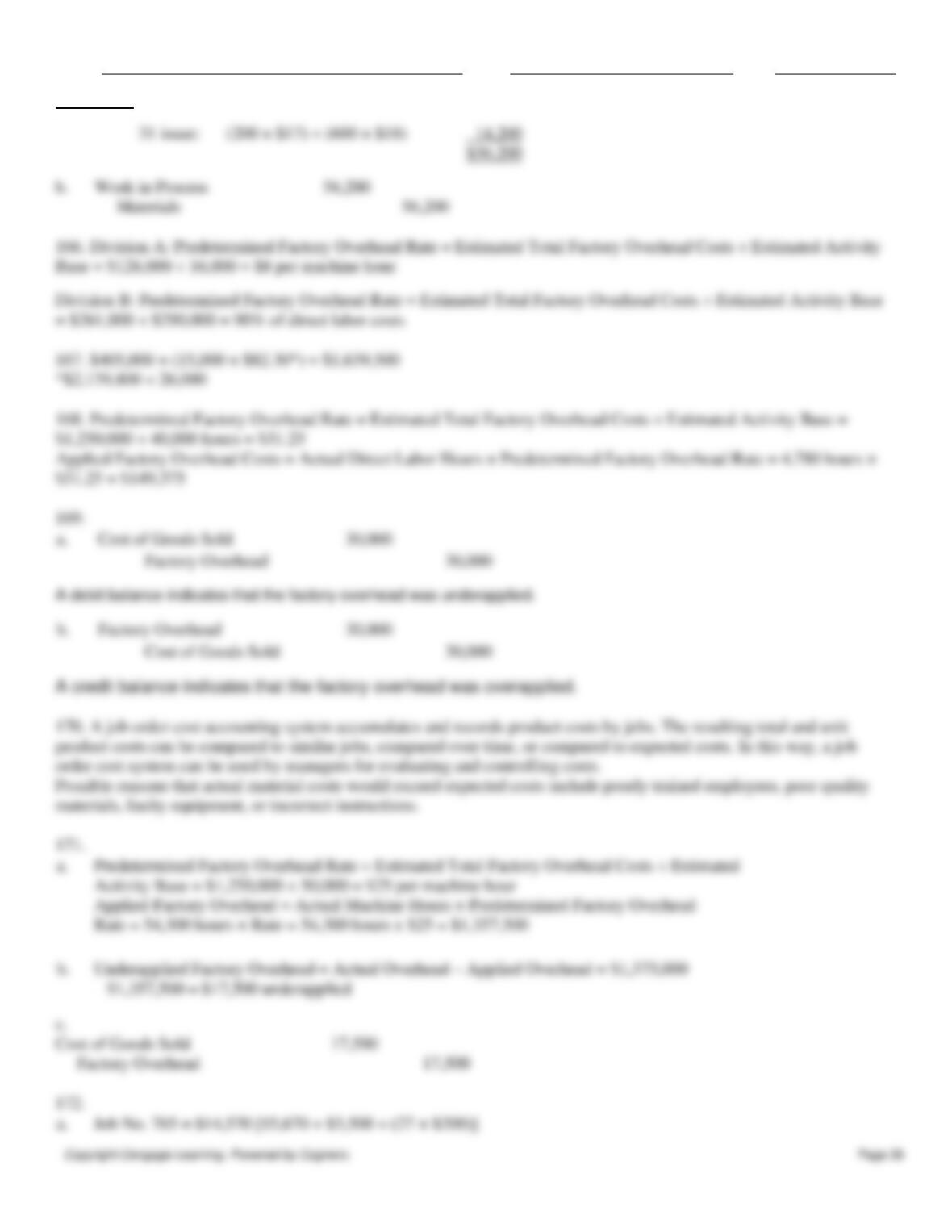
hour. Job J904 required 8 tons of direct material at a cost of $600 per ton and took employees who earn $21 per hour a
total of 80 hours to complete. What is the total cost of Job J904?
163. List the accounts used in the cost flow for (a) a manufacturer and (b) a service provider.
164. Put the following in the order of the flow of manufacturing costs for a company:
a.
Closing under/overapplied factory overhead to cost of goods sold
b.
Materials purchased
c.
Factory labor used and factory overhead incurred in production
d.
Completed jobs moved to finished goods
e.
Factory overhead applied to jobs according to the predetermined overhead rate
f.
Materials requisitioned to jobs
g.
Selling of finished product
h.
Preparation of financial statements to determine gross profit
165. During August, the receipts and distributions of Material No. B4G9 are as follows:
Received
Aug. 3
1,100 units at $15
16
1,700 units at $17
29
900 units at $18

Name:
Class:
Date:
chapter 19
Issued
Aug. 11
700 units for Job No. 116
18
1,900 units for Job No. 117
30
800 units for Job No. 118
a.
Determine the cost of each of the three issues under a perpetual system, using the first-in,
first-out method.
b.
Journalize a summary entry for the issuance of the materials for the month, assuming that
the cost of issuances is determined by the first-in, first-out method.
166. Technics Inc., a manufacturing company, utilizes job order costing. Each division establishes its own estimates
regarding overhead, which are as follows:
Division A
Division B
Total estimated factory overhead
$128,000
$261,000
Total estimated machine hours
16,000
72,500
Total estimated direct labor hours
$155,000
$290,000
If Division A allocates overhead on the basis of machine hours and Division B allocates overhead as a percentage of
direct labor costs, what would the predetermined factory overhead rate be for each division?
167. Cavy Company completed 26,000 units during the year at a cost of $2,139,800. The beginning finished goods
inventory was 5,000 units valued at $405,000. Assuming a FIFO cost flow, determine the cost of goods sold for 20,000
units.
168. Cavy Company estimates that total factory overhead for the following year will be $1,250,000. The company has
determined that the basis for applying factory overhead will be machine hours, which is estimated to be 40,000 hours.
There are 4,780 machine hours for all of the jobs in the month of April. What amount will be applied to all of the jobs for
the month of April?
169. At the end of the period, Carson Company had the following balances in selected accounts:
Materials
$ 80,000
Finished goods
190,000
Work in process
70,000
Cost of goods sold
1,000,000
Factory overhead
30,000
a.
The factory overhead balance is relatively small; journalize the entry to close the factory overhead
account assuming a debit balance. What does a debit balance mean?
b.
The factory overhead balance is relatively small; journalize the entry to close the factory overhead
account assuming a credit balance. What does a credit balance mean?
170. Discuss how job order cost information is used in decision making. What are some possible reasons that actual cost
of materials would exceed expected costs for a job?
171. Winston Company estimates that total factory overhead for the following year will be $1,250,000. The company has
decided that the basis for applying factory overhead should be machine hours, which is estimated to be 50,000 hours. The
total actual machine hours for the year were 54,300 hours. The actual factory overhead for the year was $1,375,000.
a.
Determine the total factory overhead applied during the year.

Name:
Class:
Date:
chapter 19
b.
Compute the over- or underapplied factory overhead for the year.
c.
Journalize the entry to close Factory Overhead to Cost of Goods Sold.
172. At the end of April, Cavy Company had completed Jobs 765 and 766. The individual job cost sheets reveal the
following information:
Job
Direct Materials
Direct Labor
Machine Hours
Job No. 765
$5,670
$3,500
27
Job No. 766
8,900
4,775
44
Job 765 produced 152 units, and Job 766 consisted of 250 units.
Assuming that the predetermined factory overhead rate is applied by using machine hours at a rate of $200 per hour,
determine the (a) balance on the job cost sheets for each job and (b) the cost per unit at the end of April.
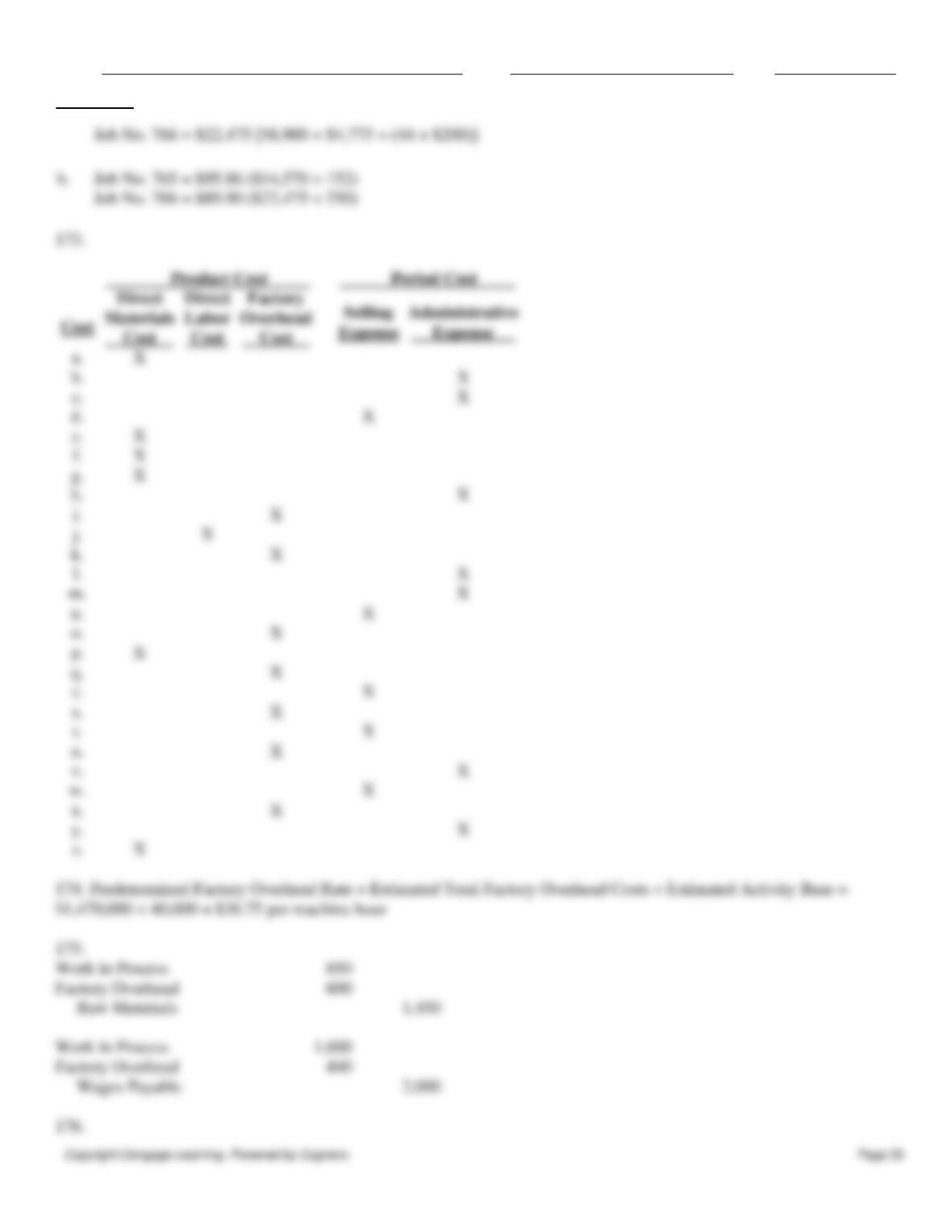
173. The following is a list of costs incurred by several business organizations:
a.
Telephone cable for a telephone company
b.
Membership fees for a health club for executives
c.
Salary of the director of internal auditing
d.
Long-distance telephone bill for calls made by salespersons
e.
Carrying cases for a manufacturer of video camcorders
f.
Cotton for a textile manufacturer of blue jeans
g.
Bandages for the emergency room of a hospital
h.
Cost of company holiday party
i.
Electricity used to operate factory machinery
j.
State unemployment compensation taxes for factory workers
k.
Gloves for factory machine operators
l.
Fees paid for lawn service for office grounds
m.
Salary of secretary to vice president of finance
n.
Salary of secretary to vice president of marketing
o.
Production supervisor’s salary
p.
Engine oil for manufacturer and distributor of motorcycles
q.
Oil lubricants for factory plant and equipment
r.
Cost of a radio commercial
s.
Depreciation on factory equipment
t.
Wages of checkout clerk in company-owned retail outlet
u.
Maintenance and repair costs for factory equipment
v.
Depreciation on office equipment
w.
Bonuses paid to salespersons
x.
Insurance on factory building
y.
Training for accounting personnel on use of microcomputer
z.
Steel for a construction contractor
Classify each of the preceding costs as product costs or period costs. For those costs classified as product costs, indicate
whether the product cost is a direct materials cost, direct labor cost, or factory overhead cost. For those costs classified as
period costs, indicate whether the period cost is a selling expense or an administrative expense. Use the following tabular
headings for preparing your answer. Place an X in the appropriate column.
Product Cost
Period Cost
Cost
Direct
Materials
Cost
Direct
Labor
Cost
Factory
Overhead
Cost
Selling
Expense
Administrative
Expense

Name:
Class:
Date:
chapter 19
174. Cavy Company estimates that total factory overhead for the following year will be $1,470,000. The company has
decided that the basis for applying factory overhead should be machine hours, which is estimated to be 40,000 hours.
Compute the predetermined factory overhead rate.
175. Harper Company uses a job order cost system. Journalize the entries for materials and labor, based on the following
data:
Raw materials issued: Job No. 609, $850; for general use in factory, $600
Labor time tickets: Job No. 609, $1,600; $400 for supervision
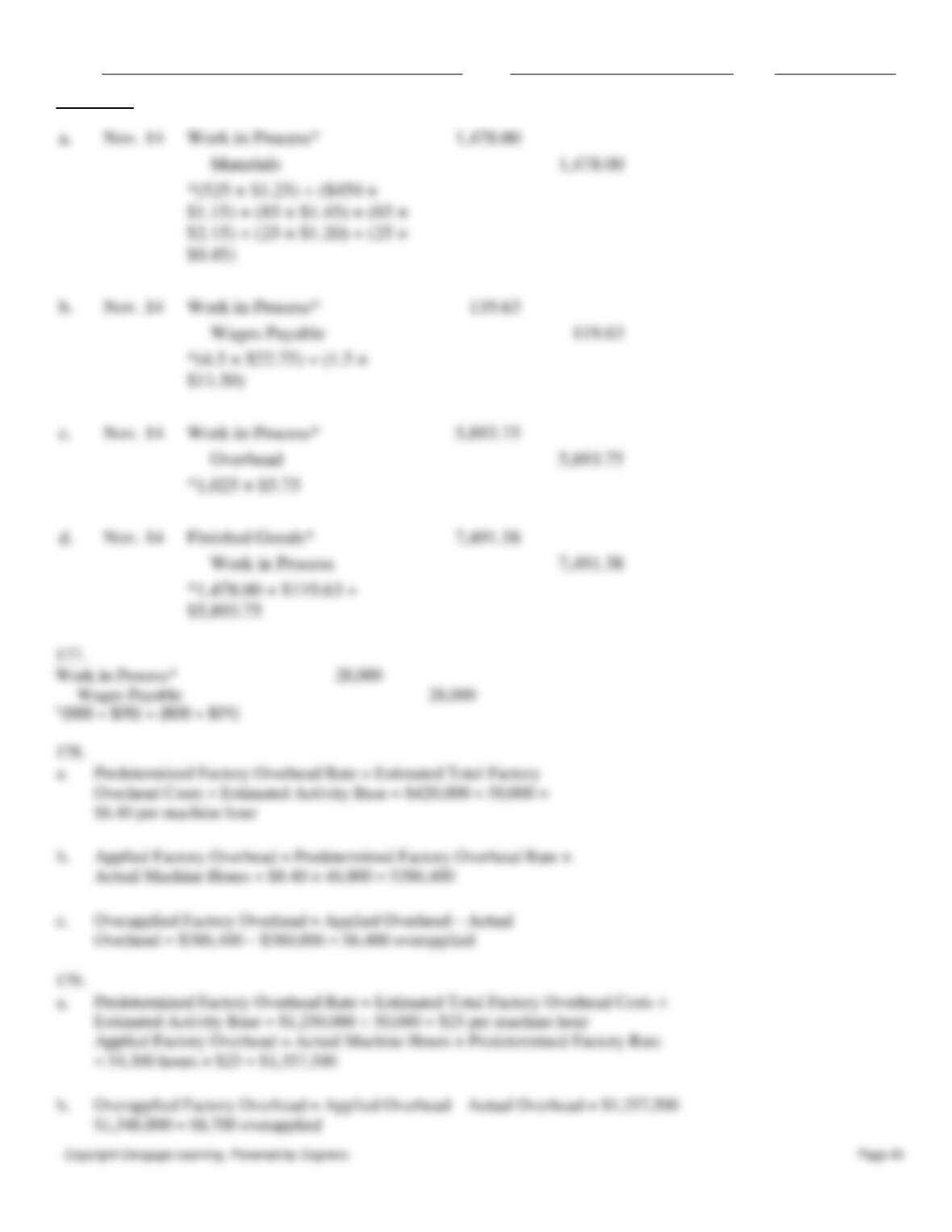
176. On November 14, the Milling Department accepted Job 111407A for 1,000 pounds of cereal mix.
Materials:
Standard Qty.
Standard Cost
Oats
525 pounds
$1.25 per pound
Wheat
450 pounds
$1.15 per pound
Barley
85 pounds
$1.45 per pound
Malt
65 pounds
$2.15 per pound
Honey
25 quarts
$1.20 per quart
Water
25 gallons
$0.45 per gallon
Time:
Miller
4.5 hours
$22.75 per hour
Loader
1.5 hours
$11.50 per hour
Overhead is applied at $5.75 per pound completed. The recipe produced 1,025 pounds of cereal mix.
a.
Journalize the entry for the issuance of raw materials to Job 111407A.
b.
Journalize the entry for direct labor incurred for Job 111407A.
c.
Journalize the entry to apply manufacturing overhead to Job 111407A.
d.
Journalize the entry to transfer Job 111407A to finished goods on November 14.
177. Cavy Company accumulated 560 hours of direct labor on Job 345 and 800 hours on Job 777. The direct labor was
incurred at a rate of $20 per direct labor hour for Job 345 and $21 per direct labor for Job 777. Journalize the entry for the
flow of labor costs into production.
178. Flagler Company allocates factory overhead based on machine hours. It estimated total factory overhead costs for the
year to be $420,000 and estimated machine hours to be 50,000. Actual hours and costs for the year were 46,000 machine
hours and $380,000 of factory overhead.
a.
Compute the predetermined factory overhead rate for the year.
b.
Compute the amount of applied factory overhead for the year.
c.
Determine the amount of under- or overapplied factory overhead for the year.
179. Winston Company estimates that total factory overhead for the following year will be $1,250,000. The company has
decided that the basis for applying factory overhead should be machine hours, which is estimated to be 50,000 hours. The
total actual machine hours for the year were 54,300 hours. The actual factory overhead for the year was $1,348,800.
a.
Determine the total factory overhead applied.
b.
Compute the over- or underapplied factory overhead for the year.
c.
Journalize the entry to close Factory Overhead to Cost of Goods Sold.
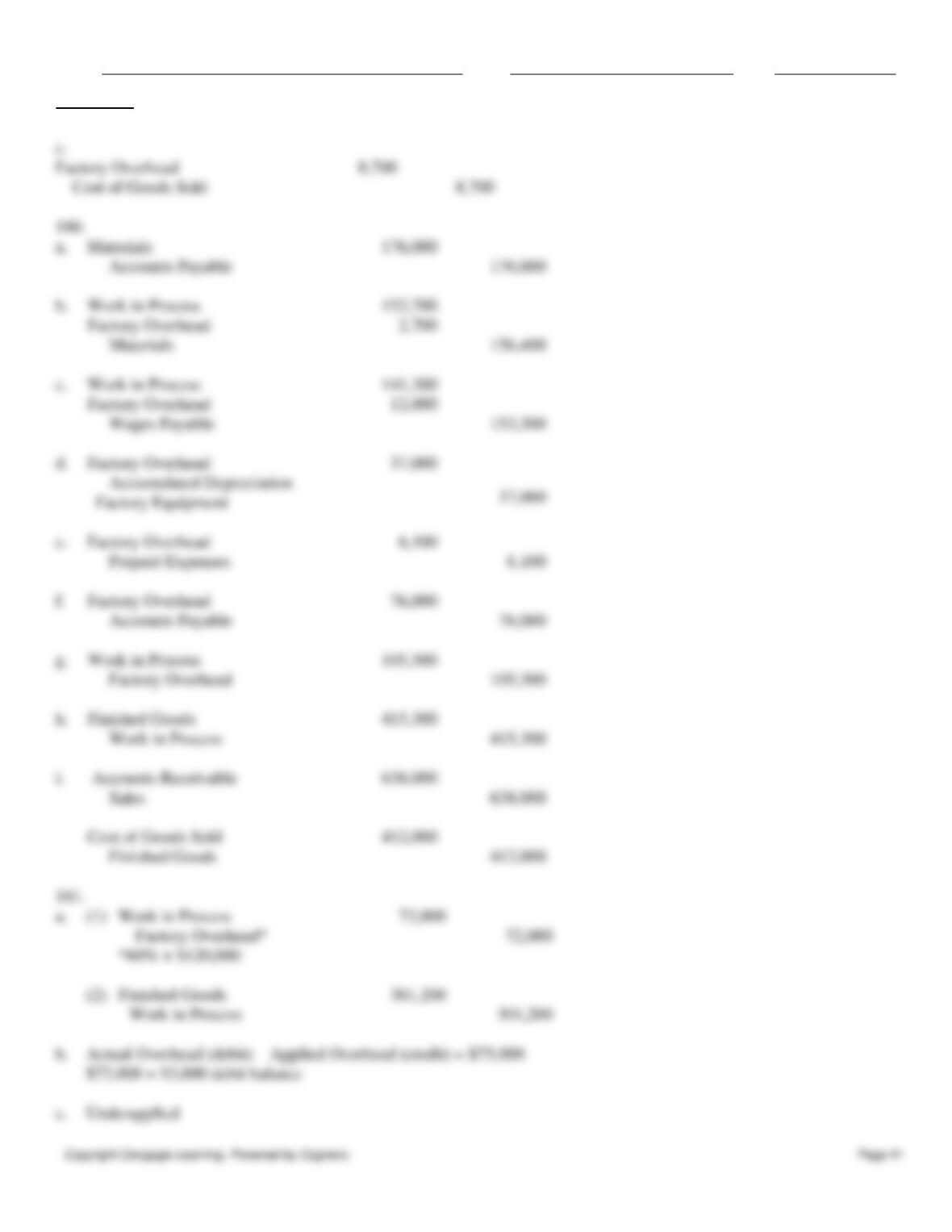
180. Journalize the entries for the following summarized operations related to production for a company using a job order

Name:
Class:
Date:
chapter 19
cost system:
a.
Materials purchased on account
$176,000
b.
Materials requisitioned:
For production orders
153,700
For general factory use
2,700
c.
Factory labor used:
On production orders
141,300
For general factory purposes
12,000
d.
Depreciation on factory equipment
37,000
e.
Expiration of prepaid expenses, chargeable to factory
6,100
f.
Factory overhead costs incurred on account
76,000
g.
Factory overhead applied, based on machine hours
105,300
h.
Jobs finished
415,300
i.
Jobs shipped to customers:
Selling price (assume all sold on account)
638,000
Cost of goods sold
412,000
181. The following account appears in the ledger after only part of the postings have been completed for July, the first
month of the current fiscal year:
Work in Process
July 1 Balance
60,200
Direct materials
147,000
Direct labor
120,000
Factory overhead is applied to jobs at the rate of 60% of direct labor cost. The actual factory overhead incurred for July
was $75,000. Jobs completed during the month totaled $301,200.
a.
Journalize the entries for (1) the application of factory overhead to production during July
and (2) the jobs completed during July.
b.
What is the balance of the factory overhead account on July 31?
c.
Was factory overhead over- or underapplied on July 31?
d.
Determine the balance of Work in Process on July 31.
182. During April, Cavy Company incurred factory overhead as follows:
Indirect materials
$11,000
Factory supervision labor
4,000
Utilities
500
Depreciation (factory)
700
Equipment rental
750
Journalize the factory overhead incurred during April.
183. Journalize the following transactions:
1.
March 10: 500 units of raw materials were purchased on account at $4.00 per unit.
2.
March 15: 250 units of raw materials were requisitioned at $4.50 per unit for production, Job 872.
3.
March 25: 215 units of raw materials were requisitioned at $5.00 per unit for production, Job 879.
184. Crain Company budgeted 35,000 direct labor hours and incurred 40,000 direct labor hours during the year. It
estimated factory overhead at $735,000 and actually incurred $780,000 of factory overhead costs for the year.

Name:
Class:
Date:
chapter 19
a. Compute the predetermined factory overhead rate for the year.
b. Compute the amount of applied factory overhead for the year.
c. Determine the amount of under- or overapplied factory overhead for the year.
185. The balance of Material Q on May 1 and the receipts and issuances during May are as follows:
Balance, May 1
8 at $32
Received, May 11
23 at $33
Received, May 25
15 at $35
Issued, May 17
14
Issued, May 27
18
Determine the cost of each of the issuances under a perpetual system, using the FIFO method.
186. Cavy Company estimates that total factory overhead for the following year will be $1,250,000. The company has
decided that the basis for applying factory overhead should be machine hours, which is estimated to be 40,000 hours. The
actual machine hours for the month of April for all of the jobs were 4,780. If the actual factory overhead totaled $141,800,
determine the over- or underapplied amount for the month.
187. A summary of the time tickets for August follows:
Job No.
Amount
Description
Amount
321
$11,000
342
$8,300
329
9,200
346
5,700
336
5,000
Indirect
8,000
Journalize the entries for (a) the labor cost incurred and (b) the application of factory overhead to production for August.
The factory overhead rate is 70% of direct labor cost.
188. Cavy Company estimates that total factory overhead costs will be $660,000 for the year. Direct labor hours are
estimated to be 100,000.
a.
Determine the:
(1)
Predetermined factory overhead rate
(2)
Amount of factory overhead applied to Job 345 if the amount of direct labor hours is 560 and Job 777 if the
amount of direct labor hours is 800
b.
Journalize the entry to apply factory overhead for April, assuming Jobs 560 and 777 are the only jobs in production
during the month.
189. Cavy Company estimates that total factory overhead for the following year will be $1,470,000. The company has
decided that the basis for applying factory overhead should be machine hours, which is estimated to be 40,000 hours. The
machine hours for the month of April for all of the jobs were 4,780. Journalize the entry to apply factory overhead.
190. On November 2, Newsprint Manufacturing purchases 5 rolls of paper on account at $125 per roll for use within the
production process. On November 5, 4 rolls of this paper are issued to Job 157A in the Printing Department. The Printing
Department records $675 in direct labor and $1,150 of factory overhead to Job 157A. On November 8, Printing transfers
Job 157A to the Folding Department. The Folding Department applies $450 in direct labor and $655 in factory overhead
to Job 157A. Job 157A is transferred to finished goods inventory on November 9.
a.
Journalize the purchase of the paper.
b.
Journalize the transfer of raw materials to work in process, the application of direct labor, and the

Name:
Class:
Date:
chapter 19
application of manufacturing overhead to Job 157A while in the Printing Department.
c.
Journalize the transfer of Job 157A to the Folding Department at actual cost.
d.
Journalize the application of direct labor and the application of manufacturing overhead to Job
157A while in the Folding Department.
e.
Journalize the transfer of Job 157A to finished goods inventory at actual cost.
191. Cranston Company estimates the following overhead costs for the coming year:
Equipment depreciation
$160,000
Equipment maintenance
60,000
Supervisory salaries
40,000
Factory rent
100,000
Total
$360,000
Cranston is also budgeting $600,000 in direct labor costs and 15,000 machine hours for the coming year.
a.
Compute the predetermined factory overhead rate using direct labor costs as the allocation base.
b.
Compute the predetermined factory overhead rate using machine hours as the allocation base.
192. Six selected transactions for the current month are indicated by letters in the following T accounts in a job order cost
accounting system:
Materials
Work in Process
(a)
(a)
(d)
(b)
(c)
Wages Payable
(f)
(b)
Factory Overhead
Finished Goods
(a)
(c)
(d)
(e)
(b)
(f)
(f)
Cost of Goods Sold
(e)
(f)
Describe each of the six transactions.
193. Define and discuss the two main types of cost accounting systems for manufacturing operations. What are their
similarities and differences?
194. Discuss the use of job order costing for professional services businesses. What are the similarities and differences
between service and manufacturing business job order costing?
195. National Survey Company uses a job order cost system.
a.
Indicate the source of the data for debiting Work in Process for each of the following:
(1)
Direct materials requisitioned
(2)
Direct labor used
b.
Indicate the source of the data for crediting Work in Process for jobs completed.
c.
Present a list of the three controlling accounts used in the general ledger to record the inventories and, in

Name:
Class:
Date:
chapter 19
each case, indicate the related subsidiary ledger.
196. On May 15, the Stamping Department accepted Job 051507A to make 1,000 funnels. Materials requisitioned were
1,100 sheets at $1.20 per sheet and 1,150 grommets at $0.15 per set. The activity base used by the Stamping Department
is the drop-forge strokes indicated by a machine-mounted counter. The counter indicated 1,115 strokes were used on the
job in the current period. Factory overhead is applied at $2.25 for each drop-forge stroke. Additionally, $375 of overhead
is applied to each job due to setup and tear down. Direct labor is applied at $22.50 per hour for the machine operator and
$11.10 for the machine loader. The job required 6.5 hours of labor.
Upon completion, the job was transferred to finished goods inventory.
Journalize all events as of May 15.

Name:
Class:
Date:
chapter 19
Answer Key

Name:
Class:
Date:
chapter 19

Name:
Class:
Date:
chapter 19
Name:
Class:
Date:
chapter 19
Name:
Class:
Date:
chapter 19
Name:
Class:
Date:
chapter 19
Name:
Class:
Date:
chapter 19
Name:
Class:
Date:
chapter 19
Name:
Class:
Date:
chapter 19
Name:
Class:
Date:
chapter 19
*(560 × $20) + (800 × $21)
Name:
Class:
Date:
chapter 19
Name:
Class:
Date:
chapter 19
Name:
Class:
Date:
chapter 19
*($1,470,000 ÷ 40,000) × 4,780
Name:
Class:
Date:
chapter 19
Name:
Class:
Date:
chapter 19