
Intermediate Accounting, 9e (Spiceland)
Chapter 19 Share-Based Compensation and Earnings per Share
1) GAAP requires using intrinsic value accounting for employee stock options.
2) If previous experience indicates that a material number of stock options will be forfeited
before they vest, the fair value estimate of the options on the grant date should be adjusted to
reflect that expectation.
3) Compensation expense must be adjusted during the service period to reflect changes in the
fair value of options caused by changes in the market price of the underlying shares.
4) Current year stock dividends and splits require retroactive restatement of EPS for all prior
years presented in comparative financial statements.

5) Stock options will be dilutive and included in the calculation of diluted EPS if the exercise
price is greater than the average market value of the stock.
6) Dilutive convertible bonds affect both the numerator and the denominator in computing
diluted EPS.
7) Except for tax considerations the potentially dilutive effect of convertible preferred stock is
handled in EPS calculations in much the same way as convertible debt.
8) No time-weighting of contingently issuable shares is required when computing basic EPS.
9) If a company’s capital structure includes convertible bonds, diluted EPS might be reduced
even if the bonds are not actually converted during the year.

10) If a company reports discontinued operations, EPS must be disclosed for both income from
continuing operations and net income.
11) Lance Chips granted restricted stock units (RSUs) representing 40 million of its $1 par
common shares to executives, subject to forfeiture if employment is terminated within four
years. After the recipients of the RSUs satisfy the vesting requirement, the company will
distribute the shares. The common shares had a market price of $5 per share on the grant date.
The total compensation cost pertaining to the restricted stock units is:
A) $5 million.
B) $40 million.
C) $50 million.
D) $200 million.
12) Taxon Corp. granted restricted stock units (RSUs) representing 30 million of its $1 par
common shares to executives, subject to forfeiture if employment is terminated within three
years. After the recipients of the RSUs satisfy the vesting requirement, the company will
distribute the shares. The common shares had a market price of $8 per share on the grant date.
Ignoring taxes, what is the effect on earnings in the year after the shares are granted to
executives?
A) $0.
B) $30 million.
C) $80 million.
D) $240 million.
13) The compensation associated with restricted stock units (RSUs) under a stock award plan is:
A) The book value of an unrestricted share of the same stock times the number of shares
represented by the RSUs.
B) Allocated to expense over the service period which usually is the vesting period.
C) The estimated fair value of a share of similar stock times the number of shares represented by
the RSUs.
D) The book value of a share of similar stock times the number of shares represented by the
RSUs.

14) The compensation associated with restricted stock units (RSUs) under a stock award plan is
the number of shares represented by the RSUs multiplied by:
A) The market price of a share of similar fixed income securities.
B) The market price of an unrestricted share of the same stock.
C) The book value of an unrestricted share of the same stock.
D) The book value of a share of similar stock.
15) Restricted stock units (RSUs):
A) are a grant valued in terms of a set number of shares of company stock.
B) are reported as a liability if payable in shares rather than cash.
C) are recorded based on a value estimated by a restricted stock valuation model.
D) represent shares issued at the date of grant that must be returned if the recipient fails to satisfy
the vesting requirement.
16) Restricted stock units (RSUs):
A) are reported as a liability if payable in shares rather than cash.
B) are reported as part of shareholders’ equity if payable in shares rather than cash.
C) are reported as part of shareholders’ equity if payable in cash rather than shares.
D) are reported as part of shareholders’ equity if the recipient will receive cash or can elect to
receive cash.
17) FX Services granted 15 million of its $1 par common shares to executives, subject to
forfeiture if employment is terminated within three years. The common shares have a market
price of $8 per share on the grant date. Ignoring taxes, what is the effect on earnings in the year
after the shares are granted to executives?
A) $0.
B) $15 million.
C) $40 million.
D) $120 million.
18) The compensation associated with restricted stock under a stock award plan is:
A) The book value of an unrestricted share of the same stock times the number of shares.
B) The estimated fair value of a share of similar stock times the number of shares.
C) Allocated to expense over the service period which usually is the vesting period.
D) The book value of a share of similar stock times the number of shares.

19) On January 1, 2018, M Company granted 90,000 stock options to certain executives. The
options are exercisable no sooner than December 31, 2020, and expire on January 1, 2024. Each
option can be exercised to acquire one share of $1 par common stock for $12. An option-pricing
model estimates the fair value of the options to be $5 on the date of grant.
What amount should M recognize as compensation expense for 2018?
A) $30,000.
B) $60,000.
C) $120,000.
D) $150,000.
20) On January 1, 2018, M Company granted 90,000 stock options to certain executives. The
options are exercisable no sooner than December 31, 2020, and expire on January 1, 2024. Each
option can be exercised to acquire one share of $1 par common stock for $12. An option-pricing
model estimates the fair value of the options to be $5 on the date of grant.
If unexpected turnover in 2019 caused the company to estimate that 10% of the options would
be forfeited, what amount should M recognize as compensation expense for 2019?
A) $30,000.
B) $60,000.
C) $120,000.
D) $150,000.
21) Under its executive stock option plan, N Corporation granted options on January 1, 2018,
that permit executives to purchase 15 million of the company’s $1 par common shares within the
next eight years, but not before December 31, 2020 (the vesting date). The exercise price is the
market price of the shares on the date of grant, $18 per share. The fair value of the options,
estimated by an appropriate option pricing model, is $4 per option. No forfeitures are
anticipated. Ignoring taxes, what is the effect on earnings in the year after the options are granted
to executives?
A) $0.
B) $20 million.
C) $60 million.
D) $90 million.
22) The compensation associated with executive stock option plans is:
A) The book value of a share of the company’s shares times the number of options.
B) The estimated fair value of the options.
C) Allocated to expense over the number of years until expiration.
D) Recorded as compensation expense on the date of grant.

23) The most important accounting objective for executive stock options is:
A) Measuring and reporting the amount of compensation expense during the service period.
B) Measuring their fair value for balance sheet purposes.
C) To disclose increases or decreases in the stock options held at the end of each accounting
period.
D) None of these answer choices is correct.
24) Executive stock options should be reported as compensation expense:
A) Using the intrinsic value method.
B) Using the fair value method.
C) Using either the fair value method or the intrinsic value method.
D) Only on rare occasions.
25) On January 1, 2018, Red Inc. issued stock options for 200,000 shares to a division manager.
The options have an estimated fair value of $6 each. To provide additional incentive for
managerial achievement, the options are not exercisable unless divisional revenue increases by
6% in three years. Red initially estimates that it is probable the goal will be achieved. Ignoring
taxes, what is compensation expense for 2018?
A) $0.
B) $200,000.
C) $400,000.
D) $1,200,000.
10
26) On January 1, 2018, Oliver Foods issued stock options for 40,000 shares to a division
manager. The options have an estimated fair value of $5 each. To provide additional incentive
for managerial achievement, the options are not exercisable unless Oliver Foods’ stock price
increases by 5% in four years. Oliver Foods initially estimates that it is not probable the goal will
be achieved. How much compensation will be recorded in each of the next four years?
A) $10,000.
B) $45,000.
C) $50,000.
D) No effect.
27) On January 1, 2018, G Corp. granted stock options to key employees for the purchase of
80,000 shares of the company’s common stock at $25 per share. The options are intended to
compensate employees for the next two years. The options are exercisable within a four-year
period beginning January 1, 2020, by the grantees still in the employ of the company. No options
were terminated during 2018, but the company does have an experience of 4% forfeitures over
the life of the stock options. The market price of the common stock was $31 per share at the date
of the grant. G Corp. used the Binomial pricing model and estimated the fair value of each of the
options at $10. What amount should G charge to compensation expense for the year ended
December 31, 2018?
A) $307,200.
B) $320,000.
C) $384,000.
D) $400,000.
28) Under its executive stock option plan, W Corporation granted options on January 1, 2018,
that permit executives to purchase 15 million of the company’s $1 par common shares within the
next eight years, but not before December 31, 2020 (the vesting date). The exercise price is the
market price of the shares on the date of grant, $18 per share. The fair value of the options,
estimated by an appropriate option pricing model, is $4 per option. No forfeitures are
anticipated. The options are exercised on April 2, 2021, when the market price is $21 per share.
By what amount will W’s shareholder’s equity be increased when the options are exercised?
A) $60 million.
B) $270 million.
C) $315 million.
D) $330 million.
29) On January 1, 2018, D Corp. granted an employee an option to purchase 6,000 shares of D’s
$5 par common stock at $20 per share. The options became exercisable on December 31, 2019,
after the employee completed two years of service. The option was exercised on January 10,
2020. The market prices of D’s stock were as follows: January 1, 2018, $30; December 31, 2019,
$50; and January 10, 2020, $45. An option pricing model estimated the value of the options at $8
each on the grant date. For 2018, D should recognize compensation expense of:
A) $0.
B) $24,000.
C) $30,000.
D) $60,000.
30) Under its executive stock option plan, M Corporation granted options on January 1, 2018,
that permit executives to purchase 15 million of the company’s $1 par common shares within the
next eight years, but not before December 31, 2020 (the vesting date). The exercise price is the
market price of the shares on the date of grant, $18 per share. The fair value of the options,
estimated by an appropriate option pricing model, is $4 per option. No forfeitures were
anticipated; however, unexpected turnover during 2019 caused the forfeiture of 5% of the stock
options. Ignoring taxes, what is the effect on earnings in 2019?
A) $18.5 million.
B) $18 million.
C) $20 million.
D) $19 million.
31) Under its executive stock option plan, Z Corporation granted options on January 1, 2018,
that permit executives to purchase 15 million of the company’s $1 par common shares within the
next eight years, but not before December 31, 2020 (the vesting date). The exercise price is the
market price of the shares on the date of grant, $18 per share. The fair value of the options,
estimated by an appropriate option pricing model, is $4 per option. No forfeitures are
anticipated. The options expired in 2024 without being exercised. By what amount will Z’s
shareholder’s equity be increased?
A) $60 million.
B) $270 million.
C) $315 million.
D) $330 million.

32) If restricted stock is forfeited because an employee leaves the company, the appropriate
accounting procedure is to:
A) Reverse related entries previously made.
B) Do nothing.
C) Prepare correcting entries.
D) Record an income item.
33) When recognizing compensation under a stock option plan, unanticipated forfeitures are
treated as:
A) A change in accounting principle.
B) A loss.
C) An income item.
D) A change in estimate.
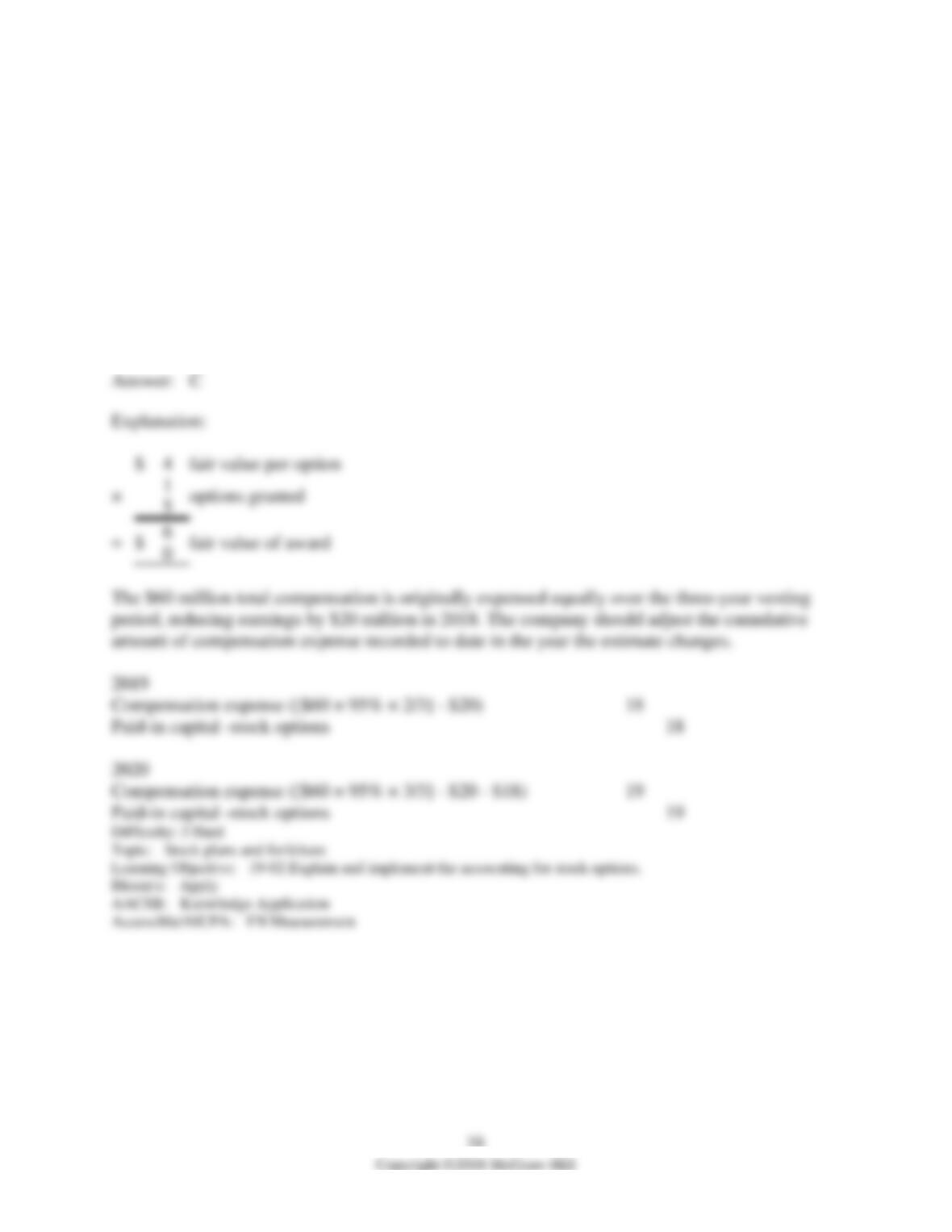
34) Under its executive stock option plan, Q Corporation granted options on January 1, 2018,
that permit executives to purchase 15 million of the company’s $1 par common shares within the
next eight years, but not before December 31, 2020 (the vesting date). The exercise price is the
market price of the shares on the date of grant, $18 per share. The fair value of the options,
estimated by an appropriate option pricing model, is $4 per option. No forfeitures were
anticipated; however, unexpected turnover during 2019 caused the forfeiture of 5% of the stock
options. Ignoring taxes, what is the effect on earnings in 2020?
A) $18.5 million.
B) $18 million.
C) $19 million.
D) $20 million.
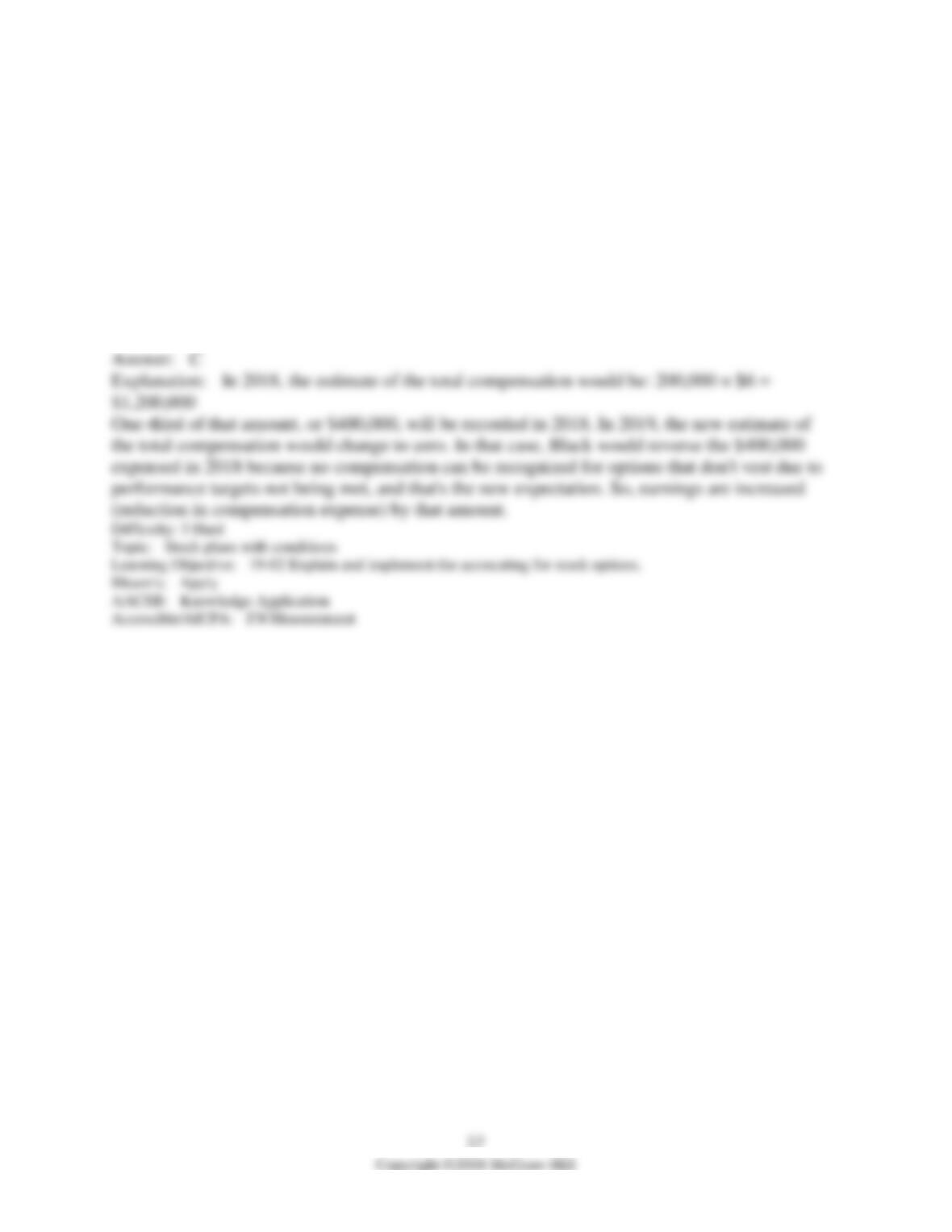
35) On January 1, 2018, Black Inc. issued stock options for 200,000 shares to a division
manager. The options have an estimated fair value of $6 each. To provide additional incentive
for managerial achievement, the options are not exercisable unless divisional revenue increases
by 6% in three years. Black initially estimates that it is probable the goal will be achieved. In
2019, after one year, Black estimates that it is not probable that divisional revenue will increase
by 6% in three years. Ignoring taxes, what is the effect on earnings in 2019?
A) $200,000 decrease.
B) $200,000 increase.
C) $400,000 increase.
D) No effect.
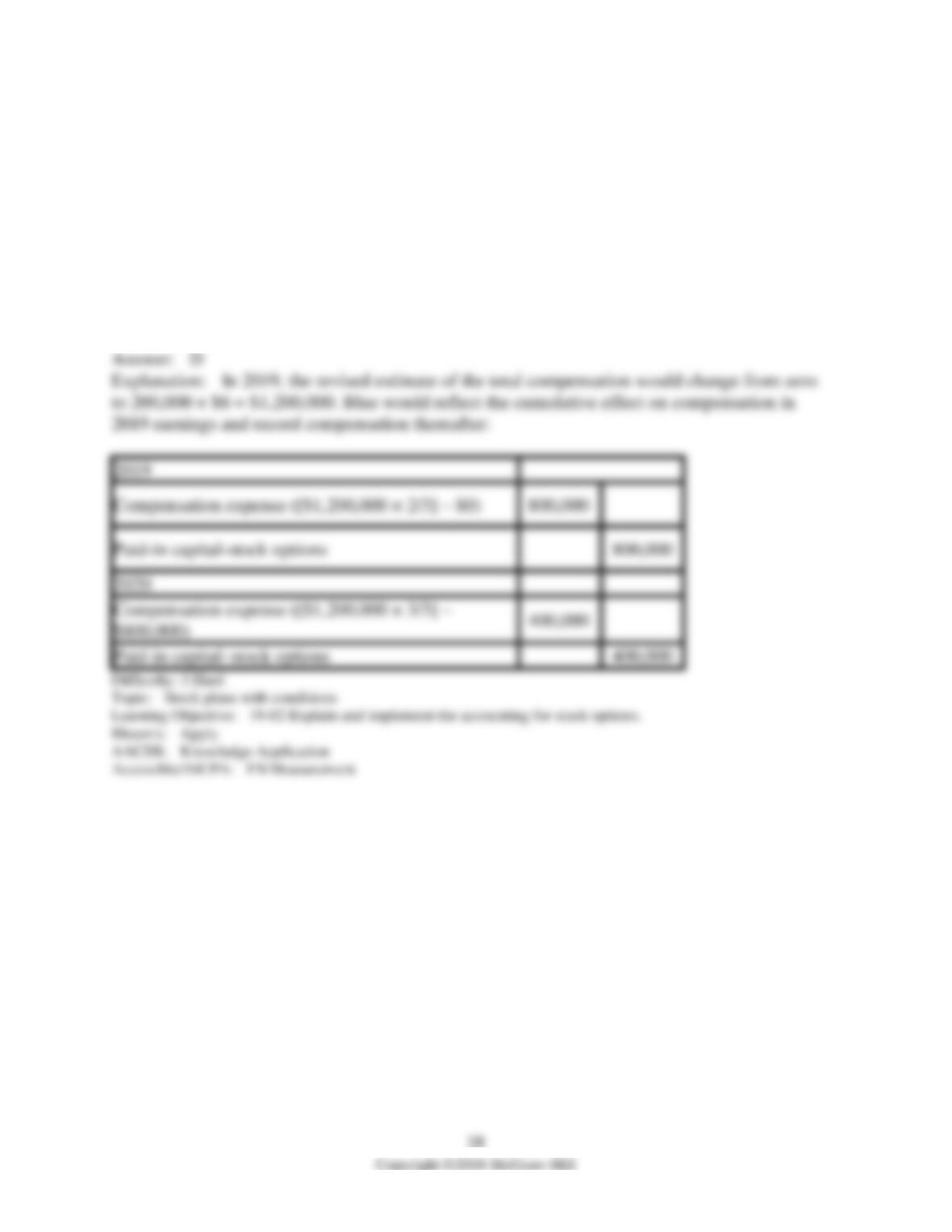
36) On January 1, 2018, Blue Inc. issued stock options for 200,000 shares to a division manager.
The options have an estimated fair value of $6 each. To provide additional incentive for
managerial achievement, the options are not exercisable unless divisional revenue increases by
6% in three years. Blue initially estimates that it is not probable the goal will be achieved, but in
2019, after one year, Blue estimates that it is probable that divisional revenue will increase by
6% by the end of 2020. Ignoring taxes, what is the effect on earnings in 2019?
A) $200,000.
B) $400,000.
C) $600,000.
D) $800,000.
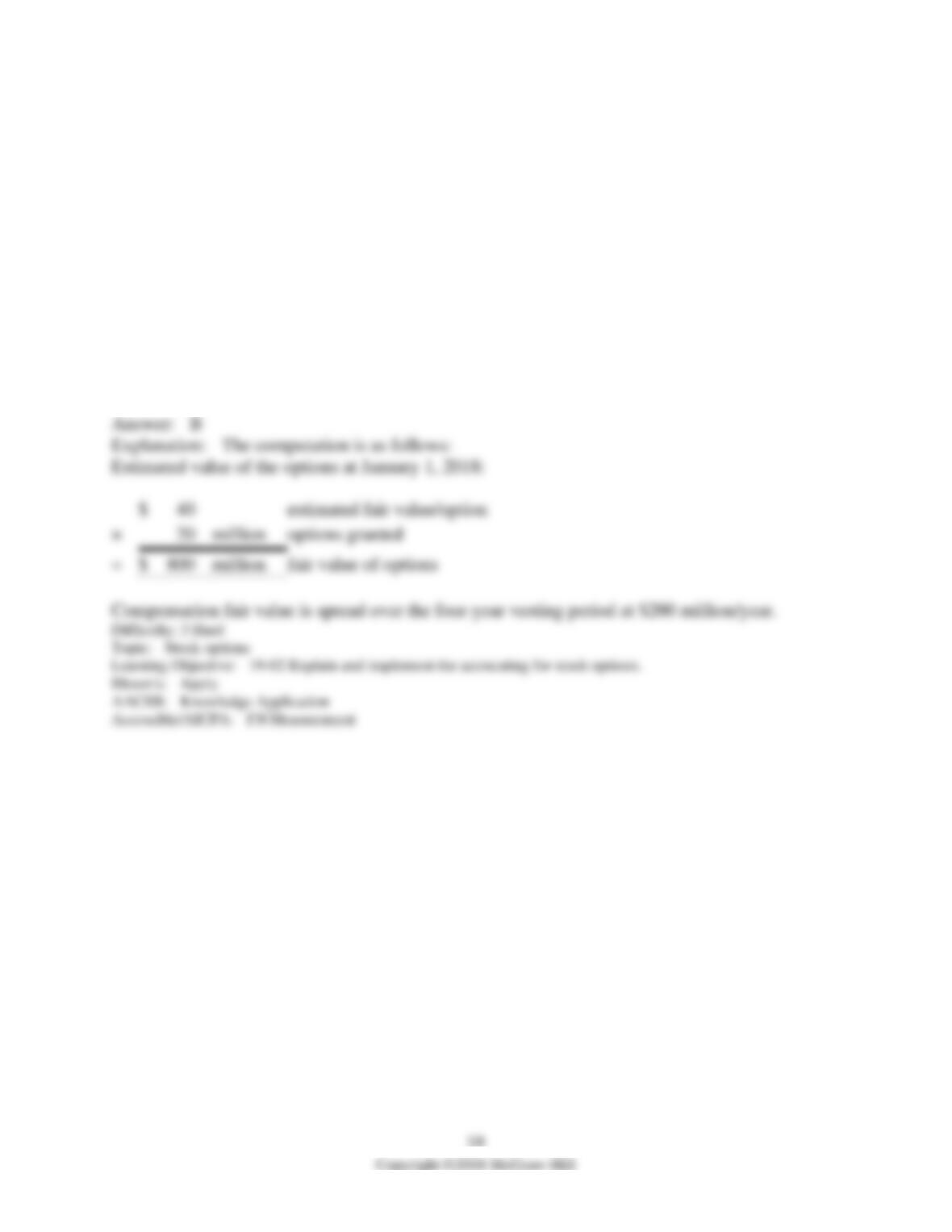
37) Wilson Inc. developed a business strategy that uses stock options as a major compensation
incentive for its top executives. On January 1, 2018, 20 million options were granted, each
giving the executive owning them the right to acquire five $1 par common shares. The exercise
price is the market price on the grant date—$10 per share. Options vest on January 1, 2022.
They cannot be exercised before that date and will expire on December 31, 2024. The fair value
of the 20 million options, estimated by an appropriate option pricing model, is $40 per option.
Ignore income tax.
Wilson’s compensation expense in 2018 for these stock options was:
A) $0.
B) $200 million.
C) $400 million.
D) $800 million.
38) Wilson Inc. developed a business strategy that uses stock options as a major compensation
incentive for its top executives. On January 1, 2018, 20 million options were granted, each
giving the executive owning them the right to acquire five $1 par common shares. The exercise
price is the market price on the grant date—$10 per share. Options vest on January 1, 2022.
They cannot be exercised before that date and will expire on December 31, 2024. The fair value
of the 20 million options, estimated by an appropriate option pricing model, is $40 per option.
Ignore income tax.
On March 1, 2022, when the market price of Wilson’s stock was $14 per share, 3 million of the
options were exercised. The journal entry to record this would include:
A) A debit to paid-in capital—stock options for $42 million.
B) A credit to paid–in capital—excess of par for $255 million.
C) A credit to common stock for $75 million.
D) All of these answer choices are correct.