214) Blair Systems offers its employees a variety of share-based compensation plans including
stock options, stock appreciation rights, and restricted stock. The following is an excerpt from a
disclosure note from Blair’s 2018 financial statements:
Note 11 Employee Benefit Plans (in part)
The Company adopted accounting guidelines under ASC Topic 718 which require the
measurement and recognition of compensation expense for all share-based payment awards
made to the Company’s employees and directors including employee stock options and
employee stock purchase rights, based on estimated fair values. Employee share-based
compensation expense under ASC Topic 718 was as follows (in millions):
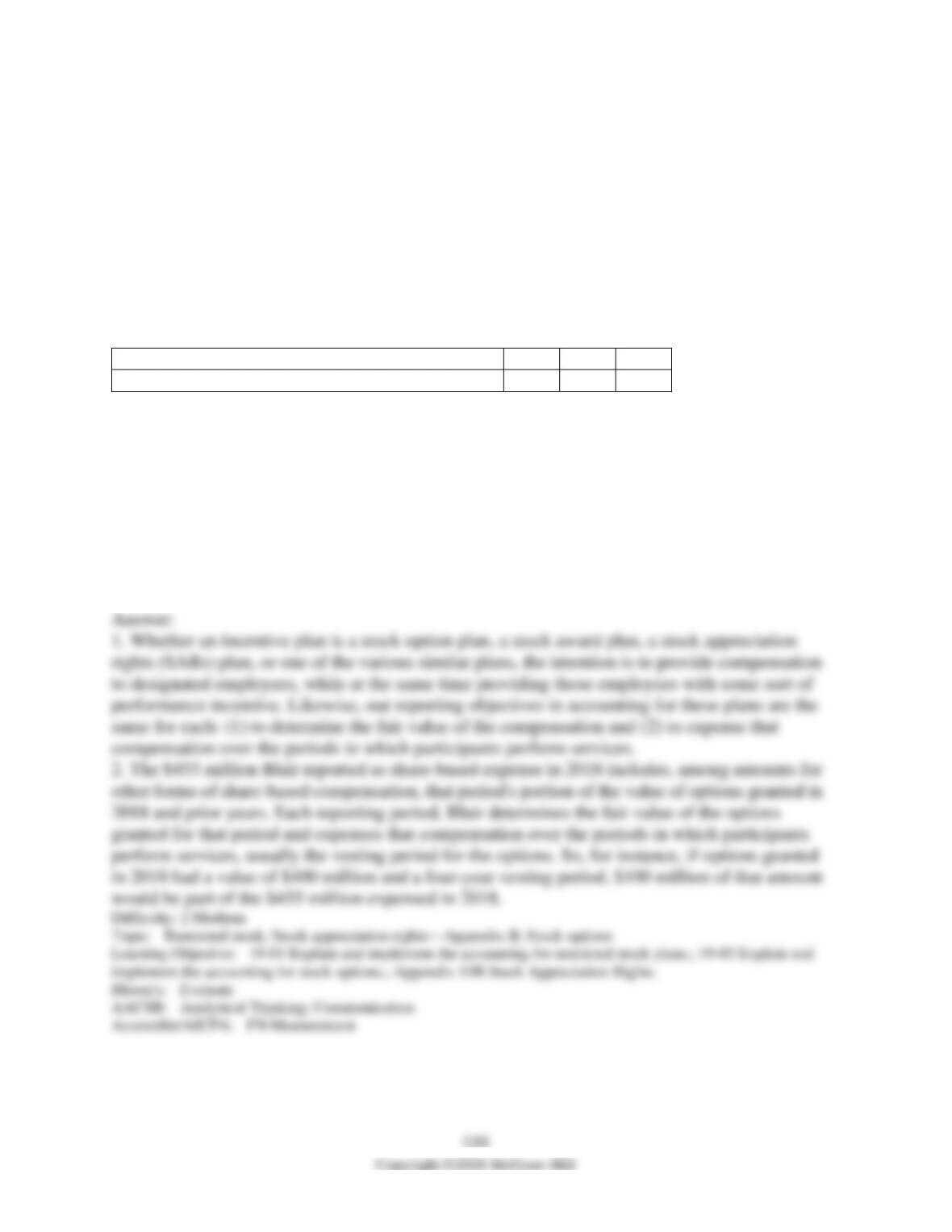
Years Ended
2018
2017
2016
Total employee share-based compensation expense
$455
$870
$760
Required:
1. Blair’s share-based compensation includes stock options, stock appreciation rights, and
restricted stock awards. What is the general financial reporting objective when recording
compensation expense for these forms of compensation?
2. Blair reported share-based expense of $455 million in 2018. Without referring to specific
numbers and ignoring other forms of share-based compensation, describe how this amount
reflects the value of stock options.

215) Reacting to opposition to the FASB’s “Share-Based Payment” Exposure Draft, Senator
Carl Levin stated, “Stock options are the 800-pound gorilla that has yet to be caged by corporate
reform.” In reference to a bill that would thwart the FASB’s position, Senator John McCain said,
“This legislation blocking stock option expensing not only undermines FASB’s independence,
but undermines the effort to restore confidence in our financial markets as well.” Discuss what
these two senators meant by their statements.

216) Stock option plans give employees the option to purchase (a) a specified number of shares
of the firm’s stock, (b) at a specified price, (c) during a specified period of time. One of the most
heated controversies in standard-setting history has been the debate over the amount of
compensation to be recognized as expense for stock options. At issue is how the value of stock
options is measured, which for most options determines whether any expense at all is
recognized. The opposition included corporate executives, auditors, members of Congress, and
the SEC.
Required:
Describe the primary objections of critics of the FASB’s eventually successful attempt to require
expensing of the fair value of the options.
217) A disclosure note from E Corp.’s 2018 annual report is shown below:
Employee Stock Purchase Plan. We have an employee stock purchase plan for all eligible
employees. Compensation expense for the employee stock purchase plan is recognized in
accordance with GAAP. Shares of our common stock may be purchased by employees at
three-month intervals at 85% of the fair value on the last day of each three-month period.
Employees may purchase shares having a value not exceeding 10% of their gross compensation
during an offering period. Employees purchased the following shares:
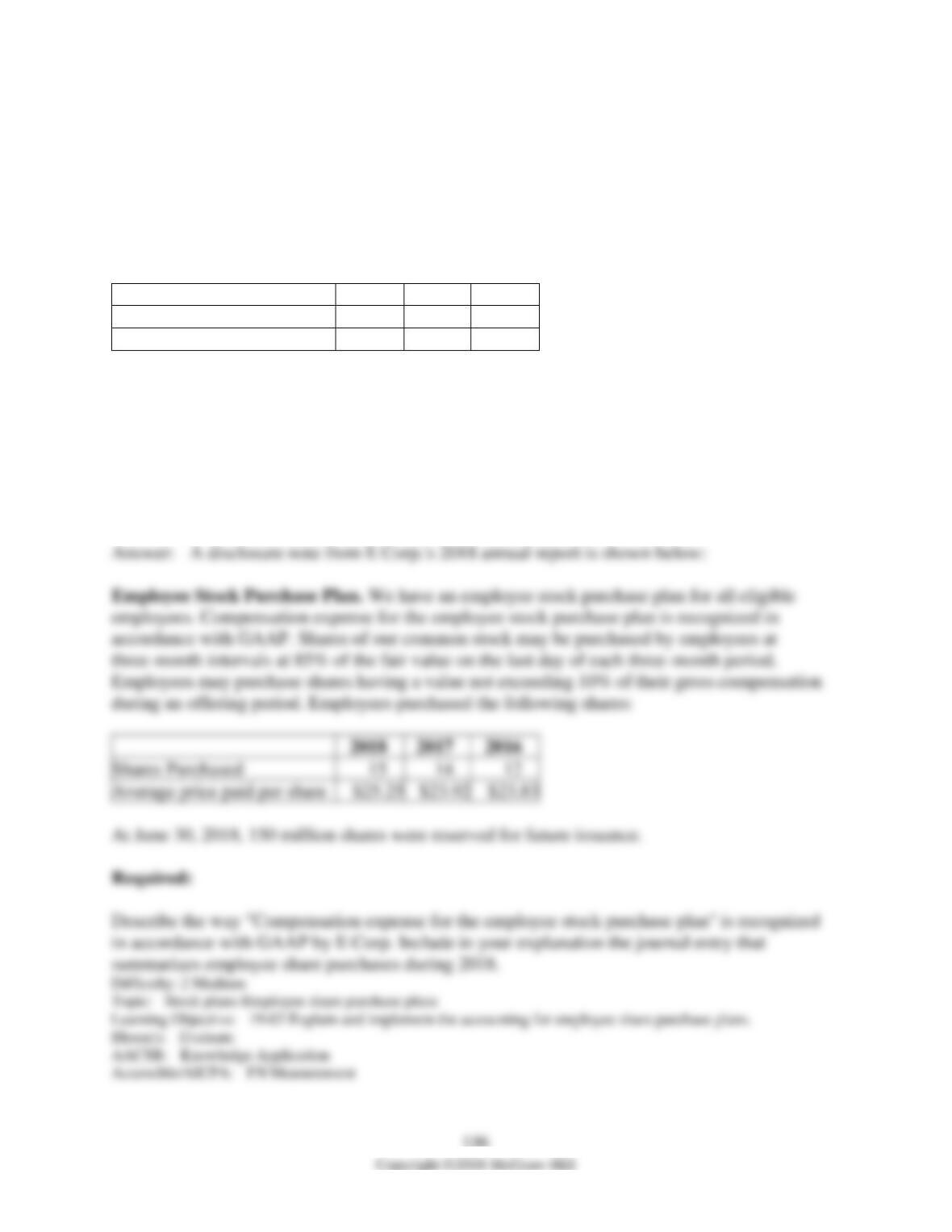
2018
2017
2016
Shares Purchased
15
14
12
Average price paid per share
$25.25
$23.92
$23.83
At June 30, 2018, 150 million shares were reserved for future issuance.
Required:
Describe the way “Compensation expense for the employee stock purchase plan” is recognized
in accordance with GAAP by E Corp. Include in your explanation the journal entry that
summarizes employee share purchases during 2018.
2018
2017
2016
Shares Purchased
Average price paid per share
$25.25
$23.92
$23.83
218) How is a complex capital structure different from a simple capital structure?
219) What is the treasury stock method of accounting for stock options, warrants, and rights?
220) At the end of 2018, what is the maximum number of shares that could possibly be issued if
all stock options and awards are exercised? Explain why V Co. used only 3.3 million in its
computation for 2018.
221) Why are earnings per share figures for prior years adjusted for stock splits and stock
dividends when data from prior years is presented in comparative financial statements?
222) Why are preferred dividends deducted from net income when calculating EPS?
223) What is the “if converted method”?
224) What is an antidilutive security?
225) M, Inc. supplies consumer products used in the United States and other markets. In its 2018
Annual Report to Shareholders, M, Inc. disclosed the following note about its EPS:
Basic earnings per share is computed using the weighted average number of common shares
outstanding during the period. Diluted earnings per common share incorporates the incremental
shares issuable upon the assumed exercise of stock options and upon the assumed conversion of
the Company’s Convertible Notes in fiscal 2018 as if conversion to common shares had occurred
at the beginning of the fiscal year. Earnings have also been adjusted for interest expense on the
Convertible Notes in fiscal 2018.
Explain why M mentioned the adjustment in the last sentence of the disclosure note.
140
226) Salle Services issued $300 million of 6% bonds in 2016. The bonds are convertible into 60
million shares of its no par common stock. Salle elected the option to report the bonds at fair
value, with changes in fair value reported in earnings. As a result the bonds are reported at $312
million in the December 31, 2018, balance sheet.
Required:
When calculating diluted EPS at December 31, 2018, what will be the net increase in the
denominator of the EPS fraction? Explain.
227) If executive stock options or restricted stock are outstanding when calculating diluted EPS,
what are the components of the “proceeds” assumed available for the repurchase of shares under
the treasury stock method?
228) When the income statement includes discontinued operations, which amounts require per
share presentation?
229) Compare the concepts of basic and diluted earnings per share with respect to their
calculation.
230) What is the advantage of stock appreciation rights over stock options?

142
231) Pastner Brands is a calendar-year firm with operations in several countries. As part of its
executive compensation plan, at January 1, 2018, the company had issued 20 million executive
stock options permitting executives to buy 20 million shares of stock for $25. The vesting
schedule is 20% the first year, 30% the second year, and 50% the third year (graded-vesting).
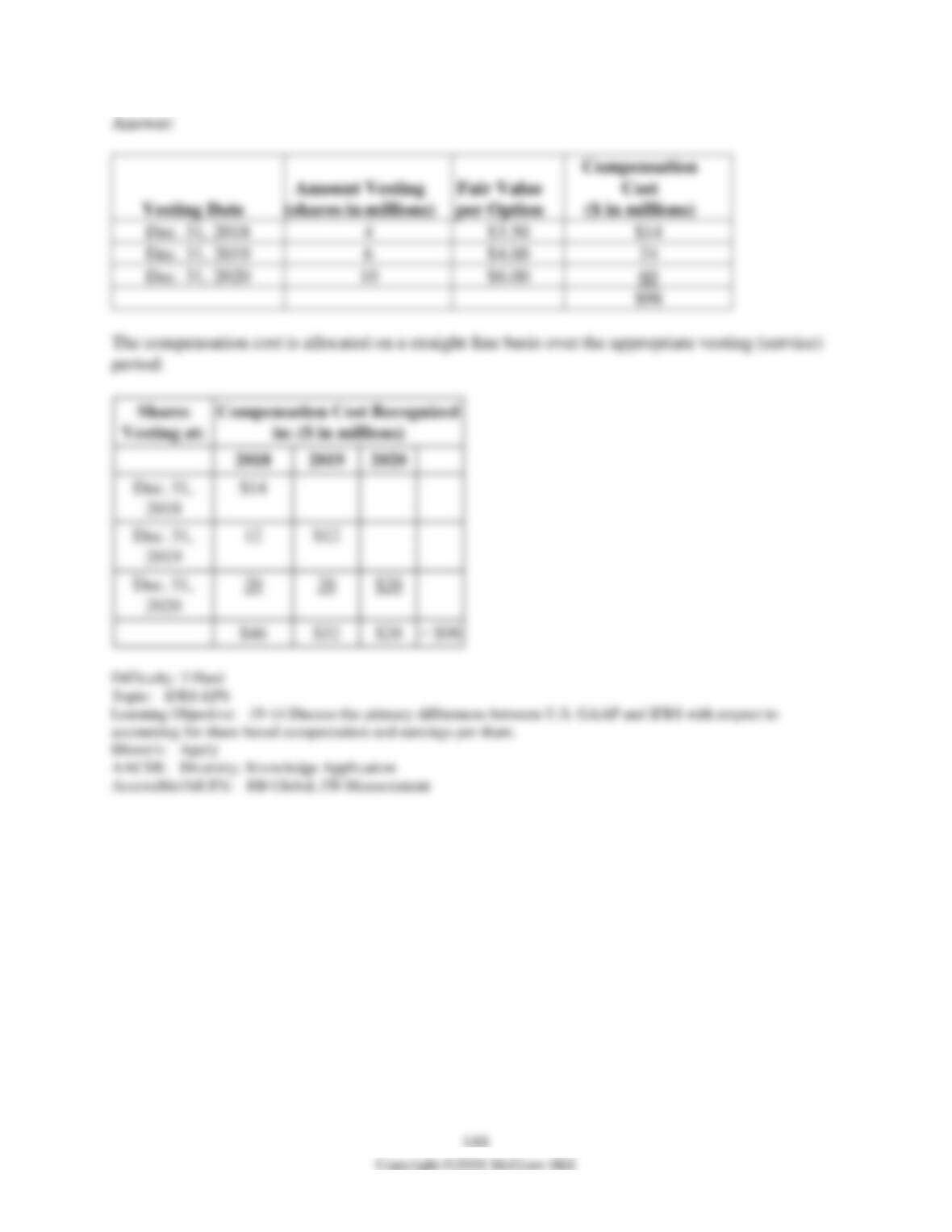
The fair value of the options is estimated as follows:
Vesting Date
Amount Vesting
Fair Value per Option
Dec. 31, 2018
20%
$3.50
Dec. 31, 2019
30%
$4.00
Dec. 31, 2020
50%
$6.00
Required:
Determine the compensation expense related to the options to be recorded each year for
2018-2020, assuming Pastner prepares its financial statements in accordance with International
Financial Reporting Standards (IFRS).