39) Wilson Inc. developed a business strategy that uses stock options as a major compensation
incentive for its top executives. On January 1, 2018, 20 million options were granted, each
giving the executive owning them the right to acquire five $1 par common shares. The exercise
price is the market price on the grant date—$10 per share. Options vest on January 1, 2022.
They cannot be exercised before that date and will expire on December 31, 2024. The fair value
of the 20 million options, estimated by an appropriate option pricing model, is $40 per option.
Ignore income tax.
Assume that all compensation expense from the stock options granted by Wilson already has
been recorded. Further assume that 200,000 options expire in 2023 without being exercised. The
journal entry to record this would include:
A) Debit to paid-in capital—stock options for $8 million.
B) A debit to common stock for $5 million.
C) A debit to paid-in capital—expiration of stock options for $8 million.
D) None of these answer choices is correct.
40) Pastore Inc. granted options for 1 million shares of its $1 par common stock at the beginning
of the current year. The exercise price is $35 per share, which was also the market value of the
stock on the grant date. The fair value of the options was estimated at $8 per option.
What would be the total compensation indicated by these options?
A) $3 million.
B) $27 million.
C) $8 million.
D) $35 million.
41) Pastore Inc. granted options for 1 million shares of its $1 par common stock at the beginning
of the current year. The exercise price is $35 per share, which was also the market value of the
stock on the grant date. The fair value of the options was estimated at $8 per option.
If the options have a vesting period of five years, what would be the balance in “Paid-in
Capital—Stock Options” three years after the grant date?
A) A credit of $4.8 million.
B) A credit of $16.2 million.
C) A debit of $4.8 million.
D) A debit of $16.2 million.
42) Wall Drugs offered an incentive stock option plan to its employees. On January 1, 2018,
options were granted for 60,000 $1 par common shares. The exercise price equals the $5 market
price of the common stock on the grant date. The options cannot be exercised before January 1,
2021, and expire December 31, 2022. Each option has a fair value of $1 based on an option
pricing model.
What is the total compensation cost for this plan?
A) $0.
B) $60,000.
C) $240,000.
D) $300,000.
43) Wall Drugs offered an incentive stock option plan to its employees. On January 1, 2018,
options were granted for 60,000 $1 par common shares. The exercise price equals the $5 market
price of the common stock on the grant date. The options cannot be exercised before January 1,
2021, and expire December 31, 2022. Each option has a fair value of $1 based on an option
pricing model.
Which is the correct entry to record compensation expense for the year 2018?
A)
Compensation expense
12,000
Paid-in capital—stock options
12,000
B)
Compensation expense
20,000
Common stock
20,000
C)
Compensation expense
20,000
Paid-in capital—stock options
20,000
D)
Compensation expense
80,000
Paid-in capital—stock options
80,000

24
44) Wall Drugs offered an incentive stock option plan to its employees. On January 1, 2018,
options were granted for 60,000 $1 par common shares. The exercise price equals the $5 market
price of the common stock on the grant date. The options cannot be exercised before January 1,
2021, and expire December 31, 2022. Each option has a fair value of $1 based on an option
pricing model.
Which is the correct entry to record the exercise of 90% the options on April 15, 2021, when the
market price of the stock was $8?
A)
Cash
270,000
Paid-in capital—stock options
54,000
Common stock
60,000
Paid-in capital—excess of par
264,000
B)
Cash
378,000
Paid-in capital—stock options
54,000
Common stock
54,000
Paid-in capital—excess of par
378,000
C)
Cash
270,000
Paid-in capital—stock options
54,000
Compensation expense
108,000
Common stock
54,000
Paid-in capital—excess of par
378,000
D)
Cash
270,000
Paid-in capital—stock options
54,000
Common stock
54,000
Paid-in capital—excess of par
270,000
Cash (60,000 × 90% × $5)
Paid-in capital—stock options ($60,000 × 90%)
Common stock (60,000 × 90% × $1)
Paid-in capital—excess of par
270,000
45) Wall Drugs offered an incentive stock option plan to its employees. On January 1, 2018,
options were granted for 60,000 $1 par common shares. The exercise price equals the $5 market
price of the common stock on the grant date. The options cannot be exercised before January 1,
2021, and expire December 31, 2022. Each option has a fair value of $1 based on an option
pricing model.
What is the entry to record the expiration of 10% of the options on December 31, 2022?
A)
Paid-in capital—stock options
6,000
Paid-in capital—expired stock options
6,000
B)
Paid-in capital—stock options
6,000
Retained earnings
6,000
C)
Paid-in capital—stock options
6,000
Compensation expense
6,000
D)
Stock options receivable
30,000
Common stock
6,000
Paid-in capital—excess of par
27,000
46) Under U.S. GAAP, a deferred tax asset for stock options:
A) is created for the cumulative amount of the fair value of the options the company has
recorded for compensation expense.
B) is the portion of the options’ intrinsic value earned to date times the tax rate.
C) is the tax rate times the fair value of all the options.
D) isn’t created if the award is “in the money;” that is, it has intrinsic value.
47) On January 1, 2018, Albacore Company had 300,000 shares of its common stock issued and
outstanding. Albacore issued a 10% stock dividend on July 1, 2018. On October 1, 2018,
Albacore retired 12,000 of its common shares. When calculating basic earnings per share for
2018, what is the appropriate number of shares for Albacore to use in the denominator of the
EPS fraction?
A) 303,000.
B) 342,000.
C) 312,000.
D) 327,000.
48) To encourage employee ownership of the company’s common shares, KL Corp. permits any
of its employees to buy shares directly from the company through payroll deduction. There are
no brokerage fees and shares can be purchased at a 15% discount. During May, employees
purchased 10,000 shares at a time when the market price of the shares on the New York Stock
Exchange was $15 per share. KL will record compensation expense associated with the May
purchases of:
A) $0.
B) $15,000.
C) $22,500.
D) $150,000.
49) Martin Corp. permits any of its employees to buy shares directly from the company through
payroll deduction. There are no brokerage fees and shares can be purchased at a 10% discount.
During 2018, employees purchased 8 million shares; during this same period, the shares had a
market price of $15 per share at the end of the year. Martin’s 2018 pretax earnings will be
reduced by:
A) $12 million.
B) $108 million.
C) $120 million.
D) $0.
50) How many types of potential common shares must a corporation have in order to be said to
have a complex capital structure?
A) Three.
B) Two.
C) One.
D) Zero.
51) Which of the following does not represent potential shares for an EPS calculation?
A) Convertible preferred stock.
B) Convertible bonds.
C) Stock rights.
D) Participating preferred stock.
52) Basic earnings per share ignores:
A) All potential common shares.
B) Some potential common shares, but not others.
C) Dividends declared on noncumulative preferred stock.
D) Stock splits.
53) A simple capital structure might include:
A) Stock rights.
B) Convertible bonds.
C) Nonconvertible preferred stock.
D) Stock purchase warrants.
54) When several types of potential common shares exist, the one that enters the computation of
diluted EPS first is the one with the:
A) Highest incremental effect.
B) Higher numerator.
C) Median incremental effect.
D) Lowest incremental effect.
55) Which of the following results in increasing basic earnings per share?
A) Paying more than book (carrying) value to retire outstanding bonds.
B) Issuing cumulative preferred stock.
C) Purchasing treasury stock.
D) All of these answer choices increase basic earnings per share.
56) ABC declared and paid cash dividends to its common shareholders in January of the current
year. The dividend:
A) Will be added to the numerator of the earnings per share fraction for the current year.
B) Will be added to the denominator of the earnings per share fraction for the current year.
C) Will be subtracted from the numerator of the earnings per share fraction for the current year.
D) Has no effect on the earnings per share for the coming year.
57) Nonconvertible bonds affect the calculation of:
A) Basic earnings per share.
B) Diluted earnings per share.
C) Basic earnings per share and Diluted earnings per share.
D) None of these answer choices are correct
58) During 2018, Angel Corporation had 900,000 shares of common stock and 50,000 shares of
6% preferred stock outstanding. The preferred stock does not have cumulative or convertible
features. Angel declared and paid cash dividends of $300,000 and $150,000 to common and
preferred shareholders, respectively, during 2018.
On January 1, 2017, Angel issued $2,000,000 of convertible 5% bonds at face value. Each
$1,000 bond is convertible into five common shares.
Angel’s net income for the year ended December 31, 2018, was $6 million. The income tax rate
is 20%.
What is Angel’s basic earnings per share for 2018, rounded to the nearest cent?
A) $5.29.
B) $5.57.
C) $6.50.
D) None of these answer choices are correct.
59) During 2018, Angel Corporation had 900,000 shares of common stock and 50,000 shares of
6% preferred stock outstanding. The preferred stock does not have cumulative or convertible
features. Angel declared and paid cash dividends of $300,000 and $150,000 to common and
preferred shareholders, respectively, during 2018.
On January 1, 2017, Angel issued $2,000,000 of convertible 5% bonds at face value. Each
$1,000 bond is convertible into five common shares.
Angel’s net income for the year ended December 31, 2018, was $6 million. The income tax rate
is 20%.
What will Angel report as diluted earnings per share for 2018, rounded to the nearest cent?
A) $6.43.
B) $6.25.
C) $6.22.
D) None of these answer choices are correct.
60) Basic earnings per share is computed using:
A) The actual number of common shares outstanding at the end of the year.
B) A weighted-average of preferred and common shares.
C) The number of common shares outstanding plus potential common shares.
D) Weighted-average common shares outstanding for the year.
61) When computing diluted earnings per share, which of the following will not be considered
in the calculation?
A) Dividends paid on common stock.
B) The weighted average common shares.
C) The effect of stock splits.
D) The number of common shares represented by stock purchase warrants.
62) When a company’s only potential common shares are convertible bonds:
A) Diluted EPS will be greater if the bonds are actually converted than if they are not converted.
B) Diluted EPS will be smaller if the bonds are actually converted than if the bonds are not
converted.
C) Diluted EPS will be the same whether or not the bonds are converted.
D) The effect of conversion on diluted EPS cannot be determined without additional
information.
63) The adjustment to the weighted-average shares for retired shares is the same as for issuing
new shares except:
A) The shares are deducted rather than added.
B) The shares are added rather than deducted.
C) The shares are treated as being acquired at the end of the year.
D) The shares are treated as being acquired at the beginning of the year.
64) On December 31, 2017, the Frisbee Company had 250,000 shares of common stock issued
and outstanding. On March 31, 2018, the company sold 50,000 additional shares for cash.
Frisbee’s net income for the year ended December 31, 2018, was $700,000. During 2018,
Frisbee declared and paid $80,000 in cash dividends on its nonconvertible preferred stock. What
is the 2018 basic earnings per share (rounded)?
A) $2.16.
B) $3.50.
C) $3.10.
D) $2.80.
65) Flyaway Travel Company reported net income for 2018 in the amount of $90,000. During
2018, Flyaway declared and paid $2,125 in cash dividends on its nonconvertible preferred stock.
Flyaway also paid $10,000 cash dividends on its common stock. Flyaway had 40,000 common
shares outstanding from January 1 until 10,000 new shares were sold for cash on April 1, 2018.
What is 2018 basic earnings per share?
A) $1.85.
B) $1.64.
C) $1.76.
D) None of these answer choices are correct.
66) The result of a stock split is:
A) A larger number of more valuable shares.
B) An increase in corporate assets.
C) An increase in shareholders’ equity.
D) A larger number of less valuable shares.
67) If a stock split occurred, when calculating the current year’s EPS, the shares are treated as
issued:
A) At the end of the year.
B) On the first day of the next fiscal year.
C) At the beginning of the year.
D) On the date of distribution.
68) Stock options, rights, and warrants are different from convertible securities in that they:
A) Typically increase cash upon exercise.
B) Usually reduce total assets upon exercise.
C) Often reduce liabilities upon exercise.
D) Normally increase retained earnings upon exercise.
69) The calculation of diluted earnings per share assumes that stock options were exercised and
that the proceeds were used to buy treasury stock at:
A) The average market price for the reporting period.
B) The market price at the end of the period.
C) The purchase price stated on the options.
D) The stock’s par value.
70) When we take into account the dilutive effect of stock options, rights, and warrants in the
calculation of EPS, the method used is called the:
A) Optional method.
B) If converted method.
C) Dilution method.
D) Treasury stock method.
71) In computing diluted earnings per share, the treasury stock method is used for:
A) Stock warrants.
B) Stock splits.
C) Reverse stock splits.
D) Convertible preferred stock.
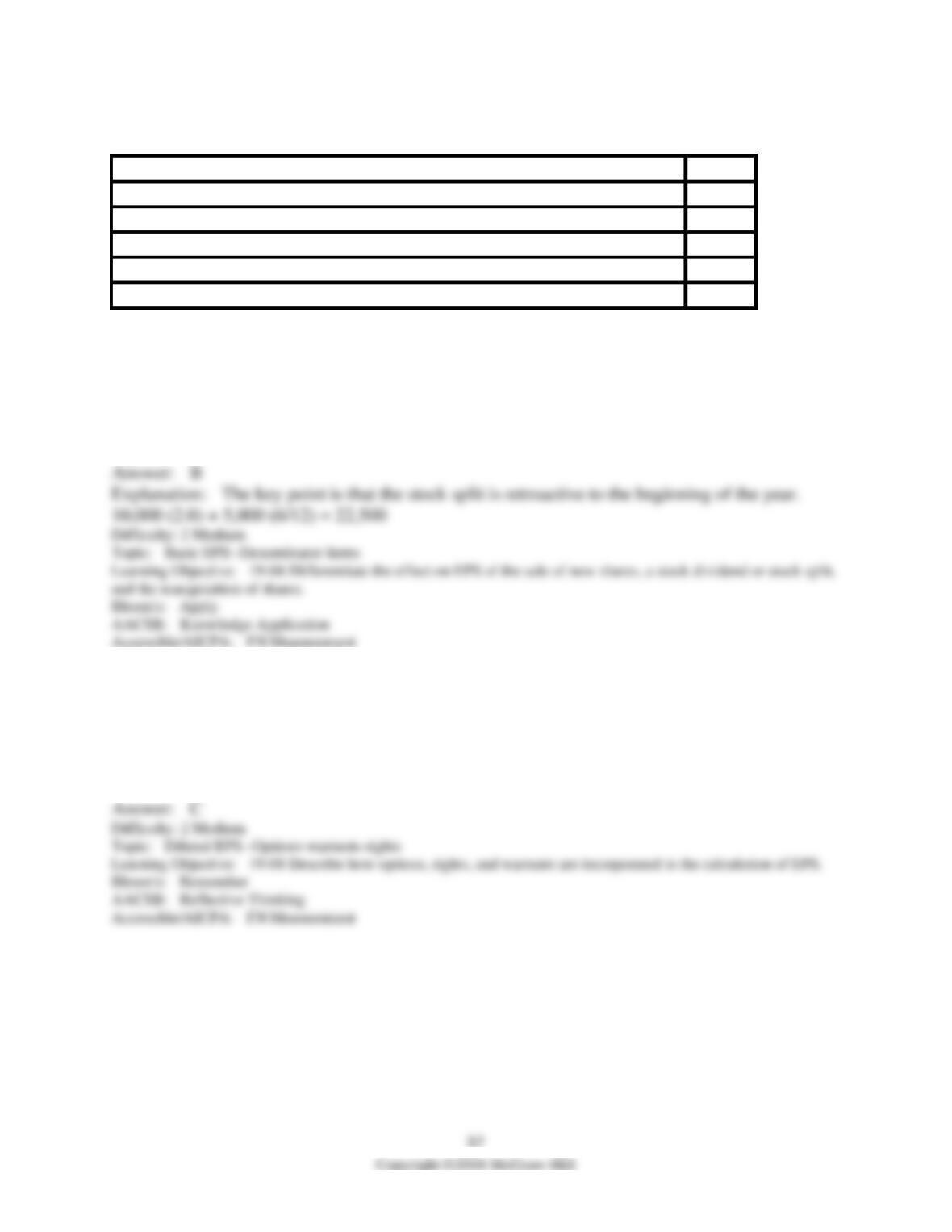
72) The following information pertains to J Company’s outstanding stock for 2018:
Common stock, $1 par
Shares outstanding, 1/1/2018
10,000
2 for 1 stock split, 4/1/2018
10,000
Shares issued, 7/1/2018
5,000
Preferred stock, $100 par, 7% cumulative
Shares outstanding, 1/1/2018
4,000
What is the number of shares J should use to calculate 2018 basic earnings per share?
A) 20,000.
B) 22,500.
C) 25,000.
D) 27,000.
73) When calculating diluted earnings per share, stock options:
A) Are included if they are antidilutive.
B) Should be ignored.
C) Are included if they are dilutive.
D) Increase the numerator while not affecting the denominator.
74) Which of the following will require a recalculation of weighted-average shares outstanding
for all years presented?
A) Stock dividends and stock splits.
B) Stock dividends but not stock splits.
C) Stock splits but not stock dividends.
D) Stock rights.
75) All other things equal, what is the effect on earnings per share when a corporation acquires
shares of its own stock on the open market?
A) Decrease.
B) No effect if the shares are held as treasury shares.
C) Increase only if the shares are considered to be retired.
D) Increase.
76) If a stock dividend were distributed, when calculating the current year’s EPS, the shares
distributed are treated as having been issued:
A) At the end of the year.
B) At the beginning of the year.
C) On the declaration date.
D) On the date of distribution.
77) Stock options do not affect the calculation of:
A) Diluted EPS.
B) Weighted-average common shares.
C) The denominator in the diluted EPS fraction.
D) Basic EPS.
78) The calculation of diluted earnings per share assumes that stock options were exercised and
that the proceeds were used to:
A) Buy common stock as an investment.
B) Retire preferred stock.
C) Buy treasury stock.
D) Increase net income.
79) During 2018, Falwell Inc. had 500,000 shares of common stock and 50,000 shares of 6%
cumulative preferred stock outstanding. The preferred stock has a par value of $100 per share.
Falwell did not declare or pay any dividends during 2018.
Falwell’s net income for the year ended December 31, 2018, was $2.5 million. The income tax
rate is 40%. Falwell granted 10,000 stock options to its executives on January 1 of this year.
Each option gives its holder the right to buy 20 shares of common stock at an exercise price of
$29 per share. The options vest after one year. The market price of the common stock averaged
$30 per share during 2018.
What is Falwell’s basic earnings per share for 2018, rounded to the nearest cent?
A) $3.14.
B) $4.40.
C) $5.00.
D) None of these answer choices are correct.