115) A primary goal of earnings per share determination is:
A) Conservatism.
B) Comparability.
C) Materiality.
D) Objectivity.
116) The reporting of earnings per share is required only for:
A) Private companies.
B) Companies with complex capital structures.
C) Publicly traded corporations.
D) Medium-sized and large corporations.
117) Which of the following is a correct statement concerning earnings per share?
A) Earnings per share can never be a negative number.
B) Earnings per share must be reported for all corporations.
C) If a company has discontinued operations, at least two EPS amounts must be reported.
D) Reported earnings per share is the result of dividing weighted-average shares by net income.

118) When a company’s income statement includes discontinued operations, the company
should report per share information on:
Net Income
Income from Continuing
Operations
a.
Yes
No
b.
Yes
Yes
c.
No
No
d.
No
Yes
A) Option A
B) Option B
C) Option C
D) Option D
119) When a company’s income statement includes discontinued operations and a gain on the
sale of machinery, the company should report per share information on:
Net Income
Income from Continuing
Operations
Gain on sale of
machinery
a.
Yes
No
No
b.
Yes
Yes
No
c.
Yes
No
Yes
d.
Yes
Yes
Yes
A) Option A
B) Option B
C) Option C
D) Option D
120) Earnings per share data is required to be reported:
A) In disclosure notes to the financial statements.
B) Only if it adds to the relevance of the income statement.
C) In the summary section of the annual report.
D) On the face of the income statement.
121) Under IFRS, a deferred tax asset for stock options:
A) Is created for the cumulative amount of the fair value of the options the company has
recorded for compensation expense.
B) Is the portion of the options’ intrinsic value earned to date times the tax rate.
C) Is the tax rate times the amount of compensation.
D) Isn’t created if the award is “in the money;” that is, it has intrinsic value.

122) Which of the following statements is true regarding share appreciation rights (SAR)
payable in cash?
A) Any change in estimated total compensation is recorded as a prior adjustment.
B) The total amount of compensation is not known for certain until the date the SAR is
exercised.
C) The liability is adjusted only to reflect each additional year of service.
D) None of these answer choices are correct.
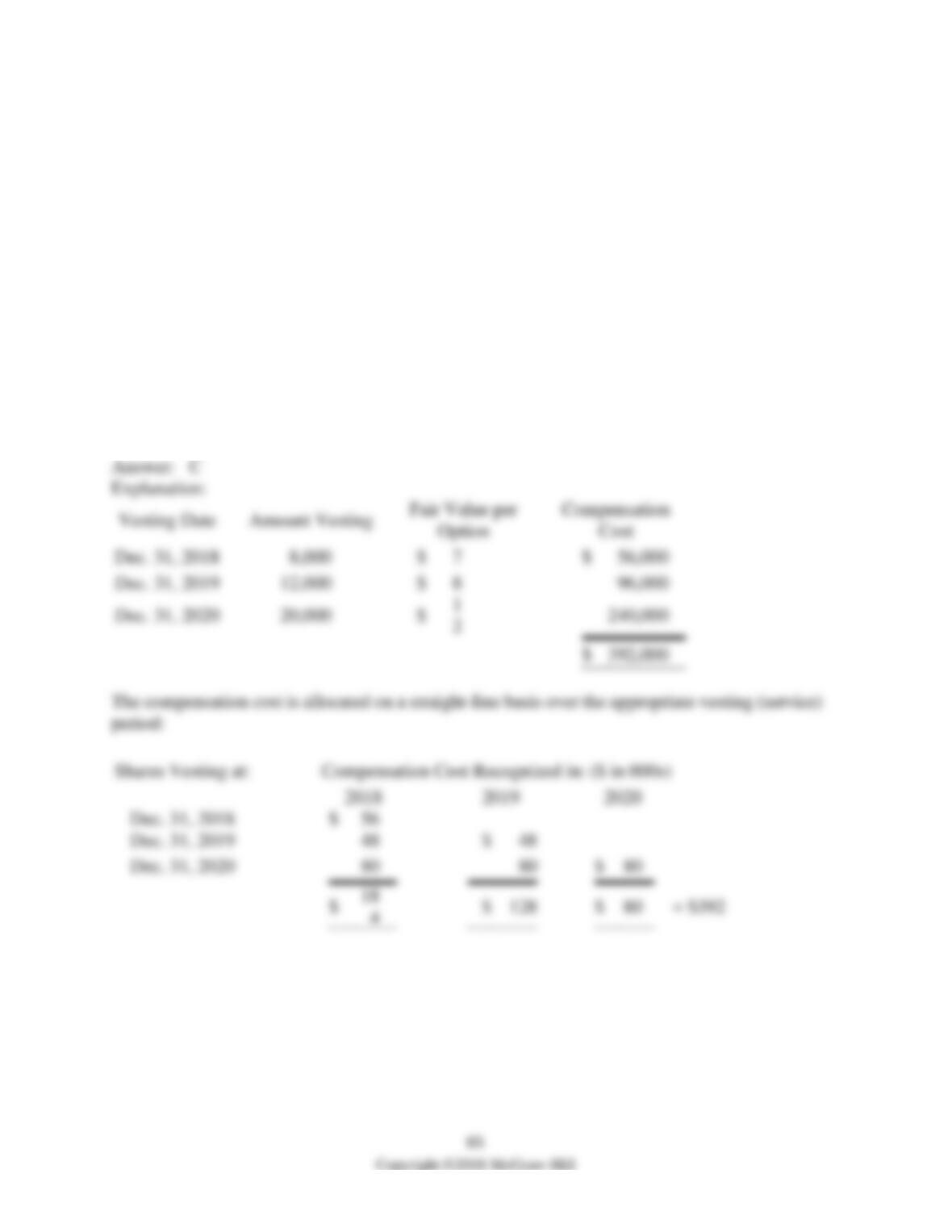
123) Red Company is a calendar-year U.S. firm with operations in several countries. At January
1, 2018, the company had issued 40,000 executive stock options permitting executives to buy
40,000 shares of stock for $25. The vesting schedule is 20% the first year, 30% the second year,
and 50% the third year (graded-vesting). The fair value of the options is estimated as follows:
Vesting Date
Amount Vesting
Fair Value per Option
Dec. 31, 2018
20
%
$
7
Dec. 31, 2019
30
%
$
8
Dec. 31, 2020
50
%
$
12
What is the compensation expense related to the options to be recorded in 2019?
A) $48,000.
B) $96,000.
C) $128,000.
D) $140,000.
Dec. 31, 2019
Dec. 31, 2018
$
Dec. 31, 2019
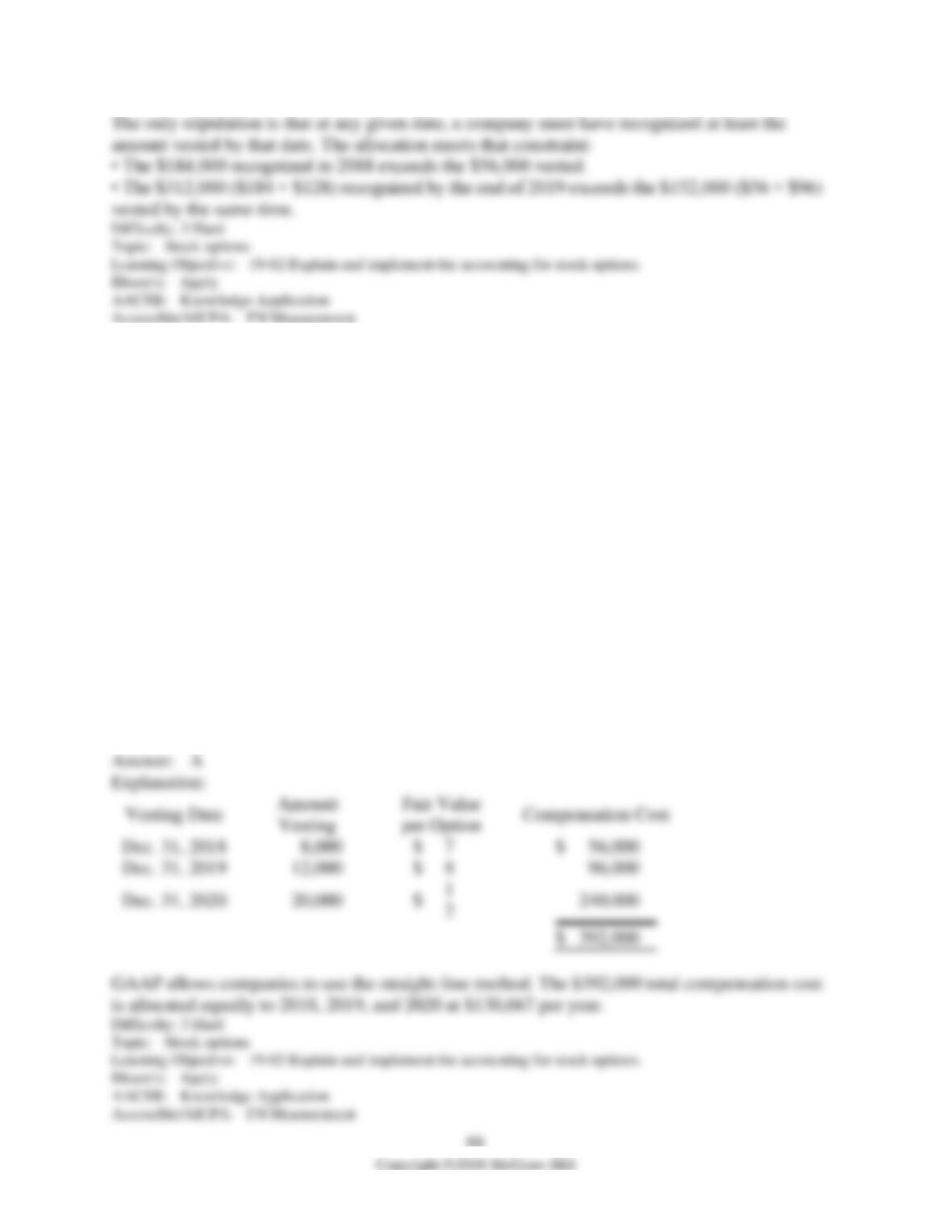
124) Green Company is a calendar-year U.S. firm with operations in several countries. At
January 1, 2018, the company had issued 40,000 executive stock options permitting executives
to buy 40,000 shares of stock for $25. The vesting schedule is 20% the first year, 30% the second
year, and 50% the third year (graded-vesting). The fair value of the options is estimated as
follows:
Vesting Date
Amount
Vesting
Fair Value
per Option
Dec. 31, 2018
20
%
$
7
Dec. 31, 2019
30
%
$
8
Dec. 31, 2020
50
%
$
12
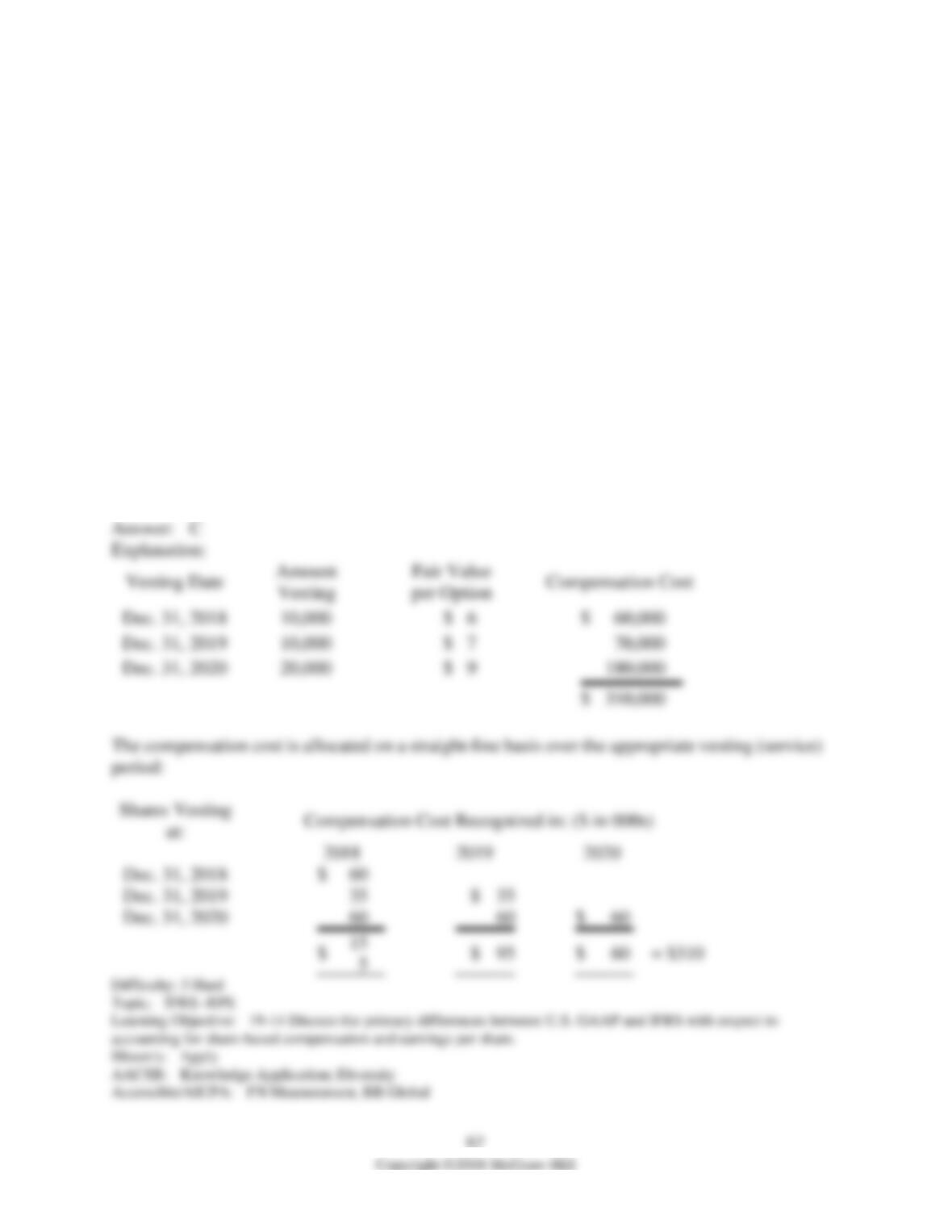
Assuming Green uses the straight-line method, what is the compensation expense related to the
options to be recorded in 2019?
A) $130,667.
B) $200,000.
C) $333,333.
D) $400,000.
Vesting
Dec. 31, 2018
$
7
$
Dec. 31, 2019
$
8
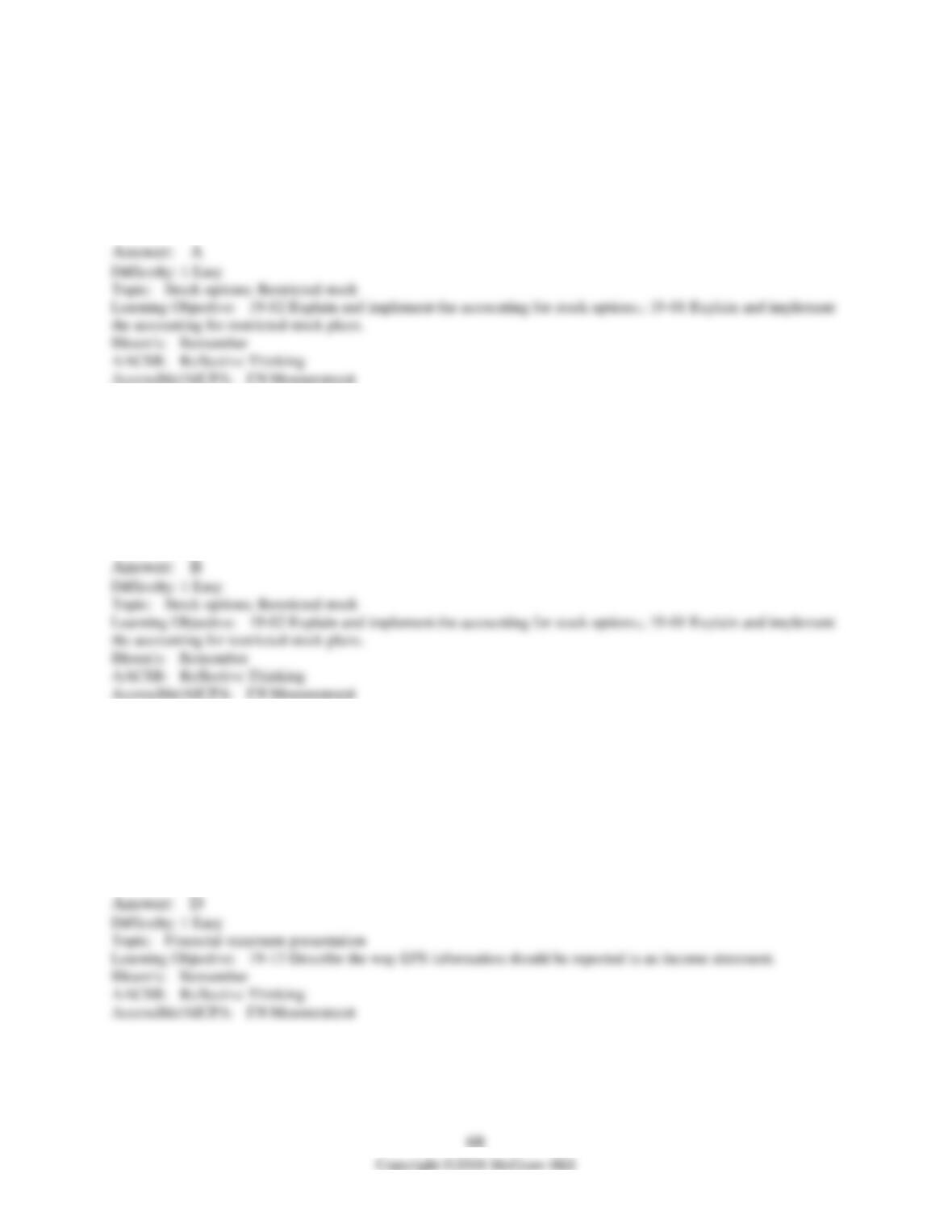
125) Yellow Company is a calendar-year firm with operations in several countries. At January 1,
2018, the company had issued 40,000 executive stock options permitting executives to buy
40,000 shares of stock for $30. The vesting schedule is 20% the first year, 30% the second year,
and 50% the third year (graded-vesting). The fair value of the options is estimated as follows:
Vesting Date
Amount
Vesting
Fair Value
per Option
Dec. 31, 2018
25
%
$
6
Dec. 31, 2019
25
%
$
7
Dec. 31, 2020
50
%
$
9
Assuming Yellow prepares its financial statements in accordance with International Financial
Reporting Standards (IFRS), what is the compensation expense related to the options to be
recorded in 2019?
A) $40,000.
B) $60,000.
C) $95,000.
D) $130,000.
2018
2019
$
$
126) Common forms of share-based compensation include each of the following except:
A) stock splits.
B) restricted stock.
C) restricted stock units.
D) stock options.
127) Regardless of the form of share-based compensation, the accounting objective is to record
compensation expense:
A) as the book value of the compensation expensed over the vesting period.
B) as the fair value of the compensation expensed over the vesting period.
C) as the book value of the compensation expensed at the date of grant.
D) as the fair value of the compensation expensed at the date of grant.
128) For a firm with a simple capital structure, EPS is:
A) earnings available to common and preferred shareholders divided by the weighted-average
number of common and preferred shares outstanding.
B) earnings available to common and preferred shareholders divided by the number of common
and preferred shares outstanding at the end of the reporting period.
C) reported for both basic and diluted EPS.
D) reported for both earnings before discontinued operations and net income.

129) A company is said to have a complex capital structure if:
A) the company has preferred stock outstanding at the end of the period.
B) the company has potential common shares outstanding at the end of the period.
C) the company’s capital structure includes more debt than shareholders’ equity.
D) the company’s capital structure includes more shareholders’ equity than debt.
130) Executive stock options:
A) allow the holder the option to buy shares at a specified exercise price during a specified
period of time.
B) allow the holder the option to buy shares at a specified exercise price any time prior to the
executive ceasing to be employed by the firm.
C) are expensed at their intrinsic value.
D) permit executives to purchase restricted stock.
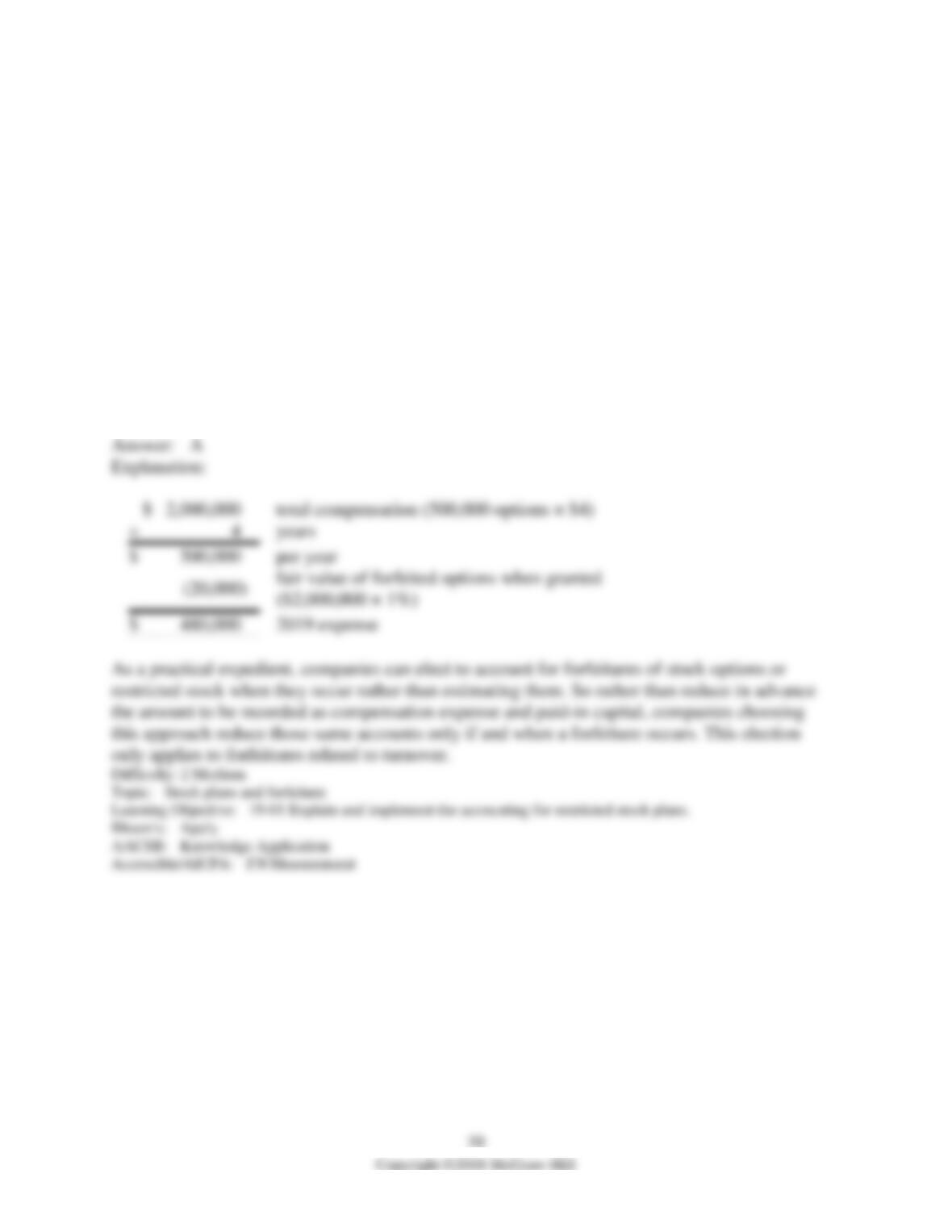
131) On January 1, 2018, Felix Austead Athletic Club (FAAC) granted stock options to key
executives exercisable for 500,000 shares of the company’s common stock at $18 per share. The
stock options are intended as compensation for the next four years. The options are exercisable
within a four-year period beginning January 1, 2022, by the executives still in the employ of the
company. No options were terminated during 2018, but the company anticipates 5% forfeitures
over the life of the stock options. The market price of the common stock was $18 per share at the
date of the grant. FAAC estimated the fair value of the options at $4 each. 1% of the options are
forfeited during 2019 due to executive turnover. What amount should FAAC record as
compensation expense for the year ended December 31, 2019, assuming FAAC chooses the
option not to estimate forfeitures?
A) $480,000.
B) $500,000.
C) $2,160,000.
D) $2,250,000.
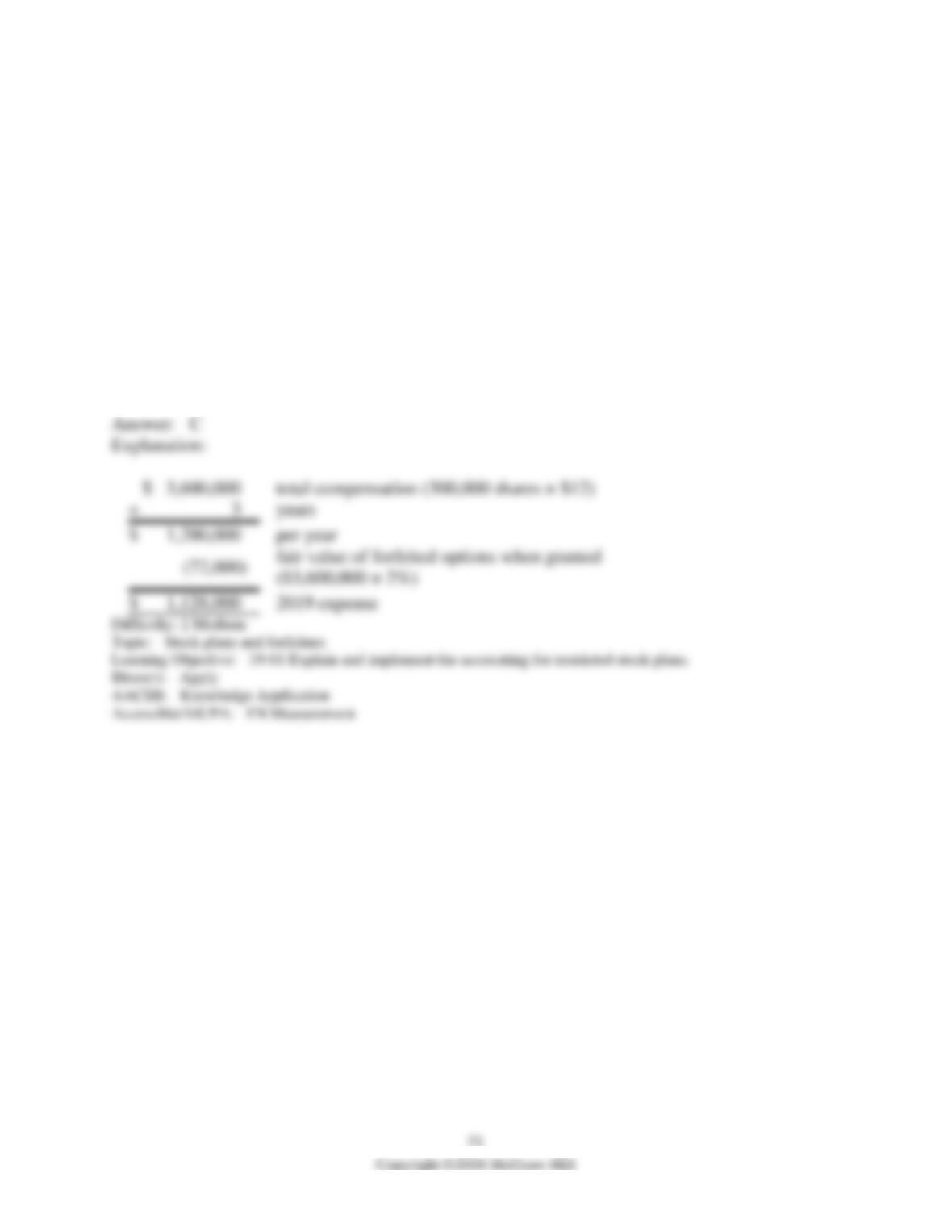
132) On January 1, 2018, Marguerite DeVille Co. granted restricted stock units (RSUs)
representing 300,000 of its $1 par common shares to executives, subject to forfeiture if
employment is terminated within three years. After the recipients of the RSUs satisfy the vesting
requirement, the company will distribute the shares. The common shares had a market price of
$12 per share on the grant date. At the date of grant, DeVille anticipated that 6% of the recipients
would leave the firm prior to vesting. In 2019, 2% of the options are forfeited due to executive
turnover. DeVille chooses the option not to estimate forfeitures. What amount should DeVille
record as compensation expense for the year ended December 31, 2019, assuming DeVille
chooses the option not to estimate forfeitures?
A) $72,000.
B) $94,000.
C) $1,128,000.
D) $1,200,000.
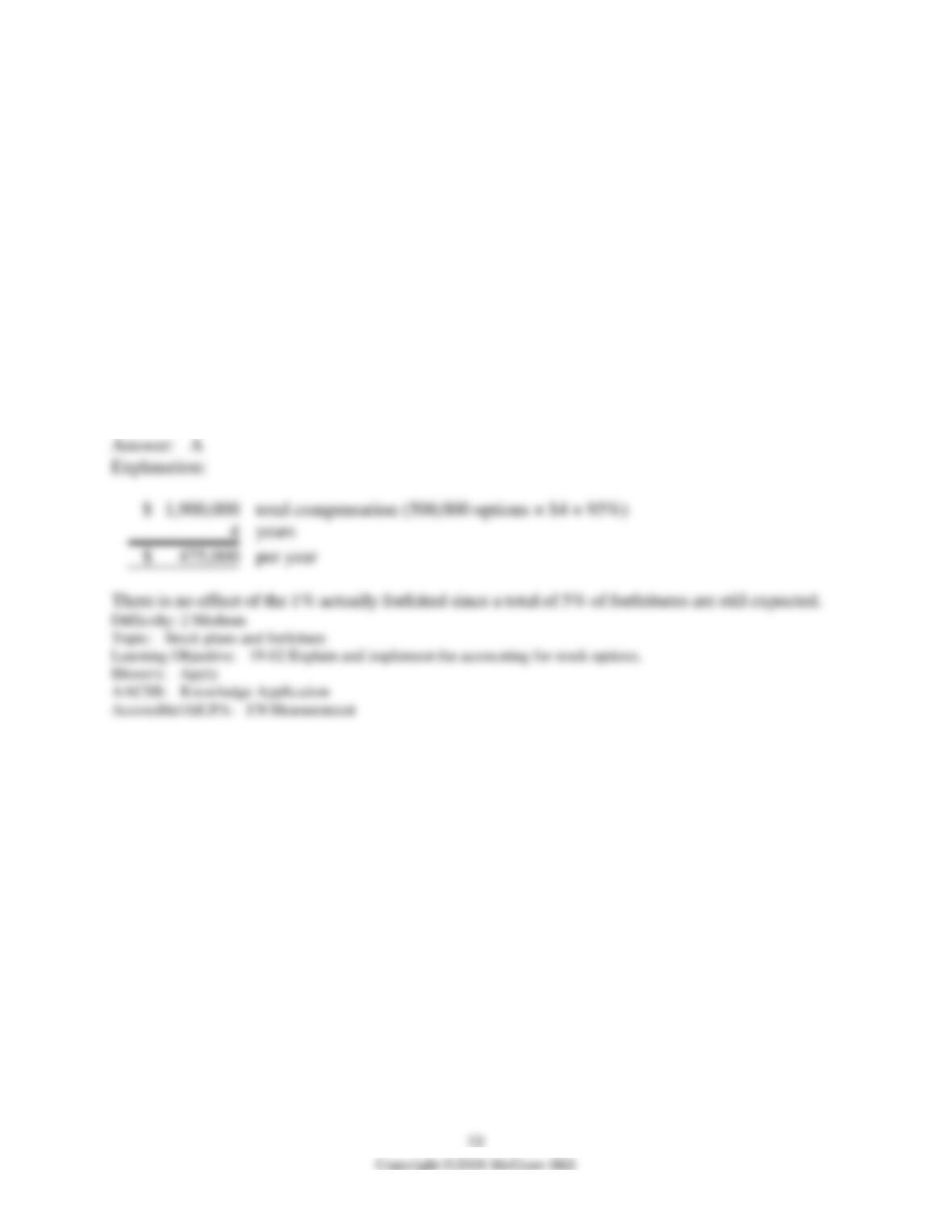
133) On January 1, 2018, Wendy Day Co. granted stock options to key executives exercisable
for 500,000 shares of the company’s common stock at $18 per share. The stock options are
intended as compensation for the next four years. The options are exercisable within a four-year
period beginning January 1, 2022, by the executives still in the employ of the company. No
options were terminated during 2018, but the company anticipates 5% forfeitures over the life of
the stock options. The market price of the common stock was $18 per share at the date of the
grant. Wendy Day estimated the fair value of the options at $4 each. 1% of the options are
forfeited during 2019 due to executive turnover. What amount should Wendy Day record as
compensation expense for the year ended December 31, 2019, assuming the company chooses
to estimate forfeitures?
A) $475,000.
B) $495,000.
C) $500,000.
D) $520,000.
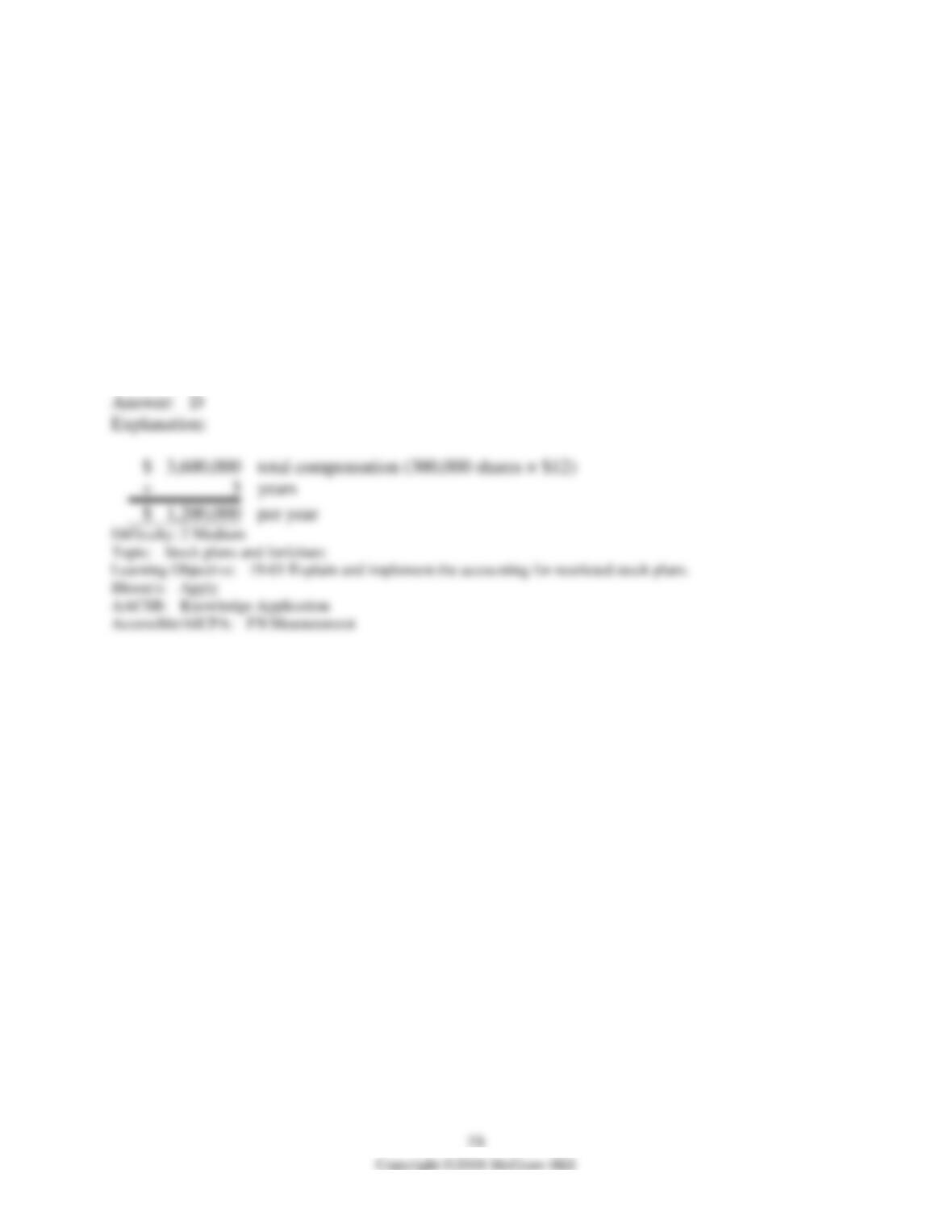
134) On January 1, 2018, Cori Ander Herbs granted restricted stock units (RSUs) representing
300,000 of its $1 par common shares to executives, subject to forfeiture if employment is
terminated within three years. After the recipients of the RSUs satisfy the vesting requirement,
the company will distribute the shares. The common shares had a market price of $12 per share
on the grant date. At the date of grant, the company anticipated that 6% of the recipients would
leave the firm prior to vesting. In 2019, 2% of the options are forfeited due to executive
turnover. The company chooses the option not to estimate forfeitures. What amount should the
company record as compensation expense for the year ended December 31, 2019?
A) $72,000.
B) $94,000.
C) $1,128,000.
D) $1,200,000.
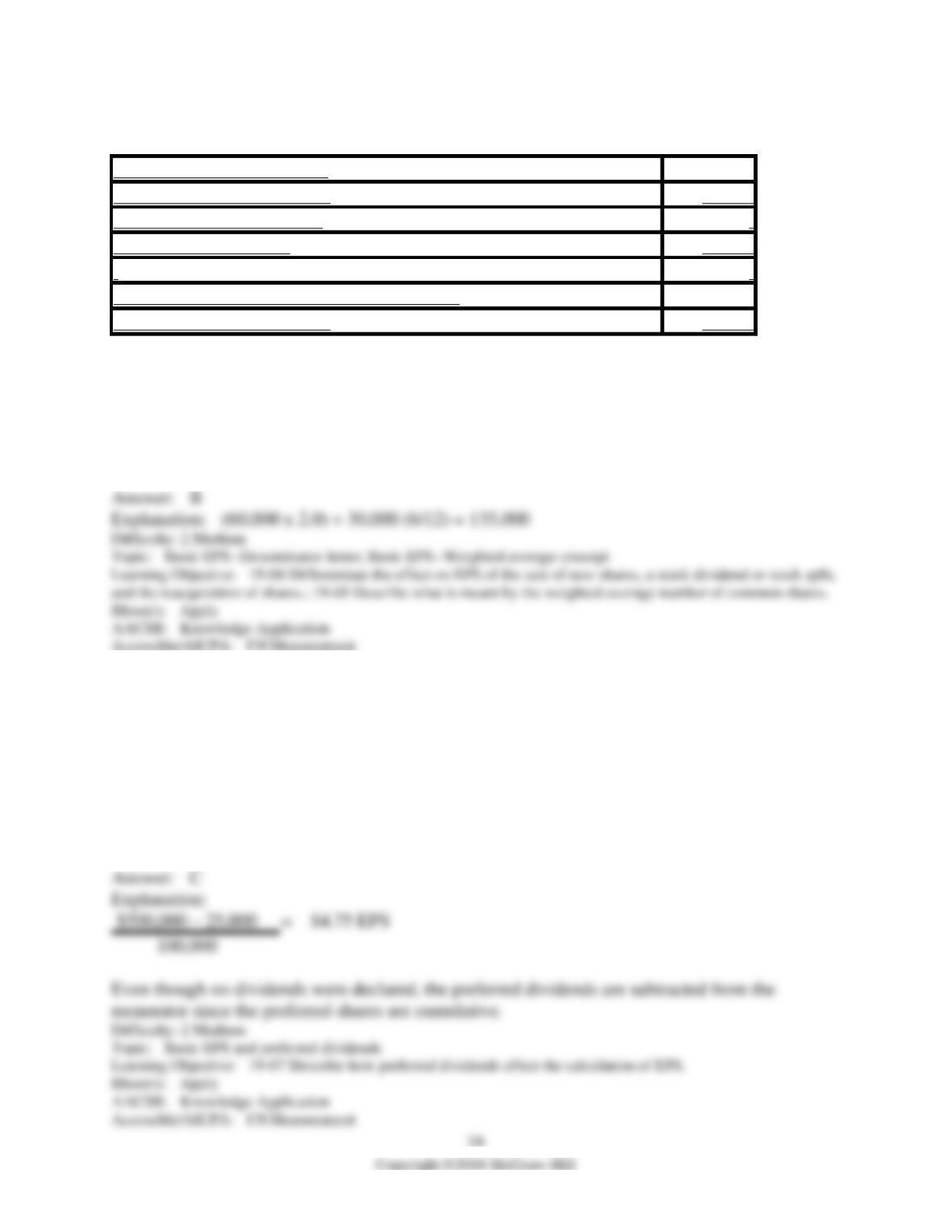
135) The following information pertains to Torque Corp.’s outstanding stock for 2018:
Common stock, $1 par value
Shares outstanding, 1/1/2018
60,000
2-for-1 stock split, 4/1/2018
Shares issued, 7/1/2018
30,000
Preferred stock, $10 par value, 6% cumulative
Shares outstanding, 1/1/2018
12,000
How many shares should Torque use to calculate 2018 basic earnings per share?
A) 120,000
B) 135,000
C) 150,000
D) 162,000
136) At December 31, 2018 and 2017, Cow Co. had 100,000 shares of common stock and 5,000
shares of 5%, $100 par value cumulative preferred stock outstanding. No dividends were
declared on either the preferred or common stock in 2018 or 2017. Net income for 2018 was
$500,000. For 2018, basic earnings per share was:
A) $2.50
B) $4.50
C) $4.75
D) $5.00
$4.75 EPS
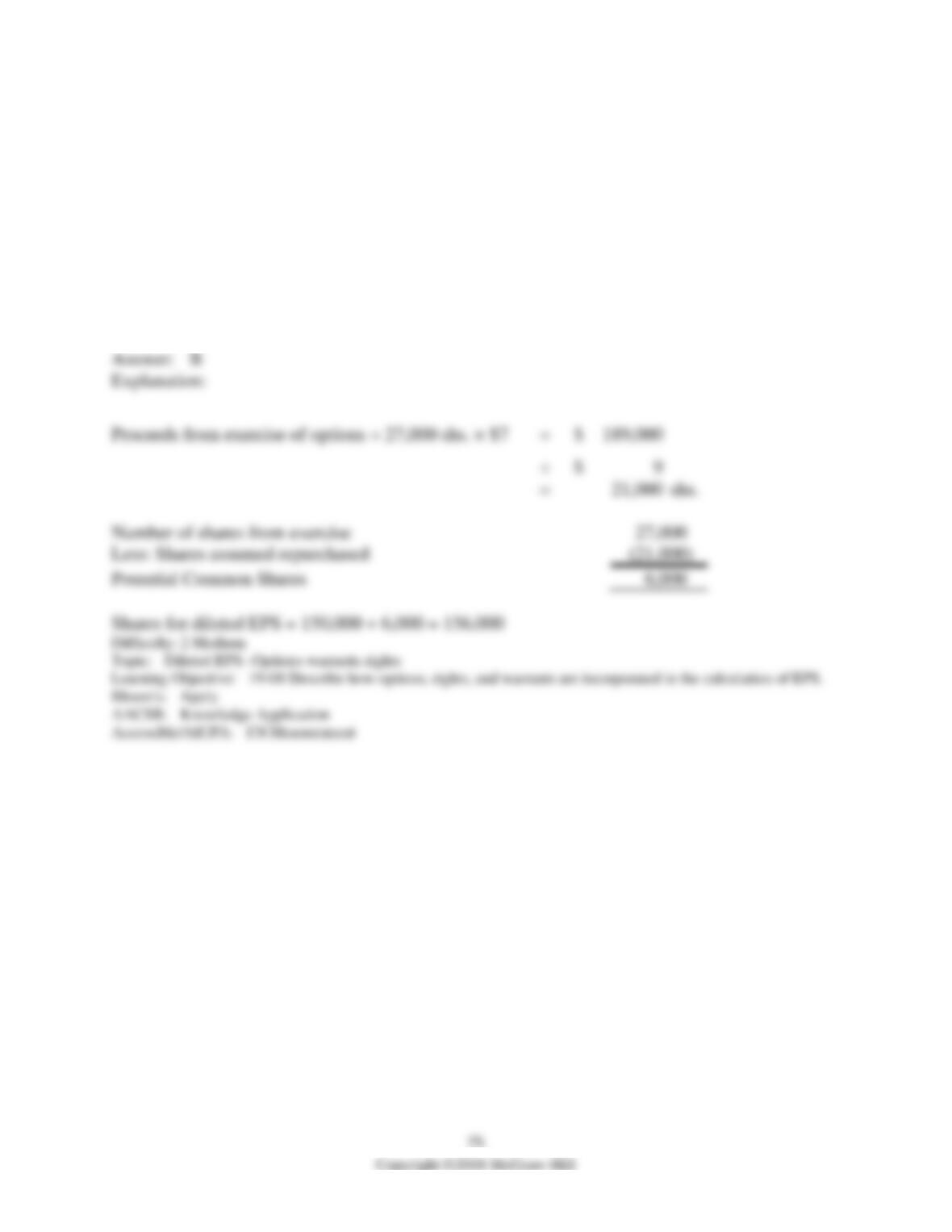
137) January 1, 2018, Woody Forrest Corporation granted executive stock options to purchase
27,000 of its common shares at $7 each. The market price of common stock was $10 per share
on December 31, 2018, and averaged $9 per share during the year then ended. There was no
change in the 150,000 shares of outstanding common stock during the year. Net income for the
year was $25,000. The number of shares to be used in computing diluted earnings per share for
the quarter is
A) 150,000
B) 156,000
C) 171,000
D) 177,000
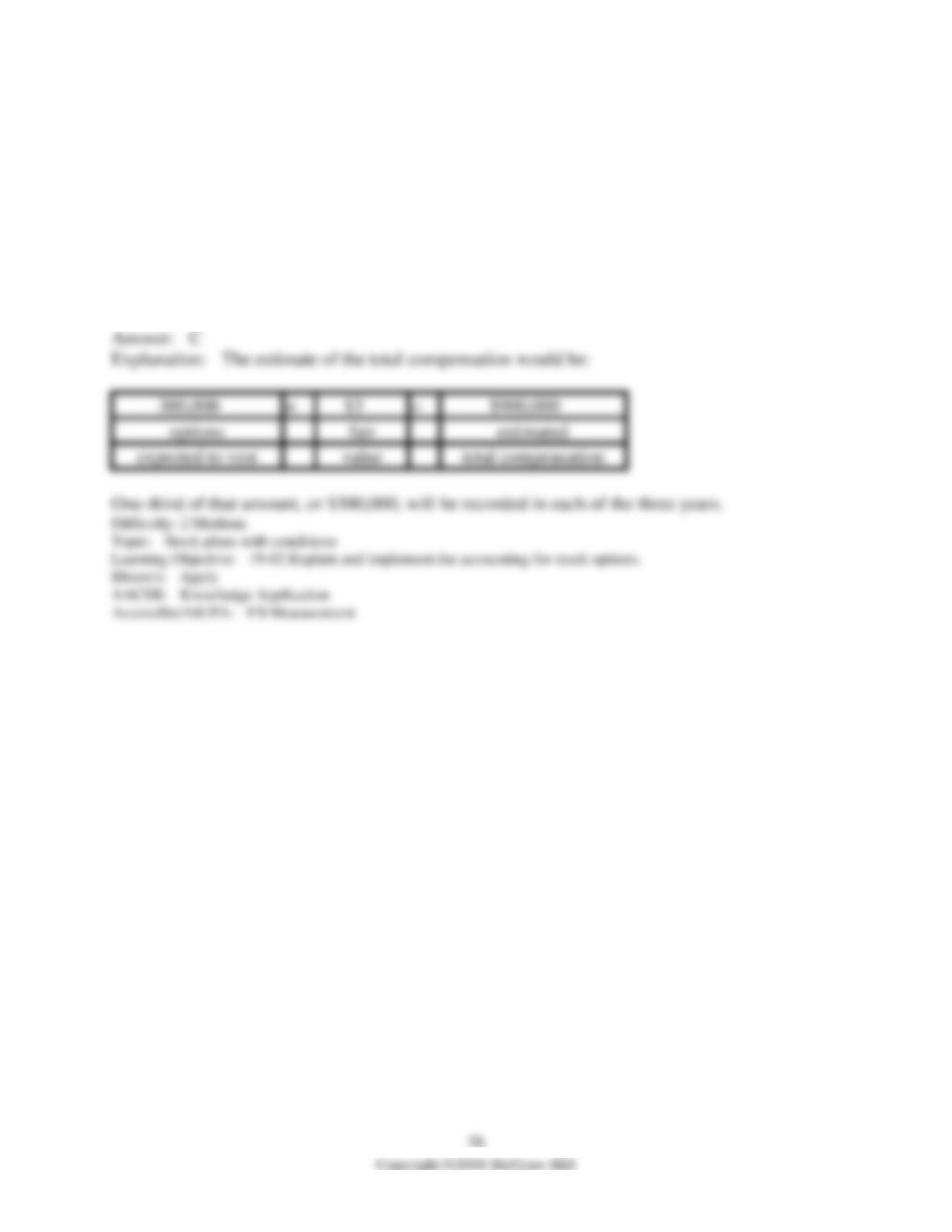
138) On October 1, 2018, Iona Frisbee Co. issued stock options for 300,000 shares to a division
manager. The options have an estimated fair value of $3 each. To provide additional incentive
for managerial achievement, the options are not exercisable unless divisional revenue increases
by 6% in three years. Frisbee initially estimates that it is probable the goal will be achieved. How
much compensation will be recorded in each of the next three years?
A) 0
B) 100,000
C) 300,000
D) 900,000
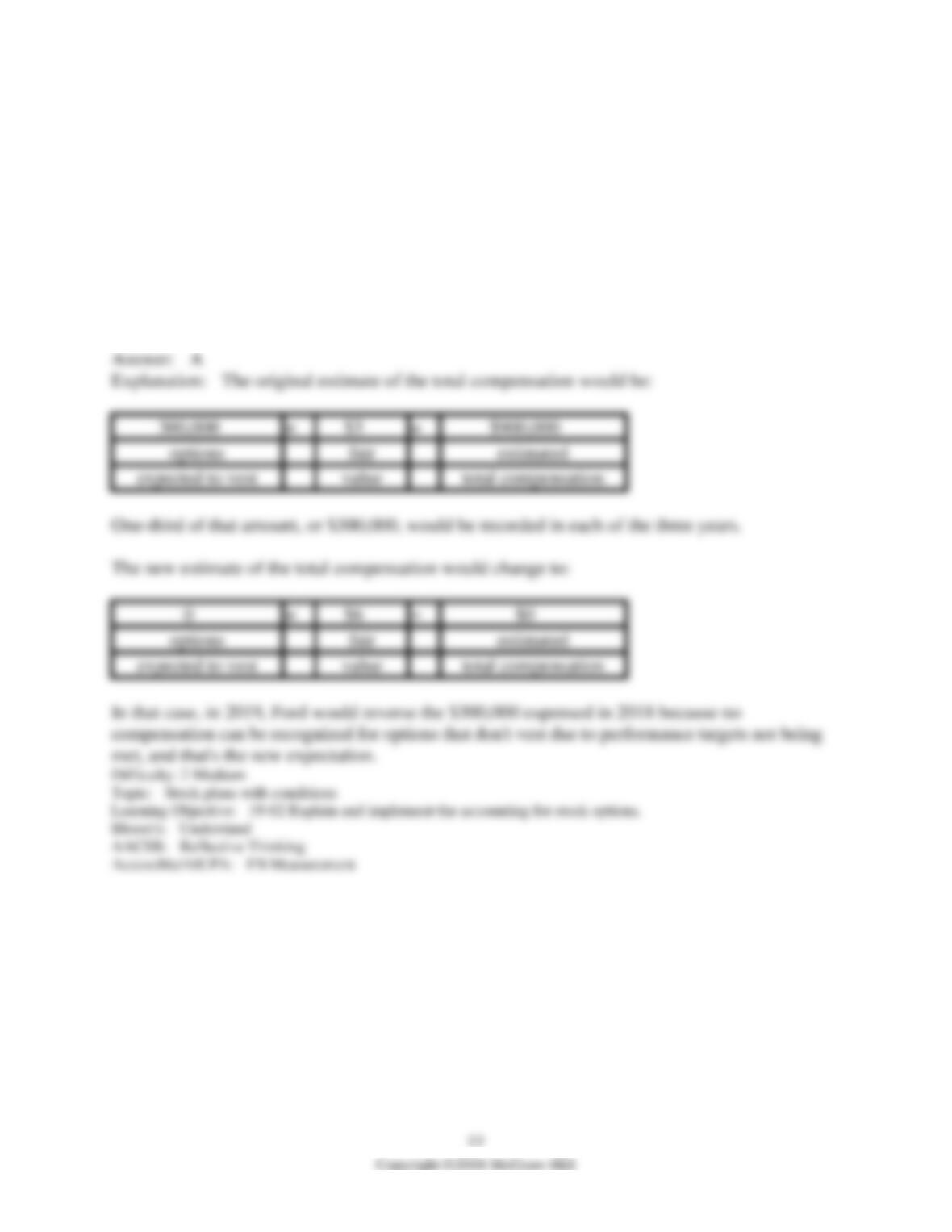
139) On October 1, 2018, Iona Ford Co. issued stock options for 300,000 shares to a division
manager. The options have an estimated fair value of $3 each. To provide additional incentive
for managerial achievement, the options are not exercisable unless divisional revenue increases
by 6% in three years. Ford initially estimates that it is probable the goal will be achieved. After
one year, Ford estimates that it is not probable that divisional revenue will increase by 5% in
three years. In 2019, Ford will:
A) reverse the amount expensed in 2018.
B) record one-half of the new estimated total compensation.
C) take no action.
D) continue to record the original estimated compensation.
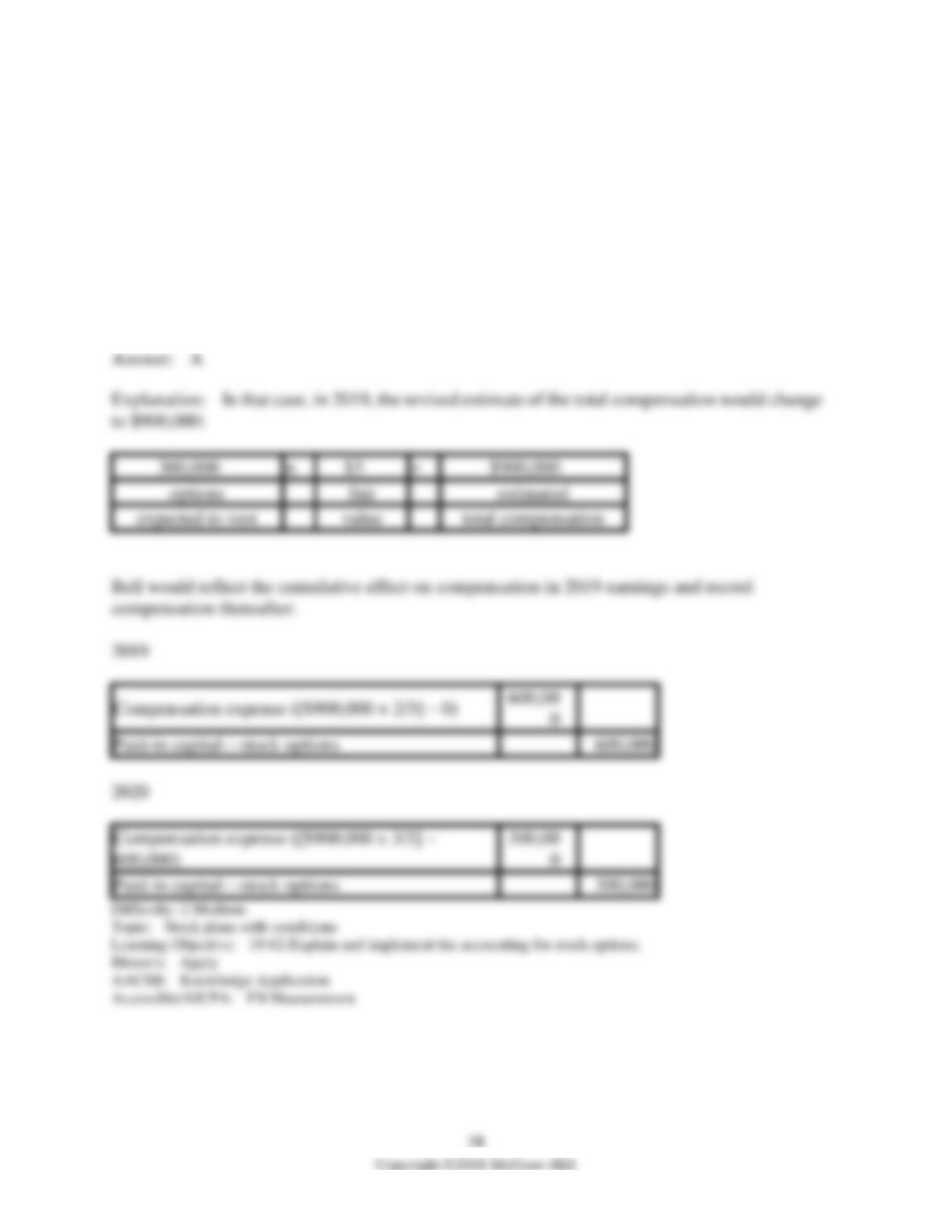
140) On October 1, 2018, Iona Bell Co. issued stock options for 300,000 shares to a division
manager. The options have an estimated fair value of $3 each. To provide additional incentive
for managerial achievement, the options are not exercisable unless divisional revenue increases
by 6% in three years. Bell initially estimates that it is not probable the goal will be achieved, but
then after one year, Bell estimates that it is probable that divisional revenue will increase by 6%
by the end of 2020. Bell will:
A) record compensation expense of $600,000 in 2019 and $300,000 in 2020.
B) record compensation expense of $300,000 in 2019 and $300,000 in 2020.
C) record compensation expense of $450,000 in 2019 and $450,000 in 2020.
D) record compensation expense of zero in 2019 and in 2020.
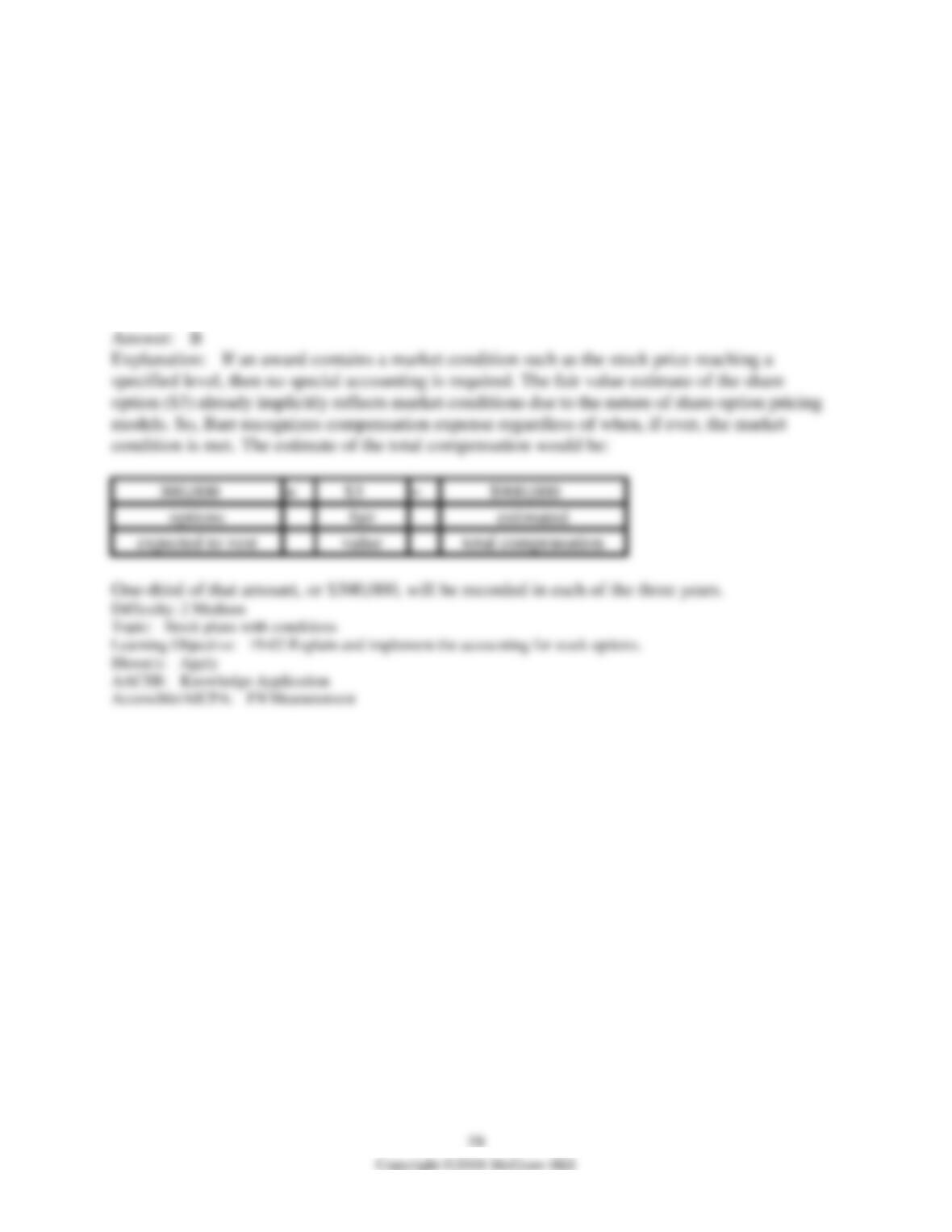
141) On October 1, 2018, Iona Barr issued stock options for 300,000 shares to a division
manager. The options have an estimated fair value of $3 each. To provide additional incentive
for managerial achievement, the options are not exercisable unless Barr’s stock price increases
by 6% in three years. Barr initially estimates that it is not probable the goal will be achieved.
How much compensation will be recorded in each of the next three years?
A) 100,000
B) 300,000
C) 0
D) 900,000
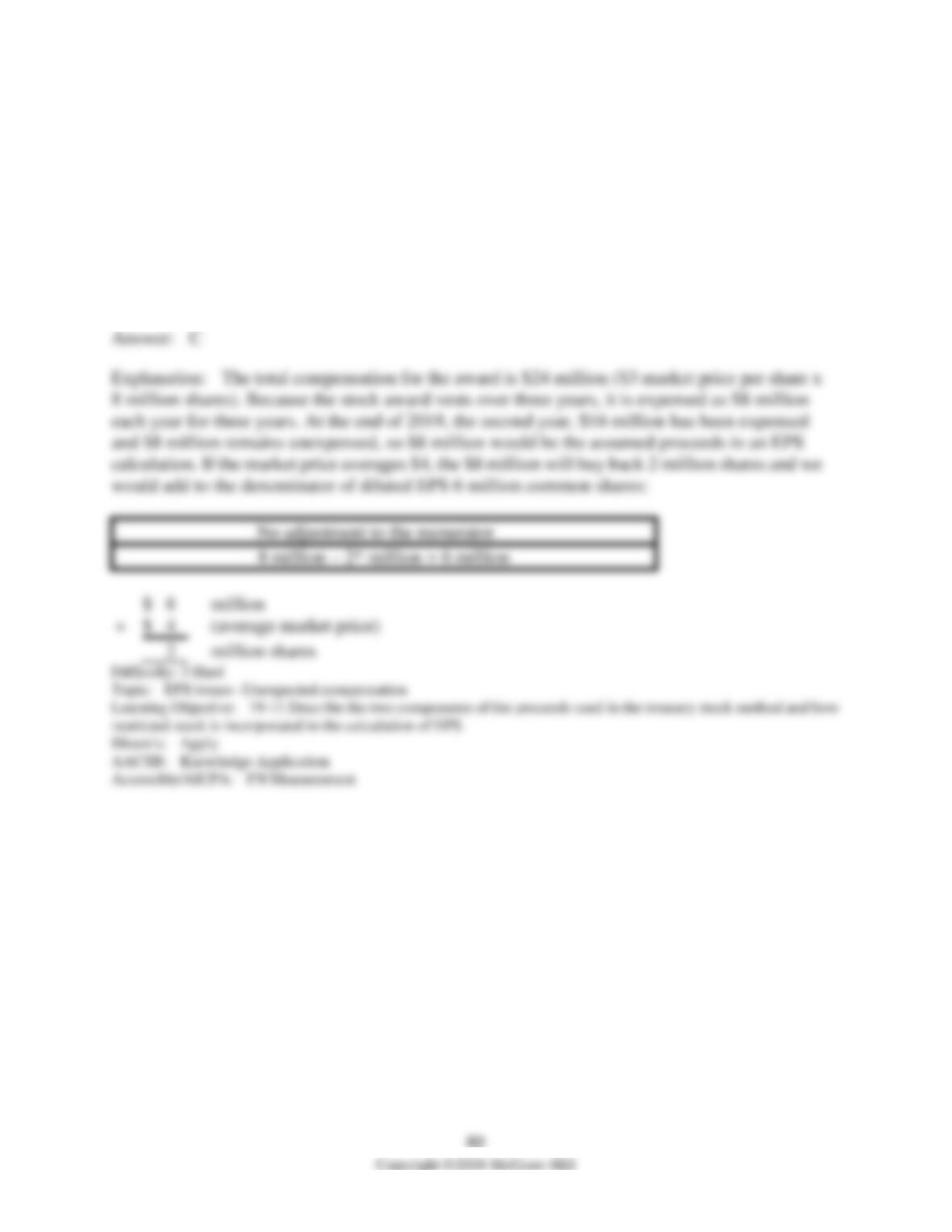
142) Isadore Bell Company granted 8 million of its no par common shares to executives, subject
to forfeiture if employment is terminated within three years. The common shares have a market
price of $3 per share on January 1, 2018, the grant date. When calculating diluted EPS at
December 31, 2019, what will be the net increase in the denominator of the EPS fraction if the
market price of the common shares averaged $4 per share during 2019?
A) 2 million
B) 2.67 million
C) 6 million
D) 8 million