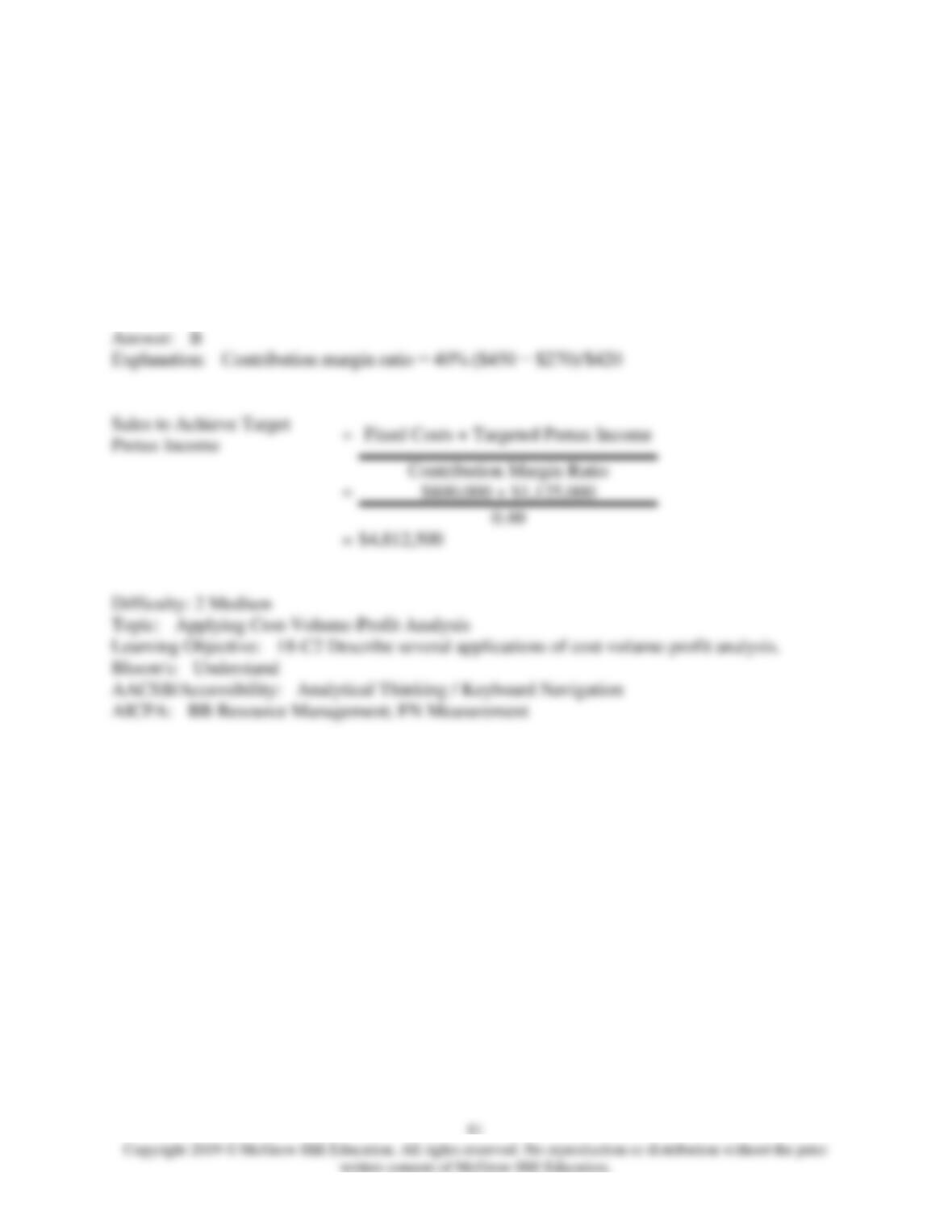
164) Wang Co. manufactures and sells a single product that sells for $450 per unit; variable costs
are $270 per unit. Annual fixed costs are $800,000. Current sales volume is $4,200,000.
Management targets an annual pre-tax income of $1,125,000. Compute the dollar sales to earn
the target pre-tax net income.
A) $5,640,000.
B) $4,812,500.
C) $3,378,378.
D) $2,991,004.
E) $2,612,613.
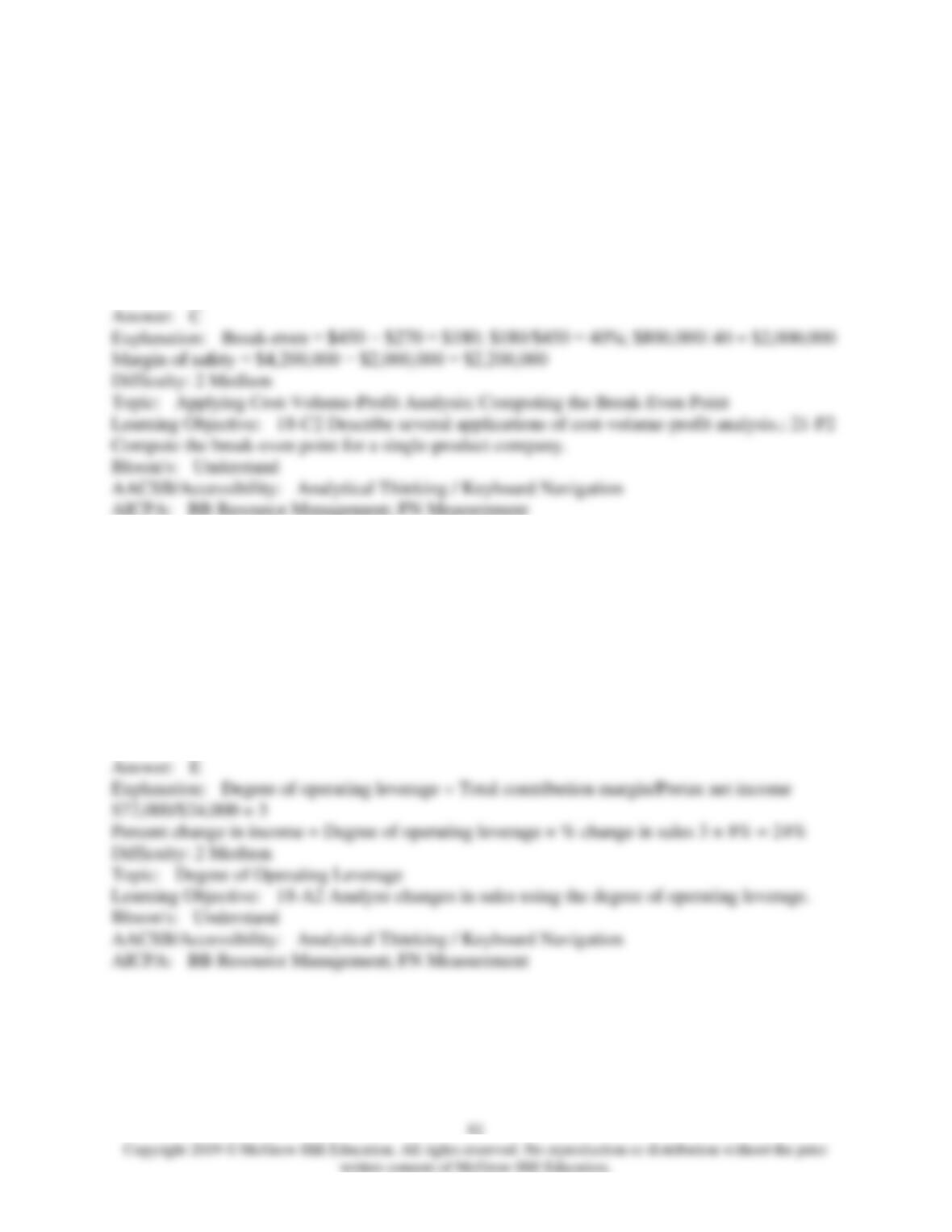
165) Wang Co. manufactures and sells a single product that sells for $450 per unit; variable costs
are $270 per unit. Annual fixed costs are $800,000. Current sales volume is $4,200,000.
Compute the current margin of safety in dollars.
A) $1,560,000.
B) $2,000,000.
C) $2,200,000.
D) $2,895,652.
E) $2,460,000.
166) Carver Packing Company reports total contribution margin of $72,000 and pretax net
income of $24,000 for the current month. In the next month, the company expects sales volume
to increase by 8%. The degree of operating leverage and the expected percent change in income,
respectively, are:
A) 4.0 and 32%
B) 0.33 and 8%
C) 0.33 and 2.7%
D) 3.0 and 8%
E) 3.0 and 24%
167) Morse Company reports total contribution margin of $48,000 and pretax net income of
$12,000 for the current month. The degree of operating leverage is:
A) 4.0
B) 0.25
C) 1.25
D) 2.5
E) 250%
168) A manufacturer reports the following costs to produce 10,000 units in its first year of
operations: Direct materials, $10 per unit, Direct labor, $6 per unit, Variable overhead, $70,000,
and Fixed overhead, $120,000. The total product cost per unit under absorption costing is:
A) $16 per unit.
B) $23 per unit.
C) $35 per unit.
D) $28 per unit.
E) $17 per unit.
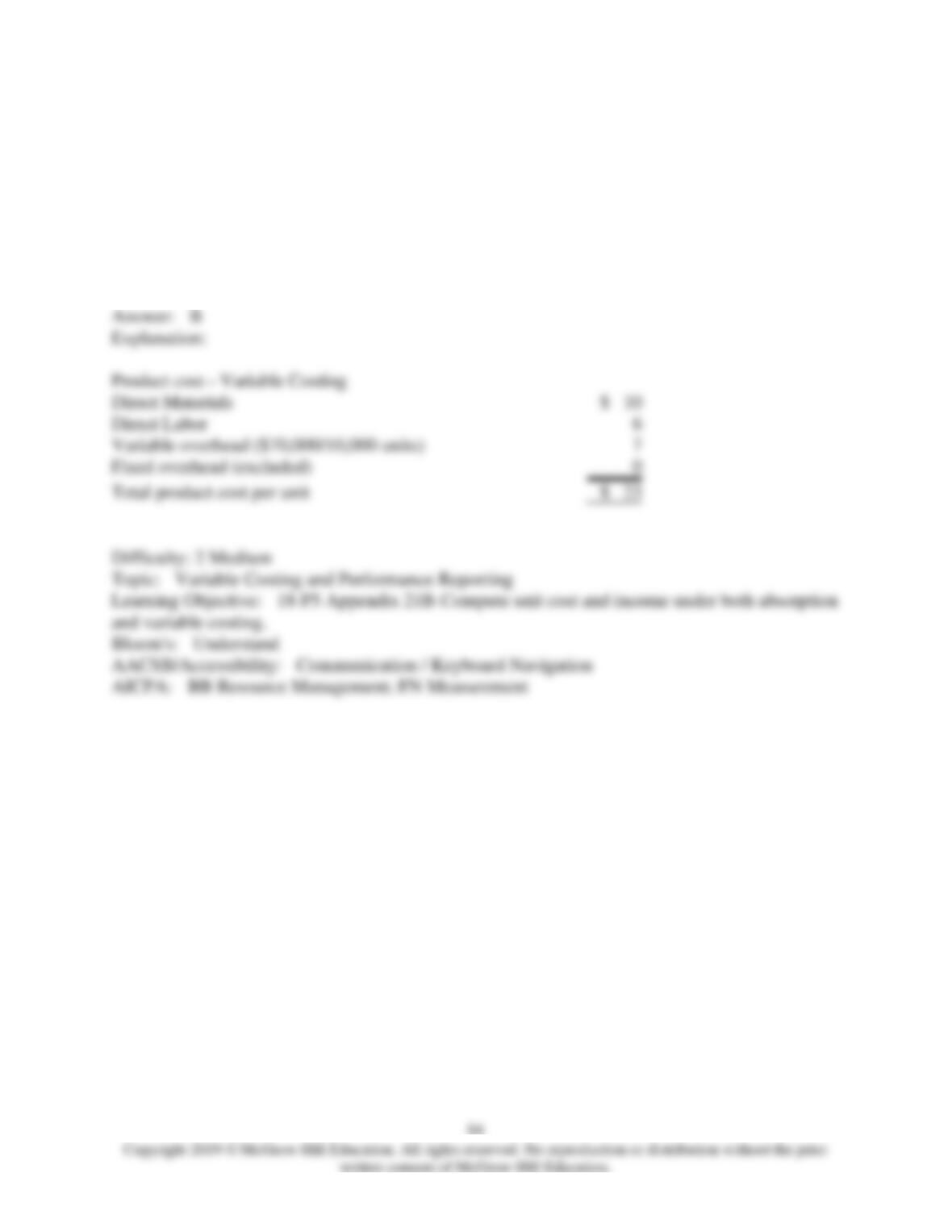
169) A manufacturer reports the following costs to produce 10,000 units in its first year of
operations: Direct materials, $10 per unit, Direct labor, $6 per unit, Variable overhead, $70,000,
and Fixed overhead, $120,000. The total product cost per unit under variable costing is:
A) $16 per unit.
B) $23 per unit.
C) $35 per unit.
D) $28 per unit.
E) $17 per unit.
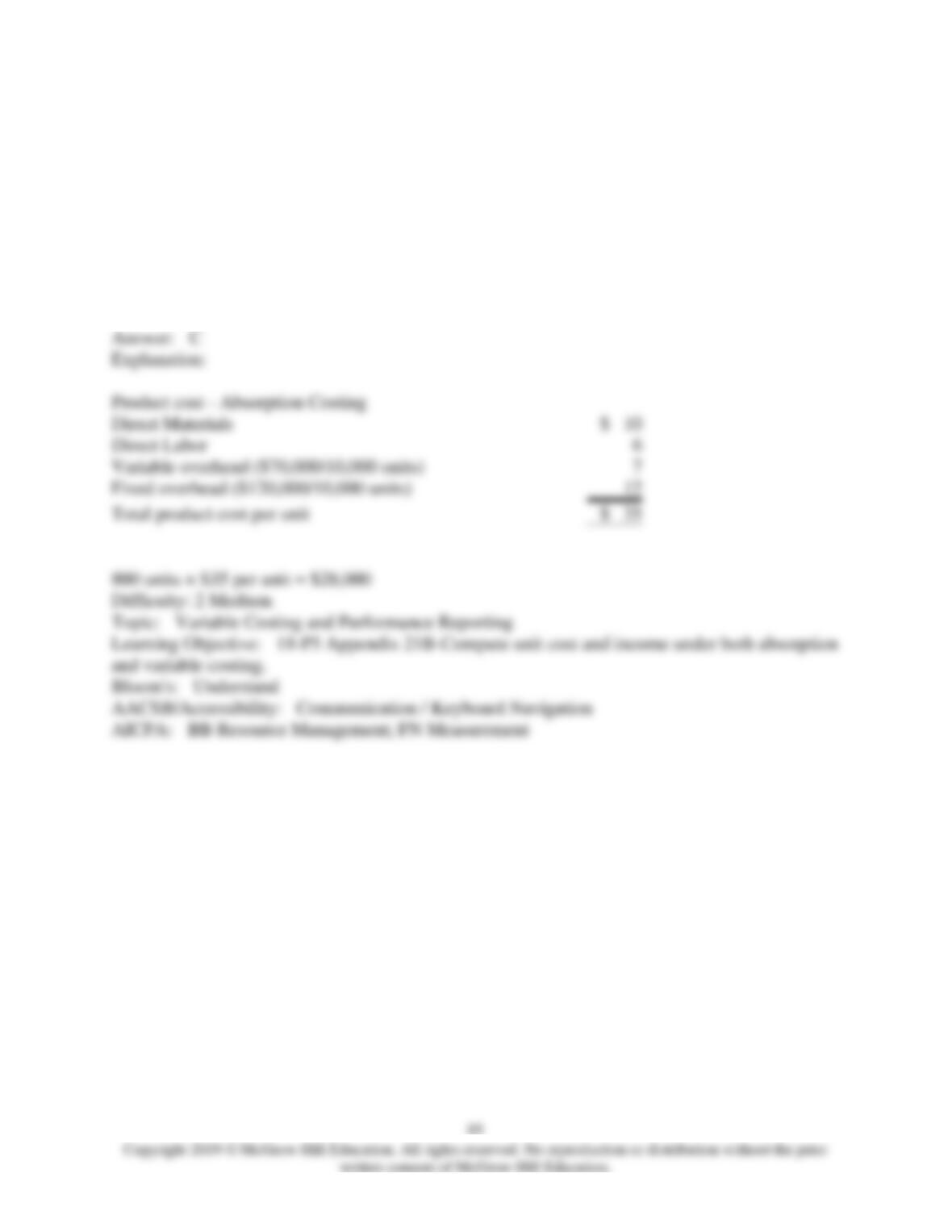
170) A manufacturer reports the following costs to produce 10,000 units in its first year of
operations: Direct materials, $10 per unit, Direct labor, $6 per unit, Variable overhead, $70,000,
and Fixed overhead, $120,000. Of the 10,000 units produced, 9,200 were sold, and 800 remain in
inventory at year-end. Under absorption costing, the value of the inventory is:
A) $12,800.
B) $18,400.
C) $28,000.
D) $22,400.
E) $13,600.
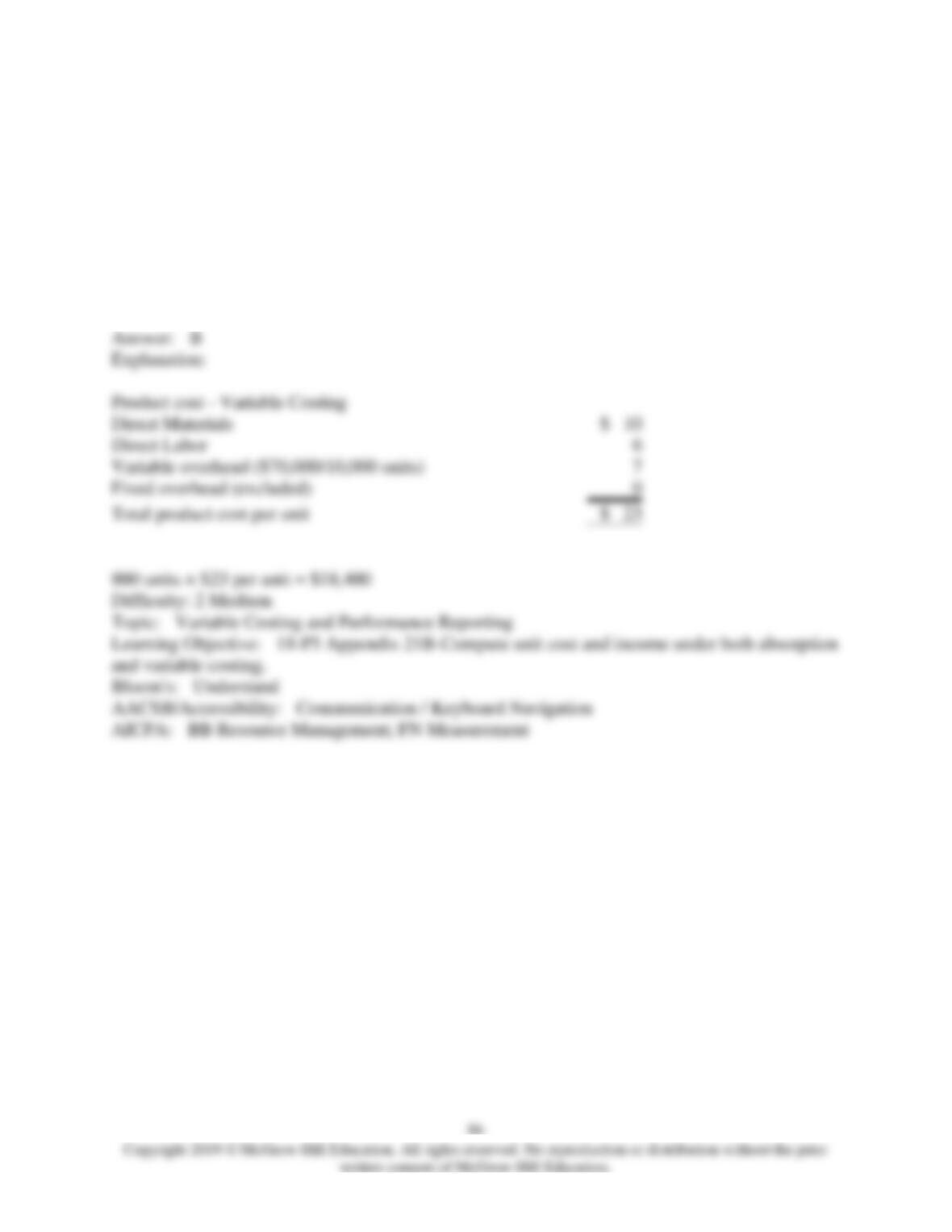
171) A manufacturer reports the following costs to produce 10,000 units in its first year of
operations: Direct materials, $10 per unit, Direct labor, $6 per unit, Variable overhead, $70,000,
and Fixed overhead, $120,000. Of the 10,000 units produced, 9,200 were sold, and 800 remain in
inventory at year-end. Under variable costing, the value of the inventory is:
A) $12,800.
B) $18,400.
C) $28,000.
D) $22,400.
E) $13,600.
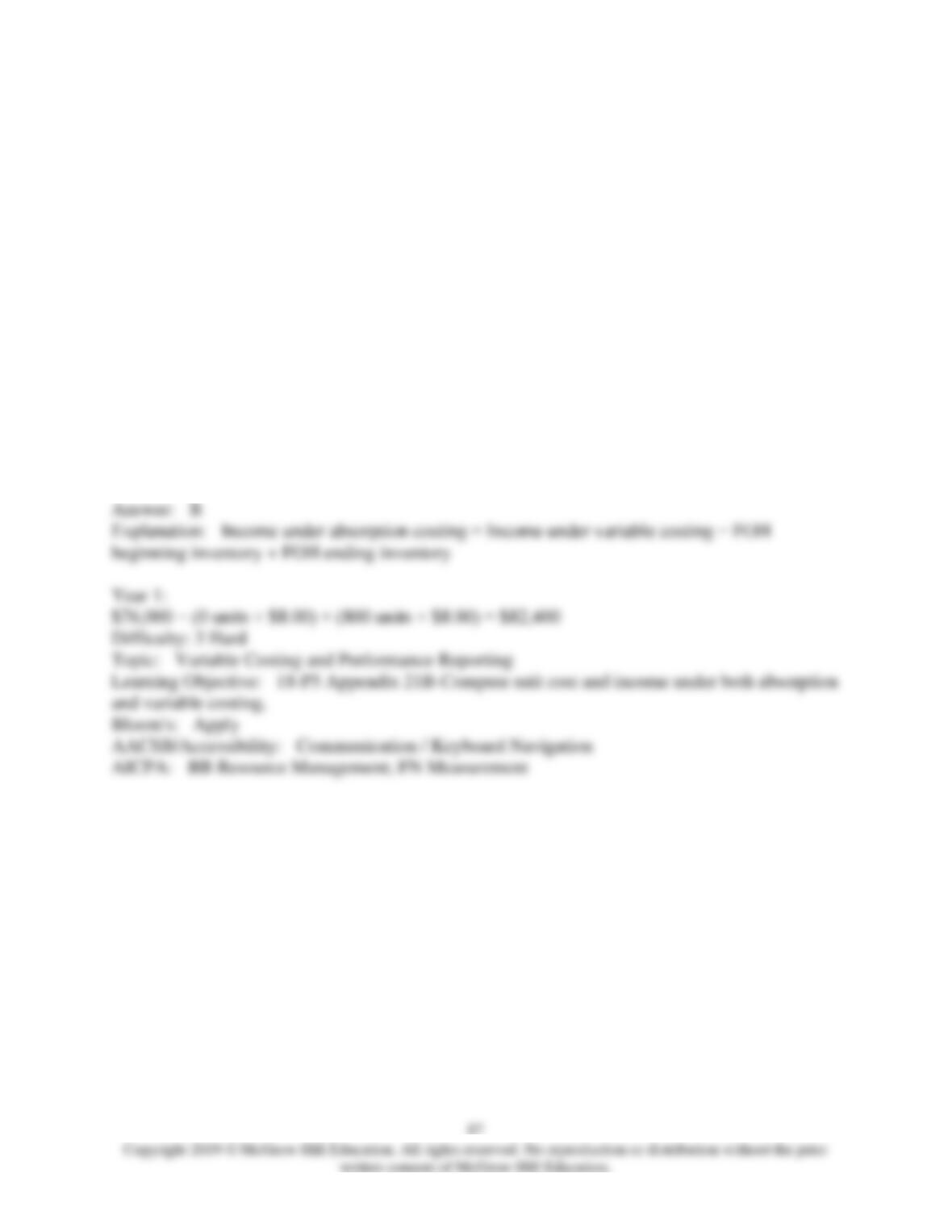
172) A manufacturer reports the following information below for its first three years in
operation.
Year 1
Year 2
Year 3
Income under variable costing
$
76,000
$
109,000
$
115,000
Beginning inventory (units)
0
800
500
Ending inventory (units)
800
500
0
Fixed manufacturing overhead per unit
$
8.00
$
8.00
$
8.00
Income for year 1 using absorption costing is:
A) $76,000.
B) $82,400.
C) $88,800.
D) $106,600.
E) $111,000.
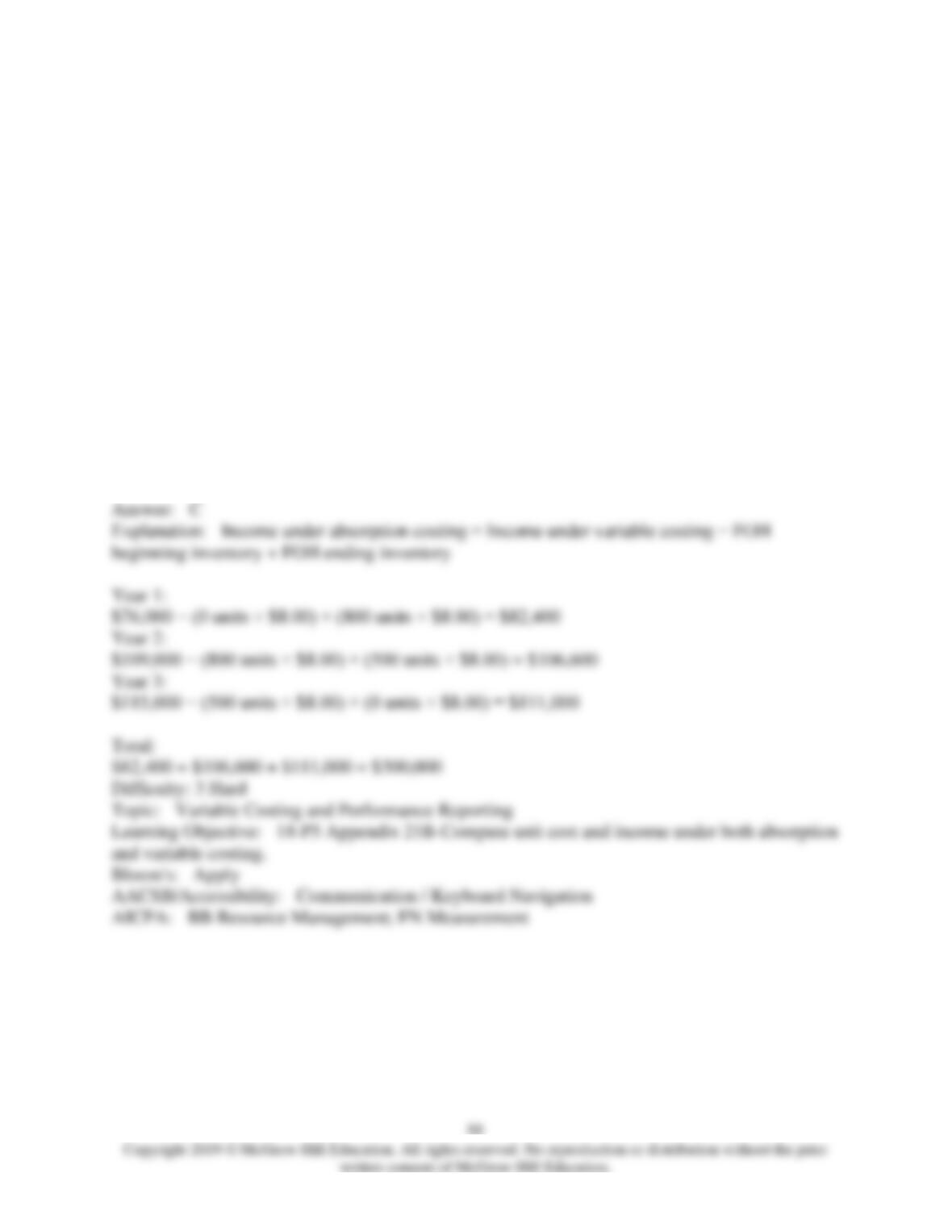
173) A manufacturer reports the following information below for its first three years in
operation.
Year 1
Year 2
Year 3
Income under variable costing
$
76,000
$
109,000
$
115,000
Beginning inventory (units)
0
800
500
Ending inventory (units)
800
500
0
Fixed manufacturing overhead per unit
$
8.00
$
8.00
$
8.00
Income for year 2 using absorption costing is:
A) $109,000.
B) $117,000.
C) $106,600.
D) $115,000.
E) $111,000.
174) A manufacturer reports the following information below for its first three years in
operation.
Year 1
Year 2
Year 3
Income under variable costing
$
76,000
$
109,000
$
115,000
Beginning inventory (units)
0
800
500
Ending inventory (units)
800
500
0
Fixed manufacturing overhead per unit
$
8.00
$
8.00
$
8.00
Income for year 3 using absorption costing is:
A) $109,000.
B) $117,000.
C) $106,600.
D) $115,000.
E) $111,000.
175) A manufacturer reports the following information below for its first three years in
operation.
Year 1
Year 2
Year 3
Income under variable costing
$
76,000
$
109,000
$
115,000
Beginning inventory (units)
0
800
500
Ending inventory (units)
800
500
0
Fixed manufacturing overhead per unit
$
8.00
$
8.00
$
8.00
Income for year 3-year period using absorption costing is:
A) $280,000.
B) $310,000.
C) $300,000.
D) $305,000.
E) $308,000.
176) Shown below are terms or phrases preceded by letters a through j followed by a list of
definitions. Match the terms or phrases 1 through 10 with the correct definitions by placing the
letter of the term or phrase in the answer space provided at the beginning of each definition.
(a) Mixed cost
(b) Fixed cost
(c) Contribution margin per unit
(d) Curvilinear cost
(e) Variable cost
(f) Step-wise cost
(g) Relevant range of operations
(h) Estimated line of cost behavior
(i) Least-squares regression
(j) Cost-volume-profit analysis
________(1) The amount that the sale of one unit contributes toward covering fixed costs and
generating profit.
________(2) A cost that changes in total in proportion to changes in volume of activity.
________(3) A cost that includes both fixed and variable cost components.
________(4) A cost that changes as volume changes, but at a nonconstant rate.
________(5) A line drawn on a graph to reflect the relation between cost and unit volume.
________(6) A statistical method for identifying cost behavior that is more precise than the high-
low method and a scatter diagram.
________(7) A company’s normal operating range of production volume; excludes extremely
high and low operating levels that are unlikely to recur.
________(8) A cost that remains constant over limited ranges of volumes of activity but shifts to
another level when volume changes significantly.
________(9) A business planning tool that helps managers predict how changes in costs and
sales levels affect profit.
________(10) A cost that remains unchanged in total amount despite variations in the volume of
activity within a relevant range.
177) Define variable cost, fixed cost, and mixed cost.
178) What are the cost behaviors per unit and in total for variable cost and fixed costs within the
relevant range?
179) Describe what happens to the net income of a company under each of the following
assumptions: (a) Units sold are less than break-even units. (b) Units sold are greater than break-
even units. (c) Units sold are equal to the break-even units.
180) Discuss how CVP analysis can be useful in planning.
181) Describe and compare the three cost estimation methods used to develop a cost equation.
182) What are the unit contribution margin and the contribution margin ratio? What do these
measures reveal about a company’s cost structure?
183) What is operating leverage? How can the degree of operating leverage be used in analyzing
changes in sales?
184) What is a scatter diagram? How is a scatter diagram used to estimate cost behavior?
185) What is the high-low method? Briefly describe how it is applied.
186) Define the break-even point of a company.
187) Briefly describe a CVP chart, including its major components.
188) Describe how a cost-volume-profit analysis would be performed for a company that sells
more than one product when the sales mix is known.
189) A company has a goal of earning $128,000 in pre-tax income. The contribution margin ratio
is 30%. What dollar amount of sales must be achieved to reach the goal if fixed costs are
$64,000?
190) A company has total fixed costs of $200,000. Its product sells for $25 per unit and variable
costs amount to $15 per unit. The company has a target pre-tax income of $50,000. How many
units must be sold to achieve this pre-tax target income?
191) Proctor Company has fixed costs of $315,000 and a contribution margin ratio of 24%. If
sales are expected to be $1,500,000, what is the margin of safety, in percent?
192) Johnston Co. anticipates total fixed costs of $120,000 and variable costs equal to 40% of
sales. What is the pretax income if sales are $650,000?
193) Journey Company is considering the production and sale of a new product with the
following sales and cost data: unit sales price $18; unit variable costs $8.50; and total fixed costs
of $81,250. Determine the dollar sales needed to generate a pre-tax income of $44,000, rounded
to the nearest whole dollar.
194) Philadelphia Co. is considering the production and sale of a new product with the following
sales and cost data: unit sales price, $300; unit variable costs, $180; total fixed costs, $270,000;
and projected sales, $900,000. What is the margin of safety:
(a) In dollar sales? And (b) As a percent of sales?
195) Zola Co. has a contribution margin ratio of 40% and would like to determine whether an
additional advertising expenditure of $4,000 would increase sales by $8,000. Calculate the
increase or decrease in net income that would result from this change, and comment on whether
Zola should purchase the additional advertising.
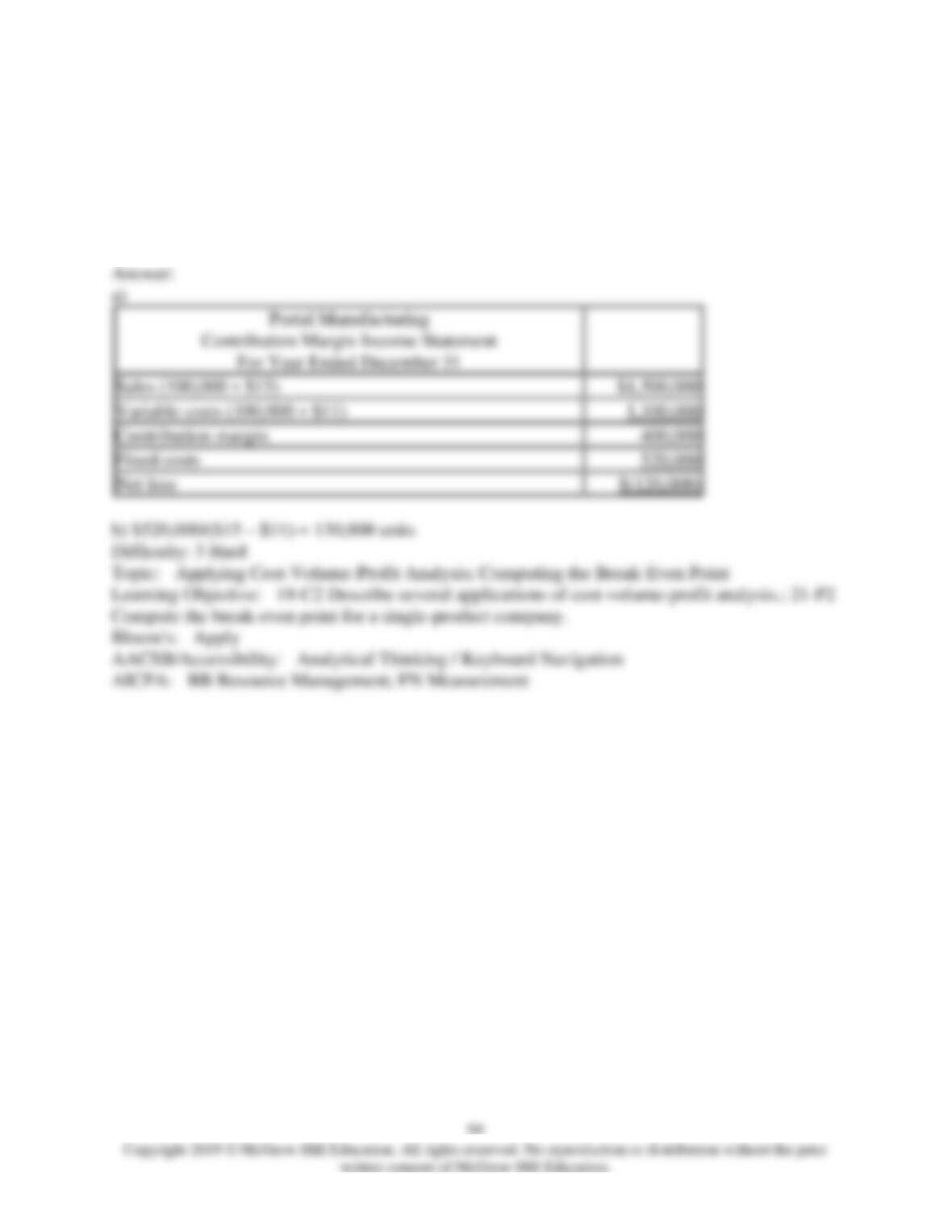
196) Portal Manufacturing has total fixed costs of $520,000. A unit of product sells for $15 and
variable costs per unit are $11.
a) Prepare a contribution margin income statement showing predicted net income (loss) if Portal
sells 100,000 units for the year ended December 31.
b) At a minimum, how many units must Portal sell in order not to incur a loss?
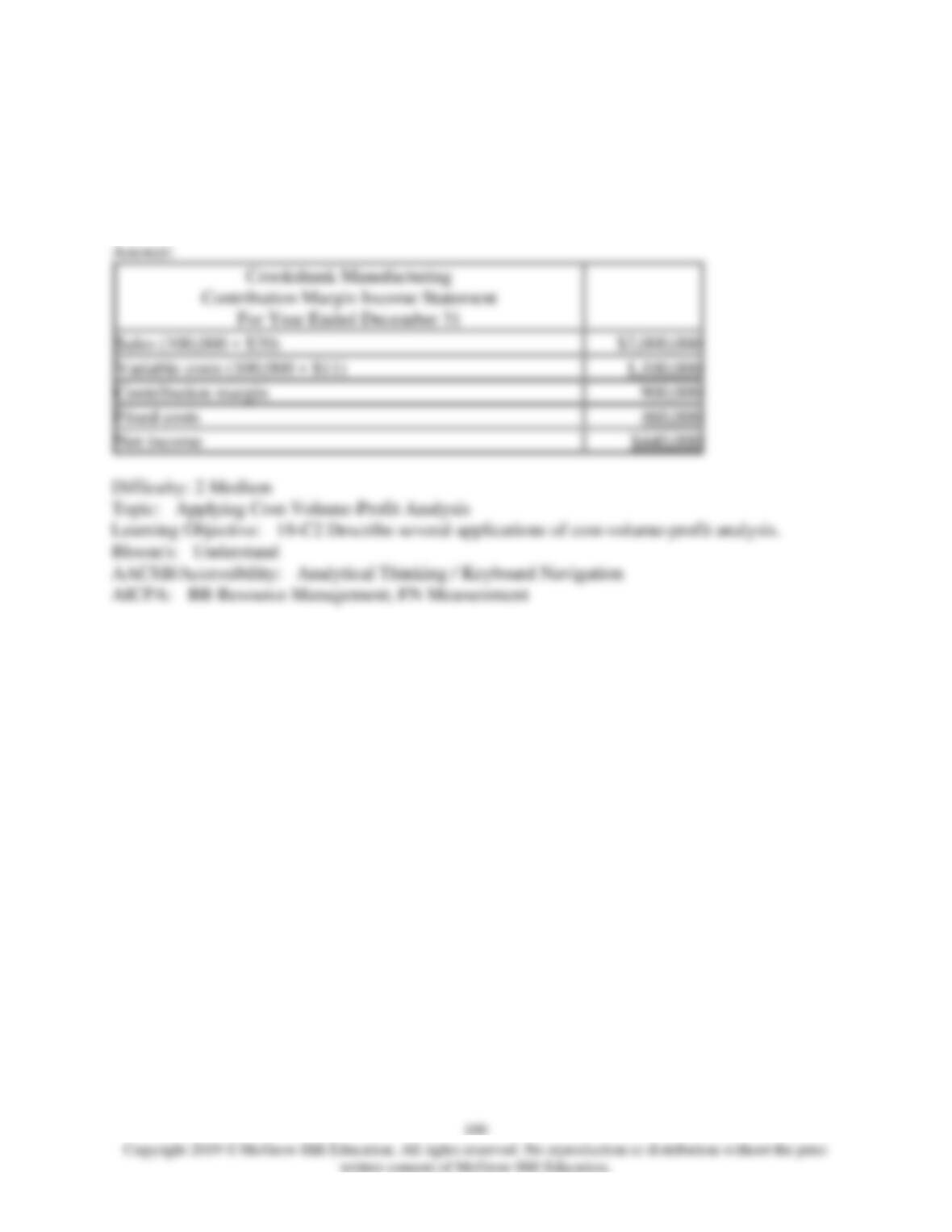
197) Crookshank Manufacturing has total fixed costs of $460,000. A unit of product sells for $20
and variable costs per unit are $11.
Prepare a contribution margin income statement showing predicted net income (loss) if
Crookshank sells 100,000 units for the year ended December 31.