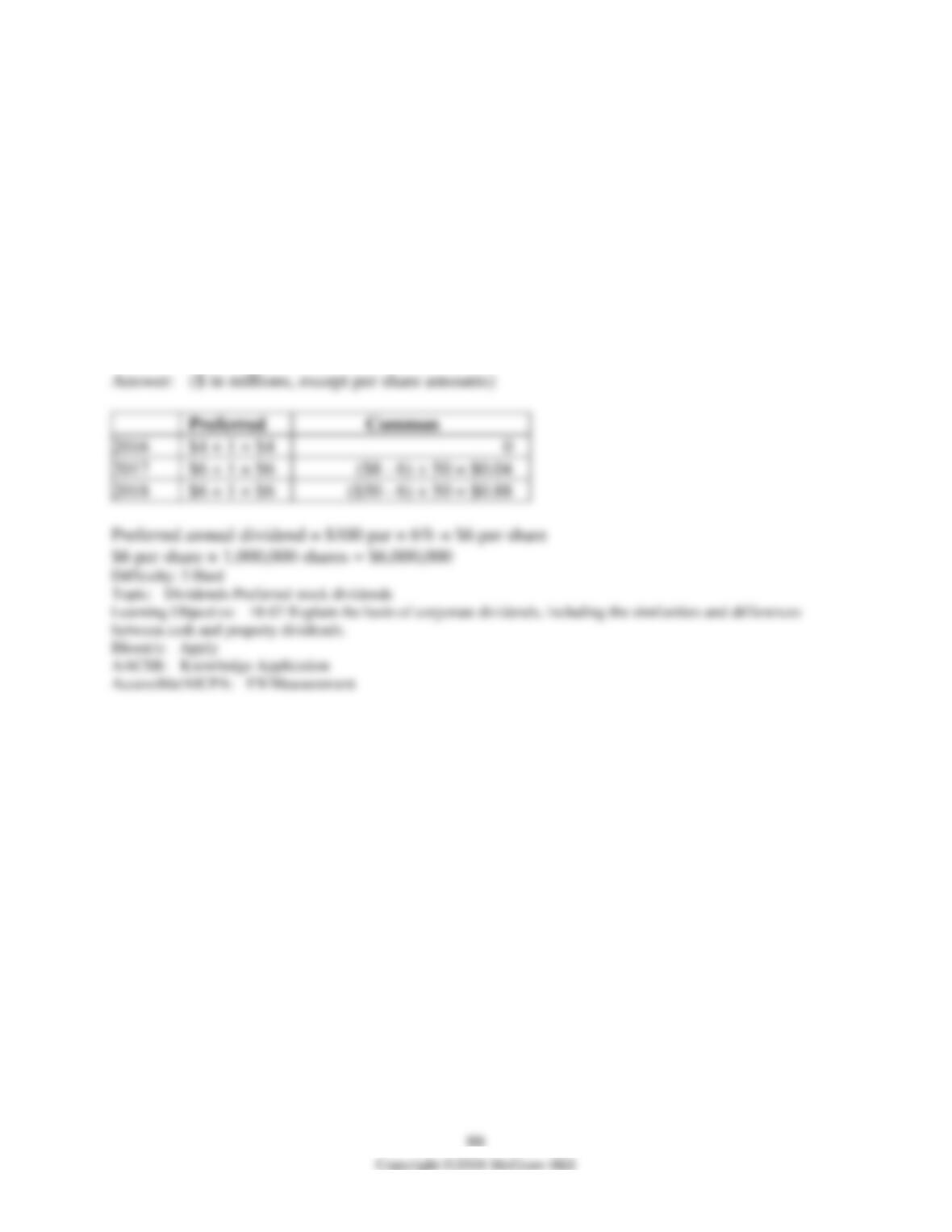
166) The shareholders’ equity of Nick Co. includes the items shown below. The board of
directors of Nick declared cash dividends of $4 million, $8 million, and $50 million in each of its
first 3 years of operation: 2016, 2017, and 2018, respectively.
Common stock, $1 par, 50,000,000 shares outstanding
Preferred stock, 6%, $100 par, 1,000,000 shares outstanding
Required:
Determine the amount of dividends per share on preferred and common stock for each of the
three years. The preferred stock is noncumulative and nonparticipating.
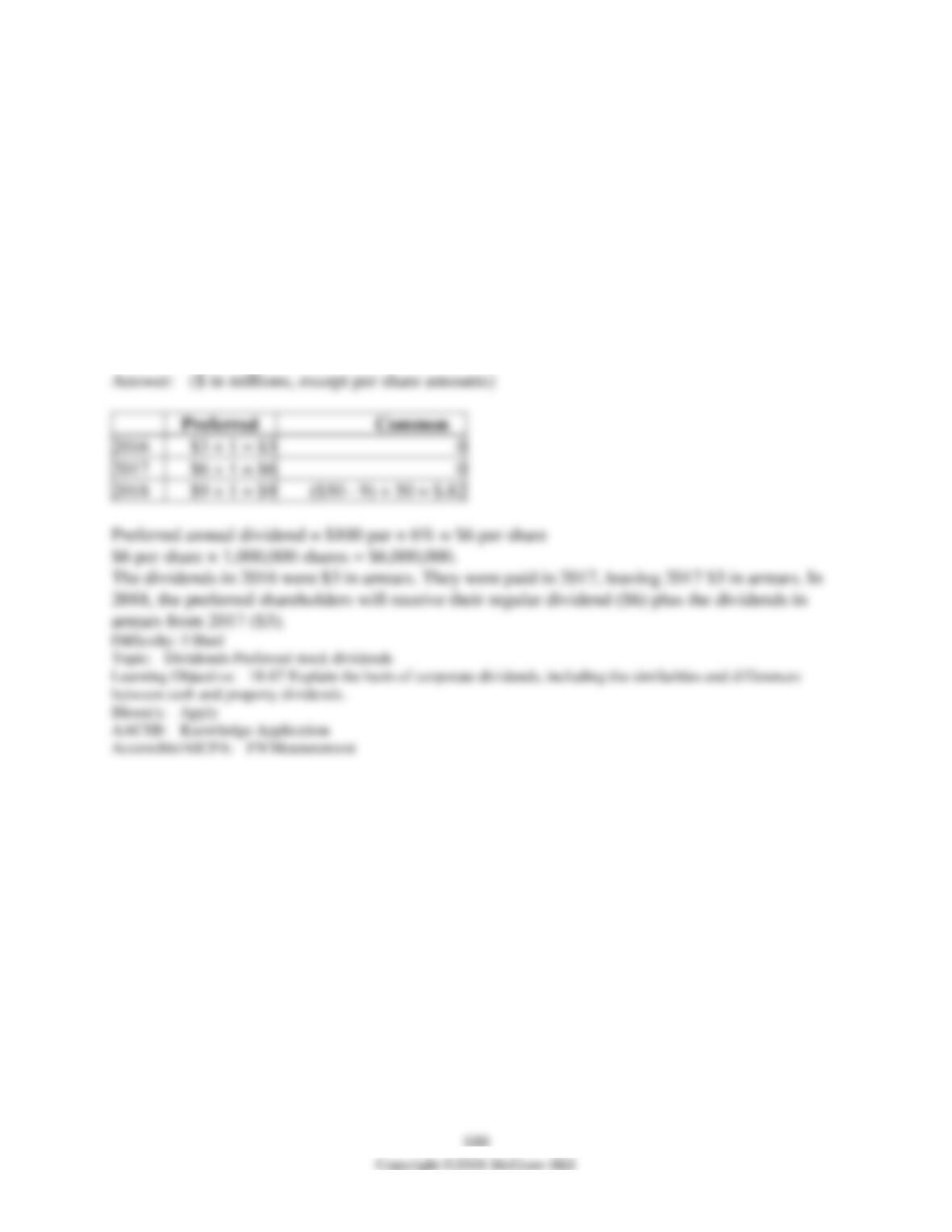
167) The shareholders’ equity of Crystal Company includes the items shown below. The board
of directors of Crystal declared cash dividends of $3 million, $6 million, and $50 million in each
of its first three years of operation: 2016, 2017, and 2018, respectively.
Common stock, $1 par, 50,000,000 shares outstanding
Preferred stock, 6%, $100 par, 1,000,000 shares outstanding
Required:
Determine the amount of dividends per share on preferred and common stock for each of the
three years. The preferred stock is cumulative and nonparticipating.
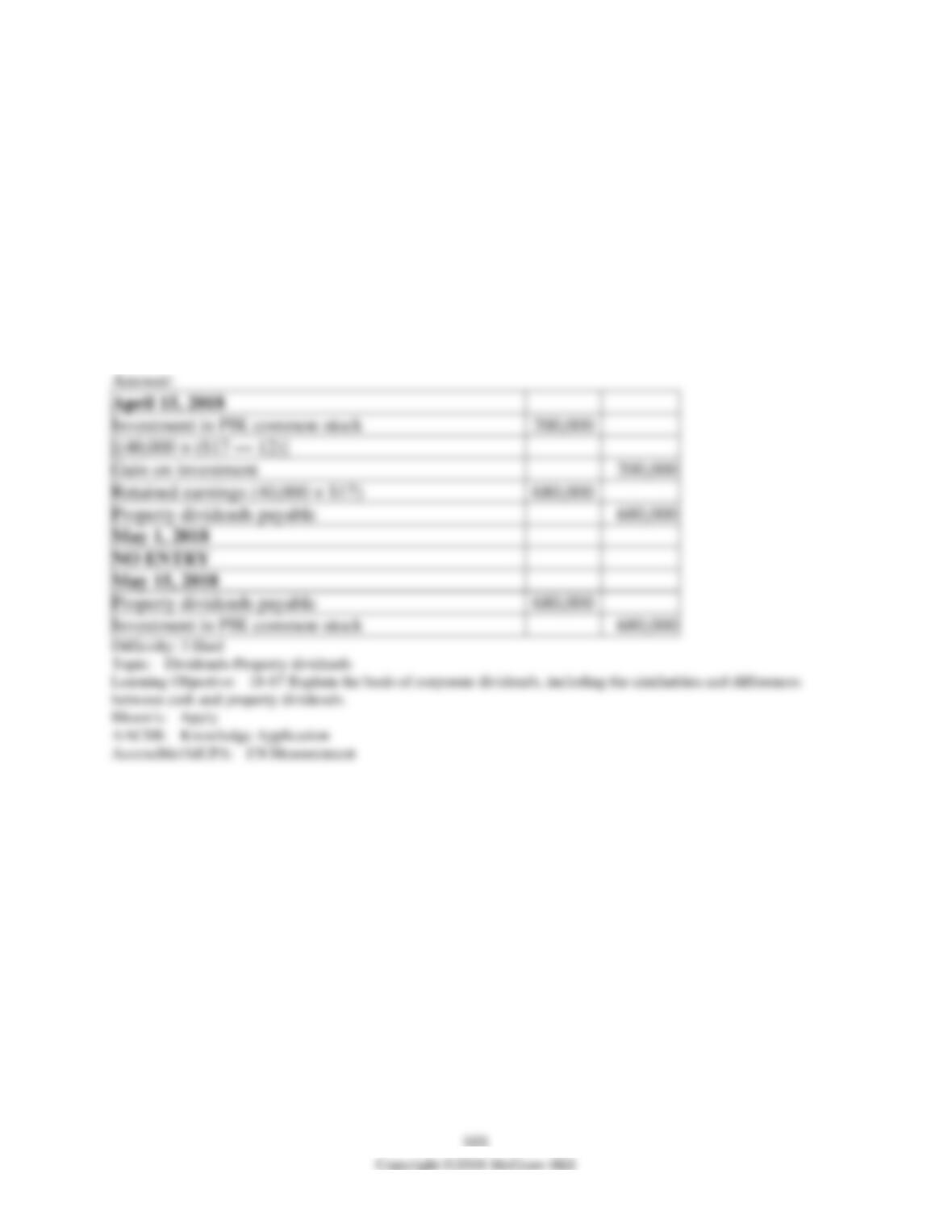
168) ZIP Company owns 40,000 shares of the common stock of PIK Company. ZIP decided to
divest itself of this investment by distributing the PIK shares in the form of a property dividend.
The dividend ratio is one share of PIK for every four shares of ZIP common held by
shareholders. ZIP has 160,000 common shares outstanding. On April 15, 2018, the date of
declaration, PIK stock had a par of $5 per share, a book value of $12 per share, and a fair value
of $17 per share.
Required:
Prepare any necessary journal entries. The shares were distributed on May 15, 2018, to
stockholders of record on May 1, 2018
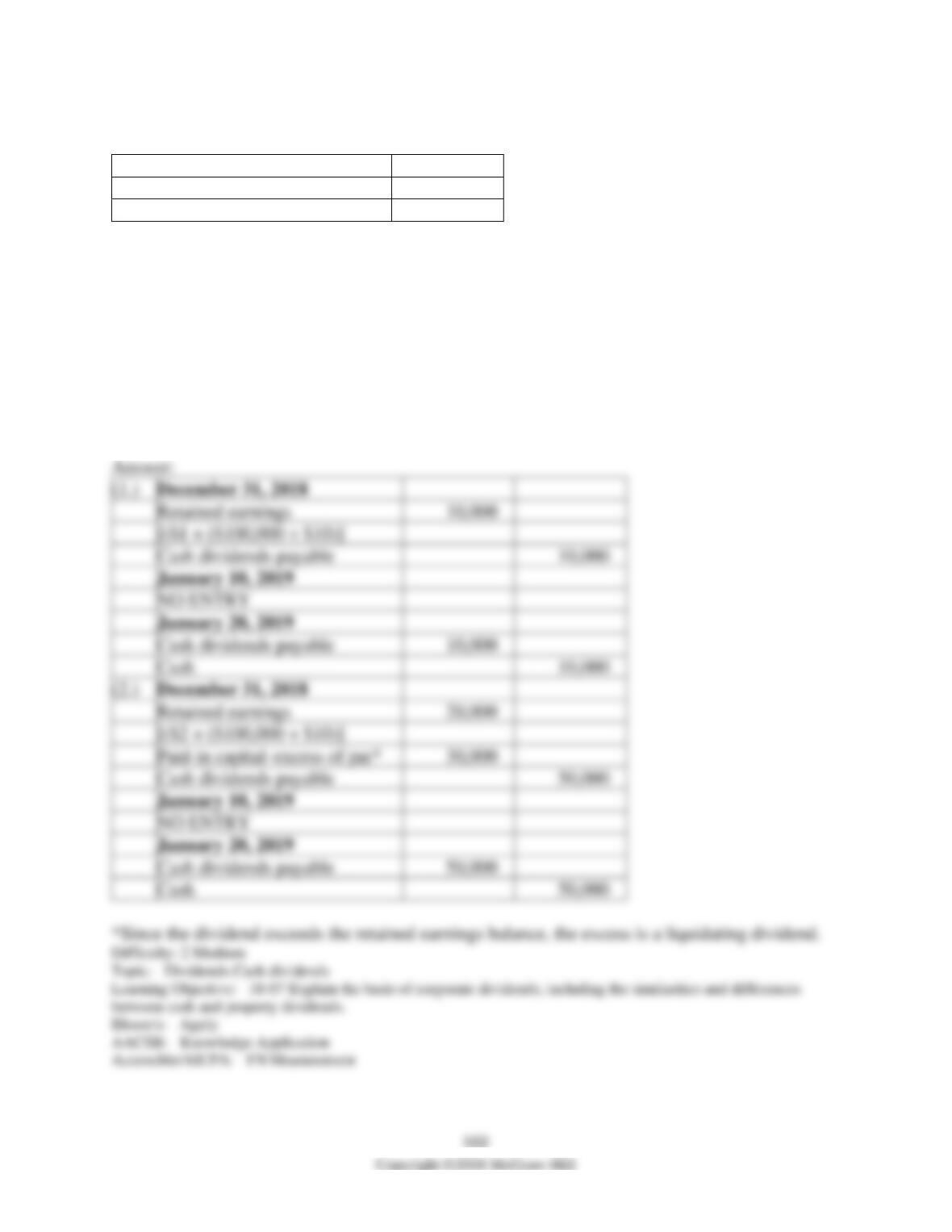
169) Fowler Co.’s balance sheet showed the following at December 31, 2018:
Common stock, $10 par
$100,000
Paid-in capital–excess of par
50,000
Retained earnings
20,000
A cash dividend is declared on December 31, 2018, and is payable on January 20, 2019, to
shareholders of record on January 10, 2019.
Required:
(1.) Prepare all appropriate journal entries, assuming a cash dividend in the amount of $1.00 per
share.
(2.) Prepare all appropriate journal entries, assuming a cash dividend in the amount of $5.00 per
share.
(1.)
Retained earnings
10,000
[($1 × ($100,000 ÷ $10)]
Cash dividends payable
10,000
NO ENTRY
Cash dividends payable
10,000
Cash
10,000
(2.)
Retained earnings
20,000
[($2 × ($100,000 ÷ $10)]
Paid-in capital–excess of par*
30,000
Cash dividends payable
50,000
NO ENTRY
Cash dividends payable
50,000
Cash
50,000

103
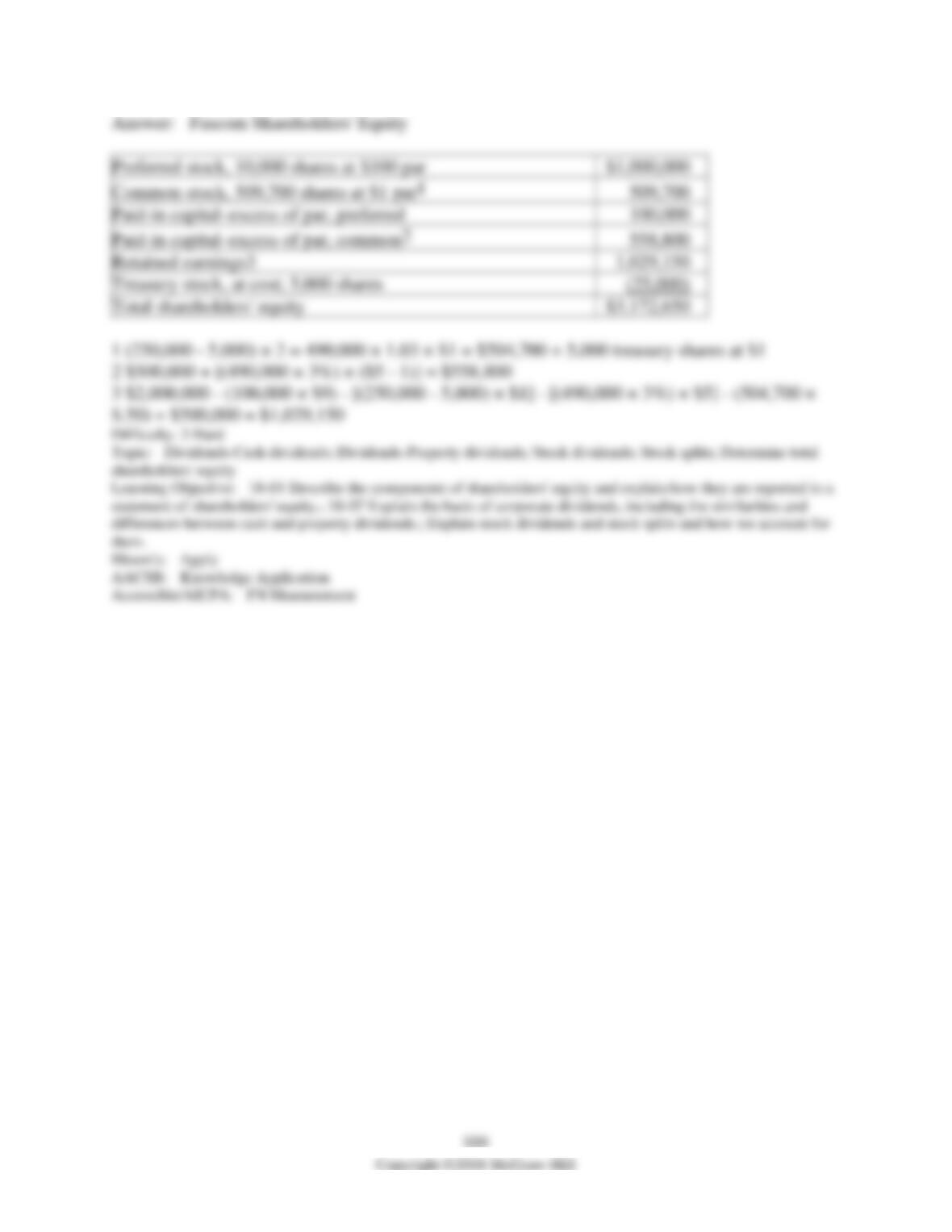
170) On January 1, 2018, Fascom had the following account balances in its shareholders’ equity
accounts.
Common stock, $1 par, 250,000 shares issued
250,000
Paid-in capital–excess of par, common
500,000
Paid-in capital–excess of par, preferred
100,000
Preferred stock, $100 par, 10,000 shares outstanding
1,000,000
Retained earnings
2,000,000
Treasury stock, at cost, 5,000 shares
25,000
During 2018, Fascom Inc. had several transactions relating to common stock.
January 15:
Declared a property dividend of 100,000 shares of Slowdown
Company (book value $10 per share, fair value $9 per share).
February 17:
Distributed the property dividend.
April 10:
A 2-for-1 stock split was declared and distributed on outstanding
common stock and effected in the form of a stock dividend. The fair
value of the stock was $4 on this date.
July 18:
Declared and distributed a 3% stock dividend on outstanding common
stock.The fair value is $5 per share.
December 1:
Declared a 50 cents per share cash dividend on the outstanding common
shares.
December 20:
Paid the cash dividend.
Required:
Without preparing journal entries, prepare the shareholders’ equity section of Fascom’s balance
sheet as of December 31, 2018. Assume net income is $500,000 for 2018.
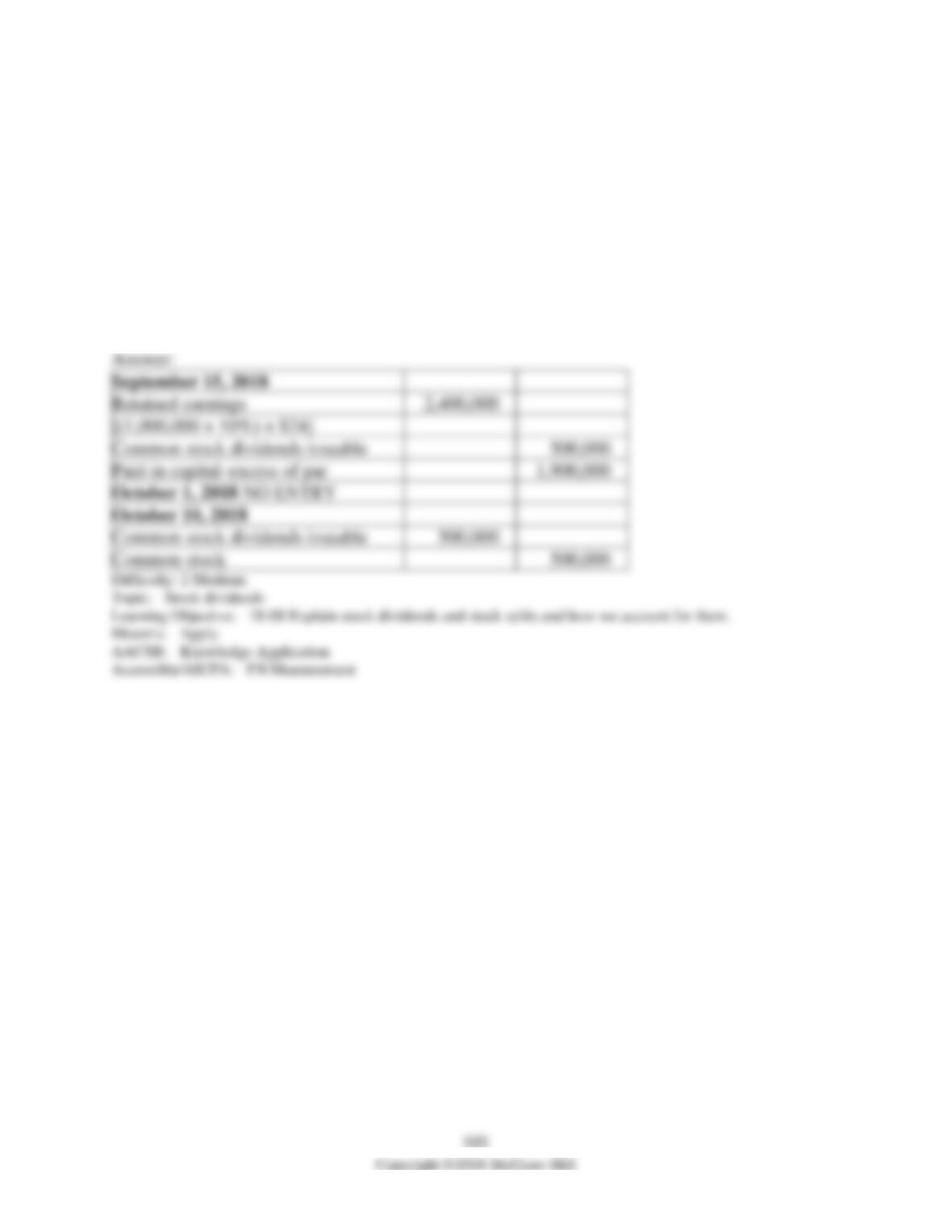
171) On September 15, 2018, the Scottie Company board of directors declared a 10% stock
dividend on common shares. The shares are to be distributed on October 10, 2018, to
shareholders of record on October 1, 2018. The market price per share on the date of declaration
was $24 while the market price on the date of distribution was $26. The common stock has a par
of $5 per share and there were 1,000,000 shares outstanding prior to the declaration of the stock
dividend.
Required:
Prepare any necessary journal entries to record the above transactions.
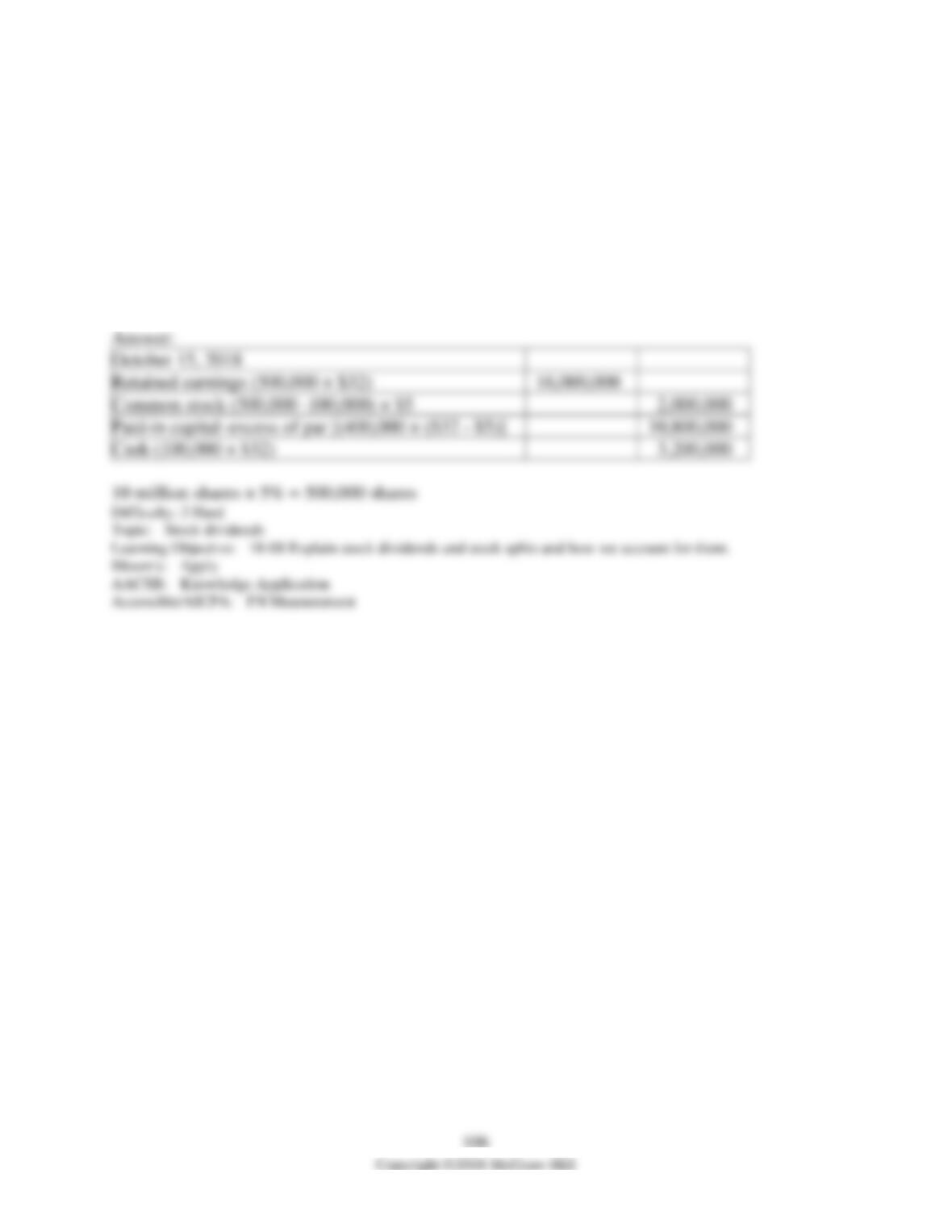
172) On October 15, 2018, a 5% stock dividend was declared and distributed. The fair value of
the common stock on this date was $32 per share. Fractional share rights represented 100,000
shares. Cash was paid in lieu of issuing fractional share rights. On the date of declaration and
payment, the company had 10 million shares of common stock outstanding. The par of the
common shares was $5.
Required:
Prepare any necessary journal entries to record the above events.

107
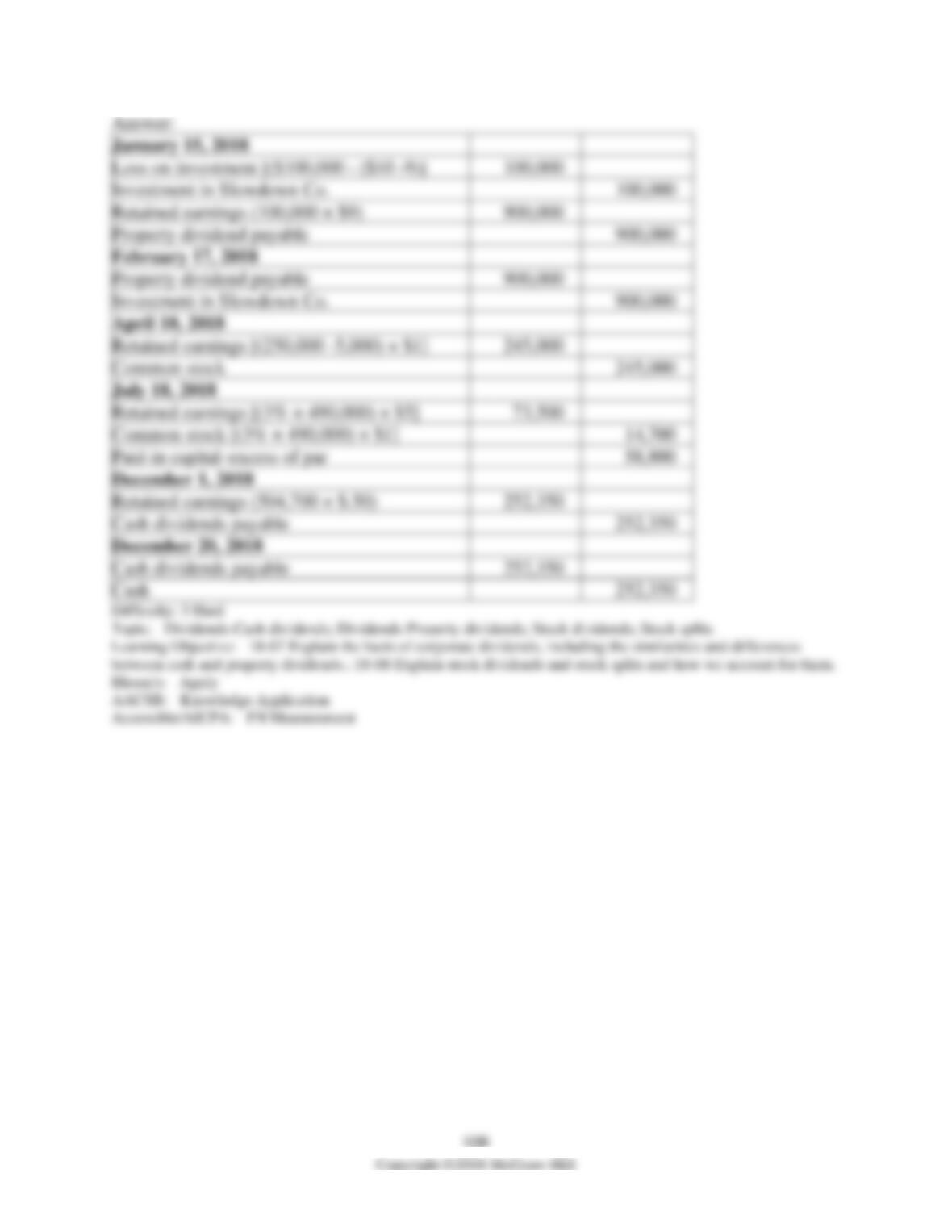
173) On January 1, 2018, Gerlach Inc. had the following account balances in its shareholders’
equity accounts.
Common stock, $1 par, 250,000 shares issued
250,000
Paid-in capital–excess of par, common
500,000
Paid-in capital–excess of par, preferred
100,000
Preferred stock, $100 par, 10,000 shares
outstanding
1,000,000
Retained earnings
2,000,000
Treasury stock, at cost, 5,000 shares
25,000
During 2018, Gerlach Inc. had several transactions relating to common stock.
January 15:
Declared a property dividend of 100,000 shares of Slowdown
Company (book value $10 per share, fair value $9 per share).
February 17:
Distributed the property dividend.
April 10:
A 2-for-1 stock split was declared and distributed on outstanding
common stock and effected in the form of a stock dividend. The fair value
of the stock was $4 on this date.
July 18:
Declared and distributed a 3% stock dividend on outstanding common
stock; fair value per share, $5.
December 1:
Declared a 50 cents per share cash dividend on the outstanding common
shares.
December 20:
Paid the cash dividend.
Required:
Record the above transactions and events in journal entry format.

109
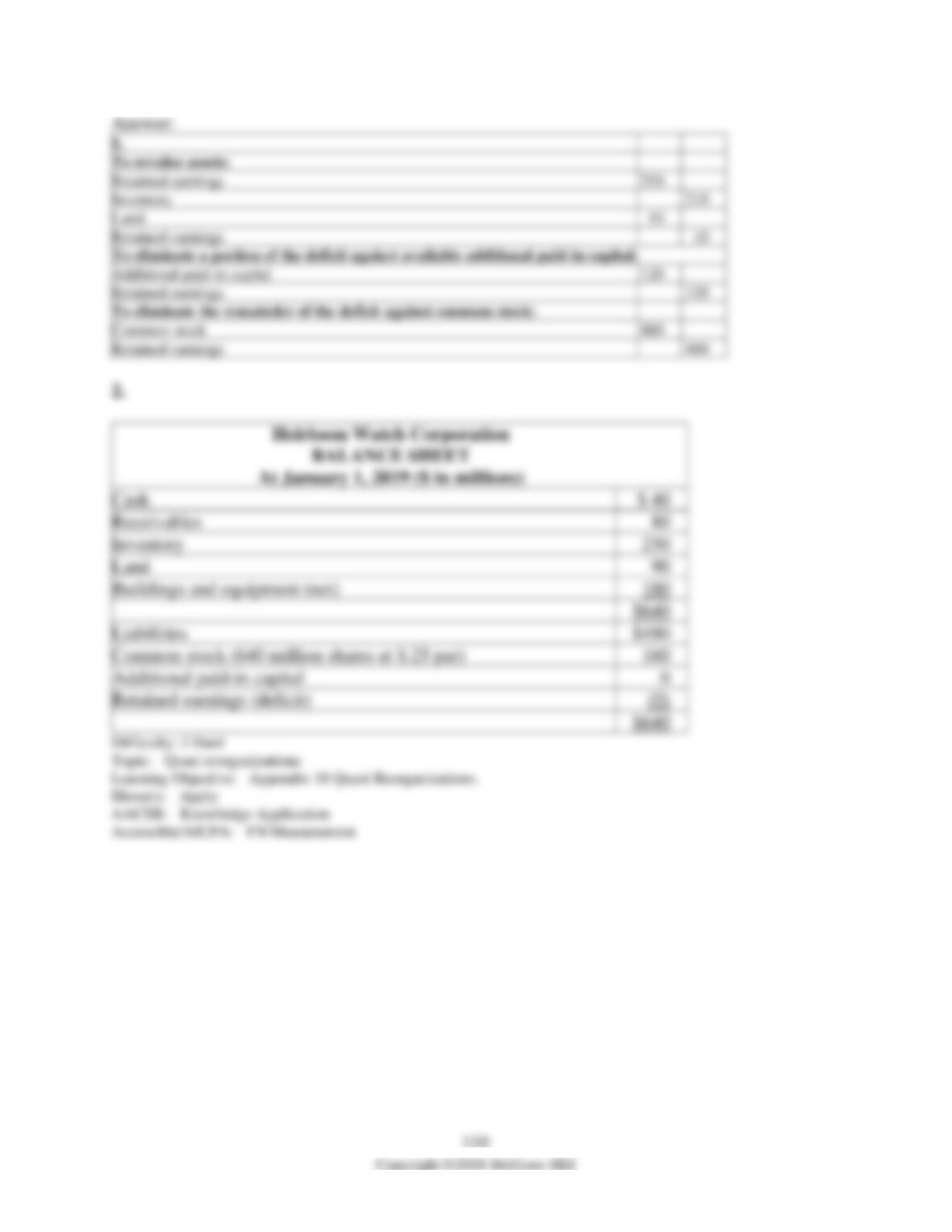
174) A new CEO was hired to revive the floundering Heirloom Watch Corporation. The
company had endured operating losses for several years, but confidence was emerging that
better times were ahead. The board of directors and shareholders approved a
quasi-reorganization for the corporation. The reorganization included devaluing inventory for
obsolescence by $210 million and increasing land by $10 million. Immediately before the
restatement, at December 31, 2018, Heirloom Watch Corporation’s balance sheet appeared as
follows (in condensed form):
Heirloom Watch Corporation
BALANCE SHEET
At December 31, 2018 ($ in millions)
Cash
$ 40
Receivables
80
Inventory
460
Land
80
Buildings and equipment (net)
180
$840
Liabilities
$480
Common stock (640 million shares at $1 par)
640
Additional paid-in capital
120
Retained earnings (deficit)
(400)
$840
Required:
1. Prepare the journal entries appropriate to record the quasi-reorganization on January 1, 2019.
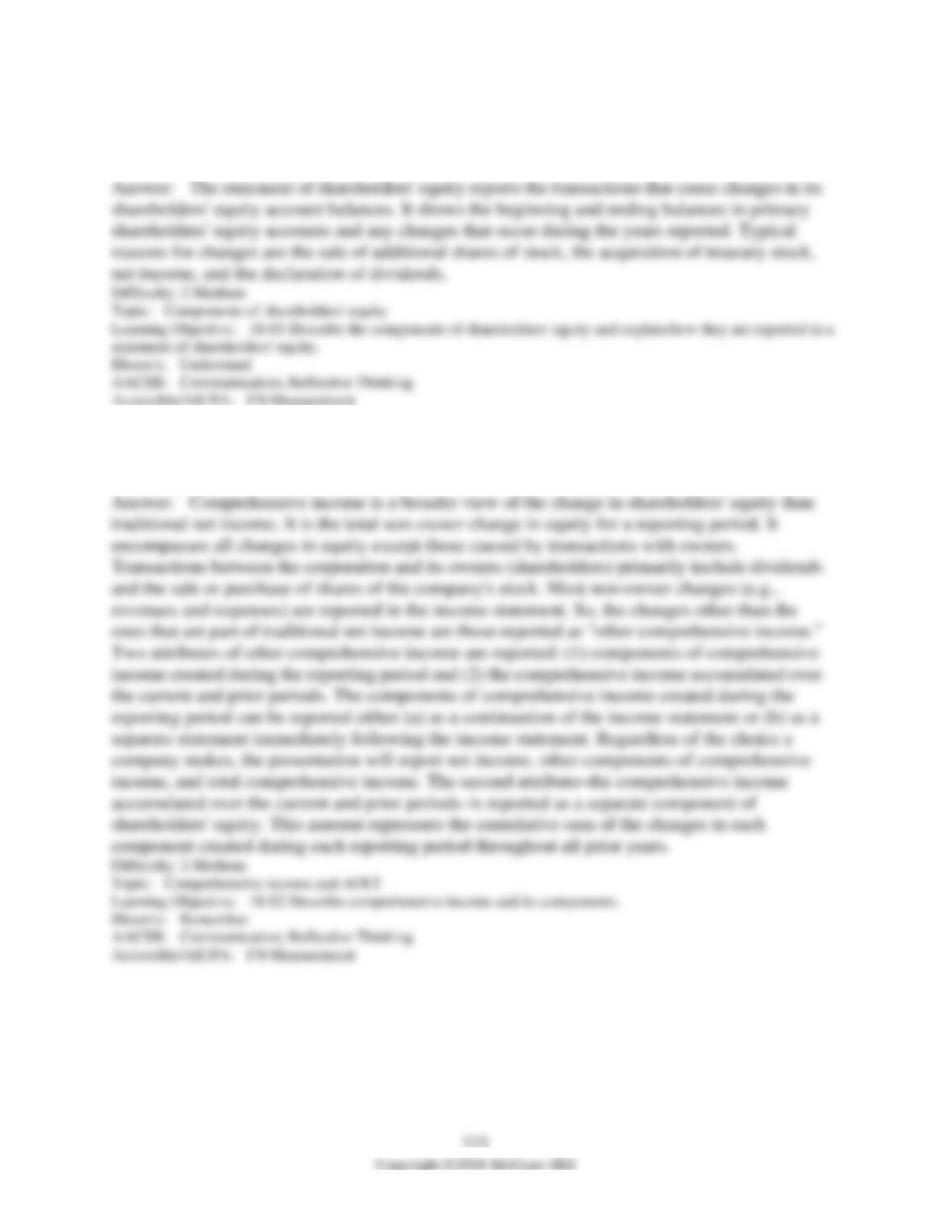
2. Prepare a balance sheet as it would appear immediately after the restatement.
175) The balance sheet reports the balances of shareholders’ equity accounts. What additional
information is provided by the statement of shareholders’ equity?
176) What is comprehensive income and how does it differ from net income? Where is it
reported in the balance sheet?
177) Identify the three common forms of business organization and the primary difference in the
way we account for them.
178) When stock is issued for consideration other than cash, what is the measurement objective?
179) The costs of legal, promotional, and accounting services necessary to effect the sale of
shares are referred to as share issue costs. How are these costs recorded? Compare this approach
to the way debt issue costs are recorded.
180) When a corporation acquires its own shares, those shares assume the same status as
authorized but unissued shares, as if they never had been issued. Explain how this is reflected in
the accounting records if the shares are formally retired.
181) Some preferred stock is cumulative while other preferred stock is noncumulative. What
does this mean?
182) What is the difference between a stock split and a stock split effected in the form of a stock
dividend?
183) The prescribed accounting treatment for stock dividends implicitly assumes that
shareholders are fooled by “small” stock dividends and benefit by the market value of their
additional shares. Explain this statement. Is it logical?
184) How do U.S. GAAP and International Financial Reporting Standards (IFRS) differ with
respect to debt and equity for preferred stock?