138) A firm sells two products, Regular and Ultra. For every unit of Regular sold, two units of
Ultra are sold. The firm’s total fixed costs are $1,612,000. Selling prices and cost information for
both products follow. The contribution margin per composite unit is:
Product
Unit Sales
Price
Variable Cost Per
Unit
Regular
$
20
$
8
Ultra
24
4
A) $12.
B) $20.
C) $32.
D) $44.
E) $52.
$
Contribution margin per composite unit
$
139) A firm sells two products, Regular and Ultra. For every unit of Regular sold, two units of
Ultra are sold. The firm’s total fixed costs are $1,612,000. Selling prices and cost information for
both products follow. What is the firm’s break-even point in units of Regular and Ultra?
Product
Unit Sales
Price
Variable Cost Per
Unit
Regular
$
20
$
8
Ultra
24
4
A) 31,000 Regular units and 31,000 Ultra units.
B) 31,000 Regular units and 62,000 Ultra units.
C) 10,333 Regular units and 20,667 Ultra units.
D) 36,167 Regular units and 72,333 Ultra units.
E) 62,000 Regular units and 31,000 Ultra units.
$
2 Ultra units at [$24 − $4] contribution margin per unit
Contribution margin per composite unit
$
140) The ratio (proportion) of the sales volumes for the various products sold by a company is
called the:
A) Current product mix.
B) Relevant mix.
C) Sales mix.
D) Inventory cost ratio.
E) Production ratio.
141) Mott Company’s sales mix is 3 units of A, 2 units of B, and 1 unit of C. Selling prices for
each product are $20, $30, and $40, respectively. Variable costs per unit are $12, $18, and $24,
respectively. Fixed costs are $320,000. What is the break-even point in composite units?
A) 1,111 composite units.
B) 1,600 composite units.
C) 2,666 composite units.
D) 4,000 composite units.
E) 5,000 composite units.
142) Madison Corporation sells three products (M, N, and O) in the following mix: 3:1:2. Unit
price and cost data are:
M
N
O
Unit sales price
$
7
$
4
$
6
Unit variable costs
3
2
3
Total fixed costs are $340,000. The selling price per composite unit for the current sales mix
(rounded to the nearest cent) is:
A) $17.00.
B) $ 5.67.
C) $20.00.
D) $37.00.
E) $25.00.
3 units of M at $7 each
$
21
1 unit of N at $4 each
2 units of O at $6
12
143) Madison Corporation sells three products (M, N, and O) in the following sales mix: 3:1:2.
Unit price and cost data are:
M
N
O
Unit sales price
$
7
$
4
$
6
Unit variable costs
3
2
3
Total fixed costs are $340,000. The contribution margin per composite unit for the current sales
mix (round to the nearest cent) is:
A) $17.00.
B) $ 5.67.
C) $20.00.
D) $37.00.
E) $25.00.
$
12
Contribution margin per composite unit
$
20
144) Madison Corporation sells three products (M, N, and O) in the following sales mix: 3:1:2.
Unit price and cost data are:
M
N
O
Unit sales price
$
7
$
4
$
6
Unit variable costs
3
2
3
Total fixed costs are $340,000. The break-even point in composite units for the current sales mix
(round to the nearest unit) is:
A) 17,000
B) 20,000
C) 102,000
D) 51,000
E) 34,000
$
12
Contribution margin per composite unit
$
20
145) Madison Corporation sells three products (M, N, and O) in the following sales mix: 3:1:2.
Unit price and cost data are:
M
N
O
Unit sales price
$
7
$
4
$
6
Unit variable costs
3
2
3
Total fixed costs are $340,000. The break-even point in sales dollars for the current sales mix is
(round to the nearest thousand):
A) $ 20,000.
B) $289,000.
C) $400,000.
D) $629,000.
E) $740,000.
3 units of M at $7 each
$
21
1 unit of N at $4 each
2 units of O at $6
12
Selling price per composite unit
$
37
$
12
2 units of O at [$6 − 3] contribution margin per unit
Contribution margin per composite unit
$
20
146) Barclay Bikes manufactures and sells three distinct styles of bicycles: the Youth model sells
for $300 and has a unit contribution margin of $105; the Adult model sells for $850 and has a
unit contribution margin of $450; and the Recreational model sells for $1,000 and has a unit
contribution margin of $500. The company’s sales mix includes: 5 Youth models; 9 Adult
models; and 6 Recreational models. If the firm’s annual fixed costs total $6,500,000, calculate
the firm’s selling price per composite unit.
A) $1,255.
B) $15,150.
C) $7,575.
D) $1,950.
E) $13,200.
147) Barclay Bikes manufactures and sells three distinct styles of bicycles: the Youth model sells
for $300 and has a unit contribution margin of $105; the Adult model sells for $850 and has a
unit contribution margin of $450; and the Recreational model sells for $1,000 and has a unit
contribution margin of $500. The company’s sales mix includes: 5 Youth models; 9 Adult
models; and 6 Recreational models. If the firm’s annual fixed costs total $6,500,000, calculate
the firm’s contribution margin per composite unit.
A) $1,055.
B) $1,950.
C) $1,255.
D) $7,575.
E) $1,500.
148) Barclay Bikes manufactures and sells three distinct styles of bicycles: the Youth model sells
for $300 and has a unit contribution margin of $105; the Adult model sells for $850 and has a
unit contribution margin of $450; and the Recreational model sells for $1,000 and has a unit
contribution margin of $500. The company’s sales mix includes: 5 Youth models; 9 Adult
models; and 6 Recreational models. If the firm’s annual fixed costs total $6,500,000, calculate
the firm’s break-even point in composite units (rounded to the nearest whole unit).
A) 7,575 composite units.
B) 15,150 composite units.
C) 858 composite units.
D) 6,161 composite units.
E) 429 composite units.
149) Barclay Bikes manufactures and sells three distinct styles of bicycles: the Youth model sells
for $300 and has a unit contribution margin of $105; the Adult model sells for $850 and has a
unit contribution margin of $450; and the Recreational model sells for $1,000 and has a unit
contribution margin of $500. The company’s sales mix includes: 5 Youth models; 9 Adult
models; and 6 Recreational models. If the firm’s annual fixed costs total $6,500,000, calculate
the firm’s contribution margin ratio per composite unit (rounded to the nearest whole
percentage).
A) 35%
B) 50%
C) 53%
D) 200%
E) 40%
150) Barclay Bikes manufactures and sells three distinct styles of bicycles: the Youth model sells
for $300 and has a unit contribution margin of $105; the Adult model sells for $850 and has a
unit contribution margin of $450; and the Recreational model sells for $1,000 and has a unit
contribution margin of $500. The company’s sales mix includes: 5 Youth models; 9 Adult
models; and 6 Recreational models. If the firm’s annual fixed costs total $6,500,000, calculate
the firm’s break-even point in total sales dollars.
A) $13,250,000.
B) $13,000,000.
C) $12,750,000.
D) $12,900,050.
E) $12,750,625.
151) Kent Co. manufactures a product that sells for $50.00 and has variable costs of $24.00 per
unit. Fixed costs are $260,000. Kent can buy a new production machine that will increase fixed
costs by $11,400 per year, but will decrease variable costs by $3.50 per unit. Compute the
contribution margin per unit if the machine is purchased.
A) $22.50.
B) $26.00.
C) $29.50.
D) $28.50.
E) $27.50.
152) Kent Co. manufactures a product that sells for $50.00 and has variable costs of $24.00 per
unit. Fixed costs are $260,000. Kent can buy a new production machine that will increase fixed
costs by $11,400 per year, but will decrease variable costs by $3.50 per unit. Compute the
revised break-even point in units if the new machine is purchased.
A) 10,438 units.
B) 8,814 units.
C) 10,000 units.
D) 9,200 units.
E) 9,869 units.
153) Kent Co. manufactures a product that sells for $50.00. Fixed costs are $260,000 and
variable costs are $24.00 per unit. Kent can buy a new production machine that will increase
fixed costs by $11,400 per year, but will decrease variable costs by $3.50 per unit. What effect
would the purchase of the new machine have on Kent’s break-even point in units?
A) 800 unit increase.
B) 800 unit decrease.
C) 5,714 unit increase.
D) 4,444 unit decrease.
E) No effect on the break-even point in units.
154) Kent Co. manufactures a product that sells for $50.00. Fixed costs are $260,000 and
variable costs are $24.00 per unit. Kent can buy a new production machine that will increase
fixed costs by $11,400 per year, but will decrease variable costs by $3.50 per unit. Compute the
revised break-even point in dollars with the purchase of the new machine.
A) $500,000.
B) $440,678.
C) $521,923.
D) $480,000.
E) $460,000.
155) McCoy Brothers manufactures and sells two products, A and Z in the ratio of 5:2. Product
A sells for $75; Z sells for $95. Variable costs for product A are $35; for Z $40. Fixed costs are
$418,500. Compute the contribution margin per composite unit.
A) $310.
B) $200.
C) $300.
D) $330.
E) $285.
156) McCoy Brothers manufactures and sells two products, A and Z in the ratio of 5:2. Product
A sells for $75; Z sells for $95. Variable costs for product A are $35; for Z $40. Fixed costs are
$418,500. Compute the break-even point in composite units.
A) 2,092.
B) 3,805.
C) 1,350.
D) 1,395.
E) 1,550.
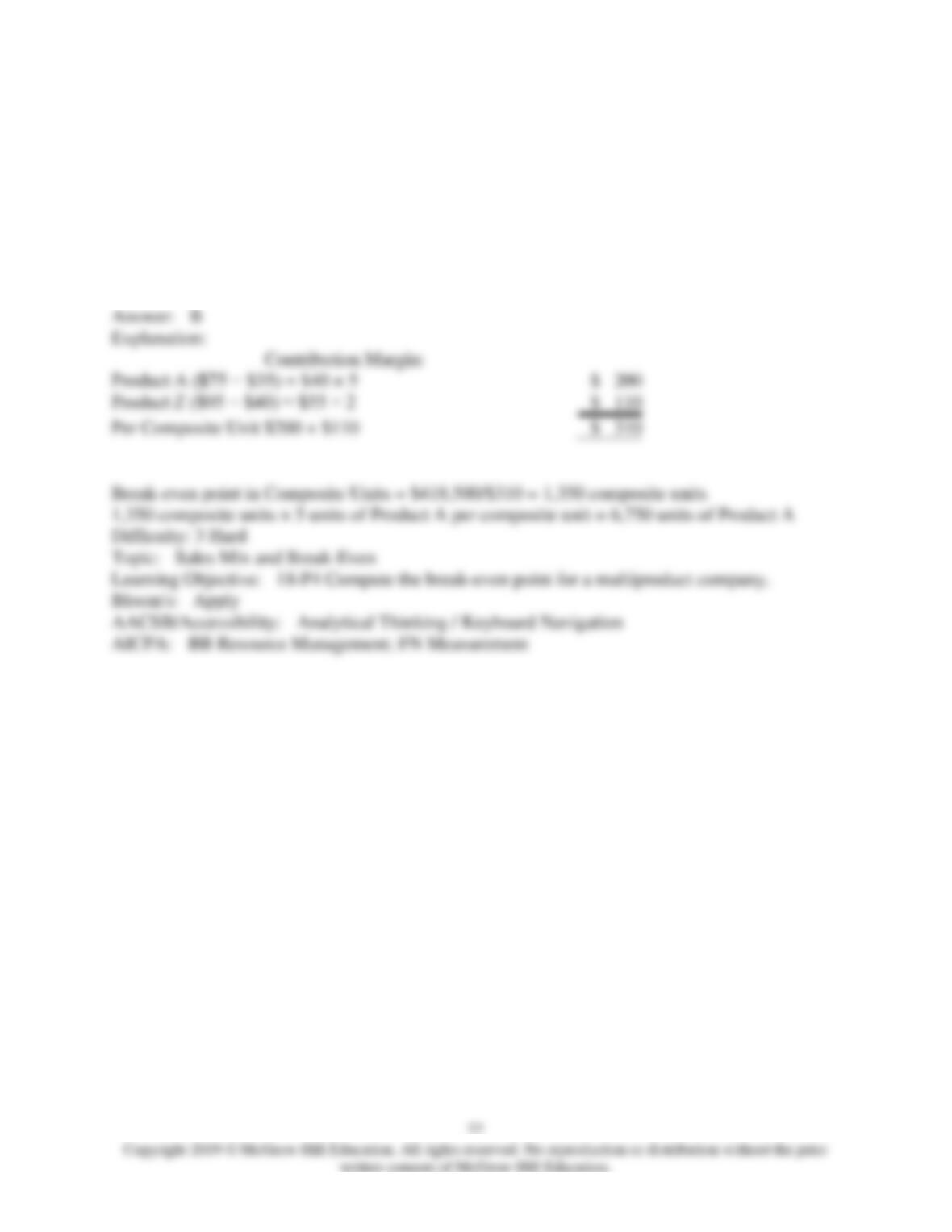
157) McCoy Brothers manufactures and sells two products, A and Z in the ratio of 5:2. Product
A sells for $75; Z sells for $95. Variable costs for product A are $35; for Z $40. Fixed costs are
$418,500. Compute the number of units of Product A McCoy must sell to break even.
A) 1,350.
B) 6,750.
C) 2,700.
D) 10,463.
E) 6,200.
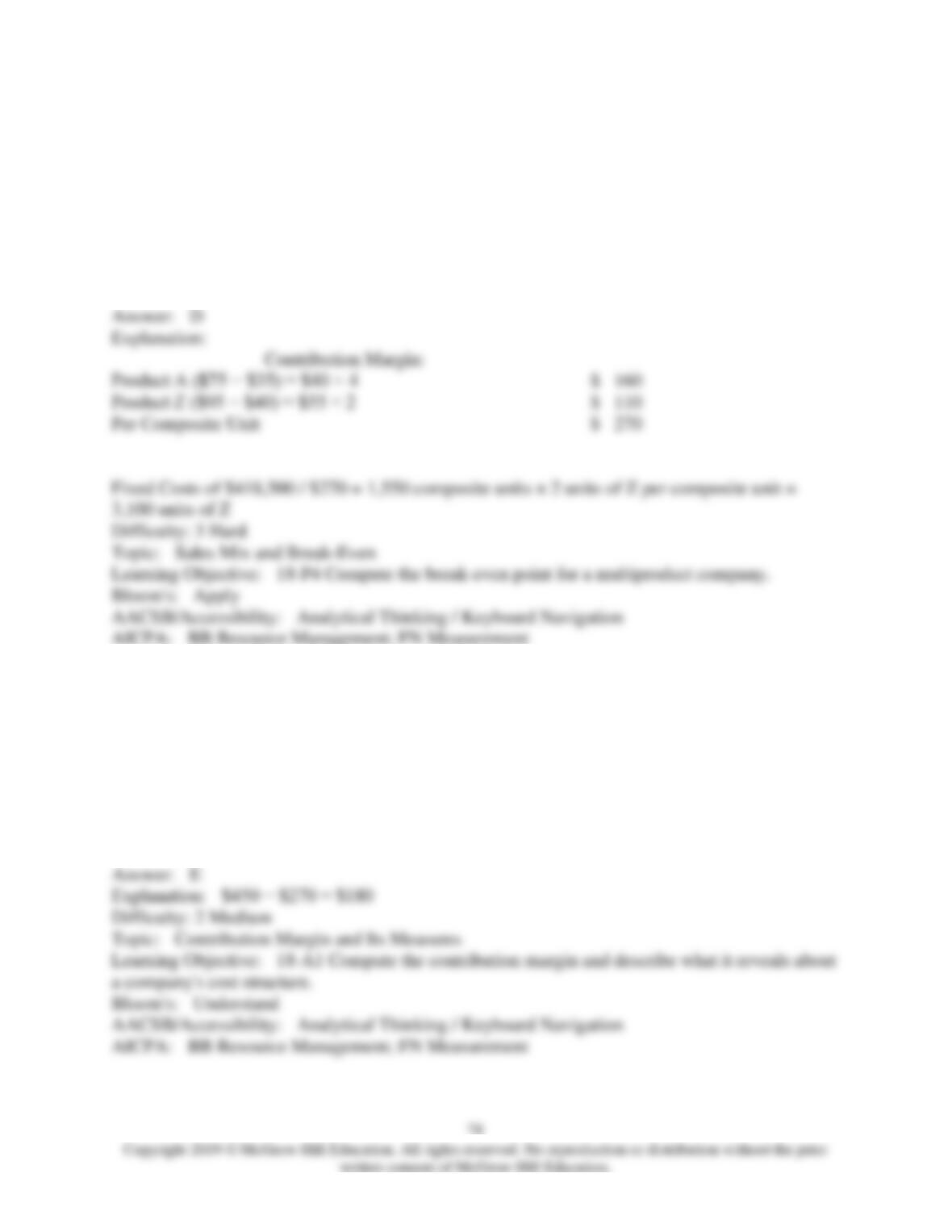
158) McCoy Brothers manufactures and sells two products, A and Z in the ratio of 4:2. Product
A sells for $75; Z sells for $95. Variable costs for product A are $35; for Z $40. Fixed costs are
$418,500. Compute the number of units of Product Z McCoy must sell to break even.
A) 9,300.
B) 6,200.
C) 1,550.
D) 3,100.
E) 6,750.
159) Wang Co. manufactures and sells a single product that sells for $450 per unit; variable costs
are $270 per unit. Annual fixed costs are $800,000. Current sales volume is $4,200,000.
Compute the contribution margin per unit.
A) $450.
B) $270.
C) $200.
D) $190.
E) $180.
160) Wang Co. manufactures and sells a single product that sells for $450 per unit; variable costs
are $270 per unit. Annual fixed costs are $800,000. Current sales volume is $4,200,000.
Compute the contribution margin ratio.
A) 40.0%.
B) 66.7%.
C) 20.7%.
D) 50.0%.
E) 19.3%.
161) Wang Co. manufactures and sells a single product that sells for $450 per unit; variable costs
are $270. Annual fixed costs are $800,000. Current sales volume is $4,200,000. Compute the
break-even point in units.
A) 5,500.
B) 1,933.
C) 4,444.
D) 2,900.
E) 1,160.
162) Wang Co. manufactures and sells a single product that sells for $450 per unit; variable costs
are $270 per unit. Annual fixed costs are $800,000. Current sales volume is $4,200,000.
Compute the break-even point in dollars.
A) $1,740,000.
B) $2,000,000.
C) $1,304,348.
D) $4,202,899.
E) $2,640,000.
163) Wang Co. manufactures and sells a single product that sells for $450 per unit; variable costs
are $270 per unit. Annual fixed costs are $800,000. Current sales volume is $4,200,000.
Management targets an annual pre-tax income of $1,125,000. Compute the unit sales to earn the
target pre-tax net income.
A) 4,444.
B) 7,500.
C) 6,650.
D) 10,694.
E) 11,750.